Two for Tuesday
Reply

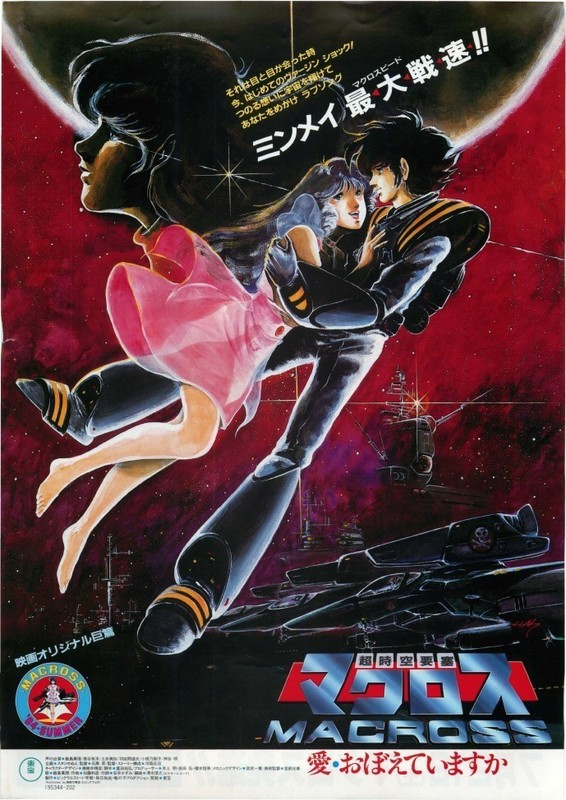
Remembering Macross: Do You Remember Love?
By Victor de la Cruz
Source: 3rd World Geeks
There have been so many anime movies that have come and gone. A lot of them have, deservedly so, have been called classics and must-watch animes. You’ve got your My Neighbor Totoro, Ghost in the Shell, Weathering with You, Your Name and Akira. They are undoubtedly classics in their own right and every anime fan needs to see them. But there always seems to be one anime film that’s left out of the conversation for one reason or another. I’m here to shine a spotlight on that anime that usually gets lost in the shuffle when people list down great anime movies.
That movie is Macross: Do You Remember Love?
But before I do talk about Macross: Do You Remember Love?, I do have to talk about my very complicated relationship with the first Macross franchise. Like most anime fans, the very first contact I had with Macross wasn’t actually called Macross. It was from Robotech. Now, Robotech was this weird mishmash of three animes, namely, Super Dimension Fortress Macross, Super Dimension Cavalry Southern Cross and Genesis Climber MOSPEADA. The original Japanese animes had nothing to do with each other. However, the people over at Harmony Gold had the bright idea to attempt to link these three disparate shows. The writers did a good job with what they were given but this did greatly affect how the later chapters, more specifically the Southern Cross story, was almost totally revamped to retrofit it into the overarching story. Thankfully, as it was the first chapter in Robotech, Macross was hardly touched story-wire. Basically, if all you have is the Robotech version of Macross, you’re still getting pretty much the original story.
I also have to mention that my first experience with Do You Remember Love? isn’t by watching the movie. The first time I did see the movie was the Clash of the Bionoids dub. And, god help me, I loved it! I managed to catch this by pure accident while channel surfing when I was a kid. Seeing they actually pushed out a movie based on Robotech (because I didn’t know any better then) blew my mind and maybe that was a part of why I loved it so much. It would be an easy excuse to say I was young and foolish to like something as bad as the dubbing done in Clash of the Bionoids. But there’s just something so earnest in the performances! Oh, I also didn’t know they cut out a lot of stuff from the original film but, hey, I didn’t know there was an unedited version back then! Of course, now that I’ve seen the original cut, it’s hard to go back to Clash of the Bionoids unless it’s to kind of laugh at some of the dialogue.
Anyway, back to Do You Remember Love? and why I believe it deserves to be called a classic. For one thing, just look at it! Despite it being released way back in 1984, a good 35 years ago now, Do You Remember Love? still looks incredible. I can’t deny they touched up the film to bring everything into high resolution. But even so, you gotta admire the amount of detail the animators put into each frame of animation here! The number of little things, like lights flashing on the screen, the wires that stick out of a console, how the shadows lay on objects realistically, the tiny details of the Valkyrie stabilization thrusters looks outstanding.
The animation of how the Valkyrie also transform from mode to mode so seamlessly is also incredible. Of course, you also have to love those spiraling missiles the Valkyrie fire at the enemy Zentradi and how well animated those things are. Considering this was way before computer animation was a thing, that means you had a bunch of animators drawing up each and every frame of those missiles careening at wild directions while making it look real. They did a fantastic job on Do You Remember Love?
I also have to commend the writers of managing to streamline the entire 36 episode arc into something that would fit into roughly a couple of hours. Well, it’s not exactly streamlining as Do You Remember Love? alters the story quite a bit. But the changes they did do make sense. The movie actually starts right in the middle of the Macross’ journey back to Earth and ends after the defeat of the Zentradi leader Boddole Zer. This does leave out a good chunk of story but it also cuts out the more boring parts. We get to see the Macross transform without having the long, complicated episode explaining how they figured out to do so. We don’t have the Macross return to Earth only to be exiled to deep space. We also don’t get the aftermath of the Macross War and see the Zentradi have difficulty integrating in human society. These may be part of the entire drama of Macross. But, by cutting out these more slower parts, Do You Remember Love? gets into the meatier part of the entire story, which does makes things more satisfying.
Of course, no talk about Do You Remember Love? can be made without talking about the phenomenal final act of the film. The big battle where the loose forces of the Zentradi, Meltradi and remaining humans join forces to attack Boddole Zer while Lynn Minmay sings the titular song. There’s just something to the entire buildup to the song and the beautiful simplicity of the lyrics that makes it come off as more awesome than it should be. Of course, it certainly doesn’t hurt that Mari Iijima, who does both the normal and singing voices of Lynn Minmay, sounds really ethereal with her performance of the song. There’s also a kind of beautiful message in the scene where a simple love song can touch even the hardest of hearts to make them do the right thing.
I’m not saying Do You Remember Love? is a flawless anime film. I actually have to say I have some problems with it. The melodrama can be irritating at times as the characters would suddenly start behaving like they’re in the middle of a cheap soap opera. Lynn Minmay can definitely be grating at times because of how bratty she comes off in certain scenes. And while I did give high praise to the writers for focusing on the more important elements of the series, there are a couple of times when things just seem to happen in order to move the story forward.
However, these shortcomings should not really detract from how great Do You Remember Love? actually is. There’s just an overall epic feel to the story and the animation, despite its age, seems to have richer details than the anime movies we get today. But it’s that really memorable final act that really clinches it for me. The song, while nothing great in itself, feels much more epic in scale because of everything that accompanies it. Honestly, I would’ve watched it for those final ten minutes and still feel satisfied with how well done everything is.
I honestly think Macross: Do You Remember Love? deserves a little love as it seems to have been lost in the shuffle of all of the other anime films out there. If you’re interested in watching it, you’re in luck! The entire movie is available on YouTube on the Macross channel. It’s not in super hi-def but the high quality animation will make you forget it isn’t.
Give it a watch if you can spare a couple of hours. You can thank me later.
Have you seen Macross: Do You Remember Love? What did you think of it? What other classic anime films do you think deserves a little more attention? Let me know in the comments section below!

By Ken Zurski
Source: Unremembered
In 1976, a controversial new book was released that contended the Apollo 11 moon mission never happened. We Never Went to the Moon: America’s Thirty Million Dollar Swindle was written by Bill Kaysing, a Navy midshipman and rocket specialist, who claimed to have inside knowledge of a government conspiracy to fake the moon landing.
Kaysing believes NASA couldn’t safely put a man on the moon by the end of the 1960’s (a promise made by President Kennedy) so they staged it instead. Kaysing’s theories were technical and persuasive and soon a movement of nonbelievers, inspired by the book, was born.
Whether you believed Kaysing or not was a moot point for American screenwriter and director Peter Hyams. A former TV news anchor, Hyams was more interested in how such a thing could actually be pulled off?
“I grew up in the generation where my parents basically believed if it was in the newspaper it was true,” Hyams said in an interview with a film trade magazine. For him, he admits, it was the same with television. “I wondered what would happen if someone faked a whole story.”
So he wrote a story based on the concept.
That was in 1972, four years before Kaysing’s book was released. Hyams shopped the script around but got no takers. Then something unexpected happened. Watergate broke and America was thrown into a government scandal at its highest levels. Interest in a story like a fake moon landing (in the movie’s case, the first manned mission to Mars) had appeal. In 1976, Hyams was given the green light to make his movie as part of deal with ITC Entertainment to produce films with a conspiracy bent.
“Capricorn One” was released in the Summer of 1977. “Would you be shocked to find out the greatest moment of our recent history may not have happened at all?” the movie posters read.
Reviews were mixed. Chicago Tribune film critic Gene Siskel called it “a surprisingly good thriller” while another critic Harry Themal said it was a “somewhat feeble effort at an adventure film.” Variety was even less complimentary calling it “underdeveloped” and the cast “scattershot.”
In the movie, Sam Waterston, James Brolin and O.J. Simpson play the three astronauts. Elliott Gould, Hal Holbrook, Telly Savalas, Brenda Vaccaro and Karen Black round out the cast. While Brolin was known mostly for his television role as Dr, Steven Kiley on Marcus Welby, M.D. Simpson was a celebrity athlete whose acting career was just beginning.
In hindsight the cast was impressive, but the actors weren’t as important as the story.
After the landing is staged and broadcast as real, the nation is told the three astronauts died instantly in a failed reentry. But Gould, as journalist Robert Caulfield, is suspicious. The astronauts, who are harbored, realize they have no recourse but to escape or be killed. “If we go along with you and lie our asses off, the world of truth and ideals is, er, protected,” say’s Waterston’s Lt Col. Peter Willis. “But if we don’t want to take part in some giant rip-off of yours then somehow or other we’re managing to ruin the country.”
From there its a cat and mouse game between the good guys and bad. A dramatic helicopter chase scene ensues. In the end, Caulfield with the help from Brolin’s character exposes the conspiracy.
The movie’s tag-line accentuated the drama:
The mission was a sham. The murders were real.
“In a successful movie, the audience, almost before they see it, know they’re going to like it,” remarked Hyams. “I remember standing in the back of the theater and crying because I knew that something had changed in my life.”
The film’s final chase scenes were pure escapism. “People were clapping and cheering at the end,” Brolin relayed to a reporter shortly after the film’s release.
Today, the film’s legacy may be in the conspiracy only. It’s impact may also have been diminished by the negative attitudes towards O.J. Simpson who in 1994 was charged and acquitted in the brutal murder of his ex-wife, Nicole Brown.
Even Hyams concedes to his own bizarre trivia: “I’ve made films with two leading men who were subsequently tried for the first degree murder of their wives,” he said referring to Simpson in Capricorn One and Robert Blake in his first film Busting (1974).
Fifty years later, on the 2019 anniversary date of July 20, 1969, the moon landing is still celebrated as one of man’s greatest achievements. “We choose to go to the Moon in this decade and do the other things, not because they are easy, but because they are hard,” President Kennedy prophetically said in 1962.
For some, apparently, that was just too hard to believe.
Several years after it happened, a movie showed how it could be done…Hollywood style.
By Brian Eggert
Source: Deep Focus Review
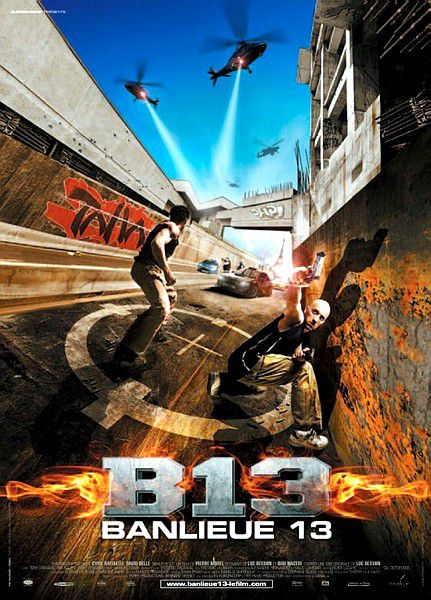
If the movies from French producer Luc Besson’s factory of B-grade actioners, District 13 (Banlieue 13, 2004) stands among the best. This is your typical martial arts-laden action extravaganza, filled with thumping techno music, a thin plot, and impressive stunts. But the increasingly prosaic clichés evident in Besson’s other films, which are also evident here, electrify with an uncommon kinetic energy. The action feels and looks real thanks to its stuntmen stars. The plot seems to have a social resonance behind it. And indeed the French soundtrack of techno and rap augments the no-holds-barred attitude of the movie.
The setting is Paris, 2010, which upon the release of this movie in 2004 was the future. Use your imagination. The city is plagued by unruly slums, and to isolate the problem areas, the government has erected a wall around a particular neighborhood known as District 13. The walls create a makeshift ghetto wherein all schools, all civil servants, and all hope has been evacuated. Inside, two million people are divided into various gangs and the police have no say, except that no one can leave through the guarded checkpoints. Drugs and crime run rampant on the streets within. Meanwhile, Elitist politicians would prefer to wipe this blotch off their maps entirely and start over.
Two heroes ban together to fight both a crime boss polluting the inside and political corruption stewing from outside the walls. One hero, Leïto (David Belle), comes from the slums. After being double-crossed by the local police, Leïto watches as his sister, Lola (Dany Verissimo), is taken hostage by the seedy gangster Taha (Bibi Naceri), and then he’s put in jail for 6 months to rot. Enter the other hero, supercop Damien (Cyril Raffaelli), who is commissioned by his superiors to go undercover, befriend Leïto, stage a prison break, and then use Leïto to sneak into District 13 to defuse a deadly bomb. The bomb was supposedly stolen from the government by the District 13 gangs, but this McGuffin proves to be slightly more complicated. And of course, Damien has only 24 hours to complete his mission.
Nevermind the plot, though. You’re not watching to find out what happens with Leïto, Damien, and the bomb. You’re watching to see the physical bravado of the two leads, as they demonstrate some of the most impressive stunts you’ve ever seen in any action movie. Belle and Raffaelli run across rooftops, leaping from building to building with ease. They scale obstacles and scuttle across walls like Spider-man. Whenever surrounded by a horde of goons, the heroes take them down without a minimum of fuss, exacting fisticuffs with a seemingly effortless precision. Through it all, they keep up a light banter that keeps the tone chummy and enjoyable.
Belle and Raffaelli are actual stuntmen and practitioners of a street-born, pseudo-martial art known as Parkour. According to the definition of those who practice it, “Parkour is the physical discipline of training to overcome any obstacle within one’s path by adapting one’s movements to the environment.” As opposed to a direct defensive strategy such as karate or jujitsu, Parkour involves running and jumping with fluidity, dodging obstructions with competence and speed through a complete awareness of one’s surroundings. But all you need to understand Parkour exists within this movie. The most amazing scenes aren’t those brimming with violence, they’re the chase scenes where Parkour skills are used to escape.
Director Pierre Morel, who would later helm Taken and From Paris with Love for the American market, exhibits clear and decisive action. The editing captures all the movements of Belle and Raffaelli with amazing clarity, whereas action movies nowadays so often rely on shaky-cam to disguise the stuntmen standing in for big-name stars. There’s nothing to hide in District 13, however, as Belle and Raffaelli complete the stunts and the fights themselves. Comparable to Jackie Chan in his heyday, these actors have the charisma, humor, and ability to advance themselves from stuntmen to stars, and they advance this movie from another dull actioner to must-see entertainment.
Watch District B13 on Tubi here: https://tubitv.com/movies/439503/district-b13
INDIAN COUNTRY NEWS
"It is the duty of every man, as far as his ability extends, to detect and expose delusion and error"..Thomas Paine
Human in Algorithms
From the Roof Top
I See This
blog of the post capitalist transition.. Read or download the novel here + latest relevant posts
अध्ययन-अनुसन्धानको सार
 After the Crash