A Timeless Message From Charlie Chaplin

Charlie_Chaplin

Today marks the 125th anniversary of Charlie Chaplin’s birthday. Countless video clips demonstrate his comic genius, but the enlightened aspect of his soul was never more apparent than in his monologue at the end of “The Great Dictator” which to this day remains one of cinema’s greatest political speeches. The film was released at the peak of Chaplin’s career, for shortly after he was investigated by the FBI, his personal life was sensationalized by the media, he was accused of being a communist sympathizer and was forced to leave the U.S. for Switzerland. Interesting facts about the The Great Dictator are recounted in the following passage from Chaplin’s Wikipedia page:

The 1940s saw Chaplin face a series of controversies, both in his work and in his personal life, which changed his fortunes and severely affected his popularity in the United States. The first of these was a new boldness in expressing his political beliefs. Deeply disturbed by the surge of militaristic nationalism in 1930s world politics, Chaplin found that he could not keep these issues out of his work. Parallels between himself and Adolf Hitler had been widely noted: the pair were born four days apart, both had risen from poverty to world prominence, and the German dictator wore the same toothbrush moustache as the Tramp. It was this perceived physical resemblance that supplied the pretext for the plot for Chaplin’s next film, The Great Dictator, which directly satirized Hitler and attacked fascism.

Chaplin spent two years developing the script, and began filming in September 1939 – six days after Britain declared war on Germany. He had submitted to using spoken dialogue, partly out of acceptance that he had no other choice, but also because he recognized it as a better method for delivering a political message. Making a comedy about Hitler was seen as highly controversial, but Chaplin’s financial independence allowed him to take the risk. “I was determined to go ahead,” he later wrote, “for Hitler must be laughed at.” Chaplin replaced the Tramp (while wearing similar attire) with “A Jewish Barber”, a reference to the Nazi party’s belief that he was a Jew. In a dual performance he also played the dictator “Adenoid Hynkel”, who parodied Hitler.

The Great Dictator spent a year in production, and was released in October 1940. There was a vast amount of publicity around the film, with a critic for the New York Times calling it “the most eagerly awaited picture of the year”, and it was one of the biggest money-makers of the era. The ending was unpopular, however, and generated controversy. Chaplin concluded the film with a six-minute speech in which he looked into the camera and professed his personal beliefs. Charles J. Maland has identified this overt preaching as triggering a decline in Chaplin’s popularity, and writes, “Henceforth, no movie fan would ever be able to separate the dimension of politics from [his] star image”. The Great Dictator received five Academy Award nominations, including Best Picture, Best Original Screenplay and Best Actor.

The Great Dictator’s Speech

I’m sorry, but I don’t want to be an emperor. That’s not my business. I don’t want to rule or conquer anyone. I should like to help everyone – if possible – Jew, Gentile – black man – white. We all want to help one another. Human beings are like that. We want to live by each other’s happiness – not by each other’s misery. We don’t want to hate and despise one another. In this world there is room for everyone. And the good earth is rich and can provide for everyone. The way of life can be free and beautiful, but we have lost the way.

Greed has poisoned men’s souls, has barricaded the world with hate, has goose-stepped us into misery and bloodshed. We have developed speed, but we have shut ourselves in. Machinery that gives abundance has left us in want. Our knowledge has made us cynical. Our cleverness, hard and unkind. We think too much and feel too little. More than machinery we need humanity. More than cleverness we need kindness and gentleness. Without these qualities, life will be violent and all will be lost….

The aeroplane and the radio have brought us closer together. The very nature of these inventions cries out for the goodness in men – cries out for universal brotherhood – for the unity of us all. Even now my voice is reaching millions throughout the world – millions of despairing men, women, and little children – victims of a system that makes men torture and imprison innocent people.

To those who can hear me, I say – do not despair. The misery that is now upon us is but the passing of greed – the bitterness of men who fear the way of human progress. The hate of men will pass, and dictators die, and the power they took from the people will return to the people. And so long as men die, liberty will never perish. …..

Soldiers! don’t give yourselves to brutes – men who despise you – enslave you – who regiment your lives – tell you what to do – what to think and what to feel! Who drill you – diet you – treat you like cattle, use you as cannon fodder. Don’t give yourselves to these unnatural men – machine men with machine minds and machine hearts! You are not machines! You are not cattle! You are men! You have the love of humanity in your hearts! You don’t hate! Only the unloved hate – the unloved and the unnatural! Soldiers! Don’t fight for slavery! Fight for liberty!

In the 17th Chapter of St Luke it is written: “the Kingdom of God is within man” – not one man nor a group of men, but in all men! In you! You, the people have the power – the power to create machines. The power to create happiness! You, the people, have the power to make this life free and beautiful, to make this life a wonderful adventure.

Then – in the name of democracy – let us use that power – let us all unite. Let us fight for a new world – a decent world that will give men a chance to work – that will give youth a future and old age a security. By the promise of these things, brutes have risen to power. But they lie! They do not fulfill that promise. They never will!

Dictators free themselves but they enslave the people! Now let us fight to fulfill that promise! Let us fight to free the world – to do away with national barriers – to do away with greed, with hate and intolerance. Let us fight for a world of reason, a world where science and progress will lead to all men’s happiness. Soldiers! in the name of democracy, let us all unite!

The Boston Marathon Bombing’s Constructed Reality

By James F. Tracy

Source: Memory Hole

“The only feeling that anyone can have about an event he does not experience is the feeling aroused by his mental image of that event … For it is clear enough that under certain conditions men respond as powerfully to fictions as they do to realities.” Walter Lippmann, Public Opinion, 1922.

The careful coordination of information and visual representations governs the mass mind. The conditions for such are accentuated in times of perceived crisis. For a relatively brief period following the Boston Marathon bombing two sets of photographs emerged that actually depicted what appeared to have taken place at “ground zero,” where the first explosive device detonated. Each series of photos strongly suggests the execution of a mass casualty exercise.

The first set of photographs was taken by amateur sports photographer Benjamin Thorndike, whose employment as a financial advisor at FOC Partners on Boylston provided him with an ideal position. The second set was taken by graphic designer Aaron Tang, whose office is several doors down Boylston Street from FOC. In fact, Tang’s photos are especially revealing as they chronicle the unusual law enforcement and first responder reactions to the incident.

While Tang’s photos and personage are almost entirely absent from corporate news reportage and commentary, Thorndike and a handful of his more than two dozen photos receive sporadic consideration in the short-lived news cycle preceding 5:00PM on April 18, when the FBI revealed images of Tamarlan and Dzhokhar Tsarnaev in the vicinity of the finish line.

The federal government and its major media appendages would then employ this dubious evidence vis-á-vis the Tsarnaevs’ non-American otherness to essentially indict the brothers in the court of public opinion. The spectre of Muslim terrorism–an important propaganda element of the “war on terror”–further legitimated the declaration of martial law in the greater Boston area, culminating in the extrajudicial killing of Tamarlan and the near-murder (so far as the public is lead to believe) of Dzhokhar.

The Boston bombing’s “forgotten” photographs are worthy of further consideration as they suggest the ways in which major news media operate in a de facto censorial fashion with the federal government to highlight certain phenomena while simultaneously rendering important artifacts down the memory hole. The images’ misuse or sheer absence arguably contributed to a major tragedy and miscarriage of justice.

Thorndike’s credentials alongside his bird’s eye perspective of America’s most horrendous terrorist attack since September 11 are of tremendous significance. With this in mind one would think major media would have been clamoring to disseminate his eyewitness account and series of photographs worldwide. Indeed, following the event Mr. Thorndike made himself readily available to the media for interviews.

Although the Associated Press circulating a select few of Thorndike’s photos, LexisNexis and Start Page web searches for “Ben Thorndike” and “Boston Marathon bombing” between the dates April 15, 2013 to May 15, 2013 reveal photo credits in only three US print publications within two weeks of the incident–the New York Daily News (April 17) the Boston Globe (April 18) and the New York Times (April 27)[1] each of which used the photo below; one European paper, the Scottish Express, also used the photos in two pieces.[2] The Globe was the sole outlet to publish remarks from Thorndike extending beyond a soundbite.[3]

As for broadcast outlets, the same search for transcripts reveals only four stories referencing Thorndike, none of which extend beyond a reference or brief interview excerpt. CNN published seven of Thorndike’s photos on its website, yet referenced them only once in subsequent broadcasts.[4]

Mr. Thorndike asserts that he was at his office building on Boylston almost directly above where the first explosion erupted on April 15, 2013. “Almost momentarily when I got there, directly in front of me, right in my sight-line, the explosion went off,” he said. “Just out of reflex, I had the camera on, had it in sports mode, which means I can shoot rapid-fire.” As CBS Boston reported,

“Thorndike shot a sequence of 25 photos right after the blast that shows injured and stunned victims on the ground below. But it was the behavior of one man — seen running from the scene — that prompted Thorndike to contact the FBI.”

“His reflex is to sprint away that really caught my eye [sic]” Thorndike recalls. “Everyone else in the photo is stunned, shocked and frozen,” he said. “It’s either someone who is badly burned, panicked and running, or they’re running for another reason.”[5]

The important fact overlooked, however, that the observed man is running with all limbs intact from the epicenter of a harrowing blast and its purportedly lethal wave of shrapnel.

Thorndike turned the photos over to FBI investigators, who repeatedly interviewed him concerning what he observed. The FBI was tight-lipped concerning the investigation, and what some media termed the “running away man” depicted in the photographs who remains unidentified.

Thorndike’s photographs of what transpired at “ground zero” of the Boston Marathon bombing event contrast sharply with the widely-circulated video footage from the Boston Globe, where the videographer appears to purposely arch the camera away from alleged bombing victims and activity on the sidewalk.

Although more than 260 individuals supposedly suffered injuries as a result of the bombings,[6] the high resolution photographs of both Thorndike and Tang indicate no more than three-to-four dozen persons in the immediate vicinity of the initial explosion, most of whom remain mobile in the immediate aftermath and are soon eclipsed in number by law enforcement and medical responders.

According to the CBS Boston report, “Thorndike and his co-workers fled soon after the photos were taken.” This is perhaps an unusual observation since journalists given that within seconds of the detonations the Boston Police locked down surrounding buildings in order to strictly control media access to the unfolding event. [See, for example, video here at 0:07-2:24].[7] CBS also curiously reports, “All the other bay windows in the office were blown out except the one where Thorndike stood.”[8]

img_8722

{Photo Credit: Benjamin Thorndike]

In terms of broadcast, with the exception of the more detailed interview highlighted above by CBS Boston, the novice photographer is given a soundbite on ABC and NBC newscasts, as the photos are presented and lightly touched upon.[9] For example, like Thorndike, NBC’s Pete Williams similarly references the man emerging from the center of the initial blast. “[Y]ou can see the impact of the blast has partially ripped his clothes away,” Williams remarks.[10]

Thorndike’s photos are also brought up twice on one specific CNN program by the cable channel’s “law enforcement analyst” Mike Brooks, who explains how the visual evidence from a typical crime investigation is handled. “What [federal law enforcement] have done,” Brooks remarks, is that

they will take this picture, any video that is along that route, and they will try to put together a timeline. Going back before, during and after and what they’ll do is they’ll take this video, and they will send it to Quantico. The FBI lab at Quantico has an engineering section. I have used them on a number of my cases to help enhance video and the technology has increased so much, you know, over the years–”[11]

What the FBI in fact proceeded to do with the assistance of major media was almost the exact opposite–focusing on the Tsarnaevs to the exclusion of all other agents and phenomena–and foregrounding these images alongside those of purported evidence and the injured to forthrightly incriminate the Tsarnaevs. The overall effect of this gross manipulation was evident in the jubilation exhibited by Boston residents upon Tamarlan’s murder and Dzhokhar’s capture; mass ecstasy eerily akin to the effect of a public lynching.

Events such as momentous political assassinations, the Tonkin Gulf, Oklahoma City, and 9/11 have suggested that government-corporate manipulation of the public for broader political ends is not difficult to achieve. Control over an event and the select use of stimuli elicits certain desired responses. This is particularly the case in a society that exercises almost unquestioning allegiance toward what Erich Fromm termed “anonymous authority.” The Boston Marathon bombing event suggests the end result of this blind faith; how such finely tuned stagecraft can mobilize a mass mentality to the degree that it misinterprets the implementation of martial law as a genuine representation of a public will.

Notes:

[1] Bev Ford, Greg B. Smith, and Larry McShane, “Police Narrow in on Two Suspects in Boston Marathon Bombing,” New York Daily News, April 17, 2013; Brian MacQuarrie, “Spectator’s Picture [sic] of Scene Draws Attention,” Boston Globe, April 18, 2013; Katharinie Q. Steelye and Ian Lovett, “After Attack, Suspects Returned to Routines, Raising No Suspicions,” New York Times, April 28, 2013.

[2] “Boston Terror Link to N-bomb at Olympics,” Scottish Express, April 21, 2013; “Did Hamza [sic] Inspire Boston Bombers?” Scottish Express, April 28, 2013.

[3] Sera Congi, “Photographer Discusses Images of Boston Marathon Bombing Blast,” CBS WBZ TV Boston, April 17, 2013.

[4] “After the Explosion: Moment by Moment,” CNN, April 17, 2013.

[4] Congi, “Photographer Discusses Images of Boston Marathon Bombing Blast.”

[5] Ibid.

[6] James F. Tracy, “The Boston Marathon Bombing’s Inflated Injury Tallies,” Global Research, May 11, 2013.

[7] PlasmaBurns, “Heroes Are Scripted – Boston Lies,” YouTube, January 11, 2014.

[8] Congi, “Photographer Discusses Images of Boston Marathon Bombing Blast.”

[9] Brian Williams, Anne Thompson, et al., “NBC News for April 16, 2013,” NBC; “Images of Bomb and Torn Backpack, Pressure Cooker with Ball Bearings,” ABC News Transcript, April 17, 2013; Anderson Cooper, Tom Fuentes, et al., “Reports On Bombing Arrest; Justice Department: No Arrest Made,” CNN, April 17, 2013; Mark Lauer, Savannah Guthrie, et al., “NBC News for April 17, 2013.”

[10] Lauer, Guthrie, et al., “NBC News for April 17, 2013.”

[11] Cooper, Fuentes, et al., “Reports On Bombing Arrest; Justice Department: No Arrest Made,” CNN, April 17, 2013.

For more information, read The Boston Marathon Bombing: A Compendium of Research and Analysis 4/13/14

Mass Incarceration in the US Viral Video

imgpress

Though many of us may be aware of the widespread societal harm caused by the prison-industrial complex, as is the case with many complex issues, it’s helpful to compile and organize the multitude of relevant data through infographics or short videos to drive the message home for others who may be less familiar with the issues. This is exactly what the Vlogbrothers did in collaboration with Visual.y, Kurzgesagt and The Prison Policy Initiative with this recently released video:

Notes from the vlogbrothers YouTube channel:

Thanks to Visually (http://Visual.ly) for facilitating the creation of this video, to http://youtube.com/kurzgesagt for the animation, and to The Prison Policy Initiative for research help and fact checking. (http://www.prisonpolicy.org).

It wasn’t easy to pick this topic, but I believe that America’s 40-year policy of mass incarceration is deeply unethical, not very effective, and promotes the security of the few at the expense of the many.

It’s hard for me, as a person who was born into privilege, to imagine the challenges convicted criminals face, often for crimes that are utterly non-violent.

If you’re feeling like you want to do something about this, I’m mostly just making this video as an informational resource and to encourage people to think of felons not as bad, scary people but just as people.

The people at The Prison Policy Initiative were very helpful in the creation of this video and if you want to learn more about their work and how to get involved go to http://www.prisonpolicy.org


A lot of people have been asking why I didn’t cover race in this video. It is absolutely true that our justice system has serious racial bias at every step: arrest, prosecution, conviction, and sentencing. But as I researched this video (I started this project three months ago) it was very clear that I wouldn’t be doing anyone any favors if I tried to make this a comprehensive study of the US criminal justice system.

Racism, the war on drugs, sentencing laws, class bias…I found that as soon as I started hitting those topics there was no way to do it justice without a lot more time. It’s not a simple discussion (though many would have you believe that it is). So I decided to make this video a top-down introduction for people who know very little about our incarceration policy (the vast majority of people.) I wanted to discuss how this policy is bad for /everyone/ whether you’re black or white, privileged or not.

Do I feel bad about not talking about race? Absolutely…but I had a goal and I determined what I thought was the best path for accomplishing it.


Saturday Matinee: The Hidden

Hidden_2

In the fine tradition of Robocop and They Live, “The Hidden” (1987) is a sci-fi thriller with a layer of social commentary skewering excesses of late 80s American culture. The plot revolves around the pursuit of a psychopathic body-snatching alien with a predilection for things that happen to be Hollywood action movie tropes (ie. sex, drugs, rock and roll, fast cars, guns, money, etc). Whether intended by the filmmakers or not, the shapeshifting alien is a perfect metaphor for the corporate Id free from the moral and ethical constraints of the Superego; an embodiment of pure unbridled greed. Whatever it wants it takes through brute force with no regard for the interests of others or even the bodies it inhabits, a strategy which gets it dangerously close to the highest levels of political power. Various actors depicting hosts for the villain effectively convey their possession by the same entity while Kyle MacLachlan stars as a more benevolent alien posing as a detective with a performance reminiscent of his role as Dale Cooper in Twin Peaks. Michael Nouri plays a skeptical cop who goes through the traditional buddy cop story story arc (though it’s made more intriguing by the fact that he’s partnered with an alien).

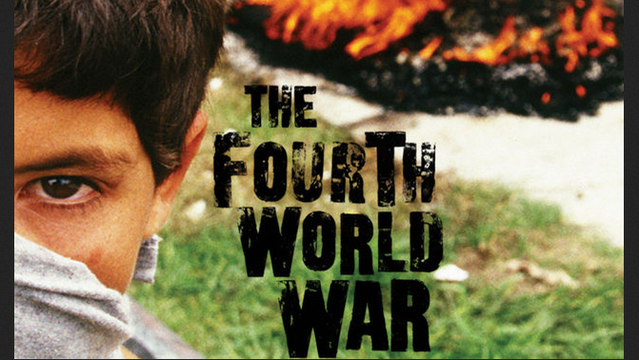
Saturday Matinee: The Fourth World War

the_fourth_world_war

From Big Noise Films:

From the front-lines of conflicts in Mexico, Argentina, South Africa, Palestine, Korea, and the North; from Seattle to Genova, and the War on Terror in New York, Afghanistan, and Iraq, The Fourth World War is the story of men and women around the world who resist being annihilated in this war.While our airwaves are crowded with talk of a new world war, narrated by generals and filmed from the noses of bombs, the human story of this global conflict remains untold. The Fourth World War brings together the images and voices of the war on the ground. It is a story of a war without end and of those who resist.The product of over two years of filming on the inside of movements on five continents, The Fourth World War is a film that would have been unimaginable at any other moment in history. Directed by the makers of This Is What Democracy Looks Like and Zapatista, produced through a global network of independent media and activist groups, it is a truly global film from our global movement.

For English speakers, portions of the film may need translation, activated by clicking on the “CC” button on bottom right corner of the video (on some mobile device browsers the function can be found on the upper right corner).