By Lauren Carroll Harris
Source: Adbusters
Within contemporary Russian film, it seems there is an ability to make the grandest statements from the smallest stories. From the insides of tiny flats, dying towns and treeless bays, directors like Andrey Zvyagintsev are able to tell big morality tales of corruption, futility, class and superstition that are at once national and universal in their scope and ambition. Zvyaginstev’s latest film, Leviathan, offers the newest iteration of these massive themes.
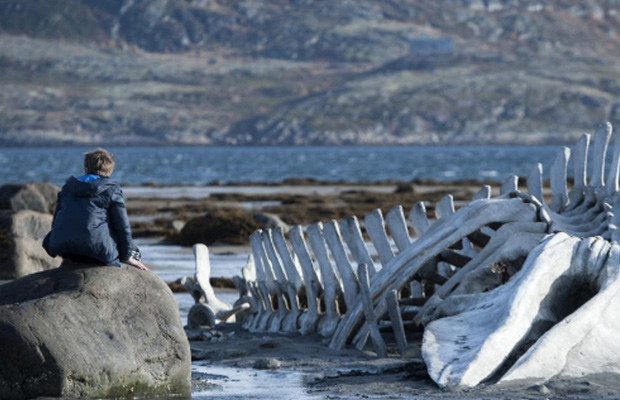
Our ‘Job’, Kolya, is a hotheaded everyman, whose house and land are to be seized, razed and developed by the corrupt major. His old lawyer friend from Moscow, Dmitri, must resort to blackmail to defend him, his second wife Lilya looks on despairingly, and his son Roma is busy learning how to drink in the ruins of a nearby church. Our protagonist is never idealized, nor is his gut reaction – to fight – rendered noble, it is merely taken for granted that he is on the edge of a last chance cliff. This is a story of one man against a terrible system and his fate is sealed from the start. It follows that even Leviathan’s portrayals of beautiful things are heavy with doom: the whale carcass in the film’s poster is the film’s strongest visual statement of political futility.
In all these contemporary Russian films I’ve seen – Zvyaginstev’s third film Elena, last year’s The Fool – concepts of social justice are dismissed as naive. The protagonists inch closer to their foregone conclusions blindly, the humor is black and the philosophical currency is fatalism. As in last year’s Two Days, One Night, there is humanity in the fightback, but unlike that film, Leviathan and its cohort underline the tragedy and futility of the fightback. The tides, the courts, the politicians, the priests – all carry on, undeterred. The end of history may have arrived, but not in post-Soviet Russian cinema, where it is accepted that history merely repeats, and repeats and repeats. What if there’s no march of progress? What if the world is growing flatter? Those questions at Leviathan’s heart are threatening for their antithetical stance to one of capitalism’s most inherent and foundational myths: that progress and growth is happening and will always happen. But what I found the most demoralizing thing about Leviathan is that it forestalls the march of progress because its only vision of post-capitalist political change is backwards – towards Stalinism. In that respect, the film is emblematic of the world’s lack of political imagination of visualizing alternatives to the current neoliberal ways of doing and thinking – in that way it is complementary with capitalism’s ‘end of history’ narrative.
In this respect, Leviathan’s global success – it is perhaps the most critically lauded foreign art-house film of 2015 so far – may speak to the way in which it tells Westerners what they already know and want to hear about Russia. It illuminates the truths about that post-socialist country that those in the West look down upon with the assurance of someone from a self-declared ‘democracy’ and reinforces Russia as blackly enigmatic. Never mind the continued use of torture in the USA, or the flagrant assaults on the human rights of asylum seekers in Australia: to foreign viewers, the idea of Russia as a black-hole for human rights is a seductive myth that distracts from their own societies’ hypocrisies.
Perhaps the most despairing storytelling technique in Leviathan is the visual concealment of key plot points. The film’s grimmest, most violent moments – Lilya’s affair with Dmitri, their altercation in the wilderness, Kolya’s retaliative attack, Dmitri’s beating at the hands of the mayor’s thugs – none of these are shown, just the moments leading up to them and following them. There’s something distinctly anti-Hollywood in Zvyaginstev’s withholding and something more violent. What we imagine is far more brutal, far more sinister and the present state of everything is both unimaginable and bitterly accepted. If Leviathan is a masterpiece, and by all critical consensus it is, it’s a masterpiece of political pessimism. The end of history has arrived and it is in post-Soviet Russia.