

From Open Culture:
The Collins English Dictionary defines “Ballardian” as “resembling or suggestive of the conditions described in J. G. Ballard’s novels and stories, especially dystopian modernity, bleak man-made landscapes and the psychological effects of technological, social or environmental developments.” You’ll find no more distilled dose of the Ballardian than in Ballard’s book The Atrocity Exhibition, a 1969 experimental novel, or collection of fragments, or what’s been called a collection of “condensed novels.” Subject to an obscenity trial in the United States and the subsequent pulping of nearly a whole print run, the book has earned a permanent place in the canon of controversial literature. Its twelfth chapter, “Crash!”, even provided the seed for a Ballard novel to come: 1973’s Crash, a story of symphorophilia which David Cronenberg adapted into a film 23 years later. The movie, in its turn, stoked a furor in the United Kingdom, culminating in a Daily Mail campaign to ban it. But as far as filming material born of Ballard’s fascination with the intersection of auto wrecks and sexuality, Cronenberg didn’t get there first.
Susan Emerling and Zoe Beloff drew from Crash the novel to make the still-unreleased Nightmare Angel in 1986, but fifteen years before that, Harley Cokeliss turned “Crash!” the chapter into Crash! the short film (also known as The Atrocity Exhibition). Casting Ballard himself in the starring role and Gabrielle Drake (sister of singer-songwriter Nick Drake) opposite, Cokeliss crafts a vision almost oppressively of the seventies: the protagonist’s wide, striped shirt collar dominates his even wider jacket collar below the grim visage he wears while ensconsed in the suit of armor that is his hulking American vehicle. “I think the key image of the twentieth century is the man in the motor car,” Ballard says in voiceover. “Have we reached a point now in the seventies where we only make sense in terms of these huge technological systems? I think so myself, and that it is the vital job of the writer to try to analyze and understand the huge significance of this metallized dream.” If this Ballardian vision resonates with you, see also Simon Sellars’ thorough essay on the film at fan site Ballardian.

A Mossack Fonseca law firm logo is pictured in Panama City April 3, 2016. REUTERS/Carlos Jasso
By
Source: The Free Thought Project
While it seems the Panama Papers are a genuine attempt at exposing rampant corruption of the world’s corporate-political uber-elite, a closer inspection reveals a likely Western geopolitical power play utilizing the latest techniques in information warfare.
The 11.5 million documents that were stolen from Mossack Fonseca were leaked to Suddeutsche Zeitung, which then turned to the International Consortium of Investigative Journalists to investigate the documents.
This process created a dynamic where control of the information resides in the hands of corporate mainstream media, thus allowing them to cherry pick stories they deem “newsworthy” – this exclusive access is troubling.
The reason this exclusive access is troubling becomes apparent when one recalls the infamous incident where The Guardian physically smashed the copies of the Snowden files in their possession upon the command of MI6 and the British government.
Had the Mossack Fonseca documents been turned over to WikiLeaks, the information would have been released en mass, as to allow for a publicly searchable database that would allow for anyone to search the documents in detail.
The immediate initial reporting on the Panama Papers has been curiously focused on Russian President Putin and Chinese President Xi Jinping, the leaders of two countries that have been recently labeled as strategic threats by Washington – with explicit implications that both of their leaders are corrupt.
Coincidentally, the U.S. has been working to actively “contain” both of these states – actively hedging against Russian influence in Syria and Ukraine, as well as actively engaging in an “Asian pivot” strategically designed to usurp a rising China and maintain U.S. hegemony.
And while there are some pro-Western interests revealed thus far, such as holdings by British Prime Minister David Cameron’s father, Ukrainian President Petro Poroshenko and Saudi Arabian King Salman, the vast amount of the reporting has focused on the usual suspects demonized by the West.
Curiously, there is no mention of any Western corporations or billionaires – the primary customers of Mossack Fonseca – in any of the articles written on the leak thus far, with The Guardian ominously stating that “much of the leaked material will remain private.”
With so much power residing in the hands of journalists, it begs the question; who or what is behind the International Consortium of Investigative Journalists?
The International Consortium of Investigative Journalists was launched by the Center for Public integrity – a group heavily funded by Putin arch-nemesis George Soros. Soros has been implicated in being a hidden hand behind numerous revolutions across the world.
Other groups that provide funding include:
Rockefeller Family Fund
Open Society Foundation (Soros)
Carnegie Endowment
Ford Foundation
W K Kellogg Foundation
The simple fact that information is being kept out of the public’s reach seems to speak clearly to the fact that this leak is most likely being perpetrated with an agenda to destabilize certain powerful states that are working to create a more multipolar world i.e. (Russia and China) at the expense of U.S. hegemony.
While there is no mistaking the corruption within every state apparatus on earth, curiously these leaks seem to focus heavily on those the U.S. political elite has established as threats. Perhaps there is more to come that will bring to light the corruption of the West as well… but until then, it looks to be a geopolitical hit job by the West — with a few sacrificial lambs thrown in to cause reasonable doubt.
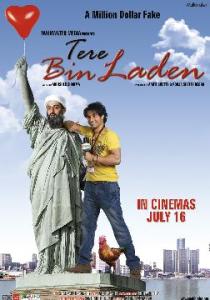
“Tere Bin Laden” (2010) is a Bollywood comedy written and directed by Abhishek Sharma. Pakistani pop star Ali Zafar stars as Ali Hassan, a TV reporter for a low budget news station in Karachi. Determined to find success in America despite previously being deported after being mistaken for a terrorist, he hatches a plan to raise funds for a fake ID with a sensational video using Noora (Pradhuman Singh), a dimwitted chicken farmer who happens to be a convincing Bin Laden lookalike. The plan rapidly spins out of control when it gets the attention of US government officials and the Pakistani intelligence agency. Though some gags dependent on regional references and wordplay may be lost on western audiences, much of it is broad enough to transcend cultures (especially bits mocking the paranoid and xenophobic post 9/11 milieu). Not surprisingly, the film was banned upon release in the US and several countries in the Middle East including Pakistan. The sequel Tere Bin Laden: Dead or Alive was released last February.
Rather than post a prank (which can all too easily be mistaken for “news” in today’s increasingly absurd media landscape) here’s a random assortment of intentionally funny clips:
The hypothesis behind The Walk of Life Project is that “Walk of Life” by Dire Straits improves the ending of any movie.
It certainly seems to work for The Shining, ideally the version depicted in this trailer:
From ClickHole:

From Wikipedia:
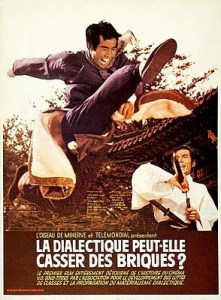
La Dialectique Peut-Elle Casser Des Briques?, in English, “Can Dialectics Break Bricks?”, is a 1973 Situationist film produced by the French director René Viénet which explores the development of class conflict through revolutionary agitation against a backdrop of graphic kung-fu fighting.
The film uses 1972 martial arts film Crush by Tu Guangqi, which tells the story of anti-colonialist revolt in Korea during the period of Japanese occupation, for its visuals which has been dubbed over by the filmmakers in an attempt at détournement. The concept and motivation of this film was to adapt a “spectacular” film into a radical critique of cultural hegemony and thus into tools of subversive revolutionary ideals.
The Narrative is based upon a conflict between the proletarian and bureaucrats within state capitalism. The proletarians enlist their dialectics and radical subjectivity to fight their oppressors whilst the bureaucrats defend themselves using a combination of co-optation and violence. The film is noted for its humorous approach to this serious subject matter.
The film also contains many praising references to revolutionaries who thought and fought for the realisation of a post-capitalist world, including Marx, Bakunin, and Wilhelm Reich, as well as scathing criticism towards the French Communist Party, trade unionism and Maoism. Also Subplots dealing with issues of gender equality, alienation, Paris Commune, May 1968, and the Situationist themselves are riddled throughout the film.
INDIAN COUNTRY NEWS
"It is the duty of every man, as far as his ability extends, to detect and expose delusion and error"..Thomas Paine
Human in Algorithms
From the Roof Top
I See This
blog of the post capitalist transition.. Read or download the novel here + latest relevant posts
अध्ययन-अनुसन्धानको सार
 After the Crash