I don’t have to tell you that your money doesn’t go as far as it once did. You see it every time that you go shopping. Our leaders flooded the system with money and pursued highly inflationary policies for years, and now we are all paying the price. The cost of living has been rising much faster than our incomes have, and this is systematically destroying the middle class. Survey after survey has shown that a solid majority of the population is living paycheck to paycheck, and at this point most U.S. consumers are tapped out. In fact, one brand new survey just discovered that 57 percent of Americans cannot even afford to pay a $1,000 emergency expense…
According to Bankrate’s Annual Emergency Fund Report, 68% of people are worried they wouldn’t be able to cover their living expenses for just one month if they lost their primary source of income. And when push comes to shove, the majority (57%) of U.S. adults are currently unable to afford a $1,000 emergency expense.
When broken down by generation, Gen Zers (85%) and Millennials (79%) are more likely to be worried about covering an emergency expense.
These numbers are quite ominous, because they clearly demonstrate that we are completely and utterly unprepared for any sort of a major economic downturn.
And thanks to the rapidly rising cost of living, we are losing even more ground with each passing month.
Nearly three-quarters, or 72%, of middle-income families say their earnings are falling behind the cost of living, up from 68% a year ago, according to a separate report by Primerica based on a survey of households with incomes between $30,000 and $100,000. A similar share, 74%, said they are unable to save for their future, up from 66% a year ago.
We haven’t experienced anything like this in the United States in decades.
When I walked into a Walmart store the other day, I was shocked by how high the prices are now.
Isn’t Walmart supposed to be the place with “low prices every day”?
Well, the prices were certainly not “low” when I walked through the store.
And I was stunned to learn that McDonald’s is now selling one hash brown for three dollars.
I am sure that many of you can remember a time when they were 50 cents.
Sadly, those days are not coming back.
Food prices are going to continue to go up, and the CEO of Unilever recently admitted that his company has actually “been accelerating the rate of price increases that we’ve had to put into the market”…
“For the last 18 months we’ve seen extraordinary input cost pressure … it runs across petrochemical derived products, agricultural derived products, energy, transport, logistics,” he said.
“It’s been feeding through for quite some time now and we’ve been accelerating the rate of price increases that we’ve had to put into the market,” he added.
US retail sales continued their fall in December, dropping by 1.1% as inflation remained high, the Commerce Department reported Wednesday.
That’s the largest monthly decline since December 2021, and practically every category (except for building materials, groceries and sporting goods) saw sales drop from the prior month.
U.S. existing home sales slowed for the 11th consecutive month in December as higher mortgage rates, surging inflation and steep home prices sapped consumer demand from the housing market.
-More Americans than ever before are being forced to pay at least 30 percent of their incomes on rent…
The average US household is now considered ‘rent-burdened’ as a record-high number of people are spending more than 30 percent of their income on rent.
According to Moody’s Analytics’ latest affordability report, the national average rent-to-income (RTI) ratio reached 30 percent for the first time since the company began tracking the data more than 20 years ago.
U.S. consumers are being stretched financially like never before, and many are turning to debt to help them maintain their current lifestyles.
As a result, the savings rate has plunged to a historic low, credit card debt has surged to a record high, and the average rate of interest on credit card balances has also risen to a record high. As Zero Hedge has aptly noted, this is “nothing short of catastrophic”…
The combination of record high credit card debt and record high credit card interest is nothing short of catastrophic for both the US economy, and the strapped consumer who has no choice but to keep buying on credit while hoping next month’s bill will somehow not come. Unfortunately, it will and at some point in the very near future, this will also translate into massive loan losses for US consumer banks; that’s when Powell will finally panic.
For a long time, we have been warned that the very foolish economic policies that our leaders were implementing would have deeply tragic consequences.
And now it is starting to happen right in front of our eyes.
Sadly, the truth is that this is just the beginning.
The entire system is cracking and crumbling all around us, and there is much more pain ahead.
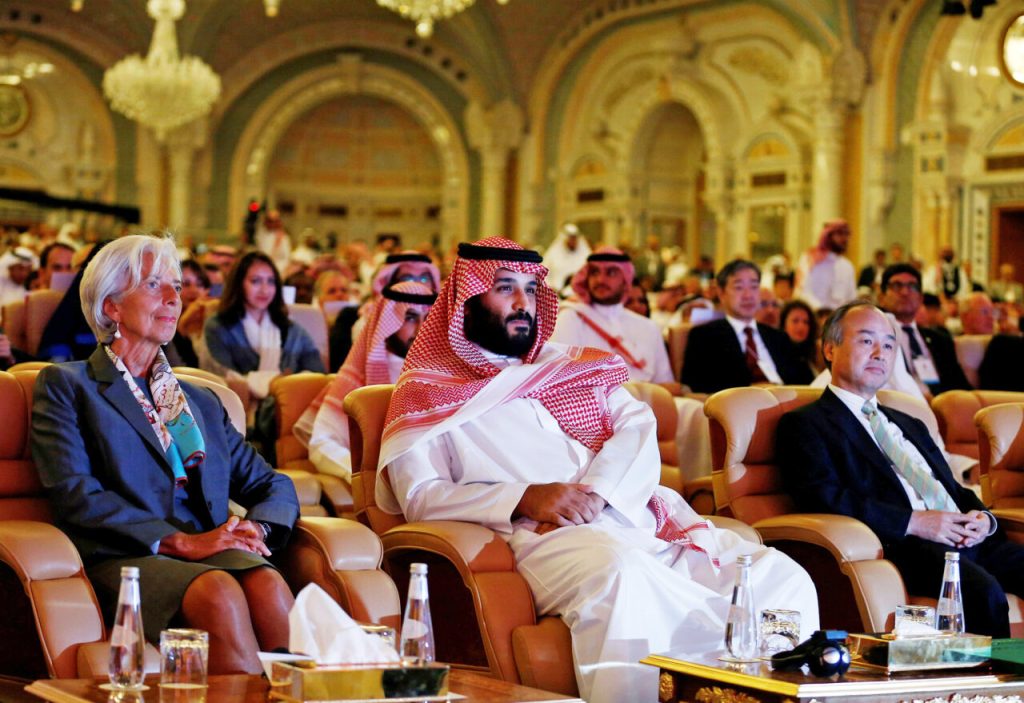
Saudi Crown Prince Mohammed bin Salman, Masayoshi Son, SoftBank Group Corp. Chairman and CEO, and Christine Lagarde, International Monetary Fund (IMF) Managing Director, attend the Future Investment Initiative conference in Riyadh, Saudi Arabia October 24, 2017. REUTERS/Faisal Al Nasser
The decline of a currency’s world reserve status is often a long process rife with denials. There are numerous economic “experts” out there that have been dismissing any and all warnings of dollar collapse for years. They just don’t get it, or they don’t want to get it. The idea that the US currency could ever be dethroned as the defacto global trade mechanism is impossible in their minds.
One of the key pillars keeping the dollar in place as the world reserve is its petro-status, and this factor is often held up as the reason why the Greenback cannot fail. The other argument is that the dollar is backed by the full force of the US military, and the US military is backed by the US Treasury and the Federal Reserve – In other words, the dollar is backed by…the dollar; it’s a very circular and naive position.
These sentiments are not only pervasive among mainstream economists, they are also all over the place within the alternative media. I suspect the main hang-up for liberty movement analysts is the notion that the globalist establishment would ever allow the dollar or the US economy to fail. Isn’t the dollar system their “golden goose”?
The answer is no, it is NOT their golden goose. The dollar is just another stepping stone towards their goal of a one-world economy and a one-world currency. They have killed the world reserve status of other currencies in the past, why wouldn’t they do the same to the dollar?
Globalist white papers and essays specifically outline the need for a diminished role for the US currency as well as a decline in the American economy in order to make way for Central Bank Digital Currencies (CBDCs) and a new global currency system controlled by the IMF. I warned about this years go, and my position has always been that the derailment of the dollar would likely start with the end of its petro status.
In 2017 I published an article titled ‘Saudi Coup Signals War And The New World Order Reset’. I noted at the time that the sudden power shift over to crown prince Mohammed Bin Salman indicated a change in Saudi Arabia’s relationship to the US. I stated that:
“To understand how drastic this coup has been, consider this — for decades Saudi Kings maintained political balance by doling out vital power positions to separate, carefully chosen successors. Positions such as Defense Minister, the Interior Ministry and the head of the National Guard. Today, Mohammed Bin Salman controls all three positions. Foreign policy, defense matters, oil and economic decisions and social changes are now all in the hands of one man.”
The rise of MBS was backed by the Public Investment Fund (PIF), a fund comprised of trillions of dollars supplied by globalists within Carlyle Group (Bush family, etc.), Goldman Sachs, Blackstone and Blackrock. MBS garnered the favor of the globalists for one specific reason – He openly supported their “Vision For 2030”, a plan for the dismantling of “fossil fuel” based energy and the implementation of carbon controls. Yes, that’s right, the head of Saudi Arabia is backing the eventual end of oil based energy, and part of that includes the end of the dollar as the petro currency.
In exchange for their cooperation, the Saudis are being given access to ESG-like funding as well as access to AI advancements and the so-called “digital economy.” It sounds crazy, but there is much talk of AI developments to cure numerous health problems and extend lifespan. With those kinds of promises, it’s not surprising that Saudi elites would be willing to dump the dollar and even oil.
In 2017 I noted that:
“I believe the next phase of the global economic reset will begin in part with the breaking of petrodollar dominance. An important element of my analysis on the strategic shift away from the petrodollar has been the symbiosis between the U.S. and Saudi Arabia. Saudi Arabia has been the single most important key to the dollar remaining as the petrocurrency from the very beginning.”
I believed that the threat to petro status would ultimately be spurred on by a proxy war between East and West:
“World economic war is the real name of the game here, as the globalists play puppeteers to East and West. It is a geopolitical crisis they will have created to engineer public support for a solution they predetermined.”
Back then I thought that such a proxy war would be initiated in the Middle East, possibly in Iran. However, it’s clear that Ukraine is the powderkeg the globalists have chosen, at least for now, with Taiwan being the next shoe to drop.
In the years since I made these predictions the relationship between Saudi Arabia, Russia and China has grown very close. Arms deals and energy deals are becoming a mainstay of trade and this has led to a quiet but steady distancing of the Saudis from the dollar. This past week, the dominoes were set in motion for dollar collapse when Saudi Arabia announced at Davos that they are now willing to trade oil in alternative currencies.
In response, Xi Jinping pledged to ramp up efforts to promote the use of the Chinese yuan in energy deals. This falls in line with another article I wrote in 2017 titled ‘The Economic End Game Continues,’ in which I described how conflict with Eastern nations (China and Russia) would be exploited to create a catalyst for the end of the dollar’s petro status.
The importance of the Saudi announcement cannot be overstated; this is the beginning of the end of the dollar. The dollar’s world reserve status is largely dependent on its petro-status. Without one, you cannot have the other. This is almost the exact same dynamic that led to the implosion of the British Sterling decades ago as the global petro currency which resulted in the rise of the dollar to take its place.
This time, though, it will not be a single foreign currency that takes on the role of world reserve, it will be a basket currency system controlled by the IMF called Special Drawing Rights, along with a single global digital currency that is yet to be named but is now under development.
The consequences of the loss of reserve status will be devastating to the US economy. It is the only glue holding our system together – The ability to defer inflation by exporting it overseas is a superpower only the US enjoys. The Fed can print money perpetually if it wants to in order to fund the government or prop up US markets, as long as foreign central banks and corporate banks are willing to absorb dollars as a tool for global trade. If the dollar is no longer the primary international trade mechanism, the trillions upon trillions of dollars the Fed has created from thin air over the years will all come flooding back to the US through various avenues, and hyperinflation (or hyperstagflation) will be the result.
This dynamic is already in play, as foreign holders of US debt and dollars have been dumping them at record pace since 2017. The process continues at a time when the Federal Reserve is cutting it’s balance sheet and raising interest rates, which means there is no longer a buyer of last resort.
This may be why multiple foreign central banks have renewed their purchases of gold reserves and are once again stockpiling precious metals. They seem to be well aware of what is about to happen to the dollar, while the American public is kept in the dark.
The effects of the decline of the dollar may not be immediately felt, or become obvious for another year or two. What will happen is consistent inflation on top of the high prices we are already dealing with. Meaning, the Federal Reserve will continue to hold interest rates higher and prices will barely budge or they may climb in spite of monetary tightening. Even in the face of a major recessionary contraction, which I predict will be triggered starting in April, prices will STILL remain higher.
All the while the mainstream media and government economists will say they have “no idea” why inflation is so persistent, and that “nobody could have seen this coming.” Some of us saw it coming, but only because we accept the reality that the dollar’s days are numbered.
On January 20th, the great American military and geostrategic analyst Brian Berletic, who has had a stunningly high percentage of his predictions turning out to have been 100% accurate, did a youtube at his “The New Atlas” Website, headlining “US, Allies Send More Weapons to Ukraine in Absence of Real Solution”, and it had been sparked by Berletic’s advance knowledge that America and its allies would probably decide to send to Ukraine some of the German-manufactured Leopard tanks and some of the U.S.-manufactured Abrams tanks. Near the end of his video, at 25:24 in it, he summarized what the prior portion had already documented to be the case: that these tanks will be useless to turning the tide of this war away from a Russian victory, and into a U.S.-and-allied victory.
Then, on January 25th, came the announcements that America, Germany, and Poland, had, in fact, decided to do this (send those tanks to Ukraine), and the BBC reported that, “Germans endured months of political debate about concerns that sending tanks would escalate the conflict and make Nato a direct party to the war with Russia.” The reason why Germany’s leaders ultimately decided to go along with these supplies to Ukraine isn’t that they had concluded that doing so wouldn’t “escalate the conflict and make Nato a direct party to the war with Russia” (and that’s oblique terminology for “globalize the war in Ukraine and turn it into a very hot WW III between NATO (the U.S.) and Russia”) but was instead that “The US and Germany had resisted internal and external pressure to send their tanks to Ukraine for some time.” The BBC, being an extension of Britain’s own military contractors — such as the world’s 7th-largest weapons-manufacturer, BAE Systems — many of which had been lobbying heavily for this decision, refused to define, or to say anything about, what stood behind that amorphous phrase “external pressure”; and, so, as usual, what was causing what was happening here was being ignored; only the result was being reported. Its cause (source) was banned from being even discussed in the ‘news’-media. However, on Tuesday, January 24th, Politico bannered “U.S. closer to approving ‘significant number’ of Abrams tanks to Ukraine”, and reported that, “On Tuesday, shortly after news broke of the possible U.S. move, POLITICO reported that German Chancellor Olaf Scholz also plans to announce that German Leopards are heading to Ukraine. Last week, Scholz told U.S. lawmakers [in Switzerland, at the pro-imperialist WEF in Davos, where many billionaires and U.S.-and-allied Governments meet privately each year and which has increasingly come to replace the United Nations that the anti-imperialist FDR had initiated to serve as the basis for international laws, and for these imperialists to come to replace those international laws, by imposing America’s “rules-based international order”] that Berlin would approve the transfer only if the U.S. donated its own tanks first.” But, still, the key individuals who stood behind this supposedly crucial international agreement, to possibly start what could quickly become a nuclear World War Three, wasn’t, at all, being indicated; it was, instead, hidden, and that question wasn’t mentioned, at all — as-if it didn’t ‘really’ matter who, or how, and why, this decision to “escalate the conflict and make Nato a direct party to the war with Russia” had been made — what had caused it to be made.
Sending these additional armaments to Ukraine runs exactly opposite to public opinion in at least the imperial country itself.
As Russia’s war against Ukraine approaches its one-year mark, 33 percent of Americans think the United States is doing too much to help Ukraine, 21 percent think the U.S. is doing too little, and 38 percent think the U.S. is doing about the right amount to help Ukraine. This compares to a Quinnipiac University poll on February 28, 2022 after the war started, when 7 percent of Americans thought the U.S. was doing too much to help Ukraine, 45 percent thought the U.S. was doing too little, and 37 percent thought the U.S. was doing about the right amount to help Ukraine.
So: Why is America’s NATO driving its members to shovel yet more weaponry into Ukraine? Is it because these countries are “democracies”? Brian Berletic has a different answer — and, unlike the propagandized one, it recognizes that that is a pure scam excuse (like the invasion and occupation of Iraq used in 2003). The “MIC” Military-Industrial Complex (and that’s controlled by the leading stockholders in the top-100 ‘Defense’ firms) is behind it. NATO is the trade-organization for those international corporations, and it (especially in the U.S. and UK) runs their Governments. That’s why this is being done.
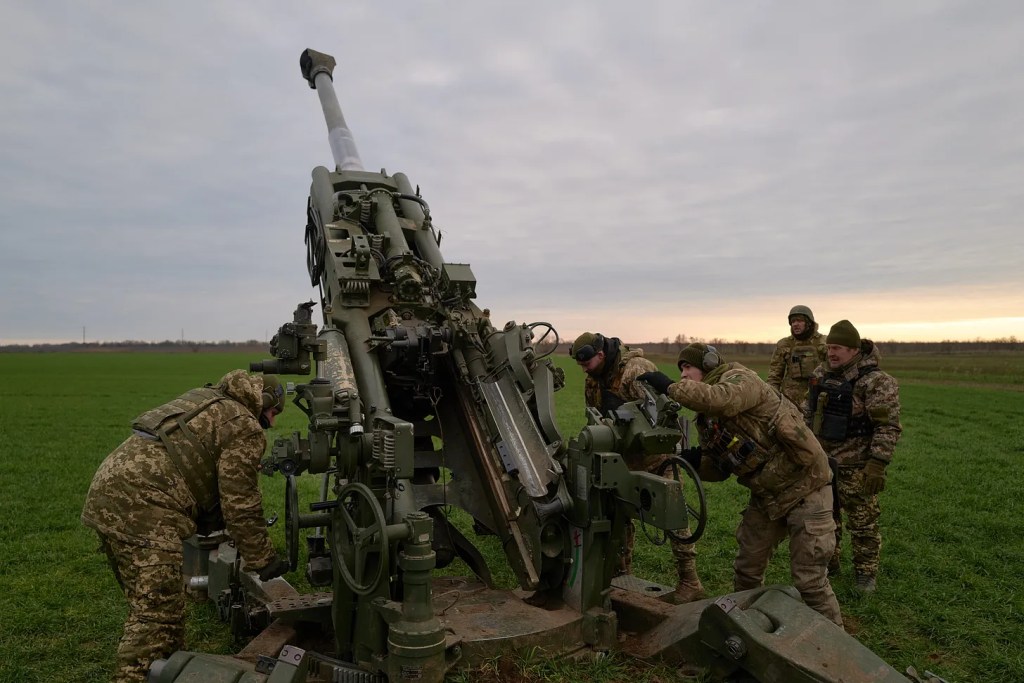
Now that Ukraine’s government will be receiving those tanks, Ukraine is expecting ultimately to receive American jet fighters and missiles that will enable Ukraine to invade Russia at least as far as Moscow — which is only 300 miles away from Ukraine. On the afternoon of January 25th, Reuters headlined “Ukraine sets sights on fighter jets after securing tank supplies”, and reported that Yuriy Sak, who advises Ukraine’s Defence Minister Oleksiy Reznikov, told Reuters, “They didn’t want to give us heavy artillery, then they did. They didn’t want to give us Himars systems, then they did. They didn’t want to give us tanks, now they’re giving us tanks. Apart from nuclear weapons, there is nothing left that we will not get.” If they get nuclear weapons, those will certainly be operated by Americans. And, of course, that has been the U.S. goal ever since Obama started by no later than June of 2011 to plan his coup to take Ukraine.
Investigative historian Eric Zuesse’s new book, AMERICA’S EMPIRE OF EVIL: Hitler’s Posthumous Victory, and Why the Social Sciences Need to Change, is about how America took over the world after World War II in order to enslave it to U.S.-and-allied billionaires. Their cartels extract the world’s wealth by control of not only their ‘news’ media but the social ‘sciences’ — duping the public.
In this age of ubiquitous surveillance, there are no private lives: everything is public.
Surveillance cameras mounted on utility poles, traffic lights, businesses, and homes. License plate readers. Ring doorbells. GPS devices. Dash cameras. Drones. Store security cameras. Geofencing and geotracking. FitBits. Alexa. Internet-connected devices.
There are roughly one billion surveillance cameras worldwide and that number continues to grow, thanks to their wholehearted adoption by governments (especially law enforcement and military agencies), businesses, and individual consumers.
With every new surveillance device we welcome into our lives, the government gains yet another toehold into our private worlds.
Indeed, empowered by advances in surveillance technology and emboldened by rapidly expanding public-private partnerships between law enforcement, the Intelligence Community, and the private sector, police have become particularly adept at sidestepping the Fourth Amendment.
As law professor Avidan Y. Cover explains:
A key feature of the surveillance state is the cooperative relationship between the private sector and the government. The private sector’s role is vital to the surveillance both practically and legally. The private sector, of course, provides the infrastructure and tools for the surveillance… The private sector is also critical to the surveillance state’s legality. Under the third-party doctrine, the Fourth Amendment is not implicated when the government acquires information that people provide to corporations, because they voluntarily provide their information to another entity and assume the risk that the entity will disclose the information to the government. Therefore, people do not have a reasonable expectation of privacy in their calling data, or potentially even their emails. As a result, the government does not normally need a warrant to obtain information transmitted electronically. But the Fourth Amendment is not only a source of protection for individual privacy; it also limits government excess and abuse through challenges by the people. The third-party doctrine removes this vital and populist check on government overreach.
Critical to this end run around the Fourth Amendment’s prohibitions against unreasonable searches and seizures by government agents is a pass play that allows police to avoid public transparency requirements (open bids, public meetings, installation protocols) by having private companies and individuals do the upfront heavy lifting, leaving police to harvest the intel on the back end.
Stingray devices, facial recognition technology, body cameras, automated license plate readers, gunshot detection, predictive policing software, AI-enhanced video analytics, real-time crime centers, fusion centers: all of these technologies and surveillance programs rely on public-private partnerships that together create a sticky spiderweb from which there is no escape.
As the cost of these technologies becomes more affordable for the average consumer, an effort underwritten by the tech industry and encouraged by law enforcement agencies and local governing boards, which in turn benefit from access to surveillance they don’t need to include in their budgets, big cities, small towns, urban, suburban and rural communities alike are adding themselves to the surveillance state’s interconnected grid.
What this adds up to for government agencies (that is, FBI, NSA, DHS agents, etc., as well as local police) is a surveillance map that allows them to track someone’s movements over time and space, hopscotching from doorbell camera feeds and business security cameras to public cameras on utility poles, license plate readers, traffic cameras, drones, etc.
It has all but eliminated the notion of privacy and radically re-drawn the line of demarcation between our public and private selves.
Over the past 50 years, surveillance has brought about a series of revolutions in how governments govern and populations are policed to the detriment of us all. Cybersecurity expert Adam Scott Wandt has identified three such revolutions.
The first surveillance revolution came about as a result of government video cameras being installed in public areas. There were a reported 51 million surveillance cameras blanketing the United States in 2022. It’s estimated that Americans are caught on camera an average of 238 times every week (160 times per week while driving; 40 times per week at work; 24 times per week while out running errands and shopping; and 14 times per week through various other channels and activities). That doesn’t even touch on the coverage by surveillance drones, which remain a relatively covert part of police spying operations.
The second revolution occurred when law enforcement agencies started forging public-private partnerships with commercial establishments like banks and drug stores and parking lots in order to gain access to their live surveillance feeds. The use of automatic license plate readers (manufactured and distributed by the likes of Flock Safety), once deployed exclusively by police and now spreading to home owners associations and gated communities, extends the reach of the surveillance state that much further afield. It’s a win-win for police budgets and local legislatures when they can persuade businesses and residential communities to shoulder the costs of the equipment and share the footage, and they can conscript the citizenry to spy on each other through crowdsourced surveillance.
The third revolution was ushered in with the growing popularity of doorbell cameras such as Ring, Amazon’s video surveillance doorbell, and Google’s Nest Cam.
Amazon has been particularly aggressive in its pursuit of a relationship with police, enlisting them in its marketing efforts, and going so far as to hosting parties for police, providing free Ring doorbells and deep discounts, sharing “active camera” maps of Ring owners, allowing access to the Law Enforcement Neighborhood Portal, which enables police to directly contact owners for access to their footage, and coaching police on how to obtain footage without a warrant.
Ring currently partners with upwards of 2,161 law enforcement agencies and 455 fire departments, and that number grows exponentially every year. As Vice reports, “Ring has also heavily pursued city discount programs and private alliances with neighborhood watch groups. When cities provide free or discounted Ring cameras, they sometimes create camera registries, and police sometimes order people to aim Ring cameras at their neighbors, or only give cameras to people surveilled by neighborhood watches.”
In November 2022, San Francisco police gained access to the live footage of privately owned internet cameras as opposed to merely being able to access recorded footage. No longer do police even have to request permission of homeowners for such access: increasingly, corporations have given police access to footage as part of their so-called criminal investigations with or without court orders.
We would suggest a fourth revolutionary shift to be the use of facial recognition software and artificial intelligence-powered programs that can track people by their biometrics, clothing, behavior and car, thereby synthesizing the many strands of surveillance video footage into one cohesive narrative, which privacy advocates refer to as 360 degree surveillance.
Finally, Wandt sees autonomous cars equipped with cameras that record everything around them as yet another revolutionary expansion of surveillance to be tapped by police.
Yet in the present moment, it’s those public-private partnerships that signify a watershed moment in the transition from a police state to a surveillance state and sound a death knoll for our privacy rights. This fusion of government power and private power is also at the heart of the surveillance state’s growing stranglehold on the populace.
As always, these intrusions into our personal lives are justified in the name of national security and fighting crime. Yet while the price to be paid for having the government’s so-called protection is nothing less than our right to privacy, the guarantee of safety remains dubious, at best.
As a study on camera surveillance by researchers at City University of New York concluded, the presence of cameras were somewhat effective as a deterrent for crimes such as car burglaries and property theft, but they had no significant effect on violent crimes.
On the other hand, when you combine overcriminalization with wall-to-wall surveillance monitored by police in pursuit of crimes, the resulting suspect society inevitably gives way to a nation of criminals. In such a society, we are all guilty of some crime or other.
The predatory effect of these surveillance cameras has also yet to be fully addressed, but they are vulnerable to being hacked by third parties and abused by corporate and government employees.
After all, power corrupts. We’ve seen this abuse of power recur time and time again throughout history. For instance, as an in-depth investigative report by the Associated Press concludes, the very same mass surveillance technologies that were supposedly so necessary to fight the spread of COVID-19 are now being used to stifle dissent, persecute activists, harass marginalized communities, and link people’s health information to other surveillance and law enforcement tools. As the AP reports, federal officials have also been looking into how to add “‘identifiable patient data,’ such as mental health, substance use and behavioral health information from group homes, shelters, jails, detox facilities and schools,” to its surveillance toolkit.
These cameras—and the public-private eyes peering at us through them—are re-engineering a society structured around the aesthetic of fear and, in the process, empowering “people to not just watch their neighborhood, but to organize as watchers,” creating not just digital neighborhood watches but digital gated communities.
Finally, there is a repressive, suppressive effect to surveillance that not only acts as a potentially small deterrent on crime but serves to monitor and chill lawful First Amendment activity. As Matthew Feeney warns in the New York Times, “In the past, Communists, civil rights leaders, feminists, Quakers, folk singers, war protesters and others have been on the receiving end of law enforcement surveillance. No one knows who the next target will be.”
No one knows, but it’s a pretty good bet that the surveillance state will be keeping a close watch on anyone seen as a threat to the government’s chokehold on power.
Economic sanctions and blackmail have long been the preferred methods of conducting foreign policy and advancing the United States’ own geopolitical interests.
In 2018, the US withdrew from the agreement on Iran’s nuclear program signed in May 2015, following which Washington began to implement the “maximum pressure” strategy on Iran.
In 2019, the US government imposed a slew of restrictions on the Chinese firm Huawei, which is widely regarded as a leader in digital technologies, particularly in the deployment of 5G networks. Following that, Washington began to intercept Huawei’s foreign market as a result of an open competitive struggle.
And Russia’s gas squeeze in Europe, orchestrated by the US, exacerbated an already obvious economic and financial crisis for Europeans, resulting in total population impoverishment against the backdrop of America reaping additional superprofits from the sale of expensive American LNG instead of cheap Russian gas to Europe.
Sanctions, including secondary ones, become a tool for seizing funds and assets and bankrupting competitors, and are used by the United States to strengthen its global dominance.
Although the definition of extortion as a common law crime in US criminal law varies across states, both in wording and substance, it is nevertheless recognized everywhere as a serious offense and prosecuted under domestic law. In recent years, in an effort to introduce “rules” unilaterally favorable to the United States in place of international law, Washington’s policy has begun to carry the principle of “extraterritorial” sanctions into the international arena when the United States imposes them and openly extorts not only US legal subjects but also foreign ones, including independent states.
The fact that under these conditions, the US uses the dominant role of the US dollar, blackmail, and economic sanctions as the main instruments of foreign policy (the use of sanctions almost tripled in 2009-2019 alone) makes many countries think about possible alternatives. One of them is already the increasing use of national currencies in bilateral trade.
Washington’s abuse of such criminal policies and blatantly illegal pressures are causing resentment even among the United States’ allies. It is no coincidence that in 2019 the chairman of the United Kingdom’s central bank, Mark Carney, called for the creation of an international digital currency that would weaken the dominant role of the US dollar in international trade.
Washington is increasingly using outright blackmail, not just in the political, economic, and trade spheres. It is also used in the military sphere, with the sale and subsequent use of American weapons directly threatening the national security of countries that purchase US weapons.
And one of the many egregious examples of this is the events of 2016, when the US attempted to stage a coup in Turkey by killing President Erdoğan with American weapons and preventing Turkish authorities from using US air defenses to prevent them from shooting down F-16 aircraft flying from the US military base at Incirlik. And it was only thanks to the intervention of Russian politician Alexander Dugin (against whom, by the way, Ukrainian accomplices of the United States committed an act of terrorism in 2022 and killed his daughter) and the Russian military at the behest of President Vladimir Putin that this sinister plan of Washington was foiled. The arrested Turkish coup plotters themselves have given detailed accounts of it. In particular, about how the Russian military, using seven Russian fighter jets and two S-400 missile systems in northern Syria, warned the coupist aircraft that if the radar showed any indication of their suspicious or improper actions, they would be hit directly. As a result, the Turkish F-16s could only track Erdoğan’s plane and not attack it. In addition to the testimony of the Turkish participants in this failed American coup attempt, those interested can learn more from a Turkish report published on Odatv.com on September 21, 2016.
This blackmail of Ankara with US weapons continues even now, as pointed out in particular by Bloomberg the other day, which reported that the US will not supply Turkey with F-16s until it agrees to admit Sweden to NATO.
Even if Turkey, under pressure from Washington, agrees to admit Finland and Sweden to NATO, which the United States is trying hard to push into the alliance, Turkey will never be able to use those aircraft or other American weapons unless such use would be advantageous to the White House.
And the US decision in April 2021 to withdraw US Patriot air defense batteries from the Persian Gulf region after the White House deteriorated relations with the Saudi monarchy is proof of that.
The threat from Washington to restrict the use of purchased US weapons has become increasingly serious for many countries recently. Especially considering that it is the US that sells twice as many weapons as Russia and six times as many as China, thus dominating the market for weapons of death, destruction and protection of many states from external threats, the vast majority of which are also initiated by Washington. Here one can also see the recent White House game of supplying Greece with more and more offensive weapons against Turkey, whose relations with both Athens and Washington have recently deteriorated significantly.
Washington has made similar attempts at blackmail in its arms supplies to the other two rival parties to the conflict in South Asia – Pakistan and India. Therefore, despite Washington’s blatant blackmail and intimidation of New Delhi, India continues to focus on buying arms from Russia rather than the United States. In the meantime, India has two important defense needs: the availability of weapons and their quality. In its preferential treatment of Russia on this issue, Indian leaders assume that if the country begins to buy weapons from the West, it will strengthen its autonomy but sacrifice these two needs, since Western systems are many times more expensive but inferior to Russian ones.
The Ukraine conflict was caused by the U.S. backed right wing coup in 2014 and the duplicity of Europeans who claimed to be working for peace. Anyone who supports these actions but claims leftist credentials must be challenged.
“It is urgent to end this war as soon as possible. This can only be achieved through the success of Ukraine’s resistance to Russia’s invasion. Ukraine is fighting a legitimate war of self-defense, indeed a war for its survival as a nation. Calling for “peace” in the abstract is meaningless in these circumstances.”(Ukrainian Solidarity Network )
“Social-imperialists,’ that is, socialists in words and imperialists in deeds ( V.I. Lenin)
“The Western social-imperialist left that is still addicted to its material privileges and illusions of being a part of something called the “West” has a choice that it must make: either you abandon privilege and whiteness and join as class combatants against your bourgeoisie, or you will be considered part of the enemy.” (A.Baraka,The Western Imperial Left’s Collaboration with the Western Bourgeoisie)
The clear implication from this statement issued by the newly formed Ukrainian Solidarity Network is that military victory is the only solution for resolving the conflict in Ukraine. The fact that many of the individuals supporting this network self-identify as leftists, represents a new, perhaps higher form of collaboration with Western and U.S. imperialism that may have ever developed since the end of the second imperialist war in 1945. I issued an excerpt of my statement in response to the emergence of this network that caused a stir. Here is my statement in full.
One of the most positive things to emerge from the Collective West’s war in Ukraine is that it helped to expose elements of the U.S. left that have always had a soft, sentimental spot for the West. The arrogance of these Westerners who signed on to this call for more war (see below) is reflected in the fact that they don’t even feel compelled to explain how their morally superior commitment to Ukrainian self-determination against “Putin’s” war is reconciled with the various statements from former German Chancellor Angela Merkel, former French President Francois Hollande and before them, former Ukrainian president Petro Poroshenko revealing that the Minsk agreement was just a delaying tactic to prepare for war.
We ask the Network as we have been asking Zelensky and Biden, the co-coordinators of the White Lives Matter More Movement, how this phase of the conflict that started in 2014 became Putin’s war? Do we just dismiss as Kremlin propaganda that the Russian Federation felt threatened by what appeared to be the de-facto incorporation of Ukraine into NATO as the Ukrainian army was built into the most formidable fighting force in Europe outside of Russia?
Did the Russians not have any legitimate security concerns with NATO missiles facing them from Romania and Poland, a mere six minutes away from Moscow, and that Ukraine was also making a pitch for “defensive” missiles in Ukraine? And how does the Network characterize the conflict in Eastern Ukraine that started in 2014 and produced over 14,000 deaths when the Ukrainian coup government attacked its own citizens, if the current conflict started in February 2022? What happened to the fascist issue in Ukraine that was written about for years but with even more urgency after the coup in 2014? Did the Kremlin plant those stories in the Western press?
We understand that these are questions that the organizers of the Ukrainian Network will never answer because they do not have to. As Westerners they can just postulate an assertion and it is accepted. The Network and the Western bourgeoisie declare that the war in Ukraine is Putin’s war and it becomes objective truth – because that is what the West can do and can get away with. It’s called power – white power perhaps?
The Ukrainian Solidarity Network is the ultimate expression of social imperialism that has become so normalized in the U.S. and Western Europe that it is no longer even recognized. An example from the statement makes the argument that Ukraine has the “right to determine the means and objectives of its own struggle.” That is a recognized left position. But the social imperialists of the West do not extend that principle and right to nations in the global South. In fact, we ask the signers of this call to explain when the coup government of Ukraine became the representatives of the Ukrainian nation and recognized the sovereign will of the people?
Therefore, it is not a mere coincidence that the main signatories of this Network statement pledging undying support to Ukraine and its project, are also some of the same “left” forces in the forefront of giving left legitimacy to the charge leveled by Western imperialism that the struggling socialist oriented national liberationist states like Venezuela, Nicaragua, Bolivia are nothing more than “authoritarian” states more interested in power than socialist construction. Some of those forces also cheered on the NATO attack against Libya, passionately defended Western intervention in Syria and have been silent on Western plans to violently invade Haiti.
For the contemporary neocons in the leadership of the Ukrainian network, their commitment to abstract principles, and certainty that they know more than everyone else, objectively place them in the same ideological camp with Obama, Biden, NATO strategists, the Zelensky clown, and Boris Johnson. But they will argue that their positions are different, since they represent something they call the left.
For a number of individuals who signed on to this pro-Western, pro-war letter, they are in a familiar place. However, I suspect a few of the individuals on that list were probably confused or not paying attention, not thinking about who they would be affiliated with when they signed on.
That of course, is not the case for some of the key supporters of this initiative. Individuals like the Green Party’s Howie Hawkins, Eric Draitser of Counterpunch, and Bill Fletcher who normally I would not name specifically but because these individuals and the tendency they represent embody the worst of the arrogant, Western left that in so many cases (not all) objectively provides ideological cover ( rightism with left phraseology) for the imperialist program of Western capital – they should not be allowed continued left respectability without challenge.
These individuals certainly have not hesitated in offering criticisms of those of us who never wavered from our strategic priority to defeat our primary enemy – the Western white supremacist colonial/capitalist patriarchy. For us everything else represents secondary contradictions at this specific historical moment. And is why we reject the arguments these forces advance about fighting dual imperialisms as anti-dialectical nonsense and a political cover.
History has demonstrated that it would be a complete disaster if the “collective West” secured a military victory in its proxy war with Russia. For the U.S. empire it would validate their doctrine of “Full spectrum dominance” and the wisdom of their commitment to a military-first strategy to support that doctrine. It would mean that war with China was a certainty.
The commitment to global hegemony by the Western colonial/capitalist elite by any means necessary is why the U.S./EU/NATO Axis of Domination represents an existential threat to the vast majority of humanity. A “left” position on Ukraine should at best be to support a negotiated settlement to end the war before the Dr. Strangeloves making policy in the U.S. create the circumstances that will lead to a nuclear confrontation with either Russia or China.
The position of support for more war guided by the white-boy fantasy of military victory in Ukraine is madness. For Africans/Black folks, we ask, what self-respecting African would consciously place themselves on the same side with NATO, Europe, and the U.S. settler-state in any conflict? The fact that some continue to end up on the same side with our enemies only affirms that they have made a choice, and that choice is to collaborate with our enemies – which sadly, also makes them the enemy.
In my latest article for TomDispatch.com, I parse the meaning of America’s latest National Defense Strategy. Hint: It’s not about defense.
More than two millennia ago, in the History of the Peloponnesian War, Thucydides recounted a disastrous conflict Athens waged against Sparta. A masterwork on strategy and war, the book is still taught at the U.S. Army War College and many other military institutions across the world. A passage from it describing an ultimatum Athens gave a weaker power has stayed with me all these years. And here it is, loosely translated from the Greek: “The strong do what they will and the weak suffer as they must.”
Recently, I read the latest National Defense Strategy, or NDS, issued in October 2022 by the Pentagon, and Thucydides’s ancient message, a warning as clear as it was undeniable, came to mind again. It summarized for me the true essence of that NDS: being strong, the United States does what it wants and weaker powers, of course, suffer as they must. Such a description runs contrary to the mythology of this country in which we invariably wage war not for our own imperial ends but to defend ourselves while advancing freedom and democracy. Recall that Athens, too, thought of itself as an enlightened democracy even as it waged its imperial war of dominance on the Peloponnesus. Athens lost that war, calamitously, but at least it did produce Thucydides, a military leader who became a historian and wrote all too bluntly about his country’s hubristic, ultimately fatal pursuit of hegemony.
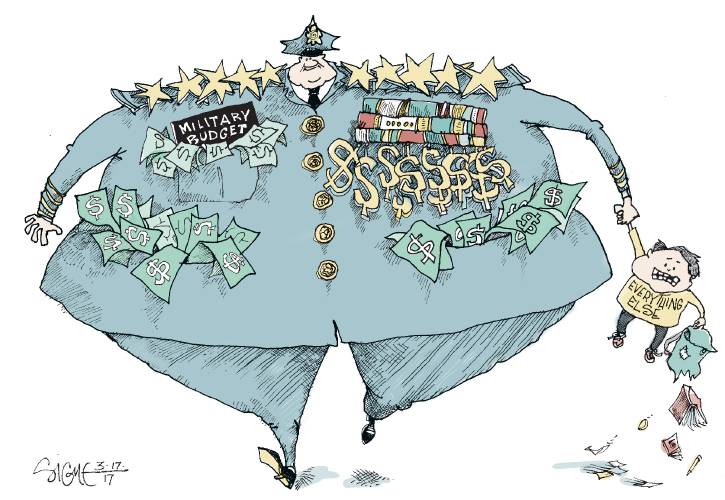
Imperial military ambitions contributed disastrously to Athens’s exhaustion and ultimate collapse, a lesson completely foreign to U.S. strategists. Not surprisingly, then, you’ll find no such Thucydidean clarity in the latest NDS approved by Secretary of Defense Lloyd Austin. In place of that Greek historian’s probity and timeless lessons, the NDS represents an assault not just on the English language but on our very future. In it, a policy of failing imperial dominance is eternally disguised as democratic deterrence, while the greatest “strategic” effort of all goes (remarkably successfully) into justifying massive Pentagon budget increases. Given the sustained record of failures in this century for what still passes as the greatest military power on the planet — Afghanistan, Iraq, and Libya, of course, but don’t forget Somalia, Syria, Yemen, and indeed the entire $8 trillion Global War on Terror in all its brutality — consider the NDS a rare recent “mission accomplished” moment. The 2023 baseline “defense” budget now sits at $858 billion, $45 billion more than even the Biden administration requested.
With that yearly budget climbing toward a trillion dollars (or more) annually, it’s easy to conclude that, at least when it comes to our military, nothing succeeds like failure. And, by the way, that not only applies to wars lost at a staggering cost but also financial audits blown without penalty. After all, the Pentagon only recently failed its fifth audit in a row. With money always overflowing, no matter how it may be spent, one thing seems guaranteed: some future American Thucydides will have the material to produce a volume or volumes beyond compare. Of course, whether this country goes the way of Athens — defeat driven by military exhaustion exacerbated by the betrayal of its supposedly deepest ideals leading to an ultimate collapse — remains to be seen. Still, given that America’s war colleges continue to assign Thucydides, no one can say that our military and future NDS writers didn’t get fair warning when it comes to what likely awaits them.
Bludgeoning America with Bureaucratese
If you can’t dazzle them with brilliance, baffle them with BS.
That’s a saying I learned early in my career as an Air Force officer, so I wasn’t exactly surprised to discover that it’s the NDS’s guiding philosophy. The document has an almost Alice in Wonderland-like quality to it as words and phrases take on new meanings. China, you won’t be surprised to learn, is a “pacing challenge” to U.S. security concerns; Russia, an “acute threat” to America due to its “unprovoked, unjust, and reckless invasion of Ukraine” and other forms of “irresponsible behavior”; and building “combat-credible forces” within a “defense ecosystem” is a major Pentagon goal, along with continuing “investments in mature, high-value assets” (like defective aircraft carriers, ultra-expensive bombers and fighter jets, and doomsday-promising new ICBMs).
Much talk is included about “leveraging” those “assets,” “risk mitigation,” and even “cost imposition,” a strange euphemism for bombing, killing, or otherwise inflicting pain on our enemies. Worse yet, there’s so much financial- and business-speak in the document that it’s hard not to wonder whether its authors don’t already have at least one foot in the revolving door that could, on their retirement from the military, swing them onto the corporate boards of major defense contractors like Boeing and Raytheon.
Perhaps my favorite redefined concept in that NDS lurks in the word “campaigning.” In the old days, armies fought campaigns in the field and generals like Frederick the Great or Napoleon truly came to know the price of them in blood and treasure. Unlike U.S. generals since 1945, they also knew the meaning of victory, as well as defeat. Perish the thought of that kind of campaigning now. The NDS redefines it, almost satirically, not to say incomprehensibly, as “the conduct and sequencing of logically-linked military initiatives aimed at advancing well-defined, strategy-aligned priorities over time.” Huh?
Campaigning, explains the cover letter signed by Secretary of Defense Austin (who won’t be mistaken for Frederick II in his bluntness or Napoleon in his military acuity), “is not business as usual — it is the deliberate effort to synchronize the [Defense] Department’s activities and investments to aggregate focus and resources to shift conditions in our favor.”
Got it? Good!
Of course, who knows what such impenetrable jargon really means to our military in 2023? This former military officer certainly prefers the plain and honest language of Thucydides. In his terms, America, the strong, intends to do what it will in the world to preserve and extend “conditions in our favor,” as the NDS puts it — a measure by which this country has failed dismally in this century. Weaker countries, especially those that are “irresponsible,” must simply suffer. If they resist, they must be prepared for some “cost imposition” events exercised by our “combat-credible forces.” Included in those are America’s “ultimate backstop” of cost imposition… gulp, its nuclear forces.
Again, the NDS is worthy of close reading (however pain-inducing that may be) precisely because the secretary of defense does claim that it’s his “preeminent guidance document.” I assume he’s not kidding about that, though I wish he were. To me, that document is to guidance as nuclear missiles are to “backstops.” If that last comparison is jarring, I challenge you to read it and then try to think or write clearly.
Bringing Clarity to America’s Military Strategy
To save you the trauma of even paging through the NDS, let me try to summarize it quickly in my version — if not the Pentagon’s — of English:
China is the major threat to America on this planet.
Russia, however, is a serious threat in Europe.
The War on Terror continues to hum along successfully, even if at a significantly lower level.
North Korea and Iran remain threats, mainly due to the first’s growing nuclear arsenal and the second’s supposed nuclear aspirations.
Climate change, pandemics, and cyberwar must also be factored in as “transboundary challenges.”
“Deterrence” is frequently used as a cloak for the planetary dominance the Pentagon continues to dream of. Our military must remain beyond super-strong (and wildly overfunded) to deter nations and entities from striking “the homeland.” There’s also lots of talk about global challenges to be met, risks to be managed, “gray zone” methods to be employed, and references aplenty to “kinetic action” (combat, in case your translator isn’t working) and what’s known as “exploitable asymmetries.”
Count on one thing: whatever our disasters in the real world, nobody is going to beat America in the jargon war.
Missing in the NDS — and no surprise here — is any sense that war is humanity’s worst pastime. Even the mass murder implicit in nuclear weapons is glossed over. The harshest realities of conflict, nuclear war included, and the need to do anything in our power to prevent them, naturally go unmentioned. The very banality of the document serves to mask a key reality of our world: that Americans fund nothing as religiously as war, that most withering of evils.
Perhaps it’s not quite the banality of evil, to cite the telling phrase political philosopher Hannah Arendt used to describe the thoughts of the deskbound mass-murderers of the Holocaust, but it does have all of war’s brutality expunged from it. As we stare into the abyss, the NDS replies with mind-numbing phrases and terms that wouldn’t be out of place in a corporate report on rising profits and market dominance.
Yet as the military-industrial complex maneuvers and plots to become ever bigger, ever better funded, and ever more powerful, abetted by a Congress seemingly lustful for ever more military spending and weapons exports, hope for international cooperation, productive diplomacy, and democracy withers. Here, for instance, are a few of the things you’ll never see mentioned in this NDS:
Any suggestion that the Pentagon budget might be reduced. Ever.
Any suggestion that the U.S. military’s mission or “footprint” should be downsized in any way at all.
Any acknowledgement that the U.S. and its allies spend far more on their militaries than “pacing challengers” like China or “acute threats” like Russia.
Any acknowledgment that the Pentagon’s budget is based not on deterrence but on dominance.
Any acknowledgement that the U.S. military has been far less than dominant despite endless decades of massive military spending that produced lost or stalemated wars from Korea and Vietnam to Afghanistan and Iraq.
Any suggestion that skilled diplomacy and common security could lead to greater cooperation or decreased tensions.
Any serious talk of peace.
In brief, in that document and thanks to the staggering congressional funding that goes with it, America is being eternally spun back into an age of great-power rivalry, with Xi Jinping’s China taking the place of the old Soviet Union and Vladimir Putin’s Russia that of Mao Zedong’s China. Consistent with that retro-vision is the true end goal of the NDS: to eternally maximize the Pentagon budget and so the power and authority of the military-industrial-congressional complex.
Basically, any power that seeks to push back against the Pentagon’s vision of security through dominance is defined as a threat to be “deterred,” often in the most “kinetic” way. And the greatest threat of all, requiring the most “deterrence,” is, of course, China.
In a textbook case of strategic mirror-imaging, the Pentagon’s NDS sees that country and its People’s Liberation Army (PLA) as acting almost exactly like the U.S. military. And that simply cannot be allowed.
Here’s the relevant NDS passage:
“In addition to expanding its conventional forces, the PLA is rapidly advancing and integrating its space, counterspace, cyber, electronic, and information warfare capabilities to support its holistic approach to joint warfare. The PLA seeks to target the ability of the [U.S.] Joint Force to project power to defend vital U.S. interests and aid our Allies in a crisis or conflict. The PRC [China] is also expanding the PLA’s global footprint and working to establish a more robust overseas and basing infrastructure to allow it to project military power at greater distances. In parallel, the PRC is accelerating the modernization and expansion of its nuclear capabilities.”
How dare China become more like the United States! Only this country is allowed to aspire to “full-spectrum dominance” and global power, as manifested by its 750 military bases scattered around the world and its second-to-none, blue-water navy. Get back to thy place, China! Only “a free people devoted to democracy and the rule of law” can “sustain and strengthen an international system under threat.” China, you’ve been warned. Better not dare to keep pace with the U.S. of A. (And heaven forfend that, in a world overheating in a devastating way, the planet’s two greatestgreenhouse gas emitters should work together to prevent true catastrophe!)
Revisiting the Oath of Office
Being a retired U.S. military officer, I always come back to the oath of office I once swore to uphold: “To support and defend the Constitution of the United States against all enemies, foreign and domestic.” Naturally, if China, Russia, or any other country or entity attacks or otherwise directly menaces the U.S., I expect our military to defend this country with all due vigor.
That said, I don’t see China, Russia, or weaker countries like Iran or North Korea risking attacks against America proper, despite breathless talk of world “flashpoints.” Why would they, when any such attack would incur a devastating counterattack, possibly including America’s trusty “backstop,” its nuclear weapons?
In truth, the NDS is all about the further expansion of the U.S. global military mission. Contraction is a concept never to be heard. Yet reducing our military’s presence abroad isn’t synonymous with isolationism, nor, as has become ever more obvious in recent years, is an expansive military structure a fail-safe guarantor of freedom and democracy at home. Quite the opposite, constant warfare and preparations for more of it overseas have led not only to costly defeats, most recently in Afghanistan, but also to the increasing militarization of our society, a phenomenon reflected, for instance, in the more heavily armed and armored police forces across America.
The Pentagon’s NDS is a classic case of threat inflation cloaked in bureaucratese where the “facts” are fixed around a policy that encourages the incessant and inflationary growth of the military-industrial complex. In turn, that complex empowers and drives a “rules-based international order” in which America, as hegemon, makes the rules. Again, as Thucydides put it, the strong do what they will and the weak suffer as they must.
Yet, to paraphrase another old book, what does it profit a people to gain the whole world yet lose their very soul? Like Athens before it, America was once a flawed democracy that nevertheless served as an inspiration to many because militarism, authoritarianism, and imperial pretense didn’t drive it. Today, this country is much like Thucydides’s Athens, projecting power ever-outwards in a misbegotten exercise to attain mastery through military supremacy.
It didn’t end well for Athens, nor will it for the United States.
Unveiling its latest military assistance package to Ukraine – at $3.75 billion, the largest to date — the White House declared that US weapons are intended “to help the Ukrainians resist Russian aggression.”
For their part, Ukrainians on the receiving end see it differently.
“We are carrying out NATO’s mission,” Ukrainian Defense Minister Oleksii Reznikov said in an interview. “They aren’t shedding their blood. We’re shedding ours. That’s why they’re required to supply us with weapons.” Repeating a rationale offered by his US sponsors in previous wars, including the invasion of Iraq, Reznikov added that Ukraine “is defending the entire civilized world.”
Ukrainian Defense Minister Oleksii Reznikov: “We are carrying out NATO’s mission today. They aren’t shedding their blood. We’re shedding ours. That’s why they’re required to supply us with weapons.” pic.twitter.com/uyJN4JgeaE
Receiving an endless supply of weapons from NATO countries that shed no blood of their own — all to fulfill their “mission” — is an apt description of Ukraine’s role in the US-led proxy war against Russia. And as one of its staunchest champions, Sen. Lindsey Graham, cheerfully predicted in July, that mission is using Ukraine to “fight to the last person.”
For Ukraine, the costs of fulfilling NATO’s mission are spelled out by former US cabinet secretaries Condoleezza Rice and Robert Gates. Today, the pair write, Ukraine’s “economy is in a shambles, millions of its people have fled, its infrastructure is being destroyed, and much of its mineral wealth, industrial capacity and considerable agricultural land are under Russian control. Ukraine’s military capability and economy are now dependent almost entirely on lifelines from the West — primarily, the United States.”
Rather than seeing Ukraine’s war-ravaged, Russian-occupied, Western-dependent condition as a reason to seek a negotiated end, Rice and Gates in fact regard diplomacy as an outcome to avoid.
“Absent another major Ukrainian breakthrough and success against Russian forces, Western pressures on Ukraine to negotiate a cease-fire will grow as months of military stalemate pass,” they warn. This result would be “unacceptable”, Rice and Gates conclude, because “any negotiated cease-fire would leave Russian forces in a strong position to resume their invasion whenever they are ready.” That is one possibility. Another possibility, unmentioned by the authors, is that a negotiated cease-fire leads to a permanent one. This would entail finally addressing the grievances of Ukraine’s ethnic Russian population – the proximate cause of the post-2014 Donbas war that preceded Russia’s invasion — as well as addressing Russia’s longstanding security concerns about NATO expansion and advanced weaponry on its borders.
On the latter issue, the Kremlin is far from the only advocate. “One of the essential points we must address — as President Putin has always said — is the fear that NATO comes right up to its doors, and the deployment of weapons that could threaten Russia,” French President Emmanuel Macron said last month.
Macron’s comments “appeared to go beyond anything the United States has offered” Russia, the New York Times noted. Unstated by the Times is why such an offer has yet to materialize: as defined by multiple senior US officials right up to President Biden, “NATO’s mission” is not to defend Ukraine, but to use it as a proxy to “weaken” or even cause regime change in neighboring Russia.
Accordingly, the prospect of a negotiated cease-fire must be negated. The US and its allies, Rice and Gates argue, must “urgently provide Ukraine with a dramatic increase in military supplies and capability.” A failure to do so, they warn, could lead to a scenario where “more is demanded of the United States and NATO.” For now, this can thankfully be avoided, because the US enjoys “a determined partner in Ukraine that is willing to bear the consequences of war so that we do not have to do so ourselves in the future.” For proxy warriors, there is indeed no better “partner” than one “willing to bear the consequences of war” fueled from afar.
As a gage of their commitment to Ukraine’s sovereignty and well-being, consider the merits of Rice and Gates’ attempts to appeal to international law. The US, they write, “has learned the hard way — in 1914, 1941 and 2001 — that unprovoked aggression and attacks on the rule of law and the international order cannot be ignored.” Apparently, the US did not learn the same lesson from invading dozens of countries since 1914 – including under the Bush administration, where the authors played instrumental roles in multiple acts of unprovoked aggression, such as the invasion of Iraq. Gates, who carried on as Defense Secretary under President Obama, continued this legacy by overseeing the US bombing campaign that helped topple Libya’s government.
Predictably, Ukrainian soldiers that “bear the consequences of war” are facing heavy losses. Speaking to Newsweek, retired U.S. Marine Corps Colonel Andrew Milburn, who has trained and led Ukrainian forces for the private mercenary firm Mozart Group, reports that in the battle for Bakhmut, Ukraine has been “taking extraordinarily high casualties. The numbers you are reading in the media about 70 percent and above casualties being routine are not exaggerated.”
Ukraine is now “taking high casualties on the Bakhmut-Soledar front, quickly depleting the strength of several brigades sent there as reinforcements in the past month,” the Wall Street Journal reports. “Western—and some Ukrainian—officials, soldiers and analysts increasingly worry that Kyiv has allowed itself to be sucked into the battle for Bakhmut on Russian terms, losing the forces it needs for a planned spring offensive as it stubbornly clings to a town of limited strategic relevance.” According to one battlefield Ukrainian commander, “the exchange rate of trading our lives for theirs favors the Russians. If this goes on like this, we could run out.”
The prevailing indifference to Ukraine’s death toll was recently underscored when Ursula von der Leyen, the European Commission president, made the mistake of acknowledging it. In a speech, von der Leyen noted that Ukraine has lost 20,000 civilians and 100,000 troops since Russia’s February invasion. The Ukrainian military responded by complaining that this was “classified information,” prompting von der Leyen’s office to edit out the figure from video of her remarks.
Meanwhile, the prevailing rejection of diplomacy has even led one of its staunchest European advocates to effectively renounce it. In an interview with Germany’s Die Zeit, former German Chancellor Angela Merkel claimed that the 2015 Minsk II accords – the internationally backed framework for ending the post-2014 Donbas civil war, premised on granting limited autonomy to Russia-allied eastern Ukrainians – was a ruse.
Minsk, Merkel explained, “was an attempt to give Ukraine time.” And it did so successfully: Ukraine “used this time to get stronger, as you can see today. The Ukraine of 2014/15 is not the Ukraine of today… And I very much doubt that the NATO countries could have done as much then as they do now to help Ukraine.”
Merkel, whose government helped broker Minsk, was one of the few NATO leaders to develop a cooperative relationship with Russian President Vladimir Putin. Her comments follow a similar admission from the Ukrainian leader who signed Minsk, Petro Porosenko. “We had achieved everything we wanted,” Poroshenko said in May 2022. “Our goal was to, first, stop the threat, or at least to delay the war – to secure eight years to restore economic growth and create powerful armed forces.” (emphasis added)
The claim by Merkel that Minsk was not intended to make peace, but “to give Ukraine” time to “get stronger” for war has been greeted by Putin and his supporters as confirmation that NATO cannot be trusted to uphold its agreements. (A takeaway newly bolstered by Joe Biden’s recent admission that, despite his campaign promises, the Iran nuclear deal is “dead”).
An alternative explanation is that Merkel is disingenuously attempting to appease pro-war hawks in Germany and beyond, as Moon of Alabama argues. Nicolai Petro, author of the indispensable new book “The Tragedy of Ukraine,” concurs with that interpretation, as he told me in a recent interview. The German and France-brokered Minsk process, Petro argues, were “good faith efforts to bring the hostilities to an end, at least to accomplish a ceasefire from which then further negotiations could be pursued.” The main obstacle, in Petro’s view, came from Ukraine’s far-right Ukrainian nationalists and their allies in Washington, “who basically dismissed the Minsk accords as a non-starter,” and unrealistically sought Ukraine’s complete recapture not only of the Donbas but Crimea as well.
Whether Merkel was being sincere or not, her comments reflect the fact that the aims of the Ukrainian far-right and their DC allies now dominate the NATO states, with voices for peace marginalized and diplomacy shunned.
And now, nearly one year into Russia’s invasion, the proxy war’s NATO cheerleaders have no interest in stopping the bloodshed, despite the open recognition that their mission is helping destroy the country that they claim to defend.






 After the Crash