Inside the Psyche of the 1%

na50_3514938_1_px_470_

Don Fitz, editor of Synthesis/Regeneration, recently wrote an illuminating overview of what current scientific studies can tell us about psychopaths in positions of power. In the following passage he examines why the psychiatric establishment has focused less on “successful psychopathy” than on other anti-social personality disorders:

The concept of “successful psychopath” is not new. An early text described “complex psychopaths” who were very intelligent and included unscrupulous politicians and businessmen. [6] By the 1970s it was more widely recognized that “this category includes some successful businessmen, politicians, administrators.” [7] In other words, the unsuccessful psychopath might go to jail for swindling dozens of people with home improvement scams while successful psychopaths might swindle millions with bank deals, get bailed out by friends in government, and never spend a day in jail.

Perhaps the most fascinating aspect of the medicalization of the disorder is how the psychiatric establishment departed from science in order to grant partial exemption from being characterized as psychopaths to the wealthy. According to the Diagnostic and Statistical Manual of the American Psychiatric Association, in order to receive a diagnosis of “anti-social personality disorder” (i.e., psychopathy) a person must exhibit at least 3 of 7 listed behavior patterns. These include “arrest,” “physical fights or assaults,” and “failure to sustain consistent work behavior.” [8] This means that those who can pay off cops (or never have charges pressed against them due to their social status), or pay someone else to commit violence on their behalf, or own companies instead of having to work for a living are all less likely to receive an official label of “psychopath.”

An increasing number of psychologists are becoming aware that traditional research was limited by the bias of only looking at people in jail. One wrote that subjects in psychopathy research “were usually institutionalized at the time of testing, and consequently our research may not accurately capture the internal structure and dynamics of the successful antisocial or psychopathic individual.” [9]

Support for the concept of successful and unsuccessful psychopaths is provided by the discovery that the “Psychopathic Personality Disorder” syndrome actually has two factors. [10] Statistical analyses have revealed an “emotional detachment” factor, which includes superficial charm and skill at manipulating others, as well as an “anti-social behavior” factor, which includes poor impulse control and the tendency to engage in activities that are illegal.

Multiple studies have confirmed that run-of-the-mill psychopaths (often studied while in jail) score particularly high on anti-social behavior while successful psychopaths score higher on emotional detachment factors. For example, Babiak [11] looked at “industrial psychopaths” and found that they scored higher on “emotional” factors than “deviant life style” factors. Functioning smoothly in the corporate world, they had a “charming façade” that allowed them to easily manipulate others.

In a study of “disordered personalities at work” other researchers [12] were able to give personality tests to business managers and chief executives. They contrasted their personality scores to psychiatric patients and “mentally disordered offenders.” Compared to the mental patients, the corporate executives showed greater “emotional” components of personality disorder and less “acting out” (such as aggressiveness).

There were no clear-cut differences between “psychopaths” and “normals.”
The authors concluded that “participants drawn from the non-clinical population [i.e., business managers] had scores that merged indiscernibly with clinical distributions.” There were no clear-cut differences between “psychopaths” and “normals.” The most likely explanation of psychopathy is that, like any other personality dimension, it has a bell-shaped curve: a few people have almost none of the characteristics, most people have some characteristics of psychopathy, and a few people have a lot. The most visible outlets for people high on psychopathy scales are petty con artists and corporate conniving. Operating in different worlds, their psychopathy expresses itself in different ways.

Now that it is clear that a streak of psychopathy runs through the 1%, it would be worthwhile to go back to those who espouse that “there is no ethic which requires we treat him [the psychopath] as we treat other adults” and ask if that would apply to corporate psychopaths as well. Will editors of scholarly volumes seek out articles heaping abuse on the 1% with the same vigor with which they find articles despising prison inmates? Will academics proclaim that “public health needs” dictate that we suspend civil liberties of corporate executives even if they “have not been convicted of any crime?” Will professors compare the “needed treatment” of the 1% to the “necessary slaughter” of animals?

Since academics know very well where funding for their research comes from, my guess is that they will be a wee bit less harsh on the corporate class than the jailed burglar who provides no grant money. We can be confident that the Tea Party will not be proposing that, if corporate psychopaths who blast the tops off of mountains wreak a thousand times the havoc of petty thieves who steal copper wire from air conditioners, then their punishments should be 1000 times as great.

Yet, it is important not to overstate the evidence and suggest that every capitalist is a psychopath. Not all corporate executives score high on scales of psychopathy. This is likely because many actually believe their ideology of greed makes for a better world.

Fitz also offers plausible explanations for various studies indicating that, on average, test subjects of a higher income have lower levels of empathy while test subjects of a lower income have higher levels of empathy:

Compassion reflects the opposite of psychopathy. When those with wealth and power plan to strangle social security, they never say they intend to hurt people, but rather they want to help them stand on their own. When corporations drive native people from forests, they tell us it is part of their grand scheme to stop climate change. Are we to believe that they are just as compassionate as everyone else…but that they reveal their compassion in their own way? There is now good evidence that there are, in fact, class differences in levels of compassion.

Social class could be linked to compassion more than to any other emotion.
By definition, the rich and powerful have more material resources and spend more of their time telling others what to do. Those with fewer material resources get told what to do. As a result, the rich value independence and autonomy while those with less money think of themselves as more interdependent with others. [13] In other words, the rich prize the image of the “rugged individual” while the rest of us focus on what group we belong to.

How do people explain the extremely unequal distribution of wealth? Those with more money attribute it to “dispositional” causes—they believe that people get rich because their personality leads them to work harder and get what they deserve. Those with less money more often attribute inequality to “external” factors—people’s wealth is due largely to events beyond their control, such as being born into a rich family or having good breaks in life. [14]

People with fewer financial resources live in more threatening environments, whether from potential violence, being unable to pay medical bills, or fearing the possibility of being evicted from their homes. This means that social classes differ in the way that they view the world from an early age. Children from less financially secure homes respond to descriptions of threatening and ambiguous social scenarios with higher blood pressure and heart rate. [15] Adults with lower incomes are also more reactive to emotional situations than are those with more money.

This means that people with fewer financial resources are more attentive to others’ emotions. Since low income people are more sensitive to emotional signals, they might pay more attention to the needs of others and show more altruism in response to suffering.

This was the thinking behind research linking higher income to less compassion. In one study people either watched a neutral video or one depicting a child suffering from cancer. People with lower income had more change in their heart rate and reported feeling more compassion. But they did not rate other emotions as higher. Social class could be linked to compassion more than to any other emotion. [16]

In another study, people reported their emotions toward a partner when the two of them went through a hypothetical job interview. Lower income people perceived more distress in their partners and expressed more compassion toward them. Again, they did not report more intense feelings of other emotions. Nor did participants show more compassion toward people with the same income level as their own. [17]

Like most psychological research, these findings are limited by their use of university students. This makes it hard to conclude that their findings apply to those not in school. Of course, it is quite possible that effects would be even stronger in situations that are far more intense than the somewhat mild experiences that occur in psychological laboratories. A greater problem is interpreting psychological findings as showing absolute differences between groups rather than shades of grey.

It would not be accurate to claim that research proves that the 1% have no compassion while all of the 99% do. But it strongly implies that the 1% feel less compassion, whether watching a videotape of suffering or participating in a live social interaction. Also, lab studies are consistent with findings that people with fewer financial resources give a higher proportion of what they do have to charity. In economic game research, they give more to others. [18]

The greatest reason is the huge jump in happiness as people move out of poverty …
This line of research confirms that (1) people with fewer financial resources identify with a larger “in-group;” (2) “attention to and recognition of suffering is a prerequisite step before compassion can take place;” and (3) “moral emotion is not randomly distributed across social classes…” [19] Compassion toward the suffering of others is less likely among the 1%.

He follows this with a recap of studies indicating how once the accumulation of wealth and material possessions get people above poverty level, it generally doesn’t correlate to increased levels of happiness. There tends to be a “tolerance” effect for happiness derived from wealth while social connection and altruism are more important for sustained happiness for most non-psychopaths. In his conclusion, Fitz argues that for corporate psychopaths, obtaining wealth and power is an addiction with harmful consequences for everyone and the entire planet, and it’s a societal problem requiring nothing less than a cultural transformation to solve:

The 1% could easily find compassion getting in their way as their actions affect an increasing number of lives. Gaining enough wealth to move out of poverty makes a significant difference in the life satisfaction of a person who has little. Gaining the same amount of wealth has no effect on the happiness of the very rich. They must grab the wealth of many impoverished people in order to have a perceptible increase in happiness. As for a drug addict, the rush from an increase in material possessions of those who already have more than enough is merely a temporary fix.

Soon they will have to prevent even more from rising out of poverty if they are to get another short-term happiness rush. Whether the rush is from the actual possessions or the power that they manifest, it still won’t be enough. They must increase the rate of wealth accumulation that they push through their veins. If those with spectacular quantities of obscene wealth are to get their next high, they cannot merely snort enough happiness objects to prevent masses of people from rising out of poverty—they have to manipulate markets to grind an ever-increasing number into poverty.

The petty psychopath and the grand corporate psychopath seek happiness through the act of obtaining material possessions as much as having them. A major difference between them is that the grand psychopath has the ability to cause so much harm. Even more important, the amount of harm that corporate psychopaths cause grows at an exponential rate. Their financial schemes are no longer millions or billions, but now trillions. Not content to drive individual farmers off their land, they design trade deals that force entire countries to plow under the ability to feed their own people and replace it with cash crops to feed animals or produce biofuels.

Finding that the pollution of small communities generates insufficient funds, they blow off the tops of mountain ranges for coal, raze boreal forests for tar sands, attack aquatic ecosystems with deep sea drilling, and contaminate massive natural water systems by mining gold or fracking for gas. While the petty psychopath may become proficient enough to become a godfather, the grand psychopath is driven not merely to planetary destruction but to a frenetic increase in the rate of destruction at precisely the moment when the tipping point of climate change is most haunting. A natural question might seem to follow: Would getting rid of the current batch of corporate psychopaths benefit the world greatly? Actually, no. It would do no good whatsoever because what psychologists call the “reward contingencies” of the corporate world would still exist. The fact that capitalism prizes accumulation of wealth by the few at the expense of the many would mean that, even if the worst corporate criminals disappeared, they would soon be replaced by marketplace clones.

Progressives should avoid using the same “categorical” model so adored by right wing theorists for its utility in hating the poor. A much better explanation for psychopathy among the 1% is that the corporate drive to put profits before all else encourages norms of manipulating people without compassion. The more readily corporate leaders succumb to this mind set, the more likely they will be to climb the ladder. As the corporate mentality dominates society, it reproduces its attitudes and expectations of behavior throughout every organization, institution and individual it touches.

In challenging what the market does to our souls, Alan Nasser said it so well:

A certain kind of society tends to produce a certain kind of person. More precisely, it discourages the development of certain human capacities and fosters the development of others. Aristotle, Rousseau, Marx and Dewey were the philosophers who were most illuminating on this. They argued that the postures required by successful functioning in a market economy tend to insinuate themselves into those areas of social intercourse which take place outside of the realm of the market proper. The result, they claimed, was that the arena for potentially altruistic and sympathetic behavior shrinks over time as society is gradually transformed into a huge marketplace. [35]As mentioned, there are differences in compassion and types of psychopathy between high and low income people. But the differences are not large. Perhaps, even in the corporate board room, many feel the old norms of group loyalty. It is also possible that differences are small, not because of the unwillingness of corporate executives to be ultra-manipulative, but because capitalism pushes everyone toward a “use people” mode.

Thus, building a new society involves going beyond equalizing material wealth. It means changing the core nature of interpersonal relationships. This requires vastly reducing the emphasis on material possessions. Relationships of people to people can never flourish as long as relationships of people to objects reign supreme.

As long as society continues to be deeply divided between those who tell others what to do and those who get told, it will not be possible to establish the emotional sharing that is the basis of widespread altruism. If the 1% are to develop the same level of understanding of others that the 99% has, they will need to walk in their shoes. If they continue to be the ones who live their lives telling others what to do while the rest of us continue being told what to do, they will not develop levels of compassion typical of the 99%.

This means that in office jobs, they should be able to share the joys of typing letters rather than ordering others to type for them. If we decide mining is necessary, those who are now the 1% should get to know that work life. In work at home, they should not be excluded from washing toilets but should participate in the same human activities as the rest of society. Creating a world of universal compassion requires a world of shared experiences.

Read the full article here: http://www.greens.org/s-r/60/60-06.html
On the Slow Kill of the World’s Oceans

images

By Aaron Dames

Originally posted at Divided Core on November 1, 2013

It is probable that every major ecological pillar however tenuously stabilizing the structure of the oceans is crumbling. Although some endangered fish populations and coral reef systems are being protected and restored, the seas overall are in deep shit. Overfishing and pollution are reducing biodiversity by killing-off large swaths of ocean life. The destruction of vast marine habitats will have catastrophic repercussions for humanity. [According to some earth scientists, oceanic ecocide poses a greater threat to the existence of humanity than climate change. Higher global temperature averages which melt icecaps and glaciers will lead to higher sea levels and the inundation of a plethora of coastal industries, cities, and urban centers that are responsible for contributing to environmental destruction and the mass production of excessive, heat-trapping, carbon-dioxide emissions. As in times of major economic depressions or financial stagnation, the inundation of coastal megalopolises will result in a decrease of industrial activity which may subsequently benefit nature as a whole (until industrial activity is resumed), but would have horrible consequences for humanity, especially for those hundreds of millions of impoverished coastal inhabitants who already live in deprivation, and who would become environmental refugees in the event of a significant increase in sea levels. (Click here to view an interactive map from National Geographic which depicts how coastlines would change if all glaciers and icecaps on Earth were to melt.)]

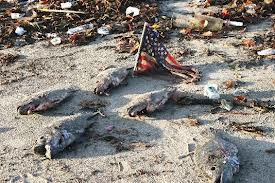
Not that there’s anything wrong with them, but human beings have caused a lot of trouble for life in the world’s oceans. The process in which the destruction of sea life occurs is largely two-fold. Large-scale destructive events like oil spills (Deepwater Horizon) and nuclear power plant disasters (Fukushima) can cause serious damage to the affected aquatic areas. Damage from such disasters is often immediately evident, such as the deformed and eyeless fish and shrimp that appeared in the Gulf of Mexico after the Deepwater Horizon oil spill, or the dying sea lions pups and seals with bleeding lesions that have washed up on beaches in California and Alaska the wake of the Fukushima Daiichi Nuclear Power Plant meltdown. Yet as grave and harmful as they are, explosive, headline-making disasters are less deleterious to life in the seas than the cumulative, synergistic effects of routine human activities such as oceanic commerce, commercial fishing, and pollution. For example, a 2002 study by the National Academy of the Sciences found that the 85 percent of the 29 million gallons of marine oil pollution originating from North America derives from runoff from cars and oil-based machines and accessories (like lawnmowers and household robots) – and the sum of these tiny releases of oil, carried into the ocean by streams and storm drains, is equivalent to an Exxon Valdez oil spill every eight months. [As additional food for thought: there are apparently 90,000 cargo ships in the world. (Incidentally, there are also roughly 760 million vehicles and 30,000 commercial airplanes.) Many of these vessels run off of “bunker fuel,” a byproduct of the oil refining process. The burning of bunker fuels in cargo ships may be responsible for 3.5 – 4% of all carbon-dioxide emissions; and particulate pollution (such as sulphur-dioxide fumes) from cargo ships may contribute to as many as 60,000 human deaths a year. These chemical emission-related figures exclude the effects of pollution produced by navy vessels, cruise ships, and fishing fleets. Also, often overlooked are the human costs involved in the process of shipbreaking, where wretched working conditions plague extremely low-paid laborers, mainly on the Indian subcontinent. For a glimpse into their lives, check out the film Ironeaters.]

Daily activities which contribute to ocean pollution and the depletion of fish stocks are decimating underwater habitats, driving down biodiversity, and have the potential to reduce the populations of certain marine species to irrecoverable extents or down to zero. The elimination of any species from an ecological network could have devastating and unforeseen impacts on the rest of the planet. According to the Monterey Bay Aquarium, “Overfishing may be the single biggest threat to ocean ecosystems. Today, 85 percent of the world’s fisheries are either fully exploited, overexploited or have collapsed. The global fishing fleet is operating at 2.5 times the sustainable level – there are simply too many boats chasing a dwindling number of fish.” Commercial, illegal, and game fishing operations are wiping-out the populations of major fish species, such as bluefin tuna and blue and white marlin; both of which species are likely to be overfished to extinction within the century. Dolphins and small whales are facing extinction off the coast of Japan, where over a million such creatures have been hunted and killed over the past seventy years. 100 million sharks are estimated to be killed by humans every year. (Click here to view a picture that was taken earlier this year and shows thousands of shark fins drying on a rooftop in Hong Kong.) It is unlikely that the current rate of exploitation and depletion can be sufficiently curbed in order to allow time for the dwindling populations of many fish species to recover. For those more interested in the subject of overfishing, I highly recommend watching the film End of the Line.

Pollution is another major force contributing to the demise of life in the oceans. Over the last century immense volumes of trash and industrial chemicals have contaminated whole cross-sections of the oceans. Toxins that enter the oceans are spread throughout food chains, and varying degrees of visible and microscopic waste accumulate in the water and on shores. One diabolical clusterfuck that highlights the deleterious effects of pollution on the marine environment is the Great Pacific Garbage Patch. Like other ocean regions, the North Pacific Ocean has immense gyre-like convergence zones which are formed by wind and rotating currents. The Pacific convergence zones currently contain astronomical quantities of accumulated rubbish, much of which has been or is being broken down into tiny particles of microplastic. Subsisting in the gyres and consuming the plastic are around 260 species of fish, sea turtles, birds, and other sea creatures. These animals often die from the consumption of plastic, which may also end-up in the bodies of the predators that feed off them, or, as in the case of the Laysan albatross, in their young. On the Midway Atoll, where twenty tons of plastic wash up every year, as many as one-third of all albatross chicks die due to eating plastic inadvertently fed to them by their parents.

In addition to plastic, a broad range of manufactured organic and toxic chemicals have made their way into the oceans. Many of these contaminants lodge themselves in the tissues of fish and bioaccumulate as the fish are ingested up the food chain. Studies have found high levels of mercury and industrial chemicals like polychlorinated biphenyls (PCBs) in dolphin and whale meat. What the hell are PCBs? Allow Cathy Britt to explain:

PCBs are manufactured organic chemicals that were primarily used as insulating liquids, such as coolants and lubricants in electrical equipment, but were also used in other common materials such as paints, cement, adhesives, and even the flame retardants used in some children’s clothing…Though production of PCBs was banned in the 1970s because of its harmful effects to the environment, the chemical still presents a significant environmental threat today.

Orcas have accumulated such high concentrations of PCBs that when female orcas breast feed their young, the firstborn calf usually dies as a result of receiving a toxic overdose of PCBs contained in its mother’s fatty-rich breast milk. PCBs and other toxins are also known to cause health problems in other large Artic animals, like polar bears and seals. Although PCBs, some pesticides, and other persistent organic pollutants have been phased out and banned, many industrial chemicals (such as brominated flame-retardants) are still widely used and find their way into the oceans. Humans are not immune to this process of bioaccumulation, and toxins are accruing in the bodies of people as a result of eating fish. But perhaps the real blow will come later, when there are no more fish to eat.

Human beings are carrying out a slow kill of the world’s seas, as well as on much of the planet’s other ecosystems. Modern man finds himself in living in a paradox where he knows more than ever about how the natural world functions, and nevertheless the natural world is in its worst shape yet due to how modern man mistreats it. How is that we can care so much about ourselves and our friends and family, but so little about others and the natural systems that we depend on to survive? The Earth revolves through day and night, and it seems that billions of people are clocking-in and out of shifts to partake in the wholesale destruction of the world on their side of the planet. If the day arrives when the seas have become polluted dead zones void of great shoals of fish – assuming there will be humans to witness it, they’ll look out across the grey and desolate tides toward the bleak horizon and ask, “How did we let this happen?” And this is the answer: We let it happen through stupidity, laziness, arrogance, apathy, and greed. We couldn’t stop gorging ourselves, we couldn’t control our insatiable appetite, and we didn’t think to heed the warnings we were given (though we saw them); we didn’t think to step back, to slow down, and to stop ourselves and each other. It was a free for all, and we didn’t care enough about our world and Mother Nature to make a difference and to save her oceans from death. We are like addicts, and we only take; we always take, and we never give back. And in her darkest hour, when nature desperately needed a hand – when her battered reefs became bleached and white like bones, when her bays became choked with smog and clogged with oil, when the whales and dolphins were beaching themselves in mass die-offs along the shores, when the nets that we cast came back with less and less until there was nothing – when she needed us most, we refused to reach out and instead we looked the other way in betrayal. But it doesn’t have to be that way. You can leave this planet in better shape than you found it. You can try to make a difference and stand up for those creatures on this planet that can’t stand up for themselves; even if it doesn’t work, they’ll appreciate that you tried. And you’ll also feel a lot better about yourself that you did.

Podcast Roundup: Halloween Edition

Photo: The Onion

Photo: The Onion

Though I don’t regularly feature podcasts delving into horror/sci-fi aspects of pop culture or the world of metaphysics and the paranormal, today seems an appropriate time to share a few in observance of Halloween, All Hallow’s Eve, Samhain, Day of the Dead, etc.

10/27 Maja D’Aoust and Erik Davis discuss magical and synchronistic aspects of politics and modern culture at Expanding Mind: Show link: http://prn.fm/category/archives/expanding-mind/

10/28 A great discussion on John Carpenter’s 1982 remake of “The Thing” and what makes it a classic horror film at the Debatable Podcast: Show link: http://debatablepodcast.tumblr.com/post/65307821240/episode-56-the-thing-with-sip-eric-sipple-joins

10/29 Guillermo Jimenez and Dr. Paul Cantor have a conversation about the political meaning of apocalyptic “end of the world” narratives in shows like The Walking Dead, X- Files, Fringe, and Falling Skies from a libertarian perspective: Show Link: http://tracesofreality.com/2013/10/29/tor-radio-the-truth-behind-the-walking-dead-liberty-vs-authority-in-pop-culture-with-dr-paul-cantor/

10/30 Tim Binnall and David Acord commemorate the 75th anniversary of Orson Welles’ infamous “War of the Worlds” radio broadcast with an analysis of the program, how it came to be, its importance in the context of emerging technology and the field of media literacy, and how it’s connected to conspiracy and UFOlogy: Show link: http://www.binnallofamerica.com/boaa103013.html

Judging from the last few minutes of this trailer for his film “F For Fake”, Welles himself was involved in perpetuating the mystery and speculation surrounding his War of the Worlds broadcast:

10/30 The always educational “Stuff They Don’t Want You to Know” video podcast covers the origins of Halloween traditions:

Show link: http://www.howstuffworks.com/podcasts/stuff-they-dont-want-you-to-know.rss

Out of the Wild

london20after20people-jj-001

At Orion Magazine, authors William Cronon and Michael Pollan share a stimulating conversation about how language shapes our world. They cover questions such as “what is wild?”, “what is cultivated?”, and “what can these ideas teach us about our relationship to landscape?”. What I found most compelling was the last part of the conversation where they talk about the power and importance of storytelling:

Bill:  Right. Ecology, storytelling, history—they all render connections visible. We make that which is invisible visible through story, and thereby reveal people’s relationships to other living things.

Michael:  Stories establish canons of beauty, too. There is a role for art in changing cultural norms about what’s worth valuing. One hundred fifty years ago, certain people looked at a farm and saw what you might see if you look today at a nuclear power plant or some other degraded landscape. Part of the reason we tell stories is to create fresh value for certain landscapes, certain relationships.

Bill:  And stories make possible acts of moral recognition that we might not otherwise experience. They help us see our own complicity in things we don’t ordinarily see as connected to ourselves.

Michael:  Yes, exactly. That recognition can help remove the condescension in so much environmental writing by showing us that, look, these things we abhor are done in our name, and we are complicit in them, and we need to take account of them. It was Wendell Berry’s idea that the environmental crisis is a crisis of character. The big problem is the result of all the little problems in our everyday lives. That can be a guilt trip, but it doesn’t have to be. You can tell that story in ways that empower people.

Storytelling can also help us find hopeful solutions. For example, when I was writing Omnivore’s Dilemma and I went to Joel Salatin’s farm in Virginia, I learned how his grazing worked—intensive rotational grazing—and he explained to me what happens under the surface, how every time the ruminants come through and shear that pasture and reduce that leaf mass, a roughly equivalent amount of root mass is broken down and turned into soil. I learned that he takes vast amounts of food off this pastureland, without subtracting anything. To the contrary, the sun is feeding the grass, and the grass is feeding the ruminants; the ruminants are feeding us, and they’re also feeding the soil.

I suddenly saw a whole other way of conceiving our relationship to nature, that there are systems that exist, and could exist, that are non zero sum. There is a free lunch in nature: it’s solar energy, which means it isn’t necessarily true that for us to feed ourselves we have to diminish the world.

When you tell an audience that story, it fills them with hope and a sense of possibility, and that’s a function of storytelling. But, of course, it isn’t always so neat. There are questions of scale, and if you eat meat, there are problems with cattle. But I’m always looking for stories that refresh this narrative about nature that we’re so stuck in.

Bill:  Messy stories invite us into politics. They also invite us to laugh at ourselves. And those things together—the ability to laugh, to experience hope, to be inspired toward action at the personal and political levels—these strike me as the work of engaged storytelling in a world we’re trying to change for the better.

Michael:  I do have a lot of faith in the power of stories to do things. My greatest thrill as a writer is when I see people changed by the work, when people tell me that they’ve changed their behavior in some way because of something they’ve read.

One of the things I’ve fought very hard to do with my editors is to talk about alternatives when I talk about problems. For example, if I’m writing an incredibly dark story about industrial meat production and following a cow through the feedlot and slaughterhouse, I really want three paragraphs on the alternative to this system, which is to say, grass-finished beef. Those three paragraphs have more impact than anything else in the piece. And I still hear from ranchers that it was on the day that an article on that topic came out that we began to see the stirrings of a new market for grass-finished beef. “We no longer send them to the auction barn right away,” they tell me. “We’re finishing on grass now.”

Bill:  That’s a good story about storytelling.

Michael:  You have to pass through the dark wilderness of the feedlot before you can get there, but I think that there’s an appetite for hope that journalists don’t often satisfy.

I’ve met people, in their twenties especially, who really hate the model of the investigative article that tells them how messed up things are and doesn’t point to some alternative. True, the alternative you’re proposing can seem tacked on, and it can be incommensurate with the scale of the evils—but I think people want hope, a course of action they can take. This is something many journalists are missing right now. I think if our writing doesn’t include that dimension in some way, we lose people.

Bill:  It strikes me that you’re pointing to a great tradition in the environmental movement, which is the power of good storytelling, going back to Rachel Carson.

Michael:  She was incredibly effective rhetorically. Silent Spring is a very sophisticated piece of work.

Bill:  It’s stunningly done.

Michael:  It’s stunningly done. And it speaks to the power of fictional ideas like wilderness. Carson understood that, even if you’re writing about science, narrative is important. The trick I learned from her is never to talk about “neurotoxins”; instead, you tell the story of the molecule in the cell. Because there’s a narrative everywhere, even at the level of molecules.

Bill:  Maybe that’s a good note for us to end on, don’t you think? The poet Muriel Rukeyser once said that “the world is made of stories, not of atoms.” When we lose track of the narratives that human beings need to suffuse their lives and the world with meaning, we forget what makes the world worth saving. Telling stories is how we remember.

Read the complete transcript here: http://www.orionmagazine.org/index.php/articles/article/7811

NSA Under Fire

(PHOTO by Nemo, 21WIRE/GMN)

(PHOTO by Nemo, 21WIRE/GMN)

The past few days have been especially turbulent ones for the NSA and its Director Keith Alexander. On Friday afternoon the NSA website experienced a shutdown which was widely reported as a denial of service attack, possibly involving members of hacker collective Anonymous. The NSA later claimed the problem was due to an “internal error” during a scheduled update. It goes without saying that we should take what the NSA says with an industrial-sized carton of salt.

On Friday night Foreign Policy magazine reported a multinational coalition has formed in the U.N. to draft a General Resolution to curb the power of the NSA’s surveillance network. The delegations involved include Brazil, Germany, France, Mexico, Cuba, Venezuela, Argentina, Austria, Bolivia, Ecuador, Guyana, Hungary,
India, Indonesia, Liechtenstein, Norway, Paraguay, South Africa,
Sweden, Switzerland, and Uruguay. This action follows the political upheaval caused by Thursday’s release of Snowden documents which revealed at least 35 world leaders were spied on by the NSA. Since it’s doubtful they were under suspicion of terrorism, what’s a more likely explanation for the spying? Blackmail.

Just yesterday a massive “Stop Watching Us” rally demonstrated near the White House demanding an investigation, regulatory reform and accountability for those found to be responsible for unconstitutional surveillance. Twelve large boxes of 575,000 petition signatures were shown to the crowd at the foot of the US Capitol. According to a Reuters report:

The march attracted protesters from both ends of the political spectrum as liberal privacy advocates walked alongside members of the conservative Tea Party movement in opposition to what they say is unlawful government spying on Americans.

…The event was organized by a coalition known as “Stop Watching Us” that consists of some 100 public advocacy groups and companies, including the American Civil Liberties Union, privacy group Electronic Frontier Foundation, Occupy Wall Street NYC and the Libertarian Party.

As damaging as the NSA has been to our privacy, they may prove to be more damaging to the government itself. The first steps towards ending an abusive relationship are to snap out of denial, seek support, and address the underlying root of the problem. A positive aspect of the NSA spying scandal is that it’s helping the world wake up to the previously hidden (to many) evil behind the friendly facade. It’s truly a hopeful development to see countries around the world and groups of different political stripes in solidarity organizing around the issue of NSA criminality. We need more of this type of focus and cooperation if we are to confront the sources of our biggest problems and make positive changes in this arena and others.

Russell Brand on Voting and Revolution

Though I’m not familiar with Russell Brand’s work as an actor, judging from interview clips he’s a pretty good comedian and social critic in the tradition of Bill Hicks. In this excerpt from the BBC program Newsnight he defends his choice not to vote and voices concern for a number of topics not usually discussed on television.

While I understand the position of not voting, I believe in the U.S. there’s still good reason to vote at least for local elections, initiatives or referendums. Voting may be a form of coersion but in some cases it can block the enaction of policies leading to greater coersion. If one uses absentee ballots voting doesn’t take much time and effort and though vote rigging is a problem, not all elections are rigged and voting can in some cases make it more difficult to do. For now in this country, with education and organization, voting can still lead to positive change or prevent things from getting worse, and of course one’s political activity shouldn’t be limited to voting. However, when it comes to presidential elections, low turnouts are one way to send a message of illegitimacy and disgust. Despite political disagreements I’m glad public figures such as Brand use their fame as a platform for thoughtful and substantive ideas not usually found in the world of corporate media. It seems he’s been on a roll lately because just last month he was banned from the GQ Awards for this speech:

And earlier this year he made a mockery of MSNBC’s “Morning Joe” program:

While Brand may have good reason to be annoyed with the hosts, it’s unfortunate that he resorted to lewd jokes near the end. Stooping to their level undermines the effectiveness of his critique, in my opinion.

Are We Living In a Police State?

police-share-1

Based on the criteria listed by Sibel Edmonds here, we definitely are. Even folks at the “Top Criminal Justice Degrees” website (Your Online Guide to the Best Criminal Justice Degrees) seem to think so.

The Militarization of the Police
Image source: www.topcriminaljusticedegrees.org

The Militarization of the Police

Are we living in a police state?

– There has been a 4000% increase in “no knock,” militarily-armed swat team raids over the past thirty years.
– Mid 80’s: 2,000-3,000 raids per year[1]
– Present day: 80,000 raid estimate[1]
– ——————
– Pros:
– –Element of Surprise
– –Suspect can’t destroy evidence
– Cons:
– –Invasion of privacy
– –Seconds for suspect to decide if these or cops or break in.
– –Faulty intelligence

– ————
Case Study

– Basics:[4]
– Ogden, Utah. 1/4/12 8:40 pm.
– Local swat team battered down Matthew David Stewart’s door with no warning. Thinking his home was being invaded, Stewart readied his pistol.
– Stewart: 31 rounds fired
– Swat: 250 rounds fired
– Tip: Stewart’s girlfriend saying he might be growing weed.
– Previous record: Clean, veteran.
– Result: 6 wounded swat. 1 killed. Stewart shot twice.
– Findings: 16 small pot plants. No intent to sell.
– Outcome: Upon losing hearing about search warrent legality. Stewart hangs himself in jail cell.

– ————-

And that’s just one of potentially hundreds of similar tragedies.

– Spotlight: NY
– 1994: 1,447 swat style drug raids
– 2002: 5,117
– “I have my own army in the NYPD–the seventh largest army in the world.” Michael Bloomberg

– ————
– Swat Armament:[3]
– Submachine Guns
– Automatic Weapons
– Breaching Shotguns
– Sniper Rifles
– Stun Grenades
– Heavy Body Armor
– Motion Detectors
– Advanced Night Vision Wear
– Armored Personal Carriers
– “From the Gulf war to the drug war–Battle proven” Heckler and Koch’s slogan for the M5[6]

– ————-

These “criminals” are heavily armed too, right?

– WRONG:
– [Weapon used in violent crime: %]
– Gun: 12.7%
– Knife: 10.1%
– Other: 12.1%
– Unknown weapon: 1.8%
– None: 55.8%
– Don’t Know: 5.8%

– —-
– So how can we allow this? The fact is, we don’t.
– 1970: The “no-knock” law is passed with the beginning of the war on drugs.
– 1974: The law was repealed.
– Today: “No knock” happens ALL THE TIME.
– ——
– Leading to more and more unecessary, intrusive, illegal, and deadly SWAT raids.
– Raids leading to civilian injuries, death, or intrusion of the privacy of innocents.
– While injuries from “no knock” raids have been around since the inception of the swat team. Paramilitary like brutality has become a feature of the increasing armed SWAT of the last 10 years.

– Using the military in civic life is like using a hammer when you need a butter knife. There’s bound to be collateral damage. It could happen to you, your neighbors, your friends, or your family. Speak out against the militarization of the police.
Citations- http://usatoday30.usatoday.com/news/nation/2011-02-14-noknock14_ST_N.htm
– https://www.aclu.org/blog/criminal-law-reform-free-speech-technology-and-liberty/too-many-cops-are-told-theyre-soldiers
– http://en.wikipedia.org/wiki/SWAT
– http://online.wsj.com/article/SB10001424127887323848804578608040780519904.html?mod=WSJ_hpp_LEFTTopStories
– http://www.cato.org/raidmap


Update 10/25:

Lee Camp recently posted his thoughts on the topic of police militarization: