8 Simple Steps to Forgive Even the Unforgivable


Cats And Dogs Hugging

By Christina Sarich

Source: Yoga for the New World

Are you feeling resentment? Pain? Anguish? Perhaps even fury? It doesn’t matter if your emotions are directed at the general idiocy of a government that seems bought-out by an elitist class, or a close friend or family member. It doesn’t matter if you are raging at a complete stranger on the road, in a moment that dissipates fairly quickly, or if you are dealing with years of abuse or emotional torment. Forgiveness is a spiritual act that requires us to see things differently than we do now.

It doesn’t seem to be so when we are thinking of the wrong another has done to us, or the hurt they’ve so carelessly lavished, but forgiveness can free us from even the most unforgivable acts. Many of us hold onto our anger in hopes that this emotion will somehow anchor in some Universal Justice – as if our teeth gritting, and brow furrowing can somehow balance the teetering scales of righteousness in the world.

Sadly, the act or words of another that we keep running in our minds is like emotional cement, keeping us stuck and unable to move into peace. Our unforgiveness often doesn’t even affect the ‘other’ as much as it does us. There is a Tibetan Buddhist story about two monks who encounter each other many years after being released from prison where they had been horribly tortured by their captors. “Have you forgiven them?” asks the first. “I will never forgive them! Never!” replies the second. “Well, I guess they still have you in prison, don’t they?” the first says.

Many mistakenly believe that forgiveness somehow absolves another from their wrong-doing. That in forgiving, we helplessly accept, give up, surrender to defeat – that we are helpless. The exact opposite is true. When we face a terrible wrong, and look within to see how we can prevent the same incident from happening again, then we are truly on the correct spiritual path.

Dr. Fred Luskin is the Director of the Stanford University Forgiveness Projects. He has led the largest research project to date to study the effects of forgiveness on hurt individuals. He has dealt with people suffering from a huge range of things needing to be forgiven – from a romantic break up to the murder of a child. He believes that there are specific steps one can take to reduce the stress that comes with holding onto hurt, and make the progress of forgiveness as easy as possible. I tend to agree. Forgiveness usually takes a little time, but it needn’t consume your life for years. You can start with these eight steps to move your heart into the right place, and begin to forgive:

  1. We are often afraid to truly articulate just how much we have been wronged, but we must. In cases that are more obvious – such as losing a family member in a war-torn country to the hands of an unfeeling mercenary – it is easier to explain how angry and sad we are, but in other cases, such as with long-term familial abuse, we may have even come to think the behaviors we were subjected to were ‘normal,’ and only later do we realize how much pain and hurt we stuffed down over the years in order to function within our family unit. When that pain is realized, it is helpful to articulate it to a counselor or a few close friends. Keeping those emotions locked inside does not permit the process of forgiveness to begin.
  1. Forgiveness is a personal journey. You do it for yourself, not for the person you think needs to be forgiven, or anyone else. Once you make a commitment to do whatever it takes to let go of the pain and feel better – and do it for you, then forgiveness starts to become an easier endeavor. When you feel better about yourself, after all, you will find it more difficult to hold grudges against others. When needed practice self-care and self-love. If you are still involved with the person or people who you are trying to forgive, you can simply explain to them that you need time to care for yourself. If this is not appropriate due to the ongoing behavior of another, then simply practice uncompromising self-love and distance yourself from the other person until your feelings of anger and hatred dissipate. Reconciliation may be possible in the future.
  1. While reconciliation is at times possible, sometimes it just isn’t. If someone is emotionally unstable, and will likely continue to act in hurtful or harmful ways, we don’t need to be physically or emotionally near them to forgive them. What you’re after is internal peace. Forgiveness can be defined as the peace and understanding that comes from dropping the blame for whoever has hurt you – changing your never-ending story of grievance, and realizing that they were possibly playing a role in the grand play of life – called maya – to help you learn more about yourself. It doesn’t mean that murdering your child is right, or that stealing, cheating, emotional abuse, or other ‘wrongs’ are ‘right.’ It simply means that you choose to see that person’s pain as the impetus for their own actions, and not as a personal affront to you. Maya Angelou once said, “You can’t forgive without loving. And I don’t mean sentimentality. I don’t mean mush. I mean having enough courage to stand up and say, ‘I forgive, I’m done with it.’” If someone has been narcissistic, selfish, hateful, or jealous, you can forgive them for your own peace of mind, and allow them to learn from the Universal lessons, which are surely coming their way, to help them forgive those who hurt them also. While you don’t have to reconcile with others who are not ready to do this spiritual work for themselves, you do have to reconcile your own emotions.
  1. Believe it or not your hurt is coming from what you feel now, not what happened ten minutes ago, an hour ago, days ago, or even ten years ago. That old adage about time healing all wounds is true, but this is because we tend to get caught in karmic cycles that cause us to mentally recycle pain instead of letting it go. In the book Karma and Reincarnation Transcending Your Past, Transforming Your Future, Elizabeth Clare Prophet and Patricia R. Spadaro explain that while “karma means accountability and payback, reincarnation is simply another word for opportunity.” Karmic retribution is not punishment, but the benevolent Universe’s way of allowing us free will. It does mean, however, that what we do unto others, will be done unto us, somehow, at some time, in some way. The Sioux holy man, Black Elk, has explained that even nature comes full circle, and Voltaire espoused the fact that “it is not more surprising to be born twice, than once; everything in nature is resurrection. The cycles of karma and reincarnation can help us to understand family patterns, community patterns, and even wider societal patterns that need undoing. When we stay stuck in thoughts of the pain another has caused us, we miss the opportunity of this incarnation. After talking about a hurt with another person, and expressing it fully, it is time to start letting it go, and looking at the patterns which we created it. This is the true gift of being ‘hurt’ be another – it is really a chance to see how we have hurt ourselves.

I had the feeling that I was a historical fragment, an excerpt for which the preceding and succeeding text was missing . . . I could well imagine that I might have lived in former centuries and there encountered questions I was not yet able to answer; that I had to be born again because I had not fulfilled the task that was given to me. ~ Carl Jung

  1. Stop your fight or flight response. When we start to ruminate about what another has done to us, our hypothalamus gets in gear, engaging both the sympathetic nervous system and the adrenal-cortical system. When the effect of these two systems goes ‘online’ the fight or flight response begins – this means we are in moderate to full-blown fear mode. We are afraid this will happen to us again. We are feeling the incident as if it were happening right now, no matter now long ago it occurred. Our heart rates and blood pressure rise. We might even sweat a little. Our bodies are flooded with 30 different stress hormones and it can make ‘forgiving’ very difficult. By instead practicing a simple, calming mantra meditation, a few yoga asanas, yoga nidra, nadi shodhana, or going for a short walk outdoors, we can reverse this fight-or-flight response, and deal with the fear behind our pain from a more level emotional state.
  1. Give up your expectations of others – Dr. Luskin calls this ‘recognizing the unenforceable rules.’ In other words, you can’t expect to get from others, what they have no ability or desire to give you. While we can practice love without expectation, we also should be aware that others aren’t always capable of loving back. If your inner child is still bemoaning the inability of an emotionally shutdown father to be affectionate and caring, or you expect a selfish boss to behave differently, then you are setting yourself up for more pain, and often. Realize that what you seek from others – kindness, love, affection, support – will come from those willing and able to give it, and the more you offer it to yourself, the more likely these individuals will come into your orbit. Just let the others, who are not ready to act as evolved, be. No resentment – that’s just where they are at in their cycle or karma and reincarnation.
  1. Know that a life well lived is your best revenge – as long as you stay hurt and angry, you are feeding the ego of the person who felt the need to hurt you. You give that person power over you – you are still in ‘prison’ like the two monks said. Find personal power in the good things in your life. Robert Emmons and Michael McCullough are two of the leading American investigators of gratitude. They describe gratitude as personality strength—the ability to be keenly aware of the good things that happen to you and never take them for granted. Grateful individuals express their thanks and appreciation to others in a heartfelt way, not just to be polite. If you possess a high level of gratitude, you often feel an emotional sense of wonder, thankfulness and appreciation for life itself. Start a gratitude journal, or simply practice a few moments of quiet contemplation realizing all you do have now, instead of getting stuck on your hurt feelings. Counting your blessings is not only good for your health, but it helps to dissipate sadness, anger, and frustration.
  1. Change your ‘story’ – Instead of telling a story to yourself and others about how you were done wrong, decide to rewrite the script. You can, instead of being a victim, decide to use the experience as a way to heal others, and practice one of the most profound spiritual practices ever taught. Imagine the ripples that the pebbles of forgiveness could send out into the world. I give the example of a man named Robert Rule to explain exactly how profound changing your story can be:

“Gary Leon Ridgway is better known as the infamous Green River Killer. In 2003, he confessed to the murders of 48 women. In 2011, Ridgway was convicted of the murder of Rebecca Marrero, bringing the victim count up to 49. By his own confession, he may have murdered as many as 60 women. Ridgway especially despised prostitutes and targeted them for his killings. At Ridgway’s 2003 sentencing, the families of the victims had the opportunity to speak out and address Ridgway directly. Understandably, many were angry and lashed out at Ridgway for the unimaginable grief he had put them through. As Ridgway stonily listened to the family members express their grief and anger, one person came up and said something unexpected. When the time came for Robert Rule, the father of teenage victim Linda Jane Rule, to speak, Ridgway finally showed a glimpse of remorse. Rule’s words to Ridgway were: “Mr. Ridgway . . . there are people here that hate you. I’m not one of them. You’ve made it difficult to live up to what I believe, and that is what God says to do, and that’s to forgive. You are forgiven, sir.” These words brought Ridgway to tears.”

About the Author

Christina Sarich is a musician, yogi, humanitarian and freelance writer who channels many hours of studying Lao Tzu, Paramahansa Yogananda, Rob Brezny, Miles Davis, and Tom Robbins into interesting tidbits to help you Wake up Your Sleepy Little Head, and *See the Big Picture*. Her blog is Yoga for the New World . Her latest book is Pharma Sutra: Healing The Body And Mind Through The Art Of Yoga. Please reprint this article with attribution bio and all links in tact.

Ice Buckets: NOT the Cure for ALS

ice-bucket-challenge-4917fd4aed73bb35

By Sayer Ji

Source: GreenMedInfo.com

Let’s stop pretending like pouring ice on ourselves means anything until we can acknowledge the research that some of the causes and cures for ALS already exist — none of them involving pharmaceutical intervention.

The ALS Association’s ‘Ice Bucket Challenge,’ as of the writing of this article, has grossed over 41 million dollars in donations, which “has driven hundreds of thousands to join the fight against ALS,” according to a recent Huffington Post blog written by Jose Costa.

The perpetual meme of ‘fighting’ idiopathic diseases — meaning, diseases ‘with no known cause’ — has become the most successful cause-marketing strategy of our time, with billions of dollars raised without appreciable yield for the ultimate outcome: saving lives.  Just look at Susan G. Komen, which raises billions for races and research into pharmaceutical and/or radiation-based treatments, but has yet to do anything to stem the overdiagnosis and overtreatment of healthy women (1.3 million women falsely diagnosed of breast cancer in the past 30 years), much less improve the survival times of those who actually do have a life threatening form of breast cancer.

For organizations that explicitly confess their ignorance about causes or cures of diseases they presumably intend to overcome, co-opting the good intentions of the mainstream with viral social media campaigns has become the flavor of the day.

In these monthly ‘Wars’ against disease, neither the combatants or victims stand to make much ground because no one is looking at root causes, the essential precondition to removing them and finding a real cure.

At Greenmedinfo.com we have spent years finding studies on about 3,000 ailments — obtained through the government’s own biomedical research database MEDLINE — that can clearly be identified to have unnatural/manmade causes and natural solutions.

Take a look at our ALS page now, and you will a wide range of published and peer-reviewed studies indicating that we shouldn’t be spending so much time raising capital, but rather awareness as to the already obvious ways we could reduce the morbidity and mortality associated with the disease. Some highlights include:

Some of the Actual ALS CAUSES:

These are a sampling of some of the full vetted, biomedically-confirmed contributing causes, but thankfully, the ‘curative’ natural agents are far more numerous. Of the 39 substances found to have potential therapeutic value in ALS — none of which Big Pharma, or their cause-marketing collaborators, acknowledge – these are the most compelling we have found:

ALS Solutions:


Don’t forget the basics: something as simple as moving the body — exercise — has been found in at least 3 studies to improve ALS.

Keep in mind, these are only the studies we have indexed, with limited resources and time. Go to the National Library of Medicine’s bibliographic citation database and search yourself. You will have 23 million abstracts under your fingertips. Search for “ALS” and you will find over 13,000 published studies on the topic. Many of these studies concern the issues we discuss here: unnatural/man made causes and natural solutions. If you find anything we don’t already have on our database please send it to info@greenmedinfo.com and improve the free resource we have created.

Let’s hope the ALS Association puts their newly contributed money where their mouth is, and dedicate it to finding solutions that relieve the suffering of those with the condition. Those who donate money, show that they care enough to give up a fragment of their financial freedom to help others. But if the causes are at least partially known (including pharmaceuticals that do more harm than good) — chemicals that damage the brain — and the solutions are as well — addressing nutritional deficiencies and chemical/toxicant exposures and correcting them — let’s at least stop pretending raising more money, or making a game of pouring ice on oneself is anything but a charade to distract from the real solution.

Let’s stop pretending like pouring ice on ourselves means anything until we can acknowledge the research that some of the causes and cures for ALS already exist — none of them involving pharmaceutical intervention.

Don’t forget the basics: something as simple as moving the body — exercise — has been found in at least 3 studies to improve ALS.

Keep in mind, these are only the studies we have indexed, with limited resources and time.  Go to the National Library of Medicine’s bibliographic citation database and search yourself. You will have 23 million abstracts under your fingertips. Search for “ALS” and you will find over 13,000 published studies on the topic. Many of these studies concern the issues we discuss here: unnatural/man made causes and natural solutions. If you find anything we don’t already have on our database please send it to info@greenmedinfo.com and improve the free resource we have created.

Let’s hope the ALS Association puts their newly contributed money where their mouth is, and dedicate it to finding solutions that relieve the suffering of those with the condition. Those who donate money, show that they care enough to give up a fragment of their financial freedom to help others.  But if the causes are at least partially known (including pharmaceuticals that do more harm than good) — chemicals that damage the brain — and the solutions are as well — addressing nutritional deficiencies and chemical/toxicant exposures and correcting them — let’s at least stop pretending raising more money, or making a game of pouring ice on oneself is anything but a charade to distract from the real solution.

Let’s stop pretending like pouring ice on ourselves means anything until we can acknowledge the research that some of the causes and cures for ALS already exist — none of them involving pharmaceutical intervention.

WikiLeaks Cables Reveal U.S. Gov’t Planned To “Retaliate and Cause Pain” On Countries Refusing GMOs

monsanto

By Arjun Walia

Source: Collective Evolution

Studies that link Genetically Modified (GM) food to multiple human health ailments are not the only thing that has millions of people questioning the production of GM food. The fact that previously classified secret government documents show how the Bush administration developed ways to retaliate against countries that were refusing to use GM seeds is another. If documents regarding our food are required to be concealed from the public domain, something is not right, and it’s great to have an organization like WikiLeaks shed some light into the world that’s been hidden from us for so many years.

Targeting Certain Countries

The cables reveal that the State Department was lobbying all over the world for Monsanto, and other major biotech corporations. They reveal that American diplomats requested funding to send lobbyists for the biotech industry to meet with politicians and agricultural officials in “target countries.” These included countries in Africa, Latin America and some European countries.

A non-profit consumer protection group called Food & Water Watch published a report showing the details of the partnership between the federal government and a number of biotech companies who have pushed their GMO products on multiple countries for a number of years.

“The United States has aggressively pursued foreign policies in food and agriculture that benefit the largest seed companies. The U.S. State department has launched a concerted strategy to promote agricultural biotechnology, often over the opposition of the public and government, to the near exclusion of other more sustainable, more appropriate agricultural policy alternatives. The U.S. State department has also lobbied foreign governments to adopt pro-agricultural biotechnology politics and laws, operated a rigorous public relations campaign to improve the image of biotechnology and challenged common sense biotechnology safeguards and rules – even including opposing laws requiring the labeling of genetically engineered (GE) foods.” (source) 

HERE is one cable (out of many) from Morocco.

HERE Is a 2008 cable that summarizes a French documentary called “The World According to Monsanto which attacks the U.S. biotech industry and the fact that Monsanto and the U.S. Government constantly swap employees and positions, below is a excerpt from the cable:

Corporations Dictate Government Policy

“The film argues that Monsanto exerted undue influence on the USG. Former Secretary of Agriculture Dan Glickman is interviewed saying he had felt that he was under pressure and that more tests should have been conducted on biotech products before they were approved. Jeffrey Smith, Director, Institute for Responsible Technology, who is interviewed says that a number of Bush Administration officers were close to Monsanto, either having obtained campaign contributions from the company or having worked directly for it: John Ashcroft, Secretary of Justice, received contributions from Monsanto when he was re-elected, as did Tommy Thompson, Secretary of Health; Ann Veneman, Secretary of Agriculture, was director of Calgene which belonged to Monsanto; and Donald Rumsfeld, Secretary of Defense, was CEO of Searle, a Monsanto subsidiary; and Justice Clarence Thomas was a former lawyer for Monsanto.”

This is one example (out of many) that clearly show how giant corporations pretty much dictate government policy. When it comes to these food corporations, they are responsible for forcing independent agriculturists to go out of business, controlling the world’s seed supply and forcing farmers to become dependent on their seed. Monsanto and corporations like them have created this seed, and have prevented farmers from seed saving and sharing, which results in a dependence on Monsanto’s patented GMO seeds.

“The state department sent annual cables to ‘encourage the use of agricultural biotechnology,’ encouraging every diplomatic post worldwide to ‘pursue an active biotech agenda’ that promotes agricultural biotechnology, encourages the export of biotech crops and foods and advocated for pro-biotech policies and laws.” (source)

“The US Department of State is selling seeds instead of democracy. This report provides a chilling snapshot of how a handful of giant biotechnology companies are unduly influencing US foreign policy and undermining our diplomatic efforts to promote security, international development and transparency worldwide. This report is a call to action for Americans because public policy should not be for sale to the highest bidder.” – Wenonah Hauter, Food & Water Watch Executive (source)

One of the most revealing cables is from 2007, with regards to French efforts to ban a Monsanto GM corn variety. HERE is a cable that shows Craig Stapleton, former ambassador to France under the Bush administration, asking Washington to punish the EU countries that did not support the use of GM crops:

“Country team Paris recommends that we calibrate a target retaliation list that causes some pain across the EU since this is a collective responsibility, but that also focuses in part on the worst culprits. Moving to retaliation will make clear that the current path has real costs to EU interests and could help strengthen European pro-biotech voices.” (see source in above paragraph)

The U.S. government was not only working for the biotech industry, they were also threatening other governments who did not comply. Think about that for a moment. Over the years the United States government and Monsanto have collectively pushed their GMO agenda upon the rest of the world. Why? Do you really think it is to help feed the world? This could easily be done if we came together and pooled our resources. The entire planet could easily be fed organic food, and it could be done for free.

The World’s Resistance To GMOs

The past two years alone has seen millions of people from across the globe gather to show their opposition towards Monsanto and similar corporations. The “March Against Monsanto” is clear evidence of this. The people of the world are starting to see through the veil that’s been blinding the masses for years, and our food industry is one small, but large and important area where the veil is being lifted.

Activism and awareness has contributed to the banning of GMO products and the pesticides that go with them in multiple countries across the planet, it’s time for North America to follow suit.

Related CE articles:

New Study Links GMOs To Cancer, Liver/Kidney Damage & Severe Hormonal Disruption.

10 Scientific Studies Proving That GMOs Can Be Harmful To Human Health

For more CE articles on this subject please click HERE


Sources:

http://wikileaks.org/cable/2010/01/10RABAT14.html

http://www.cablegatesearch.net/cable.php?id=08PARIS614&q=monsanto

http://www.cablegatesearch.net/cable.php?id=07PARIS4723&q=france%20gm

http://rt.com/usa/wikileaks-monsanto-cables-report-273/

http://www.foodandwaterwatch.org/reports/biotech-ambassadors/


Five Questions We’re Asking About the Ebola Scare

Viral-Hemorrhagic-Fever-Erupts-in-Guinea-Caused-by-the-Ebola-Virus-650x433

By Aaron Dykes and Melissa Melton

Source: Truthstream Media

Now that the Ebola situation has hit the 24/7 mainstream media zoo, serious questions are being raised as to why now.

After all, people were dying of Ebola in the hundreds in West Africa before this week. Aid workers and doctors were getting infected before. These things are not new, but the sudden media focus raises lots of questions.

To start…

Why are they shipping Ebola-infected patients onto American soil for the first time?

As many have pointed out, this move seems particularly…ill-advised. The U.S. Centers for Disease Control and Prevention cautioned people not to fly to the affected areas, but our State Department is going to go out of its way to put together heavily publicized, special containment tents inside planes to fly two Americans here while the media in lockstep makes a huge play-by-play deal?

It isn’t exactly level 4 containment all the way, either, as Underground Medic‘s Lizzie Bennett pointed out yesterday: the one guy arrived at the hospital and just got out of the ambulance and walked on in.

Why is Obama amending executive orders about quarantining people infected with Ebola when he already had that power?

The president just amended a G.W. Bush-era executive order 13295 which allows “apprehension, detention, or conditional release of individuals to prevent the introduction, transmission, or spread of suspected communicable diseases.”

Section 1, subjection b has now been replaced with the following:

“(b)  Severe acute respiratory syndromes, which are diseases that are associated with fever and signs and symptoms of pneumonia or other respiratory illness, are capable of being transmitted from person to person, and that either are causing, or have the potential to cause, a pandemic, or, upon infection, are highly likely to cause mortality or serious morbidity if not properly controlled.  This subsection does not apply to influenza.”

Sure sounds like Ebola, doesn’t it?

But in reality, those quarantine powers were already in place. It even says so on this CDC map of U.S. quarantine stations fact sheet the agency released in August 2013.

cdcfactsheetquarantine

Ebola definitely counts under the category “viral hemorrhagic fevers”.

So why make a big deal amending an executive order when the power to detain people who have, or are suspected to have Ebola, already exists?

The CDC also just released a brand new, timely webpage “Infection Prevention and Control Recommendations for Hospitalized Patients with Known or Suspected Ebola Hemorrhagic Fever in U.S. Hospitals” as if it just completely slipped the agency’s mind to disseminate information to medical professionals on how to deal with Ebola before now. Come on. The page does, however, mention guidance for exposure to “contaminated air,” which is odd considering the CDC director has gone out of his way to say that there’s no way an Ebola outbreak could ever happen in the U.S. 

What exactly have Ft. Detrick biowarfare researchers been doing in the Ebola hot zone in West Africa all this time?

Independent investigative reporter Jon Rappaport asked this very same question the day before yesterday, but it seems like a good one. He had several other questions, and they are all good ones:

What exactly have they been doing?

Exactly what diagnostic tests have they been performing on citizens of Sierra Leone?

Why do we have reports that the government of Sierra Leone has recently told Tulane researchers to stop this testing?

Have Tulane researchers and their associates attempted any experimental treatments (e.g., injecting monoclonal antibodies) using citizens of the region? If so, what adverse events have occurred?

The research program, occurring in Sierra Leone, the Republic of Guinea, and Liberia—said to be the epicenter of the 2014 Ebola outbreak—has the announced purpose, among others, of detecting the future use of fever-viruses as bioweapons.

Is this purely defensive research? Or as we have seen in the past, is this research being covertly used to develop offensive bioweapons?

The same day, Navy Times published an article talking about how U.S. biowarfare scientists have been highly interested in Ebola since at least the late 1970s for engineering bioweapons: “mainly because Ebola and its fellow viruses have high mortality rates…and its stable nature in aerosol make it attractive as a potential biological weapon.”

But the article goes on to say that scientists from the U.S. Army Medical Research Institute of Infectious Diseases (USAMRIID) have been working on a vaccine since then, a purely defensive measure. Of course, they can’t come out and say they’re working on offensive weapons. The Biological Weapons Convention went into effect in 1975, supposedly putting an end to the government’s biological weapons program.

Why does the U.S. government own a patent on a novel strain of Ebola that those same Ft. Detrick researchers quietly admitted in a CDC journal article last month may actually be the cause of the current Sierra Leone outbreak, not Ebola Zaire as widely reported?

This one gets tricky.

There are five types of Ebola virus and the newest strain is named Bundibugyo, or Ebobun for short. The U.S. government actually holds a patent on this strain — US 20120251502 A1, for “Human Ebola Virus Species and Compositions and Methods Thereof” related to the Bundibugyo version of the virus.

Last month, the same Ft. Detrick researchers who have been over in the Ebola hot zone published an article in the CDC’s Emerging Infectious Diseases where they discuss the human testing that has been going on over there and down near the bottom of the article, they quietly admit, “Ebolavirus infections in Sierra Leone might be the result of Bundibugyo virus or an ebolavirus genetic variant and not EBOV.”

The kicker?

The Ebobun version of Ebola, which is apparently been found to be “genetically distinct,” as it differs by more than 30% at the genome level from all other known ebolavirus species, apparently has a much lower death rate than the Zaire version the media keeps talking about.

Not that Ebola in any form isn’t dangerous. It’s deadly, period. But Ebobun had a 36% mortality rate at the initial outbreak in 2007, versus 70-90% on average for Zaire.

Additionally, because it is much more unique, researchers have suggested that if a vaccine or treatment is created for Ebola and the Ebobun strain is not taken into account, the resulting treatment or vaccine obviously might not work on it.

Regardless, all the mainstream media seems interested in driving home on repeat these days is that this outbreak is the Zaire strain which has a 90% mortality rate and no cure. Well…even that isn’t entirely true…

A NOVA presentation from 1995 clearly shows survivors and discusses how a nurse named Nicole was given blood transfusions from an infected patient who survived, to build up antibodies. A review sums it up:

After one week, Nicole began to recover. Spurred by this result, the Zairian doctors transfused an additional eight patients. Seven of the eight patients survived, but the Western doctors remain unconvinced. Because the experiment was completely uncontrolled, they argue that we will never know that the transfusion saved the lives of those patients.

That was 20 years ago. Current news stories even discuss how the doctor who was flown here infected with Ebola was given a unit of blood from a 14-year-old who survived Ebola. The female patient flown in was also reportedly given an experimental serum no one seems to elaborate much on.

On top of that, articles from 2008 show a vaccine was highly effective in monkeys and even used experimentally in a human patient with success. Where did those vaccines go? Why aren’t they widely available six years later?

And finally, as with any crisis, who stands to gain from this, and what is it they are ultimately after?

Just asking.

One company Tekmira, who has been performing Phase I clinical trials for an Ebola drug it has been working on in otherwise healthy adult patients has seen its stock skyrocket over the last two weeks, even though its experiments in humans have now been halted due to safety concerns.

Tekmira apparently has a $140 million contract with none other than the USAMRIID to work on this drug, along with a multi-million contract with biotech giant Monsanto for the same technology. The drug was granted FDA fast track status back in March. As the company’s site says, however, the drug is apparently for the Zaire strain of the virus.

So has Tekmira taken the Ebobun strain into account?

In addition, now Reuters is reporting that Ebola vaccines have been fast tracked as well, with human experiments starting as early as next month. Wow, that was fast. Will those vaccines take Ebobun into account?

The last time a vaccine was fast tracked in such a manner, it was for the purposefully overblown swine flu “pandemic” — a created “campaign of panic” basically designed to sell vaccines and grant more emergency powers.

As Aaron Dykes reported in 2010:

Wolfgang Wodarg, head of health at the Council of Europe, claims that the threshold for alert was deliberately lowered at the WHO, allowing a “pandemic” to be declared despite the mildness of the ‘swine flu.’ That designation would force a demand for the vaccine, which was subsequently purchased by governments or health facilities and pushed on the public through a full-scale fear campaign in the media…

Wodarg is focusing on the motives for profit, as well as the ties between the World Health Organization (WHO), the pharmaceutical-industrial complex and research scientists, a nexus which Canada Free Press points out is eerily similar to the Climategate revelations that CRU research scientists fudged data to “hide the decline” in proxy temperatures in order to support global warming claims.

Wodarg made several disconcerting statements to the media, including:

“Never before the search for traces of a virus was carried out so broadly and intensively, besides, many cases of death that happen to coincide with seropositive H1N1 lab-findings were simply attributed to “swine-flu” and used to foster fear.”

“A group of people in the WHO is associated very closely with the pharmaceutical industry.”

“The great campaign of panic we have seen provided a golden opportunity for representatives from labs who knew they would hit the jackpot in the case of a pandemic being declared.”

In fact, that’s what CBS investigative reporter Sharyl Attkisson was set to expose, but her bosses refused to air her story. The mainstream media completely shut her down. Fear sells. The truth, by contrast, doesn’t.

“With the CDC keeping the true Swine Flu stats secret, it meant that many in the public took and gave their children an experimental vaccine that may not have been necessary,” Attkisson said. Read this piece on her 2009 interview with Jon Rappaport for more on how the CDC stopped counting cases of swine flu altogether and hyped the public into a panic that ultimately led to millions of people receiving potentially dangerous, fast-tracked vaccinations.

That’s right. Countries the world over reported many deaths and disabilities suffered in the wake of the fast-tracked H1N1 vaccine, a vaccine people scrambled to get after the hysteria over swine flu was over hyped everywhere, from government agencies to the mainstream media.

But hey, a lot of people in the military-medical-media industrial complex made a lot of money.

Much worse than mere greed, though, is the possibility of martial law and a forced mass vaccination scenario — a scenario where the military is “forced” to step in to contain “bio-threats” (regardless of whether or not those threats are real or made up). For more on that, see DARPA’s “Blue Angel” project.

Talking about something scary isn’t automatically scaremongering — but if the powers that shouldn’t be are scaremongering, we should talk about it.

(Meanwhile, headlines about ‘Ebola fear going viral’ are already screaming at people to be afraid…very very afraid.)


Big Corporations Have an Overwhelming Amount of Power Over Our Food Supply

By Michael Snyder

Source: The Economic Collapse

From our fields to our forks, huge corporations have an overwhelming amount of power over our food supply every step of the way.  Right now there are more than 313 million people living in the United States, and the job of feeding all of those people is almost entirely in the hands of just a few dozen monolithic companies.  If you do not like how our food is produced or you don’t believe that it is healthy enough, it isn’t very hard to figure out who is to blame.  These mammoth corporations are not in business to look out for the best interests of the American people.  Rather, the purpose of these corporations is to maximize wealth for their shareholders.  So the American people end up eating billions of pounds of extremely unhealthy food that is loaded with chemicals and additives each year, and we just keep getting sicker and sicker as a society.  But these big corporations are raking in big profits, so they don’t really care.

If we did actually have a capitalist system in this country, we would have a high level of competition in the food industry.  But instead, the U.S. food industry has become increasingly concentrated with each passing year.  Just consider the following numbers about the U.S. agricultural sector…

The U.S. agricultural sector suffers from abnormally high levels of concentration. Most economic sectors have concentration ratios around 40%, meaning that the top four firms in the industry control 40% of the market. If the concentration ratio is above 40%, experts believe competition can be threatened and market abuses are more likely to occur: the higher the number, the bigger the threat.

The concentration ratios in the agricultural sector are shocking.

-Four companies own 83.5% of the beef market.
-The top four firms own 66% of the hog industry.
-The top four firms control 58.5% of the broiler chicken industry.
-In the seed industry, four companies control 50% of the proprietary seed market and 43% of the commercial seed market worldwide.
-When it comes to genetically engineered (GE) crops, just one company, Monsanto, boasts control of over 85% of U.S. corn acreage and 91% of U.S. soybean acreage.

When so much power is concentrated in so few hands, it creates some tremendous dangers.

And many of these giant corporations (such as Monsanto) are extremely ruthless.  Small farmers all over America are being wiped out and forced out of the business by the predatory business practices of these huge companies

Because farmers rely on both buyers and sellers for their business, concentrated markets squeeze them at both ends. Sellers with high market power can inflate the prices of machinery, seeds, fertilizers and other goods that farmers need for their farms, while powerful buyers, such as processors, suppress the prices farmers are paid. The razor-thin profit margins on which farmers are forced to operate often push them to “get big or get out”—expanding into mega-operations or exiting the business altogether.

Of course the control that big corporations have over our food supply does not end at the farms.

The distribution of our food is also very highly concentrated.  The graphic shared below was created by Oxfam International, and it shows how just 10 gigantic corporations control almost everything that we buy at the grocery store…

10-Corporations-Control-What-We-Eat-425x265

And these food distributors are often not very good citizens either.

For example, it was recently reported that Nestle is running a massive bottled water operation on a drought-stricken Indian reservation in California

Among the windmills and creosote bushes of San Gorgonio Pass, a nondescript beige building stands flanked by water tanks. A sign at the entrance displays the logo of Arrowhead 100% Mountain Spring Water, with water flowing from a snowy mountain. Semi-trucks rumble in and out through the gates, carrying load after load of bottled water.

The plant, located on the Morongo Band of Mission Indians’ reservation, has been drawing water from wells alongside a spring in Millard Canyon for more than a decade. But as California’s drought deepens, some people in the area question how much water the plant is bottling and whether it’s right to sell water for profit in a desert region where springs are rare and underground aquifers have been declining.

Nestle doesn’t stop to ask whether it is right or wrong to bottle water in the middle of the worst drought in the recorded history of the state of California.

They have the legal right to do it and they are making large profits doing it, and so they are just going to keep on doing it.

Perhaps you are thinking that you can avoid all of these corporations by eating organic and by shopping at natural food stores.

Well, it isn’t necessarily that easy.

According to author Wenonah Hauter, the “health food industry” is also extremely concentrated

Over the past 20 years, Whole Foods Market has acquired its competition, including Wellspring Grocery, Bread of Life, Bread & Circus, Food for Thought, Fresh Fields, Wild Oats Markets and others. Today the chain dominates the market because it has no national competitor. Over the past five years its gross sales have increased by half (47 percent) to $11.7 billion, and its net profit quadrupled to $465.6 million. One of the ways it has achieved this profitability is by selling conventional foods under the false illusion that they are better than products sold at a regular grocery store. Consumers falsely conclude that these products have been screened and are better, and they are willing to pay a higher price.

The distribution of organic foods is also extremely concentrated. A little-known company, United Natural Foods, Inc. (UNFI) now controls the distribution of organic and natural products. Publically traded, the company has a contract with Whole Foods and it is the major source of these products for the remaining independent natural food stores. This relationship has resulted in increasingly high prices for these foods. Small manufacturers are dependent on contracts with UNFI to get their products to market and conversely, small retailers often have to pay a premium price for products because of their dependence on this major distributor. Over the past five years, UNFI’s net sales increased by more than half (55.6 percent) $5.2. billion. Its net profit margin increased by 88 percent to $91 million.

Everywhere you look, the corporations are in control.

And this is especially true when you look at big food retailers such as Wal-Mart.

Right now, grocery sales account for about half of all business at Wal-Mart, and approximately one out of every three dollars spent on groceries in the United States is spent at Wal-Mart.

That is absolutely astounding, and it obviously gives Wal-Mart an immense amount of power.

In fact, if you can believe it, Wal-Mart actually purchases a billion pounds of beef every single year.

So the next time someone asks you where the beef is, you can tell them that it is at Wal-Mart.

On the restaurant side, the ten largest fast food corporations account for 47 percent of all fast food sales, and the love affair that Americans have with fast food does not appear to be in danger of ending any time soon.

Personally, if you do not like how these corporate giants are behaving, you can always complain.

But you are just one person among 313 million, and most of these big corporations are not going to consider the ramblings of one person to be of any significance whatsoever.

Collectively, however, we have great power.  And the way that we are going to get these big corporations to change is by voting with our wallets.

Unfortunately, the vast majority of Americans seem quite satisfied with the status quo.  So the population as a whole is likely going to continue to get sicker, fatter and less healthy with each passing year, and the big food corporations are going to keep becoming even more powerful.

Seralini Republished: Roundup-ready GMO maize causes serious health damage

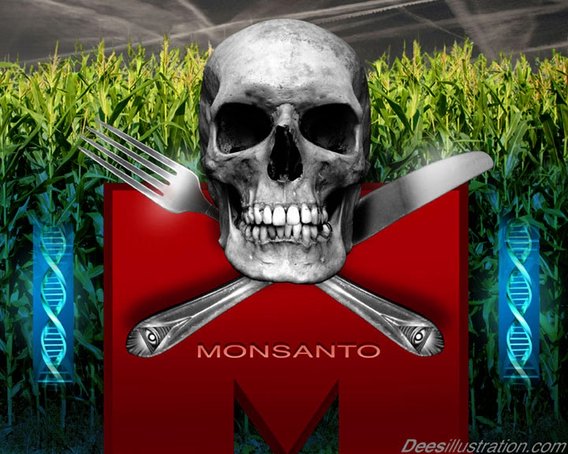
monsantoskull_dees

By Oliver Tickell

Source: The Ecologist

A scientific study that identified serious health impacts on rats fed on ‘Roundup ready’ GMO maize has been republished following its controversial retraction under strong commercial pressure. Now regulators must respond and review GMO and agro-chemical licenses, and licensing procedures.

A highly controversial paper by Prof Gilles-Eric Séralini and colleagues has been republished after a stringent peer review process.

The chronic toxicity study examines the health impacts on rats of eating  a commercialized genetically modified (GM) maize, Monsanto’s NK603 glyphosate-based herbicide Roundup.

The original study, published in Food and Chemical Toxicology (FCT) in September 2012, found severe liver and kidney damage and hormonal disturbances in rats fed the GM maize and low levels of Roundup that are below those permitted in drinking water in the EU.

However it was retracted by the editor-in-chief of the Journal in November 2013 after a sustained campaign of criticism and defamation by pro-GMO scientists.

Toxic effects were found from the GM maize tested alone, as well as from Roundup tested alone and together with the maize. Additional unexpected findings were higher rates of large tumours and mortality in most treatment groups.

Criticisms addressed in the new version

Now the study has been republished by Environmental Sciences Europe. The republished version contains extra material addressing criticisms of the original publication.

The raw data underlying the study’s findings are also published – unlike the raw data for the industry studies that underlie regulatory approvals of Roundup, which are kept secret. However, the new paper presents the same results as before and the conclusions are unchanged.

The republication restores the study to the peer-reviewed literature so that it can be consulted and built upon by other scientists.

The republished study is accompanied by a separate commentary by Prof Séralini’s team (also published on The Ecologist) describing the lobbying efforts of GMO crop supporters to force the editor of FCT to retract the original publication.

The authors explain that the retraction was “a historic example of conflicts of interest in the scientific assessments of products commercialized worldwide.”

“We also show that the decision to retract cannot be rationalized on any discernible scientific or ethical grounds. Censorship of research into health risks undermines the value and the credibility of science; thus, we republish our paper.”

Paper subjected to extraordinary scrutiny and peer review

Claire Robinson, editor of GMOSeralini.org, commented: “This study has now successfully passed no less than three rounds of rigorous peer review.”

First the paper was peer reviewed for its initial publication in Food and Chemical Toxicology, and according to the authors it passed with only minor revisions.

The second review involved a non-transparent examination of Prof Séralini’s raw data by a secret panel of unnamed persons organized by the editor-in-chief of FCT, A. Wallace Hayes, in response to criticisms of the study by pro-GMO scientists.

In a letter to Prof Séralini, Hayes admitted that the anonymous reviewers found nothing incorrect about the results, but argued that the tumour and mortality observations in the paper were “inconclusive”, and this justified his decision to retract the study:

“A more in-depth look at the raw data revealed that no definitive conclusions can be reached with this small sample size regarding the role of either NK603 or glyphosate in regards to overall mortality or tumor incidence. Given the known high incidence of tumors in the Sprague-Dawley rat, normal variability cannot be excluded as the cause of the higher mortality and incidence observed in the treated groups.”

“The rationale given for the retraction was widely criticized by scientists as an act of censorship and a bow to the interests of the GMO industry”, says Robinson.

“Some scientists pointed out that numerous published scientific papers contain inconclusive findings, including Monsanto’s own short (90-day) study on the same GM maize, and have not been retracted. The retraction was even condemned by a former member of the editorial board of FCT.”

Now the study has passed a third peer review arranged by the journal that is republishing the study, Environmental Sciences Europe.

Let the critics carry out their own studies

Dr Michael Antoniou, a molecular geneticist based in London, commented, “Few studies would survive such intensive scrutiny by fellow scientists.

“The republication of the study after three expert reviews is a testament to its rigour, as well as to the integrity of the researchers. If anyone still doubts the quality of this study, they should simply read the republished paper. The science speaks for itself.

“If even then they refuse to accept the results, they should launch their own research study on these two toxic products that have now been in the human food and animal feed chain for many years.”

Dr Jack A Heinemann, Professor of Molecular Biology and Genetics, University of Canterbury New Zealand, said: “I applaud Environmental Sciences Europe for submitting the work to yet another round of rigorous blind peer review and then bravely standing by the process and the recommendations of its reviewers, especially after witnessing the events surrounding the first publication.

“This study has arguably prevailed through the most comprehensive and independent review process to which any scientific study on GMOs has ever been subjected.”

‘Significant biochemical disturbances and physiological failures’

The study examines the health effects on rats of eating Roundup-tolerant NK603 genetically modified (GM) maize (from 11% in the diet), cultivated with or without Roundup application, and Roundup alone (from 0.1 ppb of the full pesticide containing glyphosate and adjuvants) in drinking water. It found:

  • “Biochemical analyses confirmed very significant chronic kidney deficiencies, for all treatments and both sexes; 76% of the altered parameters were kidney-related.
  • “In treated males, liver congestions and necrosis were 2.5 to 5.5 times higher. Marked and severe nephropathies were also generally 1.3 to 2.3 times greater.
  • “In females, all treatment groups showed a two- to threefold increase in mortality, and deaths were earlier.
  • “This difference was also evident in three male groups fed with GM maize.
  • “All results were hormone- and sex-dependent, and the pathological profiles were comparable.
  • “Females developed large mammary tumors more frequently and before controls;
  • “the pituitary was the second most disabled organ;
  • “the sex hormonal balance was modified by consumption of GM maize and Roundup treatments.
  • “Males presented up to four times more large palpable tumors starting 600 days earlier than in the control group, in which only one tumor was noted.
  • “These results may be explained by not only the non-linear endocrine-disrupting effects of Roundup but also by the overexpression of the EPSPS transgene or other mutational effects in the GM maize and their metabolic consequences.
  • “Our findings imply that long-term (2 year) feeding trials need to be conducted to thoroughly evaluate the safety of GM foods and pesticides in their full commercial formulations.”

The paper concludes: “Taken together, the significant biochemical disturbances and physiological failures documented in this work reveal the pathological effects of these GMO and R treatments in both sexes, with different amplitudes.

“They also show that the conclusion of the Monsanto authors that the initial indications of organ toxicity found in their 90-day experiment were not ‘biologically meaningful’ is not justifiable.

“We propose that agricultural edible GMOs and complete pesticide formulations must be evaluated thoroughly in long-term studies to measure their potential toxic effects.”

Regulators must take these results seriously

Dr Heinemann commented: “The work provides important new knowledge that must be taken into account by the community that evaluates and reports upon the risks of genetically modified organisms, indeed upon all sources of pesticide in our food and feed chains.”

According to Patrick Holden, Chief Executive of the Sustainable Food Trust (SFT) the study highlights the inadequacy of current safety testing:

“The most obvious deficiency relates to the fact that the current approval process is based on animal feeding trials of only 90 days, a totally inadequate duration when one considers that chronic diseases in animals and humans do not usually manifest until mid-life.”

A second deficiency, he added, relates to the newly emerging science of epigenetics – which demonstrates that endocrine systems can be seriously disrupted by the presence of chemical residues at concentrations as low as a few parts per billion.

“This turns on its head the logic of an approval process based on MRL (maximum residue levels), since it is becoming increasingly apparent that these chemicals have patterns of non-linear response.”

An ‘urgent review’ of pesticide licensing is needed

Given these concerns, said Holden, “there is a strong case for an urgent review of the regulatory process for licensing both the herbicide Roundup and the neonicotinoid class of insecticides. A fundamental review of the entire process for licensing agricultural chemicals is required to ensure that in future the public interest is better served.”

Professor Pete Myers, Chief Executive of Environmental Health Sciences and scientific advisor to the SFT points out that only “the tiniest fraction of agricultural chemicals” have been studied for health effects by independent scientists:

“Over the last two-decades there has been a revolution in environmental health sciences that suggests the proportion of diseases attributable to chemical exposures is far bigger and more significant than previously understood.

“The tools we have available to us to say what is safe and not safe are deeply flawed. They are not based on two decades of development in the fields of endocrine disruption and epigenetics, but instead on tests developed in the 1950s.

“They do not reflect the complexity of mixtures, or the way in which chemicals interact.”

Related articles:

Monsanto’s Herbicide Linked to Fatal Kidney Disease Epidemic: Could It Topple the Company?

New Study finds Monsanto’s Roundup Herbicide 125 Times More Toxic Than Regulators Say


GMOs: the ‘right to know’ campaign is winning

did-you-know-graph

By Ralph Nader

Source: The Ecologist

Campaigners for the labeling of GMOs in food are winning their battle against corporate America, writes Ralph Nader. No wonder the corporations are fighting back with lawsuits and scare stories … they’re on the back foot, and they know it.

Let us celebrate today the latest initiatives of our nation’s growing food safety movement.

Across the country, consumers are demanding the right to know what is in their food, and labeling of genetically engineered food.

It’s a vibrant and diverse coalition: mothers and grandmothers, health libertarians, progressives, foodies, environmentalists, main street conservatives and supporters of free-market economics.

Last year, a New York Times poll found that a near-unanimous 93% of Americans support such labeling.

FDA: GMO food not proven safe

This is no surprise. Genetically engineered food has yet to be proven safe. In 1998, the US Food and Drug Administration (FDA) admitted in court that it had reached “no dispositive scientific findings” about the risks of genetically engineered foods.

There is no scientific consensus about the risks of eating genetically engineered food, according to a statement last year signed by nearly 300 scientists.

The scientists agree that “Concerns about risks are well-founded” and that a “substantial number” of “animal feeding studies and reviews of such studies … found toxic effects and signs of toxicity” in animals fed genetically engineered food, compared with controls. “Some of the studies give serious cause for concern.”

For example, a review of 19 studies on mammals, published in Environmental Sciences Europe, found that the “data appear to indicate liver and kidney problems” arising from diets of genetically engineered food.

According to Consumers Union senior scientist Michael Hansen PhD, the ability of genetically engineered crops to induce allergic reactions is a major food safety concern.”

GMO risks – many questions, few answers

When it comes to genetically engineered food, there are questions about risks, but no convincing answers. There is no mandatory pre-market safety testing for genetically engineered food.

These questions of risks and safety have festered for years because the big agrichemical companies use their intellectual property rights to deny independent scientists the ability to test genetically engineered crops, or to report their results.

Scientific American called these restrictions on free inquiry “dangerous”. “In a number of cases”the magazine reports“experiments that had the implicit go-ahead from the seed company were later blocked from publication because the results were not flattering.”

When scientists do publish studies adverse to the interests of the big agrichemical companies, they are met with vicious attacks on their credibility, their science and even in their personal lives.

Sixty-four nations have already required labeling of genetically engineered food, including the members of the European Union, Australia, Brazil, Turkey, South Africa, even Russia and China.

Nestlé: it’s no longer business as usual

The food industry is feeling the pressure. Paul Bulcke, CEO of Nestle, the world’s largest food and beverage company, said that “It is not business as usual anymore. Pressure is mounting from all sides and angles.”

Despite the overwhelming popularity of labeling, Congress refused to act, so citizens took up the cause in their own states.

Under heavy corporate lobbying and deceptive TV ads, ballot initiatives for labeling of genetically engineered food were narrowly defeated by 51% – 49% in both California and Washington State. In May, legislation in the California Senate led 19-16, but failed without the 21 vote majority needed for passage.

Finally, on May 8, in a major victory, Vermont approved the first unconditional statewide labeling law for genetically engineered food.“Vermonters take our food and how it is produced seriously, and we believe we have a right to know what’s in the food we buy”, said Gov. Peter Shumlin.

Since then, the food and agrichemical industries have escalated to a full panic. On June 13, the Grocery Manufacturers Association and three other trade associations – the heart of the junk food industry – filed a lawsuit in federal court to block the new Vermont labeling law.

The good news is that people are rushing to Vermont’s defense, including Ben & Jerry’s ice cream, which will re-name one of its flavors ‘Food Fight! Fudge Brownie’ to help fund a vigorous legal defense of Vermont’s new labeling law.

No, GMO labeling will not increase food prices

Elsewhere, industry is spending lavishly against the food movement. In New York State, the Daily News reported that “Trade organizations, farm groups and corporate giants such as Coca-Cola and Kraft have spent millions of dollars on lobbyists and campaign contributions to defeat” labeling of genetically engineered food.

The food industry is quick to scare consumers with the canard that labeling of genetically engineered food will raise food prices. But manufacturers change their labels often, so their claim doesn’t make sense.

It has been debunked in an study by Joanna Shepherd Bailey, a professor at Emory University School of Law, who found that“consumers will likely see no increases in prices” as a result of labeling genetically engineered food.

In Congress, US Rep Mike Pompeo (R-KS) introduced a bill at the behest of the Grocery Manufacturers Association – dubbed by its consumer opponents the ‘Deny Americans the Right-to-Know (DARK) Act’ – to block any federal or state action for labeling of genetically engineered food.

Sometimes, politics is drearily predictable: Can you guess Rep. Pompeo’s largest campaign contributor? You got it: Koch Industries.

Left and Right united can defat the corporate lobbies

But the shame is fully bipartisan: sleazy Democratic lobbyists like former US Senator Blanche Lincoln and Steve Elmendorf are plying their trade for Monsanto and the Grocery Manufacturers Association to keep you from knowing what’s in your food.

Meanwhile, the food disclosure movement is going full speed ahead with ballot initiatives for GMO labeling in Oregon and Colorado, as well aslegislative efforts in many other states.

There’s a great lesson in all this: when left and right join together, they can defeat big corporations and their subservient politicians. That’s the theme of my new book, Unstoppable: The Emerging Left-Right Alliance to Dismantle the Corporate State.

Food labeling is hardly a radical idea. Conservative economists are quick to point out that the free exchange of information about products is crucial to the proper functioning of a free market.

Even Monsanto supported labeling of genetically engineered food in Britain. But it spends millions to oppose labeling here in America. Such is corporate patriotism in the 21st Century: St. Louis-based Monsanto believes the British deserve more consumer rights than Americans do.

Not worried? You ought to be …

There are other reasons to be concerned about genetically engineered crops.

Genetically engineered crops have led to increased use of pesticides. For example, a study by Professor Chuck Benbrook of Washington State University found that between 1996 and 2011, genetically engineered crops have brought an increased use of more than 400 million pounds of pesticides.

Mutating weed resistance is requiring the Monsantos to sell even more powerful herbicides. More details on these backfiring GMO crop technologies are contained in the new book titled The GMO Deceptionedited by Professor Sheldon Krimsky and Jeremy Gruber.

Perhaps most alarming is the corporate control of agriculture in the hands of the world’s largest agrichemical companies – Monsanto, DuPont, Syngenta, Dow, Bayer and BASF.

“The Big 6 chemical and seed companies are working diligently to monopolize the food system at the expense of consumers, farmers and smaller seed companies”said Philip H. Howard, an associate professor at Michigan State University.

Food is love

These companies may be meeting their match in the mothers and grandmothers who have powered the movement for labeling of genetically engineered food. Like Pamm Larry, the pioneering grandmother who came up with the spreading idea reflected by the California ballot initiative for labeling.

Mothers know that food is love. Certainly, my mother did. She taught me early and often about how important it is to eat healthy food. She even wrote about these values in the book, It Happened in the Kitchen.

I’d like to think that she’d feel right at home with the mothers and grandmothers of today’s food movement. I sure do. In some ways, that’s the point: a movement that makes you feel at home, no wonder it is so popular.


Ralph Nader’s latest book is: Unstoppable: the Emerging Left-Right Alliance to Dismantle the Corporate State.


Top Reasons You Should Never Buy E-Cigs From Big Tobacco

Cigarette-butts

Source: Cascadia Vape Blog

It’s long been suspected that Big Tobacco money was behind early efforts to attack the e-cig industry because it posed a potential threat to the tobacco cigarette industry. Now it’s apparent Big Tobacco is not only jumping on the bandwagon, but setting its sights on taking over the bandwagon.

Lorillard, the 3rd largest Big Tobacco company in the US acquired Blu brand e-cigs last year and just earlier this month Reynolds, America’s 2nd largest Big Tobacco company announced its entry into the market with Vuse e-cigarettes. The no. 1 US Big Tobacco company, Altria, acquired Green Smoke for $110 million in February and is planning national distribution of a new e-cig, NuMark, by the end of the year while Philip Morris, a subsidiary of Altria, recently announced it acquired British e-cigarette maker Nicocig for an undisclosed price. Some in the e-cig community might see this as a positive development thinking that with increased marketing from Big Tobacco brands there’ll be increased public awareness of e-cigarettes. However, I think there’s good reasons to worry about the quality of information and products Big Tobacco pushes to the public, leading to the first of the reasons to not support them:

Reason 1: It is in the interests of Big Tobacco to associate e-cigarettes with tobacco cigarettes.

Big Tobacco companies aren’t about to lose their customer base without a fight, and even as more smokers continue to switch to e-cigarettes, they’re often lured towards e-cig brands owned by the corporations that understand their addiction best. Big Tobacco have decades of experience effectively marketing cigarettes and they’re using similar tactics to make e-cigs especially attractive to smokers and former smokers. Big Tobacco e-cigs such as Green Smoke and Vuse are designed and packaged to look very similar to tobacco cigarettes and are often marketed as “tobacco products”. This may seem like a fair label on the surface because e-cigs use liquids containing nicotine usually extracted from tobacco, but one could argue they’re not exactly tobacco products because nicotine is a chemical that can be synthesized and is found in other plants such as eggplant, tomatoes and peppers. It’s an important distinction to make because a common misconception is that e-cigs are as harmful as tobacco cigarettes when in fact much of the damage caused by smoking cigarettes can be attributed to the combustion of processed tobacco which have been found to contain radiation, gmo genes, ammonia and pesticides. There is at least one e-cig specifically designed for use with tobacco and not surprisingly it’s made by Philip Morris. Many e-cigs produced by big tobacco are designed to emulate the experience of smoking with smoke-like nicotine content and taste. This is great for smokers content to continue vaping in a manner similar to how they’re accustomed to smoking, but not so good for those trying to decrease or end their addiction or would like to experience a wider range of flavors, vape temperatures, nicotine levels, or psychoactive substances. E-cigs and vapes produced by smaller businesses are far more versatile, allowing users to choose the flavors and nicotine content of e-liquids they use, select from variable voltage settings, and with modular attachments they can also vape non-tobacco herbs, oils and concentrates instead. E-cigs from Big Tobacco, on the other hand, use disposable cartridges which have a host of problems leading to the next argument:

Reason 2: E-cigs produced by Big Tobacco are more harmful to you and the environment. 

Nearly every Big Tobacco-owned electronic cigarette uses disposable cartridges which are cheap to produce but end up costing consumers more in the long run than refillable cartridges. They also limit consumer choice because such cartridges are usually proprietary, not designed for use with components from other brands and more limited in selection of flavors and nicotine content than liquids sold separately. E-cigs using disposable cartridges are also potentially more hazardous to your health than other forms of vaporizers. Though there still needs to be more research on comparative health effects, a 2009 FDA study (often cited by critics as proof that e-cigs emit low levels of tobacco-specific nitrosamines and other impurities) only tested devices using disposable cartridges (“Njoy”, “Smoking Everywhere” and “Nicotrol” brands). Just like with tobacco cigarette filters, we may one day see disposable e-cig cartridges littered everywhere if Big Tobacco has its way. As with other cheap disposable products, disposable e-cigs and e-cig filters are designed for planned obsolescence; a policy which creates demand by making a product obsolete faster forcing consumers to buy more regularly and discard old products into landfills more often. Such practices of Big Tobacco and other large corporations leads to the third argument:

Reason 3: Big Tobacco has proven itself untrustworthy.

The history of the American tobacco industry is steeped in shame. Early settlers ripped off Native American tribes in order to acquire more land for tobacco fields. Indentured servants were exploited for labor intensive tobacco field work later to be replaced by slaves from Africa. By the 1880s, the industry was dominated by the monopolistic American Tobacco Company which was one of the companies forced to dissolve to comply with the Sherman Antitrust Act. The dissolution led to an increase in cigarette advertising while the four firms created from the breakup continue to dominate the tobacco market to this day. We now know that senior scientists and executives within the cigarette industry knew there was a correlation between smoking and cancer as early as the 1940s and were aware that smoking could cause lung cancer by the mid 1950s. However, it wasn’t until the 1990’s amidst successful lawsuits against Big Tobacco aided by leaked documents that major US cigarette manufacturers publicly admitted to varying degrees that smoking causes cancer and other health problems. Given their track record, it should come as no surprise how Big Tobacco approaches the e-cig market with the same focus on the bottom line.

Like many other large corporations with outsize influence, Big Tobacco is less concerned with wealth creation which extracts value by engaging in mutually beneficial transactions than rent-seeking; the use of social institutions such as government to gain monopolistic advantages while imposing disadvantages on competitors. The effects of rent-seeking are reduced economic efficiency through poor allocation of resources, reduced wealth creation, increased income inequality, lost government revenue (except for select paid-off legislators and regulators), decreases in innovation and entrepreneurship and national decline. Large corporations also create fewer quality domestic jobs per capita because they have the ability to cut costs through increased automation and outsourcing overseas. While CEOs of such companies may have wonderful jobs, there’s an increasingly wide income and quality gap between their position and the people at the lowest level of the company. In most cases, much of their profits are siphoned off to a small group at the top of the hierarchy who hoard it in offshore bank accounts.

Smaller domestic companies, while they may have to source certain components from overseas, tend to do more of the work in-house such as assembly, quality control, packaging, warehousing, etc. which creates more local jobs that distribute wealth into local economies. Small businesses also tend to have less of a wealth gap between employees and are run by people who are more passionate about their line of work, not people who inherited their careers, acquired it through connections or were hired by committee solely for their ability to generate income.

For the sake of your health, the environment, the economy and country, don’t support Big Tobacco. Support responsible small businesses and spread the message.