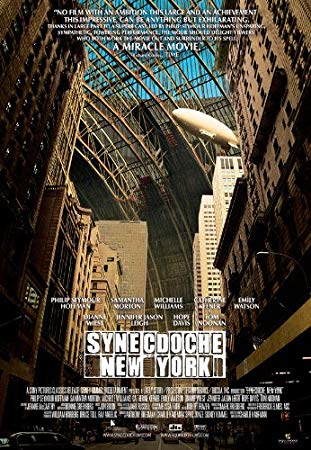
Exploring Charlie Kaufman’s “Synecdoche, New York”: A Philosophical Analysis
By Jordan Siron
Source: Deathbed Decameron
PREFACE
“There are too many ideas and things and people. Too many directions to go. I was starting to believe the reason it matters to care passionately about something, is that it whittles the world down to a more manageable size.”
— Susan Orleans, Adaptation (written by Charlie Kaufman)
I’ve wrestled near-tirelessly with this analysis, as Synecdoche, New York is a unique beast. Standard film analysis won’t do, and far more capable minds have already broken down the film’s narrative, thematic, and technical components. This left me a little lost.
Should I discuss the film’s merits on a technical level? Should I address themes and how they are tackled via visual and narrative motifs? How much backstory should I present, or withhold? Should I focus on the unique structure of the film, which plays with our concept of time and how it is perceived as we age?
At the end of the day, I decided to throw my hands in the air and declare, “Fuck it!” What interests me most about the film — what I feel really makes it one of the most important films of modern cinema — is the philosophy at its core. After all, the conceit behind Synecdoche, New York is what endears the film to me over any other. It is as good a subject for analysis as any of the myriad options at my disposal.
I take for granted that you have seen the film prior to reading this. As such, I will not be providing a synopsis. I will be referring to characters as events as if you are already familiar with them. Should you have stumbled upon this and have yet to see the film, you can buy it via iTunes, Amazon.com, and elsewhere. Hell, you can probably torrent it.
I would also like to take a moment to send a shoutout to Mick over at Being Charlie Kaufman for sharing this piece with his audience. I love the site, and it means a lot to me. I cannot thank you enough! Any one looking for a wealth of information on Charlie Kaufman and his work, BCK is your best bet. It’s a veritable treasure trove.
The Philosophy of Synecdoche, New York:
Dethroning Solipsism, and Dispelling The Concept of “The Other”
“I do believe you have a wound too. I do believe it is both specific to you and common to everyone. I do believe it is the thing about you that must be hidden and protected, it is the thing that must be tap danced over five shows a day, it is the thing that won’t be interesting to other people if revealed. It is the thing that makes you weak and pathetic. It is the thing that truly, truly, truly makes loving you impossible. It is your secret, even from yourself. But it is the thing that wants to live.”
— Charlie Kaufman, BAFTA Screenwriters Lecture 2011
Synecdoche, New York is a film that concerns itself with examining solipsism, and in disposing of the harmful concept of “The Other”. Solipsism is the belief that only one’s own mind is certain to exist; that one’s perception of reality and events is the only certainty, the only truth. As a philosophy, it is akin to Objectivism — the belief that the pursuit of one’s own self interest is the only moral obligation to which any human is bound.
Solipsism is a gross philosophy. It does not leave room for the understanding or concern of others. It is diametrically opposed to Altruism, which — while impractical to some extent — at least gives us something worthy to strive for. While one can argue against the practicality of Altruism, it’s hard to rationalize Objectivism and Solipsism as being inherently healthy life philosophies. While they may serve the individual, they do not foster the wellbeing of the human community writ large.
Now, all of that isn’t to say that individuals who prescribe to philosophies that place themselves at the center of their own universe are inherently bad. One can argue that such philosophies drive individuals towards great personal success, and through that success said individuals can turn around and provide aid of which they might not have otherwise been capable. There is a certain benefit to being concerned with one’s own self, but this dissection is not concerned with those few individuals who put their own universes in check before extending their helping hand. So it follows that Synecdoche, New York does not concern itself with such.
The film examines solipsism at its worst, demonstrating the dangers of such a philosophy through its chosen vehicle: Caden Cotard.
Solipsism As A Catalyst For Emotional Distance
As is often the case in Kaufman’s films, Caden is a hard protagonist to like. In fact, the more time we spend with him the harder it is to view him with even a modicum of sympathy. From the word go, we see that Caden is a fairly self-involved person. While his wife, Adele, wears herself ragged trying to support herself, their daughter, Olive, as well as Caden’s mounting insecurities, Caden seems concerned only with what exists within his own private universe.
We are introduced to Caden as he laments, as would a broken record, his impending death. He constantly feels ill, and sees detritus in every newspaper headline or mail order magazine. He even occupies his time by re-staging the Arthur Miller classic Death of a Salesman, a play that concerns itself with an old nobody trying desperately to amount to some pre-conceived notion of success before the chance escapes him. Like Caden, the play’s protagonist, Willy Loman, is revealed to be a pathetic creature who chases self-satisfaction at the expense of his closest loved ones.
Willy Loman is revealed to be an adulterous, distant husband, and Caden is revealed to be something quite similar. While there are suggestions placed throughout the film that Caden is unfaithful to Adele (or at least capable of such infidelity), it is his “why me” woes that bind him to Loman. He is a man who is personally responsible for the deteriorating status of his marriage to Adele, and to his lack of fulfillment as an artist, but he cannot see outside of himself in order to look upon the seeds he has sown. And, as we learn, the crops his selfishness yields are beyond poisoned.
When Sammy jumps to his death after Caden refuses him his right to fall in love with Hazel (mirroring Caden’s early attempt at suicide), Caden reacts shamefully. While every one involved with his production gathers around Sammy’s lifeless body to mourn, Caden screams at the deceased man for “getting it wrong”. After all, Caden did not jump to his death. He doesn’t even see Sammy as a fellow human being by this point, merely as a liability. His suicide was not a loss of life, but a hiccup in the production that created an issue of logistics for Caden.
Even more troubling is Caden’s inability to notice the looming apocalypse that will some day lay waste to New York, perhaps the entire world. As the film progresses, we start to see signs that all is not well in the real world. Army vehicles round up citizens. Gunfire and explosions can be heard in the distance, almost non-stop. Men and women walk the streets wearing gas masks, or leading one another around by leashes as if they were pets.
In one scene Caden leaves his warehouse/theatre for the night with Claire (his second wife/leading lady),and he fails to notice a line of people standing outside. One man stops Caden to ask him when “it” will be finished, as “things are getting bad out here”. Caden assumes the man is anticipating his play; the man is actually referring to the life-sized recreation of New York City Caden is building within the warehouse. The people of New York are hoping to escape the impending calamity by seeking refuge within the safety of the warehouse. Caden, ever the self-important artist, simply assumes they are just anxious to behold his work.
This is very troubling, as it demonstrates Caden’s inability to see the decaying state of life outside of his own mind. He has every opportunity to save the people of New York, but he can’t be bothered to take notice of that fact. And, as the film reaches its conclusion, we see that Caden’s obsession with his own rational self-interest allows for millions of lives to be snuffed out when they might have been spared.
The film never really resolves this plot element, unfortunately. We see Caden accept that he is not unique, but we never see how he dealt with the realization that he could have saved all of those lives — or if he even has that realization at all. This might be my only valid complaint regarding the film, but it is forgivable. It is already quite dense, and I suppose there just wasn’t enough time to tackle that aspect.
Solipsism As A Catalyst For Sexism
As mentioned earlier, Caden does very little in the way of parenting. It is established that Adele tends to the physical and emotional needs to Olive while Caden soaks in self-pity. Caden offers his wife no means of validation, yet weakly begs for all that Adele can spare. He wants her to admire him as an artist, even at the cost of ignoring her own aspirations to be a painter.
For instance: when Adele opts to miss the opening night of his re-staging of Death of a Salesman, so that she can meet her own deadline, Caden sets up shop in the town called Passive Aggression. Add to that, Caden fishes for Adele’s admiration after she does finally attend the play.
When Adele stands by her principles and denies Caden that validation (as she sees no merit in re-staging other people’s plays, which we infer to be Caden’s schtick), he sulks about like a scorned child. And therein lies the ultimate issue between the two: Where Caden should be a partner to Adele, some one who reciprocates the support he receives, he is instead like another child for Adele to raise and nurture. This is a particularly poignant character flaw, as it reflects the all-too-common issue that husbands have with their wives — a difference in the sexes granted not by nature, but by privilege.
Gender becomes a very integral aspect of the film, as it ties so perfectly to Kaufman’s thesis regarding Solipsism. Caden is a man who wants the women in his life to be the driving forces behind his brilliance. They are instruments to him, when they should be people. We might call this affliction the Muse Dilemma — the pathological need to attribute any greatness in ourselves to a woman we place on a pedestal, woefully viewing Her as some divine influence through which we achieve our greatness. The trouble with this view is three pronged:
- First: We diminish in ourselves the ability to create without some heavenly catalyst.
- Second: We refuse to see that the Muse, herself, longs to achieve her own aspirations and desires. She does not exist to simply inspire greatness in us.
- Third: Viewing women (any person, really, but for the sake of the themes of the film, women specifically) as vessels for our potential breeds a penchant for solipsist thinking. We rob them of their own identities. We humor the idea of women being “others”.
Taking the above into consideration, it should come as no surprise that the story demands that Caden see existence through the eyes of a woman — an “other”. Kaufman provides this opportunity for Caden’s growth brilliantly, in the form of Ellen Bascomb.
Ellen, we learn, is the cleaning lady who services Adele’s Manhattan loft. Through the machinations of the narrative, Caden finds himself stepping into Ellen’s shoes. While he does so with the surreptitious intention of getting re-connected with Adele (writing letters under Ellen’s identity, even basking in the smell of her bed sheets), there is something much more important taking place beyond his knowledge — as well as our own. There is a subtle transformation taking place. Caden is unwittingly evolving.
The full effects of Caden’s charade are not revealed to him, nor to us, until Millicent takes over as the director of his play. Through her God-like direction (delivered to Caden through an ear piece, serving as a wonderfully, thematically ironic metaphor for divine guidance), Millicent steadily leads Caden to shed his own persona while adopting Ellen’s. What comes to pass is a heartbreaking sequence in which we learn about Ellen who, up until now, has been an unseen “Other” merely used by Caden for his own agenda.
In one of the most beautifully sullen monologues in recent film history, Ellen tells us of her life of woes. She is stuck in an unfulfilling marriage, wed to a husband who looks at her as a burden. We learn that her life-long dream was to have a daughter with whom she could enjoy picnics akin to those Ellen herself enjoyed with her mother. She wanted the warmth of companionship, the fulfillment of a loving family. For whatever reason, Ellen and her husband, Eric, never had that child. So they grow old together, drifting further apart with each passing day.
Caden is moved to tears, feeling some one else’s pain for the first time in the film — perhaps in his entire life. He sees so much of his own woes are shared by Ellen. Where she was the overlooked wife, Caden was the husband doing the overlooking. Where Ellen longs for a daughter she never had, Caden longs for the daughter he felt had been stolen from him. In fact, this tie that binds reveals an interesting twist that can easily be missed.
(This is an especially poignant scene, as Caden — who has lost the ability to cry genuine tears without medical aid, as a side effect of his mysterious illness — is able to cry of his own volition. It isn’t until he feels the very real pain of another person that he can manage this feat.)
During Caden’s visit to a dying Olive, she refuses to forgive him — but for what? Olive claims that Caden betrayed the family by running off to have anal sex with his gay lover, Eric. This is important, as Caden had already been impersonating Ellen well before this point in the film. Eric is, of course, Ellen’s husband.
One might deduce that the reason Ellen never had a daughter was to do with Eric’s insistence on having anal sex with Ellen (potentially because he did not love her enough to participate in a deeper intimacy), and thus never affording the opportunity to conceive a child. Even though this scene takes place long before Caden’s self realization, the line between Ellen and Caden has blurred to the point that they are essentially the same person.
The Moral Of The Story
“You have struggled into existence, and are now slipping silently out of it. This is everyone’s experience. Every single one. The specifics hardly matter. Everyone’s everyone.” Millicent Weems, Act III
Herein lies the existential rub of the film: Caden comes to discover that he is Ellen. So, too, is he Adele, and Hazel, and any number of persons who populate this earth. Now, that is not to say that he is physically these people. He is Caden, and they are Adele, or Hazel, or Ellen. They are individuals who, taken on their own, represent the whole of humanity. Kaufman is telling us that individuals are synecdoches of the human race — mere slivers of the greater whole. Caden suffers because others suffer, because that is the nature of a living being. His woes are specific to himself, but they are common of every one.
Every one gets sick. Every person has his/her heart broken, or dreams crushed. And, in the end, every one dies. Caden is not unique, so he should not look at his own circumstances as being as such.
While it may be easy to mistake this moral for cynicism, it is actually quite beautiful. In making this statement, Kaufman is telling us all that we should be as mindful of the problems of others as we are the issues that plague ourselves. It’s enticing to get lost in self pity, and even more attractive to pursue our own self interests, but there is very little good that can come from such behavior. Only by seeing ourselves in the eyes of “the other” can humanity’s redeeming qualities outweigh it’s ills.
Watch the full film here.





 After the Crash