
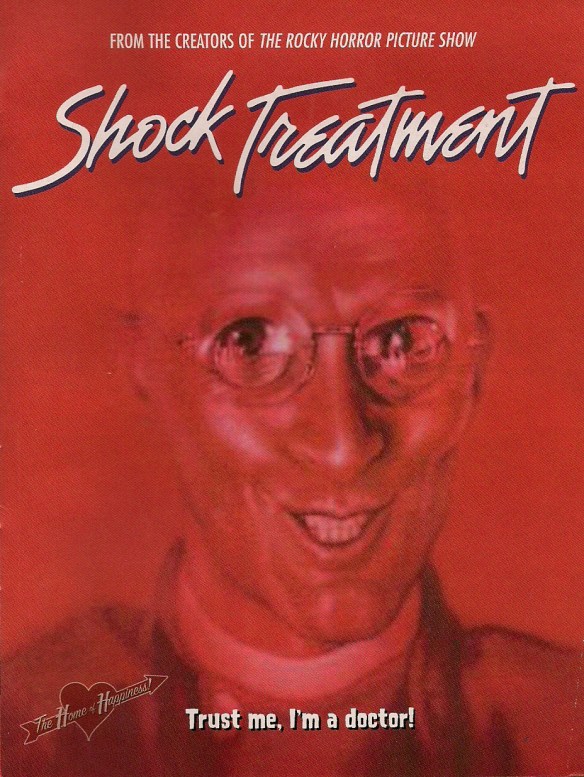
Saturday Matinee: Shock Treatment

Why Shock Treatment is an “equal” to The Rocky Horror Picture Show

Was creator Richard O’Brien on the money when describing his other box office flop?

By Aimee Knight

Source: Little White Lies

It’s a few years since Brad Majors and Janet Weiss escaped the leather-clad clutches of Dr Frank-N-Furter and his frenemies. Back in their native Denton, USA – the so-called “home of happiness” – their marriage has hit the skids. While attending a live taping at their local TV station, they become embroiled in a series of interrelated game shows. This plays out in front of ever-present townspeople, who soak up the C-list exploits 24/7.

So goes the plot of Shock Treatment, the maligned sequel to cult staple The Rocky Horror Picture Show. Before its theatrical release, the creator, composer and star Richard O’Brien said, “It’s not a sequel, it’s not a prequel, it’s an equal.” Audiences and critics disagreed.

Like its older sibling, it was directed by Jim Sharman, produced by Lou Adler and Michael White, and featured several of the same key cast members. Just like Rocky Horror, it was a box office flop – one that O’Brien went so far as to call “an abortion”. The musical black comedy was foisted upon the midnight circuit in 1981. Though it celebrates its 35th anniversary this Halloween, it remains mostly obscure. Would Shock Treatment be remembered were it not positioned in the stilettoed shadow of its big sis?

Produced at the height of Rocky Horror’s cult frenzy, it failed to garner the titillating ubiquity of its forebear. A healthy dose of ‘easter eggs’ couldn’t convert even Rocky Horror’s most devoted disciples, who were deterred by the conspicuous absence of core cast members Tim Curry, Susan Sarandon and Barry Bostwick, among others.

Cult films are like Domino’s pizzas. You can’t scrimp on ingredients, deliver at midnight and expect everyone to love it. But when either comes with extra cheese, it’s definitely a plus. With its synth-heavy soundtrack, saturated neon palette and hammy performances, Shocky’s certainly not as gouda cult movies can get. But for all its flaws, the film deserves recognition at least for its prescient prediction of reality TV and the coming devotion to the cult of celebrity.

Sure, the premise seems absurd. Fast food tycoon Farley Flavors (one of two characters played by Cliff De Young) owns a television station, which is seemingly home to the town’s entire population. Plucked from the crowd, Brad (De Young again) and Janet (Suspiria’s Jessica Harper) try their hand at the Marriage Maze game. They soon find themselves committed and seduced, respectively, by the kooky cohorts who run the joint. Among them are O’Brien, Patricia Quinn and Nell Campbell, playing new wave exports of their Rocky Horror foils, and providing familiar faces to the core audience.

They’re joined by such inexplicable new casting choices as Ruby Wax (taking over minor Rocky Horror role Betty Hapschatt), Barry Humphries (arbitrarily Austrian game show host Bert Schnick) and baby-faced Rik Mayall in one of his first roles (‘Rest Home’ Ricky, an orderly at the station’s on-site mental health ward).

A carnivalesque crowd (strewn with former Transylvanians) watches in real time as the soap operatic narrative unfurls over 36 hours, ad break inclusive. Brad is seen bound, gagged and locked away on the Dentonvale set, while Janet flaunts her newfound sexuality on the breakfast show. When Janet refuses to sell her husband out in exchange for smalltown stardom (reminiscent of her role in Phantom of the Paradise – Rocky Horror’s glam rock godmother), the cast, crew and crowd spurn the couple, just as real world audiences would with Shock Treatment itself.

Criticised for its convoluted plot – the result of excessive redrafting – perhaps Shock Treatment was misunderstood because it arrived dreadfully ahead of its time. O’Brien depicts reality TV, and society’s interest in the sex lives of strangers, twenty-plus years prior to The Bachelor’s premiere. Denton’s addicted masses crave content around the clock, and they’re wholly invested in the shows they watch, almost three decades before Netflix began streaming. Shock Treatment shows how advertising and sponsorship influence production, and even explores the link between media and mental health – one of today’s most pertinent Western concerns.

With the 2016 remake of The Rocky Horror Picture Show comes a tidal wave of pop proprietary scorn, decrying this cinematic era of remakes, reboots, prequels, sequels and spin-offs. (Re)visit Shock Treatment for a filmic follow-up that was satirical, psychic and truly inventive.
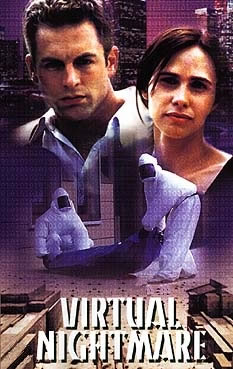


Saturday Matinee: Virtual Nightmare

“Virtual Nightmare” (2000) is an Australian television film adaptation of the 1955 science fiction short novel by Frederik Pohl. It was directed by Michael Pattinson and written by Dan Mazur and David Tausik (who two years earlier collaborated for a tv adaptation of Brave New World). Like the stories of Philip K. Dick and the late 90s wave of gnostic films such as Dark City, Fight Club, eXistence, Pleasantville, The Matrix, The Thirteenth Floor, The Truman Show, etc. (some of which were inspired/influenced by PKD), the plot centers on protagonists piercing the veil of a superficial and hegemonic consensus reality.

Astute viewers may also recognize plot elements reminiscent of a couple of other literary works which Pohl’s source novel predates: Eight O’ Clock in the Morning (1963) by Ray Faraday Nelson (a short story adapted into the 1988 film They Live and whose author happened to be a close friend of PKD’s), and The Futurological Congress (1971) by Stanislaw Lem (a satirical dystopian novel loosely adapted for the 2013 film The Congress).

Visually and technically, Virtual Nightmare is comparable to made for television and direct-to-home video sci-fi fare of the late 90s and early 2000s, but where it stands apart is its intelligent and compelling storytelling. It’s a prime example of how limited budget/FX and occasionally subpar acting can be transcended by a narrative addressing eternally relevant questions.

A big shout-out to Tom of Montalk.net for bringing wider attention to this diamond in the rough via random tweet.

Saturday Matinee: Puffball Studio double feature

With films like Swipe, Shehr e Tabassum, Pakistan’s Puffball Studio depicts dystopias that feel all too real

An app that mirrors mob justice. A dystopia where smiling is the only expression allowed. Pakistan’s Puffball Studio and its founder Arafat Mazhar skewer the mechanisms of intolerance and hate through their films.

By Manik Sharma

Source: Firstpost.

In the animated short film Shehr e Tabassum, the ‘Supreme Leader’ of a dystopian Pakistan in 2071 passes a law declaring all expressions other than smiling a crime. It’s the state’s way of manufacturing both consent and a flimsy yet persuasive image of a happy civilisation. People who refuse are deemed as traitors. The drugged, exclusionary vision of the future that the short film offers is eerily echoed by the present of many countries around the world.

Mimicking to an extent the consumerist hell of Blade RunnerShehr e Tabassum released earlier this year on YouTube. Behind the film is Puffball Studio, a group of young creators from the country, led by Arafat Mazhar. In November, Puffball released its second film Swipe, a Black Mirror-ish reflection of the intolerance of today, through the lens of technology. In Swipe, an app basically mimics mob justice, by enabling users to have people executed via a simple swipe.

“My research has been centered around the way ideas like ghairat (honour), ishq (love) ghaddar (traitor) and tauheen (insult) have been distorted in the recent past and forcibly circumscribed to violence while at the same time, the definition for blasphemous or traitorous acts continue to broaden,” Mazhar says. Curiously, the protagonist of Swipe is a child. “I have seen so many videos of young people at rallies organised by religious activists and NGOs calling for violence against other groups, videos of children taking part in mob violence. I can’t help but think that we’re failing our children when we teach them manufactured meanings of honour and love that are devoid of any spirituality,” he adds.

Mazhar and his team created Swipe during the pandemic. The intersection of technology and culture is something the filmmaker has always been interested in. He also leads other initiatives like Engage Pakistan, a project that counters the country’s blasphemy laws with research and alternative histories. Procuring funding for all these projects can’t possibly be a cakewalk.

Swipe and Shehr e Tabassum were both self-financed for the most part,” Mazhar explains. “What helps is that our team is very versatile: we have excellent traditional artists but also an excellent 3D and motion graphics team which means that we do premium service work for clients too. Aside from that, we also have an alternative critical histories channel called Hashiya, where we collaborate with local and international universities to create historical short films and explainers.”

Both Shehr e Tabasum and Swipe cross paths with technology, intolerance and the brutalising nature of consumerist economies. If empathy and humanism are shown the door, the natural course culture takes is the commodification of everything human — from faith to love. It’s a lesson the young protagonist of Swipe learns the hard way.

“We knew from the outset that both Shehr e Tabassum and Swipe would be unapologetically political films but I was just as set on making them a thrilling and evocative experience for viewers. So when we wanted to explore how different fundamental freedoms — to express, to protest etc. — are stifled in a hyper-surveillant and increasingly oppressive society, we used the allegory of a smile as the only expression allowed to citizens,” Mazhar says of his first film.

“Other times, the story writes itself: when we wanted to show a city hooked to an app (iFatwa) that generates allegations against citizens and gamifies extrajudicial violence, we would look to news stories around us to draw inspiration for the app cases,” he adds about Swipe. (The anecdotal stories that feature on iFatwa are reminiscent of outrage we witness every other day on this side of the border.)

Through both films, Mazhar channels a kind of activism that he promises the group will continue to work on. But with activism these days comes the risk of outing yourself to trolls and self-appointed moralists. It’s a price some have paid heavily for on both sides of the border, and perhaps around the world.

“I believe storytelling, fiction or otherwise, speaks to possibilities of greater awareness, understanding and connection between people and communities. I believe in creating art that speaks to our collective humanity, that forces us to think beyond our biases and our conditioned hate towards those who are different from us. With Swipe, there was no pretense about what we had set out to do: we aren’t claiming to change the fabric of our society or our thinking. Swipe is just a heartfelt plea to pause and reflect collectively,” Mazhar says.

Filmmaking is hard enough; such provocative, truthful and political filmmaking even more so. “For those who attack us online because they fear an agenda behind our films, I always try and respond to their anxieties which usually stem from perceived threats to tradition, religion, etc. Beyond that, there isn’t much that anyone can do. I think our viewers recognise and appreciate that though our films are uncomfortable to watch, they go beyond mere cynicism and derision,” Mazhar says, optimistic that his work will be afforded the tolerance his films paint the absence of.

Saturday Matinee: Star Trek Acid Party

Saturday Matinee: Visioneers

Review by Eric D. Snider

Source: EricDSnider.com

Most of the individual components of “Visioneers” are not new, nor are the film’s ideas particularly deep. Yet somehow the combination, written and directed by brothers Jared and Brandon Drake — in their first film, amazingly — feels fresh and invigorating. It’s a high-concept comedy, but it’s down-to-earth and accessible, even a little touching. It’s a terrific start for a pair of new filmmakers.

The setting is a dystopian version of modern-day America, where the Jeffers Corporation is the most powerful entity in the world. Even the U.S. president kowtows to the monolithic company, whose employees are called “tunts” and “goobs” and work at ill-defined tasks at various bureaucratic levels. As with most firms in dystopian movies, it’s never established what, exactly, the Jeffers Corp. does, but its influence is felt everywhere. Common people greet each other with the “Jeffers salute,” which looks suspiciously like flipping the bird.

Our hero is a Level 3 tunt named George Washington Winsterhammerman (Zach Galifianakis). He’s the supervisor of a little pod of employees who work in a depressing office where an automated voice announces, every 60 seconds, how many minutes remain before the weekend. Everyone is generally disheartened and depressed, but this has been enhanced in recent weeks as citizens have been spontaneously combusting due to stress.

One way to avoid stress, of course, is to just accept things as they are. (“Forget ourselves, work together” is the Jeffers Corp. motto.) Unfortunately, George Washington Winsterhammerman has been suffering from dreams and ambitions lately, and it’s been established that this is a precursor to exploding. He has a wife, Michelle (Judy Greer), who spends all her time seeking happiness via TV products and eating a lot of butter, but he hardly loves her anymore. Instead, he looks forward to the few minutes each day that he can talk on the phone to Charisma (Mia Maestro), the Level 4 goob who supervises his department. It is the one time that George’s mood brightens.

As George worries more and more about the possibility of explosion, the film dives deeper and deeper into its satire of modern corporate-driven life, where happiness is elusive while complacency is easily achieved. It’s a simple truth that everyone wants to be happy. What separates us is how we go about looking for happiness, or whether we even look for it at all. Sometimes we try elaborate, stupid measures to produce happiness when the real solution is staring us in the face. George’s brother (James LeGros) has already found that pole-vaulting makes him happy, though his refusal to participate in the Jeffers-sanctioned programs has made him a government target.

“Visioneers” is about George’s search for meaning in his life, and comedian Zach Galifianakis plays the role with more conviction and depth than you might have expected. George is subdued and contemplative, but not boring — and that’s a fine line for an actor to walk. He earns laughs through the old-fashioned method of being the only sane person in a sea of crazies, but the filmmakers avoid overplaying the lunacy of the world they’ve created. Understatement is the rule.

And it works magnificently. Like I said, we’ve seen a lot of these ideas before. But even if it’s not reinventing the wheel, “Visioneers” still manages to be insightful, intelligent, and melancholically funny. If the Drake brothers have any more stories as good as this one, they could become an exciting new force in the film world. Let me be the first to give them a Jeffers salute, but in a good way.


Watch the film on Hoopla here: https://www.hoopladigital.com/title/11670081

Saturday Matinee: Valley Girl

80S BITS: VALLEY GIRL

By Richard Grey

Source: TheRealBits.com

With the release of a fourth American Pie film this year, one that largely looks back at the highs and lows of the 1999 original, it is tough to imagine a time when teen sex comedies weren’t a dime a dozen. When reflecting on Martha Coolidge’s 1983 hit film Valley Girl, what makes it stand out is just how much hasn’t changed in the last three decades. Some of the fashions might have altered, the music is now retro and valley girls have been parodied in everything from Frank Zappa music to Buffy the Vampire Slayer. Yet there remains a central familiarity that this film set the tone for in many ways.

In fair California, where we lay our scene, Julie Richman (Deborah Foreman) is a rich valley girl who has everything a young lady could dream of: cool parents, money, a gaggle of friends and the hottest boyfriend in town. After hanging out with her valley friends Loryn (Elizabeth Daily), Stacey (Heidi Holicker), and Suzi (Michelle Meyrink), she decides that Tommy (Michael Bowen) doesn’t respect her anymore and unceremoniously dumps him. When she meets Hollywood punk Randy (Nicolas Cage) at a party, the pair share an instant connection, and Randy falls in love hard, showing her a world she never knew existed. Yet Julie’s friends don’t approve, and she must decided whether to go with Randy or cave to peer pressure and reconcile with Tommy.

The disparity between rich and poor, and the class war it created, was a major theme in the films of the 1980s, proving to be the Romeo and Juliet stumbling block that stopped couples from uniting in Pretty in Pink and Some Kind of Wonderful to name but a few. Just as the decade of decadence was getting underway, the familiar trope is pulled out here not so much as a cheap cash grab, but rather as a parody of the popular youth culture of the 1980s. More so than any other film that has lampooned or been set in the 1980s since, Valley Girl captures the era perfectly, from the plastic image-focused girls of the valley, to the New Wave punks of Hollywood, just as caught in the scene as the sex-obsessed girls.

Where most teen comedies are the fantasies of the middle-aged, who vicariously live out deflowering fantasies that they missed out in their own formative years, female filmmaker Martha Coolidge creates a world inhabited with real kids. Much of the film cleverly sits back and observes conversations, adopting an almost documentary approach to exposition. Refreshingly, this means that catching girls out in the nude or obtaining a pair of panties as a trophy are not the ultimate goals in the film, nor is there a contest to be the first past the cherry-popping post. These young characters are sexual active, aware of their own bodies but in contrast conflicted over the dichotomy between their feelings and social status. Through the mere act of listening, we find out their fears and their desires. Who knew that girls talk about sex almost as much, if not more than, boys?

Valley Girl is fuelled by a terrific New Wave soundtrack, making liberal use of  The Plimsouls and Josie Cotton, who both appear in the film. Peppered with minor hits of the 1982-83 charts, “I Melt with You” by Modern English serves as an unofficial theme song for the film. The film originally had a lot more on the soundtrack, with the music rights costing $250,000 on top of the film’s original $350,000 budget. However, while The Clash, Culture Club, Bananarama, and The Jam all originally appeared in the credits to the film, none of their songs can be found in the actual picture thanks to an inability to secure the rights. Frank Zappa, whose satirical 1982 song “Valley Girl” served as the basis for the film, unsuccessfully attempted to sue the film’s makers for capitalising on his song’s name.

Trivia fans will know that this was the first film in which a young Nicolas Coppola first used his more famous stage name of Nicolas Cage, but the legacy of the film goes well beyond beginning the career that launched a thousand hairpieces. Apart from popularising the highly imitable “Valspeak”, Valley Girl opened the door for frank and open explorations of youth anxiety and sex, far more than the Porky’s films ever did. Indeed, a direct line can be traced between Valley Girl‘s star-crossed lovers and the Jane Austen-inspired Clueless. Like, totally for sure.


Watch the full film for free here: https://youtu.be/9VbyTLnRXCs


Saturday Matinee: Tim & Eric’s Billion Dollar Movie

Review by Jim Tudor

Source: Screen Anarchy

Having never seen the comedic TV work of Tim Heidecker and Eric Wareheim (“Tim & Eric Awesome Show, Great Job!”), I went into their feature-length variation, “Tim and Eric’s Billion Dollar Movie”, braced for a merciless expansion of inside jokes that I would be terminally outside of. Mercifully, I was able to navigate these strange waters successfully enough to understand and even enjoy the film, even as it came apart in places.

Aesthetically speaking, it’s got about as much going for it as an early Kevin Smith film. Comically speaking, it’s a downhill ride that starts out promising but then fizzles out.
Heidecker and Wareheim play fictionalized versions of themselves, occasionally wandering beyond the forth wall to further muddy the meta-waters. The laughs are the most solid in terms of the plot itself. When “Tim & Eric’s Billion Dollar Movie” opens, we come to learn that that’s exactly what Tim & Eric have made – a movie, with a billion dollar budget. And it sucks in every possible way. Because they are morons, in every possible way. And the Hollywood execs who green lit their billion-dollar movie are bigger morons for letting it happen. They want their billion dollars back, but having pissed it all away on flamboyant houses, clothing, and a guru/mooch played by Zach Galifianakis, they have no choice but to take a job reviving the world’s deadest shopping mall, owned by a tyrannically delusional Will Ferrell. (And I do mean dead – the place looks like George Romero just got done shooting “Dawn of the Dead” in there four times over. It’s wolf-plagued and everything!) Huh? Don’t worry, it all actually makes an absurd bit of sense, and legitimate satire abounds… for a while. It’s semi-intelligent fun, until Tim & Eric as actual filmmakers (as opposed to the meta ones they are portraying on screen) (which makes this whole thing ultra-confusing to write about; great job on that, Tim & Eric) lose control of the whole operation, and simply opt to let it careen, because hey, who doesn’t love a wreck?

That said, there was a lot I didn’t get, and I’m not talking about the graphic shrim crapping sequence or appearances by “Awesome Show, Great Job!” stock actors that brought instant chuckles to the initiated viewers. What I didn’t get is why a promising comedy would willingly and irrevocably veer into the realm of the pseudo-sadistic, beyond the confines of dark humor. By taking full advantage of the freedoms of their R rating, Tim & Eric end up attempting to mine laughs by wallowing and attacking rather than through the time-tested methods of careful craft and construction. Maybe I sound like an old school curmudgeon when I say that they’re taking the easy way out, as they increasingly abandon what makes their film clever as the running time wears on. I get that Tim and Eric are absurdist comedians who’ve made their mark by seizing upon and distorting the familiar TV tropes we take for granted. But in this movie, what begins as a sly riff on consumption, advertising, and self-obsession becomes a manufactured midnight movie; a subpar comedic Jodorowsky film (of all things).

As would-be auteurs and stars of their own big-screen ego-trip, Heidecker and Wareheim make every attempt to turn their filmmaking shortcomings (budgetary, experience, etc.) to their advantage. (It’s clearly not really a billion dollar movie. Maybe not even a million.) 1980s corporate video aesthetic is embraced, and that much works. There are moments when it even looks and sounds like synth-fueled Video Toaster-generated cheese. Jeff Goldblum, Michael Gross, Robert Loggia, William Atherton, Will Forte, and Erica Durance, among others, all turn up in amusing roles. John C. Reilly indulges his shameless comedic side with a larger role as yet another moron, although he manages to steal every scene he’s in. So there are redeeming qualities. But Tim & Eric’s unwavering on-screen attempts to be as unlikable, despicable and morally bankrupt as the bloodthirsty Hollywood moguls they screwed over drowns everything by the end. Tim & Eric become the failed, new Butch & Sundance in a hail of ridiculous grindhouse-level violence for it’s own sake and it’s own sake only. This sort of thing could’ve been very smart and memorable, but in light of the utter lack of comedic build permeating this movie, it’s just whack-a-mole sound and fury, signifying only other signifiers.

Whether this obvious attempt to forge a deliberate cult classic out of their TV program will work or not, time will tell. Hailing from Will Ferrell’s Funny Or Die comedy farm, “Tim & Eric’s Billion Dollar Movie” manages to both be funny and die. It’s the dying that’s easy, which this film proves. Even if it is funny for a while.


Watch the film on Kanopy here: https://www.kanopy.com/product/tim-erics-billion-dollar-movie

Saturday Matinee: Winnebago Man double feature

From Wikipedia:

Winnebago Man is a 2009 American documentary film directed by Ben Steinbauer. The film follows the Internet phenomenon created by a series of twenty-year-old outtakes from a Winnebago sales video featuring profane outbursts from the salesperson, Jack Rebney. Originally intended as an inside joke, the video spread across the globe first on VHS then via YouTube and other online video sites, earning the salesman the title of “The Angriest Man in the World”. The documentary explores the story of the clips’ origins and how, two decades later, it affects the reluctant star.

Steinbauer released a short film Extraordinarily Unusual: Surprising the Winnebago Man in 2017, documenting his return to visit Rebney on his 87th birthday, bringing some of Rebney’s old friends to celebrate.

Watch Winnebago Man on Kanopy here: https://www.kanopy.com/product/winnebago-man

Extraordinarily Unusual: Surprising the Winnebago Man: