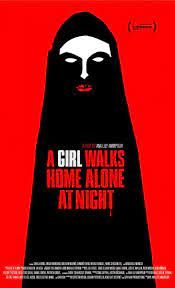
Saturday Matinee: A Girl Walks Home Alone at Night

By Jonathan Romney

Source: Film Comment

A term beloved of French film critics—and one I never tire of borrowing, just because it pinpoints its referent so well—is OVNI, meaning “UFO.” It’s used to refer to a film, usually a first feature, that’s next to impossible to categorize, that seems to have come out of nowhere, to have been made entirely against the odds—a film that appears to originate if not actually from other planets, then from some parallel cinematic dimension where the usual rules don’t apply.

Little could qualify more for OVNI-dom than an “Iranian vampire Western,” as Ana Lily Amirpour’s first feature has been dubbed. In fact, the skewed quality of A Girl Walks Home Alone at Night is accentuated by the fact that it both is and isn’t “really” Iranian. That is, the film is in Farsi, and stars a cast of Iranian or Iranian-American actors, but was shot in California, not far from Bakersfield, where writer-director Ana Lily Amirpour grew up. Taft stands in for Bad City, as the subtitles call it—or “Shahr Bad,” which may possibly be a Farsi play on words—a run-down, isolated burg where weird things happen by night, and nothing too ordinary takes place by day.

The Girl of the title (Sheila Vand) is a gamine-ish music fan who likes to dance alone in her poster-decorated den. But when she steps out onto the streets, she’s not the imperiled victim that the title—misleadingly, cleverly—would have you expect. She’s a figure of menace: a marauder who wears a chador over a very Gallic stripy matelot top, adding a curious dash of indie-kid chic to her image as a ghost figure who glides rather than walk. In fact, her gliding gait comes from the fact that she’s commandeered a terrified child’s skateboard. Spreading her robe like black wings, the Girl haunts the night like an Islamic descendant of Musidora’s Irma Vep, lawless masked heroine of Louis Feuillade’s silent serial Les Vampires.

The Girl is indeed a vampire, and more than a match for supposedly the scariest presence on this city’s mean streets—thuggish drug dealer Saeed (Dominic Rains), who has “SEX” tattooed across his neck, a sleazy drooping moustache on his chops, and a pad filled with big-bad-hunter tat (deer’s heads, tiger-print throws…). The predatory Saeed practically licks his chops at the thought of feral sex when the Girl’s canines pop out to full length with an almost comical sound effect; he doesn’t look so happy once she snaps his finger off.

The Girl can be downright terrifying: the young boy who loses his skateboard probably hasn’t done anything to merit being chilled to the bone by her, when she leans in to ask him if he’s been good, then warns him (in one of the most authentically ghoulish horror-movie rasps since Mercedes McCambridge did voice duty for Linda Blair), “I can take your eyes out of your skull and give them to the dogs to eat.” We don’t, by the way, see the dogs of Bad City, but the local cat is unsettling enough: a naturally charismatic starer which looks like it’s taking a break from sitting in a Bond villain’s lap, and which gets the best close-up in the film.

Meanwhile in Bad City, a devilishly handsome young man named Arash (Arash Marandi) is coping with the depressed excesses of his overweight junkie dad Hossein (Marshall Manesh), and working as gardener and handyman to a rich family whose spoiled daughter, the recent recipient of a nose job, sees him as her latest toy.

Things take an overtly comic turn when Arash—something of a sweet-natured dork despite his quiffed rebel demeanor—attends a Halloween party as Dracula. Walking home the worse for wear in a too-baggy cape and really ill-fitting fangs, he meets the Girl, who “lures” him to her den—or rather, wheels her decidedly floppy prospective beau back to her place on the skateboard. Things turn romantic, at once chastely and very sensually, in a beautiful extended take, as Arash approaches her and she closes in—not, as you’d expect, on his neck, but on his chest. It all happens in swoony slow motion, but with a mirror ball spinning round and filling the room with sparkles at crazy speed: a magnificent, and inexplicably romantic, paradox of pacing that adds to the eerie romance of the scene.

The couple later tryst at dead of night at the local power plant, itself lit up like a jeweled city. Why at the power plant? For the chiaroscuro, of course—that seems to be what motivates Amirpour most. This is one of those films that are shot in black and white because a director is genuinely in love with the affective and expressive possibilities of that visual choice, and especially with its ability to draw magic out of night scenes: I’m reminded of another piece of black-and-white small-town dream romance, Eric Mendelsohn’s Judy Berlin (99), which used an eclipse as the narrative excuse for its midsummer night’s encounters. In her own nightscapes, Amirpour doesn’t mess around with half-measures: DP Lyle Vincent saturates his shadows with the inkiest of blackness (as does the graphic novel that Amirpour has created to accompany the film).

A Girl Walks Home Alone at Night is a wayward, genuinely oneiric creation—look at its sudden arresting focus-pull on some oil derricks, and its graceful, gratuitous interlude of a transgender cowgirl figure dancing with a helium balloon. It manages to be tender, chilly, comic, and willfully bizarre all at once, but never has you wishing it would choose one register and stick to it. In his very enthusiastic recent review, David Thomson invokes not only David Lynch, but Vigo, Cocteau, and Buñuel, no less. Perhaps more modestly, A Girl Walks reminded me most of early Jarmusch, and of the general spirit of  late-Seventies/early-Eighties punk-influenced U.S. cinema (names like Scott B and Beth B, Amos Poe, Slava Tsukerman of Liquid Sky), because of Amirpour’s brisk disregard for genre norms, for the sense that she’s up for telling whatever story she wants to tell, any way she wants to tell it. While manifestly very polished and composed, the film nevertheless gives the impression that it’s making itself up—or dreaming itself into being—as it goes along.

There’s an oddly innocent blazing-youth romanticism about it, especially when the Girl and Arash bond over music. That feeling comes across all the more strongly because non-Farsi speakers will depend on the subtitles: it adds a tender but absurd irony to the revelation that the last song the Girl listened to was, of all things, Lionel Richie’s “Hello.” Fortunately, there’s cooler stuff on the soundtrack: the Tom-Waits-in-Tehran opening number by Iranian band Kiosk, and some Morricone-ish fanfare by Federale, a group from Portland.

A Girl Walks Home Alone at Night is bound to cause a stir in academic circles for the way that it blurs its Eastern and Western codes so thoroughly: making manifestly American settings stand in for an imaginary Iran, playing provocatively on the chador as Islamic garment and as vampire-cape substitute, having its heroine at once tender lover and murderous monster in a way that neither Anne Rice nor Stephenie Meyer would quite recognize. Overall, Amirpour’s film feels like an elaborately punkish code-scrambling gesture rather than a fully formed organic statement, but that doesn’t matter—it has style, grace, and imagination, and as artistic gestures go, could hardly be more devil-may-care. By the time it takes a final Aldrich-esque drive into the shadows, A Girl Walks Home has more than earned your attention—and got you wondering where that shadow-steeped road leads, either for its romantic duo or for Amirpour as audacious writer-director.

Watch A Girl Walks Home Alone at Night on Kanopy here: https://www.kanopy.com/product/girl-walks-home-alone-night

Saturday Matinee: 1984

A scary reminder of how easily totalitarian ideas and ideals crop up in societies and take fierce hold.

Film Review by Frederic and Mary Ann Brussat

Source: Spirituality & Practice

Winston Smith lives on Airstrip One, a part of Oceania. He resides in a shabby one-room apartment where his movements are monitored by a two-way telescreen. Winston works for the Ministry of Truth, where he rewrites history according to the party line.

Big Brother dominates the lives of Oceania citizens through psychological manipulation via the media. The totalitarian state seems to be in a constant state of war with either Eurasia or Eastasia. Hate rallies are designed to encourage allegiance to Big Brother; dissenters are publicly executed; and natural sexual behavior is forbidden.

Winston defies the authorities when he begins keeping a diary of his feelings. He goes a step further by beginning a love affair with Julia, another rebellious individual. O’Brien, a member of the privileged Inner Party, befriends Winston but later betrays him. The maverick is taken by the Thought Police to the Ministry of Love. Then in the notorious Room 101, O’Brien proceeds to torture and brainwash Winston. His ultimate goal is to replace the man’s love for Julia with love for Big Brother.

This screen version of 1984 is unrelentingly grim and ominous. Airstrip One seems more like a dank and dreary prison than a city. John Hurt is just right as Winston Smith, a stubborn individualist who refuses to reduce his life to a series of reductive slogans. Despite the haggard look, this British actor vividly conveys his character’s inner fire. Suzanna Hamilton plays Julia as flinty outsider who savors sex and sees it as a sacrament. In his final screen performance, Richard Burton plays O’Brien with convincing clout; he is an efficient bureaucrat whose cool demeanor masks an ugly love of raw power.

Although screenplay writer and director Michael Radford (Another Time, Another Place) gives the drama’s ending a twist that goes against the grain of George Orwell’s 1984, this intense film version of the book succeeds very well in depicting the totalitarian tendencies which tend to crop up in societies all over the world. The human spirit is violated when war is made into a vehicle for peace, when truth is twisted into disinformation and language is turned upside down; when loyalty to the state is built upon paranoia and neighbor begins betraying neighbor; and when surveillance takes away personal privacy and makes all dissent a crime. While many refuse to acknowledge the present reality of this Orwellian nightmare, others know that creeping totalitarianism thrives best when it moves quietly in the shadows.

Watch 1984 on Hoopla here: https://www.hoopladigital.com/title/11080278

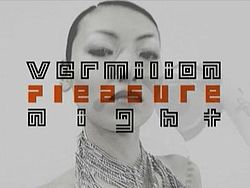
Saturday Matinee: Vermilion Pleasure Night

“Vermilion Pleasure Night” (2000) was a Japanese late night variety show incorporating live-action and animated skits that run the gamut from surreal, sexy, profane, disturbing and satirical. Director Yoshimasa Ishibashi is an acclaimed artist whose installations have been featured at New York’s MOMA and London’s Tate Modern.

This premiere episode provides a sample of the recurring vignettes featured throughout the series including the Fuccon family (a dysfunctional family of smiling mannequins), Starship Residence (chronicling the misadventures of an alien bachelor and his neighbors), One Point English Lessons (a satire of English language learning programs), Midnight Cooking (a macabre musical cooking show), Cathy’s House (a live action skit evoking the setting and aesthetics typical of Barbie dolls), and random short scenes directed in the style of David Lynch films.

Saturday Matinee: Cold Case Hammarskjöld

Review: COLD CASE HAMMARSKJÖLD, Pretzels of Truth and Performance Art

By Kurt Halfyard

Source: Film Anarchy

“This could either be the world’s biggest murder mystery, or the world’s most idiotic conspiracy theory.”

Two years before the JFK assassination, on the 18th of September 1961, the world was shocked by the suspicious death of the second serving Secretary-General of the United Nations. In a plane crash in Ndola, Rhodesia, Dag Hammarskjöld was the only person on board not horribly scorched in the ‘accident.’ Instead he was bloodied, and a playing card was tucked in his shirt collar.

Nearly six decades later, the UN is still (nominally) investigating the details of what was thought first thought to be an accident, then a targeted assassination, of a man who had designs on the political and financial independence of the African continent. In fact, U.S. President John F.  Kennedy himself described the Secretary General as “the greatest statesman of our century.” The assassination theory holds several motive possibilities – various industrial interests active in the region (both then and now) or various clandestine military or mercenary operations taking orders from the US, the UK and Europe who had designs at odd with the ‘activist’ Secretary General.

There are crimes, and then there are crimes. Outside of the small circles of Denmark Television or offbeat cinephiliia, Mads Brügger is criminally unknown. The journalist, comedian, satirist, filmmaker, but above all, provocateur, has been twisting the documentary form into pretzels of truth and performance art for more than a decade.

In 2006, he toured an autistic theatre troupe though North Korea, cascading through a collection of political handlers and bureaucrats, to make a point about propaganda and totalitarian fear imposed on the so-called Democratic Peoples Republic of Korea. As if that stunt, The Red Chapel, was not fraught with enough risk, he then purchased illegal diplomatic credentials from the Central African Republic (CAR) to set up his own personal blood diamond operation (under the front of a match factory whose product would be manufactured by the local Pygmy population). By the time The Ambassador wowed Sundance attendees (and yours truly) in 2011, several of the ‘characters’ in the film, political figures in the CAR, had disappeared or been killed.

The Danish filmmaker takes large risks, some might say indefensible ones. Along with his countryman Lars Von Trier (whose outfit Zentropa produced The Ambassador), Brügger keeps plenty of his own skin in the game of his cinematic endeavours — for the sake of your education, and entertainment. He is a hell of a talented filmmaker.

With Cold Case Hammarskjöld, things go the full Errol Morris (WormwoodA Wilderness of Error) investigation route. With the help of Göran Björkdahl, a Swedish activist/investigator who is in possession of the only part of Hammarskjöld’s plane that was not buried under the soil of the Ndola airport, Brügger uses every trick in the documentary playbook: re-creations, animations, historical footage, official and redacted document scavenging, and a lot of interviews with people who where sidelined, ignored, or simply unknown at the time.

Above all, Brügger recreates, in glossy cinematic terms, himself making the documentary itself. Form as function, as with any good conspiracy theory, things start to fold back on themselves in increasingly avant garde ways.  

But there is purpose in this narrative trickery. By filming himself, twice, it offers Brügger the storyteller the opportunity to rope a Zodiac-level ‘filing cabinet ‘of names, facts, dates, and political organizations, together into a ‘lean in’ yarn of far reaching proportions. Two hundred old Secret Marine Societies, megalomaniac villains dressed in white, biological guerrilla warfare, the fallout of Apartheid, World War II fighter aces, assassins leaving Playing Cards in their victims’ collar, and of course, the fate of both a continent, and a fledgling World Government Body are all tethered together.

To say that the film’s 128 minutes is dense, is an understatement. Via this experimental technique (which of course the filmmaker acknowledges, in somewhat of a mea culpa, at one point) along with some pretty detailed, rational, detective work, makes the whole thing as seductive and addicting as Serial or The Staircase.

At one point, Michael Moore-style, Brügger and Björkdahl arm themselves with a high powered metal detectors, shovels, and a cigar (in the off chance they are successful), and go scouring the back-fields of the Ndola airport looking for the 50+ year old burial site of the plane. The authorities arrive. They are polite, but firm, regarding this activity. You are simply not welcome to do this kind of digging.

Cold Case Hammarskjöld has caused a stir in ‘papers of record’ such as The New York Times and The Guardian, reacting to the film compelling presentation and investigation of SAIMR, the South African Institute for Maritime Research, and its quack doctor, Lord Nelson cosplaying Commodore, Keith Maxwell, the “man in white”, who is said here of not only co-ordinating the murder of Dag Hammarskjöld, but also weaponizing AIDS virus for genocidal purposes, and ostensibly participating in bad amateur theatre.

The former may have been at the behest of the CIA and MI6, the latter was on his own personal time. Maxwell was a surreal combination of L. Ron Hubbard, and Colonel Kurtz, and Brügger condemns, mythologizes, exposes, at several points even mimics, him in the way only larger than life cinema can.

If there is a signature image across several of the films of Mads Brügger, it is that of an impeccably dressed man, wildly out of place, sitting on a skinny boat drifting on the current of a wide, and fast moving body of water. Here it is Göran Björkdahl, no closer to the truth of the matter, but still floating on the river of possibilites. We have learned things, both true and untrue, along the way.

Cold Case Hammarskjöld is the most engaging (and entertaining) documentary of the year.

Watch Cold Case Hammarskjöld on Kanopy here: https://www.kanopy.com/product/cold-case-hammarskjold

Saturday Matinee: Koyaanisqatsi

Source: Koyaanisqatsi.org

KOYAANISQATSI, Reggio’s debut as a film director and producer, is the first film of the QATSI trilogy. The title is a Hopi Indian word meaning “life out of balance.” Created between 1975 and 1982, the film is an apocalyptic vision of the collision of two different worlds — urban life and technology versus the environment. The musical score was composed by Philip Glass.

KOYAANISQATSI attempts to reveal the beauty of the beast! We usually perceive our world, our way of living, as beautiful because there is nothing else to perceive. If one lives in this world, the globalized world of high technology, all one can see is one layer of commodity piled upon another. In our world the “original” is the proliferation of the standardized. Copies are copies of copies. There seems to be no ability to see beyond, to see that we have encased ourselves in an artificial environment that has remarkably replaced the original, nature itself. We do not live with nature any longer; we live above it, off of it as it were. Nature has become the resource to keep this artificial or new nature alive.

That being said, my intention in-other-words, let me describe the bigger picture. KOYAANISQATSI is not so much about something, nor does it have a specific meaning or value. KOYAANISQATSI is, after all, an animated object, an object in moving time, the meaning of which is up to the viewer. Art has no intrinsic meaning. This is its power, its mystery, and hence, its attraction. Art is free. It stimulates the viewer to insert their own meaning, their own value. So while I might have this or that intention in creating this film, I realize fully that any meaning or value KOYAANISQATSI might have comes exclusively from the beholder. The film’s role is to provoke, to raise questions that only the audience can answer. This is the highest value of any work of art, not predetermined meaning, but meaning gleaned from the experience of the encounter. The encounter is my interest, not the meaning. If meaning is the point, then propaganda and advertising is the form. So in the sense of art, the meaning of KOYAANISQATSI is whatever you wish to make of it.

This is its power.

Watch Koyaanisqatsi on Kanopy here: https://www.kanopy.com/product/koyaanisqatsi-0

Saturday Matinee: J.R. “Bob” Dobbs and the Church of the SubGenius

Review By Steve Davis

Source: The Austin Chronicle

You couldn’t escape his ubiquitous mug back when Austin was truly weird. It appeared on bumper stickers, bulletin boards, telephone poles, streetlights, bathroom walls, and more: A perfectly coiffed and lantern-jawed 1950s dad, his perfectly straight teeth clenching a pipe in an ear-to-ear grin worthy of Ward Cleaver. Although his face archetypically evoked white, middle-class, heterosexual Christian conformity, J.R. ‘Bob’ Dobbs (note the mandatory quotation marks) served as the symbol of something completely different from post-war homogeneity. He was the appointed figurehead of the Church of the SubGenius, a somewhat wacky “religious” (more quotation marks, but subjectively imposed) organization formed to counter the “conspiracy of normalcy” pervading American society. Initially hatched in the playfully demented minds of two Dallas-area merry pranksters, Reverend Ivan Stang and Dr. Philo Drummond (née Douglass St. Clair Smith and Steve Wilcox, respectively), in the late Seventies, the Church was intended as a dogmatic antidote to a re-emergent mediocrity, embracing an aesthetic in confluence with evolving new wave sensibilities and tropes in music, film, and pop culture. It was an in-joke with a half-serious punchline.

The image christened ‘Bob’ first appeared in a 1979 DIY pamphlet that asked readers questions like “Are You Abnormal?” and announced “The World Ends Tomorrow AND YOU MAY DIE!” before soliciting a dollar subscription fee for this new fringe theology masquerading as performance art and satire. (Or was it performance art and satire masquerading as fringe theology?) Afterwards, non-conformists everywhere (including the band Devo, magician Penn Jillette, film director Alex Cox, and actor Paul “Pee-wee Herman” Reubens) began to jump on board and the Church ended up becoming, inexplicably or not, a phenomenon of sorts, making the indefatigable ‘Bob’ the first piece of clip art to lead a world-wide congregation.

The deftly executed documentary J.R. ‘Bob’ Dobbs and the Church of the Subgenius demonstrates great affection for Bob and his acolytes, many of whom enthusiastically relate the Church’s mythology, history and doctrine here with a nostalgic sentimentality usually reserved for reckless-youth silliness. (Full disclosure: the film was executive produced by Chronicle co-founder Louis Black.) Their monikers set the tone – Reverend Susie the Floosie, Nurses Vicki and Kelly, Papa Joe Mama, Dr. Howland Owll, and Reverend Dr. Onan Canobite, among others. Special mention must go to a delighted Arch Doctor Saint Margaret, the late and sorely missed Margaret Moser, Austin Chronicle music columnist and legendary Texas Blonde. These eager talking heads – including the aforementioned Messrs. Stang and Drummond—discuss the early anarchic gatherings of the SubGenius faithful at so-called “devivals”, attempt to explain the undefinable zen of “Slack” that all church members strive for, recount Bob’s infamous assassination onstage at San Francisco’s Victoria Theatre (catlike, he has many lives), and recall the prophecy of the Rupture, when (7 a.m., July 5, 1998, to be exact) Church members would rise up against the norms who’ve robbed them of Slack and ascend to pleasure saucers piloted by alien sex goddesses. (Like most patriarchal sects, the Church skewed towards a boy’s club mentality.) It all sounds fantastic. And it is, in every meaning of the word.

Director Boone and her crew make good use of those interviews, as well as grainy film footage and subliminal imagery, to document the story of Bob and his Church, which still thrive albeit to a much lesser degree, despite challenges that include competition from the internet, cult-related tragedies like the Columbine massacre, and some negative press (deserved and undeserved) over the years. While some question whether there’s any room left for relatively benign organizations like the Church of SubGenius in this hardcore conspiracy-driven world, the documentary ends with the hope there will always be a place for nonthreatening weirdos to worship. To those naysayers who disagree, I quote from the Scripture of Bob: “Fuck ’em if they can’t take a joke.”

Watch J.R. “Bob” Dobbs and the Church of the SubGenius on Kanopy here: https://www.kanopy.com/product/jr-bob-dobbs-and-church-subgenius

Saturday Matinee: Cops vs. Thugs

Cops Vs. Thugs — No Honour Among Thieves (or Cops)

By Ben Warnock

Source: Ben Warnock Blog

“Yakuza and cops are just the same. We respect the law instead of a code. We’re the dropouts who couldn’t get good jobs.”

“We too are the dropouts of society. We all are!”

Kinji Fukasaku’s yakuza films are perhaps best described as being surrounded by an almost impenetrable, bleak aura of despair and nihilism. The cops who are supposed to be the protectors of the people are corrupt to the core, Fukasaku basically presents them as a mercenary force — one that can be bought if the bid is high enough. Government officials often use the police to do their bidding and much like their underlings are as corrupt as they come. This damning indictment of these systems does not mean that the director sides with the yakuza — often portraying them as morally reprehensible criminals — whilst their code may be one of honour, post-war Japan has created a society that allows for greedy capitalists to gain power simply at the expense of sullying their morals and code. Those who stick to a code of honour become the dead that litters the senseless gang wars that follow. Corruption is a recurring theme throughout Fukasaku’s yakuza films and Cops Vs. Thugs is perhaps his most interesting example of this outside of his famous Battles Without Honour and Humanity series.

Much like the aforementioned series of films, Fukasaku looks to highlight the corrupting nature of power and that those who seek power are often those who are corrupted the easiest. The police of the film are split between those who are corrupt but perhaps honourable in their own, twisted way — as characterised by Bunta Sugawara’s Kuno whose corruption is described as a way of keeping the peace — and the new faction led by Kaida who is vehemently against collaboration with the yakuza. However, Kaida’s allegiances should not be mistaken as honourability as Fukasaku is certain to illustrate. Kaida’s behaviour humiliates his co-workers in public spectacles — including repeatedly using his judo skills on an elderly police officer — where his power is cemented amongst the other police officers. This damning indictment of the police is nothing new to the films of Fukasaku but here, the director highlights that those who seek the position of a police officer are those who are power-hungry and susceptible to corruption from many outside forces. As Sugawara’s Kuno states when asked why he became a cop:

“I wanted to carry a gun. After the war only cops and narcotic agents could carry guns….we were short of food…every time we tried to buy rice on the black market, the cops snatched it away. So I decided to be a snatcher”.

Unlike the famous notion that power corrupts, Fukasaku’s films prove that it is not power that corrupts but it is in the nature of those who seek positions of power in a patriarchal, capitalist system to become corrupt. It is the damaged system’s cyclical nature that corrupts individuals.

The fates of those characters who have a shred of honour — Kuno and Kawamoto — ultimately end in tragedy. Kuno’s honour and trust in his friend Hirotani ultimately leads to his escape attempt and forces Kuno’s hand in killing Hirotani. Violence begets violence and Kuno — after being demoted and transferred as a reward for saving Kaida’s life — is killed by the remaining members of Hirotani’s gang. The yakuza honour forces them to avenge the death of their leader. Kawamoto, on the other hand, attempts to save his friend’s life by getting them to surrender and is gunned down by the very friend he tried to save. The honour and trust showcased have no place within the world of the police and the yakuza. Corrupt institutions whose original purposes have become eroded and replaced by pawns of the capitalist society they inherit. This ever-changing, impermeable alliance between characters is highlighted by Fukasaku’s camera. Battles devolve into a sweeping landscape of betrayal with snitches followed by the judging eye of the camera and gunfights where the action can barely be contained within the confines of the screen. Fukasaku’s frantic kineticism within these scenes is indicative of the disorientating landscape of unknown allegiances which these characters inhabit and thrive.

The world which is represented in Cops Vs. Thugs is one that is inherently damaged from its systems of government to its criminals whose honour and code have become meaningless in the current political landscape. The real threat presented to the governing officials is not the yakuza who seek to exploit the corrupted system but a change in ideology that would bring the system crashing down. Fukasaku even highlights this own threat with the police officer whose entire character consists of his hatred of communists even ahead of the very criminals that are terrorising the streets he is meant to protect. Fukasaku’s (literal) red herring of communism here is one that rewards those who buy into the paranoia. The anti-communist officer is inexplicably a member of Kaida’s team and Fukasaku ensures that he is the first officer seen to be arresting the yakuza once they surrender. This perhaps explains that Kaida’s corruption does not lie with the yakuza but the capitalist government which seeks to strengthen its own resolve within society. The film’s epilogue showing the demotion and untimely fate of Kuno also highlights that Kaida is now a leading figure in Nikko Oil — a company that was mentioned to be corrupt as well. Hiding behind a facade of friendly exercising with his co-workers — Fukasaku pulls out from a close-up to a wide shot allowing the audience to realise that this corrupt institution is just one of many within the industrial landscape. Corruption does not just lie with the police working with the yakuza but also — and more dangerously so — lies with the police collaborating with the government.

Watch Cops vs. Thugs on Kanopy here: https://www.kanopy.com/product/cops-vs-thugs-0

Saturday Matinee: The Prisoner: Arrival

Perfect Pilots: The Prisoner “Arrival”

By John Bernardy

Source: 25 Years Later

A man resigns from his previous post. He is followed and taken captive into a surreal resort town. He tries his best to escape over and over but the location proves inescapable. But the man never backs down from the challenge. He will not conform to his prison. He will escape it.

This is The Prisoner. And this is its pilot.

The adversaries in the Village want the main character to answer this question: “Why did you resign?” They’re not interested in facts and statistics because they have plenty of those. They’re interested in the reasons behind the events—the hard-to-quantify process an individual goes through as they make decisions.

We learn the main character—most often referred to as Number Six—draws this line in the sand: “I will not be pushed, filed, stamped, indexed, briefed, debriefed, or numbered. My life is my own.”

That, ladies and gentleman, is The Prisoner’s main conflict. Six thinks in terms of conformity versus individualism. The Village thinks in terms of security and power at all cost versus breach of security.

In this pilot episode we are introduced to the Village—its physical boundaries and its social ecosystem—and we learn how long Six could be trapped in it. We meet some of the people who run it and why they’re interested in keeping Number Six under their thumb. We see an escape plan and we see that the main villain, Number Two, is easily replaceable with different actors. We also see how the other villagers are pawns for whatever the Village wants of them. There is a lot of world-building necessary to understand The Prisoner’s high-concept premise yet it does so organically, with minimal words, and all within 49 minutes.

By the end of this pilot episode, it’s hard to decide if Number Six should trust anyone. It’s even difficult to know for sure if Number Six deserves our trust, but compared to how inhumanely the Village treats people with its ends-justify-the-means methods, Six sure behaves like one of the good guys. The one thing that you do understand, however, is Six’s situation. Fight at all costs and escape. Remain an individual. The Prisoner is a moody show about big ideas such as privacy and surveillance, and you understand this struggle well after just one episode.

That is an achievement all by itself, yet the camera work is worthy of its own discussion. It is visually stunning and surreal. When Six is disconcerted and making his first escape, we see rapid camera cuts between him moving through a “garden” and statues turning as Six moves past them.

There’s similar frantic camera work as Six looks around the #6 apartment for the source of the omnipresent classical music filling his room. You could tell how necessary it was for Six to have the option to turn that radio on and off himself. The show regularly makes the viewer feel the interior space of its characters without saying a word.

The show is purposely quiet. We don’t get a word of dialogue (counting the opening credits sequence) until four minutes in. Every chance it gets, The Prisoner shows rather than tells. Its ethos is baked into every stage of the show, and I’m glad that holds true with its dialogue.

I’ll show you with my subheadings how organically information is revealed to us over the course of this episode.

The Main Character Resigns

Each week, the show opens with the main character—played by auteur show-creator Patrick McGoohan—driving his Lotus into a parking garage. He walks down a hallway and announces something to a man behind a desk. There are no words in this sequence but the character is grandstanding—emphatic and demanding. Then he storms out and drives away while a file with his picture is being typed over with “X”s. The word “resigned” is shown. The main character heads home and begins to pack quickly, but a man in a top hat has been following him and gasses the main character’s apartment. The next thing we see is McGoohan’s character waking up in the new location.

The Village Gets Its Name

The room looks identical to the flat in London, except the view outside the window is of the eccentric buildings found in Portmeirion, Wales. Not that we knew that at the time; the resort town was not listed by name until The Prisoner’s final episode. Not even viewers knew where this location was.

We get a minute and a half of the disoriented main character searching for people he’d seen off in the distance. We finally get dialogue when he comes across a woman setting up an outdoor café. After being rebuffed a few times for his question, “where is this place?” she finally tells him, “the Village.”   

Local Service Only For This Multinational Operation

The café worker tells the main character where to find a phone but he can’t use the service without a number. He takes a taxi, which is basically a golf cart, and the driver speaks to the main character in English and French, proving they deal with multiple nationalities there. She also tells him that she only does local service inside the Village, just like the phone system. She takes him to a general store where he tries to buy a map. The small map looks like this:

The larger map is the same image, only bigger and in color. There is no way to pinpoint where The Village is in relation to the rest of the known world.

An Announcement System Tells You How to Feel about the Day and Doors Tell You to Enter Them

The main character leaves the store and a nearby speaker broadcasts (in Fenella Fielding’s voice, as always) about how today is another beautiful day. He returns to the room he woke up in. There is a “6” on its sign and the door opens automatically for him, beckoning him to enter.

The main character looks out his window and sees a maid walking away from the place. Absolutely nothing is left to the individual’s responsibility in the Village, and this is told to us with action rather than exposition.

Six Gets His Title and Number Two Is the Adversary

The phone rings and a man’s voice declares him “Number Six” and that he should stop by to get acquainted. “Number Two, Green Dome,” the man says.

“Pop Goes the Weasel” is a musical cue referenced in the soundtrack as the main character heads to the Green Dome. This cue will be referenced regularly and, in my interpretation, seems to be related to the logical conclusion of the Village’s method of ruling.

When the main character arrives, the unnamed butler (Angelo Muscat) opens the door and takes him into Number Two’s chamber.

Intimidation by Breakfast: The Village Knows Everything about Their Prisoners

Number Two asks Six what he’d like for breakfast. As Six answers him, the butler immediately uncovers the exact choices as asked for. The Village keeps track of the most normal behaviors and shows that they know how predictable people are.

Yet Number Two does not know why Six resigned. The information inside Six’s head makes him a valuable commodity to many different parties. This tells us that Six knows important secrets. The Village needs to protect these secrets from falling into the wrong hands. We do not, however, learn the Village’s allegiances.

This is the entire crux of the show’s conflict. If Six reveals his motives, the Village will get what they want. If Six does not reveal his secrets and escapes, he maintains his individuality and achieves his goal.

Over the course of Six and Two’s battle of words and wills, we are shown that the Village has multiple pictures of Six’s littlest decisions from before his capture. They surveyed every part of his life before he was captured.

A Helicopter Tour Reveals the Time Frame of a Sentence

In addition to Six revealing why he resigned, Number Two wants him to conform to the Village’s rule. It will help them break him. To that end, they take a helicopter tour of the Village grounds. It serves as exposition for viewers, but it’s organic and there’s a bite to it. There’s a council building where villagers put on amateur theatrics, implying that the villagers are expected to be there a while—but how long? Number Two points out that they have their own graveyard. It sounds like a standard town detail, but the threat is clear.

People Make the Choice to Conform or Face Rover

After the characters land, Six walks around the village and notices how extremely happy everyone appears. He has a conversation with Number Two, even though Two is across the square from Six using a bullhorn and everyone is listening. Yet the villagers appear completely oblivious until Two says “be still!”

Everyone freezes in place except for one man who freaks out. He is then chased by a creepy white bubble. We learn later that its name is Rover but when Six asks, “what’s that?” Number Two only says, “That would be telling.” The Village thinks it holds all the cards. They need not reveal anything, but they must know everything.

These people in the village square had a choice to come around to Number Two’s way of thinking: the choice to survive through conformity or die as a free thinker.

Six Refuses to Conform and First Speaks of Escape

Two takes Six to the labor exchange where they test Six to conform him to a role within the community. Inside we see creepy signs on the wall such as this one: “Questions are burdens to others. Answers a prison to oneself.”

True to form, Six refuses to answer the overly invasive questions asked of him. Therefore, he is not assigned a job; instead, he goes home.

He kicks the maid out because he doesn’t want the Village doing anything for him. He also searches everywhere for the music filling his house. He did not turn it on himself, therefore it must go. An announcement call for radio repair happens just as Six destroyed his radio speaker, showing the extent to which he is under surveillance.

The maid then returns and Six begins to grill her about whether anyone has ever escaped the Village. She is visibly uncomfortable with this. She also pleads with Six to tell her his secrets so she can get what she wants in return. It’s official: all the villagers work for the Village on all levels. It’s also official that Six is always being watched. This scene is being broadcast on a giant screen in the creepy camera room where both the unnamed director and Number Two are watching it play out.

This reinforces that Six is an important person with particularly special information in his head. Only necessary force is sanctioned, nothing extreme.

The Hospital Reveals the Extent of the Village’s Methods for Conforming

Six leaves his apartment and sneaks through the garden with the unnerving statues I described earlier. He sneaks past Rover, but the director is calling Station 14 to collect Number Six before his escape is finalized. Two men catch up with him on the beach and Six wins a round of fisticuffs. It takes Rover to stop him.

Six wakes up in a hospital with a creepily pleasant woman watching over him. When she leaves to get the doctor, Six notices an old colleague, Cobb, a few beds down. Then men exchange a few sentences and it’s revealed that Cobb is in the same boat as Six. But before anything else can be said, the doctor collects Six for his physical.

On the way, Six witnesses what group therapy looks like in the Village:

We hear Number Two conversing on the phone with an unknown party about Six’s progress, and we also learn that Six’s old clothes have been burned. The only clothes he has now are from the Village. Also, Cobb is declared dead after having jumped out a window, taking away an avenue of answers for Six.

The first thing Six does as he leaves the hospital is ditch the hat and his number badge. Then he makes an abrupt visit to the Green Dome.

The First New Number Two

Six wants answers from Number Two, but instead all he learns is that a different man wears the badge and sits in the office now. He announces himself as the new Number Two.

In the first episode, we learn that the power of the office is more important than the power of the individual in that office. You have to applaud the Village for message consistency.

The face may change, but the goal remains the same. The new Number Two is all business and matter-of-factly says, “I need facts.”

Six’s First Escape Plan

Back at his apartment, Six sees Cobb’s funeral procession and meets a villager woman who appears conflicted about the whole thing. They talk about Cobb, and how she and Cobb had a plan to escape but the Village got to him before they could enact it. In the episode’s final 12 minutes, she decides to help Six escape in the same manner.

Six sees her leave the Green Dome later on but he doesn’t know he wasn’t her assignment before then. She wants to help him anyway and tells Six they’re onto him so they have to move fast. He trusts her enough to try the plan. She gives him the device that will activate a helicopter. He moves past a suspicious Rover, gets in the helicopter, and takes off.

It looks like it’s going to work—at first—but then a villager tells the woman that she should learn to play chess, “because we’re all pawns, m’dear.” It looks like the woman was trustworthy after all. She was just playing a game rigged against her.

At that moment, the Director uses a remote control to bring Six’s helicopter right back to where it started.

Escape Is Predetermined to Fail

It turns out that Cobb was part of a plan to manipulate Six into revealing his secret. Send in someone he trusts from outside. Make Six feel that they’re in the same situation. Let them commiserate. What are you in for? Same thing you are, what secret are you holding onto?

But it didn’t work, and Cobb is not surprised by this. He says as much to the new Number Two, declaring Six a challenge for the Village. Not only do we know Six is seen as important, now we know he is seen as a formidable opponent.

Yet the episode still ends with the face of Six coming towards the screen, before prison bars slam shut on him before he can get to us. He did not escape, but they did not break him. Stalemate. This is the kind of victory we get in The Prisoner.

Who Is Number Six?

There are clues to this question’s answer: McGoohan played spy John Drake on his previous show, Danger Man. Most people think this is that character continuing into a new story. Another clue: when Six tells Number Two his birthday, the shot is of Patrick McGoohan right in front of the camera, telling us his own birthday. Is this show that meta? I would believe it.

We don’t know what occupation Six held in his previous life. He could be a spy, a politician, a scientist. He could have some other kind of job entirely, maybe in the military. We understand well the world he is in now, but we don’t know who he is or, for that matter, who his captors are. As Cobb—the only person with a spoken name—left the show for other masters, there’s a distinct feeling that names don’t belong on this show and they get ushered out the second we learn one.

Even though we may never know the names of characters, we understand the high concept and dynamic of Six’s struggle fairly well. This is a major victory of The Prisoner’s pilot, especially considering how out-there this concept was when it debuted in 1967.

What is the pilot’s other victory? It makes you need to watch the other 16 episodes. Get on it!