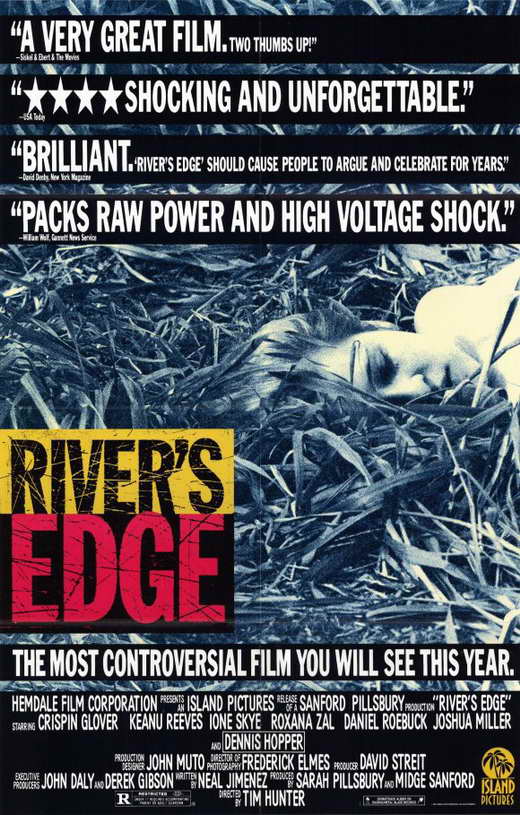
I remember reading about the case at the time. A high school kid killed his girlfriend and left her body lying on the ground. Over the next few days, he brought some of his friends out to look at her body, and gradually word of the crime spread through his circle of friends. But for a long time, nobody called the cops.
A lot of op-ed articles were written to analyze this event, which was seen as symptomatic of a wider moral breakdown in our society. “River’s Edge,” which is a horrifying fiction inspired by the case, offers no explanation and no message; it regards the crime in much the same way the kid’s friends stood around looking at the body. The difference is that the film feels a horror that the teenagers apparently did not.
This is the best analytical film about a crime since “The Onion Field” and “In Cold Blood.” Like those films, it poses these questions: Why do we need to be told this story? How is it useful to see limited and brutish people doing cruel and stupid things? I suppose there are two answers. One, because such things exist in the world and some of us are curious about them as we are curious in general about human nature. Two, because an artist is never merely a reporter and by seeing the tragedy through his eyes, he helps us to see it through ours.
“River’s Edge” was directed by Tim Hunter, who made “Tex,” about ordinary teenagers who found themselves faced with the choice of dealing drugs. In “River’s Edge,” that choice has long since been made. These teenagers are alcoholics and drug abusers, including one whose mother is afraid he is stealing her marijuana and a 12-year-old who blackmails the older kids for six-packs.
The central figure in the film is not the murderer, Sampson (Daniel Roebuck), a large, stolid youth who seems perpetually puzzled about why he does anything. It is Layne (Crispin Glover), a strung-out, mercurial rebel who always seems to be on speed and who takes it upon himself to help conceal the crime. When his girlfriend asks him, like, well, gee, she was our friend and all, so shouldn’t we feel bad, or something, his answer is that the murderer “had his reasons.” What were they? The victim was talking back.
Glover’s performance is electric. He’s like a young Eric Roberts, and he carries around a constant sense of danger. Eventually, we realize the danger is born of paranoia; he is reflecting it at us with his fear.
These kids form a clique that exists outside the mainstream in their high school. They hang around outside, smoking and sneering. In town, they have a friend named Feck (Dennis Hopper), a drug dealer who lives inside a locked house and once killed a woman himself, so he has something in common with the kid, you see? It is another of Hopper’s possessed performances, done with sweat and the whites of his eyes.
“River’s Edge” is not a film I will forget very soon. Its portrait of these adolescents is an exercise in despair. Not even old enough to legally order a beer, they already are destroyed by alcohol and drugs, abandoned by parents who also have lost hope. When the story of the dead girl first appeared in the papers, it seemed like a freak show, an aberration. “River’s Edge” sets it in an ordinary town and makes it seem like just what the op-ed philosophers said: an emblem of breakdown. The girl’s body eventually was discovered and buried. If you seek her monument, look around you.
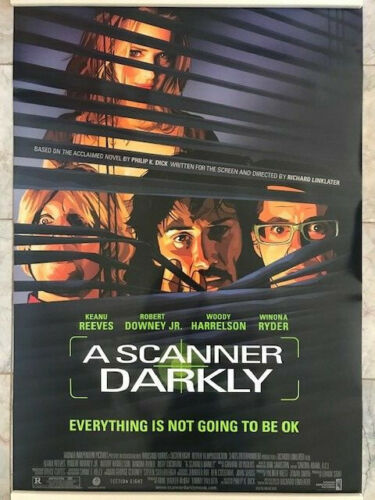
Based on the acclaimed novel by Philip K. Dick, Richard Linklater’s 2006 film of A Scanner Darkly presents a cautionary tale on drugs, surveillance, and perception in a unique formal arrangement. Set “seven years from now,” the film considers a tyrannical post-9/11 world oppressed by an ever-watchful government, widespread paranoia, corporate subjection, and pervasive pharmaceutical addiction—all elements further fuelled by the obsessive fear that governments, corporations, and even your friends conspire against you. Linklater’s decision to produce his film with rotoscoped animation turns his adaptation into one of the most visually and thematically original motion pictures in decades, and the most faithful of all Dick adaptations. The film’s world contains several Dickian existential and metaphysical dilemmas and paradoxes, from the notion of spying on oneself to becoming willing participants in one’s drug addiction. This unsettling and tragic world becomes deliciously skewed from the excessive filtering of surveillance technology and a crazed dystopian culture, so much so that it remains impossible to see anyone for who or what they really are. A Scanner Darkly beautifully, and chillingly, considers Dick’s persistent theme that our culture has destroyed its own ability to perceive objective reality.
Philip K. Dick was born in 1928 and became interested in science fiction at an early age. He attended the Berkeley, California, high school and graduated in 1947, alongside another future science fiction author, Ursula K. Le Guin, and briefly attended the University of California, Berkeley. He published his first science fiction story in 1951. From there on out, he would become one of the most prolific authors in his genre, publishing some 44 novels and more than 100 short stories until his death in 1982, just before the release of his first book-to-film adaptation, Blade Runner, based on his 1966 novel Do Androids Dream of Electric Sheep? Though science fiction was typically considered unsophisticated and a lower form of fiction, Dick’s caustic wit and social satires elevated sci-fi to the level of art. His self-proclaimed title was not that of an author but rather a truth-teller. He wrote his truth, and it consisted of a vast fictionalized philosophy, which some might argue was—and is—not necessarily fiction. His most enthusiastic followers might say his work is visionary, if not prophetic. Dick claimed his work spoke, and still speaks, to disturbed, troubled, and “off” members of society. His writing is for those who cannot rationalize society or reality: for those who need a satire, base, or frame of reference to rely on as coping mechanisms. Science fiction creates the desired satirical reality for readers, just as his characters in A Scanner Darkly see drugs as the only sane choice to escape the insane world.
Written in 1977, A Scanner Darkly stands as an ode to the drug counter-culture of Dick’s own Berkeley underground. But it’s also a thoughtful exploration of the metaphysical existence of drug users, as well as a mournful commentary on the government’s involvement in drug culture. Standing against the blatantly autocratic Nixon administration, marked by a reputation for undue suspicion and conspicuous surveillance, his Berkeley group purveyed conspiracy theories and widespread mistrust. And yet, this counter-culture also included a vast set of respected thinkers, unafraid to speak out—not just mindless stoners. According to an interview with French TV, Dick claims the group’s paranoia was not unjustified. During the interview, Dick speaks of secret CIA and FBI files on him, covert operations to get at his personal documents, and rampant spying led by the heads of various government organizations. To Nixon and his administration, the Berkeley group was an unknown element—a misunderstood collection of hippies seen through a distorted set of the administration’s famously paranoid views and political mechanisms. Fuelling this conflict between the two factions of Nixon’s administration and the Berkeley group, the author had a lifetime’s worth of experience with drugs, psychosis, and a slight case of schizophrenia. But in no way should those characteristics hinder the author’s message. Instead, Dick’s distinctiveness within the Berkeley group should reinforce that A Scanner Darkly may be more autobiographical than his other novels.
The story’s main character is Bob Arctor (Keanu Reeves), an addict of a drug called Substance D, also known as Slow Death. But Bob is also Fred, an undercover narc spying on Arctor’s group of Substance D-using friends. Arctor has lost sight of his identity because of Substance D, which chemically separates brain functions in the hemispheres; after prolonged use, the left and right sides of his brain are unaware of each other. Furthermore, the Fred portion of the main character must conceal his identity from his supervisors for his own safety. No one knows who Fred is; no one knows who Bob is—including himself. The sole man representing both the narc and the addict does not realize he is spying on himself, and in a way, informing on himself. This self-betrayal is tantamount to suicide, rendering him prey to both Substance D and the totalitarian police state that employs him. According to the novel, the drug is made from a flower called “mors ontological”—Latin for ontological death. To be sure, Dick saw first-hand the damage substance abuse caused his friends. He was not entirely unaffected himself; he relied on methamphetamines and psychedelics for much of his early career. But he weaned himself off drugs before writing this book. And at the very end of his novel, Dick dedicates his fiction to several friends who died or retained permanent physical and mental dysfunction due to excessive drug use (a dedication abbreviated at the end of Linklater’s film). He writes that users are punished excessively and even unknowingly for attempting to “play” with something dangerous.
So often, society deems drug users worthless or mindless junkies for their habits, but A Scanner Darkly—the story and the title itself—asks that we do not pass judgment until we can see, in its entirety, the role of users. However, because of the elaborate system of filters between our eyes and that which we wish to see, how can we ever trust that we see reality and not some malformed version of reality skewed through surveillance tools? These filters exist in the form of monitoring equipment such as cameras and scanners, but also the mind-altering Substance D. Drugs are the obscuring mechanism by which the narrative challenges audiences to accept and ultimately forgive the characters within. Throughout the film, viewers must accept drug use as a fact of the story rather than a downfall of the characters. The book’s title refers to a verse from the bible, namely 1 Corinthians 13: 11-12, a verse that is paradoxically read both at weddings and funerals:
For we know in part, and we prophesy in part. But when that which is perfect is come, then that which is in part shall be done away. When I was a child, I spake as a child, I understood as a child, I thought as a child: but when I became a man, I put away childish things. For now, we see through a glass, darkly; but then face to face: now I know in part; but then shall I know even as also I am known.
A pattern of dualism exists in this passage, particularly after its application to popular culture. Both in the novel and the film of A Scanner Darkly (not to mention Swedish director Ingmar Bergman’s film Through a Glass Darkly), the idea of childhood versus adulthood, known and knowing, and parts versus the whole, are circumscribed so that the reader or audience cannot reconcile metonym from metaphor.
Dick’s writing often tells of worlds that are not what they seem. With A Scanner Darkly, the world remains undefined, distorted through a complicated filtration process. Linklater magnificently captures that undercurrent through his use of rotoscoped animation. Throughout the narrative, we remain unsure about Reeves’ character’s identity—in part due to the setting’s massive use of surveillance technology. The protagonist is not altogether Bob, nor is he altogether Fred; he comprises several constructs that never assemble into a single, understandable symbol. Agent Fred watches Bob on numerous holo-scanners, located everywhere; scanners see every moment of every day in every location. Someone is always watching (or that is what they want you to think). Undoubtedly, there was a time when Fred realized he was Bob, but Substance D has destroyed his understanding of his dual roles. Now, Fred cannot fully understand or see Bob. Who is this mysterious figure? Fred wonders. Is he the mastermind behind the whole thing? When Fred looks, he watches through a filter: the scanner. He cannot see clearly because his mind has been altered. At the same time, Bob has an unsettling sensation that he’s being watched. Though Bob and Fred are the same person, they cannot fully understand themselves. Meanwhile, the overwhelming network of observational devices only puts the truth at a greater distance.
The main character questions his culture’s scoptophilia-driven ways of looking and its authenticity: “What does a scanner see?” he asks himself. “Into the head? Down into the heart? Does it see into me? Into us? Clearly or darkly? I hope it sees clearly because I can’t any longer see into myself. I see only murk. I hope for everyone’s sake the scanners do better, because if the scanner sees only darkly the way I do, then I’m cursed and cursed again, too.” The protagonist’s hopes are in vain, as scanners prevent authorities from seeing their suspects clearly. Drugs debatably prevent the film’s main characters from seeing reality clearly, just as Linklater’s innovative use of animation in the film prevents audiences from seeing clearly. All these devices—scanners, drugs, animation—are filtering devices within the film. They distance the viewer or the subject from the truth, for which knowledge thereof is impossible, thus brilliantly placing us on the same disjointed plane of existence as the protagonist. We see through these filters as if a sfumato haze lingered between our eyes, and what we see is a distortion that impedes an accurate understanding.
With the film’s animation, the distortion does not take away from the audience’s understanding of the story’s message. It adds to it. The rotoscoping technique postponed the film’s scheduled release yet made the lengthy, nearly two-year production worth every moment to waiting audiences. A Scanner Darkly’s journey to the screen actually struggled for well over a decade with interested directors and forgotten scripts. In the 1990s, filmmakers ranging from Terry Gilliam to David Cronenberg attempted but failed to get their proposed adaptation before cameras. Charlie Kaufman, the writer of Being John Malkovich and the very Philip K. Dick-esque Eternal Sunshine of the Spotless Mind, also wrote a screenplay for Dick’s much-praised drug novel, although the script was never produced. Eventually, writer and director Richard Linklater wrote an adaptation. He had previously wanted to adapt Dick’s fast-paced Ubik, but settled on A Scanner Darkly for its metaphysical pondering and sense of paranoia, both themes which Linklater had explored before. George Clooney and Steven Soderbergh’s production company Section Eight agreed to produce. And eventually, the film was sanctioned by the Philip K. Dick Trust.
Based in Austin, Texas, Linklater helped launch a movement in American independent cinema with his 1991 debut, Slacker, an ultra-low-budget film that follows a group of college-age thinkers and vagabonds in loosely connected conversational vignettes. Before that, Linklater demonstrated his love of cinema when he founded The Austin Film Society in 1985, a non-profit group devoted to rare and important filmic works, which today has an Advisory Board consisting of filmmakers such as Steven Soderbergh, Quentin Tarantino, Robert Rodriguez, Tobe Hooper, and Les Blank. After Slacker, Linklater released Dazed and Confused (1993), a box-office flop that has since become a cult favorite, along with launching the careers of Ben Affleck, Matthew McConaughey, and Parker Posey. He continued with films rooted in thoughtful conversations, such as Before Sunrise (1995), the first chapter in the transcendent Before trilogy, and subUrbia (1997), adapted from Eric Bogosian’s acidic play. Eventually, Linklater experimented with commercial work, such as The Newton Boys (1998), an underwhelming Prohibition-era bank robber story, and the underrated Jack Black comedy School of Rock (2003). But the writer-director’s real talents flourish in artistic films with a sly commercial appeal—such as the highly praised sequels to Before Sunrise, 2004’s Before Sunset and 2013’s Before Midnight; his part-documentary, part-dramatized real-life murder story Bernie(2011); or his ambitious 12-year project Boyhood (2014).
Outwardly, A Scanner Darkly remains most closely tied to Linklater’s 2001 release, Waking Life, a most meandering and philosophizing work that uses rotoscoped animation to follow an ongoing series of thought-provoking conversations. The process was originally used in 1914 by cartoonist Max Fleischer, and then next by Walt Disney, to help cartoonists simulate natural movement. By painting or inking on live-action footage, the characters in a film such as Sleeping Beauty (1959) were given more realistic bodily actions and facial expressions. But A Scanner Darkly would use the method for much more than merely painting over photography; the film uses animation to establish both reality and create hallucinatory images. As a result, the original plan scheduled nine months’ worth of post-production animation, but the process took eighteen months to allow for the detail and imagination Linklater wanted in his animation. The outcome, even in seemingly insignificant scenes, is breathtaking. The flawless animation appears to be a comic book with a pulse. Combine that with the bravado performances of the film’s actors, and the animation becomes just another piece of the apparatus that disappears in the glory of a great story. Some may hold reservations towards the technique, believing that the animation takes away from the actors’ performances or the narrative. Still, the approach helps rather than hinders the actors’ places in A Scanner Darkly’s bizarre, paranoid reality, aligning perfectly with Dick’s themes of reality distortion.
The most impressive piece of animation in the picture is Fred’s ever-shifting “scramble suit,” which prevents Fred’s supervisors from identifying him, maximizing the security of his cover. Fred’s boss wears a similar suit, and neither Fred nor his boss knows who is behind the other’s suit. The “scramble suit” projects false identities via constantly shifting characteristics so that no surveillance mechanism can pinpoint the wearer’s identity, therein eliminating any possibility of exposure. Animating the suit consists of creating hundreds, if not thousands, of facial and bodily fragments that dizzily rotate at random. But each momentary identity has to maintain an overall silhouette and still project the actor underneath. When Keanu Reeves’ Fred moves, even from under the continually changing scramble suit, the audience can still recognize Reeves’ movements and body language. The performances themselves were given by actors chosen not only for their sheer talent but, seemingly, for their off-screen reputation with drugs. Keanu Reeves, Robert Downey Jr., Woody Harrelson, Winona Ryder, and Rory Cochrane have all had or even lived similar roles to theirs in A Scanner Darkly. Somehow rotoscoping wipes away that stigma, compiling a new face literally painted over the actor’s old one. The performers are made whole again, permitting the audience to forget about Downey Jr.’s reoccurring drug problems or Harrelson’s history with pot. They are no longer actors but rather characters given free-range because of the innovative medium. Their off-screen reputations linger in our subconscious, to be remembered later upon reflecting on the film’s artistry.
The most notable performance of the group is Robert Downey Jr. as Barris—a suspicious character so burnt out from the drugs and constant onslaught of paranoia that he’s become sadistically mistrusting, if only internally, of his friends. Downey Jr. plays Barris as a fast-talking, often brilliant individual that can turn at any moment. Downey’s maniacal rapid-flow speech and brazen waving of the arms bring Barris—the most conniving, intelligent, humorous, sadistic, and strangely most likable character from the novel—to life. Reeves and Cochrane’s performances deserve acknowledgment as well, as each actor completely embodies their respective role. Reeves takes Bob (or is it Fred, or later Bruce?) to the ambiguous level demanded. While Reeves has taken his share of guff for his inexpressive acting, he seems at ease and perfectly cast here. Looking back, no other actor could have given Bob-Fred-Bruce the same ambivalence to the world and himself without making it appear too unintentional (or too intentional, for that matter). Cochrane plays Freck, an overdosing Substance D fiend and one of Arctor’s group of stoner friends. The first scenes in the film involve Freck attempting to wash and kill hallucinatory aphids from his body and out of his hair. Cochrane gives Freck the perfect helpless-yet-fearful twitch of a user who knows he has gone too far. Freck is pitiable in how prey is pitiable: although aware of his deteriorating state, he is too far gone to change the situation and helpless to prevent his eventual collapse.
This could be said for any of the characters in the film. Each floats like a moth on a calm pond—having landed on the water, they are now helpless to escape. They wait for some hideous predator from the murky bottom to float up and gulp them down. Both the film and Dick’s novel share a potent message—particularly in the story’s climax, which reveals that the foundation set up to cure people of Substance D addiction is the very organization creating it, a corporation called New Path. This turn speaks against the type of suspicious world where people have no choice but to escape. Neither the film nor the book condones drug use, but they understand it. They do not blame users for attempting to distract themselves from the ever-encroaching watchful eye of society and the government looming in. Or as Dick writes in his Author’s Note at the end of his novel:
Like children playing in the street; they could see one after another of them being killed—run over, maimed, destroyed—but they continued to play anyway. We really all were very happy for a while, sitting around not toiling but just bullshitting and playing, but it was for such a terrible brief time, and then the punishment was beyond belief; even when we could see it, we could not believe it.
Indeed, through A Scanner Darkly, Dick seems to indirectly remark on the allegations that the CIA participated in the Secret War in Laos, which in turn moved commercial opiates, including heroin, into the United States. Those who wished to “play” could do so thanks to their government, and in turn, they were destroyed for it. Surely Dick’s story would anticipate accusations of CIA cocaine trafficking, specifically during the Reagan and Clinton administrations: there are questions about how closely the government has worked alongside the Mexican Cartels; how the CIA has allowed drop points at the Mena Intermountain Municipal Airport; if the CIA collaborated to import cocaine and marijuana as part of the Contra war in Nicaragua; or how the CIA targeted certain Black neighborhoods during the 1980s crack epidemic. But, as with Freck and eventually Bob, we do not judge the users in A Scanner Darkly; instead, we see them as the product of ignorance, corruption, and an irresponsible government. Dick and his Berkeley group, which one can imagine were not dissimilar from Arctor’s group, were neither victims nor criminals for their usage.
Even today, several decades after his death, Dick’s work remains futurist and visionary, yet also reflective of our society. Since Blade Runner‘s release in 1982, Dick has become one of the most adapted-to-film authors, from Paul Verhoeven’s ruthless actioner Total Recall (1990, based on Dick’s short story “We Can Remember It For You Wholesale”) to Steven Spielberg’s breathless thriller Minority Report (2002, based on the short story of the same name). More recently, Amazon has turned Dick’s Hugo Award-winning book The Man in the High Castle into a triumphant series. But where other adaptations often abandon the author’s insights on the nature and illusion of existence in favor of sci-fi genre fun, Linklater’s A Scanner Darkly fully embraces Dick’s penchant for damaged souls and their metaphysical line of questioning. Linklater’s film has been praised, even by Philip K. Dick’s daughter Isa, as an accurate, generous, and artistic adaptation. Unfortunately, Dick’s work has a notorious reputation for being slaughtered by screenwriters, as viewers of Paycheck (2003) and Next (2007) can attest. The few good adaptations out there still stray from the writer’s original text, though in spirit, they remain faithful. But Linklater captured the plot, spirit, and most importantly, the questions of Dick’s original work. Instead of losing himself in science-fiction, he used the book to emphasize further the story’s focus on a particular subculture and what races through their minds.
Wondrous and curious sights are shown in this film—so wondrous that, quite intentionally, we begin to mistrust our eyes. When we cannot trust what we see and how we feel, when we suspect our senses, and when a world like the one depicted in A Scanner Darkly succeeds so well in drawing us in and making us as paranoid as its characters, we find ourselves involved in the story more so than we realized. Therein lies the subtle genius of A Scanner Darkly. Like the characters in the film, we’re involved in the long, drug-fueled conversations and skewed perceptions of reality, forgetting about the inherent dangers until all at once, we realize that Freck, Arctor, and eventually the rest, will succumb to a slow death. The film’s last shots are at once melancholy and hopeful. They find Arctor inside one of New Path’s many farms that produce the flower behind Substance D, though his brain has been fried beyond help. Perhaps, somehow, his presence and police work will lead to New Path’s end. Or perhaps not. Linklater superbly captures the sobering theme of Dick’s novel—how people are forced to rely on escape, either from their own psychosis or the world around them. Ultimately, they become willing casualties of their own addiction and complicit in their own demise; through their attempt to escape, they turn themselves into slaves of the very system they hoped to avoid.
Samurai Marathon reteams Bernard Rose and Philip Glass, the director and musical composer of Candyman, and it turns out this unexpected duo have crafted the best chanbara film in a very long time, and certainly my favorite since Takashi Miike’s 13 Assassins (2010).
If that’s enough to whet your appetite, and it should be, then congratulations — you don’t really need to read the rest of this review. Just know that this movie is damn great and that despite the odd title, it is definitely a samurai film with all the drama and swordplay that that suggests (not a “sports movie”). The opening is a little disorienting as it sets the stage with a large cast of characters, but stay with it and narratives soon become beautifully intertwined.
Despite the team-up of Rose and Glass who set the film’s tone with beautiful direction and score, this is in nearly all other respects a Japanese film: in cast, language, and setting.
The film revolves around a clan of samurai in service to the lord of their domain, Annaka. Sensing that the relative peace has dulled their skills, and fearful of new threats posed by political developments and western influence, he assigns them a grueling task: to run a 36-mile foot-race through the region’s rugged terrain, carrying their swords.
Several primary characters emerge: A retired samurai desperate to demonstrate his resilience and usefulness. His new student, a young boy desperate to prove his readyness. The clan’s best runner, tempted by a wealthy gambler’s bribe to throw the race. Various heroes, scoundrels, and cheaters each spurred by the generous prize offered to the winner. Even the lord’s sheltered daughter, the princess, flees the palace and joins in secret as a show of independence.
At the center of the tale is Jinnai, a secret ninja spy whose family has been loyal to the central government for generations. He mistakes the clan’s sudden mobilization as preparation for war and fires off a false warning to Edo, only to realize that his mistake could start a war.
At the height of the marathon, a team of Edo’s assassins attack the defenseless village emptied of its protectors, and as the samurai become aware of the trouble at home, they must run back to Annaka to battle at the very height of their exhaustion. This is where the film truly gets magnificent, as the weary, depleted fighters make their return and try to find their second wind, attacking their invaders (the leader of whom brandishes a pair of death-dealing pistols).
Meanwhile the anguished Jinnai deals with a crisis of conscience, to remain loyal to his family’s secret creed which he is sworn to uphold, or betray his life’s purpose and defend his home and friends from an unjustified attack which he caused.
As I mentioned, the film is dense at the start, as it sets up a lot of framing and context and multiple characters before settling into the narrative. In fact the opening segment (featuring Danny Huston as US Commodore Matthew Perry) is only indirectly tied to the plot, mostly serving as a preface placing the story in historical context: a time when western influence has introduced firearms to Japan, creating a sudden technological disparity and hailing the end of the samurai age with the innovation of instantaneous, convenient, long-range death.
The structure of the film is such that it takes awhile to get to the actual swordplay, but once it starts the action is furious and dramatic, and even a bit humorous — one particular beheading cracked me up because of the convulsive expressions on the relieved head. Overall, I found the level of violence pleasing — appropriately bloody without being gratuitous.
I really loved Samurai Marathon more and more as it went on, and by the end I was fully enamored — my second viewing started the moment the credits rolled on the first (and the first 20 minutes or so made a lot more sense the second time around, given the additional context).
Unleashed from the vaults of Austin’s American Genre Film Archive, we present a meticulously-curated selection of the best, strangest, and most amazing coming attraction trailers in the world! Most have never been available in any home format, and all are presented in TRAILER WAR!
From the high flying, explosive metal mayhem of STUNT ROCK to THUNDER COPS’ disembodied flying head chaos, each 3 minute masterpiece is like a beckoning portal to another, more exciting dimension. It’s a crippling overdose of towering flames, mechanized destruction, lurking fear, poor sexual choices and spiritual devastation on an apocalyptic scale. You might want to have a cornea donor standing by just in case…because THIS IS GOING TO BURN!
Presented in collaboration with the American Genre Film Archive, with additional support from Drafthouse Films, we look forward to sharing this evening of eye-popping, gut-punching glory with you!
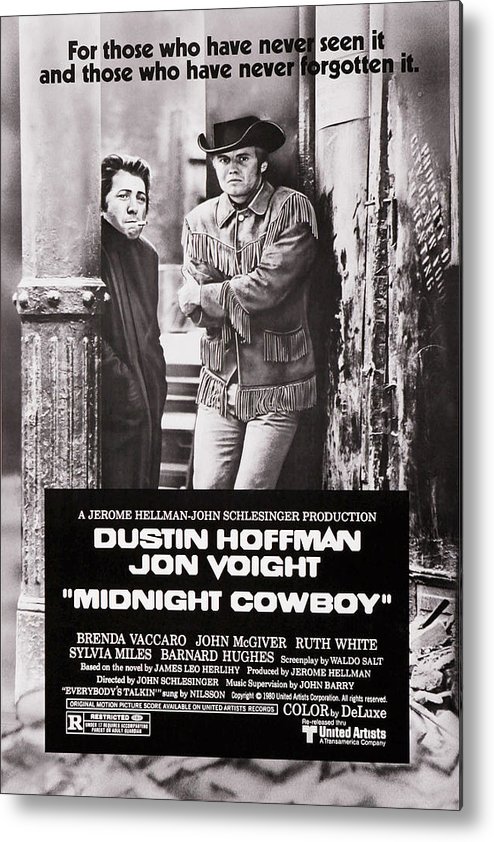
Midnight Cowboy is one of those movies that is so famous that even though this was the first time I’d ever actually watched it, I already felt familiar with it. I mean everybody knows the line, “I’m walking here!” by Dustin Hoffman. The AFI named that line the 27th greatest movie quote of all time (The movie itself is also on the AFI’s 100 greatest movies list). Most film fans also know that it is the only X-Rated film to ever win the Best Picture Oscar. Ratso Rizzo and Joe Buck are iconic cinematic characters. And yet, despite all that I’d never actually watched it until now.
Although Hoffman is top billed, Jon Voight stars as Joe Buck; a young, not very bright Texan who decides to head to New York where he thinks he’ll be able earn money as a male escort to rich New York women. Buck has a troubled past that is revealed through stream-of-consciousness flashbacks. Voight is good as the naive cowboy and his performance not only brought him to stardom, but also earned him an Oscar nomination.
As good as Voight is though, Hoffman steals the film as Enrico “Ratso” Rizzo; the streetwise, hustling New Yorker. His accent, his limp and his mannerisms form a character for the ages. His nickname is an apt one because he is very rat like as he crawls the streets of the city. Like Voight, Hoffman was also nominated for an Oscar for his role.
Together Buck and Rizzo form an unlikely friendship after a rough start when Rizzo cons Buck. As a pair they prove that the protagonists of a film don’t have to be likable for a movie to be good. You wouldn’t want to hang out with either of these two guys but at the same time you want to see what happens to them. Despite being fairly unlikable, you can empathize with their feelings of isolation, loneliness and the need to cling to another person for companionship no matter how unlikely the pairing.
The third main character in the story is New York City, but not the Disneyfied New York of today. This was a time when Times Square wasn’t a place you took the family to see. It was filled with adult theaters and male and female prostitutes on the prowl. Abandoned buildings had yet to be torn down and replaced by Condos, McDonalds and Baby Gaps. Director Schlesinger does a great job of capturing the gritty essence of that bygone city.
While the central characters are interesting and the acting is superb, the plot isn’t a cohesive whole. A series of events happen that aren’t always connected rather than a true story being told. The real story of the movie is the friendship between Joe and Ratso, but too often that is obscured by different episodes. It’s a platonic love story between two men essentially.
The fact that this movie was rated X at one time now seems quite quaint. The nudity is incredibly brief and the language is mild. Sex is talked about a great deal but only shown in a way that you could now practically get away with showing on network television. I imagine the biggest reason for the X might have been the scene when Joe gets a blow job from a strange man in a Times Square theater, although nothing is really shown of it. It has since been re-rated and now stands at the more sensible R rating.
Not every classic film lives up to its fame and I’m not sure as a whole if I’d say Midnight Cowboy does. Pieces of it though are brilliant, especially the performances of its two leads. They are the real reason this movie is remembered so well and they are the reason to watch it again or for the first time.
Brutal, sad, funny, and disarmingly sweet-natured, “Riders of Justice” is not so much a revenge movie as a movie about revenge. That might seem like a distinction without a difference until you get to the end of this surprising feature from writer/director Anders Thomas Jensen (“After the Wedding,” “Red Road,” “The Salvation“) and look back on every place that it has taken you.
The story starts a few days before Christmas in Estonia. A girl walking along a holiday-decorated street with her grandfather spots a red bicycle offered for sale by a street vendor but asks for a blue one instead. The vendor is part of a crime ring and calls an associate, who steals a blue bike belonging to Mathilde (Andrea Heick Gadeberg), which causes Mathilde’s mother Emma (Anne Birgitte Lind) to have to pick her up at the train station, only to have their car fail to start, which causes them to take a commuter train home. A statistics and probability expert named Otto (Nikolaj Lie Kaas) gives the girl’s mother his seat, and shortly after that, a freight train smashes into the commuter train and several passengers are killed, including Mathilde’s mother and a tattooed, bald, scowling fellow who was supposed to testify against a fearsome gang, Riders of Justice. Otto saw another man get off the train before the crash, oddly dropping a full beverage and a nearly uneaten sandwich in the trash on his way out, and becomes convinced that the crash was an assassination and the other victims were collateral damage. As it happens, Mathilde’s father is a stony-faced soldier named Markus (Mads Mikkelsen, a frequent leading man for the writer/director).
If this were almost any other movie, you’d be able to write the rest of this review yourself. But you soon figure out that this is not the sort of film that sets up the standard elements and switches to autopilot. For one thing, Jensen makes Otto not merely the messenger who sets the tale in motion and then disappears, but a crucial second lead, and part of a trio filled out by a fellow probability expert named Lennart (Lars Brygmann), whose secret manias and aversions are a constant source of plot complications; and a tightly wound, emotional computer hacker named Emmenthaler (Nicolas Bro). All three characters are written and performed with such skill that they form a comedy trio: a motor-mouthed intellectual answer to the Three Stooges. Like Mathilde, Markus, and everyone else who passes in front of Jensen’s viewfinder, Otto, Lennart and Emmenthaler are given endearing backstories that feed into the script’s fascination with fate, chance, justice, karma, and other subjects rarely discussed in films where the hero is a scary bald dude who can snap a man’s neck like a shingle.
“All events are products of a series of preceding events,” Otto tells an assembled panel of corporate clients who reject an algorithm he and Lennart are trying to sell them. “Because we often have insufficient data, we categorize events as coincidences.” His statement echoes through later scenes, including the church service where Mathilde’s mother and Markus’s wife is laid to rest. “When miracles happen,” the priest says, “we often attribute a divine character to them. However, when lightning strikes, when tragedy becomes reality, we have a hard time assigning a return address, and thus we refer to it as coincidence.” Once the stooges enter Markus’ life, bloodshed follows, but not in a lockstep, predictable way, thanks to the pinball-machine collisions of all the strong personalities involved (particularly Markus’s; he’s both hot-tempered and lethal, not an ideal combination).
The big question here is whether the train crash was a premeditated crime or the culmination of a series of things that quite simply happened. A large part of the charm of “Riders of Justice” (what an ironic title, in retrospect!) comes from the way that it keeps us guessing as to what side of the equation, so to speak, it’ll come down on, or whether it’ll take a position at all. What are we to make, for instance, of a seemingly precise calculation by Otto that the odds of that crash with that outcome were 234,287,121 to one? Or, for that matter, the movie’s wry awareness that no matter how bad things get, they could always be worse? “Only thing is, after all this crap, it’s unlikely more is going to happen,” Mathilde tells Otto. “That’s not how things work,” Otto replies. “A lot of awful things can happen in your life.”
Plots like the one that drive “Riders of Justice” tend to appear in crash-and-burn action thrillers wherein a curtain-raising death or atrocity is there to give the hero (or heroes) a pretext to embark on a spectacular and largely guilt-free rampage, stacking up bodies like firewood. Jensen and his cast and crew go in a different direction, creating a cast of main characters (and several colorful minor characters) with complex, contradictory psychologies that are unveiled a layer at a time, each revelation informing our understanding of what they did in a prior scene, or what they may be capable of later on. It’s hard to imagine the improvisatory, digressive, character-focused filmmaker Mike Leigh (“Secrets and Lies“) making a revenge thriller, but if he did, it might look like this. Sometimes the tangents are so out-of-nowhere, and are developed in such detail, that you and the characters sorta forget about the vengeance thing, which is the entire point.
This is a film that teaches you how to watch it. Once you’ve gotten acclimated, you understand that when a major character makes a decision that seems massively stupid—or simply counter to their self-interest—it’s always rooted in a traumatic past incident or secret, and they had no conscious control over it: it was something that had to happen, thanks to how they’re wired. Mikkelsen, the most still and reactive performer, seems a granite-faced question mark until you spend a bit of time with his character and understand the origins of his stoicism as well as his eruptions of fury. Unexpected connection points are made between him and the stooges and, more pointedly, between Mathilde and Emmenthaler, who are both sensitive about their weight; and Mathilde, Otto and Markus, who have a specific type of loss in common, and fill voids in each other’s lives.
Any of these characters could’ve been the main character in his or her own project, so attentive is the screenplay to the nuances of personality. Emmenthaler, especially, is one of the great secondary characters in action thrillers, up there with Al Powell from the original “Die Hard“—a sensitive man who sheds an angry tear when a friend makes fun of his weight, and has clearly been carrying around an unexploded bomb of suppressed rage throughout his life. He’s the first of the stooges to ask for weapons training.
But even that thread doesn’t go the way you anticipate, because this is a genre picture in which story is driven by characterization rather than the other way around. Not only are there no easy answers, the film goes out of its way to make you think it’s going to tie something off neatly, only to confound you by asking, “What would happen if these characters actually existed?” and doing that instead.
“Did a therapist write this?” is not a sentence once expects to see in one’s notes on a movie where Mads Mikkelsen guns men down with an assault rifle. But it’s consistent with the apparent mission statement of this odd, beguiling film, which is filled with philosophical, theological, moral, and ethical notions (and takes care to distinguish between them) and that weaves images of churches and snippets of religious chorales throughout its running time, as if to remind us of the Christian ideals of grace, healing, and redemption that, for many characters, remain just out of reach. The movie’s contextual scaffolding is constructed with such care that when a character insists that chess is the only game ever invented where luck isn’t a factor, your instinct is to think, “Is that true?” It is, and it isn’t. The closest Jensen gets to summing everything up is Mathilde’s statement that life “is just easier when there’s someone you can get mad at.”
What are we left with? In the best of all possible worlds, a line from Otto, offered when the gang is en route to a bloody showdown: “Let’s get this over with as a team so we can go home and eat banana cake.”
Who would have thought that Jacques Audiard, the French director of slow-burn, humanistic character studies would one day take on one of the most characteristically American of genres, the Western, with his English-language debut? While worlds apart from his socially realist “Dheepan” and “Rust and Bone,” Audiard’s “The Sisters Brothers” sports a similarly closely watched, leaned in sensitivity with its brotherly story. Adapted from Patrick deWitt’s 2011 novel (by Audiard and Thomas Bidegain) and infused with sweetness, graphic body horror (that, at times, spins a childlike icky humor) and a high body count, this alcohol-soaked Frontier road trip constantly reinvents itself at every turn in fun, witty and ultimately touching ways. Call it a revisionist or an absurdist Western if you will, but Audiard’s film feels both refreshingly new (without ever going to the extreme lengths the Zellner Brothers did with “Damsel”) and nostalgically familiar.
The backdrop is the Gold Rush, which is said to have made a Sherriff’s job much easier: if there’s trouble, you follow the gold to get to the source of the unrest. But when we meet the central brothers Eli (John C. Reilly, goofy, soulful and great at physical comedy as ever) and Charlie (Joaquin Phoenix, quietly enigmatic) one random dark night at the start of the film, there doesn’t seem to be any wealth to be pursued. With the playful last name “Sisters,” the pair of cold-blooded hit-men, without much thought about the consequences of their actions, murder a household of people in a tightly orchestrated set piece of nocturnal shootouts. The reason remains unknown—with this job and everything else, the ruthless duo answers to a much feared, mostly unseen mysterious crime boss called ‘The Commodore’ and habitually assassinates their way through the 1850s Oregon. Along the way, they bond and trivially bicker about life as casually as they kill.
But just when the soft-edged Eli starts contemplating his future and ongoing profession despite the unaffected heavy drinker Charlie’s shrugs, The Commodore sets them up for a new task. They will tail and kill a criminal called Hermann Kemit Warm (Riz Ahmed, cheekily mysterious) for reasons we would slowly piece together later—for now, he is just a thieving enemy who once betrayed their boss. Enter Morris (Jake Gyllenhaal, reuniting with Ahmed after “Nightcrawler”), a British-accented bounty hunter for hire, tasked with delivering Warm to the brothers. But then the prospect of immediate wealth turns tables for everyone involved—the brainy chemist Warm’s creamy invention that makes gold glaringly appear in water, redefines priorities at once. The two pairs, traced on parallel storylines for a while (that admittedly slows down the film’s previously absorbing rhythm), find themselves entangled in a ploy against each other. Along the way, local madams, kindly prostitutes, further the accidentally amusing events and some dead horses unfortunately enter the story, sharpening the film’s tone as an original yet studied homage to its genre.
A delightful tale of familial ties balanced well with a slick cat-and-mouse yarn, “The Sisters Brothers” owes much of its breezy charm to John C. Reilly, whose comic timing does wonders for the meatiest and most multifaceted character of the ensemble. Phoenix feels right at home in Charlie’s quieter shoes, while Gyllenhaal’s familiarly on-edge persona and a mischievous turn from Ahmed impress. Reilly and Phoenix demonstrate tremendous chemistry throughout—we buy both their longtime amity and occasional callousness, especially when the script drip-feeds the brothers’ back-story into the narrative. In this bittersweet tale with a sentimental heart, and among a dangerous milieu of blood, greed and spiders (one in particular that causes the film’s biggest gross-out moment), Audiard’s characteristically sensitive touch gradually lifts familial emotions, letting them linger in the air long after the credits roll.





 After the Crash