Two for Tuesday
Reply

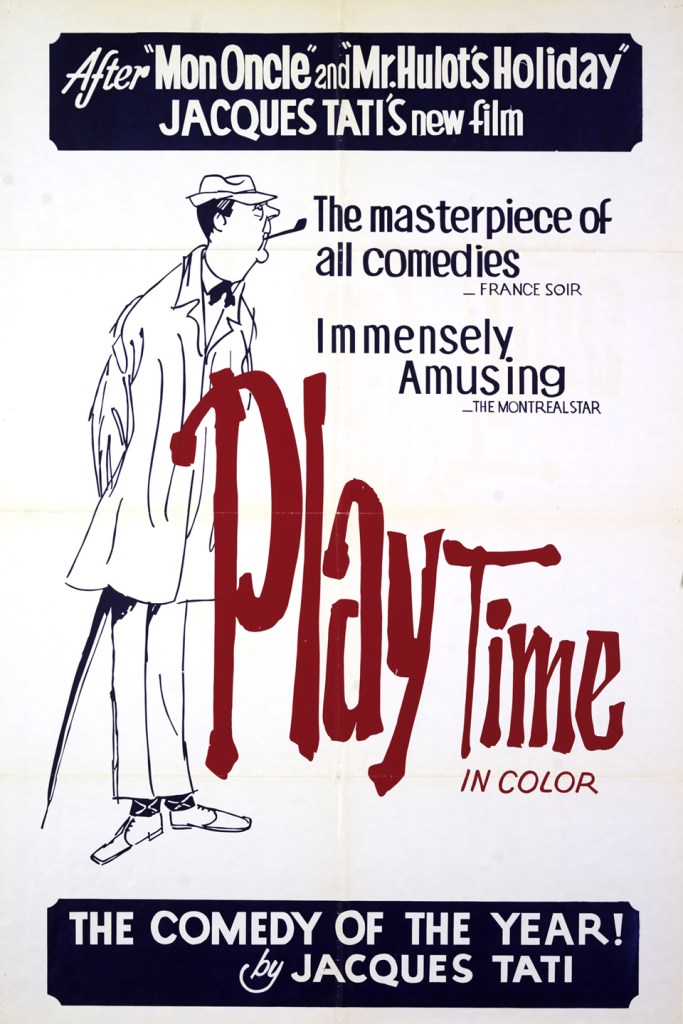
A magical mystery tour de force
By Roger Ebert
Source: RogerEbert.com
Jacques Tati’s “Playtime,” like “2001: A Space Odyssey” or “The Blair Witch Project” or “Russian Ark,” is one of a kind, complete in itself, a species already extinct at the moment of its birth. Even Mr. Hulot, Tati’s alter ego, seems to be wandering through it by accident. Instead of plot it has a cascade of incidents, instead of central characters it has a cast of hundreds, instead of being a comedy it is a wondrous act of observation. It occupies no genre and does not create a new one. It is a filmmaker showing us how his mind processes the world around him.
At the time of its making, “Playtime” (1967) was the most expensive film in French history. Tati filmed it in “Tativille,” an enormous set outside Paris that reproduced an airline terminal, city streets, high rise buildings, offices and a traffic circle. It was the direct inspiration for “The Terminal,” for which Stephen Spielberg built a vast set of a full-scale airline terminal.
Although Spielberg said he wanted to give Tom Hanks the time and space to develop elaborate situations like Tati serendipitously blundered through, he provided Hanks with a plot, dialogue and supporting characters. Tati made “Playtime” without a story, with dialogue (mostly in English) that is inaudible or disposable, and without a hero.
His film is about how humans wander baffled and yet hopeful through impersonal cities and sterile architecture. “Playtime” doesn’t observe from anyone’s particular point of view, and its center of intelligence resides not on the screen but just behind the camera lens. The most sympathetic person in the movie is a waiter who becomes a source for replacement parts. More about him later.
Tati filmed his movie in 70mm, that grand epic format that covers the largest screens available with the most detail imaginable. He shot entirely in medium-long and long shots; no closeups, no reaction shots, no over the shoulder. He shows us the big picture all of the time, and our eyes dart around it to find action in the foreground, middle distance, background and half-offscreen. It is difficult sometimes to even know what the subject of a shot is; we notice one bit of business but miss others, and the critic Noel Burch wonders if “the film has to be seen not only several times, but from several different points in the theater to be appreciated fully.”
“Playtime” is Rosenbaum’s favorite film, and unlike many of its critics, he doesn’t believe it’s about urban angst or alienation. In a lovely passage, he writes: “It directs us to look around at the world we live in (the one we keep building), then at each other, and to see how funny that relationship is and how many brilliant possibilities we still have in a shopping-mall world that perpetually suggests otherwise; to look and see that there are many possibilities and that the play between them, activated by the dance of our gaze, can become a kind of comic ballet, one that we both observe and perform…”
Consider how this works in the extended opening scene. We see a vast, sterile concourse in a modern building. In the foreground, a solicitous wife is reassuring her husband that she has packed his cigarettes and pajamas, and he wearily acknowledges her concern. We understandably conclude that this is the waiting room of a hospital; a woman goes by seeming to push a wheelchair, and a man in a white coat looks doctor-like. Nuns march past in step, their wimples bobbing up and down in unison. Only slowly do these images reveal themselves as belonging to an airline terminal.
A tour group of American women arrives down an escalator. A clerk on a stool with wheels scoots back and forth to serve both ends of his counter. Impenetrable announcements boom from the sound system. Mr. Hulot’s entrance is easy to miss; while babbling tourists fill the foreground, he walks into an empty space in the middle distance, drops his umbrella, picks it up and walks off again. The bang of the umbrella directs our eye to the action. The whole sequence is alert to sounds, especially the footfalls of different kinds of shoes and the flip-flops of sandals.
Looking and listening to these strangers, we expect to see more of Mr. Hulot, and we will, but not a great deal. Tati’s famous character, often wearing a raincoat and hat, usually with a long-stemmed pipe in his mouth, always with pants too short and argyle socks, became enormously popular in the director’s international hits “Mr. Hulot’s Holiday” (1953) and “Mon Oncle” (1958, winner of the Oscar for best foreign film).
But nearly 10 years passed before Tati found uncertain financing for the expensive “Playtime,” and he wanted to move on from Hulot; to make a movie in which the characters might seem more or less equal and — just as important — more or less random, the people the film happens to come across.
“Mon Oncle” has an ultra-modern house as its setting, and in “Playtime,” we enter a world of plate glass and steel, endless corridors, work stations, elevators, air conditioning. Hulot goes to call on a man in a modern office and is put on display in a glass waiting room, where he becomes distracted by the rude whooshing sounds the chair cushions make. He takes an elevator trip by accident. A man approaches the building guard to get a light for his cigarette and doesn’t realize a glass wall separates them.
Glass walls are a challenge throughout the film; at one point, Hulot breaks a glass door and the enterprising doorman simply holds the large brass handle in midair and opens and closes an invisible door, collecting his tips all the same.
Other characters are mistaken for Hulot in the film, a double is used for him in some scenes, and Hulot encounters at least three old Army buddies, one of whom insists he visit his flat. This generates a wonderful scene; the apartment building has walls of plate-glass windows, and the residents live in full view of the street. We see four apartments at once, and in a sly visual trick, it eventually appears that a neighbor is watching Hulot’s army buddy undress when she is actually watching the TV.
But to explain or even recount these moments is to miss the point. They aren’t laugh-out-loud gags, but smiles or little shocks of recognition. The last long sequence in the film involves the opening night of a restaurant at which everything goes wrong, and the more it goes wrong, the more the customers are able to relax and enjoy themselves.
The sequence involves a multitude of running jokes, which simultaneously unfold at all distances from the camera; the only stable reference point is supplied by a waiter who rips his pants on the modern chairs and goes to hide behind a pillar. There he is implored by other waiters to lend them his clean towel, his untorn jacket, his shoes and his bowtie, until finally he is a complete mess, an exhibit of haberdashery mishaps.
Some characters stand out more than others. Hulot, of course. An attractive American woman. A loud American man. A short and deliberate little man. A long-suffering restaurant owner. A very drunk man. But scenes don’t center on them; everyone swims with the tide. In “Mon Oncle,” there is a magical scene where Hulot adjusts a window pane, and it seems to produce a bird song. In “Playtime,” we are surrounded by modern architecture, but glass doors reflect the Eiffel Tower, the Church of the Sacred Heart in Montmartre and the deep blue sky. The sight of the sky inspires “oohs” and “ahs” of joy from the tourists, as if they are prisoners and a window has been opened in their cell.
“Playtime” is a peculiar, mysterious, magical film. Perhaps you should see it as a preparation for seeing it; the first time won’t quite work. The best way to see it is on 70mm, but that takes some doing (although a print is currently in circulation in North America). The Criterion DVD is crisp and detailed, and includes an introduction by Terry Jones, who talks about how the commercial failure of the film bankrupted Tati (1909-1982) and cost him the ownership of his home, his business and all of his earlier films. Was Tati reckless to risk everything on such a delicate, whimsical work? Reckless for you, reckless for me, not reckless for a dreamer.
Watch Playtime on Kanopy here: https://www.kanopy.com/en/kcls/video/154477
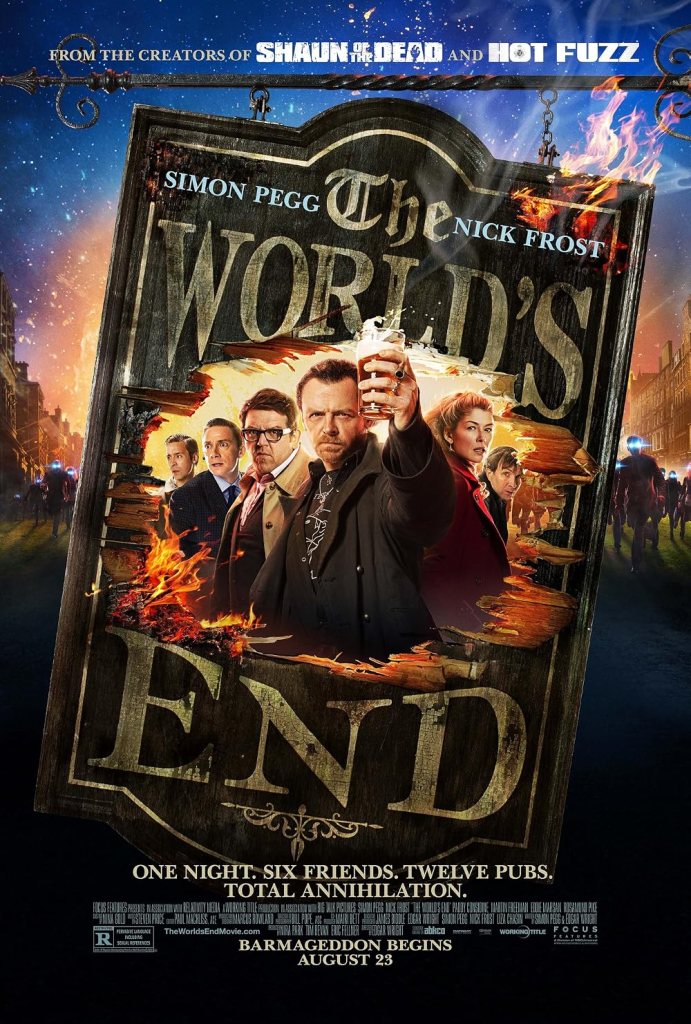
By Matt Zoller Seitz
Source: RogerEbert.com
You might not expect a slapstick comedy about middle-aged pubcrawlers brawling with superhuman extraterrestrial invaders to have brains, heart and wisdom, but that’s “The World’s End,” a rare film that’s as much fun as you’ve heard.
Directed by Edgar Wright from a script by him and his regular leading man, Simon Pegg, the film is refreshingly intimate, despite the chasing and stalking and beheading and exploding and gallons of blue goop spraying all over everything. The special effects are special, but they always serve the story and characters. And even when Wright is paying homage to his filmmaking heroes (John Carpenter especially) or staging some of the most cleverly choreographed fights this side of an early ’90s Jackie Chan film, you never get the sense that it’s bored with itself when the characters are sitting around talking about their shared history over a pint. In fact, they often talk about their shared histories while they’re whaling on the invaders—and then they have a pint. Sometimes they have a pint during the fight. It’s that kind of movie.
Pegg’s character, Gary King, wants people to call him The King and considers himself a prince among men, but he’s the sort of guy you’d tire of quickly. His friends had enough of him long ago. They tell themselves they’ve grown up; Gary thinks they’ve sold out and become tediously conventional. To the film’s credit, neither of these points-of-view are presented as entirely wrong.
Oliver (Martin Freeman) is a fussy killjoy of a real estate agent with a Bluetooth receiver jammed in his ear at all times. Steven (Paddy Considine), an architect who was once Gary’s rival for the affections of Oliver’s sister Sam (Rosamund Pike), is recently divorced and sleeping with a young fitness instructor; he brags about that last bit to everyone who’ll listen, which is how you know he’s miserable about the rest of his life. Peter (Eddie Marsan) who was horribly bullied as a child, was always the tagalong nerd of the old group; now he sells cars for his dad. Andrew (Nick Frost) is a lawyer who refuses to speak to—or of—Gary. Gary says it’s because he still owes Andrew six hundred pounds from long ago, but we deduce that the real reason for the split is much deeper. It is. In fact it’s a doozy.
The first part of the movie consists of Gary “getting the old band back together,” as he puts it, to re-enact their great thwarted pub odyssey from 1990, when they resolved to hit all twelve nightspots in their old hometown of Newton Haven. The quiet little town is home to bars with mythologically and otherwise suggestively loaded names: The Two-Headed Dog, The Famous Cock, The Trusty Servant, The World’s End. That the pals didn’t finish their quest has always gnawed at Gary. He’s obsessed with pinning a triumphant end on a long-unfinished story.
Running beneath the lively banter and knockabout slapstick is a sense of melancholy, at times despair, over lost youth and missed opportunities. Gary is an alcoholic and drug user and chronic screwup, the sort of guy who lures other lads into joining adventures that tend to end in humiliation or disaster. He’s first seen in a rehab facility, but judging from his appearance and behavior he hasn’t been there long. Pegg looks like he just crawled out of bed—a bed at the bottom of a mine shaft, most likely—and even his most jocular pronouncements have an undertone of manic desperation. “Why should getting older affect something as important as friendship?” he demands, a question thick with unexamined assumptions.
If “The World’s End” were only a picture about childhood buddies on a bittersweet pub crawl, it might have still been some sort of minor classic, so sharply observed is every shot, cut, music cue, line and close-up. When the film takes a right turn into science fiction conspiracy thriller territory—invoking “Invasion of the Body Snatchers” as well as such Carpenter films as “The Fog” and “Prince of Darkness“—you might worry that it’s about to succumb to Gary’s biggest fear, and trade spiky if heedless individuality for a tiresome grab at commercial formula. (This is the third Wright film in which a dull community proves a hotbed of slowly-creeping and highly secretive horror.) No worries: the sci-fi elements—which were hinted at in trailers, but which I’ll write around in this review and maybe revisit later in a spoiler-warning-bedecked blog post—are audaciously funny and inventively designed, and they’re always tied to the film’s concerns. Nothing, no matter how extravagant or surreal, is superfluous.
Fears of assimilation and domestication and the loss of youthful fire are never far from the movie’s mind; neither is the altogether wise and reasonable sense that, while we should strive to be better, kinder, more mature people, we still are who we are, and if we cannot tolerate one another’s frailties and treat each other decently, there’s no hope for the species. The film has great fun painting modern life itself as a prolonged and largely invisible conspiracy to rob people and their world of all personality. Every old pub the boys revisit has been Starbucked, as they put it, and later we get the sense that the very same digitally connected world that lets you read this review on a tiny handheld computer-phone is a means of social control as well. Odd as it might sound, the unexpectedly laid back climax echoes “A Clockwork Orange.” It conveys a sense that, while a totally safe and placid and perfect world might be attainable, it’s not desirable, and might in fact be a greater sin than any act that any individual might commit.
Wright is a brilliant director of turbocharged exposition, elegant but bruising action sequences, and graphically bold comedic overkill. As in “Shaun of the Dead,” “Hot Fuzz” and “Scott Pilgrim vs. The World,” even functional closeups of beer being poured or ignition keys being turned are shot as if they were events on par with the Big Bang or the release of a new Kanye West album. Wright is a pop artist who’s not inclined to relax; at times his movies play as if he’d decided to turn the first five minutes of “Trainspotting” into a career. There are times when I wished the “The World’s End” had the confidence to linger more on the characters’ conversations and nonverbal interactions. The group’s chemistry evokes the best sad-sack male bonding tales of Barry Levinson (“Diner,” “Tin Men“), and the performances are all superb, particularly Frost, who steals the film with an explosive physicality that’s John Goodmanesque.
But in an era in which mainstream movies not only lack rhythm but seem to have forgotten how to dance, this one’s briskness is inspiring. Its judgment is nearly unerring, and it has a sense of joy that’s rare. Like most genre films, “The World’s End” is working things through in an extremely broad way and having a grand time doing it, and its self-deprecating wit inoculates it against self-importance. The movie wears its themes on its sleeve and pins its symbols to its puffed-out rooster’s chest, swaggers about with a proud grin jabbing thumbs at itself, then walks into an open manhole. It’s magnificent.
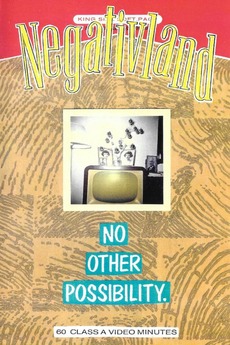
Turn on Negativland’s ‘No Other Possibility’ and fry your brain
By Martin Schneider
Source: Dangerous Minds
No Other Possibility was Negativland’s first video, released in 1989, the same year as “Helter Stupid,” pitched right between their “Christianity Is Stupid” hoax of a couple years earlier and “U2” a couple years later.
I hadn’t seen this in quite a while–I had honestly forgotten how tremendously enjoyable Negativland is. Their stuff is way more entertaining than any anti-establishment culture-jammin’ nutcases have any right to be. (I guess if you invent the term “culture jamming,” you have a license to transcend the genre.) This video is very good, and I had also not realized the high level of musicianship on display here–certainly “Nesbitt’s Lime Soda” and “Fire Song” and “Very Stupid” (I’m not sure that last one has an official title, the Internet seems to call it “Theme From ‘a Big 10-8 Place,’” which is dumb) are all top-notch.
Negativland are pitched almost exactly between DEVO and Tim & Eric–with less instinct for schtick than either (this is a brave and good thing). And yet there is a kind of schtick to it, too. In the opening crawl, supposedly penned by “Crosley Bendix, Director, Stylistic Premonitions” (later played by Don Joyce), you can hear that excessively modest and self-annihilating tone, familiar from David Letterman in his NBC days and also certain misanthropic comix guys like Chris Ware and Daniel Clowes. I think the idea is that you have to be as hard on yourself as you are on your target; you have to torch the self because you can begin to reconstruct (and also criticize/satirize others).
The video is purest 1980s slacker fodder in that the biggest sin is to be unaware, to be incapable of irony. If only the suburbans/corporates/normals could be more ironic! You see much the same idea in, say, Reality Bites, but it’s not really a good tack–the slackers (hey, I’m one too) couldn’t figure out any other point of attack. Negativland’s methods haven’t dated much at all IMO, but that part, the pro-irony ethos, does feel a bit dated here.
In addition to being an essay about the vapidity of American culture, No Other Possibility also serves as a kind of diary for the Negativland guys themselves. About halfway through we get a video report about a fire that destroyed their apartment/studio in El Cerrito, California on Friday, February 13, 1987. The very end of the video is taken up with a terribly earnest report about Negativland’s involvement in the David Brom murders of 1988, based on connections that were entirely made up by Negativland.
At some point “Crosley Bendix” (Don Joyce) has a little speech about numerology, at the end of which he cries, “Thanks a million! You’ve been a wonderful audience. Bye, Cleveland!” Which is only noteworthy because I was in fact watching it in Cleveland.
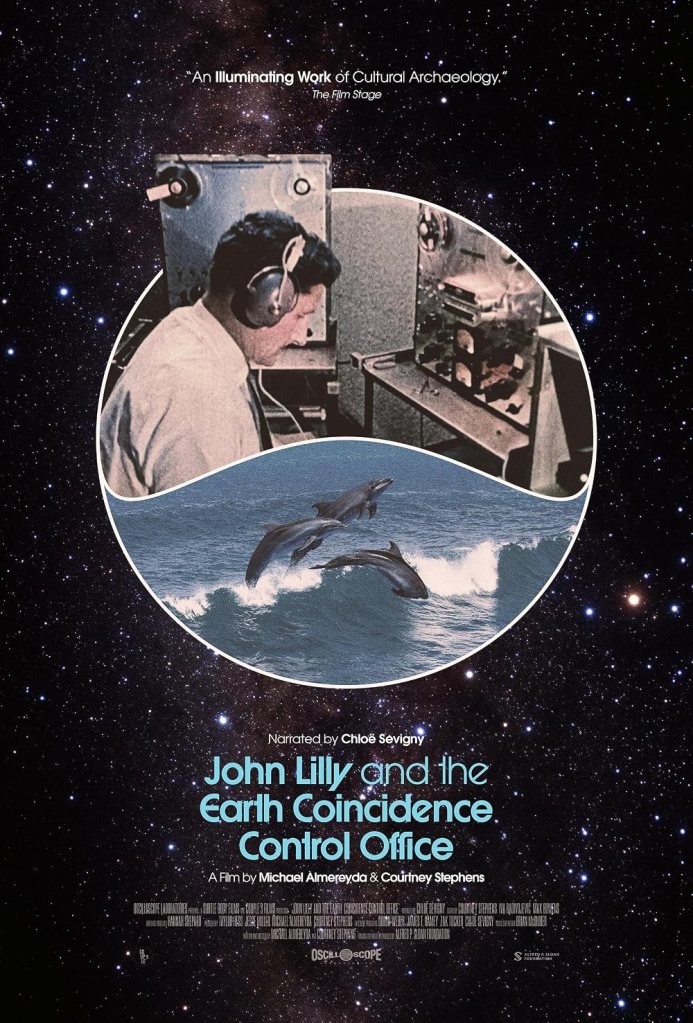
By Clint Worthington
Source: RogerEbert.com
If you’ve ever wondered why the 1980s and 1990s were replete with calls to “save the whales,” and shows like “Flipper” and “SeaQuest DSV” placed so much emphasis on the innate intelligence of dolphins, you can thank John C. Lilly. Pioneer or kook, who can say? As much as his early work popularized the notion that dolphins have the capacity for self-awareness and communication with humans, he was also deeply involved in the psychedelic movements of the 1960s, and he allowed his obsession with dolphins and self-exploration to reach unbelievable lengths.
That’s the focus of Michael Almereyda and Courtney Stephens‘ new doc, “John Lilly and the Earth Coincidence Control Office,” a curious work of deadpan collage that feels the closest you could come to actually experiencing Lilly’s experiments in documentary form. What’s more, it’s less a hagiography (or a takedown) of the man than it uses him to chart how outrageous ideas become mainstreamed, tracing his life, work, and ideas through the 1950s into the 1970s and beyond. And in so doing, Almereyda continues his work probing the nuances of difficult scientific geniuses, which he’s done in previous narrative masterworks “Experimenter” and “Tesla.”
Much like in those narrative features, Almereyda and Stephens keep their distance from Lilly himself, looking dispassionately (though not with great fascination) at the man’s eccentric notions. Coolly narrated by Chloë Sevigny, Lilly’s story begins by depicting him as a buttoned-up scientist who would calmly explain his ideas on “The Jack Parr Show”; humanity, he claimed, was merely ten years away from communicating with some other form of life. While it could be alien, he was more convinced it would be marine. And so he flooded his own pool and set up his own research institute to study dolphin communication, listening meticulously to their clicks and responses to discern meaning.
Like so many real-life visionaries, Lilly’s work teetered on the line between science fiction and animal torture. As much as we joke about “talking dolphins” now, Lilly’s work genuinely tried to coax communication and relation out of these creatures, often involving injecting them with the same LSD and ketamine he himself was taking to achieve his own form of transcendence. (A particularly curious chapter mentions one dolphin taking a sexual interest in his female research partner.) But the doc is never interested in excoriating him for these outrageous tactics; it matter-of-factly explains the effect these actions had on him and those around him, while still expanding our understanding of these creatures.
Really, the grander throughline of “Earth Coincidence” is how Lilly’s ideas started to seep out into the broader consciousness, as the kooky science of the 1950s became the counterculture rebellion of the 1960s and the environmentalism of the 1970s. Archival footage mixes with clips from films and shows and even video games that you never realized were inspired by the same man: “2001: A Space Odyssey,” “Altered States,” “The Day of the Dolphin,” even “ECCO the Dolphin” (whose name now makes total sense, so named after Lilly’s titular institute). As much as Lilly’s work feels like, and probably is, quack science, the appeal of his ideas becomes clear in his cultural footprint. That’s the hypothesis “Earth Coincidence” spends its time proving.
For a film about a man obsessed with the line between stimulus and deprivation (so noted in his patenting of the isolation tank, initially a tool for brainwashing but which Lilly used to fuel his own psychedelic explorations), “Earth Coincidence” frequently inundates you with information, however patiently it does it through Sevigny’s oratory. It can be overwhelming, and the solution can be, ironically, to let it wash over you and see what ideas you can absorb. Famed director and “fellow surrealist” Alejandro Jodorowsky, who spent time in one of Lilly’s tanks to achieve his own nirvana, gets an interview in this, where he confesses that “it’s very difficult to be a human being.” That’s probably the true mystery Lilly was trying to solve, even as the doc itself wavers between the man and his legacy.
Frequently in the doc, Almereyda and Stephens play audio out over total darkness, as if we’re submerged in one of Lilly’s patented isolation tanks. It’s a curious, immersive feeling, one that helps you get into the mind of a man like Lilly, who sought a “feeling of weirdness” in the classical sense—a kind of metaphysical awakening that lives somewhere between brainwashing and transcendence. “Earth Coincidence” carries that surreality through its 87-minute runtime, and even as it grows monotonous, its consistent tone is hypnotic in its own way.
Watch John Lilly and the Earth Coincidence Control Office on Kanopy here: https://www.kanopy.com/en/kcls/video/16559658
By Matt Zoller Seitz
Source: RogerEbert.com
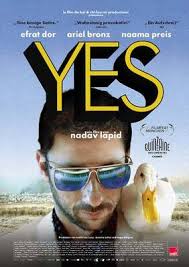
Nadav Lapid’s “Yes!” is about married entertainers performing for the rich and powerful in Tel Aviv while a genocide unfolds 40 miles away and feeling bad about it, but not bad enough to quit doing it. The film has been described elsewhere as a satire, but despite its trips into cuckoo comedy and some devices so cheerfully self-aware that they’d fit into a Looney Tunes or Three Stooges short, the movie is too earnest to wear the satire label comfortably. Like most of the director’s work—including “Ahed’s Knee”—it has many expressionistic and dreamlike elements, and weaves a loose, fairly simple story around wild situations that are mainly about questioning Israel’s self-image, prodding it, sometimes tearing at it.
The main characters are a pianist-comedian known as Y (Ariel Bronz) and his dancer-choreographer wife, Yasmine (Efrat Dor). They share a small Tel Aviv apartment with their infant son, Noah, and eke out a living mainly by performing for powerful Israelis and foreigners at parties where drugs, skin, and indifference to suffering are all on display.
Then a Russian oligarch identified in the credits only as Big Billionaire (Aleksei Serebryakov) connects with Y and offers him a huge sum to write the new anthem, a jingoistic bit of self-affirmation praising the Israeli Defense Force and validating the mistreatment of Palestinians in Gaza as a necessary for self-defense. The anthem that Y ends up writing is actually a pre-existing song, 2023’s “The Song of the Victory Generation,” a jingoistic exhortation to mass murder that rewrites the lyrics to Haim Gouri and Sasha Argov’s “Hareut,” a poem set to music honoring soldiers who were killed during Israel’s founding.
Both Y and his wife are thirty-somethings who live like college students who probably won’t graduate. They stay out all night after gigs, and join in decadent scenarios (Yasmine even snorts coke lines off two pairs of buttocks), then return home wasted. They both know such a lifestyle is neither sustainable nor conducive to good parenting. They’d love to give it up for a quieter existence, one where they aren’t constantly anxious about money. So Y says yes to the anthem assignment, then impulsively dyes his hair blonde. Radically changing one’s appearance, of course, is a way for fictional and real people alike to announce to the world that they’ve changed, or give themselves permission to change at some future date.
The first half of the movie makes Y and Yasmine seem so tightly bonded and politically aligned that they could be autonomous halves of the same organism. Y’s commission introduces real tension into the relationship, shattering their connection. “Do you know what this song will do for us?” Y pleads. “Noah will grow up in a palace!” Yasmine used to smile sweetly at her husband. Now her resting face is a go-to-hell look.
The film mostly avoids charges of being a self-satisfied but empty spectacle by regularly returning to a big question: can you consider yourself a moral person while participating in immoral acts? The question has been dealt with in countless works of art. A notable difference here, particularly in the context of films about Israeli identity post-Oct. 7, is that the filmmaker doesn’t have any sympathy for complicity, no matter what the context. That point-of-view is consistent and unyielding. It’s expressed not just in the couple’s arguments but in omniscient narration that chimes in occasionally with a sardonic quip or a cutting observation, such as noting the irony that a nation founded by survivors of a genocide would perpetrate one. The scene between Y and Big Billionaire is the serpent approaching Eve in the Garden of Eden. Y sells his soul, then tries to justify the choice as necessary for the family’s survival (i.e., their comfort).
It’s not surprising to learn that this director studied philosophy at university. Lapid’s movies often choose a straightforward, didactic approach that would soon become tedious if the filmmaking weren’t kinetic and adventurous. At a time when too many filmmakers are buckling under survival pressures and adopting the Netflix technique of constantly reminding people of what’s happening in the plot, so that viewers half-watching while scrolling their phones don’t get lost, it’s refreshing to see a movie that asks viewers to concentrate and listen, formulate opinions on every choice, and accept that not everything in the movie will be to their liking.
There are also moments in where you can’t be sure what’s real and what is, for lack of a better phrase, a visual figure of speech—hyperbole or metaphor expressed through a sight gag. After a discussion of whether the public cares about specific ethical issues, two characters look directly into the camera, their playfully reproachful faces saying, “Well, you don’t! When a character describes a new skyscraper that’s to be built on seized land, we see the building erupt from the ground and rise hundreds of feet into the air.
The immersive score (by Sleeping Giants and Omer Klein) and the lively editing (by Nili Feller) would give “Yes!” a powerful musicality even if it weren’t packed with musical interludes of various sorts—so many that it’s constantly on the edge of turning into a full-on sung-through musical. It opens with a long dance sequence at a gathering of the filthy rich, with Y and Yasmine performing a semi-improvised act that takes them from a stage down into the audience and then into a swimming pool, and involves clowning with the guests, swallowing and expelling tiny plastic balls, faking a death, even fellating a dildo for laughs. It’s as if party clowns specializing in children’s birthday parties had been hired for a bacchanal.
Things grow more visually euphonious from there. The couple’s theme song is the Elvis Presley version of “Love Me Tender,” like Sailor and Lulu in David Lynch’s “Wild At Heart,” but in place of Sailor’s snakeskin jacket (just like Marlon Brando’s in “The Fugitive Kind”), Y has snakeskin boots (a reference to a reference to a reference); the song is performed as a duet, then solo. The opening ends with a glimpse of a painting by Berlin-born George Grosz, who, per Encyclopedia Britannica, “…savagely [attacked] militarism, war profiteering, the gulf between rich and poor, social decadence, and Nazism.” Grosz’s warped, grotesque portraits connect “Yes!” to Bob Fosse’s “Cabaret,” a film full of human faces made Grosz-like (or just gross) by masks, fish-eye lenses, and funhouse-mirror reflections: a story of militarized bigotry trampling creatives, progressives, and the dispossessed—and, of course, a musical.
A pivotal sequence finds Y reconnecting with a childhood friend and onetime lover named Leah (Naama Preis), whose pre-Oct. 7 job translating texts for businesspeople was derailed into a gig translating for the IDF. She’s become radicalized in the opposite direction from Y and Yasmine. Y absorbs Leah’s reactionary sentiments by spending time with her and mirroring her self-pitying, nationalistic talking points. As he and Leah drive through occupied territory remembering days gone by, Leah recounts her experience of the Hamas attacks against Israelis, racing through a list of witnessed atrocities—shootings, rapes, dismemberments, necrophilia—until she runs out of breath and breaks down in rage and despair: a spoken-word aria from hell. It’s the capper on Preis’s tour-de-force performance. And it sets up another haunting musical moment, one that links love and loyalty to patriarchy and nationalism: a montage of the duo driving past signifiers of dictatorship (fences topped with razor wire; monolithic border walls; a flatbed truck carrying a tank) while the car radio plays “Stand by Your Man.” This is all presaged with a long, brilliantly staged piano duet by Y and Leah in which their intuitive recall of how to play a beloved song (their “Love Me Tender,” perhaps) foretells Y reconnecting with the obedient boy he used to be.
“Yes” runs 150 minutes and doesn’t always fill the running time with material that feels urgently necessary. It’s rambling, disconnected, even navel-gazing at times. But it’s always exciting to watch—sometimes to a fault, with Shaï Goldman’s camera whipping from side to side and careening through rooms and hallways to accentuate the characters’ emotions or put us in their anxious, guilt-ridden minds. There’s a branch of 21st international art cinema that works within an oddly specific mode: kinetic, visceral, with the look and sound of a top-of-the-line Hollywood production, and a confrontational attitude leavened by bleak humor. “Yes!” exemplifies it. It’s worth seeing and arguing about. Even if you end up hating it, there are moments you’ll never forget.
Watch Yes on Kanopy here: https://www.kanopy.com/en/kcls/video/16330270
INDIAN COUNTRY NEWS
"It is the duty of every man, as far as his ability extends, to detect and expose delusion and error"..Thomas Paine
Human in Algorithms
100% Accurate Google Sheets + KDP Book Formatting | 24hr Delivery
From the Roof Top
I See This
blog of the post capitalist transition.. Read or download the novel here + latest relevant posts
अध्ययन-अनुसन्धानको सार

