It’s Not Just the Stock Market That’s Rigged: the Entire Status Quo Is Rigged

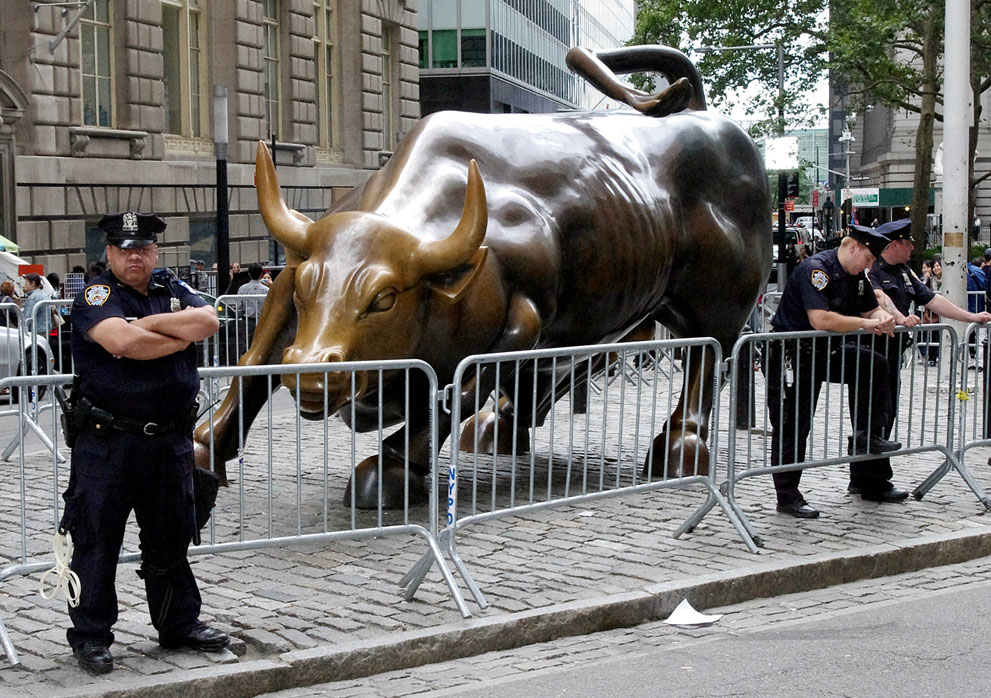
WallStreetBull

By Charles Hugh-Smith

Source: InvestmentWatch

One has to wonder why we are dodging this truth about what we’ve become: a nation that turns a blind eye to skimmers, scammers and legal looting.

As in the story of the Emperor’s new clothes, the onlooker who declares the obvious– in this case, that the stock market is rigged–shatters the consensus lie. In the current saga, author Michael Lewis plays the role of the truth-telling boy, and everyone who went along with the fiction that the Emperor’s high-frequency trading finery was resplendent is revealed as credulous, complicit or worse.

Lewis’ new book is Flash Boys: A Wall Street Revolt.

The high-frequency trading (HFT) scam is old news, and a number of fine books have addressed the mechanics of the skim, for example Dark Pools: High-Speed Traders, A.I. Bandits, and the Threat to the Global Financial System by Scott Patterson.

Many in the alternative financial media have written about HFT for years. Here are two of my own entries on the topic:

The Stock Market Is an “Attractive Nuisance” and Should Be Closed (August 22, 2012)

We Need a New Stock Market (September 14, 2012)

Interestingly, Mr. Patterson outlined the solution that the heroes of Lewis’ book ended up pursuing. Here is a Q&A I conducted with Patterson in September 2012:

CHS: While there are various regulatory “tweaks” that could be put in place, I wonder if we don’t need a more fundamental “re-set” that asks what role the market should play in finance and the economy inhabited by everyday investors.Scott: I think there are a lot of people in the industry wondering about whether there needs to be a massive overhaul. But it’s probably not a good idea for that to be imposed on the market by the SEC. The uncertainty would be potentially destabilizing. And I just don’t see it happening.

I think the change needs to come from within the market and needs to be imposed by its most important users–I mean, not the high-frequency traders, who are running the show at the exchanges in many ways–but the institutions, the giant mutual fund companies, the pension funds, the long-short hedge funds. They need to exert pressure on the exchanges to stop giving advantages to high-frequency firms.

If we pull back from the media frenzy about HFT, we find the market is rigged in many other ways. The Federal Reserve’s policies, stripped of Orwellian mumbo-jumbo, are all about rigging the market to go in one direction–up.

Consider this chart, courtesy of long-time contributor Harun I., of the Dow Jones Industrial Average: I call it the tale of Two Dows. In the Great Bull Market of 1982 – 2000, a market fueled by an extraordinary economic expansion, the DJIA gained an average of 610 points a year.

In the anemic “recovery” of 2009 – 2013, the DJIA gained an average of 2,500 points per year. While the Fed rigged the 1990s Bull Market with low interest rates and other policies, it pulled out all the stops in the last five years:

The stock market is only the tip of the iceberg of what’s being rigged. For a taste of what’s rigged, ask yourself this question: if Mr. Elite Insider perpetrates a scam, and Mr. John Q. Citizen breaks similar laws, is there any difference between the treatment each receives?

Let’s go even deeper and ask: why is looting legal, even though it is obviously crooked? Why is high-frequency trading legal? Why is it legal for the Fed to offer money at 0% to its buddies but not to Mr. John Q. Citizen?

Why is it legal to issue student loans to future debt-serfs that is unlike all other debt in that it cannot be discharged in bankruptcy?

Since the legal looting continues unabated regardless of what party or toady is in office, then what actual difference is there between the Demopublicans and Republicrats?

It’s not just the stock market that’s rigged–the entire Status Quo is rigged. There are two sets of laws and two sets of opportunities: one for those holding the concentrated wealth and power, and the other for the rest of us debt-serfs.

If the system isn’t rigged, then why are insolvent banks and bankers protected from the creative destruction of capitalism that befalls John Q. Citizen when his risky bets go bad? Why do we as a nation keep insisting the Emperor’s new clothes are splendid when he is in fact parading around buck-naked?

One has to wonder why we are dodging this truth about what we’ve become: a nation that turns a blind eye to skimmers, scammers and legal looting. Perhaps, in Joseph Conrad’s phrase, we hope to escape the grim shadow of self-knowledge. Here is the passage from Chapter 7 of Lord Jim:

I gave no sign of dissent. I had no intention, for the sake of barren truth, to rob him of the smallest particle of any saving grace that would come in his way. I didn’t know how much of it he believed himself. I didn’t know what he was playing up to–if he was playing up to anything at all–and I suspect he did not know either; for it is my belief no man ever understands quite his own artful dodges to escape from the grim shadow of self-knowledge.

Stressed: What Are They Trying To Tell Us?

economic-stress-jamaica

By Danny Schechter

Source: Disinfo.com

Ok, I have to admit it, I feel as my faith in economic justice is being tested with these stress tests. Truth is, I  am becoming more stressed than ever.

The reason: despite all the “regulations” in the Dodd Frank Financial “reform” and the Volcker Rule and The Fed’s “oversight:’ the banks seems to have free reign to do what they will despite the financial crisis, and the pathetic “recovery.”

There have been fines and settlements but nothing is settled. None of them have or will go to jail.

Economic conditions continue to stress out millions even as the Fed announces “stress tests” that appear on the surface to be a way of insuring that big banks won’t need more bailouts.

Sad to say, it’s more of the charade. Partially that’s because the banks dominate the Federal Reserve, a private, not public, institution.

And, partially, because when it comes to economic crises, the stories are buried in the business pages and rarely surface as topics of concern on popular talk shows and media that most folks watch.

Even the financial channels like CNBC prefer superficial soundbite chatter to in-depth-interviews according to “Money Honey” Maria Bartiromo who publicly criticized her old network when she took a better deal at Fox.

Many of us have seen the reports that Citibank, the biggest enchilada of finance, the bank that provided refuge to the likes of Clinton’s Treasury Secretary Robert “the great deregulator” Rubin and Obama Budget director, whiz kid Peter Orzag, who has been in Court lately hiding how much he made from Citi in a divorce proceeding, is in trouble.

Citi failed the Fed’s latest Stress test designed to see if it had adequate reserves to withstand the widely anticipated next financial jolt to the economy.

Washington’s Blog quotes the business news honchos at Bloomberg and then adds context:

“Citigroup Inc.’s capital plan was among five that failed Federal Reserve stress tests, while Goldman Sachs Group Inc. and Bank of America Corp. passed only after reducing their requests for buybacks and dividends.

Citigroup, as well as U.S. units of Royal Bank of Scotland Group Plc, HSBC Holdings Plc and Banco Santander SA, failed because of qualitative concerns about their processes, the Fed said today in a statement. Zions Bancorporation was rejected as its capital fell below the minimum required. The central bank approved plans for 25 banks.”

In reality, Citi flat lined” – went totally bust – in 2008.  It was insolvent.

And former FDIC chief Sheila Bair said that the whole bailout thing was really focused on bringing a very dead Citi back from the grave.

Indeed, “the big banks – including Citi – have repeatedly gone bankrupt.”

Why didn’t I read that in the news? Didn’t Citi “pass” earlier tests?  I thought they were stronger than ever.

Think again, says Washington:

“So why did the U.S. government give Citi a passing grade in previous stress tests?

Because they were rigged to give all of the students an “A”.

Time Magazine called then Secretary Treasury Tim Geithner a “con man” and the stress tests a “confidence game” because those tests were so inaccurate. (DS: Geither was just rewarded by the industry and named president of the private equity firm, Warburg Pincus.)

But the bigger story is that absolutely nothing was done to address the causes of the 2008 financial crisis, or to fix the system.”

That’s one good reason for all of us to be stressed because we can have absolutely no confidence in the stability of our economy, whatever they say about how it’s all getting better.

Here’s James Kwak of BaselineScenario.com, on the stress test story. He sees it as one more financial fraud:

“Despite the much-publicized black eye to Citigroup’s management, the bottom line of the Federal Reserve’s stress tests is that every other large U.S. bank will be allowed to pay out more cash to its shareholders, either as increased dividends or stock buybacks. And pay out more cash they will: at least $22 billion in increased dividends (that includes all the banks subject to stress tests), plus increased buyback plans.

Those cash payouts come straight out of the banks’ capital, since they reduce assets without reducing liabilities. Alternatively, the banks could have chosen to keep the cash and increase their balance sheets—that is, by lending more to companies and households. The fact that they choose to distribute the cash to shareholders indicates that they cannot find additional, profitable lending opportunities.”

Rather than just speculate with my own I believe well grounded if  cynical suspicions, let me quote a few more experts like Mike Harrison, an expert on Credit Write Downs who wrote earlier,

“I would say the stress tests were a mock exercise to instill confidence in the capital markets. This was important first and foremost because it would induce private investors to pay for bank recapitalization instead of taxpayers. But it was also important for the economy as a whole as the sick banking sector was dragging the whole economy down. The key, however, is that the tests were a mock exercise. Despite the additional capital, banks are still hiding hundreds of billions of dollars in losses in level three, hold to maturity, and off balance sheet asset pools. If asset prices fall and/or the economy weakens, all of this subterfuge would be for nought.”

He quotes Mike Konzcal who did his own line-by-line assessment of the actual numbers the banks report on earlier tests. He noted that banks often have to worry about several liens on the properties they have financed and hold mortgages on.

“So the original loss from second-liens, as reported by the stress tests, was $68.4 billion for the four largest banks. If you look at those numbers again, and assume a loss of 40% to 60%, numbers that are not absurd by any means, you suddenly are talking a loss of between $190 billion and $285 billion. Which means if the stress tests were done with terrible 2nd lien performance in mind, there would have been an extra $150 billion dollar hole in the balance sheet of the four largest banks. Major action would have been taken against the four largest banks if this was the case.”

Are you still with me? What comes to mind is the old adage: ‘what a web we weave when first we practice to deceive.’

Why are they doing this?

Here’s Harrison again, from his posts on the authoritative website, Naked Capitalism:

“The real question is: why is the Obama Administration running victory laps, unrolling the ‘Mission Accomplished’ banner on the credit crisis, as Mike Konczal describes it? I suspect this is just a political stunt to provide cover in the mid-term elections to somehow demonstrate that the Democrats fixed the problem that the Republicans created.

I think it could backfire if only because the (real) underemployment rate is still 17%. Nobody wants to hear the “I saved the economy routine” when they’re unemployed and losing their home.”

Now, do you see why we should be stressed too?

News Dissector Danny Schechter edits Mediachannel.org and blogs at newsdissector.net. He investigated financial fraud in The Crime of Our Time (Disinformation). His latest book is Madiba A to Z: The Many Faces of Nelson Mandela (Madibabook.com. Comments to dissector@mediachannel.org

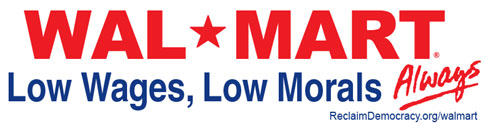
Walmart Admits: ‘Our Profits’ Depend on ‘Their Poverty’

walmart_low_morals_alt

By Lauren McCauley

Originally posted at CommonDreams.org

Although a notorious recipient of “corporate welfare,” Walmart has now admitted that their massive profits also depend on the funding of food stamps and other public assistance programs.

In their annual report, filed with the Security and Exchange Commission last week, the retail giant lists factors that could potentially harm future profitability. Listed among items such as “economic conditions” and “consumer confidence,” the company writes that changes in taxpayer-funded public assistance programs are also a major threat to their bottom line.

The company writes:

Our business operations are subject to numerous risks, factors and uncertainties, domestically and internationally, which are outside our control … These factors include … changes in the amount of payments made under the Supplement[al] Nutrition Assistance Plan and other public assistance plans, changes in the eligibility requirements of public assistance plans …

Walmart, the nation’s largest private employer, is notorious for paying poverty wages and coaching employees to take advantage of social programs. In many states, Walmart employees are the largest group of Medicaid recipients.

However, this report is the first public acknowledgement of the chain’s reliance on the funding of these programs to sustain a profit.

According to Stacy Mitchell, senior researcher with the Institute for Local Self-Reliance, the irony of their admission is that Walmart “is the company that has done, perhaps, more than any other corporation to push people into poverty.”

Citing a Penn State study, Mitchell told Common Dreams that research has proven that “when Walmart opens a store, poverty rates are negatively impacted” and that the more stores that have opened in a particular county, the worse it is. “This is a company that everywhere it goes it creates poverty.”

In addition to their own worker’s low wages, Mitchell explains that Walmart, because of their enormous size and market power, have “held down wages for the whole sector.”

As a retailer that specifically targets a low-income demographic, Mitchell adds that the “insidious genius” of their business model is that “they have so squeezed American workers […] many feel that their only choice is to shop at Walmart.”

The International Business Times reports:

Prior to the earnings report, Walmart Chief Financial Officer Charles Holley said the company didn’t anticipate how much the end to such programs as the unemployment benefits extension would affect it. Specifically, reductions to the Supplemental Nutrition Assistance Program that went into effect on Nov. 1, the first day of the company’s fourth quarter, pose a potential concern. The cuts led to a between $1 and $36 reduction in SNAP benefits per household, or up to $460 a year. Congress is debating reinstating the extension to the program and making the benefits retroactive to Nov. 1, something Walmart would clearly consider beneficial to its growth.

Previously, Walmart has joined forces with Big Food labels such as Coca Cola and Kelloggs to lobby the United States Department of Agriculture and Congress against any measures that would restrict SNAP use to healthy food choices. According to an earlier study by Michele Simon at Eat Drink Politics, in just one year, nine Walmart Supercenters in Massachusetts received more than $33 million in SNAP revenues.

Public Banking: Funding the New Economy

The most recent episode of “Guns and Butter” featured a compilation of highlights from a conference on public banking in San Rafael, California. Though it was held last year it’s worth a listen and will probably become more relevant in the future. You can listen to the whole show here:

http://archives.kpfa.org/data/20140312-Wed1300.mp3

The following are two of the speeches on the program posted as videos. The first, featuring Jim Hogue, has sound problems in the beginning but is greatly improved about three minutes in. The second clip features Charlie Eaton who discusses how bankers profit off colleges while screwing over students and taxpayers.

Though she wasn’t featured on Guns and Butter, student activist Victoria Grant presented this short but concise speech breaking down the relationship between banks, corporations and governments and how they facilitate corrupt policies.

This Is The Reality Of It: “We Are Factually In A Recession. Period.”

images

By Max Slavo

Originally posted at SHTFplan.com

We can cite scores of statistics and financials that prove without a shadow of a doubt that the U.S. economy is in a tail spin and won’t be recovering any time soon. Abysmal home sales, continued degradation in the national employment numbers, sky rocketing national debt, and ever rising consumer prices all point to serious problems.

But one number in particular pretty much sums it all up. It depicts not just the worsening state of our economy, but puts the lies and machinations of the U.S. government on full display for the world to see.

You’ll often hear the media cite the U.S. Growth Domestic Product (GDP) as a measure of economic growth. It measures the rate at which our economy grows.

In 2013, for example, our GDP was $17.08 trillion, up from the previous year’s $16.42 trillion. So, all of the goods and services sold throughout the United States (essentially, all of the money spent by Americans) rose about $661 billion dollars year-over-year.

Most people might look at the number, see 4% growth, and say it’s a no-brainer. How can the economy not be growing if the GDP rose?

The answer is simple. And when you look at it from the perspective Karl Denninger of the Market Ticker outlines below, you can’t help but realize that you’ve been purposely duped into believing that things are getting better. Just the opposite is true.

When looking at GDP you absolutely must account for the manufactured credit infused into the system during this same time period. When you do you’ll see just why the economy is not growing in any way, shape or form.

It is, in fact, contracting.

However, The Federal Reserve added $1.112 trillion in credit (unbacked by anything) during the same period of time; that’s a debasement of the units in which GDP is reported of 6.51%.

So the real change in the economy is in fact negative 2.51%.

We are factually in a recession.

Period.

There can be no progress economically or politically until the lies are stopped.  These are not mistakes; both the hosts and guest are fully-aware of The Fed’s balance sheet.

That extra trillion dollars slammed into the system by The Fed pretty much wipes out any growth noted by the Federal government’s statistics, because we never actually earned that money. It’s debt. Not growth!

Incidentally, the other oft cited measure of economic health is the Dow Jones Industrial Average, which currently sits around record all-time highs of 16,000 points, is likewise benefiting from this illusion. Guess where that stock market “growth” came from? Yes, the very same credit being used to prop up the economy (that $85 billion or so in Fed Treasury purchases every month) is also keeping stocks at record highs.

Back on Main Street, where most Americans live, we’re feeling the effects. Do we need to mention that the Patient Affordable Care Act has just forced working Americans to spend up to quadruple on their monthly premiums? Or that millions of Americans who are unemployed and no longer counted in the official statistics have absolutely no income whatsoever because their unemployment insurance has run out? Or that the price of everything from food and energy to rent and clothing is rising?

That kind of thing tends to happen when you debase your currency.

Last week famed contrarian economist John Williams noted that the economy gave a powerful recessionary signal in January that had not been seen since right before the market crash in 2007. Furthermore, one of the leading economic indicators of a recessionary environment is the price of copper because it is so closely associated with global growth. It has dropped significantly in recent months and it could well be signaling a coming crash in stocks just as it did in 2008.

When, not if, this thing buckles again we’re going to be in for an unprecedented period in U.S. history.

The system was on the brink of total collapse in 2008, as evidenced by Representative Brad Sherman on the House floor:

Many of us were told in private conversations that if we voted against this bill on Monday, that the sky would fall, the market would drop two or three thousands points the first day, another couple thousand the second day, and a few members were even told that there would be martial law in America if we voted no.

House Representative Brad Sherman (D-California)
Debate on the House Floor, October 2, 2008


They’ve used up all of the tricks in their magic hat. One misstep here and we’re going down. Any number of domestic or geo-political events could trigger a meltdown in U.S. stock markets and send the broader economy crashing.

Mainstream Economics Warns Out-of-Control Inequality Harms the Economy…But Corrupt Government Policy Keeps Increasing Inequality

land grap

Who’s Who of Prominent Economists Agree: Inequality Harms Economic Growth

By WashingtonsBlog

A who’s who of prominent liberal and conservative economists in government and academia have now said that runaway inequality harms economic growth, including:

  • Former U.S. Secretary of Labor and UC Berkeley professor Robert Reich
  • Global economy and development division director at Brookings and former economy minister for Turkey, Kemal Dervi
  • Societe Generale investment strategist and former economist for the Bank of England, Albert Edwards
  • Michael Niemira, chief economist at the International Council of Shopping Centers
  • Former executive director of the Joint Economic Committee of Congress, senior policy analyst in the White House Office of Policy Development, and deputy assistant secretary for economic policy at the Treasury Department, Bruce Bartlett
  • Deputy Division Chief of the Modeling Unit in the Research Department of the IMF, Michael Kumhof

Even the father of free market economics – Adam Smith – didn’t believe that inequality should be a taboo subject.

Numerous investors and entrepreneurs agree that runaway inequality hurts the economy, including:

How Bad Is It?

So how bad is it, really?

Inequality in America today is twice as bad as in ancient Rome, worse than it was in Tsarist Russia, Gilded Age America, modern Egypt, Tunisia or Yemen, many banana republics in Latin America, and worse than experienced by slaves in 1774 colonial America. (More stunning facts.)

It’s Not an Accident … It’s Policy

Extreme inequality helped cause the Great Depression, the current financial crisis … and the fall of the Roman Empire . Bad government policy – which favors the fatcats at the expense of the average American – is largely responsible for our runaway inequality.

And yet the powers-that-be in Washington and Wall Street are accelerating the redistribution of wealth from the lower, middle and more modest members of the upper classes to the super-elite.

Defenders of the status quo pretend that this inequality is something outside of our control … like a force of nature. They argue that it’s due to technological innovation or something else outside of policy-makers’ control.

In reality, inequality is rising due to bad policy.

Nobel prize winning economist Joe Stiglitz said recently:

Inequality is not inevitable. It is not … like the weather, something that just happens to us. It is not the result of the laws of nature or the laws of economics. Rather, it is something that we create, by our policies, by what we do.

We created this inequality—chose it, really—with [bad] laws …

Gaming the System to Pillage and Loot

The world’s top economic leaders have said for years that inequality is spiraling out of control and needs to be reduced. Why is inequality soaring even though world economic leaders have talked for years about the urgent need to reduce it?

Because they’re saying one thing but doing something very different. And both mainstream Democrats and mainstream Republicans are using smoke and mirrors to hide what’s really going on.

And it’s not surprising … Nobel winner Stiglitz says that inequality is caused by the use of money to shape government policies to benefit those with money. As Wikipedia notes:

A better explainer of growing inequality, according to Stiglitz, is the use of political power generated by wealth by certain groups to shape government policies financially beneficial to them. This process, known to economists as rent-seeking, brings income not from creation of wealth but from “grabbing a larger share of the wealth that would otherwise have been produced without their effort”

Rent seeking is often thought to be the province of societies with weak institutions and weak rule of law, but Stiglitz believes there is no shortage of it in developed societies such as the United States. Examples of rent seeking leading to inequality include

  • the obtaining of public resources by “rent-collectors” at below market prices (such as granting public land to railroads, or selling mineral resources for a nominal price in the US),
  • selling services and products to the public at above market prices (medicare drug benefit in the US that prohibits government from negotiating prices of drugs with the drug companies, costing the US government an estimated $50 billion or more per year),
  • securing government tolerance of monopoly power (The richest person in the world in 2011, Carlos Slim, controlled Mexico’s newly privatized telecommunication industry).

(Background here, here and here.)

Stiglitz says:

One big part of the reason we have so much inequality is that the top 1 percent want it that way. The most obvious example involves tax policy …. Monopolies and near monopolies have always been a source of economic power—from John D. Rockefeller at the beginning of the last century to Bill Gates at the end. Lax enforcement of anti-trust laws, especially during Republican administrations, has been a godsend to the top 1 percent. Much of today’s inequality is due to manipulation of the financial system, enabled by changes in the rules that have been bought and paid for by the financial industry itself—one of its best investments ever. The government lent money to financial institutions at close to 0 percent interest and provided generous bailouts on favorable terms when all else failed. Regulators turned a blind eye to a lack of transparency and to conflicts of interest.

***

Wealth begets power, which begets more wealth …. Virtually all U.S. senators, and most of the representatives in the House, are members of the top 1 percent when they arrive, are kept in office by money from the top 1 percent, and know that if they serve the top 1 percent well they will be rewarded by the top 1 percent when they leave office. By and large, the key executive-branch policymakers on trade and economic policy also come from the top 1 percent. When pharmaceutical companies receive a trillion-dollar gift—through legislation prohibiting the government, the largest buyer of drugs, from bargaining over price—it should not come as cause for wonder. It should not make jaws drop that a tax bill cannot emerge from Congress unless big tax cuts are put in place for the wealthy. Given the power of the top 1 percent, this is the way you would expect the system to work.

Former Sectretary of Labor Robert Reich recently noted:

When so much wealth accumulates at the top, with money comes the capacity to control politics… It’s not that people are rich, it’s that they abuse their wealth … The wealthy contribute to political candidates and the access that their contributions buy entrenches inequality by securing subsidies, bailouts and policies that lead to even greater inequality.

Bloomberg reports:

The financial industry spends hundreds of millions of dollars every election cycle on campaign donations and lobbying, much of which is aimed at maintaining the subsidy [to the banks by the public]. The result is a bloated financial sector and recurring credit gluts.

Indeed, the big banks literally own the Federal Reserve. And they own Washington D.C. politicians, lock stock and barrel. See this, this, this and this.

Two leading IMF officials, the former Vice President of the Dallas Federal Reserve, and the the head of the Federal Reserve Bank of Kansas City, Moody’s chief economist and many others have all said that the United States is controlled by an “oligarchy” or “oligopoly”, and the big banks and giant financial institutions are key players in that oligarchy.

The chairman of the Department of Economics at George Mason University says that it is inaccurate to call politicians prostitutes. Specifically, he says that they are more correct to call them “pimps”, since they are pimping out the American people to the financial giants.

Economics professor Randall Wray writes:

Thieves … took over the whole economy and the political system lock, stock, and barrel.

No wonder the government has saved the big banks at taxpayer expense, chosen the banks over the little guy, and

No wonder crony capitalism has gotten even worse under Obama than under Bush.

No wonder big Wall Street players are continuing to loot taxpayer money and public resources.

No wonder the big banks continue to manipulate every market and commit crime after crime and … and profit handsomely from it, while law-abiding citizens slide further and further behind.

Yet Obama is prosecuting fewer financial crimes than Bush, or his father, or Ronald Reagan.

No wonder:

All of the monetary and economic policy of the last 3 years has helped the wealthiest and penalized everyone else. See this, this and this.

***

Economist Steve Keen says:

“This is the biggest transfer of wealth in history”, as the giant banks have handed their toxic debts from fraudulent activities to the countries and their people.

Stiglitz said in 2009 that Geithner’s toxic asset plan “amounts to robbery of the American people”.

And economist Dean Baker said in 2009 that the true purpose of the bank rescue plans is “a massive redistribution of wealth to the bank shareholders and their top executives”.

Without the government’s creation of the too big to fail banks (they’ve gotten much bigger under Obama), the Fed’s intervention in interest rates and the markets (most of the quantitative easing has occurred under Obama), and government-created moral hazard emboldening casino-style speculation (there’s now more moral hazard than ever before) … things wouldn’t have gotten nearly as bad.

As we wrote in March 2009:

The bailout money is just going to line the pockets of the wealthy, instead of helping to stabilize the economy or even the companies receiving the bailouts:

  • A lot of the bailout money is going to the failing companies’ shareholders
  • Indeed, a leading progressive economist says that the true purpose of the bank rescue plans is “a massive redistribution of wealth to the bank shareholders and their top executives”
  • The Treasury Department encouraged banks to use the bailout money to buy their competitors, and pushed through an amendment to the tax laws which rewards mergers in the banking industry (this has caused a lot of companies to bite off more than they can chew, destabilizing the acquiring companies)

As we pointed out in 2008:

The game of capitalism only continues as long as everyone has some money to play with. If the government and corporations take everyone’s money, the game ends.The fed and Treasury are not giving more chips to those who need them: the American consumer. Instead, they are giving chips to the 800-pound gorillas at the poker table, such as Wall Street investment banks. Indeed, a good chunk of the money used by surviving mammoth players to buy the failing behemoths actually comes from the Fed.

Quantitative Easing

It is well-documented that quantitative easing increases inequality (and see this and this.)

Quantitative easing doesn’t help Main Street or the average American. It only helps big banks, giant corporations, and big investors.

The Federal Reserve has been doing quantitative easing for 5 years … and inequality has shot up over the last 5 years. It’s not a coincidence.

Subsidies to Giant, Wealthy Corporations

Massive subsidies to big corporations is also part of the problem. Indeed, some financial analysts say that the taxpayer subsidy to the giant banks alone is $780 billion per year.

The average American family pays $6,000/year in subsidies to giant corporations.

This is a direct transfer of wealth from the little guy to the big guy … which increases inequality.

Goosing the Stock Market

Moreover, the Fed has more or less admitted that it is putting almost all of its efforts into boosting the stock market.

Robert Reich has noted:

Some cheerleaders say rising stock prices make consumers feel wealthier and therefore readier to spend. But to the extent most Americans have any assets at all their net worth is mostly in their homes, and those homes are still worth less than they were in 2007. The “wealth effect” is relevant mainly to the richest 10 percent of Americans, most of whose net worth is in stocks and bonds.

AP writes:

The recovery has been the weakest and most lopsided of any since the 1930s.After previous recessions, people in all income groups tended to benefit. This time, ordinary Americans are struggling with job insecurity, too much debt and pay raises that haven’t kept up with prices at the grocery store and gas station. The economy’s meager gains are going mostly to the wealthiest.

Workers’ wages and benefits make up 57.5 percent of the economy, an all-time low. Until the mid-2000s, that figure had been remarkably stable — about 64 percent through boom and bust alike.

David Rosenberg points out:

The “labor share of national income has fallen to its lower level in modern history … some recovery it has been – a recovery in which labor’s share of the spoils has declined to unprecedented levels.”

The above-quoted AP article further notes:

Stock market gains go disproportionately to the wealthiest 10 percent of Americans, who own more than 80 percent of outstanding stock, according to an analysis by Edward Wolff, an economist at Bard College.

Indeed, as we reported in 2010:

As of 2007, the bottom 50% of the U.S. population owned only one-half of one percent of all stocks, bonds and mutual funds in the U.S. On the other hand, the top 1% owned owned 50.9%.***

(Of course, the divergence between the wealthiest and the rest has only increased since 2007.)

Professor G. William Domhoff demonstrated that the richest 10% own 98.5% of all financial securities, and that:

The top 10% have 80% to 90% of stocks, bonds, trust funds, and business equity, and over 75% of non-home real estate. Since financial wealth is what counts as far as the control of income-producing assets, we can say that just 10% of the people own the United States of America.

Tyler Durden notes:

In today’s edition of Bloomberg Brief, the firm’s economist Richard Yamarone looks at one of the more unpleasant consequences of Federal monetary policy: the increasing schism in wealth distribution between the wealthiest percentile and everyone else. … “To the extent that Federal Reserve policy is driving equity prices higher, it is also likely widening the gap between the haves and the have-nots….The disparity between the net worth of those on the top rung of the income ladder and those on lower rungs has been growing. According to the latest data from the Federal Reserve’s Survey of Consumer Finances, the total wealth of the top 10 percent income bracket is larger in 2009 than it was in 1995. Those further down have on average barely made any gains. It is likely that data for 2010 and 2011 will reveal an even higher percentage going to the top earners, given recent increases in stocks.” Alas, this is nothing new, and merely confirms speculation that the Fed is arguably the most efficient wealth redistibution, or rather focusing, mechanism available to the status quo. This is best summarized in the chart below comparing net worth by income distribution for various percentiles among the population, based on the Fed’s own data. In short: the richest 20% have gotten richer in the past 14 years, entirely at the expense of everyone else.

***

Lastly, nowhere is the schism more evident, at least in market terms, than in the performance of retail stocks:

Saks chairman Steve Sadove recently remarked, “I’ve been saying for several years now the single biggest determinant of our business overall, is how’s the stock market doing.” Privately-owned Neiman- Marcus reported “In New York City, business at Bergdorf Goodman continues to be extremely strong.”

In contrast, retail giant Wal-Mart talks of its “busiest hours” coming at midnight when food stamps are activated and consumers proceed through the check-outs lines with baby formula, diapers, and other groceries. Wal-Mart has posted a decline in same-store sales for eight consecutive quarters.

As CNN Money pointed out in 2011, “Wal-Mart’s core shoppers are running out of money much faster than a year ago …” This trend has only gotten worse: The wealthy are doing great … but common folks can no longer afford to shop even at Wal-Mart, Sears, JC Penney or other low-price stores.

Durden also notes:

Another indication of the increasing polarity of US society is the disparity among consumer confidence cohorts by income as shown below, and summarized as follows: “The increase in equity prices has raised consumer spirits, particularly among higher-income consumers. The Conference Board’s Consumer Confidence index for all income levels bottomed in February/March of 2009. The recovery since then has been notable across the board, but nowhere as much as for those making $50,000 or more.”

Business Week notes:

Barry Ritholtz, [CIO of Ritholtz Wealth, and popular financial blogger], says millions of potential investors may conclude, as they did after the Great Depression, that the market is a rigged game for insiders. Such seismic shifts in popular sentiment can have lasting effects. The Dow Jones industrial average didn’t regain its September 1929 peak of 355.95 until 1954. “You’re going to lose a generation of investors,” says Ritholtz. “And that’s how you end up with a 25-year bear market. That’s the risk if people start to think there is no economic justice.”

Americans know that the system is rigged against them. See this. We know that the government is giving Wall Street crooks a pass. 70% of Americans know that the government’s economic policies have thrown money at the banks and hosed the people.

In such an environment, the average American has largely gotten out of stocks and other investments.

Over-Financialization

When a country’s finance sector becomes too large finance, inequality rises. As Wikipedia notes:

[Economics professor] Jamie Galbraith argues that countries with larger financial sectors have greater inequality, and the link is not an accident.

Government policy has been encouraging the growth of the financial sector for decades:

https://desultoryheroics.com/wp-content/uploads/2014/03/71000-financialandnonfinancialsectors-compensationlesleopold.jpg

(Economist Steve Keen has also shown that “a sustainable level of bank profits appears to be about 1% of GDP”, and that higher bank profits leads to a ponzi economy and a depression).

Unemployment and Underemployment

A major source of inequality is unemployment, underemployment and low wages.

Corporate Profits v. Jobs

Government policy has created these conditions. And the pretend populist Obama – who talks non-stop about the importance of job-creation – actually doesn’t mind such conditions at all.

The“jobless recovery” that the Bush and Obama governments have engineered is a redistribution of wealth from the little guy to the big boys.

The New York Times notes:

Economists at Northeastern University have found that the current economic recovery in the United States has been unusually skewed in favor of corporate profits and against increased wages for workers.

In their newly released study, the Northeastern economists found that since the recovery began in June 2009 following a deep 18-month recession, “corporate profits captured 88 percent of the growth in real national income while aggregate wages and salaries accounted for only slightly more than 1 percent” of that growth.

The study, “The ‘Jobless and Wageless Recovery’ From the Great Recession of 2007-2009,” said it was “unprecedented” for American workers to receive such a tiny share of national income growth during a recovery.

***

The share of income growth going to employee compensation was far lower than in the four other economic recoveries that have occurred over the last three decades, the study found.

Obama apologists say Obama has created jobs. But the number of people who have given up and dropped out of the labor force has skyrocketed under Obama (and see this).

And the jobs that have been created have been low-wage jobs.

Low Wage Jobs

For example, the New York Times noted in 2011:

The median pay for top executives at 200 big companies last year was $10.8 million. That works out to a 23 percent gain from 2009.

***

Most ordinary Americans aren’t getting raises anywhere close to those of these chief executives. Many aren’t getting raises at all — or even regular paychecks. Unemployment is still stuck at more than 9 percent.

***

“What is of more concern to shareholders is that it looks like C.E.O. pay is recovering faster than company fortunes,” says Paul Hodgson, chief communications officer for GovernanceMetrics International, a ratings and research firm.

According to a report released by GovernanceMetrics in June, the good times for chief executives just keep getting better. Many executives received stock options that were granted in 2008 and 2009, when the stock market was sinking.

Now that the market has recovered from its lows of the financial crisis, many executives are sitting on windfall profits, at least on paper. In addition, cash bonuses for the highest-paid C.E.O.’s are at three times prerecession levels, the report said.

***

The average American worker was taking home $752 a week in late 2010, up a mere 0.5 percent from a year earlier. After inflation, workers were actually making less.

AP pointed out that the average worker is not doing so well:

Unemployment has never been so high — 9.1 percent — this long after any recession since World War II. At the same point after the previous three recessions, unemployment averaged just 6.8 percent.

– The average worker’s hourly wages, after accounting for inflation, were 1.6 percent lower in May than a year earlier. Rising gasoline and food prices have devoured any pay raises for most Americans.

– The jobs that are being created pay less than the ones that vanished in the recession. Higher-paying jobs in the private sector, the ones that pay roughly $19 to $31 an hour, made up 40 percent of the jobs lost from January 2008 to February 2010 but only 27 percent of the jobs created since then.

Alan Greenspan noted:

Large banks, who are doing much better and large corporations, whom you point out and everyone is pointing out, are in excellent shape. The rest of the economy, small business, small banks, and a very significant amount of the labour force, which is in tragic unemployment, long-term unemployment – that is pulling the economy apart.

Money Being Sucked Out of the U.S. Economy … But Big Bucks Are Being Made Abroad

Part of the widening gap is due to the fact that most American companies’ profits are driven by foreign sales and foreign workers. As AP noted in 2010:

Corporate profits are up. Stock prices are up. So why isn’t anyone hiring?

Actually, many American companies are — just maybe not in your town. They’re hiring overseas, where sales are surging and the pipeline of orders is fat.

***

The trend helps explain why unemployment remains high in the United States, edging up to 9.8% last month, even though companies are performing well: All but 4% of the top 500 U.S. corporations reported profits this year, and the stock market is close to its highest point since the 2008 financial meltdown.

But the jobs are going elsewhere. The Economic Policy Institute, a Washington think tank, says American companies have created 1.4 million jobs overseas this year, compared with less than 1 million in the U.S. The additional 1.4 million jobs would have lowered the U.S. unemployment rate to 8.9%, says Robert Scott, the institute’s senior international economist.

“There’s a huge difference between what is good for American companies versus what is good for the American economy,” says Scott.

***

Many of the products being made overseas aren’t coming back to the United States. Demand has grown dramatically this year in emerging markets like India, China and Brazil.

Government policy has accelerated the growing inequality. It has encouraged American companies to move their facilities, resources and paychecks abroad. And some of the biggest companies in America have a negative tax rate … that is, not only do they pay no taxes, but they actually get tax refunds.

And a large percentage of the bailouts went to foreign banks (and see this). And so did a huge portion of the money from quantitative easing. More here and here.

Capital Gains and Dividends

According to a 2013 study published by a researcher at the U.S. Congressional Research Service:

The largest contributor to increasing income inequality…was changes in income from capital gains and dividends.

Business Insider explains:

Drastic income inequality growth in the United States is largely derived from changes in the way the U.S. government taxes income from capital gains and dividends, according to a new study by Thomas Hungerford of the non-partisan Congressional Research Service.

Essentially, what Democrats have been saying about income inequality — that it’s in a large part due to favorable taxation and deduction policies for high income Americans — is largely right

***

The study … conclusively found that the wealthy benefitted from low tax rates on investment income, which in turn caused their wealth to grow faster.

Essentially, taxing capital gains as ordinary income would make the playing field more fair, and reduce over time income inequality.

Joseph Stiglitz noted in 2011:

Lowering tax rates on capital gains, which is how the rich receive a large portion of their income, has given the wealthiest Americans close to a free ride.

Indeed, the Tax Policy center reports that the top 1% took home 71% of all capital gains in 2012.

Ronald Reagan’s budget director, assistant secretary of treasury, and domestic policy director all say that the Bush tax cuts were a huge mistake. See this and this.

85 Richest People as Wealthy as Poorest Half of the World

As World Economic Forum starts in Davos, development charity claims growing inequality has been driven by ‘power grab’

By Graeme Wearden

Originally posted at theguardian.com

The InterContinental Davos luxury hotel in the Swiss mountain resort of Davos

The InterContinental Davos luxury hotel in the Swiss mountain resort of Davos. Oxfam report found people in countries around the world believe that the rich have too much influence over the direction their country is heading. Photograph: Arnd Wiegmann/REUTERS

The world’s wealthiest people aren’t known for traveling by bus, but if they fancied a change of scene then the richest 85 people on the globe – who between them control as much wealth as the poorest half of the global population put together – could squeeze onto a single double-decker.

The extent to which so much global wealth has become corralled by a virtual handful of the so-called ‘global elite’ is exposed in a new report from Oxfam on Monday. It warned that those richest 85 people across the globe share a combined wealth of £1tn, as much as the poorest 3.5 billion of the world’s population.

Working for the Few - Oxfam report

Source: F. Alvaredo, A. B. Atkinson, T. Piketty and E. Saez, (2013) ‘The World Top Incomes Database’, http://topincomes.g-mond.parisschoolofeconomics.eu/Only includes countries with data in 1980 and later than 2008. Photograph: Oxfam

The wealth of the 1% richest people in the world amounts to $110tn (£60.88tn), or 65 times as much as the poorest half of the world, added the development charity, which fears this concentration of economic resources is threatening political stability and driving up social tensions.

It’s a chilling reminder of the depths of wealth inequality as political leaders and top business people head to the snowy peaks of Davos for this week’s World Economic Forum. Few, if any, will be arriving on anything as common as a bus, with private jets and helicopters pressed into service as many of the world’s most powerful people convene to discuss the state of the global economy over four hectic days of meetings, seminars and parties in the exclusive ski resort.

Winnie Byanyima, the Oxfam executive director who will attend the Davos meetings, said: “It is staggering that in the 21st Century, half of the world’s population – that’s three and a half billion people – own no more than a tiny elite whose numbers could all fit comfortably on a double-decker bus.”

Oxfam also argues that this is no accident either, saying growing inequality has been driven by a “power grab” by wealthy elites, who have co-opted the political process to rig the rules of the economic system in their favour.

In the report, entitled Working For The Few (summary here), Oxfam warned that the fight against poverty cannot be won until wealth inequality has been tackled.

“Widening inequality is creating a vicious circle where wealth and power are increasingly concentrated in the hands of a few, leaving the rest of us to fight over crumbs from the top table,” Byanyima said.

Oxfam called on attendees at this week’s World Economic Forum to take a personal pledge to tackle the problem by refraining from dodging taxes or using their wealth to seek political favours.

As well as being morally dubious, economic inequality can also exacerbate other social problems such as gender inequality, Oxfam warned. Davos itself is also struggling in this area, with the number of female delegates actually dropping from 17% in 2013 to 15% this year.

How richest use their wealth to capture opportunities

Polling for Oxfam’s report found people in countries around the world – including two-thirds of those questioned in Britain – believe that the rich have too much influence over the direction their country is heading.

Byanyima explained:

“In developed and developing countries alike we are increasingly living in a world where the lowest tax rates, the best health and education and the opportunity to influence are being given not just to the rich but also to their children.

“Without a concerted effort to tackle inequality, the cascade of privilege and of disadvantage will continue down the generations. We will soon live in a world where equality of opportunity is just a dream. In too many countries economic growth already amounts to little more than a ‘winner takes all’ windfall for the richest.”

Working for the Few - Oxfam report

The Oxfam report found that over the past few decades, the rich have successfully wielded political influence to skew policies in their favour on issues ranging from financial deregulation, tax havens, anti-competitive business practices to lower tax rates on high incomes and cuts in public services for the majority. Since the late 1970s, tax rates for the richest have fallen in 29 out of 30 countries for which data are available, said the report.

This “capture of opportunities” by the rich at the expense of the poor and middle classes has led to a situation where 70% of the world’s population live in countries where inequality has increased since the 1980s and 1% of families own 46% of global wealth – almost £70tn.

Opinion polls in Spain, Brazil, India, South Africa, the US, UK and Netherlands found that a majority in each country believe that wealthy people exert too much influence. Concern was strongest in Spain, followed by Brazil and India and least marked in the Netherlands.

In the UK, some 67% agreed that “the rich have too much influence over where this country is headed” – 37% saying that they agreed “strongly” with the statement – against just 10% who disagreed, 2% of them strongly.

The WEF’s own Global Risks report recently identified widening income disparities as one of the biggest threats to the world community.

Oxfam is calling on those gathered at WEF to pledge: to support progressive taxation and not dodge their own taxes; refrain from using their wealth to seek political favours that undermine the democratic will of their fellow citizens; make public all investments in companies and trusts for which they are the ultimate beneficial owners; challenge governments to use tax revenue to provide universal healthcare, education and social protection; demand a living wage in all companies they own or control; and challenge other members of the economic elite to join them in these pledges.

• Research Now questioned 1,166 adults in the UK for Oxfam between October 1 and 14 2013.

The Last Gasp of American Democracy

tumblr_lyzbbcoWqZ1qjg60ao1_500

Chris Hedges’ regular columns for Truthdig.com are consistently informative and provocative, but his latest piece offers a particularly critical analysis of the current political moment in the United States. In the following excerpt he ruminates on a number of recent actions of our modern corporate totalitarian state:

Via Truthdig:

The object of efficient totalitarian states, as George Orwell understood, is to create a climate in which people do not think of rebelling, a climate in which government killing and torture are used against only a handful of unmanageable renegades. The totalitarian state achieves this control, Arendt wrote, by systematically crushing human spontaneity, and by extension human freedom. It ceaselessly peddles fear to keep a population traumatized and immobilized. It turns the courts, along with legislative bodies, into mechanisms to legalize the crimes of state.

The corporate state, in our case, has used the law to quietly abolish the Fourth and Fifth amendments of the Constitution, which were established to protect us from unwarranted intrusion by the government into our private lives. The loss of judicial and political representation and protection, part of the corporate coup d’état, means that we have no voice and no legal protection from the abuses of power. The recent ruling supporting the National Security Agency’s spying, handed down by U.S. District Judge William H. Pauley III, is part of a very long and shameful list of judicial decisions that have repeatedly sacrificed our most cherished constitutional rights on the altar of national security since the attacks of 9/11. The courts and legislative bodies of the corporate state now routinely invert our most basic rights to justify corporate pillage and repression. They declare that massive and secret campaign donations—a form of legalized bribery—are protected speech under the First Amendment. They define corporate lobbying—under which corporations lavish funds on elected officials and write our legislation—as the people’s right to petition the government. And we can, according to new laws and legislation, be tortured or assassinated or locked up indefinitely by the military, be denied due process and be spied upon without warrants. Obsequious courtiers posing as journalists dutifully sanctify state power and amplify its falsehoods—MSNBC does this as slavishly as Fox News—while also filling our heads with the inanity of celebrity gossip and trivia. Our culture wars, which allow politicians and pundits to hyperventilate over nonsubstantive issues, mask a political system that has ceased to function. History, art, philosophy, intellectual inquiry, our past social and individual struggles for justice, the very world of ideas and culture, along with an understanding of what it means to live and participate in a functioning democracy, are thrust into black holes of forgetfulness.

The political philosopher Sheldon Wolin, in his essential book “Democracy Incorporated,” calls our system of corporate governance “inverted totalitarianism,” which represents “the political coming of age of corporate power and the political demobilization of the citizenry.” It differs from classical forms of totalitarianism, which revolve around a demagogue or charismatic leader; it finds its expression in the anonymity of the corporate state. The corporate forces behind inverted totalitarianism do not, as classical totalitarian movements do, replace decaying structures with new structures. They instead purport to honor electoral politics, freedom of expression and the press, the right to privacy and the guarantees of law. But they so corrupt and manipulate electoral politics, the courts, the press and the essential levers of power as to make genuine democratic participation by the masses impossible. The U.S. Constitution has not been rewritten, but steadily emasculated through radical judicial and legislative interpretation. We have been left with a fictitious shell of democracy and a totalitarian core. And the anchor of this corporate totalitarianism is the unchecked power of our systems of internal security.

Our corporate totalitarian rulers deceive themselves as often as they deceive the public. Politics, for them, is little more than public relations. Lies are told not to achieve any discernable goal of public policy, but to protect the image of the state and its rulers. These lies have become a grotesque form of patriotism. The state’s ability through comprehensive surveillance to prevent outside inquiry into the exercise of power engenders a terrifying intellectual and moral sclerosis within the ruling elite. Absurd notions such as implanting “democracy” in Baghdad by force in order to spread it across the region or the idea that we can terrorize radical Islam across the Middle East into submission are no longer checked by reality, experience or factually based debate. Data and facts that do not fit into the whimsical theories of our political elites, generals and intelligence chiefs are ignored and hidden from public view. The ability of the citizenry to take self-corrective measures is effectively stymied. And in the end, as in all totalitarian systems, the citizens become the victims of government folly, monstrous lies, rampant corruption and state terror.

Read the full article here: http://www.truthdig.com/report/page2/the_last_gasp_of_american_democracy_20140105