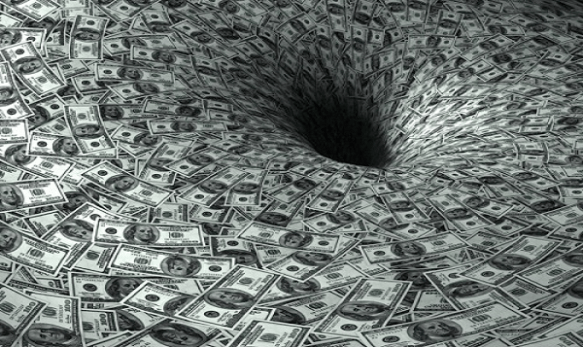
Why We’re Doomed: Our Economy’s Toxic Inequality

By Charles Hugh Smith

Source: Of Two Minds

Anyone who thinks our toxic financial system is stable is delusional.

Why are we doomed? Those consuming over-amped “news” feeds may be tempted to answer the culture wars, nuclear war with North Korea or the Trump Presidency.

The one guaranteed source of doom is our broken financial system, which is visible in this chart of income inequality from the New York Times: Our Broken Economy, in One Simple Chart.

While the essay’s title is our broken economy, the source of this toxic concentration of income, wealth and power in the top 1/10th of 1% is more specifically our broken financial system.

What few observers understand is rapidly accelerating inequality is the only possible output of a fully financialized economy. Various do-gooders on the left and right propose schemes to cap this extraordinary rise in the concentration of income, wealth and power, for example, increasing taxes on the super-rich and lowering taxes on the working poor and middle class, but these are band-aids applied to a metastasizing tumor: financialization, which commoditizes labor, goods, services and financial instruments and funnels the income and wealth to the very apex of the wealth-power pyramid.

Take a moment to ponder what this chart is telling us about our financial system and economy. 35+ years ago, lower income households enjoyed the highest rates of income growth; the higher the income, the lower the rate of income growth.

This trend hasn’t just reversed; virtually all the income gains are now concentrated in the top 1/100th of 1%, which has pulled away from the top 1%, the top 5% and the top 10%, as well as from the bottom 90%.

The fundamental driver of this profoundly destabilizing dynamic is the disconnect of finance from the real-world economy.

The roots of this disconnect are debt: when we borrow from future earnings and energy production to fund consumption today, we are using finance to ramp up our consumption of real-world goods and services.

In small doses, this use of finance to increase consumption of real-world goods and services is beneficial: economies with access to credit can rapidly boost expansion in ways that economies with little credit cannot.

But the process of financialization is not benign. Financialization turns everything into a commodity that can be traded and leveraged as a financial entity that is no longer firmly connected to the real world.

The process of financialization requires expertise in the financial game, and it places a premium on immense flows of capital and opaque processes: for example, the bundling of debt such as mortgages or student loans into instruments that can be sold and traded.

These instruments can then become the foundation of an entirely new layer of instruments that can be sold and traded. This pyramiding of debt-based “assets” spreads risk throughout the economy while aggregating the gains into the hands of the very few with access to the capital and expertise needed to pass the risk and assets off onto others while keeping the gains.

Profit flows to what’s scarce, and in a financialized economy, goods and services have become commodities, i.e. they are rarely scarce, because somewhere in the global economy new supplies can be brought online.

What’s scarce in a financialized economy is specialized knowledge of financial games such as tax avoidance, arbitrage, packaging collateralized debt obligations and so on.

Though the billionaires who have actually launched real-world businesses get the media attention–Bill Gates, Jeff Bezos, Steve Jobs, et al.–relatively few of the top 1/10th of 1% actually created a real-world business; most are owners of capital with annual incomes of $10 million to $100 million that are finance-generated.

This is only possible in a financialized economy in which finance has become increasingly detached from the real-world economy.

Those with the capital and skills to reap billions in profits from servicing and packaging student loan debt have no interest in whether the education being purchased with the loans has any utility to the indebted students, as their profits flow not from the real world but from the debt itself.

This is how we’ve ended up with an economy characterized by profound dysfunction in the real world of higher education, healthcare, etc., and immense fortunes being earned by a few at the top of the pyramid from the financialized games that have little to no connection to the real-world economy.

Anyone who thinks our toxic financial system is stable is delusional. If history is any guide (and recall that Human Nature hasn’t changed in the 5,000 uears of recorded history), this sort of accelerating income/wealth/ power inequality is profoundly destabilizing–economically, politically and socially.

All the domestic headline crises–culture wars, opioid epidemic, etc.–are not causes of discord: they are symptoms of the inevitable consequences of a toxic financial system that has broken our economy, our system of governance and our society.

The New Economy: Unemployment and the Return of the American Hobo

By Sheldon Greaves

Source: Cogito!

A few years ago I read somewhere about a trend in the “gig economy” in which people who had been reduced to living in their cars or RVs roamed the country by the thousands; homeless, nomadic workers driving from one temporary job to another. It painted a tragic picture; underpaid, overworked, often lacking health insurance, men and women, many of whom ought to be enjoying retirement but were working in warehouses filling orders for Amazon (“Camperforce”) or stocking shelves in a big-box store.

It sharply reminded me of the Great Depression, another time when mobile workers moved from place to place across the country in search of work. Thinking about this I realized that what we were seeing was the return of the migrant worker apart from the seasonal farm worker, i.e., the Hobo. Also called Tramps, Bums and other less charitable names, these men were the displaced detritus of the Great Depression who wandered the country looking for any jobs that would help them survive and, if there was any left over, to send home to their families. It was a dangerous life; travelling by hopping freight trains or hitchhiking on the highways wasn’t the safest way to get around. Many hobos were maimed or killed in accidents travelling this way, or were victims of violence. Loren Eisley’s wonderful memoir All the Strange Hours recalls his days as a young hobo with all of the dangers and troubles that went with being a hobo. They also faced hostility from towns naturally suspicious of outsiders, especially if there wasn’t any work even for the locals.

But the hobos also became a part of American folklore. The music of Woody Guthrie, who spent quite a bit of time on freight trains himself, helped to make the plight of these unemployed workers known to the rest of the country. Government programs found ways to harness this pool of labor and skill, pouring it into vast projects, many of which continue to contribute to national economy today.

There was, however, another side to hobo life. It became a sort of counter-culture, a rebellion of sorts against a social order that had unfairly cast aside decent, hard-working people for the sake of profit. Hobo life in some cases became a form of dropout culture, mainly, I suspect, as a way of embracing what apparently could not be avoided. An old professor of mine, who spent some of his youth as a tramp, recalled how some of his tramping companions actually knew more about science and literature than his college professors, but preferred tramping as a better way to enjoy God’s creations. Dropouts indeed.

I have been fascinated by American dropout culture as a response to moments when society becomes economically, intellectually, morally, and spiritually intolerable and so, like a few Biblical figures, one leaves, going out of bondage, but into the wilderness for whatever it may bring one. Historically, I’ve noticed that from Roanoke to the 1960’s and 70’s, the dropouts generally seemed to have a point, even if it wasn’t clear at the time. Sometimes the dropouts used their unique viewpoint to inform changes for the better, or became part of grander projects as happened with the government work projects of the New Deal.

So it is with some bemusement that I have noticed an interesting trend when it comes to the mobile temp workers, hobos with RVs or living out of their cars. Over the last seven or so years a small body of literature has emerged celebrating the homeless, wandering worker. Getting out of debt is a common reason for ditching less settled living, and as a rejection of consumerism (Ironic, given how many of these mobile temp jobs are serving precisely that consumer economy). The whole thing has a Small is Beautiful/Voluntary Simplicity vibe to it. Three of the six or so book titles of the last few years even reference “living in a van down by the river” in homage to a classic SNL skit.

So which is it? Is the new hobo a national tragedy in slow-motion, or rebellion against consumer culture, a new manifestation of the All-American dropout? I think it’s too early to tell. This may be nothing more or less than trying to make the best of a bad situation. I hope it’s more than that.

Famed American author and philosopher Eric Hoffer, himself a long-time migrant worker, had some remarkable insights into the responsibility of a nation to do right by such men and women. In his essay, “The Role of the Undesirables”, based on his own experience in government work camps in the early 1930’s. He draws some interesting and telling comparisons between the “human junk pile” that made up the bulk of his fellow workers and the early American pioneers–themselves undesirables from Europe–who built the nation. He points out that these pioneers craved change, much like the RV hobos of today. Hoffer writes: “…the quality and destiny of a nation are determined to a considerable extent by the nature and potentialities of its inferior elements.” He further argues that the quality of a nation is likewise manifest by how those at the bottom rise to the top. And that, I submit, is the problem. Is there an endgame to the RV hobo life that involves a chance to settle back down, to enjoy some of the fruits of one’s labor in security and dignity? Certainly a life on the road can be exciting. I find the idea compelling myself. But the other kind of mobility–upward mobility–has all but ceased to exist in this country. I cannot yet say whether these economic rebels of the road are truly making a new way of living, or accepting the unacceptable.

It’s time to call the housing crisis what it really is: the largest transfer of wealth in living memory

By Laurie Macfarlane

Source: OpenDemocracy.net

One of the basic claims of capitalism is that people are rewarded in line with their effort and productivity. Another is that the economy is not a zero sum game. The beauty of a capitalist economy, we are told, is that people who work hard can get rich without making others poorer.

But how does this stack up in modern Britain, the birthplace of capitalism and many of its early theorists? Last week, the Office for National Statistics (ONS) released new data tracking how wealth has evolved over time. On paper, the UK has indeed become much wealthier in recent decades. Net wealth has more than tripled since 1995, increasing by over £7 trillion. This is equivalent to an average increase of nearly £100,000 per person. Impressive stuff. But where has all this wealth come from, and who has it benefitted?

Just over £5 trillion, or three quarters of the total increase, is accounted for by increase in the value of dwellings – another name for the UK housing stock. The Office for National Statistics explains that this is “largely due to increases in house prices rather than a change in the volume of dwellings.” This alone is not particularly surprising. We are forever told about the importance of ‘getting a foot on the property ladder’. The housing market has long been viewed as a perennial source of wealth.

But the price of a property is made up of two distinct components: the price of the building itself, and the price of the land that the structure is built upon. This year the ONS has separated out these two components for the first time, and the results are quite astounding.

In just two decades the market value of land has quadrupled, increasing recorded wealth by over £4 trillion. The driving force behind rising house prices — and the UK’s growing wealth — has been rapidly escalating land prices.

For those who own property, this has provided enormous benefits. According to the Resolution Foundation, homeowners born in the 1940s and 1950s gained an unearned windfall of £80,000 between 1993 and 2014 alone. In the early 2000s, house price growth was so great that 17% of working-age adults earned more from their house than from their job.

Last week The Times reported that during the past three months alone, baby boomers converted £850 million of housing wealth into cash using equity release products – the highest number since records began. A third used the money to buy cars, while more than a quarter used it to fund holidays. Others are choosing to buy more property: the Chartered Institute of Housing has described how the buy-to-let market is being fuelled by older households using their housing wealth to buy more property, renting it out to those who are unable to get a foot on the property ladder. And it is here that we find the dark side of the housing boom.

As house prices have continued to increase and the gap between house prices and earnings has grown larger, the cost of homeownership has become increasingly prohibitive. Whereas in the mid-1990s low and middle income households could afford a first time buyer deposit after saving for around 3 years, today it takes the same households 20 years to save for a deposit. Many have increasingly found themselves with little choice but to rent privately. For those stuck in the private rental market, the proportion of income spent on housing costs has risen from around 10% in 1980 to 36% today. Unlike homeowners, there is no asset wealth to draw on to fund new cars or holidays.

In Britain, we have yet to confront the truth about the trillions of pounds of wealth amassed through the housing market in recent decades: this wealth has come straight out of the pockets of those who don’t own property.

When the value of a house goes up, the total productive capacity of the economy is unchanged because nothing new has been produced: it merely constitutes an increase in the value of the land underneath. We have known since the days of Adam Smith and David Ricardo that land is not a source of wealth but of economic rent — a means of extracting wealth from others. Or as Joseph Stiglitz puts it “getting a larger share of the pie rather than increasing the size of the pie”. The truth is that much of the wealth accumulated in recent decades has been gained at the expense of those who will see more of their incomes eaten up by higher rents and larger mortgage payments. This wealth hasn’t been ‘created’ – it has been stolen from future generations.

House prices are now on average nearly eight times that of incomes, more than double the figure of 20 years ago. It’s unlikely that house prices will be able to outpace incomes at the same rate for the next 20 years. The past few decades have spawned a one-off transfer of wealth that is unlikely to be repeated. While the main beneficiaries of this have been the older generations, eventually this will be passed on to the next generation via inheritance or transfer. Already the ‘Bank of Mum and Dad’ has become the ninth biggest mortgage lender. The ultimate result is not just a growing intergenerational divide, but an entrenched class divide between those who own property (or have a claim to it), and those who do not.

Misleading accounting and irresponsible economics have provided cover for this heist. The government’s national accounts record house price growth as new wealth, ignoring the cost it imposes on others in society – particularly young people and those yet to be born. Economists still hail house price inflation as a sign of economic strength.

The result is a world which is rather different to that described in economics textbooks. Most of today’s ‘wealth’ isn’t the result of entrepreneurialism and hard work – it has been accumulated by being idle and unproductive. Far from the positive sum game capitalism is supposed to be, we have a system where most wealth is gained at the expense of others. As John Stuart Mill wrote back in 1848:

“If some of us grow rich in our sleep, where do we think this wealth is coming from?  It doesn’t materialise out of thin air. It doesn’t come without costing someone, another human being. It comes from the fruits of others’ labours, which they don’t receive.”

Britain’s housing crisis is complicated mess. Fixing it requires a long-term plan and a bold new approach to policy. But in the meantime let’s start calling it what it really is: the largest transfer of wealth in living memory.

And empires die

Source: Intrepid Report

Nothing ever seems to last, everybody changes oh so fast,
promises made promises lost and pride is kept at any cost,
And flowers die, and children cry, and lonely people carry on.
—Palermo & Farruggio 1970

That was from the song And Flowers Die, by prolific composer Michael Palermo and this writer as lyricist. How appropriate to compare this song with the ‘death song’ of our Military-Industrial Amerikan Empire, now in only its 72nd year of prominence. How great and powerful our empire was for so long. We controlled the economies and governments of so many countries, even continents. Now it is the autumn of our status as Number One. The Asian rim, as many refer to it, being led by China and all those other nations in that region, will become the future economic powerhouse of this planet.

This writer will leave it to the many progressive scholars out there for the explanation of the how and why of this equation. Let me just say that we all, from grade school on, have been fed the pabulum of America as a democracy, benevolent to the entire world. Many sadly still believe that lie, and that strengthens the reason why this empire is in freefall.

Since we became the preeminent world empire at the end of WW2, two things held the greedy ones who run things in we’ll say half check: The progressive federal tax rate and the union movement. The top tax rate from 1953 to 1963 was 91%. Now, we know that the super rich did not pay at that rate, but even after their accountants sharpened a few pencils, many still had to pay at least 50%, for argument sake. Today’s top rate is 39.6%, meaning that folks like mega millionaire Mitt Romney pay at around 15%-20%. Do the math and see how much more went into the treasury then as opposed to now. The second factor that held this empire in half check was the stronger union movement in the ‘50s, ‘60s and ‘70s. In the 1950s, about 35% of American workers belonged to unions. In 1983, it went down to around 20%. Now, the percentage is around 12%. So, that means that three times more working stiffs in the recent past had the protection of a union, however weak or compliant that union may have been. Today, this empire can breathe easily as fewer and fewer working stiffs even have a union!

To this writer, with all the many factors that have contributed to the demise of our nation via this Military-Industrial Empire, the number one factor is our foreign policy. When over half of your spending goes for military reasons, how can a nation sustain itself at home? When you have over 1,000 military bases in over 100 countries, and you consistently are involved in these phony wars, the home front must feel the strain. Our myriad of domestic bleeding is so obvious . . . yet so few here will acknowledge it. Our infrastructure is crumbling, our health care is a mess, too many mediocre paying jobs (with too many being part time with NO benefits), our political system is controlled by Big Money, our media is controlled by the same Big Money . . . and the fools still fight amongst each other over the Two Party/One Party con job.

Let’s face it: All the major industrialized nations are controlled by their super rich. There are really few exceptions. Sadly, with over 99+ % of the populace in all these countries being just simple working stiffs, it is time for a change of mindset. The mindset must be simple: The super rich need to go back to paying their fair share, and government needs to become what Mark Twain prescribed: ‘To protect us from the crooks and scoundrels.’

What Happened to All Those Foreclosed Houses?

Wall Street bought them — and is now leasing them out and driving up rents.

By Jim Hightower

Source: OpEdNews.com

We know that millions of American families lost their homes after Wall Street’s 2007 financial crash. But where did all those houses go?

It turns out that Wall Streeters themselves formed profiteering investment groups that rushed out to scoop up tens of thousands of those foreclosed properties, usually grabbing them on the cheap at courthouse auctions in suburban metro areas that were hard-hit by the crash.

These moneyed syndicates have deep, deep pockets, so they easily outbid local buyers to take possession of the majority of the single-family homes being sold off in many distressed places.

Why are they buying? To turn the homes into rental properties and become the dominant suburban landlord, controlling the local market and constantly jacking up rents.

For example, the Wall Street Journal found that in Nashville’s suburb of Spring Hill, just four of these predatory giants own 700 houses — giving this oligopoly of absentee investors ownership of three-fourths of all rental houses in town.

One of these bulk buyers is an arm of Blackstone, the world’s largest private equity firm. Another is an equity outfit that was spun out of the housing speculation department of Goldman Sachs. And still another is a billionaire whose investors include the Alaska state oil fund.

Not only do rents jump dramatically when such outfits seize a market, but Wall Street’s intention is to impose “a new way” on housing America: They’re pushing a cultural shift in which homeownership is no longer part of the American Dream, and tenants are taught to accept annual rent increases as the price of having a home.

So the banksters crash the economy, you lose income and your home, they buy your house at auction, then they rent it to you at an ever-increasing price. The “new way” is the same old story: The rich robbing the rest of us.


When the Butterfly Flaps Its Wings

credit: Twitter/@caroleenarn

By James Howard Kunstler

Source: Kunstler.com

It remains to be seen what the impact will be from Mother Nature putting the nation’s fourth largest city out-of-business. And for how long? It’s possible that Houston will never entirely recover from Hurricane Harvey. The event may exceed the physical damage that Hurricane Katrina did to New Orleans. It may bankrupt large insurance companies and dramatically raise the risk of doing business anywhere along the Gulf and Atlantic coasts of the USA — or at least erase the perceived guarantee that losses are recoverable. It may even turn out to be the black swan that reveals the hyper-fragility of a US-driven financial system.

Houston also happens to be the center of the US oil industry. Offices can be moved elsewhere, of course, but not so easily the nine major oil refineries that sprawl between Buffalo Bayou over to Beaumont, Port Arthur, and then Lake Charles, Louisiana. Harvey is inching back out to the Gulf where it will inhale more energy over the warm ocean waters and then return inland in the direction of those refineries.

The economic damage could be epic. Much of the supply for the Colonial Pipeline system emanates from the region around Houston, running through Atlanta and clear up to Philadelphia and New York. There could be lines at the gas stations along the eastern seaboard in early September.

The event is converging with the US government running out of money this fall without new authority to borrow more by congress voting to raise the US debt ceiling. Perhaps the emergency of Hurricane Harvey and its costly aftermath will bludgeon congress into quickly raising the debt ceiling. If that doesn’t happen, and the debt ceiling is not raised, the federal government might have to pretend that it can pay for emergency assistance to Texas and Louisiana. That pretense can only go so far before government contractors balk and maybe even walk.

Ordinarily, failure to raise the debt ceiling would lead to a government shut-down, including hurricane recovery operations, unless the president invoked some kind of emergency powers. That would be decisive action, but it could also be the beginning of something that looks like a full-out dictatorship. Powers assumed are often not surrendered when the original emergency is over. And what would the president use for money if a substantial enough number of congresspersons and senators are prompted by their distaste for Mr. Trump to drag out the process of financially re-liquefying the government? (And nevermind even passing a budget.)

Meanwhile, two other major sources of aggravation are waiting off-stage: one is North Korea. Why wouldn’t Kim Jong-un use the opportunity of political disarray in the US to create more headaches for a distracted US government? Never let a crisis go to waste. Another potential irritant is the return of students to American college campuses. Imagine how the campus Antifa forces would react to Mr. Trump assuming emergency powers. It’s easy to foresee an acceleration of violence between the extreme Left and the Extreme right during what is shaping up to look like a major crisis in governing. If the campus Left had any tactical brains, they’d stop marching around in black uniforms and instead organize a mass renunciation of college loan debt.

Behind all this political strife will be wobbling financial markets. The message from the debt ceiling stalemate to the bond market would be that the US can no longer be relied on to pay its debts. Interest rates on US Treasury paper would have to go up as the long-lost concept of risk returned to the bond scene. People and institutions will not be induced to hold bonds unless the yield is recalibrated to the actual risk. Of course, in the mysterious world of bonds (i.e. securitized debt), the price of bonds goes down as interest rates rise. Meaning a lot of current holders of bonds would be hammered if they tried to sell. Rates rising would also spell big trouble for corporations and governments who have to make regular interest payments to bond-holders. A rate rise to as little as 3 percent on US Treasury bonds could spin the country into comprehensive bankruptcy.

How might stock markets and currency markets react to the scenario above? To me it would look like a drop of at least 1000 points on the S & P. The US dollar might actually rise initially as a whole lot of debt is renounced — which makes money actually disappear — but then you have the Federal Reserve waiting on another flank to roll out their own emergency response: Quantitative Easing No. 4, flooding the system with new “money” that has all the appearance and none of the mojo of value, tanking the dollar anew. As a wise correspondent of mine wrote a while back: “financialization is nothing more than money with its value removed.” (Graham Reinders.)

A lot can happen when a faraway butterfly flaps its wings and sets a slight current of air in motion.

Just Wait a Little While

By James Howard Kunstler

Source: Kunstler.com

The trouble, of course, is that even after the Deep State (a.k.a. “The Swamp”) succeeds in quicksanding President Trump, America will be left with itself — adrift among the cypress stumps, drained of purpose, spirit, hope, credibility, and, worst of all, a collective grasp on reality, lost in the fog of collapse.

Here’s what you need to know about what’s going on and where we’re headed.

The United States is comprehensively bankrupt. The government is broke and the citizenry is trapped under inescapable debt burdens. We are never again going to generate the kinds and volumes of “growth” associated with techno-industrial expansion. That growth came out of energy flows, mainly fossil fuels, that paid for themselves and furnished a surplus for doing other useful things. It’s over. Shale oil, for instance, doesn’t pay for itself and the companies engaged in it will eventually run out of accounting hocus-pocus for pretending that it does, and they will go out of business.

The self-evident absence of growth means the end of borrowing money at all levels. When you can’t pay back old loans, it’s unlikely that you will be able to arrange new loans. The nation could pretend to be able to borrow more, since it can supposedly “create” money (loan it into existence, print it, add keystrokes to computer records), but eventually those tricks fail, too. Either the “non-performing” loans (loans not being paid off) cause money to disappear, or the authorities “create” so much new money from thin air (money not associated with real things of value like land, food, manufactured goods) that the “money” loses its mojo as a medium of exchange (for real things), as a store of value (over time), and as a reliable index of pricing — which is to say all the functions of money.

In other words, there are two ways of going broke in this situation: money can become scarce as it disappears so that few people have any; or everybody can have plenty of money that has no value and no credibility. I mention these monetary matters because the system of finance is the unifying link between all the systems we depend on for modern life, and none of them can run without it. So that’s where the real trouble is apt to start. That’s why I write about markets and banks on this blog.

The authorities in this nation, including government, business, and academia, routinely lie about our national financial operations for a couple of reasons. One is that they know the situation is hopeless but the consequences are so awful to contemplate that resorting to accounting fraud and pretense is preferable to facing reality. Secondarily, they do it to protect their jobs and reputations — which they will lose anyway as collapse proceeds and their record of feckless dishonesty reveals itself naturally.

The underlying issue is the scale of human activity in our time. It has exceeded its limits and we have to tune back a lot of what we do. Anything organized at the giant scale is headed for failure, so it comes down to a choice between outright collapse or severe re-scaling, which you might think of as managed contraction. That goes for government programs, military adventures, corporate enterprise, education, transportation, health care, agriculture, urban design, basically everything. There is an unfortunate human inclination to not reform, revise, or re-scale familiar activities. We’ll use every kind of duct tape and baling wire we can find to keep the current systems operating, and we have, but we’re close to the point where that sort of cob-job maintenance won’t work anymore, especially where money is concerned.

Why this is so has been attributed to intrinsic human brain programming that supposedly evolved optimally for short-term planning. But obviously many people and institutions dedicate themselves to long-term thinking. So there must be a big emotional over-ride represented by the fear of letting go of what used to work that tends to disable long-term thinking. It’s hard to accept that our set-up is about to stop working — especially something as marvelous as techno-industrial society.

But that’s exactly what’s happening. If you want a chance at keeping on keeping on, you’ll have to get with reality’s program. Start by choosing a place to live that has some prospect of remaining civilized. This probably doesn’t include our big cities. But there are plenty of small cities and small towns out in America that are scaled for the resource realities of the future, waiting to be reinhabited and reactivated. A lot of these lie along the country’s inland waterways — the Ohio, Mississippi, Missouri river system, the Great Lakes, the Hudson and St. Lawrence corridors — and they also exist in regions of the country were food can be grown.

You’ll have to shift your energies into a trade or vocation that makes you useful to other people. This probably precludes jobs like developing phone apps, day-trading, and teaching gender studies. Think: carpentry, blacksmithing, basic medicine, mule-breeding, simplified small retail, and especially farming, along with the value-added activities entailed in farm production. The entire digital economy is going to fade away like a drug-induced hallucination, so beware the current narcissistic blandishments of computer technology. Keep in mind that being in this world actually entitles you to nothing. One way or another, you’ll have to earn everything worth having, including self-respect and your next meal.

Now, just wait a little while.

The Value of Everything

By James Howard Kunstler

Source: Kunstler.com

We are looking more and more like France on the eve of its revolution in 1789. Our classes are distributed differently, but the inequity is just as sharp. America’s “aristocracy,” once based strictly on bank accounts, acts increasingly hereditary as the vapid offspring and relations of “stars” (in politics, showbiz, business, and the arts) assert their prerogatives to fame, power, and riches — think the voters didn’t grok the sinister import of Hillary’s “it’s my turn” message?

What’s especially striking in similarity to the court of the Bourbons is the utter cluelessness of America’s entitled power elite to the agony of the moiling masses below them and mainly away from the coastal cities. Just about everything meaningful has been taken away from them, even though many of the material trappings of existence remain: a roof, stuff that resembles food, cars, and screens of various sizes.

But the places they are supposed to call home are either wrecked — the original small towns and cities of America — or replaced by new “developments” so devoid of artistry, history, thought, care, and charm that they don’t add up to communities, and are so obviously unworthy of affection, that the very idea of “home” becomes a cruel joke.

These places were bad enough in the 1960s and 70s, when the people who lived in them at least were able to report to paying jobs assembling products and managing their distribution. Now those people don’t have that to give a little meaning to their existence, or cover the costs of it. Public space was never designed into the automobile suburbs, and the sad remnants of it were replaced by ersatz substitutes, like the now-dying malls. Everything else of a public and human associational nature has been shoved into some kind of computerized box with a screen on it.

The floundering non-elite masses have not learned the harsh lesson of our time that the virtual is not an adequate substitute for the authentic, while the elites who create all this vicious crap spend millions to consort face-to-face in the Hamptons and Martha’s Vineyard telling each other how wonderful they are for providing all the artificial social programming and glitzy hardware for their paying customers.

The effect of this dynamic relationship so far has been powerfully soporific. You can deprive people of a true home for a while, and give them virtual friends on TV to project their emotions onto, and arrange to give them cars via some financing scam or other to keep them moving mindlessly around an utterly desecrated landscape under the false impression that they’re going somewhere — but we’re now at the point where ordinary people can’t even carry the costs of keeping themselves hostage to these degrading conditions.

The next big entertainment for them will be the financial implosion of the elites themselves as the governing forces of physics finally overcome all the ruses and stratagems of the elites who have been playing games with money. Professional observers never tires of saying that the government can’t run out of money (because they can always print more of it) but they can certainly destroy the value of that money and shred the consensual confidence that allows it to operate as money.

That’s exactly what is about to commence at the end of the summer when the government runs out of cash-on-hand and congress finds itself utterly paralyzed by party animus to patch the debt ceiling problem that disables new borrowing. The elites may be home from the Hamptons and the Vineyard by then, but summers may never be the same for them again.

The Deep State may win its war against the pathetic President Trump, but it won’t win any war against the imperatives of the universe and the way that expresses itself in the true valuation of things. And when the moment of clarification arrives — the instant of cosmic price discovery — the clueless elites will have to really and truly worry about the value of their heads.