Having spent nearly a year and nine months paralyzed, experiencing higher levels of muscle pain and relatively less social interaction, I’ve gained a visceral understanding of dukkha, the Buddhist conception of pain (which encompasses the spectrum of unpleasant mental and physical sensations from mild discomfort to agony), as well as the gnostic concept of the material world as prison. Like Russian nesting dolls, our physical bodies are a prison within a prison, but what’s inside the prison? Some might call it a soul but Gnostics view it as a divine spark, one’s true self and fragment of the Pleroma, the divine realm of the universe.
As infants we’re extremely confined in terms of physical and mental abilities. Over time the parameters of our confinement expand through natural growth, learning and exercise. We can also get a sense of transcendence through relationships, social structures, art, spirituality, technology, drugs, and various physical/mental disciplines. However, all of these can also be utilized to increase pain and confinement (which Gnostics might interpret as the work of a demiurge or archons). In any case, the relative freedom one might experience is always temporary.
Expanding one’s sense of freedom or transcending confinement is often slow and difficult but losing one’s freedom and increasing confinement can be shockingly quick and easy. Both can occur at any time by random chance or either conscious or unconscious intention. If one is fortunate enough to avoid an early debilitating injury or death, one inevitably experiences accumulating loss of functions as one ages closer towards death. When death occurs the divine spark is freed from the body to reintegrate with the divine source, the Pleroma. To facilitate this process, the divine spark can be “nourished” through various means.
One of the primary ways to nourish the divine spark is to achieve Gnosis, which can be accomplished intuitively or through direct experience to gain a sense of “knowing” regarding the true nature of the world and one’s place in it. Other methods include meditation and asceticism (both of which seem to come naturally for some experiencing paralysis). Whether or not one subscribes to Gnostic ontology, the world would likely be much improved if more people practiced the various methods involved in reaching Gnosis.
Though I was in neuro ICU for less than a month it felt much longer partly because of the number of post-injury “firsts” such as new protocols learned and significant milestones reached. “Firsts” are in quotes because I’m not completely certain whether I experienced certain things previously such as while at trauma ICU.
As far as I’m aware, “firsts” included the use of a sling and lift, being seated on a wheelchair, and visits from physical and occupational therapists. The physical therapist demonstrated a sequence of foot and leg stretches designed to preserve the range of motion of limbs. The occupational therapist did the same for hands and arms. At first I didn’t understand the value of the exercises since it seemingly had no impact on how I felt except for mild pain and discomfort and was a poor substitute for work outs I once did on my own. Only later would I understand the benefits such as preserving good circulation and joint flexibility, reducing spasms and muscle tightness, and increasing the chances of future emergent movement.
One example of a milestone would be being allowed to drink water and chew on ice. Since first waking up on a ventilator, my mouth felt continually dehydrated. When I expressed a need for water, nurses explained there was still a risk of liquids accidentally getting to my lungs and I would keep sufficiently hydrated with the saline IV drip. After about a week at neuro ICU and having taken various diagnostic tests, it was determined I could safely drink water. At first it was a great relief but was reminded of the downside which was a pain in my throat every time I swallowed caused by the medicine feed tube.
Another milestone was being able to speak again. With the breathing tube in my throat and the ventilator on I was unable to speak and at the time it was still unclear whether my lungs were strong enough to go without it. With the encouragement of a pulmonologist I started trying short amounts of time with the trach tube balloon cuff deflated. This was a key step in weaning off the ventilator and being able to speak again. At first it was painful but eventually I built up enough stamina to have short conversations before being put back on breathing assist.
Along with the milestones there were setbacks such as infections and suspected blood clots. These required pharmaceutical treatments, constant blood draws and a longer stay at the ICU. As important as it was to be under constant monitoring and in close proximity to nurses and medical specialists, neuro ICU was a sometimes chaotic environment with a constant flow of neighboring patients separated only by curtains. Some seemed calm and reasonable but others were disturbingly erratic and loud making it difficult to sleep. For this reason I made it a goal to transfer to the rehab unit as soon as possible. Unfortunately that wouldn’t be possible until I was in a more stable condition.
In my experience so far, the predominant source of pain post-injury has been muscle tightness and spasms. Because my injury resulted in damage to upper motor neurons, which relay motor signals from the brain to the spinal cord, signals which relax muscles don’t go through. This results in spasms and over-contraction of muscles. Through my stay at neuro ICU, I was just starting to feel the intensity and frequency of muscle tightness and spasms gradually increase. I also began to discern differences between types of spasms and ways to manage it.
Some spasms, usually in my feet or legs, seem to occur when touched or moved. Others happen randomly and though not painful, are problematic when trying to sleep. At Harborview my usual solution would be to request oxycodone and Tylenol. Baclofen and Dantrolene, prescription muscle relaxants I take regularly, also provide relief though not as immediately effective. Eventually I learned to counteract random spasms by triggering spasms intentionally.
I discovered this by accident, while attempting to move parts of my body I was still able to move. For example, by flexing muscles in my neck and shoulders in a certain pattern and intensity, other muscles in my chest, abdomen, back and legs would be triggered, tightening similarly to a ratchet or boa constrictor. At first the sensation alarmed me and I would quickly request oxy, not sure if the muscles would keep tightening until I was unable to breathe.
After some experimenting, I realized I wasn’t at risk for suffocation for now, though it’s possible that could change in the future since I’ve learned from talking to others with quadriplegia that some do have restricted breathing from such spasms. For now it remains slightly uncomfortable but effectively reduces the occurrence of random spasms for varying lengths of time afterwards.
Weeks later when I was transferred to the rehab unit, I discovered I had the ability to intentionally start and stop a less intense spasm at will. By using slight emergent movement in my left leg in just the right position I was able to trigger repetitive foot tapping for up to 15 or 20 minutes. It may not have had much practical function but I theorized even limited movement might have some positive effect, whether improved circulation and flexibility, strengthened muscles, perhaps even enabling more emergent movement in the future. At the very least it provides a welcome sense of control over my body and also seemed to help prevent random spasms.
Muscle tightness is another ongoing issue I began to feel worsening while at neuro ICU. It could be temporarily alleviated with the same meds used for spasms as well as with massage, stretching exercises, electro stimulation and acupuncture. Unfortunately nothing I’ve tried so far has been able to prevent the muscle tightness from continuing to get worse over time.
Over the course of just a couple of weeks I began to feel more intensely how the muscle tightness began to affect my perception of phantom limbs. For example, muscle tightening in my legs caused my phantom limb legs to feel bent with knees up while my legs were actually straight and flat. Muscle tightening in my forearms made my phantom limb arms feel tightly shackled. Muscle tightening in my hands made phantom hands feel as if they were permanently holding rocks.
One of the reasons for the strengthening muscle tightness and spasms was the decreasing inflammation from the injury. My muscles at the time were still fairly strong compared to the baseline tone they retain without additional exercise. Unfortunately as certain muscles regain strength with the help of stretches and assisted exercises, tightened muscles and spasms increase in strength and frequency as well. Like many aspects of life after spinal cord injury, it’s a blessing and a curse.
When I first arrived at neuro ICU my body felt mostly numb from strong meds and also inflammation from the injury. In the relatively short time I was there I began to sense the changes as the inflammation gradually decreased and sensations of pain emerged.
I experienced the frequency of muscle spasms incrementally increase as arm and shoulder muscles tightened. Little did I know this would continue as a chronic baseline pain to this day. Sometimes it can be temporarily alleviated with medication or other modalities, but the pain is always there.
Also during my stay at neuro ICU, a mild soreness in my throat gradually intensified to the point of finding it difficult to swallow. At the time I didn’t need to swallow often since I took in water and nutrients through tubes and phlegm could be removed with the suction tube. Fortunately that particular pain was permanently relieved about a month later when the feed tube was removed from my nose and throat.
Being unable to move makes one acutely aware of how discomfort and pain exist on a continuum. Without a way to easily relieve oneself of mildly sore muscles, I would sometimes wait it out until it escalated to legitimate pain. In such cases my only option at the time would be to trigger a nurse call light to request a dose of oxycodone.
Sometimes I’d still feel pain after the effects of the oxy wore off. Since I wasn’t allowed to take more than one dose of it within six hours I had no choice but to live with the pain, which was an experience I’ve never had to endure prior to my injury. Like most people, I’d always find some way to block, alleviate, or easily distract attention away from the pain with activities. In some cases the sustained pain became a new baseline and seemed to lose intensity over time on its own.
Being less able to completely avoid pain forced me to examine it and think of ways to ameliorate it as much as possible in my mind. I had previously noticed how emotional pain sometimes diminished with the onset of more immediate physical pain, or how a lower intensity pain would fade in the background as more acute and alarming pain emerged, highlighting the connection between pain and attention.
Another pain management strategy was one I practiced while conditioning myself to be able to sit on a wheelchair for extended periods. In conjunction with binaural beats, I visualized my soul or astral body disassociating from my physical body and floating away, usually orbiting above earth. This imagery happens to be similar to thumbnail and video art often accompanying binaural beats on YouTube. The sound and visuals seem to go together naturally and I found it to be effective for the type of pain I went through.
As if to foreshadow what was in store for my future, just a few days after being admitted to neuro ICU I was visited by Aaron, a research coordinator for a University of Washington study on hypnosis as a pain management therapy for spinal cord injury patients. He was scouting for volunteers for his study which would require a series of one hour sessions throughout my stay at Harborview (and a few months after) compensated for by a small gift card stipend and access to the hypnosis recordings.
Though still in relatively less pain at the time, I volunteered to see if hypnosis could diminish the pain I was starting to feel and to hopefully provide useful data for therapists and patients. Volunteers were split into study and control groups. Those in the study would receive the hypnotherapy while the control group was interviewed about experiences and attitudes regarding pain.
Unfortunately I ended up in the control group, but was allowed access to hypnotherapy recordings after the conclusion of the study and the interviews provided much food for thought about the nature of pain. It also helped mentally prepare me for the increasing pain to come. As it turned out, the hypnosis sessions I listened to didn’t seem to alleviate my pain, though the effectiveness may have been hindered by my mental state and/or setting.
I may give hypnotherapy another try in the future, but in the meantime I’ve found therapeutic massage, acupuncture, electrical stimulation therapy, and CBD, CBN, and CBG cannabinoids to be more effective alternative treatments.
It wasn’t long after arriving at neuro ICU when hospital staff began preparing me for life on a wheelchair. Sitting on a wheelchair seemed easy enough but as I soon learned, after a few weeks lying down and after having been intubated with an endotracheal tube implanted in my windpipe, it was quite an ordeal.
To prepare for the wheelchair I needed to be centered on a sling harness which involved being rolled to my left and right as the sling was moved under me. Once centered, straps on the lower and upper sides of the sling were attached to a ceiling lift to transfer me to the chair. The rolling was enough to trigger coughing fits and dizziness but the additional movement from being slowly lifted and swung made it much worse. The process seemed excruciatingly slow and drawn-out because the tubes attached to me and accompanying hardware had to be moved as well without getting tangled or damaged.
On two occasions within two weeks my coughing fits were so violent the trach tube decannulated (partially ejected out of my throat), requiring a stat surgical team to reinstall it and stitch up the wound. Being elevated on the lift the first few times seemed to have a negative effect on my blood pressure. On a few early occasions I became dizzy to the point of seeing stars and nearly passing out.
Initially, sitting on the wheelchair was so painful I would need a dose of oxycodone to be able to stay on it for up to an hour. As days progressed I was gradually able to stay on the chair longer which was especially challenging because for some reason nurses advised I not sleep while on the chair. At first I would listen to music to stay focused, but on the second or third day of wheelchair training Danielle suggested that I try listening to “binaural beats”.
Although I had no memory of it, binaural beats were previously recommended by my brother at the trauma ICU. It’s basically a soundscape using two overlapping tones of slightly different frequencies which are perceived by the brain as a third tone which proponents believe can enhance various beneficial brain waves. The examples I listened to were found on YouTube and most sounded like very slow ascending and descending chord progressions that evoked calmness and peace, which is what I needed during the painful early phase of adjusting to the wheelchair.
I also began listening to binaural beats rather than music at night because I found some helpful for inducing sleep starting from the third or fourth night at neuro ICU.
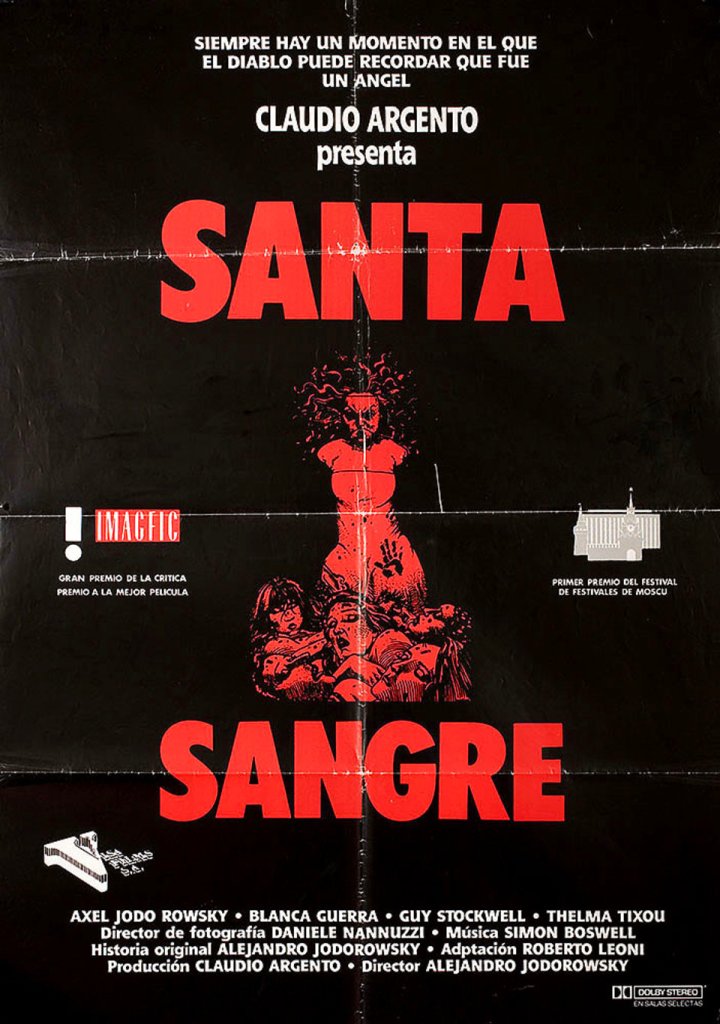
To call “Santa Sangre” (1989) a horror film would be unjust to a film that exists outside all categories. But in addition to its deeper qualities, it is a horror film, one of the greatest, and after waiting patiently through countless Dead Teenager Movies, I am reminded by Alejandro Jodorowsky that true psychic horror is possible on the screen–horror, poetry, surrealism, psychological pain and wicked humor, all at once.
The movie involves the perverse emotional and physical enslavement of a son by his mother–a control all the more macabre when we learn, late in the film, the secret of its actual nature. It is also about an instinctive hatred between characters representing lust and chastity, which are both seen as perversions in a world without a sane middle way. This bold subject matter is orchestrated by Jodorowsky in a film that inspires critics to make lists, calling it Jungian, surrealistic, Felliniesque, Bunuelian, sadomasochistic, expressionist and strongly flavored by such horror classics as “The Beast With Five Fingers,” “The Hands of Orlac” and the film that guides the hero’s fantasies, “The Invisible Man.”
The story involves Fenix, the boy magician at the Circus Gringo, a shabby touring show in Mexico. Played by two of Jodorowsky’s sons (Adan at about 8, Axel at about 20), Fenix is the child of the beautiful trapeze artist Concha (Blanca Guerra) and the bloated circus owner and knife-thrower Orgo (Guy Stockwell). Always at Fenix’s side is the dwarf Aladin (Jesus Juarez), who acts as his assistant and moral support.
The little magician’s best friend is Alma (Faviola Elenka Tapia and, when older, Sabrina Dennison). She is a deaf-mute mime, the daughter of the carnal Tattooed Woman (Thelma Tixou), who works as the target for Orgo’s knives. One night when Concha is suspended above the circus ring by her hair, she sees Orgo caressing the Tattooed Lady and screams to be brought back to earth. In a rage, she surprises them in bed and throws acid on Orgo’s genitals. Bellowing with pain, he severs her arms with mighty thrusts of two knives. Then he kills himself, the acid having rendered him uninteresting to women tattooed and otherwise.
Concha’s mutilation is a cruel irony: She is the leader of a cult of women who worship a saint whose arms were cut off by rapists. Their church contains a pool of blood, no doubt suggesting menstrual fluid (Concha’s name is Mexican slang for the vagina); its members wear tunics with crossed, severed arms. When authorities arrive to bulldoze the church, there is a clash between the women and the police, and then a shouting match between Concha and the local monsignor, she screaming that the pool contains holy blood, he replying that it is red paint.
The bulldozing reveals the shabby construction of the church, mostly made of corrugated iron and possibly reflecting the film’s limited budget. If Jodorowsky’s funds were limited, however, his imagery and imagination are boundless, and this movie thrums with erotic and diabolical energy. Consider the scene where the circus elephant dies after hemorrhaging from its trunk. In a funeral both sad and funny, the beast’s great coffin is hauled by truck to a ravine and tipped over the edge–to the delight of wretched shanty-dwellers, who rip open the casket and throw bloody elephant meat to the crowd. An image like this is one of the reasons we go to the movies: It is logical, illogical, absurd, pathetic, and sublimely original. For Alejandro Jodorowsky, all in a day’s work.
Now 74 and at work on his first film in 14 years, Jodorowsky is a legendary man of many trades. Born in Chile, living mostly in Mexico and Paris, he works here in English, which has been imperfectly dubbed; oddly enough, the oddness of the dubbing adds to the film’s eerie quality.
Jodorowsky has occupied the edges of the arts. He was a clown and puppeteer, studied under the mime Marcel Marceau, filmed a mime version of Thomas Mann’s play “The Transposed Heads,” was a friend of the surrealist Arrabal, and is, in his own words, a “very famous comic-strip artist,” the author of graphic novels that have become legendary.
He is also the author of the legendary cult film “El Topo” (1970), which was both saved and doomed by John Lennon. Saved, because Lennon admired it so much, he asked his manager, Allen Klein, to buy and distribute it. Doomed, because after the film became a worldwide sensation (Jodorowsky told me in 1989) “Klein made it disappear. He says, ‘I am waiting until you die, and then I am going to have a fortune.’ He thinks he’s immortal. If he dies first, I get the film back.” So far, both men are still alive and “El Topo” is not available on video.
Jodorowsky’s visionary world owes much to the surrealists, but even more to the quirky films that Luis Bunuel made during his Mexican exile, films showing men quietly obsessed with the details of their fetishes. Fenix, his hero, is literally a man whose world is defined by his obsessions. The witness to his mother’s mutilation and his father’s suicide, he is in an insane asylum when the film opens, perched atop a tree trunk. When he returns to the world, it is to play the role of his mother’s arms and hands. He walks behind her, slips his arms through the sleeves of her garments and feeds her, plays the piano, gestures, and even caresses her body as if it is his own. Axel Jodorowsky and Blanca Guerra do this with such perfect timing that the hands seem to sense the next thought of the mother. But Fenix has no identity except as her instrument, which is why “The Invisible Man” appeals so strongly.
The first half of the film is filled with Felliniesque exuberance, celebrating the circus with its tawdry charms and sad clowns. The second half is somber and creepy, as in a scene where Fenix and four young men with Down syndrome are taken on a movie outing that ends (not unhappily) with cocaine and a visit to the red-light district.
Fenix eventually moves with his mother into a house where timbers lean everywhere at crazy angles for no apparent reason, except to evoke expressionism. And here he begins his revolt. As his mother jealously uses his hands to kill one woman after another, he recruits a muscular giantess who will be able, he thinks, to fight off any attack.
This giantess is pretty clearly a man in drag, but the movie makes no notice of that fact, and indeed many oddities pass unremarked, including the omnipresent doves and the ability of the Tattooed Lady, the dwarf and the deaf-mute girl to materialize in Fenix’s life when and how he needs them. All is finally made clear at the end, revealing how fearlessly Jodorowsky has married magic realism to Freud, in a film that is like a shriek against Momism.
Of course the movie is rated NC-17. I believe more horror films should be made for adults, so that they are free to deal with true malevolence in the world, instead of retailing the pornography of violence without consequences. A generation is growing up that equates violence with action, instead of with harm. Not long ago “The Exorcist” was re-released and some young moviegoers laughed all the way through it. A society that laughs at evil eventually laughs at good, and then it loses its way.
The quality that Jodorowsky has above all is passionate sincerity. Apart from his wildly creative style, apart from his images, apart from his story inventions, he has strong moral feelings. He has an instinctive sympathy for Fenix, who was born into a world of fanaticism and cruelty, and has tried, with the help of a deaf girl and a dwarf, to get back the soul that was warped by his father and trapped by his mother. Maybe one difference between great horror films and all the others is that the great ones do not celebrate evil, but challenge it.
Though I had moments of deep sleep at Harborview’s neuro ICU, more often than not brief lapses into sleep were interrupted by nurses and/or assistants dropping in to administer meds, take vitals, draw blood, or change my sleep position to prevent pressure sores. Of all the various scheduled procedures the position changes were the most disruptive.
In my weakened state at the time changing positions, such as being tilted left or right, would be enough to drastically alter my blood pressure, sometimes causing dizziness. It would also cause coughing fits due to the movement loosening mucus built up around my trach tube. Because of the difficulty coughing and swallowing, I needed the assistance of a suction tube to be able to breathe.
When I was able to sleep deeply enough to dream, I dreamt of walking and exploring familiar environments from the past (usually schools and workplaces). Such dreams continue to be the most common type to this day and probably stem from an innate need to explore. I’m always walking alone and never encounter others in the various environments. Sometimes I find useful items like a flashlight which I need to use, for the buildings I explore are often dark (though for some reason I never feel afraid or anxious, just curious). After a few months of using a wheelchair I’d occasionally realize within the dream that I shouldn’t be able to walk and would wake up immediately after having that thought.
Because of the lack of deep sleep during the night in addition to the regular doses of meds, I was often tired throughout the following day. Even communication was tiring despite it usually being one-way and requiring simple yes/no answers. Listening comprehension was itself a struggle at the time, which was why I opted to listen to music rather than podcasts.
For communicating more detailed information, Danielle had to review with me a system taught by a speech therapist at the trauma ICU (which I had no memory of). It was a simple but tedious way to spell out words using a laminated grid with color-coded quadrants containing a set of letters in alphabetical order.
To communicate a specific word I would indicate the color of the quadrant with the first letter of the word by silently saying the name of the color (hoping the listener can read lips) while focusing my eyes on the quadrant linked to the color. Once the correct quadrant was understood I would mouth the name of the letter and if the listener didn’t understand they would have to ask yes or no for each letter in the section. When the correct letter was found they would write it down and move to the next until the word was deduced.
Fortunately this system didn’t need to be used very often at neuro ICU, mostly when Danielle or my mom wanted to help me select media to keep myself distracted while bedridden and unable to talk. Finding something I wanted to watch was often difficult because what I had in mind was something escapist yet relevant, abstract but not overly convoluted and with a message of hope. The films that helped me most to get through those times were Strawberry Mansion, Linoleum, and The Fall. In addition I had time to rewatch dystopian fare I’ve always enjoyed such as Children of Men and Max Headroom.
Danielle and my mom spent much of the time monitoring my health and getting help from nurses as needed, providing water and the suction tube when needed, working on medical, insurance, and financial matters, and offering words of support which I could acknowledge but not reciprocate. I imagined it might have been almost as traumatic watching me go through various ordeals as experiencing them first-hand. Later in the week it was determined I was ready to sit in a wheelchair, which initially wasn’t pleasant but at least it gave me something to do.
Once again focusing attention on my immediate situation, I self-assessed how I felt. The adjective I kept coming back to was “traumatized”. At first it didn’t seem quite right because I associated trauma with survivors of violent assault. Upon further thought, I understood how it results from any violent event and could be physical as well as psychological.
Though I have no accessible memory of the crash that caused my injury, it’s possible a buried subconscious memory exists. At times I couldn’t stop recreating scenarios of what probably happened mixed with fantasies of what could have happened (either dying or escaping unscathed). In any case, the injury resulting from the crash including aspects of hospitalization, was itself a source of trauma.
Unless one has experienced it, it’s difficult to imagine the horror of waking up in a newly immobilized body especially if one was relatively healthy immediately prior to the injury. It instantly shatters any illusions one might have had of a just universe or merciful higher power. But the evidence was always there, from psychopathic war criminals and health insurance CEOs living in luxury to innocent children killed and maimed in indiscriminate bombings and countless sick and injured living curtailed lives of misery due to denied claims and inaccessible treatments.
Initially it’s like a waking nightmare that never ends. One wouldn’t wish such an affliction on one’s worst enemy, much less easily accept that it’s actually happening to oneself. Even typing this now, nearly a year after the crash, waking life still sometimes feels like a bad dream.
As the reality of the situation sets in it begins to feel more like a fracture or demarcation point between two very different lives and lifestyles. Though fundamentally one remains the same person, the extremity of the physical change makes changes in personality, priorities, interests, beliefs, self/public image, and relationships, inevitable and how could it not?
Although in my case I experienced no physical deformation and associated acute pain, it was nevertheless traumatic to so suddenly lose such a large part of oneself. Especially early on, it was odd to feel so disconnected from one’s body despite appearing healthy on the outside (aside from breathing tube, nose tube, catheter, IV line, etc).
In a sense, my injury was analogous to accelerated aging. Rather than a gradual loss of certain functions and abilities over time, it’s a rapid loss of many functions and abilities instantly. At the same time, quadriplegia evokes the experience of infancy such as the many times when one is more of a spectator rather than participant and having to rely on others to attend to basic needs. Quadriplegia is not as restricting as Locked-in Syndrome, in which the only body part capable of movement are the eyes, but it is still a significant reduction of freedom and a loss of one’s primary means of interacting with the world.
From one’s new perspective, life pre-injury was one of relative comfort, ease and happiness (even if it didn’t always seem like it at the time). Life post-injury may have moments of comfort, ease and happiness, but much shorter, fewer and farther between, making them all the more precious. On particularly challenging days, sleep also offers a welcome respite as it did that night.
 After the Crash