
The Child That Christmas Forgot: How Would Jesus Fare in the American Police State?

By John W. Whitehead

Source: The Rutherford Institute

“Once upon a midnight clear, there was a child’s cry, a blazing star hung over a stable, and wise men came with birthday gifts. We haven’t forgotten that night down the centuries. We celebrate it with stars on Christmas trees, with the sound of bells, and with gifts… We forget nobody, adult or child. All the stockings are filled, all that is, except one. And we have even forgotten to hang it up. The stocking for the child born in a manger. It’s his birthday we’re celebrating. Don’t let us ever forget that. Let us ask ourselves what He would wish for most. And then, let each put in his share, loving kindness, warm hearts, and a stretched out hand of tolerance. All the shining gifts that make peace on earth.”—The Bishop’s Wife (1947)

The Christmas story of a baby born in a manger is a familiar one.

The Roman Empire, a police state in its own right, had ordered that a census be conducted. Joseph and his pregnant wife Mary traveled to the little town of Bethlehem so that they could be counted. There being no room for the couple at any of the inns, they stayed in a stable (a barn), where Mary gave birth to a baby boy, Jesus. Warned that the government planned to kill the baby, Jesus’ family fled with him to Egypt until it was safe to return to their native land.

Yet what if Jesus had been born 2,000 years later?

What if, instead of being born into the Roman police state, Jesus had been born at this moment in time? What kind of reception would Jesus and his family be given? Would we recognize the Christ child’s humanity, let alone his divinity? Would we treat him any differently than he was treated by the Roman Empire? If his family were forced to flee violence in their native country and sought refuge and asylum within our borders, what sanctuary would we offer them?

A singular number of churches across the country are asking those very questions, and their conclusions are being depicted with unnerving accuracy by nativity scenes in which Jesus and his family are separated, segregated and caged in individual chain-link pens, topped by barbed wire fencing.

These nativity scenes are a pointed attempt to remind the modern world that the narrative about the birth of Jesus is one that speaks on multiple fronts to a world that has allowed the life, teachings and crucifixion of Jesus to be drowned out by partisan politics, secularism, materialism and war.

The modern-day church has largely shied away from applying Jesus’ teachings to modern problems such as war, poverty, immigration, etc., but thankfully there have been individuals throughout history who ask themselves and the world: what would Jesus do?

What would Jesus—the baby born in Bethlehem who grew into an itinerant preacher and revolutionary activist, who not only died challenging the police state of his day (namely, the Roman Empire) but spent his adult life speaking truth to power, challenging the status quo of his day, and pushing back against the abuses of the Roman Empire—do?

Dietrich Bonhoeffer asked himself what Jesus would have done about the horrors perpetrated by Hitler and his assassins. The answer: Bonhoeffer risked his life to undermine the tyranny at the heart of Nazi Germany.

Aleksandr Solzhenitsyn asked himself what Jesus would have done about the soul-destroying gulags and labor camps of the Soviet Union. The answer: Solzhenitsyn found his voice and used it to speak out about government oppression and brutality.

Martin Luther King Jr. asked himself what Jesus would have done about America’s warmongering. The answer: declaring “my conscience leaves me no other choice,” King risked widespread condemnation when he publicly opposed the Vietnam War on moral and economic grounds.

Even now, despite the popularity of the phrase “What Would Jesus Do?” (WWJD) in Christian circles, there remains a disconnect in the modern church between the teachings of Christ and the suffering of what Jesus in Matthew 25 refers to as the “least of these.”

As the parable states:

“Then the King will say to those on his right, ‘Come, you who are blessed by my Father; take your inheritance, the kingdom prepared for you since the creation of the world. For I was hungry and you gave me something to eat, I was thirsty and you gave me something to drink, I was a stranger and you invited me in, I needed clothes and you clothed me, I was sick and you looked after me, I was in prison and you came to visit me.’ Then the righteous will answer him, ‘Lord, when did we see you hungry and feed you, or thirsty and give you something to drink? When did we see you a stranger and invite you in, or needing clothes and clothe you? When did we see you sick or in prison and go to visit you?’ The King will reply, ‘Truly I tell you, whatever you did for one of the least of these brothers and sisters of mine, you did for me.’ Then he will say to those on his left, ‘Depart from me, you who are cursed, into the eternal fire prepared for the devil and his angels. For I was hungry and you gave me nothing to eat, I was thirsty and you gave me nothing to drink, I was a stranger and you did not invite me in, I needed clothes and you did not clothe me, I was sick and in prison and you did not look after me.’ They also will answer, ‘Lord, when did we see you hungry or thirsty or a stranger or needing clothes or sick or in prison, and did not help you?’ He will reply, ‘Truly I tell you, whatever you did not do for one of the least of these, you did not do for me.’”

This is not a theological gray area: Jesus was unequivocal about his views on many things, not the least of which was charity, compassion, war, tyranny and love.

After all, Jesus—the revered preacher, teacher, radical and prophet—was born into a police state not unlike the growing menace of the American police state. When he grew up, he had powerful, profound things to say, things that would change how we view people, alter government policies and change the world. “Blessed are the merciful,” “Blessed are the peacemakers,” and “Love your enemies” are just a few examples of his most profound and revolutionary teachings.

When confronted by those in authority, Jesus did not shy away from speaking truth to power. Indeed, his teachings undermined the political and religious establishment of his day. It cost him his life. He was eventually crucified as a warning to others not to challenge the powers-that-be.

Can you imagine what Jesus’ life would have been like if, instead of being born into the Roman police state, he had been born and raised in the American police state?

Consider the following if you will.

Had Jesus been born in the era of the America police state, rather than traveling to Bethlehem for a census, Jesus’ parents would have been mailed a 28-page American Community Survey, a mandatory government questionnaire documenting their habits, household inhabitants, work schedule, how many toilets are in your home, etc. The penalty for not responding to this invasive survey can go as high as $5,000.

Instead of being born in a manger, Jesus might have been born at home. Rather than wise men and shepherds bringing gifts, however, the baby’s parents might have been forced to ward off visits from state social workers intent on prosecuting them for the home birth. One couple in Washington had all three of their children removed after social services objected to the two youngest being birthed in an unassisted home delivery.

Had Jesus been born in a hospital, his blood and DNA would have been taken without his parents’ knowledge or consent and entered into a government biobank. While most states require newborn screening, a growing number are holding onto that genetic material long-term for research, analysis and purposes yet to be disclosed.

Then again, had Jesus’ parents been undocumented immigrants, they and the newborn baby might have been shuffled to a profit-driven, private prison for illegals where they first would have been separated from each other, the children detained in make-shift cages, and the parents eventually turned into cheap, forced laborers for corporations such as Starbucks, Microsoft, Walmart, and Victoria’s Secret. There’s quite a lot of money to be made from imprisoning immigrants, especially when taxpayers are footing the bill.

From the time he was old enough to attend school, Jesus would have been drilled in lessons of compliance and obedience to government authorities, while learning little about his own rights. Had he been daring enough to speak out against injustice while still in school, he might have found himself tasered or beaten by a school resource officer, or at the very least suspended under a school zero tolerance policy that punishes minor infractions as harshly as more serious offenses.

Had Jesus disappeared for a few hours let alone days as a 12-year-old, his parents would have been handcuffed, arrested and jailed for parental negligence. Parents across the country have been arrested for far less “offenses” such as allowing their children to walk to the park unaccompanied and play in their front yard alone.

Rather than disappearing from the history books from his early teenaged years to adulthood, Jesus’ movements and personal data—including his biometrics—would have been documented, tracked, monitored and filed by governmental agencies and corporations such as Google and Microsoft. Incredibly, 95 percent of school districts share their student records with outside companies that are contracted to manage data, which they then use to market products to us.

From the moment Jesus made contact with an “extremist” such as John the Baptist, he would have been flagged for surveillance because of his association with a prominent activist, peaceful or otherwise. Since 9/11, the FBI has actively carried out surveillance and intelligence-gathering operations on a broad range of activist groups, from animal rights groups to poverty relief, anti-war groups and other such “extremist” organizations.

Jesus’ anti-government views would certainly have resulted in him being labeled a domestic extremist. Law enforcement agencies are being trained to recognize signs of anti-government extremism during interactions with potential extremists who share a “belief in the approaching collapse of government and the economy.”

While traveling from community to community, Jesus might have been reported to government officials as “suspicious” under the Department of Homeland Security’s “See Something, Say Something” programs. Many states, including New York, are providing individuals with phone apps that allow them to take photos of suspicious activity and report them to their state Intelligence Center, where they are reviewed and forwarded to law-enforcement agencies.

Rather than being permitted to live as an itinerant preacher, Jesus might have found himself threatened with arrest for daring to live off the grid or sleeping outside. In fact, the number of cities that have resorted to criminalizing homelessness by enacting bans on camping, sleeping in vehicles, loitering and begging in public has doubled.

Viewed by the government as a dissident and a potential threat to its power, Jesus might have had government spies planted among his followers to monitor his activities, report on his movements, and entrap him into breaking the law. Such Judases today—called informants—often receive hefty paychecks from the government for their treachery.

Had Jesus used the internet to spread his radical message of peace and love, he might have found his blog posts infiltrated by government spies attempting to undermine his integrity, discredit him or plant incriminating information online about him. At the very least, he would have had his website hacked and his email monitored.

Had Jesus attempted to feed large crowds of people, he would have been threatened with arrest for violating various ordinances prohibiting the distribution of food without a permit. Florida officials arrested a 90-year-old man for feeding the homeless on a public beach.

Had Jesus spoken publicly about his 40 days in the desert and his conversations with the devil, he might have been labeled mentally ill and detained in a psych ward against his will for a mandatory involuntary psychiatric hold with no access to family or friends. One Virginia man was arrested, strip searched, handcuffed to a table, diagnosed as having “mental health issues,” and locked up for five days in a mental health facility against his will apparently because of his slurred speech and unsteady gait.

Without a doubt, had Jesus attempted to overturn tables in a Jewish temple and rage against the materialism of religious institutions, he would have been charged with a hate crime. Currently, 45 states and the federal government have hate crime laws on the books.

Had anyone reported Jesus to the police as being potentially dangerous, he might have found himself confronted—and killed—by police officers for whom any perceived act of non-compliance (a twitch, a question, a frown) can result in them shooting first and asking questions later.

Rather than having armed guards capture Jesus in a public place, government officials would have ordered that a SWAT team carry out a raid on Jesus and his followers, complete with flash-bang grenades and military equipment. There are upwards of 80,000 such SWAT team raids carried out every year, many on unsuspecting Americans who have no defense against such government invaders, even when such raids are done in error.

Instead of being detained by Roman guards, Jesus might have been made to “disappear” into a secret government detention center where he would have been interrogated, tortured and subjected to all manner of abuses. Chicago police have “disappeared” more than 7,000 people into a secret, off-the-books interrogation warehouse at Homan Square.

Charged with treason and labeled a domestic terrorist, Jesus might have been sentenced to a life-term in a private prison where he would have been forced to provide slave labor for corporations or put to death by way of the electric chair or a lethal mixture of drugs.

Indeed, as I show in my book Battlefield America: The War on the American People, given the nature of government then and now, it is painfully evident that whether Jesus had been born in our modern age or his own, he still would have died at the hands of a police state.

Thus, as we draw near to Christmas with its celebrations and gift-giving, we would do well to remember that what happened on that starry night in Bethlehem is only part of the story. That baby in the manger grew up to be a man who did not turn away from evil but instead spoke out against it, and we must do no less.
Corporate America Is an Anti-Social Black Plague: Negative Network Effects Run Amok

By Charles Hugh Smith

Source: Of Two Minds

The anti-social carnage unleashed by Corporate America’s “lock-in” / negative network effects has no real limits.

Here’s the U.S.economy in a nutshell: Corporate America is an anti-social Black Plague, gorging on cartel-monopoly profits reaped from negative network effects running amok, enriching the few at the expense of the many and concentrating political power in the hands of the most rapacious, anti-democratic corporate sociopaths.

Let’s start with network effects: the conventional definition is “When a network effect is present, the value of a product or service increases according to the number of others using it.”

So for example, when telephone service was only available to a few users, its value was limited. As more people obtained telephone service, the value of the network increased to both its owners and to users, who could reach more people and conduct commerce more easily as a result of having telephone service.

In the conventional analysis, negative network effects occur from “congestion,” i.e. the network is adding new users so quickly that “more users make a product less valuable.”

But this superficial analysis misses the fatally anti-social consequences of corporate negative network effects, a dynamic described by analyst Simons Chase in this essay. Here is an excerpt:

Even the most imaginative and far-reaching narratives about non-obvious economic fragility and off balance sheet risks are mere rants without constructive ideas about causes and solutions.

Consider network effects, the popular economic construct applied to market concentration and increasing returns for strategies pursued by some leading tech companies. This dynamic economic agent is also known as demand side economies of scale.

W. Brian Arthur, the economist credited with first developing the theory, described the condition of increasing returns as a game of strategic positioning and building up a user base to the point where ‘lock in’ of dominant players occurs. Companies able to tap network effects have been rewarded with huge valuations and highly defensible businesses.

But what about negative network effects? What if the same dynamic applies to the U.S.’s pay-to-play political industry where the government promotes or approves of something through a policy, subsidy or financial guarantee due to private sector influence.

Benefits accrue only to the purchaser of the network effects, and consumers, induced by the false signal of large network size, ultimately suffer from asymmetric risk and experience what I’m calling a loss of intangible net worth for each additional member after the ‘bandwagon’ wares off.

If this were the case, then you would see companies experience rapid revenue growth (out of line with traditional asset leverage models), executives accumulating huge fortunes and political campaign coffers swelling.

But the most striking feature would be the anti-social outcomes, the ones not available without the instant critical mass of government-supported network effects, the ones that, at scale, monetize a society’s intangible net worth.

Some products tied to these metrics include: prescriptions drugs, junk food targeting children, mortgages, diplomas, and social media. The list of industries that are likely to have gained through the purchasing of network effects in D.C. maps closely to the decay that is visible in U.S. society.

The loss of intangible capital and other manifestations of non-obvious economic fragility (to use Simons’ apt phrase) is the subject of my latest book, Will You Be Richer or Poorer? Profit, Power and A.I. in a Traumatized World, in which I catalog the anti-social consequences of negative network effects and other forces eroding our nation’s intangible capital.

Consider Facebook, a classic case of negative network effects running amok, creating immensely anti-social consequences while reaping billions in profits: Facebook isn’t free speech, it’s algorithmic amplification optimized for outrage (TechCrunch.com).

The full social cost of social media’s negative network effects are difficult to tally, but studies have found that loneliness and alienation are correlated to how many hours a day individuals spend on social media. (An Internet search brings up dozens of reports such as NPR’s Feeling Lonely? Too Much Time On Social Media May Be Why.)

Facebook is trying to leverage its social media “lock-in” to issue its own global currency and both Facebook and Google are trying to offer banking services without any of the pesky regulations imposed on legitimate banks. (Will $10 million in lobbying do the trick? How about $100 million? We’ve got billions to “invest” in corrupting and controlling public agencies and political power.)

Once Corporate America locks in cartel-monopoly power, i.e. you have to use our services and products, the corporate sociopaths use their billions in market cap and profits to buy the sociopaths in government. Pay-to-play is the real political machinery; “democracy” is the PR fig-leaf to mask the private sector “lock-in” (monopoly) and the public-sector “lock-in” (regulatory influence, anti-competitive barriers to entry, the legalization of corporate fraud, cooking the books, embezzlement, etc.)

Consider Boeing, an effective monopoly which used $12 billion in profits to buy back its own shares and “invested” millions in buying political influence so it could minimize public-sector oversight.

Rather than spend the $12 billion designing a new safe aircraft, Boeing cobbled together a fatally flawed design dependent on software, as described in The Case Against Boeing (The New Yorker) to maximize the profitability of its “lock-in”.

Google is running amok on so many levels, it’s difficult to keep track of its anti-social “let’s be evil, it’s so incredibly profitable” agenda: Google’s Secret ‘Project Nightingale’ Gathers Personal Health Data on Millions of Americans (Wall Street Journal). The goal, of course, is to reap more billions in profits for insiders and corporate sociopaths.

The anti-social carnage unleashed by Corporate America’s “lock-in” / negative network effects has no real limits. Consider the essentially limitless private and social damage caused by Big Tech: Child Abusers Run Rampant as Tech Companies Look the Other Way (New York Times).

Then there’s the opioid epidemic, whose casualties run into the hundreds of thousands, an epidemic that was entirely a creature of Corporate America seeking to maximize “lock-in” profits by buying regulatory approval and pushing false claims that the corporate products were safe and non-addictive.

Note the media sources of these reports: these are the top tier of American journalism, not some easily dismissed alt-media source.

What does this tell us? It tells us the anti-social consequences are now so extreme and so apparent that the corporate media cannot ignore them. Once Corporate America locks-in market, financial and political power, it acts as a virulent Black Plague on the social order, legitimate democracy, and an entire spectrum of intangible social capital including the rule of law.

As Simons put it: “The ethical dimension underpinning the whole system is this: what’s moral is what’s legal and what’s legal is for sale.” Where does this Black Plague pathology take us? To a collapse of the status quo which enabled it, cheered it, and so richly rewarded it.

The Key to a Sustainable Economy Is 5,000 Years Old

By Ellen Brown

Source: Truthdig

We are again reaching the point in the business cycle known as “peak debt,” when debts have compounded to the point that their cumulative total cannot be paid. Student debt, credit card debt, auto loans, business debt and sovereign debt are all higher than they have ever been. As economist Michael Hudson writes in his provocative 2018 book, “…and forgive them their debts,” debts that can’t be paid won’t be paid. The question, he says, is how they won’t be paid.

Mainstream economic models leave this problem to “the invisible hand of the market,” assuming trends will self-correct over time. But while the market may indeed correct, it does so at the expense of the debtors, who become progressively poorer as the rich become richer. Borrowers go bankrupt and banks foreclose on the collateral, dispossessing the debtors of their homes and their livelihoods. The houses are bought by the rich at distress prices and are rented back at inflated prices to the debtors, who are then forced into wage peonage to survive. When the banks themselves go bankrupt, the government bails them out. Thus the market corrects, but not without government intervention. That intervention just comes at the end of the cycle to rescue the creditors, whose ability to buy politicians gives them the upper hand. According to free-market apologists, this is a natural cycle akin to the weather, which dates all the way back to the birth of modern economics in ancient Greece and Rome.

Hudson counters that those classical societies are not actually where our financial system began, and that capitalism did not evolve from bartering, as its ideologues assert. Rather, it devolved from a more functional, sophisticated, egalitarian credit system that was sustained for two millennia in ancient Mesopotamia (now parts of Iraq, Turkey, Kuwait and Iran). Money, banking, accounting and modern business enterprise originated not with gold and private trade, but in the public sector of Sumer’s palaces and temples in the third century B.C. Because it involved credit issued by the local government rather than private loans of gold, bad debts could be periodically forgiven rather than compounding until they took the whole system down, a critical feature that allowed for its remarkable longevity.

The True Roots of Money and Banking

Sumer was the first civilization for which we have written records. Its notable achievements included the wheel, the lunar calendar, our numerical system, law codes, an organized hierarchy of priest-kings, copper tools and weapons, irrigation, accounting and money. It also produced the first written language, which took the form of cuneiform figures impressed on clay. These tablets were largely just accounting tools, recording the flow of food and raw materials in the temple and palace workshops, as well as IOUs (mainly to these large public institutions) that had to be preserved in writing to be enforced. This temple accounting system allowed for the coordinated flow of credit to peasant farmers from planting to harvesting, and for advances to merchants to engage in foreign trade.

In fact, it was the need to manage accounts for a large labor force under bureaucratic control that is thought to have led to the development of writing. The people willingly accepted this bureaucratic control because they viewed the gods as having decreed it. According to their cuneiform writings, humans were genetically engineered to work the fields and the mines after certain lower gods tasked with that hard labor rebelled.

Usury, or the charging of interest on loans, was an accepted part of the Mesopotamian credit system. Interest rates were high and remained unchanged for two millennia. But Mesopotamian scholars were well aware of the problem of “debts that can’t be paid.” Unlike in today’s academic economic curriculum, Hudson writes:

Babylonian scribal students were trained already c. 2000 BC in the mathematics of compound interest. Their school exercises asked them to calculate how long it took a debt at interest of 1/60th per month to double. The answer is 60 months: five years. How long to quadruple? 10 years. How long to multiply 64 times? 30 years. It must’ve been obvious that no economy can grow in keeping with this rate of increase.

Sumerian kings solved the problem of “peak debt” by periodically declaring “clean slates,” in which agrarian debts were forgiven and debtors were released from servitude to work as tenants on their own plots of land. The land belonged to the gods under the stewardship of the temple and the palace and could not be sold, but farmers and their families maintained leaseholds to it in perpetuity by providing a share of their crops, service in the military and labor in building communal infrastructure. In this way, their homes and livelihoods were preserved, an arrangement that was mutually beneficial, since the kings needed their service.

Jewish scribes, who spent time in captivity in Babylon in the sixth century B.C, adapted these laws in the year or jubilee, which Hudson argues was added to Leviticus after the Babylonian captivity. According to Leviticus 25:8-13, a Jubilee Year was to be declared every 49 years, during which debts would be forgiven, slaves and prisoners freed and their property leaseholds restored. As in ancient Mesopotamia, property ownership remained with Yahweh and his earthly proxies. The Jubilee law effectively banned the outright sale of land, which could only be leased for up to 50 years (Leviticus 25:14-17). The Levitican Jubilee represented an advance over the Mesopotamian “clean slates,” Hudson says, in that it was codified into law rather than relying on the whim of the king. But its proclaimers lacked political power, and whether the law was ever enforced is unclear. It served as a moral rather than a legal prescription.

Ancient Greece and Rome adopted the Mesopotamian system of lending at interest, but without the safety valve of periodic “clean slates,” since the creditors were no longer the king or the temple, but private lenders. Unfettered usury resulted in debt bondage and forfeiture of properties, consolidation into large landholdings, a growing wedge between rich and poor, and the ultimate destruction of the Roman Empire.

As for the celebrated development of property rights and democracy in ancient Greece and Rome, Hudson argues that they did not actually serve the poor. They served the rich, who controlled elections, just as rich donors do today. Taking power away from local governments by privatizing once-communal lands allowed private creditors to pass laws by which they could legally confiscate property when their debtors could not pay. “Free markets” meant the freedom to accumulate massive wealth at the expense of the poor and the state.

Hudson maintains that when Jesus Christ preached “forgiveness of debts,” he was also talking about economic debt, not just moral transgressions. When he overturned the tables of the money changers, it was because they had turned a house of prayer into “a den of thieves.” But creditors’ rights had by then gained legal dominance, and Christian theologians lacked the power to override them. Rather than being a promise of economic redemption in this life, forgiveness of debts thus became a promise of spiritual redemption in the next.

How to Pull Off a Modern Debt Jubilee

Such has been the fate of debtors in modern Western economies. But in some modern non-Western economies, vestiges of the debt write-off solution remain. In China, for instance, nonperforming loans are often carried on the books of state-owned banks or canceled rather than putting insolvent debtors and banks into bankruptcy. As Dinny McMahon wrote in June in an article titled “China’s Bad Data Can Be a Good Thing”:

In China, the state stands behind the country’s banks. As long as authorities ensure those banks have sufficient liquidity to meet their obligations, they can trundle along with higher delinquency levels than would be regarded safe in a market economy.

China’s banking system, like that of ancient Mesopotamia, is largely in the public sector, so the state can back its banks with liquidity as needed. Interestingly, the Chinese state also preserves the ancient Near Eastern practice of retaining ownership of the land, which citizens can only lease for a period of time.

In Western economies, most banks are privately owned and heavily regulated, with high reserve and capital requirements. Bad loans mean debtors are put into foreclosure, jobs and capital infrastructure are lost, and austerity prevails. The Trump administration is now aggressively pursuing a trade war with China in an effort to level the playing field by forcing it into the same austerity regime, but a more productive and sustainable approach might be for the U.S. to engage in periodic debt jubilees itself.

The problem with that solution today is that most debts in Western economies are owed not to the government but to private creditors, who will insist on their contractual rights to payment. We need to find a way to pay the creditors while relieving the borrowers of their debt burden.

One possibility is to nationalize insolvent banks and sell their bad loans to the central bank, which can buy them with money created on its books. The loans can then be written down or voided out. Precedent for this policy was established with “QE1,” the Fed’s first round of quantitative easing, in which it bought unmarketable mortgage-backed securities from banks with liquidity problems.

Another possibility would be to use money generated by the central bank to bail out debtors directly. This could be done selectively, by buying up student debt or credit card debt or car loans bundled as “asset-backed securities,” then writing the debts down or off, for example. Alternatively, debts could be relieved collectively with a periodic national dividend or universal basic income paid to everyone, again drawn from the deep pocket of the central bank.

Critics will object that this would dangerously inflate the money supply and consumer prices, but that need not be the case. Today, virtually all money is created as bank debt, and it is extinguished when the debt is repaid. That means dividends used to pay this debt down would be extinguished, along with the debt itself, without adding to the money supply. For the 80% of the U.S. population now carrying debt, loan repayments from their national dividends could be made mandatory and automatic. The remaining 20% would be likely to save or invest the funds, so this money too would contribute little to consumer price inflation; and to the extent that it did go into the consumer market, it could help generate the demand needed to stimulate productivity and employment. (For a fuller explanation, see Ellen Brown, “Banking on the People,” 2019).

In ancient Mesopotamia, writing off debts worked brilliantly well for two millennia. As Hudson concludes:

To insist that all debts must be paid ignores the contrast between the thousands of years of successful Near Eastern clean slates and the debt bondage into which [Greco-Roman] antiquity sank. … If this policy in many cases was more successful than today’s, it is because they recognized that insisting that all debts must be paid meant foreclosures, economic polarization and impoverishment of the economy at large.

Slow-Motion US/UK Killing of Julian Assange

By Stephen Lendmen

Source: StephenLendmen.org

Establishment media are in cahoots with US/UK ruling regimes against Assange for the “crime” of truth-telling journalism abhorred in the West — totalitarian rule where these societies are heading.

In mid-October, UN special rapporteur on torture Nils Melzer denounced Assange’s judicial lynching and egregious mistreatment, saying the following:

“What has the man done? He has disclosed an enormous amount of information that governments want to remain secret, most infamously the ‘Collateral Murder’ video, which, in my view, is evidence for war crimes.”

“What is the scandal in this case is that everyone focuses on Julian Assange. Here is someone who exposes evidence for war crimes, including torture and murder, and he is under this constant pressure.”

“I am absolutely convinced he will not receive a fair trial in Virginia, and he will remain in prison under inhumane conditions for the rest of his life.”

Tulsi Gabbard is the only US presidential aspirant expressing support for journalist Assange, as well as whistleblowers Chelsea Manning, Edward Snowden, and others like them, opposing their “prosecution like criminals.”

If elected president, she’d drop charges against them, she said, calling for greater “protect(ion) (of) our civil liberties,” adding:

Assange’s arrest in Britain “poses a great threat to our freedom of the press and to our freedom of speech” — the same true about how Chelsea Manning, Snowden, and other whistleblowers are mistreated.

What happened to them “could happen to you. It could happen to any of us,” she stressed.

Bipartisan politicians in the US and UK, along with establishment media, refuse to support Assange’s struggle for justice.

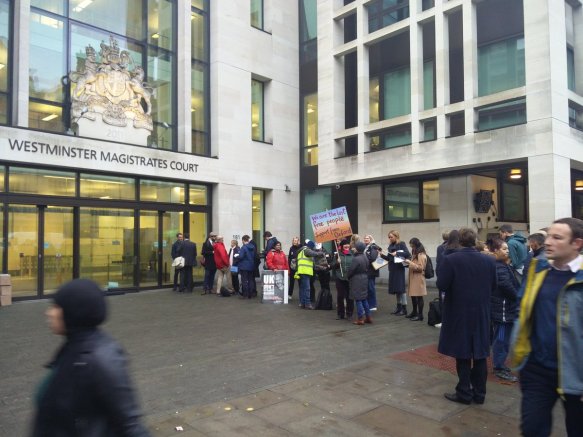
On Monday, he appeared in London’s Westminster Magistrates Court. Showing the effects of egregious mistreatment since unlawfully dragged from the city’s Ecuadorian embassy and imprisoned under harsh conditions, he was too physically and emotionally shattered to participate in his defense.

He’s an investigative journalist/whistleblower, publishing material supplied by sources believed to be credible, unidentified for their protection.

WikiLeaks is not an intelligence operation. Nor it it connected to Russia or any other country. Claims otherwise are fabricated.

Assange earlier explained that WikiLeaks has the right “to publish newsworthy content. Consistent with the US Constitution, we publish material that we can confirm to be true,” he stressed.

US charges against him are fabricated and malicious, what no legitimate tribunal would accept.

Justice Department lawyer James Lewis falsely accused him of “spying,” lied saying he’s “not a journalist,” turned truth on its head claiming his actions were “criminal in both the US and UK” — the above Big Lies how all fascist police states operate.

Assange attorney Mark Summers called for dismissal of Washington’s illegitimate extradition request, saying:

According to the 2003 UK/US extradition treaty, it “shall not be granted if the offense for which extradition is requested is a political offense,” adding:

The unjustifiable persecution of Assange and Chelsea Manning is “part of an avowed war on whistleblowers to include investigative journalists and publishers.”

Summers requested a three-month delay of Assange’s February 25 extradition hearing because “we need more time” to prepare a proper defense, given the “enormity” of issues involved, requiring “evidence gathering that would test most lawyers.”

Operating as an imperial tool, judge Vanessa Baraitser denied the request, saying the extradition hearing will proceed as schedule on February 25 at Woolwich Magistrates Court near Belmarsh Prison.

Its public gallery has three seats, assuring Assange’s judicial lynching will be virtually closed to public scrutiny.

Barely able to stand and speak after months of barbaric mistreatment, when asked if there’s “anything (he) would like to say, he replied barely audibly that he doesn’t “understand how this is equitable,” adding:

Imperial USA “had 10 years to prepare (its judicial lynching). I can’t remember anything. I can’t access any of my written work.”

“It’s very difficult to do anything with such limited resources against a superpower intent on” an illegitimate crucifixion. “I can’t think properly” from the barbaric ordeal he’s endured.

Baraitser dismissively replied that “conditions of your detainment are not the subject of this court.”

Following the hearing, WikiLeaks editor-in-chief Kristinn Hrafnsson called for the case against Assange to “be thrown out immediately,” adding:

“Not only is it illegal on the face of the (extradition) treaty, the US has conducted illegal operations against Assange and his lawyers which are the subject of a major investigation in Spain.”

John Pilger witnessed Monday’s spectacle, saying “(t)he whole thing is a grotesque absurdity. There is an extradition law between this country and the United States.”

“It states specifically that someone cannot be extradited if the offenses are political.”

“The source of this is a rogue (US) state — a state that ignores its own laws and international laws and the laws of this country.”

Summers called Assange’s crucifixion “a political attempt to signal to journalists the consequences of publishing information” ruling regimes want suppressed.

“It’s legally unprecedented…part of an avowed war on (truth-telling) whistleblowers to include investigative journalists and publishers.”

In cahoots with the Trump regime, police state Britain is killing Assange slowly, wanting him, whistleblowers like Chelsea Manning, and other truth-tellers silenced.

What’s going on is the hallmark of totalitarian rule – controlling the message, eliminating what conflicts with it, notably on major geopolitical issues.

Losing the right of free expression endangers all others. When truth-telling and dissent are considered threats to national security, free and open societies no longer exist – the slippery slope America and other Western societies are heading on.

Judge Denies Assange Extension on Extradition Hearing

Protestors line up at courthouse Monday morning. (Gordon Dimmack)

A judge at a hearing in London has denied the WikiLeaks’ publisher more time to prepare his defense, while a group of Australian politicians coalesce around a demand to return Julian Assange home.

By Joe Lauria

Source: Consortium News

The judge in Julian Assange’s extradition process on Monday denied his lawyer’s appeal for more time to prepare his case as the imprisoned WikiLeaks publisher weakly told the court he was unable to “research anything” in the conditions under which he is being held in high-security Belmarsh Prison.

Assange appeared in person at Westminster Magistrate’s Court in London Monday morning for a case management hearing on the request by the United States for Assange to be sent to Virginia to face 18 charges, including allegedly violating the U.S. Espionage Act for possessing and disseminating classified information that revealed prima facie evidence of U.S. war crimes.

Mark Summers, Assange’s lawyer, told the court the charges were “a political attempt” by the U.S. “to signal to journalists the consequences of publishing information.” The Espionage Act indictment against Assange by the Trump Administration is the first time a journalist has been charged under the 1917 Act for publishing classified material.

“It is legally unprecedented,” Summers told Judge Vanessa Baraitser. He argued that President Donald Trump was politically motivated by the 2020 election to pursue Assange.

Summers also argued before Baraitser that the U.S. “has been actively engaged in intruding into privileged discussions between Assange and his lawyers.” It was revealed this month that the Central Intelligence Agency was given access to surveillance video shot by a private Spanish company of all interactions Assange had with lawyers, doctors and visitors.

“This is part of an avowed war on whistleblowers to include investigative journalists and publishers,” Summers said. “The American state has been actively engaged in intruding on privileged discussions between Mr Assange and his lawyer.”

Because of this surveillance, including “unlawful copying of their telephones and computers” as well as “hooded men breaking into offices,” Assange’s lawyers needed more time to prepare his defense, Summers argued. But Baraitser refused the request, and ordered Assange back in court for a second management hearing on Dec. 19. The full extradition hearing is scheduled to begin on Feb. 25 next year.

Not Equitable

As the hearing ended Monday, Baraitser asked Assange if he understood what had just transpired. “Not really. I can’t think properly,” he said.

“I don’t understand how this is equitable. This superpower had 10 years to prepare for this case and I can’t access my writings. It’s very difficult where I am to do anything but these people have unlimited resources. They are saying journalists and whistleblowers are enemies of the people. They have unfair advantages dealing with documents. They [know] the interior of my life with my psychologist. They steal my children’s DNA. This is not equitable what is happening here.”

The Guardian quoted WikiLeaks Editor-in-Chief Kristinn Hrafnsson as saying that Assange’s case should be thrown out because of interference with preparing his defense. “Not only is it illegal on the face of the treaty, the U.S. has conducted illegal operations against Assange and his lawyers which are the subject of a major investigation in Spain,” Hrafnsson said.

According to witnesses in the courtroom, Assange appeared physically and mentally enfeebled after months in isolation in prison. Tristan Kirk, correspondent for the London Evening Standard, tweeted: “Julian Assange struggled to say his own name and date of birth as he appeared in the dock. He claimed to have not understood what happened in the case management hearing, and was holding back tears as he said: ‘I can’t think properly.’”

In response to Kirk’s message, Assange’s mother, Christine Assange, tweeted: “This breaks my heart! They are breaking my beautiful bright, brave journalist son, the corrupt bastards!”

https://twitter.com/AssangeMrs/status/1186254253481811970

Supporters Outside

Assange’s supporters swarmed the van in which Assange was driven away from the courthouse back to his dreary isolation in the hospital ward at Belmarsh.

https://twitter.com/matthabusby/status/1186239398385504256

Speaking outside the courthouse after the hearing, journalist John Pilger called the legal assault on Assange a “deliberate action of a rogue state, a state that ignores its own laws and international law.”

“There were people crying in the gallery,” said Assange supporter Emmy Butlin. “He is like a ghost. He could hardly talk. He’s dying.”

Australian MPs Back Assange

Meanwhile in Assange’s native Australia, members of Parliament have demanded that Assange be returned to his country.

MP Andrew Wilkie told the House of Representatives last week that Assange is “an Australian citizen and must be treated like any other Australian. He was not in the U.S. when he provided evidence of U.S. war crimes in Iraq. He can’t possibly have broken their laws.”

If Assange is extradited, Wilkie said he

“faces serious human rights violations including exposure to torture and a dodgy trial. And this has serious implications for freedom of speech and freedom of the press here in Australia, because if we allow a foreign country to charge an Australian citizen for revealing war crimes, then no Australian journalist or publisher can ever be confident that the same thing won’t happen to them. Put simply, he must be allowed to return to Australia.”

Wilkie, an Australian former intelligence officer who resigned because of the falsehoods about WMD in Iraq before the 2003 invasion, is reportedly working to set up a parliamentary committee that crosses party lines to demand that the Liberal government of Prime Minister Scott Morrison opposes Assange’s extradition.

The Australian TV program “The Project” reported on Sunday that up to 10 politicians were ready to join the committee.

“It’s important that parliamentarians learn the facts of this matter,” Wilkie told the program. “There’s so much naiveté and ignorance and disinformation swirling around that it’s no wonder that a lot of people are wary or even dislike Julian, but I reckon that when people find out the facts of the matter they will get behind him.

“This is about the right of person not to be extradited to another country based on a whim or the politics of it. The whole thing stinks quite frankly, I think he should be allowed to come to Australia.”

Wilkie called the ability for Morrison to stand up to Trump, with whom he’s said to be close, “a test for the prime minister.”

“It’s one thing to be mates with someone, but it’s another thing entirely to agree to do something which is entirely improper. I mean ScoMo is the prime minister of Australia, he’s not the vice president of the United States I hope. And this is an opportunity for Australia to say we stand for the rule of law and we stand behind people who stand up and speak about war crimes. Australian politicians kowtow to the U.S. all the time without realizing that our alliance would be even stronger if sometimes we said, ‘No.’ Because if ScoMo just rolls over on this and is happy for Julian Assange to be extradited from Belmarsh Prison in the UK to the U.S., well that just means Australia can be taken for granted. You actually lose leverage bizarrely by having a really close relationship that Scott Morrison seems to have with Donald Trump. Rather than putting Australia in a better position it can put Australia in a weaker position because the U.S. knows it can be taken for granted.”

Wilkie joined right-wing MP Barnaby Joyce who the previous week came out in Assange’s defense. “Whether you like a person or not, they should be afforded the proper rights and protections and the process of justice,” Joyce said.

Wilkie told “The Project,” “When someone like Barnaby Joyce thinks there’s an issue here then people should pay attention.”


Joe Lauria is editor-in-chief of Consortium News and a former correspondent for The Wall Street Journal, Boston GlobeSunday Times of London and numerous other newspapers. He can be reached at joelauria@consortiumnews.com and followed on Twitter @unjoe .

Sandy Hook and the Murder of the First Amendment

By Kurt Nimmo

Source: Another Day in the Empire

Let me begin by saying I have no idea what happened at Sandy Hook Elementary School on December 14, 2012.

However, since 9/11, I have questioned the veracity of many news reports and claims issued by officialdom about terrorism and mass shootings. The government and its media have been caught hundreds of times lying about or twisting news stories, so I believe skepticism is entirely warranted.

That said, I am now convinced the First Amendment is a dead letter. I have felt that way for some time. Recent events put a capstone on my previous arguments that much of the Bill of Rights is dead. This was recently underscored by the persecution of activist and author Jim Fetzer for writing a book that claims the massacre at Sandy Hook never happened.

On Thursday, Rolling Stone reported:

A Wisconsin jury has ruled that James Fetzer, a retired professor from the University of Minnesota Duluth, must pay [Leonard] Pozner $450,000 for accusing him of forging his son Noah’s death certificate. Fetzer is the coauthor of Nobody Died at Sandy Hook, which alleges that Pozner faked his son’s birth certificate and that the Obama administration staged the shooting in an effort to pass legislation on gun control.

The ruling and “award” granted to the plaintiff will undoubtedly drive Fetzer to financial ruin if it is not overturned on appeal—and I predict it will stand. This court case is a pivotal moment for those who work to eradicate free speech, a right granted to those who make controversial statements or write books some people find objectionable.

From Digital Media Law:

The right to speak guaranteed by the First Amendment to the U.S. Constitution includes the right to voice opinions, criticize others, and comment on matters of public interest. It also protects the use of hyperbole and extreme statements when it is clear these are rhetorical ploys. Accordingly, you can safely state your opinion that others are inept, stupid, jerks, failures, etc. even though these statements might hurt the subject’s feelings or diminish their reputations. Such terms represent what is called “pure opinions” because they can’t be proven true or false. As a result, they cannot form the basis for a defamation claim.

It is Fetzer’s opinion Pozner lied about the death of his son and falsified his death certificate. The incident has a number of unanswered questions, including Facebook posts about the shooting that appeared the day before the event. The corporate media narrative on the shooting was changed several times. Military experts claimed it would have been impossible for a skinny 19-year old Adam Lanza to have shot so many people in such a short period of time.

If the government really wanted to put the entire case to rest and dispel what it calls malicious conspiracy theories, it would explain why, as Dr. Wayne Carver, the medical examiner overseeing the case, said during a news conference parents were not allowed to identify their murdered children. They were shown photographs instead. This is highly unusual and suspicious.

I’m not saying Lanza isn’t responsible. I’m saying there are numerous unanswered questions swept neatly into the memory hole by the government and its media. In short, the government is responsible for engendering conspiracy theories by not resolving key issues in this case and many others.

Getting to the bottom of Sandy Hook, however, is not the point here. The point is: as a citizen born with inalienable natural rights including speech, you will not be permitted to propose theories on certain topics the state has demarcated as off-limits and punishable if a “tinfoil hate conspiracy theorist” deviates from official narratives, many which are lies designed to emotionally manipulate people and gain consensus under false pretense to further degrade your right to speak and write on crucial issues.

The Fetzer trial is a big win for the ruling elite. For years now, it has worked tirelessly to characterize investigative journalism outside limits imposed by the government as criminal—and now, according to the FBI, as terrorism.

Jim Fetzer and Alex Jones are the first to be subjected to Soviet-like show trials for the crime of disagreeing with the state. More will follow in due course.

Billionaires are a Sign of Economic Failure

Inherited wealth and crony capitalism have created an aristocratic class that undermines social mobility and democracy

By Max Lawson

Source: Inequality.org

The New York Times published an editorial comment on its front page in January 2019, provocatively entitled “abolish billionaires.” The editorial raised a serious question: what if instead of being a sign of economic success, billionaires are a sign of economic failure?  In what ways can the boom in billionaires, and the dramatic increase in extreme wealth generally, be harmful?

To answer this question, we need to understand the origins of billionaire wealth, and to understand how that wealth is used once it is gained.  The answer to both these questions I think rightly casts doubt on the value of the super-rich in our society.

Approximately one third of billionaire wealth comes from inheritance. It is very hard to make the case for the economic utility of inherited wealth, and instead there is a strong case for the fact that it undermines social mobility and economic progress. It creates instead a new aristocracy who are rich simply because their parents were rich which is hard to see as a good thing.

Whether inherited or secured in other ways, extreme wealth takes on a momentum of its own.  The super-rich have the money to spend on the best investment advice, and billionaire wealth has increased since 2009 by an average of 11 percent a year, far higher than rates ordinary savers can obtain.

Bill Gates is worth nearly $100 billion dollars in 2019, almost twice what he was worth when he stepped down as head of Microsoft.  This is despite his admirable commitment to giving his money away.  As Thomas Piketty said in his book Capital in the 21st Century, “No matter how justified inequalities of wealth may be initially, fortunes can grow beyond any rational justification in terms of social utility.”

My Oxfam colleague Didier Jacobs calculated a few years ago that another third of billionaire wealth comes from crony connections to government and monopoly.  This could be for example when billionaires secure concessions to provide services exclusively from government, using crony connections and corruption.  The Economist has developed a similar measure of crony capitalism with similar findings. What is clear it seems to me is that corruption and crony connections to governments are behind a significant proportion of billionaire wealth.

Almost all sectors of our global economy are also now characterized by monopoly power, as is detailed by Nick Shaxson in his great new book, the Finance Curse. Whether food, pharmaceuticals, media, finance, or technology, each sector is characterized by a handful of huge corporations.

Decades of largely unquestioned mergers and acquisitions, where corporations have bought up competitors, have led to this.  Historically, and especially in the United States in the early part of the 20th century, monopoly power was rightly viewed as a serious threat to the economy and to society, and steps were taken to break up monopolies.  It was President Franklin Roosevelt who famously said that “government by organized money is just as dangerous as government by organized mob.” However, in recent decades, neoliberal economics has led a much more benign view of monopoly power, and very little action is now taken to dismantle them. I think this is a key distinction between neoliberalism and classical liberal economics.  These monopolies impose hidden monopoly taxes on every consumer, as it enables these companies, and their wealthy shareholders, to extract excessive profits from the market, directly fueling the growth in extreme wealth at the expense of ordinary citizens.

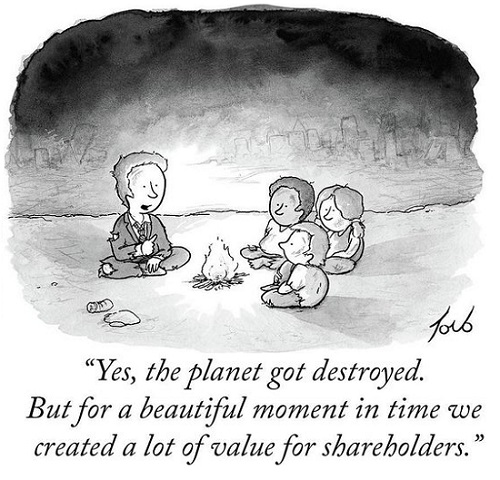
The actions of corporations, including the move towards monopoly, are driven by a relentless focus on ever-increasing returns to shareholders — shareholders who are primarily the very same extremely wealthy people.  Our new Oxfam paper on the “Seven Deadly Sins” of the G7, released this week, shows how returns to shareholders have increased dramatically whilst real wages have barely increased.

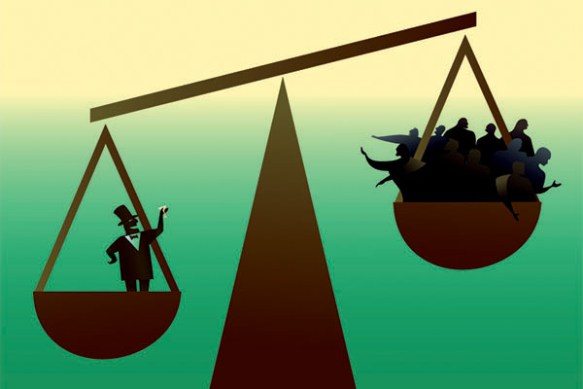
Behind corporate power and corporate actions is increasingly the power of super-rich shareholders.

Once billionaire wealth is accumulated, the way it is used also casts doubt on how useful it is to have billionaires.  The super-rich use their wealth to pay as little tax as possible, making active use of a secretive global network of tax havens, as revealed by the Panama Papers and other exposes.

One ground-breaking study that made use of this leaked information showed that the super-rich are paying as much as 30 percent less tax than they should, denying governments billions in lost tax revenue, that could have been spent on schools or on hospitals.  The super-rich are supported in this by the Society of Trust and Estate Practitioners (STEP), a secretive organization of over 20,000 wealth managers that actively pressures governments to reduce taxes on the richest.

Billions are not just used to ensure lower taxes. They can also be used to buy impunity from justice, to buy politicians, or to buy a pliant media.  The use of “dark” money to influence elections and public policy is a growing problem all over the world. The Koch brothers — Charles and the recently deceased David — two of the richest men in the world, have had a huge influence over conservative politics in the United States.

Another recent Oxfam study  showed the many ways in which politics has been captured by the very rich in Latin America.  Many of today’s new breed of nationalist, racist leaders have substantial financial backing.

This active political influencing by the super-rich directly drives greater inequality, by constructing reinforcing feedback loops, in which the winners of the game get even more resources to win even bigger next time.

For all these reasons, I think there is a strong case to be made that rather than being celebrated, as one U.S. commentator recently said, “every billionaire is a policy failure,” and that in particular if we are to end poverty and build fairer societies, we need to bring an end to extreme wealth.

The 5-Step CEO pay scam

Grossly widening inequalities of income and wealth cannot be separated from grossly widening inequalities of political power in America. This corruption must end.

By Robert Reich

Source: Nation of Change

Average CEO pay at big corporations topped 14.5 million dollars in 2018. That’s after an increase of 5.2 million dollars per CEO over the past decade, while the average worker’s pay has increased just 7,858 dollars over the decade. 

Just to catch up to what their CEO made in 2018 alone, it would take the typical worker 158 years.

This explosion in CEO pay relative to the pay of average workers isn’t because CEOs have become so much more valuable than before. It’s not due to the so-called “free market.”

It’s due to CEOs gaming the stock market and playing politics.

How did CEOs pull this off? They followed these five steps:

First: They made sure their companies began paying their executives in shares of stock.

Second: They directed their companies to lobby Congress for giant corporate tax cuts and regulatory rollbacks.

Third: They used most of the savings from these tax cuts and rollbacks not to raise worker pay or to invest in the future, but to buy back the corporation’s outstanding shares of stock.

Fourth: This automatically drove up the price of the remaining shares of stock.

Fifth and finally: Since CEOs are paid mainly in shares of stock, CEO pay soared while typical workers were left in the dust.

How to stop this scandal? Five ways:

1. Ban stock buybacks. They were banned before 1982 when the Securities and Exchange Commission viewed them as vehicles for stock manipulation and fraudThen Ronald Reagan’s SEC removed the restrictions. We should ban buybacks again.

2. Stop corporations from deducting executive pay in excess of 1 million dollars from their taxable income – even if the pay is tied to so-called company performance. There’s no reason other taxpayers ought to be subsidizing humongous CEO pay.

3. Stop corporations from receiving any tax deduction for executive pay unless the percent raise received by top executives matches the percent raise received by average employees.

4. Increase taxes on corporations whose CEOs make more than 100 times their average employees.

5. Finally, and most basically: Stop CEOs from corrupting American politics with big money. Get big money out of our democracy. Fight for campaign finance reform.

Grossly widening inequalities of income and wealth cannot be separated from grossly widening inequalities of political power in America. This corruption must end.