Joe Biden’s Secret War in Ukraine

American soldiers are already “boots on the ground”

By Philip Giraldi

Source: The Unz Review

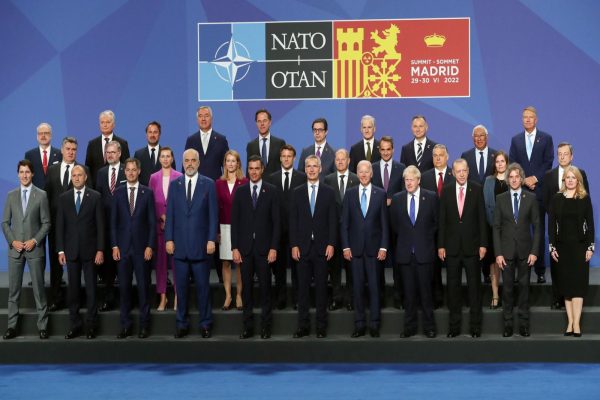
The White House keeps insisting that it will not directly involve American soldiers in the war in Ukraine, but it keeps taking steps that will inevitably lead to a large-scale open combat role for the US against Russia. Among the most recent moves to increase the pressure on the Kremlin, Biden revealed at a NATO summit meeting in Madrid on June 29th that the US will establish a permanent headquarters in Poland for the Fifth Army Corps, maintain an additional rotational brigade of thousands of troops in Romania and bolster other deployments in the Baltic states. Also, the number of US troops in Europe, currently approaching 100,000, will be increased. Biden also was pleased to learn that Turkey had been enticed to drop its objection to Finland and Sweden joining NATO.

On the way to the NATO summit aboard Air Force One, Biden’s National Security Adviser Jake Sullivan advised that “By the end of the summit what you will see is a more robust, more effective, more combat credible, more capable and more determined force posture to take account of a more acute and aggravated Russian threat.” Presumably Sullivan was reading from a prepared script, but the objective surely seemed to be to heighten tension with Moscow rather than attempt to reduce it and come to some kind of diplomatic settlement.

NATO Secretary General Jens Stoltenberg also did his bit. In an astonishing display of derriere kissing, he responded that the new US force posture commitments were demonstrative of Biden’s strong leadership. What Stoltenberg did not mention was that Biden has been lying for some time about the presence of US military personnel in Ukraine. He let the cat out of the bag back in March, when he told troops belonging to the 82nd Airborne division in Poland that they would soon be going to Ukraine, observing that “You’re going to see when you’re there, and some of you have been there, you’re gonna see —” It was an admission that US forces are already in place inside Ukraine even though the White House quickly did damage control, asserting that the president continues to be opposed to American soldiers being directly engaged in the fighting. Biden also claimed that the US was working to “keep the massacre [of Ukrainians] from continuing.” Again, the language was hardly designed to make some room for a possible accommodation with Russia to negotiate an end to the fighting.

And now there is a New York Times report entitled “Commando Network Coordinates Flow of Weapons in Ukraine, Officials Say: A secretive operation involving US Special Operations forces hints at the scale of the effort to assist Ukraine’s still outgunned military.”

The article describes a more active US role in Ukraine than the Biden Administration has been willing to admit publicly. Back in February, before intervened in Ukraine, the US reportedly withdrew its own 150 military instructors, many of whom were training Ukrainian soldiers on newly acquired American produced weapons. However, some Central Intelligence Agency (CIA) paramilitary operatives and special ops troops continued their service in the country secretly, directing most of the intelligence flow the US is sharing with Ukrainian forces. In addition to that, special ops soldiers from Washington’s NATO allies have been managing the movement of weapons and equipment into Ukraine and providing some specialized training. It has also been reported that British SAS commandos are actually guarding President Volodymyr Zelensky. The NYT specifies, citing American and other Western officials, that the soldiers and CIA officers are currently not on the front lines with Ukrainian troops. Also according to the Times, even though the US and NATO member states have not acknowledged the presence of their paramilitaries soldiers in operational roles in Ukraine, Russia and other intelligence services around the world are aware of this.

The New York Times report appears to be generally correct, though it does omit some details, some of which I have been hearing from former colleagues in the intelligence services. There has been considerable overt training at the Grafenwoehr German army base as well as at the Ramstein US Air Base to familiarize the Ukrainians with the new weapons arriving. Other NATO countries are also participating in the training. Meanwhile, the cadres of special operations soldiers and intelligence personnel operating primarily in western Ukraine are not in uniform and many of them are working under various contrived cover designations, including sometimes loose affiliations with foreign embassies and NGOs. There are also a conventional CIA Station, a group from the National Security Agency and a Military Attache’s office in the recently reopened US Embassy in Kiev.

All of the above means that Biden and other western leaders have been dissimulating regarding their active participation in the Russia-Ukraine conflict. Apart from his possible gaffe, Biden will not admit that there are American boots already on the ground, but they are there and are playing a major role in both logistics and intelligence sharing. The potential downside for the president could come when some of these soldiers in mufti get killed or, worse, captured and start to talk about their role.

Retired US Air Force Lt. Col. Karen Kwiatkowski, a former analyst for the US Department of Defense, observes that deploying plausibly deniable non-uniformed personnel “is completely typical of the initial stages of a US-backed long war, and for long-term political manipulation of the target country. This is the future that neoconservative ‘strategists’ in DC and their British and European allies imagine for Ukraine. Rather than a negotiated conclusion, with a new Ukrainian role as a neutral and productive country, independent of both Russian and US political influences, the US government and CIA see Ukraine as an expendable yet useful satrap in its competition with the Russian Federation.”

Former CIA analyst Larry Johnson sees the activity in stark terms, while also commenting that the CIA has not won a semi-clandestine insurgent war in forty years. He observes that “Ukraine is a proxy; the West is trying to destroy Russia, it’s that simple. It would be one thing if Russia was the most evil, oppressive, authoritarian regime in the world. It’s nowhere even close. Even though the West keeps trying to portray Russia as such. The fact of the matter is, the West wants the resources that Russia has and it wants to control Russia. [But] Russia is not about to be controlled.”

In other words, Washington might be seeking an unending war entangling Russia and limiting its options globally. The Biden Administration has staked its reputation and possible political future on enabling Ukraine to survive without succumbing to Russian territorial demands. It is a risky and even dangerous policy, both in practical terms and politically. The persistence of the Ukrainians in their defense is largely a product of US and Western Europe guarantees that they will do all that is necessary to support Zelensky and his regime, which is already seeking $750 billion in aid for “reconstruction.” If western military casualties begin to surface, the political support for the Ukraine war will begin to fade in Washington and elsewhere and there will be consequences in the upcoming midterm US elections in November.

A final comment on the Times piece is in response to the question why it has appeared at all at the present time. The mainstream media has been a cheerleader for aggressive US support of Ukraine and Zelensky, but now it is beginning to step back from that position, as have also the Washington Post and other media outlets. Perhaps they are becoming convinced that the game plan being promoted by Washington and its European allies is unlikely to succeed at great cost to the respective economies. Larry Johnson puts it this way: “I think the purpose of this article coming out now is just to lay the groundwork for why we can’t put or shouldn’t put any more US military personnel or even CIA personnel inside Ukraine because continuing to put US personnel…inside Ukraine to train is becoming too risky because of Russia’s success on the battlefield.” One might also add that it is exceptionally dangerous. A misstep or even a deliberate false flag coming from either side could easily make the war go nuclear.

Vaccine Hesitancy in Haiti has led to the Lowest COVID-19 cases and Death Rates in the Western Hemisphere

By Timothy Alexander Guzman

Source: Silent Crow News

The poorest country in the Caribbean has a problem according to Western governments and its global institutions.  That problem is with Haiti, a country that does not trust anything that comes out of the West including media propaganda and its experimental injections or what is known as the “Covid-19 vaccines.”  Haitians do not accept the West as a savior when it comes to their health or security, they don’t even trust their own government especially since most of them take orders from Washington and Paris.  The last president that the Haitian people supported overwhelmingly was ousted by a US-backed coup in 2004 and he was Jean Bertrand Aristide.  However, there is some positive news coming out of Haiti regarding Covid-19 and its experimental injections according to the World Health Organization’s (WHO) own words:

In Haiti, from 3 January 2020 to 5:16pm CEST, 13 July 2022, there have been 31,980 confirmed cases of COVID-19 with 837 deaths, reported to WHO. As of 8 July 2022, a total of 348,769 vaccine doses have been administered

It should not be a surprise that Haiti, a country with a population of more than 11 million people has a low vaccination rate since most Haitians do not want the experimental injections to begin with.  An article from a liberal website called Coda which you can find online under http://www.codastory.com published a propaganda piece from August 13th, 2021, titled ‘The origins of Haiti’s vaccine hesitancy’ by Erica Hellerstein on why the Haitian population refuse to get the Covid-19 vaccination shots which according to their logic, Haiti is listening to disinformation or conspiracy theories from Russia:    

Facebook unearthed a vast Russia-based anti-vaccine disinformation campaign this week. On Tuesday, the social media giant announced that it had removed 65 Facebook and 243 Instagram accounts amplifying anti-vaccine content. Investigators from the company linked the network to British marketing firm Fazze and operated from Russia. The campaign — dubbed a “disinformation laundromat” by Facebook — primarily targeted users in Latin America, India, and the U.S. through fake articles and petitions circulated on Medium, Reddit and Change.org, and then spread on social media via fake Facebook and Instagram accounts. One of the conspiracies, often accompanied in this campaign by images from the “Planet of the Apes” movies, is the claim that the AstraZeneca jab would turn people into chimpanzees – an old favorite of Russian state propaganda

Codastory.com is owned by Coda Media which is managed by a group of people who originally worked for the US mainstream-media such as Natalia Antelava, a former BBC correspondent who is the head of the organization and Ilan Greenberg who was a former staff reporter for The Wall Street Journal is the publisher and editorial director of the news outlet which already shows you the bias reporting they hold against Russia.  Hellerstein mentioned Jean-Claude Louis who was speaking to an acquaintance working in the medical field about the Covid-19 vaccine, according to Hellerstein, the acquaintance told Louis, “I will never get the vaccine,” she continued “You don’t know what you’re getting.”  Jean-Claude Louis is a coordinator for the Panos Institute which is described as “a Haitian nonprofit that trains journalists and youth on media literacy and identifying disinformation,” The Panos Institute is a non-profit organization that was originally based in the UK is now operating worldwide.  Louis has obviously fallen for Western propaganda on the efficacy and safety of the Covid-19 experimental injections:  

Louis has been paying close attention to the vaccine myths circulating online and in-person. And he is worried about how much of it is spreading inside Haiti’s medical community. “The problem is there are so many false rumors about vaccines,” he added. “People are very hesitant about getting the vaccines”

Hellerstein said that “I approached Louis after coming across a dataset laying out vaccination rates for the Americas. Topping the list was Uruguay, where nearly 75% of the population has gotten at least one vaccine dose. All the way at the bottom was Haiti, with just 0.14% of the population inoculated against Covid-19.”  She also mentioned that Haiti was the last country in Latin America and the Caribbean to receive Covid-19 vaccines from the US and the United Nations (UN) through the COVAX program: 

Haiti was one of the last countries in the world –and the last in Latin America and the Caribbean –to begin distributing the shot. In fact, it hadn’t gotten any at all until last month. Then, on July 14, a shipment of 500,000 doses from the United States via the United Nations-backed COVAX program arrived in the country. The delivery came a week after Haitian President Jovenel Moïse was brazenly assassinated in his home, plunging the country into political crisis

According to Hellerstein’s assessment, Haiti’s distribution of the vaccine was a “Bright spot” during the country’s political upheavals, but there was a statistic that was troubling to her:

The vaccine rollout was hailed as a “bright spot” during an otherwise tumultuous moment in Haiti. But another statistic caught my eye: according to a June survey by UNICEF and the University of Haiti, just 22% of adults said they were interested in getting the shot. Compare that with this February survey of global vaccination attitudes, where 88% of Brazilian adults, 85% of Chinese and Mexican adults, and 80% of Spanish and Italian adults said they intended to get the Covid-19 jab. Even in Russia, where vaccine acceptance was the lowest of all countries polled, 42% of adults said they would get a shot if made available — nearly double Haiti’s openness rate

There was an ounce of truth exposed by the article when UN peacekeepers brought cholera to Haiti where close to 10,000 people died from the outbreak:

Haitians have good reasons to distrust international institutions; after all, experts have determined that United Nations peacekeepers brought cholera to Haiti, where at least 10,000 people died of the disease, despite years of vehement denial from U.N. officials

Distrust of the UN and its Western backers is a major issue for the Haitian people:

The incident has left many Haitians deeply distrustful of the very institutions leading the global vaccination drive through the COVAX program. As Brian Concannon, founder of the Institute for Justice & Democracy in Haiti, a coalition of Haitian and U.S. human rights advocates, told me: “​​Basically the international community burned all its credibility on public health messaging by lying about cholera.”  He added: “They don’t trust the U.N., they don’t trust the government. The messenger is the problem”

On April 7th, 2021, Haiti has refused a donation of more than 756, 000 doses of the AstraZeneca vaccine from the WHO also through the COVAX program as reported by Spain’s EFE from a reliable source:

According to this source the Haitian Government refused to receive the AstraZeneca vaccine, manufactured under license by “Serum Institute of India” because of “the global unrest surrounding this vaccine”, considering that the population of Haiti “would not accept it”

In an interesting turn of events The Haitian authorities have asked the WHO to send vaccines from other laboratories to Haiti, including the vaccine from Johnson & Johnson laboratories which requires only one injection and which can be stored at temperatures between 2 and 8 degrees Celsius.”  However, WHO officials are pushing back against Haiti’s demands since the Johnson & Johnson vaccine takes only one shot.  However, the J&J vaccine can be just as dangerous as Pfizer and Moderna’s experimental injections, but the idea is maybe that one shot is more convincing to the public than having multiple shots for the long-term, perhaps they just wanted to avoid pushing “forever boosters” on their population who are already skeptical on any vaccine produced by the West to fight Covid-19 or any other disease.

Whatever people say about Haiti and their reaction to Covid-19 in the West and elsewhere may be negative, but one thing is certain, anything to do with Western governments and their institutions such as the WHO or the CDC concerning Covid-19 or any other new disease whether they are promoting vaccines or facemasks have resulted in more deaths and injuries. 

Haiti’s example should be proof that whatever the “health authorities” such as the Anthony Fauci’s of the world and their institutions are suggesting have no credibility and whatever they are promoting should be taken with a grain of salt.   

Although this news video is typical US mainstream media propaganda, you can watch this video to get a different perspective on the attitude towards Covid-19 in Haiti:

U.S.-led Imperialism is the World’s Leading Purveyor of Chaos

The western capitalist axis of domination is responsible for most of the world’s crises. The crisis of legitimacy extends from the UK to Japan, and U.S. imperialism is involved in every new catastrophe.

By Danny Haiphong

Source: Black Agenda Report

To say that the West, currently led by the dictates of U.S. imperialism, is in trouble would be an understatement. U.K. Prime Minister Boris Johnson resigned on July 7th amid an escalating political crisis of legitimacy . Three weeks before Johnson announced his departure, Emmanuel Macron’s so-called centrist alliance lost its parliamentary majority in France. U.S. President Joe Biden continues to face his own crisis of legitimacy in the form of declining favorability ratings and public humiliation from Democratic loyalists such as Debra Messing . For the West, political crisis is undergirded by an unprecedented level of system chaos which has given the vast majority of workers and oppressed people little confidence in the future.

That chaos was compounded by the murder of Japan’s former Prime Minister, Shinzo Abe on July 7th. Abe was an imperialist, a neoliberal, and the highest expression of what it means to be a puppet of the American Empire . Abe’s so-called Liberal Democratic Party (LDP) was a literal creation of the Central Intelligence Agency (CIA). Other detestable qualities of Abe include his worship of Japan’s fascist war criminals, his membership in the fascist cult Nippon Kaigi, and his unapologetic defense of Japan’s history of brutalizing and super exploiting “comfort women” from its colonies. Most important to the United States, however, was Abe’s unquestionable loyalty to the New Cold War and the military encirclement of China.

Abe’s murder and the attendant political crises in the West are a clear demonstration that U.S.-led imperialism is the world’s leading purveyor of chaos in the world. At the economic base, the U.S. and the E.U. continue to prolong their proxy war with Russia through massive arms transfers and sanctions that have boomeranged back to spur shortages and inflation. Inflation has come with political costs. Already unpopular capitalist regimes in the West are finding themselves increasingly exposed as incapable of addressing the rising cost of living. It doesn’t help matters that the so-called military superiority of the United States and its imperialist partners is also being challenged by Russia’s successful special military operation in Ukraine.

Thanks to the U.S. obsession with NATO expansion, the future is bleak for Ukraine’s U.S.-backed coup government established in 2014. Russia’s special military operation in Ukraine has made immense progress in the Donbass region. An already fragile and privatized vassal Ukrainian economy can only look forward to more pain once the U.S. and its junior partners in NATO come looking for repayment on its exorbitant aid packages. And Ukraine is just the beginning. The recent admission of Sweden and Finland into NATO is yet another declaration of war with Russia which opens the door to future conflicts even more destructive than the ongoing U.S. proxy war in Ukraine.

It is an undeniable fact that chaos follows U.S. imperialism wherever it goes. In Latin America, stability exists only where leftist governments have secured sufficient sovereignty . In Africa, the spread of the U.S. Africa Command (AFRICOM) has led to widespread destabilization and political insecurity in the aftermath of the U.S.-NATO-AFRICOM invasion of Libya in 2011. In Asia, U.S. militarism has facilitated war in the West and attempted to organize a coalition of vassal states against China in the East. U.S. meddling in Taiwan has created a dumping ground for defense contractors and prompted Joe Biden to articulate on three occasions that the U.S. is willing to militarily intervene to “defend” the island , a guaranteed nuclear exchange scenario.

U.S. militarism is the principal barrier to political stability around the world which is a prerequisite to addressing global challenges such as climate change and poverty. U.S. and E.U. sanctions murder thousands of people in poorer, non-white countries. U.S.-sponsored color revolutions and “soft power” maneuvers are preludes to regime change. So-called U.S. “soft power” strengthens the most reactionary forces in the world. The far right and fascistic Contras in Latin and Central America ISIS in West Asia, and the Azov Regiment in Ukraine are all outgrowths of U.S. interference disguised as “soft power.”

A dialectical relationship exists between the U.S.’s domestic and foreign policy. U.S. imperialism is an advanced stage in the system of capitalism predicated upon slavery, colonialism, and racism. Jayland Walker’s brutal murder at the hands of Akron police is a near daily occurrence in the United States. Black Americans and Indigenous peoples have been subject to the cruelest forms of racist violence for centuries. The U.S.’s endless wars are an expression of this violence turned toward imperialist ends.

The chickens of chaos have come home to roost. The Euro-American imperialist world order is suffering from terminal contradictions. Political instability reigns supreme. Another economic crisis is said to be looming but is more than likely already here. Imperialist wars no longer hold any prospect for any real “victory” without serious consequences for the war-maker.

While material conditions are pregnant with possibilities, there is no organized and independent left challenge to the supremacy of U.S. capital and its armed guards of the state. That is the task ahead of the people’s movement residing in the belly of the imperialist beast. In the face of the unprecedented chaos produced by its leading purveyor, the United States, this is no doubt the most difficult one that the working class and oppressed in the long and storied history of resistance. But such a task is not a choice. It is forced upon us by the weight of imperialism bearing down on our necks.

We must not rest until we get the boot off by any means necessary.

Danny Haiphong’s work can be followed on Twitter @SpiritofHo and Telegram at The Haiphong Press. You can support Danny on Patreon by clicking this link. You can contact him at haiphongpress@protonmail.com. 

The international political debacle proves that the unipolar system is crumbling

By Guilherme Wilbert

Source: The Saker

With the recent political events involving such different parts of the world, but usually for the same reasons: popular dissatisfaction, rising prices, and the like. And these causes arise with the decision-making errors of Western leaders, who end up suppressing popular opinion, in what generates a kind of democratic government in the archetype but doesn’t really care about its people.

The most practical example arises when countries try to enter into military alliances without popular consultation as to whether the people agree with what is at stake. The Nordics in NATO were a very clear example of this.

The politicians who now manage the finances of powers within Europe were clearly not prepared for what is happening, mainly because in the global production chain, which involves Russia, now sanctioned, reflects much more on the sanctioning regional economy than on the sanctioned one. Plus it destroys on many economic fronts the Global South, which directly receives the reflections of these mistakes.

People who have been put through a bureaucracy because economic power has a lot of money and unfortunately are leading Europe into disaster, but without realizing it the entire Western world as we know it. With recent cases of foreign attempts to interfere in legitimately elected governments to try to stop the advance to the multipolar world, which at this point of the championship has no more brakes.

The recent death of Shinzo Abe, former prime minister of Japan (which until then was considered one of the safest countries in the world), proves that even a supposedly quiet and peaceful nation can be the target of serious terrorist attacks like the one mentioned, and this proves that the unipolarity system is disappearing, even if it takes some along the way, unfortunately.

The political debacle unfortunately caused by the cited mistakes of Western leaders such as the sanctions, has generated dissatisfaction to the extreme point of an assassination with a homemade artifact against a prominent leader of the Asian world (many may be wondering why in the reasoning Japan would be characterized as part of the “Western World” despite being in Asia and this is because Japanese diplomacy is strongly influenced by Washington, in which it functions as a kind of diplomacy semi-colonized by the Americans).

It was not avoidable, but it could be delayed

The multipolar world was going to emerge one way or another, but the mistakes of the Western leaders accelerated a process that would still take some years, and it can’t cope since it governs for less than 1 billion people (G7 population). And Operation Z in Ukraine was the trigger for a lack of diplomatic tact and will to war that even caused Ukraine’s allied leaders to fall, such as Boris Johnson.

The bankruptcy of Europe was also imminent, since the various economic dependencies, including on Russian gas, prove that the continent, despite being so-called First World, was unable to generate an economy based on a real production of resources. And all attempts to escape from this dependency would lead to at least 10 years of pipeline works and economic agreements-treaties between other countries and them.

So it’s not like it was easy either to have prevented what was predestined to happen, but it could have been delayed if there was the right diplomacy, since the war was avoidable. But how? Simple. I’ll explain.

What was Putin’s key argument? “Ukraine cannot join NATO!”

And what could the West have done? Generated a document in multilateral coordination with the appropriate entities recognizing that the security of Russia, a member of the UN Security Council, was an important issue and Ukraine would not join the Atlanticist military alliance. Or: they could put 50,000 or 100,000 troops inside Kiev to stand up to the Russians since Biden shortly before the Special Military Operation began, acknowledged that Putin would “invade Ukraine,” so they knew the risks. But they did neither.

They wanted this war but it is not going as planned because the political debacle is happening, with the leaders who support the Atlanticist platforms falling away little by little, leaving the enthusiasts of the multipolar world standing like Putin and Xi Jinping in their proper nuclear strongholds.

Moreover, it is interesting to note how parts of the Global South opposed the various diplomatic and economic sanctions on Russia, showing that they were unwilling to continue functioning as American semi-colonies in diplomatic and other matters.

It was inevitable that a totally new world would emerge out of the totally destroyed old world, because that is the natural way of what comes after destruction: reconstruction or new construction. And that is what is happening to the world at present, in that we see prominent leaders being murdered in the open or resignations due to inability of governance, clear signs of destruction.

And after the destruction will come the construction, of which we don’t know what it will look like yet, but the first bricks have already been laid.

The BRICS+ is the only economic bloc capable of guiding the birth of the multipolar world

The BRICS+ unlike any grouping of countries into an economic bloc, has no regional or cultural limitations. On the contrary, countries from all over the world that are so different are aligned in the same multipolar thinking there, in what is seen different if you consider the G7 or NAFTA, which are limiting organizations in their birth, since they don’t carry the discourse of multipolarism ingrained, besides using destabilizing agents such as NATO for a kind of stick to impose their policies on sovereign countries.

The ability to unite so many enthusiasts of the multipolar world will be the driving force of the industrial revolution that we will see happen, which will bring the world into a state of bonanza again because even war will end one day and sanctions will be seen as useless because integration has already begun to happen. Currency baskets are being considered within the BRICS+ to escape the American monetary hegemony, which is a BIG thing!

So, to close the reasoning, I conclude that the multipolar world was something that was inevitably going to happen, but it was accelerated because of the mistakes of its enemies.


Guilherme Wilbert is a law graduate interested in geopolitics and international law.

NATO — The Most Dangerous Military Alliance on the Planet

Together We Are Wrong — by Mr. Fish

By Chris Hedges

Source: ScheerPost

The North Atlantic Treaty Organization (NATO), and the arms industry that depends on it for billions in profits, has become the most aggressive and dangerous military alliance on the planet. Created in 1949 to thwart Soviet expansion into Eastern and Central Europe, it has evolved into a global war machine in Europe, the Middle East, Latin America, Africa and Asia. 

NATO expanded its footprint, violating promises to Moscow, once the Cold War ended, to incorporate 14 countries in Eastern and Central Europe into the alliance. It will soon add Finland and Sweden. It bombed Bosnia, Serbia and Kosovo. It launched wars in Afghanistan, Iraq, Syria and Libya, resulting in close to a million deaths and some 38 million people driven from their homes. It is building a military footprint in Africa and Asia. It invited Australia, Japan, New Zealand and South Korea, the so-called “Asia Pacific Four,” to its recent summit in Madrid at the end of June. It has expanded its reach into the Southern Hemisphere, signing a military training partnership agreement with Colombia, in December 2021. It has backed Turkey, with NATO’s second largest military, which has illegally invaded and occupied parts of Syria as well as Iraq. Turkish-backed militias are engaged in the ethnic cleansing of Syrian Kurds and other inhabitants of north and east Syria. The Turkish military has been accused of war crimes – including multiple airstrikes against a refugee camp andchemical weapons use – in northern Iraq. In exchange for President Recep Tayyip Erdoğan’s permission for Finland and Sweden to join the alliance, the two Nordic countries have agreed to expand their domestic terror laws making it easier to crack down on Kurdish and other activists, lift their restrictions on selling arms to Turkey and deny support to the Kurdish-led movement for democratic autonomy in Syria.

It is quite a record for a military alliance that with the collapse of the Soviet Union was rendered obsolete and should have been dismantled. NATO and the militarists had no intention of embracing the “peace dividend,” fostering a world based on diplomacy, a respect of spheres of influence and mutual cooperation. It was determined to stay in business. Its business is war. That meant expanding its war machine far beyond the border of Europe and engaging in ceaseless antagonism toward China and Russia. 

NATO sees the future, as detailed in its “NATO 2030: Unified for a New Era,” as a battle for hegemony with rival states, especially China, and calls for the preparation of prolonged global conflict.

“China has an increasingly global strategic agenda, supported by its economic and military heft,” the NATO 2030 initiative warned. “It has proven its willingness to use force against its neighbors, as well as economic coercion and intimidatory diplomacy well beyond the Indo-Pacific region. Over the coming decade, China will likely also challenge NATO’s ability to build collective resilience, safeguard critical infrastructure, address new and emerging technologies such as 5G and protect sensitive sectors of the economy including supply chains. Longer term, China is increasingly likely to project military power globally, including potentially in the Euro-Atlantic area.”

The alliance has spurned the Cold War strategy that made sure Washington was closer to Moscow and Beijing than Moscow and Beijing were to each other. U.S. and NATO antagonism have turned Russia and China into close allies. Russia, rich in natural resources, including energy, minerals and grains, and China, a manufacturing and technological behemoth, are a potent combination. NATO no longer distinguishes between the two, announcing in its most recent mission statement that the “deepening strategic partnership” between Russian and China has resulted in “mutually reinforcing attempts to undercut the rules-based international order that run counter to our values and interests.” 

On July 6, Christopher Wray, director of the FBI, and Ken McCallum, director general of Britain’s MI5, held a joint news conference in London to announce that China was the “biggest long-term threat to our economic and national security.” They accused China, like Russia, of interfering in U.S. and U.K. elections. Wray warned the business leaders they addressed that the Chinese government was “set on stealing your technology, whatever it is that makes your industry tick, and using it to undercut your business and dominate your market.”

This inflammatory rhetoric presages an ominous future.

One cannot talk about war without talking about markets. The political and social turmoil in the U.S., coupled with its diminishing economic power, has led it to embrace NATO and its war machine as the antidote to its decline.

Washington and its European allies are terrified of China’s trillion-dollar Belt and Road Initiative (BRI) meant to connect an economic bloc of roughly 70 nations outside U.S. control. The initiative includes the construction of rail lines, roads and gas pipelines that will be integrated with Russia. Beijing is expected to commit $1.3 trillion to the BRI by 2027. China, which is on track to become the world’s largest economy within a decade, has organized the Regional Comprehensive Economic Partnership, the world’s largest trade pact of 15 East Asian and Pacific nations representing 30 percent of global trade. It already accounts for 28.7 percent of the Global Manufacturing Output, nearly double the 16.8 percent of the U.S. 

China’s rate of growth last year was an impressive  8.1 percent, although slowing to around 5 percent this year.  By contrast, the U.S.’s growth rate in 2021 was 5.7 percent — its highest since 1984 — but is predicted to fall below 1 percent this year, by the New York Federal Reserve.

If China, Russia, Iran, India and other nations free themselves from the tyranny of the U.S. dollar as the world’s reserve currency and the international Society for Worldwide Interbank Financial Telecommunication (SWIFT), a messaging network financial institutions use to send and receive information such as money transfer instructions, it will trigger a dramatic decline in the value of the dollar and a financial collapse in the U.S. The huge military expenditures, which have driven the U.S. debt to $30 trillion, $ 6 trillion more than the U.S.’s entire GDP, will become untenable. Servicing this debt costs $300 billion a year. We spent more on the military in 2021, $ 801 billion which amounted to 38 percent of total world expenditure on the military, than the next nine countries, including China and Russia, combined. The loss of the dollar as the world’s reserve currency will force the U.S. to slash spending, shutter many of its 800 military bases overseas and cope with the inevitable social and political upheavals triggered by economic collapse. It is darkly ironic that NATO has accelerated this possibility.

Russia, in the eyes of NATO and U.S. strategists, is the appetizer. Its military, NATO hopes, will get bogged down and degraded in Ukraine. Sanctions and diplomatic isolation, the plan goes, will thrust Vladimir Putin from power. A client regime that will do U.S. bidding will be installed in Moscow.

NATO has provided more than $8 billion in military aid to Ukraine, while the US has committed nearly $54 billion in military and humanitarian assistance to the country.

China, however, is the main course. Unable to compete economically, the U.S. and NATO have turned to the blunt instrument of war to cripple their global competitor. 

The provocation of China replicates the NATO baiting of Russia.

NATO expansion and the 2014 US-backed coup in Kyiv led Russia to first occupy Crimea, in eastern Ukraine, with its large ethnic Russian population, and then to invade all of Ukraine to thwart the country’s efforts to join NATO. 

The same dance of death is being played with China over Taiwan, which China considers part of Chinese territory, and with NATO expansion in the Asia Pacific. China flies warplanes into Taiwan’s air defense zone and the U.S. sends naval shipsthrough the Taiwan Strait which connects the South and East China seas. Secretary of State Antony Blinken in May called China the most serious long-term challenge to the international order, citing its claims to Taiwan and efforts to dominate the South China Sea. Taiwan’s president, in a Zelensky-like publicity stunt, recently posed with an anti-tank rocket launcher in a government handout photo.

The conflict in Ukraine has been a bonanza for the arms industry, which, given the humiliating withdrawal from Afghanistan, needed a new conflict. Lockheed Martin’s stock prices are up 12 percent. Northrop Grumman is up 20 percent. The war is being used by NATO to increase its military presence in Eastern and Central Europe. The U.S. is building a permanent military base in Poland. The 40,000-strong NATO reaction force is being expanded to 300,000 troops. Billions of dollars in weapons are pouring into the region.

The conflict with Russia, however, is already backfiring. The ruble has soared to a seven-year high against the dollar. Europe is barreling towards a recession because of rising oil and gas prices and the fear that Russia could terminate supplies completely. The loss of Russian wheat, fertilizer, gas and oil, due to Western sanctions, is creating havoc in world markets and a humanitarian crisis in Africa and the Middle East. Soaring food and energy prices, along with shortages and crippling inflation, bring with them not only deprivation and hunger, but social upheaval and political instability. The climate emergency, the real existential threat, is being ignored to appease the gods of war.

The war makers are frighteningly cavalier about the threat of nuclear war. Putin warned NATO countries that they “will face consequences greater than any you have faced in history” if they intervened directly in Ukraine and ordered Russian nuclear forces to be put on heightened alert status. The proximity to Russia of U.S. nuclear weapons based in Belgium, Germany, Italy, Netherlands and Turkey mean that any nuclear conflict would obliterate much of Europe. Russia and the United States control about 90 percent of the world’s nuclear warheads, with around 4,000 warheads each in their military stockpiles, according to the Federation of American Scientists.

President Joe Biden warned that the use of nuclear weapons in Ukraine would be “completely unacceptable” and “entail severe consequences,” without spelling out what those consequences would be. This is what U.S. strategists refer to as “deliberate ambiguity.” 

The U.S. military, following its fiascos in the Middle East, has shifted its focus from fighting terrorism and asymmetrical warfare to confronting China and Russia. President Barack Obama’s national-security team in 2016 carried out a war game in which Russia invaded a NATO country in the Baltics and used a low-yield tactical nuclear weapon against NATO forces. Obama officials were split about how to respond. 

“The National Security Council’s so-called Principals Committee—including Cabinet officers and members of the Joint Chiefs of Staff—decided that the United States had no choice but to retaliate with nuclear weapons,” Eric Schlosser writes in The Atlantic. “Any other type of response, the committee argued, would show a lack of resolve, damage American credibility, and weaken the NATO alliance. Choosing a suitable nuclear target proved difficult, however. Hitting Russia’s invading force would kill innocent civilians in a NATO country. Striking targets inside Russia might escalate the conflict to an all-out nuclear war. In the end, the NSC Principals Committee recommended a nuclear attack on Belarus—a nation that had played no role whatsoever in the invasion of the NATO ally but had the misfortune of being a Russian ally.” 

The Biden administration has formed a Tiger Team of national security officials to run war games on what to do if Russia uses a nuclear weapon, according to The New York Times. The threat of nuclear war is minimized with discussions of “tactical nuclear weapons,” as if less powerful nuclear explosions are somehow more acceptable and won’t lead to the use of bigger bombs. 

At no time, including the Cuban missile crisis, have we stood closer to the precipice of nuclear war. 

“A simulation devised by experts at Princeton University starts with Moscow firing a nuclear warning shot; NATO responds with a small strike, and the ensuing war yieldsmore than 90 million casualties in its first few hours,” The New York Times reported.

The longer the war in Ukraine continues — and the U.S. and NATO seem determined to funnel billions of dollars of weapons into the conflict for months if not years — the more the unthinkable becomes thinkable. Flirting with Armageddon to profit the arms industry and carry out the futile quest to reclaim U.S. global hegemony is at best extremely reckless and at worst genocidal.

The agony of the West

Like Rome, the Anglo-Saxon Empire is collapsing by its own decadence.

Sergey Lavrov used to compare the West to a wounded predator. According to him, it should not be provoked because it would be taken by madness and could break everything. It is better to accompany it to the graveyard. The West does not see it that way. Washington and London are leading a crusade against Moscow and Beijing. They roar and are ready for anything. But what can they really do?

By Thierry Meyssan

Source: VoltaireNet.org

The G7 summit in Bavaria and the Nato summit in Madrid were supposed to announce the West’s punishment of the Kremlin for its “special military operation in Ukraine”. But, if the image given was that of Western unity, the reality attests to their disconnection from reality, their loss of audience in the world and ultimately the end of their supremacy.

While the West is convinced that what is at stake is in Ukraine, the world sees it facing the “Thucydides trap” [1]. Will international relations continue to be organized around them or will they become multipolar? Will the peoples who have been subjugated until now break free and gain sovereignty? Will it be possible to think differently than in terms of global domination and to devote themselves to the development of each individual?

The West has devised a narrative of the Russian “special military operation” in Ukraine that overlooks their own actions since the dissolution of the Soviet Union. They have forgotten their signing of the Charter for European Security (also known as the OSCE Istanbul Declaration) and the way they violated it by making almost all the former members of the Warsaw Pact and some of the new post-Soviet states join one by one. They have forgotten the way they changed the Ukrainian government in 2004 and the coup d’état by which they put Banderist nationalists in power in Kiev in 2014. Having made a clean sweep of the past, they blame Russia for all the ills. They refuse to question their own actions and consider, at the time, they were forced into power. For them, their victories make the Law.

To preserve this imaginary narrative, they have already silenced the Russian media at home.

No matter how much they claim to be “democrats”, it is better to censor dissenting voices before lying.

So they approach the Ukrainian conflict, without contradiction, by convincing themselves that they have the duty to judge alone, to condemn and sanction Russia. By blackmailing small states, they managed to obtain a text from the UN General Assembly that seems to prove them right. They now plan to dismantle Russia as they did in Yugoslavia and tried to do in Iraq, Libya, Syria and Yemen (Rumsfeld/Cebrowski strategy).

To do this, they began to isolate Russia from world finance and trade. They cut off its access to the SWIFT system and Lloyds, preventing it from buying and selling as well as transferring goods. They thought this would cause its economic collapse. In fact, on June 27, 2022, Russia was unable to pay a debt of $100 million and the rating agency Mody’s declared it in default [2].

But this did not have the desired effect: everyone knows that the reserves of the Russian Central Bank are full of foreign currency and gold. The Kremlin paid the 100 million, but could not transfer it to the West because of Western sanctions. It has placed them in an escrow account where they await their debtors.

Meanwhile, the Kremlin, which is no longer paid by the West, has begun to sell its production, especially its hydrocarbons, to other buyers, particularly China. The exchanges that can no longer be made in dollars are made in other currencies. As a result, the dollars that their customers used to use are flowing back to the United States. This process had already begun several years ago. But Western unilateral sanctions have accelerated it sharply. The huge amount of dollars accumulating in the US is causing a massive price increase. The Federal Reserve is doing everything it can to share it with the eurozone. The price increase is spreading at high speed across the entire Western European continent.

The European Central Bank is not an economic development agency. Its main task is to manage inflation within the Union. it cannot slow down the sudden rise in prices at all, so it tries to use it to reduce its debt. The Member States of the Union are therefore invited to compensate for the drop in purchasing power of their “citizens” by lowering taxes and providing benefits. But this is a never-ending circle: by helping their citizens, they tie their hands and feet to the European Central Bank, they chain themselves a little more to the US debts and become even poorer.

There is no remedy for this inflation. This is the first time that the West has had to mop up the dollars that Washington has recklessly printed for years. The rise in prices in the West corresponds to the cost of imperial spending over the last thirty years. Today and only today is the West paying for its wars in Yugoslavia, Afghanistan, Iraq, Libya, Syria and Yemen.

Until now, the United States killed anyone who threatened the supremacy of the dollar. It hanged President Saddam Hussein for refusing it and looted the Iraqi Central Bank. They tortured and lynched the leader Muamar el-Gaddafi who was preparing a new pan-African currency and looted the Libyan Central Bank. The gigantic sums amassed by these oil states disappeared without a trace. The only thing we saw was GI’s taking tens of billions of dollars wrapped in large garbage bags. By excluding Russia from dollar trade, Washington itself has brought about what it so feared: the dollar is no longer the international reference currency.

The majority of the rest of the world is not blind. It has understood what is happening and has rushed to the St. Petersburg Economic Forum, then tried to register for the virtual Brics summit. They realize -a little late- that Russia launched the “Partnership of Greater Eurasia”, in 2016 and that its Foreign Minister, Sergei Lavrov, had solemnly announced it at the UN General Assembly, in September 2018 [3]. During four years, quantities of roads and railroads were built to integrate Russia into the networks of the new “Silk Roads”, land and sea, imagined by China. It was thus possible to shift the flow of goods within a few months.

The fall in the value of the dollar and the shift in the flow of goods are causing an even greater rise in energy prices. Russia, which is one of the world’s leading exporters of hydrocarbons, has seen its revenues increase considerably. Its currency, the ruble, has never been in better shape. In response, the G7 has set a price ceiling for Russian oil and gas. It ordered the “international community” not to pay more.

But Russia is obviously not going to let the West set the prices of its products. Those who do not want to pay market prices will not be able to buy them, and no customer intends to go without to please the West.

The G7 tries to organize, at least intellectually, its supremacy [4].. This no longer works. The wind has changed. The four centuries of Western domination are over.

In desperation, the G7 has committed itself to solving the global food crisis that its policies have caused. The countries concerned know what the G7 commitments mean. They are still waiting for the great African development plan and other smoke and mirrors. They know that the West cannot produce nitrogen fertilizers and that they prevent Russia from selling theirs. The G7 aid is only a band-aid to keep them waiting and not to question the sacred principles of free trade.

The only possible option for the rescue of Western domination is war. Nato must succeed in destroying Russia militarily as Rome once razed Carthage. But it’s too late: the Russian army has much more sophisticated weapons than the West. It has already experimented with them since 2014 in Syria. It can crush its enemies at any time. President Vladimir Putin exposed the staggering progress of its arsenal to his parliamentarians in 2018 [5]

The Nato summit in Madrid was a nice communication operation [6]. But it was only a swan song. The 32 member states proclaimed their unity with the despair of those who fear to die. As if nothing had happened, they first adopted a strategy to dominate the world for the next ten years, naming China’s “growth” as a concern [7]. In doing so, they admitted that their goal is not to ensure their own security, but to dominate the world. They then opened the accession process for Sweden and Finland and considered approaching China with, as a first step, the possible accession of Japan.

The only incident, which was quickly brought under control, was the Turkish pressure that forced Finland and Sweden to condemn the PKK [8]. Unable to resist, the United States dropped its allies, the Kurdish mercenaries in Syria and their leaders abroad.

With this, they decided to increase the NATO Rapid Reaction Force from 40,000 to 300,000 men, 7.5 times, and station it on the Russian border. In doing so, they have once again violated their own signature, that of the Charter for Security in Europe, by directly threatening Russia. Russia has no possibility to defend its huge borders and can only ensure its security by ensuring that no foreign force sets up a military base on its borders (scorched earth strategy). Already, the Pentagon is circulating prospective maps of the dismantling of Russia that it hopes to implement.

The former Russian ambassador to NATO and current director of Roscosmos, Dmitry Rogozin, has responded by publishing on his Telegram account the coordinates of the NATO decision-making centers, including the Madrid summit room [9]. Russia has hypersonic launchers, for the moment impossible to intercept, which can carry a nuclear warhead in a few minutes to the NATO headquarters in Brussels and the Pentagon in Washington. To avoid any misunderstanding, Sergei Lavrov specified, alluding to the Straussians, that the martial decisions of the West were not taken by the military, but by the US State Department. It would be the first target.

So the question is: will the West play for all it’s worth? Will they take the risk of a Third World War, even though it has already been lost, just to avoid dying alone?

Translation
Roger Lagassé

The Empire Is Showing More And More Of Its True Face

By Caitlin Johnstone

Source: CaitlinJohnstone.com

Genocide walrus John Bolton outright admitted to planning foreign coups with the US government in conversation with CNN’s Jake Tapper on Wednesday. That’s coups, plural.

While arguing that the Capitol riot on January 6th of last year was not an attempted coup but rather just Trump stumbling around trying to look after his own interests, Bolton hastened to pull authority on the matter when Tapper suggested that he might not be correct about how coups work.

“I disagree with that,” Bolton said. “As somebody who has helped plan coups d’etat — not here, but, you know, other places — it takes a lot of work, and that’s not what [Trump] did.”

Places. Plural.

Tapper just let Bolton’s remark slide like he didn’t just admit to something extraordinarily fiendish, but did eventually follow up with a request that the former National Security Advisor elaborate.

“I do want to ask a follow up,” Tapper said. “When we were talking about what is capable, or what you need to do to be able to plan a coup, and you cited your expertise having planned coups.”

“I’m not going to get into the specifics,” replied Bolton with a chuckle.

“Successful coups?” Tapper asked.

“Well, I wrote about Venezuela in the book,” Bolton answered. “And it turned out not to be successful – not that we had all that much to do with it, but I saw what it took for an opposition to try and overturn an illegally elected president, and they failed. The notion that Donald Trump was half as competent as the Venezuelan opposition is laughable.”

“I feel like there’s other stuff you’re not telling me, though,” Tapper responded.

“I’m sure there is,” Bolton said, grinning like he just finished boiling a puppy.

Tapper pursued the matter no further, because he is a propagandist first and a journalist second, and he would be acutely aware that Bolton was saying things that you are not supposed to admit to on television.

Bolton’s sole admission to coup plotting runs counter to his comments about the US government’s failed attempt to oust President Nicolas Maduro while he was facilitating that bizarre operation under the Trump administration, telling reporters in 2019 that the empire’s Venezuela shenanigans were “clearly not a coup.”

In other examples of the US empire just rearing its ugly head right out in broad daylight, an excellent new report by Alan MacLeod with Mintpress News shows that Facebook/Instagram parent company Meta has been hiring dozens of people who previously worked in the US intelligence cartel to help regulate what content gets seen on the social media giant’s platforms. Some were hired from straight out of the CIA or had (officially) left the agency very recently.

The CIA used to infiltrate the media. Now the CIA is the media. This trend of openly hiring US intelligence veterans to help teach the public what thoughts to think about the world began a few years ago in the legacy media, and now we’re seeing it in the new media as well.

This is part of a broader trend in which many of the ugly things the US empire used to do in secret it now does openly with the aid of propaganda spin. In addition to attempting coups right out in the open as we saw in Venezuela and just giving intelligence insiders positions of influence within both new and old media institutions, you’ve got things like the US government-funded National Endowment for Democracy (NED), which according to its own founding officials was set up to do overtly what the CIA used to do covertly.

We see NED’s fingerprints all over pretty much any situation where the western power alliance needs to manage public perception about a CIA-targeted government, from Ukraine to Russia to Hong Kong to Xinjiang, to the imperial propaganda firm known as Bellingcat. Rather than manipulate world narratives and foment discontent from behind the veil of hidden identities and cutouts as in CIA tactics of old, NED just manipulates them openly by pouring funds into narrative management operations which benefit the empire while framing it as promoting democracy and human rights.

Then you’ve got things like American officials telling the press that the US government has been circulating disinformation about Russia and Ukraine, Biden administration officials saying the proxy war in Ukraine is being used to “weaken” Russia and that they are fine with US brinkmanship with Russia causing global recession and hunger, and western officials telling the press that Ukraine is crawling with CIA personnel.

What the empire has found is that you don’t need to hide as much from public visibility as long as you can manipulate what people think they’re seeing. If the public is sufficiently propagandized and consent has been adequately manufactured, you can get away with just proclaiming some random guy the president of a foreign country and seeing if you can manipulate the rest of the world into playing along with you.

If your narrative control is strong enough, you can even keep the empire running smoothly when information gets out into the open that you’d rather stay hidden. Very often these days major stories about imperial malfeasance will come out that simply have no impact, either because the mainstream news media unite to ignore them or because they spin those revelations as coming from someone bad or not containing important information.

People tend to overrate the power of the US war machine and underrate the power of the US propaganda machine. While the US military finds itself losing a war to the Taliban, the awesome power of its propaganda engine has people marching in perfect alignment with the will of the oligarchic empire.

When I was in an abusive relationship, the more ground down and submitted I became the more my abuser would flaunt his abusiveness in the plain light of day. Toward the end he was just outright admitting he was a sociopath and a manipulator and openly telling me he was going to do monstrous things to me before he did them, because he was that confident that he had me wrapped around his finger.

Luckily, he was wrong. And hopefully the empire is wrong as it makes this same calculation with all of us.

What Was Covid Really About? Triggering A Multi-Trillion Dollar Global Debt Crisis. “Ramping up an Imperialist Strategy”?

Covid, Capitalism, Friedrich Engels and Boris Johnson

By Colin Todhunter

Source: Global Research

“And thus it renders more and more evident the great central fact that the cause of the miserable condition of the working class is to be sought, not in these minor grievances, but in the capitalistic system itself.” Friedrich Engels, The Condition of the Working Class in England (1845) (preface to the English Edition, p.36)  

The IMF and World Bank have for decades pushed a policy agenda based on cuts to public services, increases in taxes paid by the poorest and moves to undermine labour rights and protections.

IMF ‘structural adjustment’ policies have resulted in 52% of Africans lacking access to healthcare and 83% having no safety nets to fall back on if they lose their job or become sick. Even the IMF has shown that neoliberal policies fuel poverty and inequality.

In 2021, an Oxfam review of IMF COVID-19 loans showed that 33 African countries were encouraged to pursue austerity policies. The world’s poorest countries are due to pay $43 billion in debt repayments in 2022, which could otherwise cover the costs of their food imports.

Oxfam and Development Finance International (DFI) have also revealed that 43 out of 55 African Union member states face public expenditure cuts totalling $183 billion over the next five years.

According to Prof Michel Chossudovsky of the Centre for Research on Globalization, the closure of the world economy (March 11, 2020 Lockdown imposed on more than 190 countries) has triggered an unprecedented process of global indebtedness. Governments are now under the control of global creditors in the post-COVID era.

What we are seeing is a de facto privatisation of the state as governments capitulate to the needs of Western financial institutions.

Moreover, these debts are largely dollar-denominated, helping to strengthen the US dollar and US leverage over countries.

It raises the question: what was COVID really about?

Millions have been asking that question since lockdowns and restrictions began in early 2020. If it was indeed about public health, why close down the bulk of health services and the global economy knowing full well what the massive health, economic and debt implications would be?

Why mount a military-style propaganda campaign to censor world-renowned scientists and terrorise entire populations and use the full force and brutality of the police to ensure compliance?

These actions were wholly disproportionate to any risk posed to public health, especially when considering the way ‘COVID death’ definitions and data were often massaged and how PCR tests were misused to scare populations into submission.

Prof Fabio Vighi of Cardiff University implies we should have been suspicious from the start when the usually “unscrupulous ruling elites” froze the global economy in the face of a pathogen that targets almost exclusively the unproductive (the over 80s).

COVID was a crisis of capitalism masquerading as a public health emergency.

Capitalism  

Capitalism needs to keep expanding into or creating new markets to ensure the accumulation of capital to offset the tendency for the general rate of profit to fall. The capitalist needs to accumulate capital (wealth) to be able to reinvest it and make further profits. By placing downward pressure on workers’ wages, the capitalist extracts sufficient surplus value to be able to do this.

But when the capitalist is unable to sufficiently reinvest (due to declining demand for commodities, a lack of investment opportunities and markets, etc), wealth (capital) over accumulates, devalues and the system goes into crisis. To avoid crisis, capitalism requires constant growth, markets and sufficient demand.

According to writer Ted Reese, the capitalist rate of profit has trended downwards from an estimated 43% in the 1870s to 17% in the 2000s. Although wages and corporate taxes have been slashed, the exploitability of labour was increasingly insufficient to meet the demands of capital accumulation.

By late 2019, many companies could not generate sufficient profit. Falling turnover, limited cashflows and highly leveraged balance sheets were prevalent.

Economic growth was weakening in the run up to the massive stock market crash in February 2020, which saw trillions more pumped into the system in the guise of ‘COVID relief’.

To stave off crisis up until that point, various tactics had been employed.

Credit markets were expanded and personal debt increased to maintain consumer demand as workers’ wages were squeezed. Financial deregulation occurred and speculative capital was allowed to exploit new areas and investment opportunities. At the same time, stock buy backs, the student debt economy, quantitative easing and massive bail outs and subsidies and an expansion of militarism helped to maintain economic growth.

There was also a ramping up of an imperialist strategy that has seen indigenous systems of production abroad being displaced by global corporations and states pressurised to withdraw from areas of economic activity, leaving transnational players to occupy the space left open.

While these strategies produced speculative bubbles and led to an overevaluation of assets and increased both personal and government debt, they helped to continue to secure viable profits and returns on investment.

But come 2019, former governor of the Bank of England Mervyn King warned that the world was sleepwalking towards a fresh economic and financial crisis that would have devastating consequences. He argued that the global economy was stuck in a low growth trap and recovery from the crisis of 2008 was weaker than that after the Great Depression.

King concluded that it was time for the Federal Reserve and other central banks to begin talks behind closed doors with politicians.

That is precisely what happened as key players, including BlackRock, the world’s most powerful investment fund, got together to work out a strategy going forward. This took place in the lead up to COVID.

Aside from deepening the dependency of poorer countries on Western capital, Fabio Vighi says lockdowns and the global suspension of economic transactions allowed the US Fed to flood the ailing financial markets (under the guise of COVID) with freshly printed money while shutting down the real economy to avoid hyperinflation. Lockdowns suspended business transactions, which drained the demand for credit and stopped the contagion.

COVID provided cover for a multi-trillion-dollar bailout for the capitalist economy that was in meltdown prior to COVID. Despite a decade or more of ‘quantitative easing’, this new bailout came in the form of trillions of dollars pumped into financial markets by the US Fed (in the months prior to March 2020) and subsequent ‘COVID relief’.

The IMF, World bank and global leaders knew full well what the impact on the world’s poor would be of closing down the world economy through COVID-related lockdowns.

Yet they sanctioned it and there is now the prospect that in excess of a quarter of a billion more people worldwide will fall into extreme levels of poverty in 2022 alone.

In April 2020, the Wall Street Journal stated the IMF and World Bank faced a deluge of aid requests from scores of poorer countries seeking bailouts and loans from financial institutions with $1.2 trillion to lend.

In addition to helping to reboot the financial system, closing down the global economy deliberately deepened poorer countries’ dependency on Western global conglomerates and financial interests.

Lockdowns also helped accelerate the restructuring of capitalism that involves smaller enterprises being driven to bankruptcy or bought up by monopolies and global chains, thereby ensuring continued viable profits for Big Tech, the digital payments giants and global online corporations like Meta and Amazon and the eradication of millions of jobs.

Although the effects of the conflict in Ukraine cannot be dismissed, with the global economy now open again, inflation is rising and causing a ‘cost of living’ crisis. With a debt-ridden economy, there is limited scope for rising interest rates to control inflation.

But this crisis is not inevitable: current inflation is not only induced by the liquidity injected into the financial system but also being fuelled by speculation in food commodity markets and corporate greed as energy and food corporations continue to rake in vast profits at the expense of ordinary people.

Resistance  

However, resistance is fertile.

Aside from the many anti-restriction/pro-freedom rallies during COVID, we are now seeing a more strident trade unionism coming to the fore – in Britain at least – led by media savvy leaders like Mick Lynch, general secretary of the National Union of Rail, Maritime and Transport Workers (RMT), who know how to appeal to the public and tap into widely held resentment against soaring cost of living rises.

Teachers, health workers and others could follow the RMT into taking strike action.

Lynch says that millions of people in Britain face lower living standards and the stripping out of occupational pensions. He adds:

“COVID has been a smokescreen for the rich and powerful in this country to drive down wages as far as they can.”

Just like a decade of imposed ‘austerity’ was used to achieve similar results in the lead up to COVID.

The trade union movement should now be taking a leading role in resisting the attack on living standards and further attempts to run-down state-provided welfare and privatise what remains.

The strategy to wholly dismantle and privatise health and welfare services seems increasingly likely given the need to rein in (COVID-related) public debt and the trend towards AI, workplace automisation and worklessness.

This is a real concern because, following the logic of capitalism, work is a condition for the existence of the labouring classes. So, if a mass labour force is no longer deemed necessary, there is no need for mass education, welfare and healthcare provision and systems that have traditionally served to reproduce and maintain labour that capitalist economic activity has required.

In 2019, Philip Alston, the UN rapporteur on extreme poverty, accused British government ministers of the “systematic immiseration of a significant part of the British population” in the decade following the 2008 financial crash.

Alston stated:

“As Thomas Hobbes observed long ago, such an approach condemns the least well off to lives that are ‘solitary, poor, nasty, brutish, and short’. As the British social contract slowly evaporates, Hobbes’ prediction risks becoming the new reality.”

Post-COVID, Alston’s words carry even more weight.

As this article draws to a close, news is breaking that Boris Johnson has resigned as prime minister. A remarkable PM if only for his criminality, lack of moral foundation and double standards – also applicable to many of his cronies in government.

With this in mind, let’s finish where we began.

“I have never seen a class so deeply demoralised, so incurably debased by selfishness, so corroded within, so incapable of progress, as the English bourgeoisie…

For it nothing exists in this world, except for the sake of money, itself not excluded. It knows no bliss save that of rapid gain, no pain save that of losing gold.

In the presence of this avarice and lust of gain, it is not possible for a single human sentiment or opinion to remain untainted.” Friedrich EngelsThe Condition of the Working Class in England (1845), p.275