
Saturday Matinee: Cold Case Hammarskjöld

Review: COLD CASE HAMMARSKJÖLD, Pretzels of Truth and Performance Art

By Kurt Halfyard

Source: Film Anarchy

“This could either be the world’s biggest murder mystery, or the world’s most idiotic conspiracy theory.”

Two years before the JFK assassination, on the 18th of September 1961, the world was shocked by the suspicious death of the second serving Secretary-General of the United Nations. In a plane crash in Ndola, Rhodesia, Dag Hammarskjöld was the only person on board not horribly scorched in the ‘accident.’ Instead he was bloodied, and a playing card was tucked in his shirt collar.

Nearly six decades later, the UN is still (nominally) investigating the details of what was thought first thought to be an accident, then a targeted assassination, of a man who had designs on the political and financial independence of the African continent. In fact, U.S. President John F.  Kennedy himself described the Secretary General as “the greatest statesman of our century.” The assassination theory holds several motive possibilities – various industrial interests active in the region (both then and now) or various clandestine military or mercenary operations taking orders from the US, the UK and Europe who had designs at odd with the ‘activist’ Secretary General.

There are crimes, and then there are crimes. Outside of the small circles of Denmark Television or offbeat cinephiliia, Mads Brügger is criminally unknown. The journalist, comedian, satirist, filmmaker, but above all, provocateur, has been twisting the documentary form into pretzels of truth and performance art for more than a decade.

In 2006, he toured an autistic theatre troupe though North Korea, cascading through a collection of political handlers and bureaucrats, to make a point about propaganda and totalitarian fear imposed on the so-called Democratic Peoples Republic of Korea. As if that stunt, The Red Chapel, was not fraught with enough risk, he then purchased illegal diplomatic credentials from the Central African Republic (CAR) to set up his own personal blood diamond operation (under the front of a match factory whose product would be manufactured by the local Pygmy population). By the time The Ambassador wowed Sundance attendees (and yours truly) in 2011, several of the ‘characters’ in the film, political figures in the CAR, had disappeared or been killed.

The Danish filmmaker takes large risks, some might say indefensible ones. Along with his countryman Lars Von Trier (whose outfit Zentropa produced The Ambassador), Brügger keeps plenty of his own skin in the game of his cinematic endeavours — for the sake of your education, and entertainment. He is a hell of a talented filmmaker.

With Cold Case Hammarskjöld, things go the full Errol Morris (WormwoodA Wilderness of Error) investigation route. With the help of Göran Björkdahl, a Swedish activist/investigator who is in possession of the only part of Hammarskjöld’s plane that was not buried under the soil of the Ndola airport, Brügger uses every trick in the documentary playbook: re-creations, animations, historical footage, official and redacted document scavenging, and a lot of interviews with people who where sidelined, ignored, or simply unknown at the time.

Above all, Brügger recreates, in glossy cinematic terms, himself making the documentary itself. Form as function, as with any good conspiracy theory, things start to fold back on themselves in increasingly avant garde ways.  

But there is purpose in this narrative trickery. By filming himself, twice, it offers Brügger the storyteller the opportunity to rope a Zodiac-level ‘filing cabinet ‘of names, facts, dates, and political organizations, together into a ‘lean in’ yarn of far reaching proportions. Two hundred old Secret Marine Societies, megalomaniac villains dressed in white, biological guerrilla warfare, the fallout of Apartheid, World War II fighter aces, assassins leaving Playing Cards in their victims’ collar, and of course, the fate of both a continent, and a fledgling World Government Body are all tethered together.

To say that the film’s 128 minutes is dense, is an understatement. Via this experimental technique (which of course the filmmaker acknowledges, in somewhat of a mea culpa, at one point) along with some pretty detailed, rational, detective work, makes the whole thing as seductive and addicting as Serial or The Staircase.

At one point, Michael Moore-style, Brügger and Björkdahl arm themselves with a high powered metal detectors, shovels, and a cigar (in the off chance they are successful), and go scouring the back-fields of the Ndola airport looking for the 50+ year old burial site of the plane. The authorities arrive. They are polite, but firm, regarding this activity. You are simply not welcome to do this kind of digging.

Cold Case Hammarskjöld has caused a stir in ‘papers of record’ such as The New York Times and The Guardian, reacting to the film compelling presentation and investigation of SAIMR, the South African Institute for Maritime Research, and its quack doctor, Lord Nelson cosplaying Commodore, Keith Maxwell, the “man in white”, who is said here of not only co-ordinating the murder of Dag Hammarskjöld, but also weaponizing AIDS virus for genocidal purposes, and ostensibly participating in bad amateur theatre.

The former may have been at the behest of the CIA and MI6, the latter was on his own personal time. Maxwell was a surreal combination of L. Ron Hubbard, and Colonel Kurtz, and Brügger condemns, mythologizes, exposes, at several points even mimics, him in the way only larger than life cinema can.

If there is a signature image across several of the films of Mads Brügger, it is that of an impeccably dressed man, wildly out of place, sitting on a skinny boat drifting on the current of a wide, and fast moving body of water. Here it is Göran Björkdahl, no closer to the truth of the matter, but still floating on the river of possibilites. We have learned things, both true and untrue, along the way.

Cold Case Hammarskjöld is the most engaging (and entertaining) documentary of the year.

Watch Cold Case Hammarskjöld on Kanopy here: https://www.kanopy.com/product/cold-case-hammarskjold

Saturday Matinee: J.R. “Bob” Dobbs and the Church of the SubGenius

Review By Steve Davis

Source: The Austin Chronicle

You couldn’t escape his ubiquitous mug back when Austin was truly weird. It appeared on bumper stickers, bulletin boards, telephone poles, streetlights, bathroom walls, and more: A perfectly coiffed and lantern-jawed 1950s dad, his perfectly straight teeth clenching a pipe in an ear-to-ear grin worthy of Ward Cleaver. Although his face archetypically evoked white, middle-class, heterosexual Christian conformity, J.R. ‘Bob’ Dobbs (note the mandatory quotation marks) served as the symbol of something completely different from post-war homogeneity. He was the appointed figurehead of the Church of the SubGenius, a somewhat wacky “religious” (more quotation marks, but subjectively imposed) organization formed to counter the “conspiracy of normalcy” pervading American society. Initially hatched in the playfully demented minds of two Dallas-area merry pranksters, Reverend Ivan Stang and Dr. Philo Drummond (née Douglass St. Clair Smith and Steve Wilcox, respectively), in the late Seventies, the Church was intended as a dogmatic antidote to a re-emergent mediocrity, embracing an aesthetic in confluence with evolving new wave sensibilities and tropes in music, film, and pop culture. It was an in-joke with a half-serious punchline.

The image christened ‘Bob’ first appeared in a 1979 DIY pamphlet that asked readers questions like “Are You Abnormal?” and announced “The World Ends Tomorrow AND YOU MAY DIE!” before soliciting a dollar subscription fee for this new fringe theology masquerading as performance art and satire. (Or was it performance art and satire masquerading as fringe theology?) Afterwards, non-conformists everywhere (including the band Devo, magician Penn Jillette, film director Alex Cox, and actor Paul “Pee-wee Herman” Reubens) began to jump on board and the Church ended up becoming, inexplicably or not, a phenomenon of sorts, making the indefatigable ‘Bob’ the first piece of clip art to lead a world-wide congregation.

The deftly executed documentary J.R. ‘Bob’ Dobbs and the Church of the Subgenius demonstrates great affection for Bob and his acolytes, many of whom enthusiastically relate the Church’s mythology, history and doctrine here with a nostalgic sentimentality usually reserved for reckless-youth silliness. (Full disclosure: the film was executive produced by Chronicle co-founder Louis Black.) Their monikers set the tone – Reverend Susie the Floosie, Nurses Vicki and Kelly, Papa Joe Mama, Dr. Howland Owll, and Reverend Dr. Onan Canobite, among others. Special mention must go to a delighted Arch Doctor Saint Margaret, the late and sorely missed Margaret Moser, Austin Chronicle music columnist and legendary Texas Blonde. These eager talking heads – including the aforementioned Messrs. Stang and Drummond—discuss the early anarchic gatherings of the SubGenius faithful at so-called “devivals”, attempt to explain the undefinable zen of “Slack” that all church members strive for, recount Bob’s infamous assassination onstage at San Francisco’s Victoria Theatre (catlike, he has many lives), and recall the prophecy of the Rupture, when (7 a.m., July 5, 1998, to be exact) Church members would rise up against the norms who’ve robbed them of Slack and ascend to pleasure saucers piloted by alien sex goddesses. (Like most patriarchal sects, the Church skewed towards a boy’s club mentality.) It all sounds fantastic. And it is, in every meaning of the word.

Director Boone and her crew make good use of those interviews, as well as grainy film footage and subliminal imagery, to document the story of Bob and his Church, which still thrive albeit to a much lesser degree, despite challenges that include competition from the internet, cult-related tragedies like the Columbine massacre, and some negative press (deserved and undeserved) over the years. While some question whether there’s any room left for relatively benign organizations like the Church of SubGenius in this hardcore conspiracy-driven world, the documentary ends with the hope there will always be a place for nonthreatening weirdos to worship. To those naysayers who disagree, I quote from the Scripture of Bob: “Fuck ’em if they can’t take a joke.”

Watch J.R. “Bob” Dobbs and the Church of the SubGenius on Kanopy here: https://www.kanopy.com/product/jr-bob-dobbs-and-church-subgenius

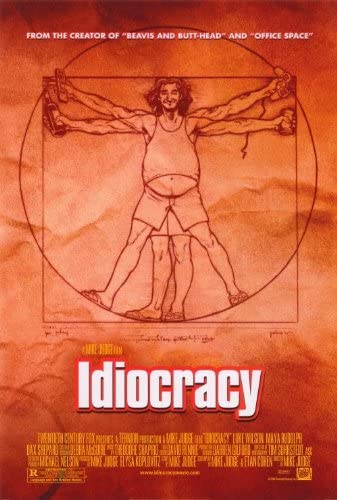
Saturday Matinee: Idiocracy

Review by Fernando F. Croce

Source: Slant

By refusing to distance itself from its targets, Mike Judge’s brand of satire risks being mistaken for what it’s satirizing. The Beavis and Butthead cartoons were erroneously dismissed as a mindless extension (rather than a complicit critique) of misdirected suburban youth, a fate that can similarly befall Idiocracy, Judge’s sophomore live-action comedy—or could have, that is, if the picture had ever been actually released. Brusquely dumped by its studio without even the courtesy of a trailer, this orphaned project has, as a result, acquired such an aura of lacerating subversion—the movie 20th Century Fox was too chickenshit to distribute!—that it is more than slightly disappointing to find, upon actual viewing, not much beyond a solid episode of Futurama. Give it props for nerve, however: A world where Starbucks has become synonymous with handjobs is surely beyond the reach of Fox’s other unceremoniously-axed vision of the future.

Joe Bowers (Luke Wilson) is an ordinary Army schmoe picked as guinea pig in a government experiment. Along with mouthy streetwalker Rita (Maya Rudolph), he’s supposed to be cryogenically frozen for one year to test a hibernation program, but it isn’t until 2505 that the two are thawed out and released into a radically mutated world: The sheer proliferation of stupid people has gradually reversed the Darwinian process in the 500 years since, and the planet has become overrun with slack-jawed numbskulls barely able to string together the slangy insults the language has degenerated into. The President (Terry Alan Crews) is an ex-wrestler and former porn star, water has been replaced everywhere by sports drinks, and people are only too happy to accept, consume, and vegetate. Judge’s dystopia is a pop wasteland triggered by rampant ignorance (the very act of thinking is dubbed “faggy”) and then held down by corporate greed, a daring concept visualized in the picture’s most evocative shot, of Costco merchandise piled high toward the skies to suggest gargantuan towers ready to topple over.

As evident in the cubicle zombies of Office Space, Judge recognizes quotidian frustration and the small ways through which people revolt against it; working on a larger, broader scale in Idiocracy, however, his control quickly dissolves into a freefall of ideas and jokes, some hitting the bullseye and others landing on the floor with a thud. Judge is indifferent to anything resembling space or rhythm, yet the low-tech chintz of his approach ultimately enhances the caustic themes by making the futuristic atmosphere absurdly transparent; as with Godard’s Alphaville, we are already living in the future, for how wide a gap really separates Date Movie and Failure to Launch from Ass, the single, unchanging shot of a gassy, naked butt topping box-office charts in 2025? (The hero recalls a past when moviegoers “cared about whose ass it was, and why it was farting.”) Idiocracy is too scattershot and compromised to push the conceptual bleakness beyond the realm of lowbrow comedy, though Judge’s cultural ire remains bracing throughout: For all the characters’ slapsticky imbecility, Judge makes it clear that it’s their docile acceptance (read: political inactivity) that makes them true dumbasses.

Saturday Matinee: Night is Short, Walk on Girl

“Night is Short, Walk on Girl” (2017) is a surreal romantic comedy anime directed by Masaaki Yuasa and based on the 2006 novel of the same name by Tomihiko Morimi. The plot follows the intertwined adventures of a college senior pursuing a fellow student he’s infatuated by over the course of a wild night and the various characters they help and and are assisted by in the process. Stylistically and philosophically, it’s a cross between Yuasa’s 2004 masterpiece Mind Game and Jean-Pierre Jeunet’s Amélie (2001). This anime is also notable for being oddly prophetic with its out of left field subplot in the third act involving a flu-like epidemic originating from a selfish and cynical old oligarch.

Watch the film on Hoopla here: https://www.hoopladigital.com/title/14253206

Saturday Matinee: Pootie Tang

“Pootie Tang” (2001) is a comedy written and directed by Louis C.K. starring Lance Crouther, Chris Rock, Wanda Sykes, Jennifer Coolidge and Robert Vaughn. It’s a feature film adaptation of a comedy sketch from The Chris Rock Show and also features appearances by Kristen Bell, David Cross, Missy Elliot, Conan O’Brien, and Bob Costas. Louis C.K. has been in cultural exile for legitimate reasons and this early film of his was unanimously panned by film critics upon release. However, like even worse offenders such as Woody Allen, he was able to make people laugh (with collaboration of a talented cast and crew) and since none of the material in the film is related to what C.K. is now infamous for and he doesn’t appear in the film, it’s still possible to watch without constant reminding of the perversion of the director (whose actions aren’t as evil as Allen’s though still terrible). So I’d encourage anyone in the mood for a dumb comedy to check it out, especially those with an appreciation for blaxploitation b-movies and anti-corporate co-optation fables.

Watch Pootie Tang on Kanopy here: https://www.kanopy.com/product/pootie-tang

Saturday Matinee: Kingpin

Why I love Kingpin – A crude comedy about horrible people

The Farrelly brothers’ reached their vulgar, freewheeling peak with this 1996 bowling comedy.

By James Oddy

Source: Single White Lies

Irecently bombed a job interview that seemed a sure thing. It was a job I wanted and, even worse, a job I needed. I got the rejection call, then I missed my bus and had to wait in the rain. Then I lost my wallet. I felt like a real Munson. A born loser. Give me a wide berth.

So I went home and (re)watched the Farrelly brothers’ 1996 film Kingpin. I know what you’re thinking, it’s not the most obvious candidate for a feel good film. Actually, it may be one of the scuzziest films ever produced by a major studio. For the uninitiated, it tells the story of former “man-child” bowling prodigy Roy Munson (Woody Harrelson). An alcoholic, and devoid of his bowling hand after an unfortunate incident involving nemesis Ernie “Big Ern” McCraken (Bill Murray), Munson believes he’s found his ticket out of poverty with Ishmael (Randy Quaid), an Amish man hailing from rural Pennsylvania.

Subtlety isn’t this film’s strong point – most of the jokes concern some bodily function or another, or slapstick violence involving someone’s testicles, sometimes at the same time. What really sets it apart from other ’90s gross out comedies is how genuinely nasty the characters are. At the time of its release many critics, even the ones that liked it, described it as tasteless, vulgar and crude. In one of his most underrated performances, Harrelson is simply hilarious as the stupid, lazy and self-serving Munson.

Meanwhile, Bill Murray ad-libs almost every time he is on screen, giving a masterclass in smart arse performance as the womanising sleaze ball Ernie. Farrelly bros’ regular Rob Moran somehow manages to be even more unpleasant as a domestically abusive “bowling enthusiast” and sometime gangster called Stanley. Vanessa Angel’s Claudia is a born grifter and a bowling groupie. Even Ishmael is all too eager to abandon his Amish ways to enjoy the earthly pleasures of coffee and cigarettes. Along with a colourful supporting cast, this is one of the most glorious collections of freaks and weirdoes you’re ever likely to see on screen.

Kingpin also has a refreshing, freewheeling approach to genre. It’s a romantic comedy, a clash of cultures played for laughs, a buddy movie, a road movie and a underdog sports story all rolled into one 113-minute caper. It should also be noted that this is very much a film for adults, with explicitly adult themes. Yet it’s undercut with the universal message that, just maybe, everything will be okay in the end.

Ultimately, this is a story of redemption. A film that says you can always turn things around, that it’s always worth persevering. The 1990s and early 2000s saw a rise in “adult genres”, allowing filmmakers to take greater risks on mid-sized studio films. Kingpin is one of the finest examples of that trend, a film in which nobody involved is particularly interested in focus groups or target markets. It is what it is, warts and all.

After Kingpin, the Farrelly brothers began to scale back the sleaze, retreating to the safer shores of more formulaic rom-coms like There’s Something About Mary and Shallow Hal. But we’ll always have Munson to remind us that you never know when an Amish bowling prodigy might walk into your life and change everything.

Saturday Matinee: Psycho Goreman

[Movie Review] PG: PSYCHO GOREMAN

By Sarah Musnicky

Source: Nightmarish Conjurings

It’s not often that you find a movie that is completely batshit crazy, all the way extra, yet entirely wholesome all in one package. Yet, this is what we have in PG: PSYCHO GOREMAN. Coated with ounces of blood, campy humor, and adolescent sassafras, audiences will be taken through a wackadoo journey that will have their heads spinning. While not quite the type of family film one would put on family night, there is enough family-fun goodness to add this to the list once all members are grown and prepared to have their eyeballs explode. By film’s end, you’ll find yourself unexpectedly wanting the best for everyone, even if it means pure, utter destruction is the end result.

Siblings Mimi (Nita-Josee Hanna) and Luke (Owen Myre) accidentally awaken an ancient alien overlord with no name from a millennia-long prison sentence. Why was this overlord imprisoned you ask? Well, he attempted to destroy the universe after working under an oppressive system that exploited his labor. While the creature has no chill, Mimi is undaunted, especially when it’s discovered that she is in possession of a magical amulet that enables her to force the creature to obey every single command she makes. Every. Single. Command. If you know children well, you know this is an absolutely awful idea.

They decide to give the evil creature the name Psycho Goreman (Matthew Ninaber), which they shorten to PG to keep things easier. PG’s re-appearance, though, triggers attention across the galaxy. There are those who want to destroy him, remembering the destruction he caused eons ago. And there are others who wish to help him, for a price that is. As the galaxy’s creatures start to zero in on this small Earth town, the fate of the galaxy may be up to Mimi and Luke. But first, we get a heavy dose of sitcom-style shenanigans, which sow the seeds of heartwarming payoff that we experience at the film’s end.

Where should anyone really begin when discussing this film? First off, PG: PSYCHO GOREMAN is a practical effects wet-dream. From slowly crawling brain-boys to a suicidal melty zombie police officer to every alien character having their own specific costume that almost reminds of classic Power Rangers episodes mixed with Doctor Who flair, there is so much craft-based love in this film that it made this reviewer positively giddy to see what we’d see next. Knowing the amount of work that went into the effects onscreen, it’s an extraordinarily ambitious undertaking in this day and age. But, in all honesty, it is so worth it to see it come to life onscreen. Forever pro-practical all the way!

With the practical effects aiming to seduce our hearts, we have to keep in mind that this is not all that writer-director Steven Kostanski is bringing to the table for us to consume in PG: PSYCHO GOREMAN. The writing and the delivery of performances from the actors really help to sell the chaos that is taking place onscreen. Matthew Ninaber’s PG’s sinister, almost deadpan delivery contrasts nicely against Nita-Josee Hanna’s manic over-the-top energy she delivers for Mimi. While this reviewer would have loved more levels in Hanna’s performance, the direction and delivery of her character performance still worked well for the over-the-top nature of the film. Adam Brooks is also a notable standout, with his comedic timing and everyman performance providing a much-needed contrast to the adventures of the children onscreen.

The script itself is hilarious and heartwarming, with lines about hunky boys coming out of PG’s mouth that would seem out of place in any other film. Yet, this is a heartwarming, tongue-in-cheek type of film that lends itself to these subtleties, where each character undergoes their own spiritual journey. Just, with wallops of blood, gore, and viscera. These little moments are subtly interwoven in, which maximizes their impact upon arrival due to the black comedy that Kostanski leans into. And, if that isn’t enough for you, the various homages paid to family-style shows in the script really help remind the viewer of the lengths this film will go to remind of what PG: PSYCHO GOREMAN is really about – love and finding your own family. Even if that family consists of a psychotic girl, a mom-turned-administrator of misguided justice, or – even – a bloodthirsty alien warlord.

Overall, PG: PSYCHO GOREMAN is a film that would make an epic Midnighter event at any film festival. It would have been a crowd-pleaser pre-COVID and it certainly will after. This reviewer would argue that it’s the alien warlord version of the little girl paired with bodyguard/former military turned babysitter trope. It’s heartwarming, bloody, incredibly fucked up, and extra as all get out. And, while at times the performances can be more one-note than not, the film just really works. It’s a family film gone wrong, which seems perfectly fitting for the age we’re in now.

Watch Psycho Goreman on Hoopla here: https://www.hoopladigital.com/title/14004800