8 Critical Factors Behind Every Food Crisis

FILE – In this Monday, Aug. 15, 2011 file photo, children from southern Somalia hold their pots as they line up to receive cooked food in Mogadishu, Somalia. A report by two U.S. government-funded famine and food agencies gives the highest death toll yet, estimating that 260,000 people died – more than double previous estimates. (AP Photo/Farah Abdi Warsameh, File)

By John Hawthorne

Source: Business Connect

From the beginning of time, their have been food crises in one form or another. Ancient books such as the Bible have records of various famines devastating portions of the world.

And while it’s easy to attribute these crises to a single cause, such as war or drought, the causes are usually much deeper and much more complex.

Nelson Mandela said, “Overcoming poverty is not an act of charity, it is an act of justice.”

In order for us to achieve the kind of justice envisioned by Mandela, it’s essential that we first understand the underlying causes of food crises. Only after we have understood can we then begin creating meaningful solutions.

With that in mind, here are 8 primary factors behind almost every global food crisis. While not all 8 of these will be present at a time, you will almost always find several of these at work.

Factor #1 – Poverty

One of the greatest factors in every food crisis is stark and abject poverty. This isn’t surprising. With enough money, anyone can ensure they have enough food. But with many developing nations sitting well below the poverty line, the population simply can’t afford the food they so desperately need.

Additionally, poverty has a distinct effect on food output. In Africa, for example, many farmers can’t afford proper irrigation and fertilizer. This, in turn, leads to lower yields, which then reduces the overall amount of food available to the population.

The population of the Sub-Saharan region of Africa is expected to grow at an astronomical rate, topping out at 2.4 billion by 2050. This will continue to exacerbate the poverty issue, which will then continue to drive the lack of sufficient food in the area.

Factor #2 – Drought and Desertification

Widespread droughts, leading to the desertification of particular locations also causes huge disruptions to food production. For example, leading up to and during the global food crisis of 2008, 110 countries experienced significant droughts. This caused even the most well-irrigated, fertile areas to become arid deserts, making it impossible to grow crops.

As Mark Hughes noted:

Australia is normally the second largest exporter of grain, after the U.S. The continent, though, is experiencing an ongoing drought that has been described as the worst in a century. Grain yields have shrunk and many silos remain empty. Australia’s drought is a major factor in global wheat stocks being at their lowest since 1979. In fact, many wheat and rice farmers are switching to crops that demand less water, such as wine grapes.

Additionally, farmers often let animals over-graze on their land, reducing the amount of vegetation and increasing desertification. If the soil becomes dry enough, it is ruined and unable to support any crops at all.

Finally, as populations grow, deforestation occurs at an increased rate, which then leads to less vegetation and more desertification.

Factor #3 – Political Pressure

In the past, the International Monetary Fund has pressured small farmers, particularly in impoverished African countries, to abandon agricultural farming in favor of industrial work. The money generated from this practice would be used to pay off debt and import food.

While it may sound like a working strategy, it has created catastrophic results.

As Eric Holt-Giménez noted:

The urban population increased seven-fold, swelling from 18% to 33% of the population. Millions of poor and unemployed workers have swelled the cities—with two-thirds of them living in slums. The manufacturing and industrial sector did not “take off” in African countries; the percent of the GDP coming from industry was 30% in 1961 and 32% in 2000. In the countryside, as plantations for agro-exports expanded, food production plummeted and poverty grew. Though the rural population, density increased by 180% as more farmers were crowded onto smaller plots.

Factor #4 – Increased Consumption of Meat and Dairy

Many countries have begun adopting a more Western diet, which includes eating significantly more meat and dairy. To make this happen, farmers have been forced to raise more cattle, and more cattle means more grain being consumed.

The problem, however, is that this causes a significant deficiency in terms of calories consumed versus calories available. A cow consumes approximately 700 calories worth of grain to produce a piece of meat containing only 100 calories. When this happens on a massive scale, an enormous shortage of food is the end result. The longer this deficit continues, the greater the imbalance will become.

Factor #5 – Increased Oil and Transportation Costs

When the price of oil goes up, the energy cost for planting and transporting foods goes through the roof. When food costs more to grow, it then costs more to sell. These rising costs then make it more difficult for the local population to purchase crops as well as for farmers to export their crops to industrialized nations.

Additionally, increased oil costs has led many countries to invest heavily in the development of agro-fuels. More agro-fuels always means less food available.

As Esther Vivas helpfully puts it:

The increase in the price of oil, which doubled in 2007 and 2008 and caused a big rise in the price of fertilizers and transport related to the food system, has resulted in increasing investment in the production of alternative fuels such as those of plant origin. Governments in the United States, the European Union, Brazil and others have subsidized production of agro-fuels in response to the scarcity of oil and global warming. But this green fuel production comes into direct competition with the production of food. To give just one example, in 2007 in the United States 20% of the total cereal harvest was used to produce ethanol and it is calculated in the next decade that this figure will reach 33%. We can imagine the situation in the countries of the South.

Factor #6 – Falling World Aid

At the peak of the 2007-2008 food crisis, food aid was at it’s lowest point since 1961. This is one of the oddities about the national food market. When cereal prices are low, countries look to sell their food through international aid. However, when food prices are high, they prefer to sell them on the open market for increased profits.

In other words, during food crises, when food is scarcest and at it’s highest prices, it isn’t available for international aid. When the bottom falls out of world aid, food crises grow in magnitude.

Factor #7 – International Conflicts

International conflicts are a particularly visible factor behind many food crises. During conflicts, it’s common for one country to restrict exports to another country, which then reduces the amount of food available to the general population.

Or, even worse, dictators will intentionally isolate their countries, refusing foreign aid that is desperately needed. Aid workers may be blocked from entering the country, making it difficult for the citizens to receive needed help. If foreign aid does come, they seize it for themselves, depriving the population of desperately needed sustenance.

Factor #8 – Disease

If a country experiences a particularly violent outbreak of a disease, it can completely disrupt the overall food supply. For example, the HIV/AIDS crisis in Africa has killed farmers, which in turn pushes families deep into poverty.

When a population is undernourished, drugs become less effective and can at times create intense hunger pains. These two factors combined create a vicious cycle of death, poverty, and hunger.

Additionally, certain highly contagious diseases can restrict the amount of aid available to a country. For example, during the 2014 Ebola epidemic in West Africa, aid workers were restricted from traveling to the region due to fear of spreading the disease.

Perfect Storms

Most food crises aren’t the result of a single factor. Rather, they are caused by a perfect storm of events that coalesce into a deadly storm.

For example, in 2011, Somalia was devastated by a drought that caused widespread crop failure. The food crisis was made even worse by a non-functioning government as well as a national conflict. All these forces combined to make it difficult for aid workers to reach those who so desperately needed help.

The result was that approximately 260,000 people died.

Because the problems are almost always complex and multi-layered, the solutions must be equally multi-faceted. Simple solutions typically exacerbate the problem at the expense of the local population.

The best solutions are those that involve numerous parties working together to create a tangible, workable solution.

There will always be food crises to one degree or another. But as we grow in our understanding of what causes them, we can also grow in our ability to bring them to an end.

The Superpower That Fought Itself — And Lost

By William Astore and TomDispatch

Source: TomDispatch.com

After 19 al-Qaeda militants armed only with box-cutters and knives hijacked four American commercial airliners, the U.S. military moved with remarkable efficiency to rectify the problem. In the years since, in its global war on terror, the Pentagon has ensured that America’s enemies in Afghanistan, Iraq, Syria, and elsewhere have regularly been able to arm themselves with… well, not to beat around the bush, a remarkable range of U.S. weaponry.  The latest such story: a report that in recent fighting around the city of Tal Afar, the Iraqi military recovered a U.S.-produced FGM-148 Javelin anti-tank missile and launcher from an Islamic State weapons cache. That’s a weapon capable of taking out an M1 Abrams tank. And this is hardly the first time U.S. anti-tank missiles meant either for the Iraqi military or Syrian rebels backed by the CIA have turned up in the hands of ISIS militants. In 2015, that group released photos of its fighters using U.S.-made BGM-71 TOW anti-tank missiles.

Of course, when the American-trained, funded, and armed Iraqi army collapsed in the summer of 2014 in the face of relatively small numbers of ISIS fighters, that group took vast stores of U.S. weaponry and vehicles that they’ve used ever since. But that was hardly the end of it.  The U.S. soon began retraining and rearming its Iraqi allies to the tune of $1.6 billion for “tens of thousands of assault rifles, hundreds of armored vehicles, hundreds of mortar rounds, nearly 200 sniper rifles, and other gear,” much of which, a government audit found, the Pentagon simply lost track of. The weaponry, you might say, went missing in action. No one knew whose hands much of it ended up in and this wasn’t a new story, either.  For example, in 2007 the Government Accountability Office found that “the United States could not account for nearly 30% of the weapons it had distributed in Iraq since 2004 — about 200,000 guns.”

Similar stories could be told about Afghanistan, another country where U.S. weaponry has disappeared in remarkable quantities. (The Taliban, for instance, recently released a video of their fighters sporting weaponry normally used only by U.S. Special Operations personnel.) In short, the Pentagon has been arming itself, its allies, and its enemies in a profligate fashion for years now in its never-ending conflicts across the Greater Middle East and Africa. As TomDispatch regular and retired Air Force Lieutenant Colonel William Astore suggests today, since 9/11 the U.S. military has in some sense been fighting itself — and losing. Someday, when historians look back on this bizarre tale, they will have to explain one thing above all: Why, year after year, in the face of obvious and repetitive failure in such conflicts, was no one in Washington capable of imagining another course of action? Tom

The American Military Uncontained

Out Everywhere and Winning Nowhere

By William Astore

When it comes to the “world’s greatest military,” the news has been shocking. Two fast U.S. Navy ships colliding with slow-moving commercial vessels with tragic loss of life.  An Air Force that has been in the air continuously for years and yet doesn’t have enough pilots to fly its combat jets.  Ground troops who find themselves fighting “rebels” in Syria previously armed and trained by the CIA.  Already overstretched Special Operations forces facing growing demands as their rates of mental distress and suicide rise.  Proxy armies in Iraq and Afghanistan that are unreliable, often delivering American-provided weaponry to black markets and into the hands of various enemies.  All of this and more coming at a time when defense spending is once again soaring and the national security state is awash in funds to the tune of nearly a trillion dollars a year.

What gives?  Why are highly maneuverable and sophisticated naval ships colliding with lumbering cargo vessels?  Why is an Air Force that exists to fly and fight short 1,200 pilots?  Why are U.S. Special Operations forces deployed everywhere and winning nowhere?  Why, in short, is the U.S. military fighting itself — and losing?

It’s the Ops Tempo, Stupid

After 16 years of a never-ending, ever-spreading global war on terror, alarms are going off in Asia from the Koreas and Afghanistan to the Philippines, while across the Greater Middle East and Africa the globe’s “last superpower” is in a never-ending set of conflicts with a range of minor enemies few can even keep straight.  As a result, America’s can-do military, committed piecemeal to a bewildering array of missions, has increasingly become a can’t-do one.

Too few ships are being deployed for too long.  Too few pilots are being worn out by incessant patrols and mushrooming drone and bombing missions.  Special Operations forces (the “commandos of everywhere,” as Nick Turse calls them) are being deployed to far too many countries — more than two-thirds of the nations on the planet already this year — and are involved in conflicts that hold little promise of ending on terms favorable to Washington.  Meanwhile, insiders like retired General David Petraeus speak calmly about “generational struggles” that will essentially never end.  To paraphrase an old slogan from ABC’s “Wide World of Sports,” as the U.S. military spans the globe, it’s regularly experiencing the agony of defeat rather than the thrill of victory.

To President Donald Trump (and so many other politicians in Washington), this unsavory reality suggests an obvious solution: boost military funding; build more navy ships; train more pilots and give them more incentive pay to stay in the military; rely more on drones and other technological “force multipliers” to compensate for tired troops; cajole allies like the Germans and Japanese to spend more on their militaries; and pressure proxy armies like the Iraqi and Afghan security forces to cut corruption and improve combat performance.

One option — the most logical — is never seriously considered in Washington: to make deep cuts in the military’s operational tempo by decreasing defense spending and downsizing the global mission, by bringing troops home and keeping them there.  This is not an isolationist plea.  The United States certainly faces challenges, notably from Russia (still a major nuclear power) and China (a global economic power bolstering its regional militarily strength).  North Korea is, as ever, posturing with missile and nuclear tests in provocative ways.  Terrorist organizations strive to destabilize American allies and cause trouble even in “the homeland.”

Such challenges require vigilance.  What they don’t require is more ships in the sea-lanes, pilots in the air, and boots on the ground.  Indeed, 16 years after the 9/11 attacks it should be obvious that more of the same is likely to produce yet more of what we’ve grown all too accustomed to: increasing instability across significant swaths of the planet, as well as the rise of new terror groups or new iterations of older ones, which means yet more opportunities for failed U.S. military interventions.

Once upon a time, when there were still two superpowers on Planet Earth, Washington’s worldwide military posture had a clear rationale: the containment of communism.  Soon after the Soviet Union imploded in 1991 to much triumphalist self-congratulation in Washington, the scholar and former CIA consultant Chalmers Johnson had an epiphany.  What he would come to call “the American Raj,” a global imperial structure ostensibly built to corral the menace of communism, wasn’t going away just because that menace had evaporated, leaving not a superpower nor even a major power as an opponent anywhere on the horizon.  Quite the opposite, Washington — and its globe-spanning “empire” of military bases — was only digging in deeper and for the long haul.  At that moment, with a certain shock, Johnson realized that the U.S. was itself an empire and, with its mirror-image-enemy gone, risked turning on itself and becoming its own nemesis.

The U.S., it turned out, hadn’t just contained the Soviets; they had contained us, too.  Once their empire collapsed, our leaders imbibed the old dream of Woodrow Wilson, even if in a newly militarized fashion: to remake the world in one’s own image (if need be at the point of a sword).

Since the early 1990s, largely unconstrained by peer rivals, America’s leaders have acted as if there were nothing to stop them from doing as they pleased on the planet, which, as it turned out, meant there was nothing to stop them from their own folly.  We witness the results today.  Prolonged and disastrous wars in Iraq and Afghanistan.  Interventions throughout the Greater Middle East (Libya, Syria, Yemen, and beyond) that spread chaos and destruction.  Attacks against terrorism that have given new impetus to jihadists everywhere.  And recently calls to arm Ukraine against Russia.  All of this is consistent with a hubristic strategic vision that, in these years, has spoken in an all-encompassing fashion and without irony of global reach, global power, and full-spectrum dominance.

In this context, it’s worth reminding ourselves of the full scope of America’s military power.  All the world is a stage — or a staging area — for U.S. troops.  There are still approximately 800 U.S. military bases in foreign lands.  America’s commandos deploy to more than 130 countries yearly.  And even the world is not enough for the Pentagon as it seeks to dominate not just land, sea, and air but outer space, cyberspace, and even inner space, if you count efforts to achieve “total information awareness” through 17 intelligence agencies dedicated — at a cost of $80 billion a year — to sweeping up all data on Planet Earth.

In short, America’s troops are out everywhere and winning nowhere, a problem America’s “winningest” president, Donald Trump, is only exacerbating.  Surrounded by “his” generals, Trump has — against his own instincts, he claimed recently — recommitted American troops and prestige to the Afghan War.  He’s also significantly expanded U.S. drone strikes and bombing throughout the Greater Middle East, and threatened to bring fire and fury to North Korea, while pushing a program to boost military spending.

At a Pentagon awash in money, with promises of more to come, missions are rarely downsized.  Meanwhile, what passes for original thinking in the Trump White House is the suggestion of Erik Prince, the founder of Blackwater, to privatize America’s war in Afghanistan (and possibly elsewhere).  Mercenaries are the answer to Washington’s military problems, suggests Prince.  And mercs, of course, have the added benefit of not being constrained by the rules of engagement that apply to America’s uniformed service members.

Indeed, Prince’s idea, though opposed by Trump’s generals, is compelling in one sense: If you accept the notion that America’s wars in these years have been fought largely for the corporate agendas of the military-industrial complex, why not turn warfighting itself over to the warrior corporations that now regularly accompany the military into battle, cutting out the middleman, that very military?

Hammering a Cloud of Gnats

Erik Prince’s mercenaries will, however, have to bide their time as the military high command continues to launch kinetic strikes against elusive foes around the globe.  By its own admission, the force recent U.S. presidents have touted as the “finest” in history faces remarkably “asymmetrical” and protean enemies, including the roughly 20 terrorist organizations in the Afghanistan-Pakistan theater of operations.  In striking at such relatively puny foes, the U.S. reminds me of the mighty Thor of superhero fame swinging his hammer violently against a cloud of gnats. In the process, some of those gnats will naturally die, but the result will still be an exhausted superhero and ever more gnats attracted by the heat and commotion of battle.

I first came across the phrase “using a sledgehammer to kill gnats” while looking at the history of U.S. airpower during the Vietnam War.  B-52 “Arc Light” raids dropped record tons of bombs on parts of South Vietnam and Laos in largely failed efforts to kill dispersed guerrillas and interdict supply routes from North Vietnam.  Half a century later, with its laser- and GPS-guided bombs, the Air Force regularly touts the far greater precision of American airpower.  Yet in one country after another, using just that weaponry, the U.S. has engaged in serial acts of overkill.  In Afghanistan, it was the recent use of MOAB, the “mother of all bombs,” the largest non-nuclear weapon the U.S. has ever used in combat, against a small concentration of ISIS fighters.  In similar fashion, the U.S. air war in Syria has outpaced the Russians and even the Assad regime in its murderous effects on civilians, especially around Raqqa, the “capital” of the Islamic State.  Such overkill is evident on the ground as well where special ops raids have, this year, left civilians dead from Yemen to Somalia.  In other words, across the Greater Middle East, Washington’s profligate killing machine is also creating a desire for vengeance among civilian populations, staggering numbers of whom, when not killed, have been displaced or sent fleeing across borders as refugees in these wars. It has played a significant role in unsettling whole regions, creating failed states, and providing yet more recruits for terror groups.

Leaving aside technological advances, little has changed since Vietnam. The U.S. military is still relying on enormous firepower to kill elusive enemies as a way of limiting (American) casualties.  As an instrument of victory, it didn’t work in Vietnam, nor has it worked in Iraq or Afghanistan.

But never mind the history lessons.  President Trump asserts that his “new” Afghan strategy — the details of which, according to a military spokesman, are “not there yet” — will lead to more terrorists (that is, gnats) being killed.

Since 9/11, America’s leaders, Trump included, have rarely sought ways to avoid those gnats, while efforts to “drain the swamp” in which the gnats thrive have served mainly to enlarge their breeding grounds.  At the same time, efforts to enlist indigenous “gnats” — local proxy armies — to take over the fight have gone poorly indeed.  As in Vietnam, the main U.S. focus has invariably been on developing better, more technologically advanced (which means more expensive) sledgehammers, while continuing to whale away at that cloud of gnats — a process as hopeless as it is counterproductive.

The Greatest Self-Defeating Force in History?

Incessant warfare represents the end of democracy.  I didn’t say that, James Madison did.

I firmly believe, though, in words borrowed from President Dwight D. Eisenhower, that “only Americans can hurt America.”  So how can we lessen the hurt?  By beginning to rein in the military.  A standing military exists — or rather should exist — to support and defend the Constitution and our country against immediate threats to our survival.  Endless attacks against inchoate foes in the backlands of the planet hardly promote that mission.  Indeed, the more such attacks wear on the military, the more they imperil national security.

A friend of mine, a captain in the Air Force, once quipped to me: you study long, you study wrong.  It’s a sentiment that’s especially cutting when applied to war: you wage war long, you wage it wrong.  Yet as debilitating as they may be to militaries, long wars are even more devastating to democracies.  The longer our military wages war, the more our country is militarized, shedding its democratic values and ideals.

Back in the Cold War era, the regions in which the U.S. military is now slogging it out were once largely considered “the shadows” where John le Carré-style secret agents from the two superpowers matched wits in a set of shadowy conflicts.  Post-9/11, “taking the gloves off” and seeking knockout blows, the U.S. military entered those same shadows in a big way and there, not surprisingly, it often couldn’t sort friend from foe.

A new strategy for America should involve getting out of those shadowy regions of no-win war.  Instead, an expanding U.S. military establishment continues to compound the strategic mistakes of the last 16 years.  Seeking to dominate everywhere but winning decisively nowhere, it may yet go down as the greatest self-defeating force in history.

Assumption of US Dominance Has ended; Imperial Decline is Looming

By Danielle Ryan

Source: Covert Geopolitics

Iran, China, and Russia are challenging the US in the seas and skies. It’s a symptom of America’s declining global influence.

In his new book about the decline of US global power, historian Alfred McCoy writes, that faced with a fading superpower, incapable of paying its bills, other powers will begin to “provocatively challenge US dominion” in the seas and skies.

This is happening already with what appears to be increasing regularity, although perhaps “provocative” is not the right adjective to describe it.

The American military has been the chief provocateur in the seas and skies for decades, entering foreign airspace and territorial waters with impunity, expecting no retaliation. Now, powers like China, Iran and Russia are more actively challenging the US’s unchecked behavior.

In January, Iran detained ten American sailors overnight after two US Navy boats entered Iranian territorial waters. American exceptionalists were dismayed at Iran’s apparent show of disregard for US power, many blaming the incident on Obama’s “weakness.”

In May, US officials accused Beijing of an “unsafe intercept” when Chinese planes buzzed an American spy plane flying off the coast of China. Later that month, two US nuke ‘sniffer’ aircraft were intercepted by Chinese planes in the East China Sea. In July, Chinese jets again drove off an American spy plane flying over the Yellow Sea. Just last week, a US ship fired warning shots at an Iranian boat in the Persian Gulf after the craft approached within 150 yards and ignored American warnings to stay away.

Those are just a few examples from a spate of recent incidents that have seen US boats and planes intercepted or harassed. Not to mention, Russian and American jets are always buzzing and chasing each other off over the Baltic and the Black Sea.

This willingness to confront the US military may be indicative of the wider, aforementioned problem for Washington: Its global influence is waning, the country and its military are enjoying less respect and clout internationally, and rising powers are beginning to assert their own national interests more forcefully.

The assumption of US dominance in regions like the Western Pacific and South China Sea has ended. In Europe, Russia has not been shy about challenging the seemingly endless eastward expansion of NATO. In the Middle East, too, Russia has come to be seen as an equal to the US in terms of clout, influence and the ability to arbitrate in regional conflicts. Despite its archipelago of more than 800 bases across the world, the US can no longer dictate to the world in the way it once could.

All these powers, that the US has worked so hard to keep in check, are continuously being pushed toward each other by a common goal: to end US domination and build a more multipolar world.

Most often, these developments are portrayed as “muscle flexing” and “aggressive” by Western media, while American efforts to maintain global hegemony are seen almost exclusively as benign and crucially important for democracy and world peace.

Among American politicians and pundits, there’s a temptation to pick someone to blame for this diminishing power. Republicans often want to blame “weak” Obama, while Democrats prefer to blame George W. Bush. In future years, the focus of their blame will undoubtedly shift to Donald Trump for compounding the image of the once-superpower now in the midst of a flailing and embarrassing decline from within.

If we had to pinpoint the most significant turning point or catalyst, it would probably be the invasion of Iraq under Bush. But it’s not about one president or policy. What sets an empire on a path toward decline is rot from within the system. That system does not change with elections, no matter how radical the candidates.

It is the system Dwight D. Eisenhower warned about in a 1953 speech, two months into his presidency. Despite his military background, the former Supreme Commander of Allied Expeditionary Force in Europe warned against “a burden of arms draining the wealth and the labor of all peoples; a wasting of strength that defies the American system or the Soviet system or any system to achieve true abundance and happiness for the peoples of this earth.

Every gun that is made, every warship launched, every rocket fired signifies, in the final sense, a theft from those who hunger and are not fed, those who are cold and are not clothed,” he said.

In his farewell address eight years later, Eisenhower warned again: “We must guard against the acquisition of unwarranted influence, whether sought or unsought, by the military-industrial complex.”

But it’s not just the overuse of the military causing the problem. There are other trends which will eventually affect America’s global decline.

US infrastructure is crumbling. About 56,000 bridges across the country are marked as “structurally deficient.” The country cannot boast a single airport which ranks among the top 20 in the world. More than two-thirds of American roads are “in dire need of repair or upgrades” — and the American Society of Civil Engineers has given the overall condition of the country’s infrastructure a “D+” grade.

Recent OECD literacy, science and math tests have seen students from Singapore, Hong Kong and Japan come out on top, while the US trails 20 or 30 places behind. Over the long run, trends like this may contribute to the US losing its reputation for cutting edge technology and innovation. All of these factors contribute to imperial decline.

Like any declining empire in denial, the top priority becomes to preserve its status at any cost. A desperate attempt to preserve that dominance can be seen in Washington’s haphazard, erratic and nonsensical foreign policies. This is not at all president-specific. Each of the last four presidents has been foreign policy failures.

When speaking of the decline of American empire, people often assume it will happen in one big bang. We wake up one day, and the empire has suddenly fallen. Empires don’t rise or fall in a day. In reality, it can be so slow you barely notice it until it’s no longer possible to correct the course.

The US has, in the past 17 years, invaded Afghanistan, invaded Iraq, launched a “humanitarian” intervention in Libya which destroyed the country, fueled a proxy war in Syria and aided Saudi Arabia’s slaughter of Yemen. Now, the Trump administration appears to be angling for a war with Iran.

Contrary to the official narrative, none of this has been to do with democracy or fighting for human rights. It has been a scramble to maintain America’s status as the world’s top-decider and go-between.

China, which is forecast to have a bigger economy than the US by 2030, has managed to quietly expand its influence and strengthen its military without deploying it abroad or starting pointless wars. Meanwhile, the US has overextended itself around the globe to little avail. It has alienated powers like Russia and Iran by constantly saber rattling in their directions, slapping sanctions on any nation which fails to do its bidding — ultimately encouraging its so-called enemies to unite against it.

The growing willingness of other countries to outwardly challenge US power on the seas and in the skies may just be a visible example of the results.

Since 1991, we have lost our global preeminence, quadrupled our national debt, and gotten ourselves mired in five Mideast wars, with the neocons clamoring for a sixth, with Iran,” wrote Pat Buchanan in a recent piece for The American Conservative.

Americans concerned at the direction their country is taking should ask themselves whether continuing on the current course will be worth it.

History would argue it is not.

There are some sectors in the alternative media who are laughing at the efforts of the Eastern Alliance towards a multipolar world. Yet, they could not present a more viable alternative. They can describe the problem so eloquently, yet they seem to dwell more on the “hopelessness of the situation.”

We consider them part of the problem, and you are the solution.

What Happened to All Those Foreclosed Houses?

Wall Street bought them — and is now leasing them out and driving up rents.

By Jim Hightower

Source: OpEdNews.com

We know that millions of American families lost their homes after Wall Street’s 2007 financial crash. But where did all those houses go?

It turns out that Wall Streeters themselves formed profiteering investment groups that rushed out to scoop up tens of thousands of those foreclosed properties, usually grabbing them on the cheap at courthouse auctions in suburban metro areas that were hard-hit by the crash.

These moneyed syndicates have deep, deep pockets, so they easily outbid local buyers to take possession of the majority of the single-family homes being sold off in many distressed places.

Why are they buying? To turn the homes into rental properties and become the dominant suburban landlord, controlling the local market and constantly jacking up rents.

For example, the Wall Street Journal found that in Nashville’s suburb of Spring Hill, just four of these predatory giants own 700 houses — giving this oligopoly of absentee investors ownership of three-fourths of all rental houses in town.

One of these bulk buyers is an arm of Blackstone, the world’s largest private equity firm. Another is an equity outfit that was spun out of the housing speculation department of Goldman Sachs. And still another is a billionaire whose investors include the Alaska state oil fund.

Not only do rents jump dramatically when such outfits seize a market, but Wall Street’s intention is to impose “a new way” on housing America: They’re pushing a cultural shift in which homeownership is no longer part of the American Dream, and tenants are taught to accept annual rent increases as the price of having a home.

So the banksters crash the economy, you lose income and your home, they buy your house at auction, then they rent it to you at an ever-increasing price. The “new way” is the same old story: The rich robbing the rest of us.


New York Times stokes anti-Russia campaign to promote Facebook, Twitter censorship

By Bill Van Auken

Source: WSWS.org

The New York Times has mounted a concerted campaign promoting a crackdown on political expression on social media on the basis of unsubstantiated allegations of Russian government interference in the 2016 US presidential election.

In conjunction with a public statement by Facebook last Wednesday on political advertising allegedly originating in Russia, the Times published a sensationalist “investigative” report titled “The Fake Americans Russia Created to Influence the Election,” an op-ed piece indicting Facebook for failing to exercise greater censorship of political content and an editorial Saturday touching on the same themes.

Facebook briefed members of both the Senate and House intelligence committees on its findings on September 6. It said it found $50,000 in spending on 2,200 “potentially politically related” ads “that might have originated in Russia” over a two-year period beginning in June 2015. It added that this included Facebook accounts and pages “with very weak signals of a connection and not associated with any known organized effort,” including “accounts with US IP addresses but with the language set to Russian.”

The vast majority of the ads, Facebook’s chief security officer Alex Stamos added, “didn’t specifically reference the US presidential election, voting or a particular candidate,” but rather appeared to focus on amplifying “divisive social and political messages.”

The testimony was seized upon by Democratic politicians attempting to promote the theme of Russia meddling in the US elections in support of Trump. Representative Adam Schiff, the senior Democrat on the House Intelligence Committee, called the highly ambiguous Facebook findings “deeply disturbing and yet fully consistent with the unclassified assessment of the intelligence committee.”

The Times “investigation” was as weak in its substantiation of a Russian government operation to influence the 2016 presidential election as the Facebook report, but far more inflammatory.

It described an “unprecedented foreign intervention in American democracy” and a “cyberarmy of counterfeit Facebook and Twitter accounts, a legion of Russian-controlled impostors whose operations are still being unraveled.”

It repeated the unproven allegations that Russia was responsible for the hacking and leaking of Democratic emails exposing the party leadership’s attempts to sabotage the presidential campaign of self-described “socialist” Senator Bernie Sanders, while accusing Russian media outlets like RT and Sputnik of having “battered” Hillary Clinton with a “fire hose of stories, true, false and in between.”

The story focuses, however, on the alleged Russian use of Facebook and Twitter, darkly accusing the two companies of failing to prevent themselves from “being turned into engines of deception and propaganda.”

The “evidence” uncovered by the Times consisted of linking “suspect” Facebook accounts, since taken down by the company, that posted material linking to a website, DCLeaks.com, that published hacked emails from billionaire financier and Democratic Party donor George Soros, a former NATO commander, and Democratic as well as Republican functionaries. With no substantiation, the newspaper claims that “United States intelligence concluded” that the site was a creation of the Russian military intelligence agency GRU.

The article also accuses Russia of exploiting Twitter, using “hundreds of accounts” for “posting anti-Clinton messages and promoting leaked material.”

It further charges that the alleged Russian campaign employed “automated Twitter bots, which send out tweets according to built-in instruction.”

According to Twitter’s own estimate, there are some 48 million such bots on Twitter, and they accounted for fully 19 percent of all election-related tweets during the 2016 presidential campaign.

The Times report acknowledges that it investigated Twitter accounts identified as “Kremlin trolls” to discover that there were real people behind them with no ties to the Russian government. It quoted one of them, Marilyn Justice, 66, from Nova Scotia, who told the newspaper she believed that “Hillary’s a warmonger” and that she was hostile to the anti-Russian bias in the Western media. Another so-called “troll” turned out to be a web producer in Zurich, who expressed sharp disagreement with Western narratives on the Ukraine and Syria.

The existence of such views, the Times concluded was “a victory for Russia’s information war—that admirers of the Kremlin spread what American officials consider to be Russian disinformation on election hacking, Syria, Ukraine and more.”

The Times followed up its “investigation” with an op-ed piece accusing Facebook of having “contributed to, and profited from, the erosion of democratic norms in the United States” by having allowed the posting of “anti-Hillary ads precisely aimed at Facebook users whose demographic profiles implied a vulnerability to political propaganda.”

It went on to comment: “Unfortunately, the range of potential responses to this problem is limited. The First Amendment grants broad protections to publishers like Facebook.”

The Times editorial published Saturday questions whether “any federal agency is focused on” the alleged “problems” uncovered in the newspaper’s report: “foreign intervention through social media to feed partisan anger and suspicion in a polarized nation.”

There is a farcical element to the Times exposé. The idea that the spending of $50,000, vaguely linked to Russia, on Facebook ads over a two-year period undermined US elections in which total spending is estimated at roughly $7 billion is ludicrous.

Whatever actions may have been taken by the government of Vladimir Putin to promote the international interests of Russia’s ruling oligarchy, Moscow’s alleged Internet activities pale in comparison to the unrelenting campaigns mounted by US government agencies, from the CIA to the Pentagon and the National Endowment for Democracy, to rig foreign elections, engineer regime change operations and militarily destroy entire countries. As the former US assistant secretary of state Victoria Nuland proudly acknowledged, Washington sunk some $5 billion into promoting pro-Western regime change in Ukraine.

Even more preposterous is the attempt to attribute the sharp social tensions and intense political antagonisms that are ripping apart the seams of American society to Russian propaganda. Both are the product of the crisis of American capitalism, characterized above all by the uninterrupted growth of social inequality.

There is, however, a sinister and deadly serious content to the campaign by the Times editorial board, which functions as a reliable conduit for CIA propaganda. It has joined its long-running campaign around allegations of Russian interference in the US election with the demand for a crackdown on political expression on social media.

The two are inextricably linked. Underlying the Times campaign around Moscow’s supposed assault on the “integrity of American democracy” lies the political agenda of powerful factions within the US ruling establishment, which are demanding the continuation and intensification of the drive toward regime change in, and military confrontation with, Russia.

The preparations for war abroad are inevitably accompanied by the growth of censorship and political repression at home. The Times ’ criticisms of Facebook and Twitter notwithstanding, these corporations, along with Google, are collaborating closely with the US government and its intelligence agencies in the attempt to suppress freedom of speech and thought and censor anti-capitalist and anti-war reporting and opinion.

Under the phony banner of combating “fake news,” Google announced a change in its search algorithms last April that was clearly directed at slashing the readership of anti-war and left-wing websites, with the World Socialist Web Site being hit the hardest, losing more than two-thirds of its traffic from Google search results.

Facebook has followed suit, rolling out a similar announcement in June that it was updating its own News Feed algorithm aimed at “deprioritizing” posts viewed as “problematic” promoting “low quality content” “sensationalism” and “misinformation.”

The attempts by these multi-billion-dollar corporations to arrogate to the themselves the power of gatekeepers of the Internet, censoring content that conflicts with the interests of the American ruling oligarchy and its military-intelligence apparatus has aroused broad popular hostility. The WSWS has spearheaded the opposition to these attacks, with 3,500 people from more than 80 different countries signing it petition demanding that Google cease its censorship of the Internet.

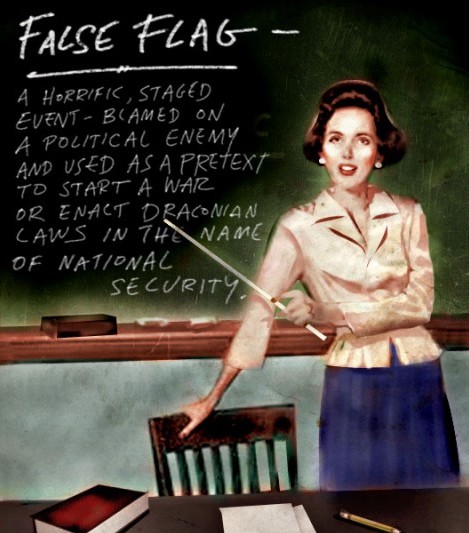
False Flag Terrorism Isn’t a “Theory” … It’s ADMITTED and Widespread

Source: Washington’s Blog

Presidents, Prime Ministers, Congressmen, Generals, Spooks, Soldiers and Police ADMIT to False Flag Terror

In the following instances, officials in the government which carried out the attack (or seriously proposed an attack) admit to it, either orally, in writing, or through photographs or videos:

(1) Japanese troops set off a small explosion on a train track in 1931, and falsely blamed it on China in order to justify an invasion of Manchuria. This is known as the “Mukden Incident” or the “Manchurian Incident”. The Tokyo International Military Tribunal found: “Several of the participators in the plan, including Hashimoto [a high-ranking Japanese army officer], have on various occasions admitted their part in the plot and have stated that the object of the ‘Incident’ was to afford an excuse for the occupation of Manchuria by the Kwantung Army ….” And see this, this and this.

(2) A major with the Nazi SS admitted at the Nuremberg trials that – under orders from the chief of the Gestapo – he and some other Nazi operatives faked several attacks on their own people and resources which they blamed on the Poles, to justify the invasion of Poland.    The staged attacks included:

  • The German radio station Sender Gleiwitz [details below]
  • The strategic railway at POSunka Pass (Jabłonków Incident), located on the border between Poland and Czechoslovakia
  • The German customs station at Hochlinden (today part of Rybnik-Stodoły)
  • The forest service station in Pitschen (Byczyna)
  • The communications station at Neubersteich (“Nieborowitzer Hammer” before 12 February 1936, now Kuznia Nieborowska)
  • The railroad station in Alt-Eiche (Smolniki), Rosenberg in Westpreußen district
  • A woman and her companion in Katowice

The details of the Gleiwitz radio station incident include:

On the night of 31 August 1939, a small group of German operatives dressed in Polish uniforms and led by Naujocks seized the Gleiwitz station and broadcast a short anti-German message in Polish (sources vary on the content of the message). The Germans’ goal was to make the attack and the broadcast look like the work of anti-German Polish saboteurs.

To make the attack seem more convincing, the Germans used human corpses to pass them off as Polish attackers. They murdered Franciszek Honiok, a 43-year-old unmarried German Silesian Catholic farmer known for sympathizing with the Poles. He had been arrested the previous day by the Gestapo. He was dressed to look like a saboteur, then killed by lethal injection, given gunshot wounds, and left dead at the scene so that he appeared to have been killed while attacking the station. His corpse was subsequently presented to the police and press as proof of the attack.

(3) The minutes of the high command of the Italian government – subsequently approved by Mussolini himself – admitted that violence on the Greek-Albanian border was carried out by Italians and falsely blamed on the Greeks, as an excuse for Italy’s 1940 invasion of Greece.

(4) Nazi general Franz Halder also testified at the Nuremberg trials that Nazi leader Hermann Goering admitted to setting fire to the German parliament building in 1933, and then falsely blaming the communists for the arson.

(5) Soviet leader Nikita Khrushchev admitted in writing that the Soviet Union’s Red Army shelled the Russian village of Mainila in 1939 – while blaming the attack on Finland – as a basis for launching the “Winter War” against Finland. Russian president Boris Yeltsin agreed that Russia had been the aggressor in the Winter War.

(6) The Russian Parliament, current Russian president Putin and former Soviet leader Gorbachev all admit that Soviet leader Joseph Stalin ordered his secret police to execute 22,000 Polish army officers and civilians in 1940, and then falsely blamed it on the Nazis.

(7) The British government admits that – between 1946 and 1948 – it bombed 5 ships carrying Jews who were Holocaust survivors attempting to flee to safety in Palestine right after World War II, set up a fake group called “Defenders of Arab Palestine”, and then had the psuedo-group falsely claim responsibility for the bombings (and see thisthis and this).

(8) Israel admits that in 1954, an Israeli terrorist cell operating in Egypt planted bombs in several buildings, including U.S. diplomatic facilities, then left behind “evidence” implicating the Arabs as the culprits (one of the bombs detonated prematurely, allowing the Egyptians to identify the bombers, and several of the Israelis later confessed) (and see this and this).

The U.S. Army does not believe this is an isolated incident. For example, the U.S. Army’s School of Advanced Military Studies said of Mossad (Israel’s intelligence service):

“Ruthless and cunning. Has capability to target U.S. forces and make it look like a Palestinian/Arab act.”

(9) The CIA admits that it hired Iranians in the 1950′s to pose as Communists and stage bombings in Iran in order to turn the country against its democratically-elected prime minister.

(10) The Turkish Prime Minister admitted that the Turkish government carried out the 1955 bombing on a Turkish consulate in Greece – also damaging the nearby birthplace of the founder of modern Turkey – and blamed it on Greece, for the purpose of inciting and justifying anti-Greek violence.

(11) The British Prime Minister admitted to his defense secretary that he and American president Dwight Eisenhower approved a plan in 1957 to carry out attacks in Syria and blame it on the Syrian government as a way to effect regime change.

(12) The former Italian Prime Minister, an Italian judge, and the former head of Italian counterintelligence admit that NATO, with the help of the Pentagon and CIA, carried out terror bombings in Italy and other European countries in the 1950s through the 1980s and blamed the communists, in order to rally people’s support for their governments in Europe in their fight against communism.

As one participant in this formerly-secret program stated: “You had to attack civilians, people, women, children, innocent people, unknown people far removed from any political game. The reason was quite simple. They were supposed to force these people, the Italian public, to turn to the state to ask for greater security” … so that “a state of emergency could be declared, so people would willingly trade part of their freedom for the security” (and see this) (Italy and other European countries subject to the terror campaign had joined NATO before the bombings occurred). And watch this BBC special. They also allegedly carried out terror attacks in France, Belgium, Denmark, Germany, Greece, the Netherlands, Norway, Portugal, the UK, and other countries.

The CIA also stressed to the head of the Italian program that Italy needed to use the program to control internal uprisings.

False flag attacks carried out pursuant to this program include – by way of example only:

(13) In 1960, American Senator George Smathers suggested that the U.S. launch “a false attack made on Guantanamo Bay which would give us the excuse of actually fomenting a fight which would then give us the excuse to go in and [overthrow Castro]”.

(14) Official State Department documents show that, in 1961, the head of the Joint Chiefs and other high-level officials discussed blowing up a consulate in the Dominican Republic in order to justify an invasion of that country. The plans were not carried out, but they were all discussed as serious proposals.

(15) As admitted by the U.S. government, recently declassified documents show that in 1962, the American Joint Chiefs of Staff signed off on a plan to blow up AMERICAN airplanes (using an elaborate plan involving the switching of airplanes), and also to commit terrorist acts on American soil, and then to blame it on the Cubans in order to justify an invasion of Cuba. See the following ABC news reportthe official documents; and watch this interview with the former Washington Investigative Producer for ABC’s World News Tonight with Peter Jennings.

(16) In 1963, the U.S. Department of Defense wrote a paper promoting attacks on nations within the Organization of American States – such as Trinidad-Tobago or Jamaica – and then falsely blaming them on Cuba.

(17) The U.S. Department of Defense also suggested covertly paying a person in the Castro government to attack the United States: “The only area remaining for consideration then would be to bribe one of Castro’s subordinate commanders to initiate an attack on Guantanamo.”

(18) A U.S. Congressional committee admitted that – as part of its “Cointelpro” campaign – the FBI had used many provocateurs in the 1950s through 1970s to carry out violent acts and falsely blame them on political activists.

(19) A top Turkish general admitted that Turkish forces burned down a mosque on Cyprus in the 1970s and blamed it on their enemy. He explained: “In Special War, certain acts of sabotage are staged and blamed on the enemy to increase public resistance. We did this on Cyprus; we even burnt down a mosque.” In response to the surprised correspondent’s incredulous look the general said, “I am giving an example”.

(20) A declassified 1973 CIA document reveals a program to train foreign police and troops on how to make booby traps, pretending that they were training them on how to investigate terrorist acts:

The Agency maintains liaison in varying degrees with foreign police/security organizations through its field stations ….

[CIA provides training sessions as follows:]

a. Providing trainees with basic knowledge in the uses of commercial and military demolitions and incendiaries as they may be applied in terrorism and industrial sabotage operations.

b. Introducing the trainees to commercially available materials and home laboratory techniques, likely to he used in the manufacture of explosives and incendiaries by terrorists or saboteurs.

c. Familiarizing the trainees with the concept of target analysis and operational planning that a saboteur or terrorist must employ.

d. Introducing the trainees to booby trapping devices and techniques giving practical experience with both manufactured and improvised devices through actual fabrication.

***

The program provides the trainees with ample opportunity to develop basic familiarity and use proficiently through handling, preparing and applying the various explosive charges, incendiary agents, terrorist devices and sabotage techniques.

(21) The German government admitted (and see this) that, in 1978, the German secret service detonated a bomb in the outer wall of a prison and planted “escape tools” on a prisoner – a member of the Red Army Faction – which the secret service wished to frame the bombing on.

(22) A Mossad agent admits that, in 1984, Mossad planted a radio transmitter in Gaddaffi’s compound in Tripoli, Libya which broadcast fake terrorist transmissions recorded by Mossad, in order to frame Gaddaffi as a terrorist supporter. Ronald Reagan bombed Libya immediately thereafter.

(23) The South African Truth and Reconciliation Council found that, in 1989, the Civil Cooperation Bureau (a covert branch of the South African Defense Force) approached an explosives expert and asked him “to participate in an operation aimed at discrediting the ANC [the African National Congress] by bombing the police vehicle of the investigating officer into the murder incident”, thus framing the ANC for the bombing.

(24) An Algerian diplomat and several officers in the Algerian army admit that, in the 1990s, the Algerian army frequently massacred Algerian civilians and then blamed Islamic militants for the killings (and see this video; and Agence France-Presse, 9/27/2002, French Court Dismisses Algerian Defamation Suit Against Author).

(25) In 1993, a bomb in Northern Ireland killed 9 civilians. Official documents from the Royal Ulster Constabulary (i.e. the British government) show that the mastermind of the bombing was a British agent, and that the bombing was designed to inflame sectarian tensions. And see this and this.

(26) The United States Army’s 1994 publication Special Forces Foreign Internal Defense Tactics Techniques and Procedures for Special Forces – updated in 2004 – recommends employing terrorists and using false flag operations to destabilize leftist regimes in Latin America. False flag terrorist attacks were carried out in Latin America and other regions as part of the CIA’s “Dirty Wars“. And see this.

(27) Similarly, a CIA “psychological operations” manual prepared by a CIA contractor for the Nicaraguan Contra rebels noted the value of assassinating someone on your own side to create a “martyr” for the cause. The manual was authenticated by the U.S. government. The manual received so much publicity from Associated Press, Washington Post and other news coverage that – during the 1984 presidential debate – President Reagan was confronted with the following question on national television:

At this moment, we are confronted with the extraordinary story of a CIA guerrilla manual for the anti-Sandinista contras whom we are backing, which advocates not only assassinations of Sandinistas but the hiring of criminals to assassinate the guerrillas we are supporting in order to create martyrs.

(28) A Rwandan government inquiry admitted that the 1994 shootdown and murder of the Rwandan president, who was from the Hutu tribe – a murder blamed by the Hutus on the rival Tutsi tribe, and which led to the massacre of more than 800,000 Tutsis by Hutus – was committed by Hutu soldiers and falsely blamed on the Tutis.

(29) An Indonesian government fact-finding team investigated violent riots which occurred in 1998, and determined that “elements of the military had been involved in the riots, some of which were deliberately provoked”.

(30) Senior Russian Senior military and intelligence officers admit that the KGB blew up Russian apartment buildings in 1999 and falsely blamed it on Chechens, in order to justify an invasion of Chechnya (and see this report and this discussion).

(31) As reported by the New York TimesBBC and Associated Press, Macedonian officials admit that in 2001, the government murdered 7 innocent immigrants in cold blood and pretended that they were Al Qaeda soldiers attempting to assassinate Macedonian police, in order to join the “war on terror”. They lured foreign migrants into the country, executed them in a staged gun battle, and then claimed they were a unit backed by Al Qaeda intent on attacking Western embassies”. Specifically, Macedonian authorities had lured the immigrants into the country, and then – after killing them – posed the victims with planted evidence – “bags of uniforms and semiautomatic weapons at their side” – to show Western diplomats.

(32) At the July 2001 G8 Summit in Genoa, Italy, black-clad thugs were videotaped getting out of police cars, and were seen by an Italian MP carrying “iron bars inside the police station”. Subsequently, senior police officials in Genoa subsequently admitted that police planted two Molotov cocktails and faked the stabbing of a police officer at the G8 Summit, in order to justify a violent crackdown against protesters.

(33) The U.S. falsely blamed Iraq for playing a role in the 9/11 attacks – as shown by a memo from the defense secretary – as one of the main justifications for launching the Iraq war.

Even after the 9/11 Commission admitted that there was no connection, Dick Cheney said that the evidence is “overwhelming” that al Qaeda had a relationship with Saddam Hussein’s regime, that Cheney “probably” had information unavailable to the Commission, and that the media was not ‘doing their homework’ in reporting such ties. Top U.S. government officials now admit that the Iraq war was really launched for oil … not 9/11 or weapons of mass destruction.

Despite previous “lone wolf” claims, many U.S. government officials now say that 9/11 was state-sponsored terror; but Iraq was not the state which backed the hijackers. (Many U.S. officials have allegedthat 9/11 was a false flag operation by rogue elements of the U.S. government; but such a claim is beyond the scope of this discussion. The key point is that the U.S. falsely blamed it on Iraq, when it knew Iraq had nothing to do with it.). 

(Additionally, the same judge who has shielded the Saudis for any liability for funding 9/11 has awarded a default judgment against Iran for $10.5 billion for carrying out 9/11 … even though no one seriously believes that Iran had any part in 9/11.)

(34) Although the FBI now admits that the 2001 anthrax attacks were carried out by one or more U.S. government scientists, a senior FBI official says that the FBI was actually told to blame the Anthrax attacks on Al Qaeda by White House officials (remember what the anthrax letters looked like). Government officials also confirm that the white House tried to link the anthrax to Iraq as a justification for regime change in that country. And see this.

(35) According to the Washington Post, Indonesian police admit that the Indonesian military killed American teachers in Papua in 2002 and blamed the murders on a Papuan separatist group in order to get that group listed as a terrorist organization.

(36) The well-respected former Indonesian president also admits that the government probably had a role in the Bali bombings.

(37) Police outside of a 2003 European Union summit in Greece were filmed planting Molotov cocktails on a peaceful protester.

(38) In 2003, the U.S. Secretary of Defense admitted that interrogators were authorized to use the following method: “False Flag: Convincing the detainee that individuals from a country other than the United States are interrogating him.” While not a traditional false flag attack, this deception could lead to former detainees – many of whom were tortured – attacking the country falsely blamed for the interrogation and torture.

(39) Former Department of Justice lawyer John Yoo suggested in 2005 that the US should go on the offensive against al-Qaeda, having “our intelligence agencies create a false terrorist organization. It could have its own websites, recruitment centers, training camps, and fundraising operations. It could launch fake terrorist operations and claim credit for real terrorist strikes, helping to sow confusion within al-Qaeda’s ranks, causing operatives to doubt others’ identities and to question the validity of communications.”

(40) Similarly, in 2005, Professor John Arquilla of the Naval Postgraduate School – a renowned US defense analyst credited with developing the concept of ‘netwar’ – called for western intelligence services to create new “pseudo gang” terrorist groups, as a way of undermining “real” terror networks. According to Pulitzer-Prize winning journalist Seymour Hersh, Arquilla’s ‘pseudo-gang’ strategy was, Hersh reported, already being implemented by the Pentagon:

“Under Rumsfeld’s new approach, I was told, US military operatives would be permitted to pose abroad as corrupt foreign businessmen seeking to buy contraband items that could be used in nuclear-weapons systems. In some cases, according to the Pentagon advisers, local citizens could be recruited and asked to join up with guerrillas or terrorists

The new rules will enable the Special Forces community to set up what it calls ‘action teams’ in the target countries overseas which can be used to find and eliminate terrorist organizations. ‘Do you remember the right-wing execution squads in El Salvador?’ the former high-level intelligence official asked me, referring to the military-led gangs that committed atrocities in the early nineteen-eighties. ‘We founded them and we financed them,’ he said. ‘The objective now is to recruit locals in any area we want. And we aren’t going to tell Congress about it.’ A former military officer, who has knowledge of the Pentagon’s commando capabilities, said, ‘We’re going to be riding with the bad boys.’”

(41) United Press International reported in June 2005:

U.S. intelligence officers are reporting that some of the insurgents in Iraq are using recent-model Beretta 92 pistols, but the pistols seem to have had their serial numbers erased. The numbers do not appear to have been physically removed; the pistols seem to have come off a production line without any serial numbers. Analysts suggest the lack of serial numbers indicates that the weapons were intended for intelligence operations or terrorist cells with substantial government backing. Analysts speculate that these guns are probably from either Mossad or the CIA. Analysts speculate that agent provocateurs may be using the untraceable weapons even as U.S. authorities use insurgent attacks against civilians as evidence of the illegitimacy of the resistance.

(42) In 2005, British soldiers dressed as Arabs were caught by Iraqi police after a shootout against the police. The soldiers apparently possessed explosives, and were accused of attempting to set off bombs. While none of the soldiers admitted that they were carrying out attacks, British soldiers and a column of British tanks stormed the jail they were held in, broke down a wall of the jail, and busted them out. The extreme measures used to free the soldiers – rather than have them face questions and potentially stand trial – could be considered an admission.

(43) Undercover Israeli soldiers admitted in 2005 to throwing stones at other Israeli soldiers so they could blame it on Palestinians, as an excuse to crack down on peaceful protests by the Palestinians.

(44) Quebec police admitted that, in 2007, thugs carrying rocks to a peaceful protest were actually undercover Quebec police officers (and see this).

(45) A 2008 US Army special operations field manual recommends that the U.S. military use surrogate non-state groups such as “paramilitary forces, individuals, businesses, foreign political organizations, resistant or insurgent organizations, expatriates, transnational terrorism adversaries, disillusioned transnational terrorism members, black marketers, and other social or political ‘undesirables.’” The manual specifically acknowledged that U.S. special operations can involve both counterterrorism and “Terrorism” (as well as “transnational criminal activities, including narco-trafficking, illicit arms-dealing, and illegal financial transactions.”)

(46) The former Italian Prime Minister, President, and head of Secret Services (Francesco Cossiga) advised the 2008 minister in charge of the police, on how to deal with protests from teachers and students:

He should do what I did when I was Minister of the Interior … infiltrate the movement with agents provocateurs inclined to do anything …. And after that, with the strength of the gained population consent, … beat them for blood and beat for blood also those teachers that incite them. Especially the teachers. Not the elderly, of course, but the girl teachers yes.

(47) An undercover officer admitted that he infiltrated environmental, leftwing and anti-fascist groups in 22 countries. Germany’s federal police chief admitted that – while the undercover officer worked for the German police – he acted illegally during a G8 protest in Germany in 2007 and committed arson by setting fire during a subsequent demonstration in Berlin. The undercover officer spent many years living with violent “Black Bloc” anarchists.

(48) Denver police admitted that uniformed officers deployed in 2008 to an area where alleged “anarchists” had planned to wreak havoc outside the Democratic National Convention ended up getting into a melee with two undercover policemen. The uniformed officers didn’t know the undercover officers were cops.

(49) At the G20 protests in London in 2009, a British member of parliament saw plain clothes police officers attempting to incite the crowd to violence.

(50) The oversight agency for the Royal Canadian Mounted Police admitted that – at the G20 protests in Toronto in 2010 – undercover police officers were arrested with a group of protesters. Videos and photos (see this and this, for example) show that violent protesters wore very similar boots and other gear as the police, and carried police batons. The Globe and Mail reports that the undercover officers planned the targets for violent attack, and the police failed to stop the attacks.

(51) Egyptian politicians admitted (and see this) that government employees looted priceless museum artifacts 2011 to try to discredit the protesters.

(52) Austin police admit that 3 officers infiltrated the Occupy protests in that city. Prosecutors admit that one of the undercover officers purchased and constructed illegal “lock boxes” which ended up getting many protesters arrested.

(53) In 2011, a Colombian colonel admitted that he and his soldiers had lured 57 innocent civilians and killed them – after dressing many of them in uniforms – as part of a scheme to claim that Columbia was eradicating left-wing terrorists. And see this.

(54) Rioters who discredited the peaceful protests against the swearing in of the Mexican president in 2012 admitted that they were paid 300 pesos each to destroy everything in their path. According to Wikipedia, photos also show the vandals waiting in groups behind police lines prior to the violence.

(55) On November 20, 2014, Mexican agent provocateurs were transported by army vehicles to participate in the 2014 Iguala mass kidnapping protests, as was shown by videos and pictures distributed via social networks.

(56) The highly-respected writer for the Telegraph Ambrose Evans-Pritchard says that the head of Saudi intelligence – Prince Bandar – recently admitted that the Saudi government controls “Chechen” terrorists.

(57) Two members of the Turkish parliamenthigh-level American sources and others admitted that the Turkish government – a NATO country – carried out the chemical weapons attacks in Syria and falsely blamed them on the Syrian government; and high-ranking Turkish government admitted on tape plans to carry out attacks and blame it on the Syrian government.

(58) The former Director of the NSA and other American government officials admit said that the U.S. is a huge supporter of terrorism. Jimmy Carter’s National Security Adviser Zbigniew Brzezinski admitted on CNN that the U.S. organized and supported Bin Laden and the other originators of “Al Qaeda” in the 1970s to fight the Soviets. The U.S. and its allies have been supporting Al Qaeda and other Islamic terrorist groups for many decades, and providing them arms, money and logistical support in LibyaSyriaMaliBosniaChechnyaIran, and many other countries. U.S. allies are also directly responsible for creating and supplying ISIS.

It’s gotten so ridiculous that a U.S. Senator has introduced a “Stop Arming Terrorists Act”, and U.S. Congresswoman – who introduced a similar bill in the House – says: “For years, the U.S. government has been supporting armed militant groups working directly with and often under the command of terrorist groups like ISIS and al-Qaeda in their fight to overthrow the Syrian government.”

(59) The Ukrainian security chief admits that the sniper attacks which started the Ukrainian coup were carried out in order to frame others. Ukrainian officials admit that the Ukrainian snipers fired on both sides, to create maximum chaos.

(60) Speaking of snipers, in a secret recording, Venezuelan generals admit that they will deploy snipers to shoot protesters, but keep the marksmen well-hidden from demonstrator and the reporters covering the events so others would be blamed for the deaths.

(61) Burmese government officials admitted that Burma (renamed Myanmar) used false flag attacks against Muslim and Buddhist groups within the country to stir up hatred between the two groups, to prevent democracy from spreading.

(62) Israeli police were again filmed in 2015 dressing up as Arabs and throwing stones, then turning over Palestinian protesters to Israeli soldiers.

(63) Britain’s spy agency has admitted (and see this) that it carries out “digital false flag” attacks on targets, framing people by writing offensive or unlawful material … and blaming it on the target.

(64) The CIA has admitted that it uses viruses and malware from Russia and other countries to carry out cyberattacks and blame other countries.

(65) U.S. soldiers have admitted that if they kill innocent Iraqis and Afghanis, they then “drop” automatic weapons near their body so they can pretend they were militants.

(66) Similarly, police frame innocent people for crimes they didn’t commit. The practice is so well-known that the New York Times noted in 1981:

In police jargon, a throwdown is a weapon planted on a victim.

Newsweek reported in 1999:

Perez, himself a former [Los Angeles Police Department] cop, was caught stealing eight pounds of cocaine from police evidence lockers. After pleading guilty in September, he bargained for a lighter sentence by telling an appalling story of attempted murder and a “throwdown”–police slang for a weapon planted by cops to make a shooting legally justifiable. Perez said he and his partner, Officer Nino Durden, shot an unarmed 18th Street Gang member named Javier Ovando, then planted a semiautomatic rifle on the unconscious suspect and claimed that Ovando had tried to shoot themduring a stakeout.

Wikipedia notes:

As part of his plea bargain, Pérez implicated scores of officers from the Rampart Division’s anti-gang unit, describing routinely beating gang members, planting evidence on suspects, falsifying reports and covering up unprovoked shootings.

(As a side note – and while not technically false flag attacks – police have been busted framing innocent people in many other ways, as well.)

(67) A former U.S. intelligence officer recently alleged:

Most terrorists are false flag terrorists or are created by our own security services.

(68) The head and special agent in charge of the FBI’s Los Angeles office said that most terror attacks are committed by the CIA and FBI as false flags.

(69) The Director of Analytics at the interagency Global Engagement Center housed at the U.S. Department of State, also an adjunct professor at George Mason University, where he teaches the graduate course National Security Challenges in the Department of Information Sciences and Technology, a former branch chief in the CIA’s Counterterrorism Center, and an intelligence advisor to the Secretary of Homeland Security (J.D. Maddox) notes:

Provocation is one of the most basic, but confounding, aspects of warfare. Despite its sometimes obvious use, it has succeeded consistently against audiences around the world, for millennia, to compel war. A well-constructed provocation narrative mutes even the most vocal opposition.

***

The culmination of a strategic provocation operation invariably reflects a narrative of victimhood: we are the 
victims of the enemy’s unforgivable atrocities.

***

In the case of strategic provocation the deaths of an aggressor’s own personnel are a core tactic of the provocation.

***

The persistent use of strategic provocation over centuries – and its apparent importance to war planners – begs the question of its likely use by the US and other states in the near term.

(70) Leaders throughout history have acknowledged the “benefits” of of false flags to justify their political agenda:

Terrorism is the best political weapon for nothing drives people harder than a fear of sudden death”.
– Adolph Hitler

“Why of course the people don’t want war … But after all it is the leaders of the country who determine the policy, and it is always a simple matter to drag the people along, whether it is a democracy, or a fascist dictatorship, or a parliament, or a communist dictatorship … Voice or no voice, the people can always be brought to the bidding of the leaders. That is easy. All you have to do is to tell them they are being attacked, and denounce the pacifists for lack of patriotism and exposing the country to danger. It works the same in any country.”
– Hermann Goering, Nazi leader.

“The easiest way to gain control of a population is to carry out acts of terror. [The public] will clamor for such laws if their personal security is threatened”.
– Josef Stalin

Postscript 1:  It is not just “modern” nations which have launched false flag attacks. For example, a Native American from one tribe (Pomunkey) murdered a white Englishwoman living in Virginia in 1697 and then falsely blamed it on second tribe (Piscataway). But he later admitted in court that he was not really Piscataway, and that he had been paid by a provocateur from a third tribe (Iroquois) to kill the woman as a way to start a war between the English and the Piscataway, thus protecting the profitable Iroquois monopoly in trade with the English.

Postscript 2:  On multiple occasions, atrocities or warmongering are falsely blamed on the enemy as a justification for war … when no such event ever occurred. This is more like a “fake flag” than a “false flag”, as no actual terrorism occurred.

For example:

  • The NSA admits that it lied about what really happened in the Gulf of Tonkin incident in 1964 … manipulating data to make it look like North Vietnamese boats fired on a U.S. ship so as to create a false justification for the Vietnam war
  • One of the central lies used to justify the 1991 Gulf War against Iraq after Iraq invaded Kuwait was the false statement by a young Kuwaiti girl that Iraqis murdered Kuwaiti babies in hospitals. Her statement was arranged by a Congressman who knew that she was actually the daughter of the Kuwaiti Ambassador to the U.S. – who was desperately trying to lobby the U.S. to enter the war – but the Congressman hid that fact from the public and from Congress
  • Pulitzer prize-winning journalist Ron Suskind reported that the White House ordered the CIA to forge and backdate a document falsely linking Iraq with Muslim terrorists and 9/11 … and that the CIA complied with those instructions and in fact created the forgery, which was then used to justify war against Iraq. And see this and this
  • Time magazine points out that the claim by President Bush that Iraq was attempting to buy “yellow cake” Uranium from Niger:

had been checked out — and debunked — by U.S. intelligence a year before the President repeated it.

  • The “humanitarian” wars in Syria, Libya and Yugoslavia were all justified by highly exaggerated reports that the leaders of those countries were committing atrocities against their people. And see this

Afterword: The corporate media will likely never report on false flags … as it is ALWAYS pro-war.

Conspiracy Theory

By Paul Craig Roberte

Source: PaulCraigRoberts.org

In the United States “conspiracy theory” is the name given to explanations that differ from those that serve the ruling oligarchy, the establishment or whatever we want to call those who set and control the agendas and the explanations that support the agendas.

The explanations imposed on us by the ruling class are themselves conspiracy theories. Moreover, they are conspiracy theories designed to hide the real conspiracy that our rulers are operating.

For example, the official explanation of 9/11 is a conspiracy theory. Some Muslims, mainly Saudi Arabians, delivered the greatest humiliation to a superpower since David slew Goliath. They outsmarted all 17 US intelligence agencies and those of NATO and Israel, the National Security Council, the Transportation Safety Administration, Air Traffic Control, and Dick Cheney, hijacked four US airliners on one morning, brought down three World Trade Center skyscrapers, destroyed that part of the Pentagon where research was underway into the missing $2.3 trillion, and caused the morons in Washington to blame Afghanistan instead of Saudi Arabia.

Clearly, the Saudia Arabians who humiliated Ameria were involved in a conspiracy to do so.

Is it a believable conspiracy?

The ability of a few young Muslim men to pull off such a feat is unbelievable. Such total failure of the US National Security State means that America was blindly vulnerable throughout the decades of Cold War with the Soviet Union. If such total failure of the National Security State had really occurred, the White House and Congress would have been screaming for an investigation. People would have been held accountable for the long chain of security failures that allowed the plot to succeed. Instead, no one was even reprimanded, and the White House resisted all efforts for an investigation for a year. Finally, to shut up the 9/11 families, a 9/11 Commission was convened. The commission duly wrote down the government’s story and that was the “investigation.”

Moreover, there is no evidence to support the official conspiracy theory of 9/11. Indeed, all known evidence contradicts the official conspiracy theory.

For example, it is a proven fact that Building 7 came down at freefall acceleration, which means it was wired for demolition. Why was it wired for demolition? There is no official answer to this question.

It is the known evidence provided by scientists, architects, engineers, pilots, and the first responders who were in the twin towers and personally experienced the numerous explosions that brought down the towers that is described as a conspiracy theory.

The CIA introduced the term “conspiracy theory” into public discourse as part of its action plan to discredit skeptics of the Warren Commission report on the assassination of President John F. Kennedy. Any explanation other than the one handed down, which is contradicted by all known evidence, was debunked as a conspiracy theory.

Conspiracy theories are the backbone of US foreign policy. For example, the George W. Bush regime was active in a conspiracy against Iraq and Saddam Hussein. The Bush regime created fake evidence of Iraqi “weapons of mass destruction,” sold the false story to a gullible world and used it to destroy Iraq and murder its leader. Similarly, Gaddafi was a victim of an Obama/Hillary conspiracy to destroy Libya and murder Gaddafi. Assad of Syria and Iran were slated for the same treatment until the Russians intervened.

Currently, Washington is engaged in conspiracies against Russia, China, and Venezuela. Proclaiming a non-existent “Iranian threat,” Washington put US missiles on Russia’s border and used the “North Korean threat” to put missiles on China’s border. The democratically elected leader of Venezuela is said by Washington to be a dictator, and sanctions have been put on Venezuela to help the small Spanish elite through whom Washington has traditionally ruled South American countries pull off a coup and reestablish US control over Venezuela.

Everyone is a threat: Venezuela, Yemen, Syria, Iran, Iraq, Afghanistan, tribes in Pakistan, Libya, Russia, China, North Korea, but never Washington. The greatest conspiracy theory of our time is that Americans are surrounded by foreign threats. We are not even safe from Venezuela.

The New York Times, the Washington Post, CNN, NPR, and the rest of the presstitutes are quick to debunk as conspiracy theories all explanations that differ from the explanations of the ruling interests that the presstitutes serve.

Yet, as I write and for some nine months to date, the presstitute media has itself been promoting the conspiracy theory that Donald Trump was involved in a conspiracy with the president of Russia and Russian intelligence services to hack the US presidential election and place Trump, a Russian agent, in the White House.

This conspiracy theory has no evidence whatsoever. It doesn’t need evidence, because it serves the interests of the military/security complex, the Democratic Party, the neoconservatives, and permits the presstitutes to show lavish devotion to their masters. By endless repetition a lie becomes truth.

There is a conspiracy, and it is against the American people. Their jobs have been offshored in order to enrich the already rich. They have been forced into debt in a futile effort to maintain their living standards. Their effort to stem their decline by electing a president who spoke for them is being subverted before their eyes by an utterly corrupt media and ruling class.

Sooner or later it will dawn on them that there is nothing they can do but violently revolt. Most likely, by the time they reach this conclusion it will be too late. Americans are very slow to escape from the false reality in which they live. Americans are a thoroughly brainwashed people who hold tightly to their false life within The Matrix.

For the gullible and naive who have been brainwashed into believing that any explanation that differs from the officially-blessed one is a conspiracy theory, there are available online long lists of government conspiracies that succeeded in deceiving the people in order that the governments could achieve agendas that the people would have rejected.

If liberty continues to exist on earth, it will not be in the Western world. It will be in Russia and China, countries that emerged out of the opposite and know the value of liberty, and it will be in those South American countries, such as Venezuela, Ecuador, and Bolivia that fight for their sovereignty against American oppression.

Indeed, as historians unconcerned with their careers are beginning to write, the primary lesson in history is that governments deceive their peoples.

Everywhere in the Western world, government is a conspiracy against the people.

American Jackboot Diplomacy

By Finian Cunningham

Source: Strategic Culture Foundation

The latest extraordinary roughshod violation of Russian diplomatic rights by the American authorities shows that the US doesn’t want to restore normal bilateral relations. Indeed, it has now resorted publicly to jackboot diplomacy.

The rapid ordering of Russia to vacate three of its diplomatic properties – in a matter of hours – amid reported threats from the American authorities that they would smash down entrance doors if the orders were not complied with, shows a reckless disregard for Russia’s sovereign rights. Not just Russia’s sovereign rights, but the rights of all nations, as far as America is concerned.

There were also reports that US secret service agents conducted inspections of the properties while Russian officials were deprived access to the building. Such conduct marks not only provocative contempt for Russian authorities, it also raises concerns that US agents were attempting to plant incriminating evidence which might be subsequently “uncovered” by the ongoing probes into alleged Russian interference in the American presidential election last year.

What’s more, the manhandling of Russian diplomatic rights came on the personal orders from President Donald Trump, according to press reports. Previously, Trump had stated his desire to restore normal bilateral relations with Russia. One has to conclude that the latest breach of Russian sovereignty is a blunt sign that American official policy is now fully aligned in an antagonistic agenda toward Moscow.

The collective American amnesia is astounding. The shuttering of the three Russian properties in San Francisco, New York and Washington was presented by the US State Department and US media as a “retaliation” for Russia’s expulsion of some 455 American diplomats in July.

Downplayed or omitted in the US media coverage was the fact that Russia expelled those diplomats in response to the Obama administration expropriating three Russian properties and ejecting 35 Russian diplomats back in December 2016. Russia had patiently waited seven months to see if the new Trump administration would do the decent thing and undo the Obama violations. The Trump administration not only did not undo the damage, it went further to impose new trade and political sanctions on Russia.

Thus, Russia had every right to reciprocate with its expulsions in July, which in any case brought the remaining 400 or so US diplomats down to the same number as Russian diplomats residing in the US. Moscow also gave the American side a month to vacate its premises. The Americans gave the Russians 12 hours.

Trump’s latest diplomatic infringement brings the total number of closed Russian properties to six, and marks a dramatic escalation in the dispute. Moscow has said it will respond appropriately.

Relations between the two nations are deteriorating rapidly beyond the already frayed level. But let’s be clear: it is the US side which is responsible for the downward spiral.

Obama’s unprecedented expulsions and expropriations were premised on lurid accusations that the Russian government ordered an interference campaign in the US presidential election. No evidence has yet been provided by the US intelligence agencies to support this sensational and nebulous claim. Yet we are in an extraordinary situation of tit-for-tat diplomatic blows based on unproven American allegations. This is a mockery of legal due process.

Russia has consistently dismissed those accusations, saying that they are motivated by anti-Russian prejudice and US political in-fighting and scapegoating. Ironically, Trump who has lambasted the “Russia collusion” claims as fake news put out by the pro-Democrat news media and intelligence community is now, in effect, jumping on the anti-Russia juggernaut with his latest order of diplomatic seizures. American folly knows no bounds.

The American amnesia is even more problematic. The sanctions against Russia began in 2014 over the Ukraine crisis. That crisis was instigated by American and European interference in the internal affairs of Ukraine and the eventual violent coup against an elected government in Kiev. The US-backed regime that seized power has been attacking the separatist ethnic Russian population of eastern Ukraine for the past three years. Meanwhile the people of Crimea voted in a referendum to join the Russian Federation instead of recognizing the Neo-Nazi Banderite Kiev regime. Yet it is Russia which is sanctioned by the US and its European allies for “destabilizing Ukraine.”

The US is showing itself with full inglorious nakedness to be a petulant bully that flaunts international law. In short, an utterly shameless rogue regime that is now completely out of control, and doesn’t even care what others think. The latest violation of Russian sovereignty epitomizes the general high-handed attitude of the Americans to international law and the sovereign rights of all nations.

Amazingly, US media made self-justifying speculative comments that the alleged burning of documents inside the Russian consulate in San Francisco was “evidence” of Russian subterfuge and espionage. It is every nation’s sovereign right under international law to be afforded privacy for its diplomats. Instead of insinuating Russian wrongdoing, the proper, more disturbing, perspective should be that America has so little respect for international law that other nations no longer trust the US to abide by diplomatic legal standards.

The violation of Russian rights is consistent with the US violation of Ukraine which is in turn consistent with American violation of Syria, Libya, Yemen, Pakistan, Venezuela, Somalia, Iraq and Afghanistan, to mention just a few other recent cases.

On North Korea, what gives the US the legal and moral authority to declare that diplomacy does not work, or that negotiations might only be permitted if stringent preconditions are met by Pyongyang? How is that the US arrogates the “right” to threaten war on North Korea (as well as Iran and Venezuela and others) while glibly ruling out the obligation to hold equal dialogue and comply with diplomatic protocols? This is the behavior and mindset of a tyrant. A fascist state.

The latest manhandling of Russian sovereign rights is a stark milestone in the degeneration of the United States. It is abandoning any pretense at civil diplomacy.

Jackboot diplomacy is the corollary of US wars of aggression, mass murder, mass torture, and the systematic destruction of international law. All with the narcissistic smile of smug self-righteousness.