Zika: Why Biotech is Imperative to National Security

5699114e78d099fc12248d9e_zika-virus-cr-getty_cntraveller-com-770x470

By Ulson Gunnar

Source: New Eastern Outlook

When we think of national security, we think of tanks, jets, missile defense systems and more recently, information space. But what about the realm of the microscopic, the biological or the genetic?

Whether you think biotechnology, genetics and microbes constitute another plane upon the modern battlefield or not is irrelevant. Someone else already does, and they have a head start on the rest of the world.

Genotype Specific Bioweapons

The Project for a New American Century or PNAC for short, penned a particularly unhinged policy paper in 2000 titled, “Rebuilding America’s Defenses: Strategy, Forces and Resources For a New Century.”

In it, among many other things, it specifically writes:

Although it may take several decades for the process of transformation to unfold, in time, the art of warfare on air, land, and sea will be vastly different than it is today, and “combat” likely will take place in new dimensions: in space, “cyber-space,” and perhaps the world of microbes.

…advanced forms of biological warfare that can “target” specific genotypes may transform biological warfare from the realm of terror to a politically useful tool.

Advanced forms of biological warfare that can “target” specific genotypes sound like the stuff of science fiction, and even if it were developed, it would be by the “bad guys,” right?

Wrong. As a matter of fact, the Western-backed apartheid government in South Africa in the 1980’s under Project Coast, attempted to create genotype specific bioweapons aimed at sterilizing the nation’s black women. PBS Frontline’s article, “What Happened in South Africa?” would recount:

In 1998 South Africa’s Truth and Reconciliation Commission held hearings investigating activities of the apartheid-era government. Toward the end of the hearings, the Commission looked into the apartheid regime’s Chemical and Biological Warfare (CBW) program and allegations that it developed a sterility vaccine to use on black South Africans, employed toxic and chemical poison weapons for political asssassination, and in the late 1970s provided anthrax and cholera to Rhodesian troops for use against guerrilla rebels in their war to overthrow Rhodesia’s white minority rule.

While South Africa’s entire CBW program was abhorrent, what is particularly frightening is the use of South Africa’s national vaccination program as a vector for infecting black women with viruses meant to sterilize them. Now that vaccination programs are being pushed globally, there lies the danger that such weapons could be used against entire regions of the planet.

PBS would elaborate further on the CBW program, stating that the South African government:

Developed lethal chemical and biological weapons that targeted ANC [African National Congress] political leaders and their supporters as well as populations living in the black townships. These weapons included an infertility toxin to secretly sterilize the black population; skin-absorbing poisons that could be applied to the clothing of targets; and poison concealed in products such as chocolates and cigarettes.   

PNAC’s dream of genotype specific bioweapons then, is not some far-off science fiction future, it is something that has been pursued in earnest for decades, and apparently by interests aligned to the West, not enemies of it.

Zika and GM Mosquitoes 

Though it is so far impossible to confirm a link between the two, it is troubling nonetheless to see the mosquito-transmitted Zika virus spreading in Brazil precisely from where GM (genetically modified) mosquitoes were released several years ago.

A 2012 entry in Nature titled, “Brazil tests GM mosquitoes to fight Dengue,” would report:

Scientists in Brazil say an experiment to reduce populations of the dengue-carrying Aedes aegyptimosquito, by releasing millions of genetically modified (GM) insects into the wild, is working.

More than ten million modified male mosquitoes were released in the city of Juazeiro, a city of 288,000 people, over a period of time starting a year ago.

The US CDC (Center for Disease Control) would report that Zika virus cases in northeast Brazil were first officially recognized in early 2015, with international hysteria finally reached early this year. The cases seem most concentrated in the Brazilian state of Pernambuco, upon the borders of which the city of Juazeiro lies.

What could have happened between 2011 and 2016 that might have led to this development? Could the GM mosquitoes designed to stamp out dengue have mutated in some unpredictable way? And could this experiment have caused the Zika virus itself to mutate in an unpredictable way? It already has mutated once, allowing it to spread among humans more prolifically.

Or what if GM mosquitoes supposedly meant to wipe out dengue were serving as a vector for something else entirely? We can only imagine the sort of stories, excuses and feigned ignorance the South African government would have conjured had its genotype specific bioweapons worked, and black women began turning up sterilized in huge numbers after receiving their “vaccines.”

Mosquitoes as a Vaccine Vector 

Using mosquitoes as a vector to deliver engineered genetic material to humans as a sort of involuntary, inescapable “vaccine” is already a reality. The London Telegraph in its article, “Genetically modified mosquitos could be used to spread vaccine for malaria,” reported in 2010 that:

Experts believe “flying vaccinators” could eventually be a radical new way of tackling malaria.

The new approach targets the salivary gland of the Anopheles mosquito.

Scientists in Japan have engineered an insect producing a natural vaccine protein in its saliva which is injected into the bloodstream when it bites.

The “prototype” mosquito carries a vaccine against Leishmania, another potentially fatal parasite disease spread by sand flies.

And if mosquitoes can naturally deliver viruses, and scientists can alter what mosquitoes carry and infect hosts with, it is possible to engineer viruses to deliver virtually anything into targeted populations much in the same way viruses are re-engineered into vectors in labs today through a process called gene therapy. In the wrong hands, this technology and these techniques could become terrifying weapons.

For those in the middle of the Zika virus hysteria, perhaps it already has.

How Could They? Why Would They?

To answer “how could they possibly do something so diabolical?” we need only think back to 2003 and recall how the United States intentionally lied to the world, then between its initial invasion and subsequent occupation of Iraq, killed upward to a million people. This includes several thousand of its own soldiers and civilians, many of whom it appears were killed by militants armed and funneled into the country by the United States’ closest regional allies, with the US’ resolute backing.

To answer “why” American and European special interests seek to render any particular population sick, weak and they and/or their offspring incapable of  perpetuating a viable civilization, PNAC itself sums it up quite clearly:

The United States is the world’s only superpower, combining preeminent military power, global technological leadership, and the world’s largest economy. Moreover, America stands at the head of a system of alliances which includes the world’s other leading democratic powers. At present the United States faces no global rival. America’s grand strategy should aim to preserve and extend this advantageous position as far into the future as possible.

A population racked with birth defects, diminishing health and IQs and a lack of physical vitality constitutes the enemy every hegemon throughout history has dreamt of facing both on the battlefield and upon the grand chessboard of geopolitics.

Whether the Zika outbreak is linked to some insidious biowarefare program, an experiment gone wrong or simply the forces of nature, it showcases the danger biology can pose and reminds us of what greater dangers may yet await us if we do not properly prepare and protect ourselves.

Domestic Biotech is Imperative to National Defense 

It has been almost painful to watch the rest of the world attempt to catch up to the United States and Europe in the information war. For decades the West dominated information warfare without contest.

Only now have nations like Russia, China, Iran and others finally caught up and in some cases exceeded Western capabilities. Only now are nations finally investing seriously in information and cyber warfare capabilities. Only now does it seem that nations realize the folly of depending on others for both information, and information technology.

Russia recently decided to switch to local computer processor manufacturers to run on all computers used for official business. This is because foreign corporations making processors imported into the Russian Federation had been apparently compromised on the factory floor with the cooperation of these foreign corporations by US intelligence agencies.

We can easily imagine the danger of having US intelligence agencies getting into Russia’s IT infrastructure through these backdoor passes. It doesn’t take much imagination to think about the trouble US intelligence agencies could cause if they could get inside Russia’s human, natural and agricultural genomes.

Developing a viable domestic biotech industry is not only a matter of economic prosperity, but clearly also a matter of vital national security. Foreign corporations should no better be able to access a nation’s “genetic code and files” than it can its computer code and files. After all, genetic information is not entirely unlike digital information.
Brazil and other nations that have invited foreign biotech corporations to meddle with their human, natural and agricultural genomes are likened to those nations who hand their vital infrastructure over to foreign interests only to find out through Wikileaks years later the sort of invasive spying, abuses and other means of self-serving treachery this access has been exploited for.

Let’s not wait for Wikileaks to tell us 10 years from now just how bad the nations of the world had been infiltrated and exploited through biotechnology before we recognize this industry as absolutely vital to national security and begin investing in it domestically, rather than outsourcing it overseas.


Ulson Gunnar, a New York-based geopolitical analyst and writer especially for the online magazine “New Eastern Outlook”.

Related Video:


Mark Ruffalo: ‘Monsanto Chief is Horrible’

mark-ruffalo-the-hulk

By Mark Ruffalo

Source: EcoWatch

Monsanto chief is horrible … And I got to tell him that to his face after his interview on CBS This Morning.

Approaching someone like this isn’t really my thing. But being so well behaved all the time doesn’t seem to be helping people. It made me really uncomfortable to do it. But that’s how we change. We must become uncomfortable. We must act out of our comfort zones for things to change. We must call out the people who are doing horrible things when they do them.

Hugh Grant (Monsanto CEO not the actor) must be made to feel uncomfortable for what he allows his company to do in the world. That is why I told him what I did and why I am sharing it with you.

Before a segment I was doing for the movie Spotlight with Mike Rezendes on Dec. 2, I was waiting in the green room watching Grant worm his way through the strong questions he was getting from the CBS team. His handlers clearly have been working very hard with him to give him every slippery non-answer to every question he was asked. I was beside myself watching this guy who is responsible for so much misery and sickness throughout the world slime his way through his interview. I could not hold my tongue. He came through the Green Room door ready to do high fives with his press agent and I simply told him this:

“You are wrong. You are engaged in monopolizing food. You are poisoning people. You are killing small farms. You are killing bees. What you are doing is dead wrong.”

A bead of sweat broke out on his head. “Well, what I think we are doing is good,” Grant replied.

“I am sure you do,” I told him.

When people get paid the kind of money he gets paid their thinking becomes incredibly clouded and the first thing to go is their morality.

He says Monsanto needs to do a better job with their messaging.

Hugh, it’s not your messaging that makes you and your company horrible. It’s the horrible stuff you guys do that makes you and your company horrible. People don’t walk around making horrible stories up about good companies because they got nothing else better to do with their time. People like you and your company are horrible because … you are horrible. No matter how much jumping around you do on morning shows (where no one can really nail you down for the horrible stuff you do), you will still always be horrible and people will always greet you the way I did, when you go around trying to cover up the fact that you are horrible.

Want to know more about the real Monsanto and Hugh Grant? Watch this:

There is a lot more horrible stuff to look at here:

Monsanto’s greatest hit jobs.

In 2003, Monsanto settled a lawsuit for $700 million with 20,000 Anniston, Alabama residents who claimed that a Monsanto plant contaminated local rivers, lakes, soil and air with polychlorinated biphenyls (PCBs). Plaintiffs reported a range of health issues including cancer, birth defects and neurological disorders.

New York Times: $700 Million Settlement in Alabama PCB Lawsuit

CBS News: Toxic Secret: Alabama Town Never Warned of Contamination

In 2012, Monsanto settled a lawsuit with tens of thousands of plaintiffs in West Virginia for $93 million. Residents of Nitro, West Virginia claimed they had been poisoned by decades of contamination from cancer-causing chemicals used in the manufacturing of Agent Orange produced in a Monsanto plant.

The Guardian: Monsanto Settles ‘Agent Orange’ Case with US Victims

In March 2015, the International Agency for Research on Cancer (IARC), an arm of the World Health Organization, concluded in a study that glyphosate, the active ingredient in Monsanto’s widely used weedkilling product Roundup, was “probably carcinogenic to humans.”

Shortly after the IARC’s study was made public, France took steps to limit the sale of Roundup. France has also banned the cultivation of genetically modified crops.

Reuters: Frances Bolsters Ban on Genetically Modified Crops

Newsweek: Frances Bans Sale of Monsanto’s Roundup in Garden Centers After UN Names it Probable Carcinogen

In September 2015, a French appeals court in Lyon upheld a decision that held Monsanto liable for poisoning a French farmer. The grain farmer, Paul Francois, developed neurological damage after inhaling Monsanto’s weedkilling product Lasso.

Reuters: French Court Confirms Monsanto Liable in Chemical Poisoning Case

Le Monde: Monsanto Condamné pour L’Intoxicite d’un Agriculteur Francais

In September 2015, two U.S. farm workers filed suit against Monsanto claiming that exposure to Roundup caused them to develop cancer.

Reuters: U.S. Workers Sue Monsanto Claiming Herbicide Caused Cancer

You can find reports of Monsanto products being linked to cancer and other health issues all over the world, for example:

Argentina is the world’s third largest soy-producing country.

According to Mother Jones, nearly 100 percent of the soy crop is genetically altered and Monsanto’s Roundup is very widely used. As the use of pesticides and herbicides in Argentina has increased, cancer clusters have begun to develop around farming communities. A 2010 study at the University of Buenos Aires also found that injecting glyphosate (the active ingredient in Roundup) into chicken and frog embryos caused the same sort of spinal defects that doctors have found to be increasingly prevalent in communities where farm chemicals are used.

Mother Jones: Argentina is Using More Pesticides than Ever. And Now It Has Cancer Clusters

On Monsanto suing small farmers:

The Guardian: Monsanto Sued Small Farmers to Protect Seed Patents

Vanity Fair: Monsanto’s Harvest of Fear


Related Article: Global Citizens Tribunal to Put Monsanto on Trial at the International People’s Court in The Hague


Capture, Smear, Contaminate: The Politics Of GMOs

gmo_crops_genfood_735_350-400x190

By Colin Todhunter

Source: RINF

When rich companies with politically-connected lobbyists and seats on public bodies bend policies for their own ends, we are in serious trouble. It is then that public institutions become hijacked and our choices, freedoms and rights are destroyed. Corporate interests have too often used their dubious ‘science’, lobbyists, political connections and presence within the heart of governments to subvert institutions set up to supposedly protect the public interest for their own commercial benefit. Once their power has been established, anyone who questions them or who stands in their way can expect a very bumpy ride.

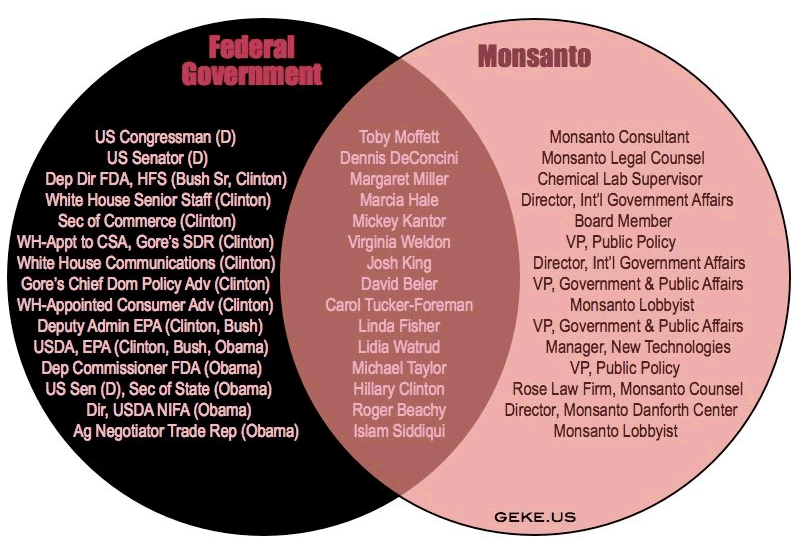
The revolving door between the private sector and government bodies has been well established. In the US, many senior figures from the Genetically Modified Organisms (GMOs) industry, especially Monsanto, have moved with ease to take up positions with the Food and Drug Administration and Evironmental Protection Agency and within the government. Writer and researcher William F Engdahl writes about a similar influence in Europe, noting the links between the GMO sector within the European Food Safety Authority. He states that over half of the scientists involved in the GMO panel which positively reviewed the Monsanto’s study for GMO maize in 2009, leading to its EU-wide authorisation, had links with the biotech industry.

“Monsanto should not have to vouchsafe the safety of biotech food. Our interest is in selling as much of it as possible. Assuring its safety is the FDA’s job” – Phil Angell, Monsanto’s director of corporate communications. “Playing God in the Garden” New York Times Magazine,October 25, 1998.

Phil Angell’s statement begs the question: then who should vouchsafe for it, especially when the public bodies have been severely comprised? Monsanto has all angles covered.

When corporate interests are able to gain access to such positions of power, little wonder they have some heavy-duty tools at their disposal to try to fend off criticism by all means necessary.

A well-worn tactic of the pro-GMO lobby is to slur and attack figures that have challenged the ‘science’ and claims of the industry. With threats of lawsuits and UK government pressure, some years ago top research scientist Dr Arpad Pusztai was effectively silenced over his research concerning the dangers of GM food. A campaign was set in motion to destroy his reputation. Professor Seralini and his team’s research was also met with intense industry pressure, with Monsanto effectively targeting the heart of science to secure its commercial interests. There are numerous examples of scientists being targeted like this. A WikiLeaks cable highlighted how GMOs were being forced into European nations by the US ambassador to France who plotted with other US officials to create a ‘retaliatory target list’ of anyone who tried to regulate GMOs. That clearly indicates the power of the industry.

What the GMO sector fails to grasp is that the onus is on it to prove that its products are safe. And it has patently failed to do this. No independent testing was done before Bush senior allowed GMOs onto the US market. The onus should not be on others to prove they are safe (or unsafe) after they are on the market, especially as public attorney Steven Druker‘s book ‘Altered Genes, Twisted Truth’ shows that GMOs are on the US market due to fraudulent practices and the bypassing of scientific evidence pointing to potential health hazards.

We therefore have the right to ask whether we should trust studies carried out by the sector itself that claims GM crops are safe? Let us turn to Tiruvadi Jagadisan for an answer.

He worked with Monsanto for nearly two decades, including eight years as the managing director of India operations. A few years ago, he stated that Monsanto “used to fake scientific data” submitted to government regulatory agencies to get commercial approvals for its products in India. The former Monsanto boss said government regulatory agencies with which the company used to deal with in the 1980s simply depended on data supplied by the company while giving approvals to herbicides. As reported in India Today, he is on record as saying that India’s Central Insecticide Board simply accepted foreign data supplied by Monsanto and did not even have a test tube to validate the data which at times was faked.

Now that scientists such as Professor Seralini are in a sense playing catch-up by testing previously independently untested GMOs, he is attacked. However, the attacks on Seralini and his study have been found to be based on little more than unscientific polemics and industry pressure. In fact, in new study, Seralini highlights the serious flaws of industry-backed studies that were apparently slanted to distort results. It remains to be seen whether he and his team are in for another bout of smears and attacks.

But this is symptomatic of the industry: it says a product is safe, therefore it is – regardless that science is being used as little more than an ideological smokescreen. We are expected to take its claims at face value. The revolving door between top figures at Monsanto and positions at the FDA makes it difficult to see where the line between lobbying and regulation is actually drawn. People are rightly suspicious of the links between the FDA and GMO industry in the US and the links between it and the regulatory body within the EU.

GM represents the so-called “Green Revolution’s” second coming. Agriculture has changed more over the last two generations than it did in the previous 12,000 years. Environmentalist Vandana Shiva notes that, after 1945, chemical manufacturers who had been involved in the weapons industry turned their attention to applying their chemical know-how to farming. As a result ‘dwarf seeds’ were purposively created to specifically respond to their chemicals. Agriculture became transformed into a chemical-dependent industry that has destroyed much biodiversity. What we are left with is crop monocultures, which negatively impact food security and nutrition. In effect, modern agriculture is part of the paradigm of control based on mass standardization and a dependency on corporate products.

The implications have been vast. Chemical-industrial agriculture has proved extremely lucrative for the oil and chemicals industry, courtesy of oil-rich Rockefeller interests which were instrumental in pushing for the green revolution throughout the world, and has served to maintain and promote Western hegemony, not least via ‘structural adjustment’ and the consequent uprooting of traditional farming practices in favour of single-crop export-oriented policies, dam building to cater for what became a highly water intensive industry, loans and indebtedness, boosting demand for the US dollar, etc.

Agriculture has been a major tool of US foreign policy since 1945 and has helped to secure its global hegemony. One must look no further than current events in Ukraine, where the strings attached to financial loans are resulting in the opening up of (GM) agriculture to Monsanto. From Africa to India and across Asia, the hijack of indigenous agriculture and food production by big corporations is a major political issue as farmers struggle for their rights to remain on the land, retain ownership of seeds, grow healthy food and protect their livelihoods.

Apart from tying poorer countries into an unequal system of global trade and reinforcing global inequalities, the corporate hijacking of food and agriculture has had many other implications, not least where health is concerned.

Dr Meryl Hammond, founder of the Campaign for Alternatives to Pesticides, told a Canadian parliament committee in 2009 that a raft of studies published in prestigious peer-reviewed journals point to strong associations between chemical pesticides and a vast range of serious life-threatening health consequences. Shiv Chopra, a top food advisor to the Canadian government, has documented how all kinds of food products that were known to be dangerous were passed by the regulatory authority and put on the market there due to the power of the food industry.

Severe anemia, permanent brain damage, Alzheimer’s, dementia, neurological disorders, reproductive problems, diminished intelligence, impaired immune system, behavioural disorders, cancers, hyperactivity and learning disability are just some of the diseases that numerous studies have linked to our food.

Of course, just like cigarettes and the tobacco industry before, trying to ‘prove’ the glaringly obvious link will take decades as deceit is passed off as ‘science’ or becomes institutionalized due to the hijacking of government bodies by the corporations involved in food production.

But anyone who questions the need for GMOs in the first place and the risks they bring and devastating impacts they have is painted as clueless and indulging in scare mongering and falsehoods, while standing in the way of human progress. But can we expect much better from an industry that has a record of smearing and attempting to ruin people who criticise it? Are those of us who question the political links of big agritech and the nature of its products ready to take lessons on ethics and high-minded notions of ‘human progress’ from anyone involved with it?

This is an industry that has contaminated crops and bullied farmers with lawsuits in North America, an industry whose companies have been charged with and most often found guilty of contaminating the environment and seriously damaging health with PCBs and dioxins, an industry complicit in concealing the deadly impact of GM corn on animals, an industry where bribery seems to be second nature (Monsanto in Indonesia), an industry associated with human rights violations in Brazil and an industry that will not label its foods in the US.

A great myth forwarded by the pro-GMO lobby is that governments are freely choosing to adopt GMOs. Any brief analysis of the politics of GM highlights that this is nonsense. Various pressures are applied and agritech companies have captured policy bodies and have a strategic hold over the WTO and trade deals like the TTIP.

For instance, take the 2005 US-India nuclear deal (allowing India to develop its nuclear sector despite it not being a signatory of the Non-Proliferation Treaty and allegedly pushed through with a cash for votes tactic in the Indian parliament). It was linked to the Knowledge Initiative on Agriculture, which was aimed at widening access to India’s agricultural and retail sectors. This initiative was drawn up with the full and direct participation of representatives from various companies, including Monsanto, Cargill and Walmart.

When the most powerful country comes knocking at your door seeking to gain access to your markets, there’s good chance that once its corporate-tipped jackboot is in, you won’t be able to get it out.

And it seems you can’t. So far, Bt cotton has been the only GM crop allowed in India, but the open field trials of many GM crops are now taking place around the country despite an overwhelming consensus of official reports warning against this. The work of numerous public bodies and research institutes is now compromised as a result of Monsanto’s strategic influence within India (see this and this).

If global victory cannot be achieved by the GMO biotech sector via the hijack of public bodies and trade deals or intimidation, then the politics of another form of contamination may eventually suffice:

“The hope of the industry is that over time the market is so flooded [with GMOs] that there’s nothing you can do about it. You just sort of surrender” – Don Westfall, biotech industry consultant and vice-president of Promar International, in the Toronto Star,January 9 2001.

Open field planting is but one way of achieving what Westfall states. Of course, there are numerous other ways too (see this).

As powerful agribusiness concerns seek to ‘consolidate the entire food chain’ with their seeds, patents and GMOs, it is clear that it’s not just the health of the nation (any nation) that is at stake but the global control of food and by implication nations.

“What you are seeing is not just a consolidation of seed companies, it’s really a consolidation of the entire food chain” – Robert Fraley, co-president of Monsanto’s agricultural sector 1996, in the Farm Journal. Quoted in: Flint J. (1998) Agricultural industry giants moving towards genetic monopolism. Telepolis, Heise.

Colin Todhunter is an independent writer: colintodhunter.com

Hawaii Sees 10 Fold Increase in Birth Defects After Becoming GM Corn Testing Ground

hawaiians_against_gmo_720_375

By Jay Syrmopoulos

Source: The Free Thought Project

Waimea, HI – Doctors are sounding the alarm after noticing a disturbing trend happening in Waimea, on the island of Kauai, Hawaii. Over the past five years, the number of severe heart malformations has risen to more than ten times the national rate, according to an analysis by local physicians.

Pediatrician Carla Nelson, after seeing four of these defects in three years, is extremely concerned with the severe health anomalies manifesting in the local population.

Nelson, as well as a number of other local doctors, find themselves at the center of a growing controversy about whether the substantial increase in severe illness and birth defects in Waimea stem from the main cash crop on four of the six islands, genetically modified corn, which has been altered to resist pesticide.

Hawaii has historically been used as a testing ground for almost all GMO corn grown in the United States. Over 90% of GMO corn grown in the mainland U.S. was first developed in Hawaii, with the island of Kauai having the largest area used.

According to a report in The Guardian:

In Kauai, chemical companies Dow, BASF, Syngenta and DuPont spray 17 times more pesticide per acre (mostly herbicides, along with insecticides and fungicides) than on ordinary cornfields in the US mainland, according to the most detailed study of the sector, by the Center for Food Safety.

That’s because they are precisely testing the strain’s resistance to herbicides that kill other plants. About a fourth of the total are called Restricted Use Pesticides because of their harmfulness. Just in Kauai, 18 tons – mostly atrazine, paraquat (both banned in Europe) and chlorpyrifos – were applied in 2012. The World Health Organization this year announced that glyphosate, sold as Roundup, the most common of the non-restricted herbicides, is “probably carcinogenic in humans”.

Waimea is a small town that lies directly downhill from the 12,000 acres of GMO test fields leased mainly from the state. Spraying takes place often, sometimes every couple of days. Residents have complained that when the wind blows downhill from the fields, the chemicals have caused headaches, vomiting, and stinging eyes.

“Your eyes and lungs hurt, you feel dizzy and nauseous. It’s awful,” local middle school special education teacher Howard Hurst told the Guardian. “Here, 10% of the students get special-ed services, but the state average is 6.3%,” he says. “It’s hard to think the pesticides don’t play a role.”

To add insult to injury, Dow AgraSciences’ main lobbyist in Honolulu, until recently, actually ran the main hospital in town. Although only 1,700ft away from a Syngenta field, the hospital has never done any research into the effects of pesticides on its patients.

Hawaiians have attempted to reign in the industrial chemical/farming machine on four separate occasions over the past two years. On August 9 an estimated 10,000 people marched through Honolulu’s main tourist district to protest the collusion of big business and state putting profits over citizens’ health.

“The turnout and the number of groups marching showed how many people are very frustrated with the situation,” native Hawaiian activist Walter Ritte said.

Hawaiians have also attempted to use a ballot initiative to force a moratorium on the planting of GMO crops, according to The Guardian:

In Maui County, which includes the islands of Maui and Molokai, both with large GMO corn fields, a group of residents calling themselves the Shaka Movement sidestepped the company-friendly council and launched a ballot initiative that called for a moratorium on all GMO farming until a full environmental impact statement is completed there.

The companies, primarily Monsanto, spent $7.2m on the campaign ($327.95 per “no” vote, reported to be the most expensive political campaign in Hawaii history) and still lost.

Again, they sued in federal court, and, a judge found that the Maui County initiative was preempted by federal law. Those rulings are also being appealed.

Even amidst strong public pressure, the chemical companies that grow the GMO corn have continued to refuse to disclose the chemicals they are using, as well as the specific amounts of each chemical being used. The industry and its political cronies have continually insisted that pesticides are safe.

“We have not seen any credible source of statistical health information to support the claims,” said Bennette Misalucha, executive director of Hawaii Crop Improvement Association in a written statement distributed by a publicist.

Nelson pointed out that American Academy of Pediatrics’ report, Pesticide Exposure in Children, found “an association between pesticides and adverse birth outcomes, including physical birth defects,” going on to note that local schools have twice been evacuated and kids sent to the hospital due to pesticide drift. “It’s hard to treat a child when you don’t know which chemical he’s been exposed to.”

Sidney Johnson, a pediatric surgeon at the Kapiolani Medical Center for Women and Children who oversees all children born in Hawaii with major birth defects says he’s noticed that the number of babies born here with their abdominal organs outside. This is a rare condition known as gastroschisis and has grown from three a year in the 1980s to about a dozen now, according to The Guardian.

Johnson and a team of medical students have been studying hospital records to determine if any of the parents of the infants with gastroschisis were residing near fields that were undergoing spraying during conception and early pregnancy.

“We have cleanest water and air in the world,” Johnson said. “You kind of wonder why this wasn’t done before,” he says. “Data from other states show there might be a link, and Hawaii might be the best place to prove it.”

It was recently revealed that these chemical companies, unlike farmers, are allowed to operate under an antiquated decades-old Environmental Protection Agency permit. This permit was grandfathered in from the days of sugar plantations when the amounts and toxicities were significantly lower, and which allowed for toxic chemicals to be discharged into water. Tellingly the state of Hawaii has asked for a federal exemption to allow these companies to continue to not comply with modern standards.

The ominous reality of collusion between these mega-corporations and the political class in Hawaii has seemingly left the citizens of the state with virtually no ability to safeguard their children’s health. We tread dangerously close to corporate fascism when profits are put above the health of the people.


Jay Syrmopoulos is an investigative journalist, free thinker, researcher, and ardent opponent of authoritarianism. He is currently a graduate student at University of Denver pursuing a masters in Global Affairs. Jay’s work has been published on BenSwann’s Truth in Media, Chris Hedges’s Truth-Out, AlterNet, InfoWars, MintPress News and many other sites. You can follow him on Twitter @sirmetropolis, on Facebook at Sir Metropolis and now on tsu.

Real Rewilding

6ae1ed82e41b1b306efe339273279b5f-565x403

By Glenn Aparicio Parry

Source: Reality Sandwich

In an attempt to circumvent enmity toward genetically modified foods, Danish scientists are proposing what they claim is a precision breeding technique called “rewilding.” It is named rewilding because it mixes current genes from a plant with ancient genes of the same plant (old genes that were either lost or bred out somewhere along the way). The name sounds harmless, even restorative, and would likely be labelled non-GMO in the US because the genes are modified from the same plant. It could even be labelled “organic” if the introduced gene is determined not to be “foreign.” Like most genetic experiments, it is difficult to know the efficacy of this technique or if it ever will be successfully introduced. The outcome of the initiative notwithstanding, I find the name “rewilding” troubling. It reminds me of other similarly deceptive euphemisms, such as “tax relief” for millionaires. Who could be against “tax relief?” It sounds like a laxative, something we need to make it through the day.

Rewilding is exactly what we need—but not through genetic breeding. We need to rewild by reconnecting with what is wild in Nature and within ourselves if we are to save humanity and many of the other species with which we share this planet. Rewilding is a biological imperative.

So, how do we do this? One important way is to use our mind and our thoughts differently, in ways that reconnect us with our wild roots. These ancient ways of instinctual and intuitive thinking are not obsolete, just suppressed, and their recovery could help promote emotional and spiritual healing. We all need a sense of belonging, especially now. But modern abstract thinking has produced the opposite result—separating us from our “environment.” This fosters alienation, depression, and if untreated, violence.

Of course, abstract thinking has its benefits, and is largely responsible for much of high level science. But we would be wrong to assume that modern rationality is the most advanced form of thought. In my view, it has actually degenerated from its roots in ancient Greece. It is true that the Greeks prized rational thinking as the pinnacle of thought, but they also considered it to be the most beautiful form of thought. The key is in the word. “Rational” comes from “ratio,” or a relationship between things. In the right proportions (what the ancient Greeks called divine proportion or the sacred ratio) the relationship between things is beautiful. It is possible to think harmonious and beautiful thoughts that are inspired by and connect us to living nature, and this is what we should aspire to do.

Original Thinking = The Best of Old and New Thought

I find it curious that genetic rewilding seeks to bring modern and ancient genes together because I often support the idea of bringing old and new together, particularly old and new ideas. If an idea is wise, it is timeless. It can be brought back as needed, even if it has fallen out of favor for so long it is forgotten and its reintroduction is misperceived as brand new. The holistic health movement is a prime example of this phenomenon. It is only after we stopped treating people as whole that we rediscovered a need to do so. I recently saw a newspaper story proclaiming “new hospitals” that have fresh air, sunlight, and gardens for the patients to walk in. The concept is actually very old, used in the sanatoriums of the Middle Ages, where people were very much treated as whole (holy), even if the technologies were not as proficient.

I am not necessarily opposed to bringing old and new genes together providing it is something that genuinely helps the plant and if the plant wants it. That’s right. You read correctly. We should ask the plant first. I am opposed to human beings playing with the DNA of other species as if those species have no rights, as if all of nature is here merely to serve us. This is a fundamental flaw in modern Western thinking.

Of course, mainstream science would scoff at the idea of communicating with plants, but this is a self-imposed limitation. As the visionary physicist David Bohm noted, “The strength of science is that it is based in lived experience. The weakness is that it only admits certain kinds of experiences as legitimate.”

In antiquity, we possessed the ability to communicate with plants, as did Goethe, living in the late 18th and early 19th centuries, and Clive Backster (albeit through the medium of a lie detector) living in the 20th century. Contemporary Indigenous peoples (and other people who have reindigenized to the land) are still able to communicate with plants. In my opinion, all of us do this to some extent, even those who think they can’t. And why shouldn’t we be able to talk with plants? After all, plants and animals are so radically interconnected that we are in a literal conspiracy; we conspire, or breathe together, taking in what the other breathes out in a sacred circle of life.

As Paula Underwood, an Oneida elder observed, the development of one ability often disables another. Our capacities to study about nature have closed off the capacity we once had to speak directly with nature. It is also possible that our abilities to experiment upon the natural world only emerged out of necessity after we had lost our ability to listen. This would explain Frances Bacon’s frustrated cry to “put Nature on a rack and torture her” to learn her secrets.

My chief complaint about genetic engineering is that it tinkers with what ought to be left alone. We do this largely because we believe that knowledge must be obtained through trial and error, but this is one of the greatest fallacies of modern mind. We are so certain that trial and error is the only way to obtain knowledge that we have trouble imagining any other way. But there is another way.

Many intact Indigenous cultures have comprehensive knowledge of plant medicine. Ask them how they know this, and they will tell you that they learned (or their ancestors learned) by directly communicating with the spirit of the plants. The rishis of India were said to have written the Vedic texts in the same way. How else could the Native peoples of the Amazon have received the recipe for making ayahuasca? It is necessary to blend two plants together to make the brew, and one of them contains the monooxidase inhibitor necessary for transforming the DMT molecule in the other to be psychoactive. It boggles the mind to predict the odds of coming upon this by trial and error. I choose instead to believe the Indigenous peoples.

Real rewilding opens the possibility of connection, even communion, with other species. We humans have the instinctual capacity to do this. Of course, instinct has become a pejorative word, something we supposedly transcended in favor of free will. But this is misguided. Instinct serves a vital purpose, connecting us with the rest of creation. Ultimately, humans cannot thrive, or even survive, if the water, air, soil, other plants and animals we share this Earth with are not respected and protected.

Humans have free will, but that does not mean we should act in our selfish interest experimenting on the rest of nature willy-nilly. Our task is to first rewild and learn what nature wants to happen, and then use our free will to align with that sacred purpose.

Ukraine a Vector for GMO Poison’s Spread Through EU

MOnsanto-Blackwater

By Ulson Gunnar

Source: Land Destroyer Report

When the Washington Post chooses to pen an insulting, condescending editorial targeting entire nations speaking up against Western impropriety, one can just as well assume the precise opposite of whatever narrative the Post is trying to push forward is true.

Regarding American biotech companies and their attempts to infest the planet with genetically modified organisms (GMOs), and in particular their attempts to corrupt the whole of Europe with their unwanted poison through a backdoor (Ukraine), has prompted Russia to speak up for their Eastern European neighbor. Up until the armed coup in 2013-2014, also known as the “Euromaidan,” Ukraine had adamantly rejected GMOs.

With an obedient client regime now installed in Kiev, a series of political, economic and military decisions have been made that have more or less extinguished Ukraine as a sovereign nation state. Along with its extinguished sovereignty comes a complete lack of desire for self-preservation, and so, sowing one’s fields with genetically tainted, unsafe, literal poison goes from being adamantly avoided, to being openly embraced.

This brings us back to the Washington Post and a recent editorial it has published. Titled, “Russia says Western investment in Ukraine’s farms is a plot to take over the world,” it first attempts to make Russia’s accusations that Monsanto is now moving in on Ukraine with plans to institute GMOs nationwide sound unfounded. That is until the Post itself admits that is precisely what Monsanto is doing. The pieces claims:

Ukraine has long tried to sell itself to Europe as the once-and-future breadbasket of the continent, promising that Western investment is the key to making its under-exploited black earth bloom. 

But official Russia would like you to know that all this agricultural development talk is really just a secret plot to help companies like Monsanto take over the world.

Then the Post openly admits:

Genetically-modified cultivation was long banned in Ukraine – as was the sale of farmland.

Then admits:

But the association agreement signed between the European Union and Ukraine last year may have created new space for the potential introduction of genetically-modified crops in Ukraine. 

Finally, the Post mentions Monsanto:

Monsanto – perhaps the most recognizable corporate name in genetically modified products – did express interest in investing in Ukraine last year. (It’s worth noting that the company operates in Russia as well, though not with GMOs, just as it has operated in Ukraine.)

Since Monsanto already operates in Ukraine, what else would it be investing in additionally that it hasn’t had the opportunity to before besides GMOs? Ukraine would serve as the perfect victim to host Monsanto and other biotech corporations’ GMO-infected products in the heart of Europe.

With the EU itself relaxing some of its regulations regarding GMOs, likely without the consent of a population increasingly conscious of the risks and actively seeking organic alternatives, biotech conglomerates hope to make GMO products spread from what will be the completely unregulated fields of Ukraine, into Europe and to become as ubiquitous and unavoidable as they are in America.

Elsewhere around the world, big-agriculture has attempted to use other backdoors to bring their products into regions they are wholly rejected, including Asia where “Golden Rice” has been proposed as the answer to fighting “vitamin A deficiency,” even  when simply planting some carrots would accomplish this goal more easily, cheaper and without the threat of tainting Asia’s rice crops with a strain consumers would reject out of hand.

In other instances, conquering Western interests, like in Afghanistan, have used “aid” as a backdoor to bring big-agriculture and GMOs into the region.

So by the Post’s own admission and by simply looking at what Monsanto and its counterparts have done all over the world already, they themselves couldn’t agree more with the Russian Federation regarding Monsanto’s obvious intentions in Ukraine and for the rest of Europe.

The Post, like many papers across America and Europe, has long-served the interests of the monied elite, with biotech and big-agriculture counted prominently among them. The Post and others will spin and obfuscate Monsanto’s intentions until it is too late to overturn the genetic corruption their crops will inflict on the once well-protected, sovereign fields of Ukraine.

Like many other things in Ukraine, the so-called “Euromaiden” that was allegedly spurred for freedom and self-determination has clearly stripped Ukraine of both its freedom and its ability to determine what is best for itself. From a military set upon its own people, to an economy looted by foreign interests, to a government directed literally by foreigners who chair it, to now fields to be sown with genetically altered poison, the ruination of Ukraine is nearly complete and a lasting testament to what the West truly means when it says “democratization.”

No One Will Buy GMO-Tainted Crops 

Included in Russia’s comments regarding the impending despoilment of Ukraine’s agricultural industry by Monsanto and others, the Post would report:

Russian Security Council Secretary Nikolai Patrushev told a meeting of his counterparts in the Shanghai Cooperation Organization on Tuesday that the West plans to grown “genetically modified crops” in Ukraine. And it’s a fool’s errand too, he suggested, because, “to put it mildly, Europe will not approve of such products.”

The Post, in its role as associate lobbyist for big-agriculture, attempts to downplay this fact. However, reported elsewhere, even within the Western media itself, are reports that the agricultural powerhouse that is the United States is now importing organic corn because consumers refuse to eat tainted GMO products grown within the States.

Bloomberg in its report “U.S. Forced to Import Corn as Shoppers Demand Organic Food” would claim:

A growing demand for organics, and the near-total reliance by U.S. farmers on genetically modified corn and soybeans, is driving a surge in imports from other nations where crops largely are free of bioengineering. 

Imports such as corn from Romania and soybeans from India are booming, according to an analysis of U.S. trade data released Wednesday by the Organic Trade Association and Pennsylvania State University.

The humiliation of a nation historically self-reliant agriculturally having to import something as basic as corn because everything grown domestically is poisoned is a lesson any Ukrainian seeking to preserve what is left of not only their dignity, but their sense of self-preservation should take note of. Even as the “miracle” of GMO evaporates amid an increasingly astute market in the United States, US corporations are buying off Ukraine’s infinitely servile regime to place Ukraine’s neck into the same noose.

However, in a way the Post is right. Russia is crazy to think Monsanto is taking over the world. The corporation, despite untold of billions pumped into lobbying, propaganda, bribes and other forms of mass persuasion, is failing miserably to convince people to ingest their poison, even in the nation their headquarters is located in. However, Russia shedding light on what Monsanto is trying to do in Ukraine, against the obvious best interests of Ukraine itself, is yet another illustration of how the “Euromaiden” putsch had nothing to do with freedom, and everything to do with Washington and Wall Street hijacking yet another nation and its resources out from under its own people under the guise of “democracy.”


G.M.O. Resistance

GMO-Protect-the-land-and-farmers-from-GMOs

By Rebel Fagin

Source: The Daily Censored

We don’t have to do what the corporate death state says. We can choose how we’ll live, what media we’ll consume, and what foods we’ll eat.

Genetically Modified Organisms (GMO) have been added to a dozen crops. GMOs are used in Monsanto’s Roundup Ready seeds – the only seeds that will allegedly survive an attack of the herbicide Roundup. Roundup contains glyphosate, a chemical that disrupts photosynthesis and the immune system. It is a civilian off-shoot of Agent Orange, Monsanto’s notorious herbicide made from 2, 4-D and 2, 4, 5-T.

Here’s how the chemical farmer’s cycle goes. A farmer uses Roundup and other glyphosate based chemicals. Most of the weeds die. Those that survive pass on this survival gene to their offspring and the weeds come back stronger. The farmer then uses more chemicals. Ever wonder where those chemicals go?

You are what you eat. The American Academy of Environmental Medicine (AAEM) states, “Several animal studies indicate serious health risks associated with GM foods.” These include: infertility, immune problems, accelerated aging, faulty insulin regulation, allergic reactions, gastrointestinal disorders, obesity, heart disease, depression, infertility, cancers, and Alzheimer’s disease.

It’s worse for infants. Their immune systems are still developing and they metabolize food at a much higher rate than adults. This makes them more sensitive to chemical toxins. Independent laboratory tests have found genetically engineered soy in four popular infant formulas: Similac Soy (42%), Gerber Good Start Soy (48%), Enfamil Pro Soybee (49%), and Walmart Soy (66%). The Cornucopia Institute Report found GMO contamination in several cereals including: Mother’s Bumpers (28%), Kix Corn Puffs (56%), Nutritious Living Hi-Lo (85%), and Kashi Go Lean (100%)!

GMOs are common in processed foods. They frequently turn up in the forms of sugar, corn starch, corn syrup, cotton seed oil, and canola oil.

GMOs arrive in meat and meat byproducts as rbGH and rbST. These growth hormones have been banned in Canada.

Another dangerous GMO product is aspartame which is found in Nutrisweet and Equal. Aspartame has been linked to disorders ranging from tumors to seizers.
As of March 2015 we know that soy, cotton, canola, sugar beets (not cane sugar), corn, salmon, Hawaiian papaya, alfalfa used for hay, a small amount of yellow and crookneck squash, and recently Arctic Apples can all contain GMOs.

So what can we do? First look at the label. If it says Federal Organic, Non GMO Project Verified, or rbGH and rbST free then it is GMO free. Web sites like http://www.ocsoco.org/gmo, LabelGMOs.org. NonGMOShoppingGuide.com will keep you up to date. However, looking out only for number one is half steppin’. To do the whole dance, couple these labels with Fair Trade or Fair for Life labels and look out for the people who provide you with your food as well.

Shop at your local farmer’s market and get to know your farmers and their practices. Shop at stores that champion organic foods. You can always raise your own food. D.I.Y.
Here’s how to grow a simple organic garden in 10 easy steps.

1) Build beds and put soil in them. Soil is not dirt. Dirt is what happens when you don’t clean. Soil is interactive biological communities. Beds can be made from wood, bricks, chicken wire, etc. You can build them on the ground or at any convenient height. Build them to last several years. Rake out the rocks and level the ground.

2) Add green vegetable cuttings, animal manure, and rock nutrients to your soil. Mix well and level again.

3) You can plant seeds directly in the ground or start them indoors and then transplant them. Space them according to their mature size. This is a good time to put in a flex line drip irrigation system. Drip irrigation is a good way to conserve water. Many people like to include timers.

4) Lay mulch, such as organic hay, between your beds. It will both help retain water and control pests. Till the mulch into the soil at the end of the season.

5) Water and weed regularly. Spend time in your garden and get to know it well. Your garden will serve you for this. Add organic nutrients only as needed. Usually you need more nitrogen in the beginning. Check with your local organic gardener for what works best in your region.

6) For large pests you’ll need a fence tall enough for deer and deep enough so wild pigs don’t dig under it.

7) For smaller pests good soil preparation and a clean garden is your best foundation. Rotate crops for both pest control and to keep soil healthy.

8) Compost discarded organic, non-meat foods in a compost bin. Mix together green (vegetables) and brown (leaves), stir them up, water them, close the lid, and let ‘em cook. Avoid thick skinned foods like bananas and melon rinds as they take longer to break down. Coffee grounds and egg shells add beneficial nutrients to the soil. Stir and wait. After a year or two you’ll retrieve rich black soil from the bottom of your compost to add to your garden. Good compost is warm and alive with worms and other creatures.

9) Check your plants for color, firmness, and smell before you harvest them. You can either harvest the whole plant or take clippings from it and allow it to grow. It depends on the plant and what you want.

10) Take extra food to your local Food Pantry or contact cropmobsters.com and they will help you with distribution.
We are not slaves to the corporate death state. We can choose how we’ll live. Choose life over death and make conscious choices about food today.

Sources: Monsanto A Corporate Profile © 2013 by Food & Water Watch, ResponsibleTechnology.org, LabelGMOs.org, Herbicide forum in Willits, CA 3/8/15

Rebel can be read at the Sonoma County Peace Press & the Daily Censored.

Get Big or Get Out: Complex Systems and Reciprocal Ecocide

Europe-must-change-policy-on-GM-crops-warn-experts

By Gary Gripp

Source: The Hampton Institute

For awhile now I have been saying that the complex systems which supposedly serve us actually serve themselves: they call the tune and we dance as directed. But I haven’t offered a whole lot of examples of what I mean. Now I would like to remedy that by offering some examples of how systems may interlock with each other and lock us into their individual and collective agendas. I will jump in – not at the beginning, but in medias res – the world I was born into, in the middle of World War Two.

At this time, the bomb factories were manufacturing great guns here in America thanks to a discovery made in Germany in the early part of the twentieth century by Fritz Haber. The Haber process, for which Haber received the Nobel Prize, is a way of turning atmospheric nitrogen into ammonia, which can in turn be used as a basis for making military weapons like bombs. Munitions factories built amazing industrial capacity during the war years, but then, finally, the war came to an end. With such industrial infrastructure already in place, but with the cash flow drying up, there was incentive within these corporate-owned businesses to keep all their interconnected systems of extraction, production, and distribution chugging along, which, thanks to the Green Revolution, they were able to do by cranking out artificial fertilizer, pesticides, and other agro-chemicals.

During these same war years scientist Norman Borlaug was developing hybrid strains of wheat and other grains that required intensive irrigation and just the kinds of artificial fertilizers that these erstwhile bomb factories were now turning out. And thus began a revolution in land use, a population explosion, and a movement of people off the land and into cities. The institution of the small family farm, where parents and children worked together to make a living off the land, would come to be seen as an archaic way of life, and American Secretary of Agriculture, Ezra Taft Benson, would intone the new mantra of “Get big or get out” of agriculture. A later Secretary of Agriculture, Earl Butz, would enjoin those still on the farm to “plant fencerow to fencerow,” getting rid even of kitchen gardens and the trees that acted as wind breaks and thermal insulation in order to maximize “efficiency” in this industrial model of the economies of scale. In this atmosphere of postwar boom-times, America’s once small-scale farming became large-scale agribusiness where giant machines, artificial fertilizer, hybridized seed, and imported irrigation water became the order of the day. This trend continues, as less than two percent of Americans now make their living farming, while genetic engineering is touted as a technological breakthrough that will “feed the world.”

Many, many systems are involved in this revolution that has changed the face of America in our lifetimes. Two cultural institutions that preceded this land-use and societal revolution are the corporation and the banks, and both these have served as important drivers to the way things played out on the ground and in people’s lives. What keeps the banks in business is the culturally established convention of interest on debt. Money is borrowed to accomplish some desired project with the understanding (in the form of a contract) that all the money would be paid back plus a large bonus to the lenders: interest paid on debt is a huge factor in our economic system and a driver of continual growth. The system imperative of interest on debt is in fact a pyramid scheme that requires new players to enter the game in order to keep this system going. Likewise, the corporation, with its imperative to earn profits for shareholders above any societal or other value, requires management decisions that maximize profits while minimizing costs and risks to that single class of people. And this imperative is also a driver of growth. The “get big or get out” injunction applies not only to farmers; it applies at nearly all levels of business.

Between them, Fritz Haber and Norman Borlaug are credited with allowing the human population to grow to twice the size that it could have without the intervention of the systems their innovations set in motion. A burgeoning population in turn drives all the systems to do more and more: more extraction, more production, more distribution, more consumption, along with more waste products coming out of each one of these systems of the global industrial economy. Add to this the revolution of rising expectations, where everybody wants to live in the lavish way we do, and you have a recipe for using up every last asset of a living planet, until it is stripped down to a lifeless cinder. This is the direction we are headed in, and we are not slowing this juggernaut down; in fact, it is accelerating, as we add more people, more systems, and more drivers to push us at breakneck speed, toward what?

But let’s go back and consider some other implications of bomb factories becoming a driver of industrial-style agriculture. We have built one hell of a lot of dams in the last half of the twentieth century in order to supply irrigation water to chemically-enhanced crops on machine-carved, corporately-owned land. Redistributing the natural flow of rivers has been less than a boon to fish populations, including migratory fish like steelhead and salmon. Runoff of nitrogen-rich chemical fertilizers has created dead zones in the Gulf of Mexico, and everywhere this form of agriculture (temporarily) flourishes. All the little scraps of land that were once saved for wildlife by the small farmer have been effectively removed in the name of efficiency. The relationship that the small farmer once had to the land is all but gone now, replaced by a relationship to massive machines, and to the banks. All those small farmers who have lost their land to the economics of giant-sized agribusiness have surrendered a life they loved for something far less satisfactory, and how much less satisfactory is attested to by many a farmer suicide-sometimes by drinking the poisonous chemicals used to saturate the land. And the land itself is now all but dead, its living topsoil blown and washed away, and what is left depleted of its living, soil-building organisms. When the organisms that build soil health are drenched with poisons and leached away, the plants that grow in this diminished medium are robbed of much of their nutritional value, including many of the vitamins, minerals, and phytonutrients that are so important to human health. Deprived of full nutrition, the health of the people suffers-as we now see all around us.

This is just a sketch of some the interconnected systems that impinge on our lives. I personally don’t see much opportunity here for human interventions that are going to make meaningful change, and the reasons for this are several. The systems we find ourselves entangled in all seem to share in the same imperative for growth, and this growth manifests in several ways. One way it manifests can be seen is in the growth of medium-sized corporations in global mega-corporations, through mergers, buyouts, and hostile takeovers, resulting in an ever greater concentration of power in the hands of a few. This is a trend that became evident in post-war America, and has only intensified in the years since-despite lip service to anti-trust laws designed to prevent monopolistic distortions of a market that calls itself ‘free.’ The explosion of the human population, from 1.6 billion at the twentieth century’s start to 6.1 billion at its end, is another obvious example of the growth imperative gone off the rails. What may not be so obvious is how feedback loops between our population growth and the complex systems in which we were – and are – entangled, have swapped roles as driver in the growth of the other; were, and are, mutually reinforcing causes, while also being mutually reinforcing effects, of synergistic runaway growth. I personally don’t see that we humans have the clear option of disconnecting ourselves from these systems that both serve us and cause us to serve them. Something from outside this entangled relationship could break these very sticky bonds-something big, like Mother Nature, for instance. Short of such an intervention, I don’t expect to see our trajectory changing direction anytime soon.