Assumption of US Dominance Has ended; Imperial Decline is Looming

By Danielle Ryan

Source: Covert Geopolitics

Iran, China, and Russia are challenging the US in the seas and skies. It’s a symptom of America’s declining global influence.

In his new book about the decline of US global power, historian Alfred McCoy writes, that faced with a fading superpower, incapable of paying its bills, other powers will begin to “provocatively challenge US dominion” in the seas and skies.

This is happening already with what appears to be increasing regularity, although perhaps “provocative” is not the right adjective to describe it.

The American military has been the chief provocateur in the seas and skies for decades, entering foreign airspace and territorial waters with impunity, expecting no retaliation. Now, powers like China, Iran and Russia are more actively challenging the US’s unchecked behavior.

In January, Iran detained ten American sailors overnight after two US Navy boats entered Iranian territorial waters. American exceptionalists were dismayed at Iran’s apparent show of disregard for US power, many blaming the incident on Obama’s “weakness.”

In May, US officials accused Beijing of an “unsafe intercept” when Chinese planes buzzed an American spy plane flying off the coast of China. Later that month, two US nuke ‘sniffer’ aircraft were intercepted by Chinese planes in the East China Sea. In July, Chinese jets again drove off an American spy plane flying over the Yellow Sea. Just last week, a US ship fired warning shots at an Iranian boat in the Persian Gulf after the craft approached within 150 yards and ignored American warnings to stay away.

Those are just a few examples from a spate of recent incidents that have seen US boats and planes intercepted or harassed. Not to mention, Russian and American jets are always buzzing and chasing each other off over the Baltic and the Black Sea.

This willingness to confront the US military may be indicative of the wider, aforementioned problem for Washington: Its global influence is waning, the country and its military are enjoying less respect and clout internationally, and rising powers are beginning to assert their own national interests more forcefully.

The assumption of US dominance in regions like the Western Pacific and South China Sea has ended. In Europe, Russia has not been shy about challenging the seemingly endless eastward expansion of NATO. In the Middle East, too, Russia has come to be seen as an equal to the US in terms of clout, influence and the ability to arbitrate in regional conflicts. Despite its archipelago of more than 800 bases across the world, the US can no longer dictate to the world in the way it once could.

All these powers, that the US has worked so hard to keep in check, are continuously being pushed toward each other by a common goal: to end US domination and build a more multipolar world.

Most often, these developments are portrayed as “muscle flexing” and “aggressive” by Western media, while American efforts to maintain global hegemony are seen almost exclusively as benign and crucially important for democracy and world peace.

Among American politicians and pundits, there’s a temptation to pick someone to blame for this diminishing power. Republicans often want to blame “weak” Obama, while Democrats prefer to blame George W. Bush. In future years, the focus of their blame will undoubtedly shift to Donald Trump for compounding the image of the once-superpower now in the midst of a flailing and embarrassing decline from within.

If we had to pinpoint the most significant turning point or catalyst, it would probably be the invasion of Iraq under Bush. But it’s not about one president or policy. What sets an empire on a path toward decline is rot from within the system. That system does not change with elections, no matter how radical the candidates.

It is the system Dwight D. Eisenhower warned about in a 1953 speech, two months into his presidency. Despite his military background, the former Supreme Commander of Allied Expeditionary Force in Europe warned against “a burden of arms draining the wealth and the labor of all peoples; a wasting of strength that defies the American system or the Soviet system or any system to achieve true abundance and happiness for the peoples of this earth.

Every gun that is made, every warship launched, every rocket fired signifies, in the final sense, a theft from those who hunger and are not fed, those who are cold and are not clothed,” he said.

In his farewell address eight years later, Eisenhower warned again: “We must guard against the acquisition of unwarranted influence, whether sought or unsought, by the military-industrial complex.”

But it’s not just the overuse of the military causing the problem. There are other trends which will eventually affect America’s global decline.

US infrastructure is crumbling. About 56,000 bridges across the country are marked as “structurally deficient.” The country cannot boast a single airport which ranks among the top 20 in the world. More than two-thirds of American roads are “in dire need of repair or upgrades” — and the American Society of Civil Engineers has given the overall condition of the country’s infrastructure a “D+” grade.

Recent OECD literacy, science and math tests have seen students from Singapore, Hong Kong and Japan come out on top, while the US trails 20 or 30 places behind. Over the long run, trends like this may contribute to the US losing its reputation for cutting edge technology and innovation. All of these factors contribute to imperial decline.

Like any declining empire in denial, the top priority becomes to preserve its status at any cost. A desperate attempt to preserve that dominance can be seen in Washington’s haphazard, erratic and nonsensical foreign policies. This is not at all president-specific. Each of the last four presidents has been foreign policy failures.

When speaking of the decline of American empire, people often assume it will happen in one big bang. We wake up one day, and the empire has suddenly fallen. Empires don’t rise or fall in a day. In reality, it can be so slow you barely notice it until it’s no longer possible to correct the course.

The US has, in the past 17 years, invaded Afghanistan, invaded Iraq, launched a “humanitarian” intervention in Libya which destroyed the country, fueled a proxy war in Syria and aided Saudi Arabia’s slaughter of Yemen. Now, the Trump administration appears to be angling for a war with Iran.

Contrary to the official narrative, none of this has been to do with democracy or fighting for human rights. It has been a scramble to maintain America’s status as the world’s top-decider and go-between.

China, which is forecast to have a bigger economy than the US by 2030, has managed to quietly expand its influence and strengthen its military without deploying it abroad or starting pointless wars. Meanwhile, the US has overextended itself around the globe to little avail. It has alienated powers like Russia and Iran by constantly saber rattling in their directions, slapping sanctions on any nation which fails to do its bidding — ultimately encouraging its so-called enemies to unite against it.

The growing willingness of other countries to outwardly challenge US power on the seas and in the skies may just be a visible example of the results.

Since 1991, we have lost our global preeminence, quadrupled our national debt, and gotten ourselves mired in five Mideast wars, with the neocons clamoring for a sixth, with Iran,” wrote Pat Buchanan in a recent piece for The American Conservative.

Americans concerned at the direction their country is taking should ask themselves whether continuing on the current course will be worth it.

History would argue it is not.

There are some sectors in the alternative media who are laughing at the efforts of the Eastern Alliance towards a multipolar world. Yet, they could not present a more viable alternative. They can describe the problem so eloquently, yet they seem to dwell more on the “hopelessness of the situation.”

We consider them part of the problem, and you are the solution.

US Seeks to Monopolize Cyberwarfare

By Ulson Gunnar

Source: New Eastern Outlook

The use of information to enhance martial power goes back to the beginning of human civilization itself, where propaganda and psychological warfare went hand-in-hand with slings, arrows, swords and shields.

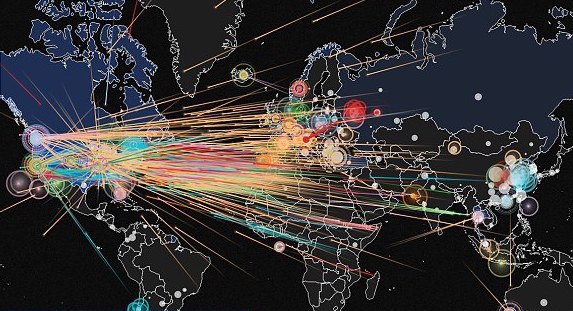
The most recent iteration of this takes the form of social media and cyberwarfare where tools are being developed and deployed to influence populations at home and abroad, to manipulate political processes of foreign states and even tap into and exploit global economic forces.

In the beginning of the 21st century, the United States held an uncontested monopoly over the tools of cyberwarfare. Today, this is changing quickly, presenting an increasingly balanced cyberscape where nations are able to defend themselves on near parity with America’s ability to attack them.

To reassert America’s control over information and the technology used to broker it, Jared Cohen, current Google employee and former US State Department staff, has proposed a US-created and dominated “international” framework regarding cyberconflict.

His op-ed in the New York Times titled, “How to Prevent a Cyberwar,” begins by admitting the very pretext the US is using to expand its control over cyberwarfare is baseless, noting that “specifics of Russia’s interference in the 2016 America election remain unclear.”

Regardless, Cohen continues by laying out a plan for reasserting American control over cyberwarfare anyway, by claiming:

Cyberweapons won’t go away and their spread can’t be controlled. Instead, as we’ve done for other destructive technologies, the world needs to establish a set of principles to determine the proper conduct of governments regarding cyberconflict. They would dictate how to properly attribute cyberattacks, so that we know with confidence who is responsible, and they would guide how countries should respond.

Cohen, unsurprisingly, nominates the US to lead and direct these efforts:

The United States is uniquely positioned to lead this effort and point the world toward a goal of an enforceable cyberwarfare treaty. Many of the institutions that would be instrumental in informing these principles are based in the United States, including research universities and the technology industry. Part of this effort would involve leading by example, and the United States can and should establish itself as a defender of a free and open internet everywhere.

Cohen never explains how this US-dominated framework will differ from existing “international” frameworks regarding conventional warfare the US regularly abuses to justify a growing collection of devastating conflicts it is waging worldwide.

And as has been repeatedly documented, the United States’ definition of a “free and open internet everywhere” is an Internet dominated by US tech companies seeking to enhance and expand US interests globally.

Cohen ironically notes that:

Cyberweapons have already been used by governments to interfere with elections, steal billions of dollars, harm critical infrastructure, censor the press, manipulate public conversations about crucial issues and harass dissidents and journalists. The intensity of cyberconflict around the world is increasing, and the tools are becoming cheaper and more readily available.

Indeed, cyberweapons have already been used, primarily by the United States.

Jared Cohen himself was directly involved in joint operations between Google, Facebook, the US State Department and a number of other US tech and media enterprises which before and during 2011 set the stage for the so-called “Arab Spring.”

It included the training, funding and equipping of activists years ahead of the the uprisings as well as active participation in the uprisings themselves, including providing assistance to both protesters and militants everywhere from Libya to Syria in overthrowing governments targeted by Washington for regime change.

One such tool used in these efforts was described in a UK Independent article titled, “Google planned to help Syrian rebels bring down Assad regime, leaked Hillary Clinton emails claim,” which would report that:

An interactive tool created by Google was designed to encourage Syrian rebels and help bring down the Assad regime, Hillary Clinton’s leaked emails have reportedly revealed.

By tracking and mapping defections within the Syrian leadership, it was reportedly designed to encourage more people to defect and ‘give confidence’ to the rebel opposition.

The article would continue, mentioning Jared Cohen by name:

The email detailing Google’s defection tracker purportedly came from Jared Cohen, a Clinton advisor until 2010 and now-President of Jigsaw, formerly known as Google Ideas, the company’s New York-based policy think tank.

In a July 2012 email to members of Clinton’s team, which the WikiLeaks release alleges was later forwarded to the Secretary of State herself, Cohen reportedly said: “My team is planning to launch a tool on Sunday that will publicly track and map the defections in Syria and which parts of the government they are coming from.”

Would Cohen’s more recently proposed “framework” have prevented the United States’ use of these cyberweapons against sovereign states to undermine sociopolitical stability, overturn entire governments and plunge them into enduring chaos many still remain in 6 years later? Most likely not.

What Cohen and the interests he represents are truly concerned with is that nations are now not only able to recognize, prepare for and defend against US cyberwarfare, they may be capable of retaliating against the US.

Cohen’s proposal for an international framework to govern cyberwarfare simply seeks to define it in terms that leaves the US with both an uncontested monopoly over cyberwarfare as well as the means to wield it globally with absolute impunity.

It would be not unlike current “international” frameworks used to govern conflicts between nations which the US has used to justify an expansive, global campaign of extraterritorial war stretching from North Africa to Central Asia and beyond.

Such frameworks have become enablers of injustice, not a deterrence to it.

As nations from Iran to North Korea are discovering, the only true means of defending oneself from foreign military aggression is creating a plausible deterrence to dissuade foreign nations from attacking. This is done by creating a price for attacking and invading that is higher than the perceived benefits of doing so.

Nations like Russia and China have already achieved this balance with the United States in terms of conventional and nuclear warfare, and have now nearly established a similar deterrence in terms of cyber and information warfare. For the rest of the world, developing cyberdefense is not as costly as conventional military or nuclear arsenals, making cyberwarfare a corner of the battlefield unlikely to be monopolized by the US as it had done at the turn of the century.

Ensuring that no single nation ever has the opportunity to abuse such a monopoly again means exposing and confronting efforts by those like Google’s Jared Cohen and his proposal for an “international framework” for cyberwarfare that resembles the same sort of enabling the United Nations provides the US in terms of proliferating conventional conflicts across the globe.

New York Times stokes anti-Russia campaign to promote Facebook, Twitter censorship

By Bill Van Auken

Source: WSWS.org

The New York Times has mounted a concerted campaign promoting a crackdown on political expression on social media on the basis of unsubstantiated allegations of Russian government interference in the 2016 US presidential election.

In conjunction with a public statement by Facebook last Wednesday on political advertising allegedly originating in Russia, the Times published a sensationalist “investigative” report titled “The Fake Americans Russia Created to Influence the Election,” an op-ed piece indicting Facebook for failing to exercise greater censorship of political content and an editorial Saturday touching on the same themes.

Facebook briefed members of both the Senate and House intelligence committees on its findings on September 6. It said it found $50,000 in spending on 2,200 “potentially politically related” ads “that might have originated in Russia” over a two-year period beginning in June 2015. It added that this included Facebook accounts and pages “with very weak signals of a connection and not associated with any known organized effort,” including “accounts with US IP addresses but with the language set to Russian.”

The vast majority of the ads, Facebook’s chief security officer Alex Stamos added, “didn’t specifically reference the US presidential election, voting or a particular candidate,” but rather appeared to focus on amplifying “divisive social and political messages.”

The testimony was seized upon by Democratic politicians attempting to promote the theme of Russia meddling in the US elections in support of Trump. Representative Adam Schiff, the senior Democrat on the House Intelligence Committee, called the highly ambiguous Facebook findings “deeply disturbing and yet fully consistent with the unclassified assessment of the intelligence committee.”

The Times “investigation” was as weak in its substantiation of a Russian government operation to influence the 2016 presidential election as the Facebook report, but far more inflammatory.

It described an “unprecedented foreign intervention in American democracy” and a “cyberarmy of counterfeit Facebook and Twitter accounts, a legion of Russian-controlled impostors whose operations are still being unraveled.”

It repeated the unproven allegations that Russia was responsible for the hacking and leaking of Democratic emails exposing the party leadership’s attempts to sabotage the presidential campaign of self-described “socialist” Senator Bernie Sanders, while accusing Russian media outlets like RT and Sputnik of having “battered” Hillary Clinton with a “fire hose of stories, true, false and in between.”

The story focuses, however, on the alleged Russian use of Facebook and Twitter, darkly accusing the two companies of failing to prevent themselves from “being turned into engines of deception and propaganda.”

The “evidence” uncovered by the Times consisted of linking “suspect” Facebook accounts, since taken down by the company, that posted material linking to a website, DCLeaks.com, that published hacked emails from billionaire financier and Democratic Party donor George Soros, a former NATO commander, and Democratic as well as Republican functionaries. With no substantiation, the newspaper claims that “United States intelligence concluded” that the site was a creation of the Russian military intelligence agency GRU.

The article also accuses Russia of exploiting Twitter, using “hundreds of accounts” for “posting anti-Clinton messages and promoting leaked material.”

It further charges that the alleged Russian campaign employed “automated Twitter bots, which send out tweets according to built-in instruction.”

According to Twitter’s own estimate, there are some 48 million such bots on Twitter, and they accounted for fully 19 percent of all election-related tweets during the 2016 presidential campaign.

The Times report acknowledges that it investigated Twitter accounts identified as “Kremlin trolls” to discover that there were real people behind them with no ties to the Russian government. It quoted one of them, Marilyn Justice, 66, from Nova Scotia, who told the newspaper she believed that “Hillary’s a warmonger” and that she was hostile to the anti-Russian bias in the Western media. Another so-called “troll” turned out to be a web producer in Zurich, who expressed sharp disagreement with Western narratives on the Ukraine and Syria.

The existence of such views, the Times concluded was “a victory for Russia’s information war—that admirers of the Kremlin spread what American officials consider to be Russian disinformation on election hacking, Syria, Ukraine and more.”

The Times followed up its “investigation” with an op-ed piece accusing Facebook of having “contributed to, and profited from, the erosion of democratic norms in the United States” by having allowed the posting of “anti-Hillary ads precisely aimed at Facebook users whose demographic profiles implied a vulnerability to political propaganda.”

It went on to comment: “Unfortunately, the range of potential responses to this problem is limited. The First Amendment grants broad protections to publishers like Facebook.”

The Times editorial published Saturday questions whether “any federal agency is focused on” the alleged “problems” uncovered in the newspaper’s report: “foreign intervention through social media to feed partisan anger and suspicion in a polarized nation.”

There is a farcical element to the Times exposé. The idea that the spending of $50,000, vaguely linked to Russia, on Facebook ads over a two-year period undermined US elections in which total spending is estimated at roughly $7 billion is ludicrous.

Whatever actions may have been taken by the government of Vladimir Putin to promote the international interests of Russia’s ruling oligarchy, Moscow’s alleged Internet activities pale in comparison to the unrelenting campaigns mounted by US government agencies, from the CIA to the Pentagon and the National Endowment for Democracy, to rig foreign elections, engineer regime change operations and militarily destroy entire countries. As the former US assistant secretary of state Victoria Nuland proudly acknowledged, Washington sunk some $5 billion into promoting pro-Western regime change in Ukraine.

Even more preposterous is the attempt to attribute the sharp social tensions and intense political antagonisms that are ripping apart the seams of American society to Russian propaganda. Both are the product of the crisis of American capitalism, characterized above all by the uninterrupted growth of social inequality.

There is, however, a sinister and deadly serious content to the campaign by the Times editorial board, which functions as a reliable conduit for CIA propaganda. It has joined its long-running campaign around allegations of Russian interference in the US election with the demand for a crackdown on political expression on social media.

The two are inextricably linked. Underlying the Times campaign around Moscow’s supposed assault on the “integrity of American democracy” lies the political agenda of powerful factions within the US ruling establishment, which are demanding the continuation and intensification of the drive toward regime change in, and military confrontation with, Russia.

The preparations for war abroad are inevitably accompanied by the growth of censorship and political repression at home. The Times ’ criticisms of Facebook and Twitter notwithstanding, these corporations, along with Google, are collaborating closely with the US government and its intelligence agencies in the attempt to suppress freedom of speech and thought and censor anti-capitalist and anti-war reporting and opinion.

Under the phony banner of combating “fake news,” Google announced a change in its search algorithms last April that was clearly directed at slashing the readership of anti-war and left-wing websites, with the World Socialist Web Site being hit the hardest, losing more than two-thirds of its traffic from Google search results.

Facebook has followed suit, rolling out a similar announcement in June that it was updating its own News Feed algorithm aimed at “deprioritizing” posts viewed as “problematic” promoting “low quality content” “sensationalism” and “misinformation.”

The attempts by these multi-billion-dollar corporations to arrogate to the themselves the power of gatekeepers of the Internet, censoring content that conflicts with the interests of the American ruling oligarchy and its military-intelligence apparatus has aroused broad popular hostility. The WSWS has spearheaded the opposition to these attacks, with 3,500 people from more than 80 different countries signing it petition demanding that Google cease its censorship of the Internet.

New York Times Propagates Russia Hacking Conspiracy Theory

The New York Times reports as fact that Russia hacked the 2016 US presidential election despite failing to present any evidence to support this claim.

By Jeremy R. Hammond

Source: Foreign Policy Journal

In late 2002 and early 2003, those of us who were warning that the US government was lying, that there was no evidence that Iraq still possessed stockpiles of weapons of mass destruction (WMD), much less active WMD manufacturing programs, were frequently dismissed as “conspiracy theorists”.

Of course, in reality, it was the US mainstream media that was propagating the government’s unfounded conspiracy theory that Saddam Hussein had such weapons and, further, had a cooperative relationship with Al-Qaeda, the terrorist organization held responsible for the attacks of September 11, 2001.

The New York Times served the government in its campaign of deception by spearheading the media’s dissemination of the lies out to the public, thus manufacturing Americans’ consent for this illegal war of aggression.

Spreading government propaganda is a function the Times never ceases to serve well — the lesson from its own reporting during the run-up to the Iraq war, and from the mainstream media’s reporting in general, having been dutifully disregarded.

One of the latest government conspiracy theories the Times is helping to propagate, by serving effectively as the political establishment’s very own public relations firm, is the claim that the government of Russia was responsible for hacking into computers of the Democratic National Committee (DNC) and email accounts of John Podesta, who was then chairman of Hillary Clinton’s presidential campaign.

In a report published September 1, 2017, the Times elaborated on this conspiracy theory under the headline “Russian Election Hacking Efforts, Wider Than Previously Known, Draw Little Scrutiny”.

In it, the Times reports as fact that Russia was responsible not only for hacking the DNC and Podesta’s email account, but also for hacking directly into the US election system itself. All that’s old news, however, so the Times‘ new spin is that Russia’s efforts to hack state electoral systems were much more extensive than previously thought.

However, the Times presents not one shred of evidence to support the underlying claim that Russia hacked these systems, much less that this alleged hacking was much more widespread than previously reported.

To the scrutinous reader who is familiar with the propaganda techniques mainstream media use in order to manufacture consent for various government policies, the total lack of evidence is apparent. In fact, the Times actually acknowledges that there is no evidence to support the claim it is making in the headline. Yet, through obfuscation, use of deceptive language, and various other techniques, the Times leads the general reader to believe that its headline is true.

An examination of the article is useful to see just how the Times manages to lead readers to the conclusion the Russia hacking is a demonstrated fact when, in reality, it remains just another conspiracy theory originating from the government that the Times is all too happy to help propagate.

The Alleged Russian Hacking of US Electoral Systems

The first thing to note about this New York Times piece is its title. The headline makes two claims: 1) it’s a fact that Russia tried to hack the US election, and this fact has been known publicly for some time; and 2) the Times has new information showing not only that US election systems were hacked and that Russia was responsible, but also that Russia’s hacking efforts even more widespread than previously known.

The story begins with the case of Durham county, North Carolina, where, we learn, various irregularities occurred at polling stations on election day last November (bold emphasis added throughout):

Dozens were told they were ineligible to vote and were turned away at the polls, even when they displayed current registration cards. Others were sent from one polling place to another, only to be rejected. Scores of voters were incorrectly told they had cast ballots days earlier. In one precinct, voting halted for two hours.

Susan Greenhalgh, a troubleshooter at a nonpartisan election monitoring group, was alarmed. Most of the complaints came from Durham, a blue-leaning county in a swing state [North Carolina]. The problems involved electronic poll books — tablets and laptops, loaded with check-in software, that have increasingly replaced the thick binders of paper used to verify voters’ identities and registration status. She knew that the company that provided Durham’s software, VR Systems, had been penetrated by Russian hackers months before.

“It felt like tampering, or some kind of cyberattack,” Ms. Greenhalgh said about the voting troubles in Durham.

Note that the Times does not say that Ms. Greenhalgh “believed” or “had heard” that Russian hackers were responsible for earlier hacking VR Systems, but that she “knew” this was so. With this verb choice, the Times is asserting that this claim is a proven fact.

The purpose of this assertion is to establish credibility in the mind of the reader that its headline is true, that the evidence shows that Russian hacking efforts were more widespread than previously known. If it is a fact that Russia hacked US election systems, then it is not hard to believe that its hacking was more extensive than previously thought.

But what evidence does the Times present to support its assertion that this earlier Russian hacking of VR Systems occurred?

Well, to answer that question, let’s first look at how Ms. Greenhalgh “knew” that Russians had hacked VR Systems. Much further into the article, more than halfway through, the Times tells us:

As the problems mounted, The Charlotte Observer reported that Durham’s e-poll book vendor was Florida-based VR Systems, which Ms. Greenhalgh knew from a CNN report had been hacked earlier by Russians. “Chills went through my spine,” she recalled.

So there were irregularities at the Durham county polling stations, and Durham county used VR Systems for its polling system, which Ms. Greenhalgh “knew” Russians had hacked because she’d heard it on CNN.

Mid-article, however, the Times also quotes Ms. Greenhalgh acknowledging, with respect to the specific case of Durham county, “We still don’t know if Russian hackers did this.”

If we don’t know whether Russian hacking was responsible for the supposed irregularities in Durham county’s polling station, why is the Times using it as an example to support the claim made in its headline that this hacking was more extensive than previously thought? If there are cases where there is evidence, why not feature one of those, instead?

The answer is that no such evidence exists; the Times has no evidence to support that claim in its headline. In fact, it acknowledges this in several other places in the article. What the Times is trying to do is to build the case that we can safely assume that what happened in Durham county was a consequence of Russian hacking. After all, if Russia hacked VR Systems, that certainly could explain those election-day irregularities, right?

But how solid is the Times‘ premise that Russia hacked VR Systems in the first place?

The Times doesn’t attempt to support this premise solely with hearsay about something CNN reported. It exerts slightly greater effort to convince the reader. Nine paragraphs into the article, we read:

Beyond VR Systems, hackers breached at least two other providers of critical election services well ahead of the 2016 voting, said current and former intelligence officials, speaking on condition of anonymity because the information is classified. The officials would not disclose the names of the companies.

Note here that the Times is once again acknowledging that it doesn’t actually have any evidence to support the claim that Russia hacked other companies in addition to VR Systems, which it is using to support the claim made in its headline that the Russian hacking was more widespread than previously thought. The Times is simply parroting government officials who’ve made this claim.

The Times‘ case crumbles even further the deeper one reads into the article. With respect to the Durham county irregularities, the Times next notes:

There are plenty of other reasons for such breakdowns — local officials blamed human error and software malfunctions — and no clear-cut evidence of digital sabotage has emerged, much less a Russian role in it. Despite the disruptions, a record number of votes were cast in Durham, following a pattern there of overwhelming support for Democratic presidential candidates, this time Hillary Clinton.

But months later, for Ms. Greenhalgh, other election security experts and some state officials, questions still linger about what happened that day in Durham as well as other counties in North Carolina, Virginia, Georgia and Arizona.

So keep in mind as we proceed that the Times is here once again acknowledging that no evidence exists to support the suspicion that the Durham county irregularities were due to Russian hacking. Yet it attempts to lead readers to that conclusion by suggesting that Russians did hack states’ electoral systems:

After a presidential campaign scarred by Russian meddling, local, state and federal agencies have conducted little of the type of digital forensic investigation required to assess the impact, if any, on voting in at least 21 states whose election systems were targeted by Russian hackers, according to interviews with nearly two dozen national security and state officials and election technology specialists.

Note that here the Times is attributing the claim that Russia hacked into states’ electoral systems to various sources. In its next paragraph, however, the Times does away with attribution and transforms this claiminto an ostensibly verified fact:

The assaults on the vast back-end election apparatus — voter-registration operations, state and local election databases, e-poll books and other equipment — have received far less attention than other aspects of the Russian interference, such as the hacking of Democratic emails and spreading of false or damaging information about Mrs. Clinton. Yet the hacking of electoral systems was more extensive than previously disclosed, The New York Times found.

Here we see that the Times is back to asserting as fact that the Russian hacking was more extensive than previously reported, even though it has admittedly not yet provided even a single piece of supporting evidence! How can it do that? Well, transparently, what is important to the Times is that its readers believe that its headline is true, not to actually demonstrate it. Whether it is actually true does not matter; it is just the belief that the Times is aiming to instill.

This is the nature of propaganda.

Turning to the premise, note that the Times is here claiming as fact that, one, US electoral systems were extensively hacked, and, two, Russia was responsible.

It continues:

Intelligence officials in January reassured Americans that there was no indication that Russian hackers had altered the vote count on Election Day, the bottom-line outcome. But the assurances stopped there.

Government officials said that they intentionally did not address the security of the back-end election systems, whose disruption could prevent voters from even casting ballots.

That’s partly because states control elections; they have fewer resources than the federal government but have long been loath to allow even cursory federal intrusions into the voting process.

That, along with legal constraints on intelligence agencies’ involvement in domestic issues, has hobbled any broad examination of Russian efforts to compromise American election systems. Those attempts include combing through voter databases, scanning for vulnerabilities or seeking to alter data, which have been identified in multiple states. Current congressional inquiries and the special counsel’s Russia investigation have not focused on the matter.

Note here how the Times is explaining that the federal government has not really focused much on investigating US election systems irregularities even while continuing to assert as fact that there were Russian efforts to compromise those systems! Further:

“We don’t know if any of the problems were an accident, or the random problems you get with computer systems, or whether it was a local hacker, or actual malfeasance by a sovereign nation-state,” said Michael Daniel, who served as the cybersecurity coordinator in the Obama White House. “If you really want to know what happened, you’d have to do a lot of forensics, a lot of research and investigation, and you may not find out even then.”

In interviews, academic and private election security experts acknowledged the challenges of such diagnostics but argued that the effort is necessary. They warned about what could come, perhaps as soon as next year’s midterm elections, if the existing mix of outdated voting equipment, haphazard election-verification procedures and array of outside vendors is not improved to build an effective defense against Russian or other hackers.

So, again, the Times is acknowledging that the kind of forensic investigation that would be required to determine whether US election systems were hacked have not actually been conducted. How, therefore, can the Times report as fact not only that such hacking occurred, but that Russia was responsible?

It gets worse. The Times at this point in the article has already acknowledged that there could be perfectly benign explanations for what happened in Durham county. As we continue reading, we learn that the those supposedly alarming irregularities the Times opened the article with were not actually all that irregular (and hence not all that alarming). To the contrary:

Still, some of the incidents reported in North Carolina occur in every election, said Charles Stewart III, a political scientist at the Massachusetts Institute of Technology and an expert on election administration.

“Election officials and advocates and reporters who were watching most closely came away saying this was an amazingly quiet election,” he said, playing down the notion of tampering.

The Times next quotes Ms. Greenhalgh’s admission that there’s no evidence hackers got into Durham county’s system (much less that Russia was responsible).

Keep in mind that the claim the government and media have been making is that Russia interfered in the US election to throw the vote to Donald Trump. Yet, in the case of Durham county, the result was that, as the Times informs, “Hillary Clinton won 78 percent of the 156,000 votes”. This is a strange outcome if we are to assume that Russia hacked the system to tamper with the election!

But the Times is not unskilled in the art of propaganda, so it has an explanation ready for us: Russia tried to hack the system there, but was just unsuccessful! It continues:

Details of the breach did not emerge until June, in a classified National Security Agency [NSA] report leaked to The Intercept, a national security news site. That report found that hackers from Russia’s military intelligence agency, the G.R.U., had penetrated the company’s computer systems as early as August 2016, then sent “spear-phishing” emails from a fake VR Systems account to 122 state and local election jurisdictions. The emails sought to trick election officials into downloading malicious software to take over their computers.

The N.S.A. analysis did not say whether the hackers had sabotaged voter data. “It is unknown,” the agency concluded, whether Russian phishing “successfully compromised the intended victims, and what potential data could have been accessed.”

VR Systems’ chief operating officer, Ben Martin, said he did not believe Russian hackers were successful. He acknowledged that the vendor was a “juicy target,” given that its systems are used in battleground states including North Carolina, Florida and Virginia. But he said that the company blocked access from its systems to local databases, and employs security protocols to bar intruders and digital triggers that sound alerts if its software is manipulated.

Take note again of the Times choice of verb: the NSA report “found” that hackers working for Russian intelligence had penetrated VR Systems’ computer systems. Through this choice of verb, the Times is communicating that it is a verified fact that Russia hacked VR Systems. But is it? To answer that, let’s turn to the Times‘ source.

The Intercept reported on this alleged hack much earlier, on June 5, 2017. Unlike the Times, however, The Intercept provided the following important caveat:

While the document provides a rare window into the NSA’s understanding of the mechanics of Russian hacking, it does not show the underlying “raw” intelligence on which the analysis is based. A U.S. intelligence officer who declined to be identified cautioned against drawing too big a conclusion from the document because a single analysis is not necessarily definitive.

To reiterate, the supposed evidence that exists proving that Russia hacked VR Systems is classified and still unknown to either the public or the media, including The Intercept and New York Times.

As The Intercept notes, the NSA report “states unequivocally in its summary statement that it was Russian military intelligence, specifically the Russian General Staff Main Intelligence Directorate, or GRU, that conducted the cyber attacks described in the document.”

But upon what actual evidence is that unequivocal statement based?

The Intercept, like the Times, proceeds to accept this unequivocal summary statement as fact despite its acknowledged lack of access to the evidence supposedly supporting this claim:

The NSA has now learned, however, that Russian government hackers, part of a team with a “cyber espionage mandate specifically directed at U.S. and foreign elections,” focused on parts of the system directly connected to the voter registration process, including a private sector manufacturer of devices that maintain and verify the voter rolls.

Here The Intercept is being as disingenuous with its readers as the Times. Note again the deceptive verb choice. The NSA had not actually “learned” that Russia tried to hack US electoral systems; it had rather assessed that this was so. As the manufactured “intelligence” about Iraq’s WMDs should have taught us, those are far from the same thing.

Conveniently, The Intercept provides a graphic image from the NSA report illustrating the point:

The key element of this chart to note is in the left column, where it identifies the “Operators” responsible sending Phishing emails — emails designed to trick the recipient into giving away login credentials for whatever system the hackers were trying to get into. Note that, according to the NSA, these “Operators” were “Probably within” the GRU.

“Probably”.

So, does the NSA know that the Russian government was responsible for these Phishing emails?

No.

The NSA is claiming this is so. But the supposed evidence it is basing this claim upon has not been shown to even exist.

Now, perhaps the NSA has solid reasoning to arrive at this conclusion. Perhaps it has solid, though not definitive, evidence to back this up.

But the New York Times ought to be properly informing its readers that the Russian hacking of VR Systems is an allegation. It ought to be including the caveat with this information that this is according to the government, but that it has not yet been proven. Moreover, the Times ought to be informing its readers that the evidence supposedly supporting this conclusion has not been made public, and, further, that nobody at the Times has been able to verify it even exists.

But continuing in its propaganda effort, the Times reminds us that, “In an assessment of Russian cyberattacks released in January, intelligence agencies said Kremlin spy services had been collecting information on election processes, technology and equipment in the United States since early 2014.”

But that was just another example of the government making a claim for which no evidence has actually been provided. Each of these claims simply builds upon those that preceded it. In the next manifestation, the New York Times claim that Russia’s supposed hacking was even more extensive than previously known will likewise be presented as fact, and the acknowledgments about the lack of supporting evidence will be omitted, just as the Times omitted that important caveat from The Intercept.

Of course, to write and publish this kind of story requires extreme cognitive dissonance on the part of journalists and editors at the Times. This psychological phenomenon of holding two fundamentally contradictory beliefs at the same time is palpable throughout the piece. Once more, even while reporting its headlined claim as fact, the Times acknowledges that it has no evidence to support it:

Beginning in 2015, the American officials said, Russian hackers focused instead on other internet-accessible targets: computers at the Democratic National Committee, state and local voter databases, election websites, e-poll book vendors and other back-end election services.

Apart from the Russian influence campaign intended to undermine Mrs. Clinton and other Democratic officials, the impact of the quieter Russian hacking efforts at the state and county level has not been widely studied. Federal officials have been so tight-lipped that not even many election officials in the 21 states the hackers assaulted know whether their systems were compromised, in part because they have not been granted security clearances to examine the classified evidence.

Of course, nobody at the New York Times has seen that evidence, either, to be able to verify that it even exists.

The Times closes by noting that, unlike Ms. Greenhalgh, Durham county officials “have rejected any notion that an intruder sought to alter the election outcome.” Nevertheless, the county has turned over computers to the North Carolina State Board of Elections and Ethics Enforcement in order for the matter to be investigated.

Of course, the Times‘ purpose with this piece, rather than being to properly inform the public, is to lead readers into the belief that, regardless of whether it happened in Durham county, there were extensive efforts by the government of Russia to hack into state electoral systems.

Never mind that the Times presents not one shred of actual evidence to support either of the two claims it makes in its headline.

Conclusion

We can again recall how the media, including the New York Times, piled lie upon lie in order to manufacture consent for the US’s war of aggression against Iraq.

Here, again, the political establishment has an agenda. Donald Trump campaigned on a platform of seeking improved relations with Russia, a deescalation of tensions, and greater cooperation with Moscow. The so-called “Deep State” was upset by Hillary Clinton’s loss. In order for the national security state to retain the authoritarian powers it has assumed supposedly in order to keep Americans safe, it needs to convince Americans that they need protecting. Russia has been selected to serve as a useful “enemy” to that end.

Framing Russia as an enemy of the United States also serves the interests of the military/security complex and the goal of maintaining and expanding US hegemony across the globe. This narrative has been used, for example, to prevent Trump from deescalating in Syria and increasing cooperation with Russia there. Trump had indicated that he would shift US policy away from the Obama administration’s goal of seeking regime change in Syria and only focus on combating the so-called “Islamic State” (a.k.a., ISIS, ISIL, or Daesh). The national security state has maneuvered rather to ensure that relations between the US and Russia remain tense and that US policy remains effectively to prolong the violence.

Whatever the motives for the propaganda campaign, we can observe that this propaganda campaign is occurring. Members of the establishment media have not only failed to learn the relevant lesson from their reporting about Iraqi WMD, but refusing to do so almost seems a job prerequisite.

News consumers should not make the same mistake.

Scrutinize. Question. Think.

If we want the mainstream media to change its behavior and actually do its job of properly informing the public, then news consumers need to change their behavior. Ever news consumers knows the old adage that you can’t believe everything you read in the newspaper. Nevertheless, all too habitually, that is precisely what they do — just as the journalists and editors they are relying on for information all too habitually accept claims from government officials as fact.

It is supposed to be the job of news media to analyze information, assess the veracity of sources, question government claims, and reveal the truth. Yet the establishment media not only fail to do so, but actively serve to propagate conspiracy theories originating from the government, and thus to manufacture consent for various government policies and the private agendas of the politically and financially powerful.

In light of how the mainstream media serve this function, it is critical for the consumers to develop the analytic skills necessary to determine the truth for themselves and be able to identify state propaganda when they see it.

Hopefully, this exercise has provided some useful insights into how to do just that.

Conspiracy Theory

By Paul Craig Roberte

Source: PaulCraigRoberts.org

In the United States “conspiracy theory” is the name given to explanations that differ from those that serve the ruling oligarchy, the establishment or whatever we want to call those who set and control the agendas and the explanations that support the agendas.

The explanations imposed on us by the ruling class are themselves conspiracy theories. Moreover, they are conspiracy theories designed to hide the real conspiracy that our rulers are operating.

For example, the official explanation of 9/11 is a conspiracy theory. Some Muslims, mainly Saudi Arabians, delivered the greatest humiliation to a superpower since David slew Goliath. They outsmarted all 17 US intelligence agencies and those of NATO and Israel, the National Security Council, the Transportation Safety Administration, Air Traffic Control, and Dick Cheney, hijacked four US airliners on one morning, brought down three World Trade Center skyscrapers, destroyed that part of the Pentagon where research was underway into the missing $2.3 trillion, and caused the morons in Washington to blame Afghanistan instead of Saudi Arabia.

Clearly, the Saudia Arabians who humiliated Ameria were involved in a conspiracy to do so.

Is it a believable conspiracy?

The ability of a few young Muslim men to pull off such a feat is unbelievable. Such total failure of the US National Security State means that America was blindly vulnerable throughout the decades of Cold War with the Soviet Union. If such total failure of the National Security State had really occurred, the White House and Congress would have been screaming for an investigation. People would have been held accountable for the long chain of security failures that allowed the plot to succeed. Instead, no one was even reprimanded, and the White House resisted all efforts for an investigation for a year. Finally, to shut up the 9/11 families, a 9/11 Commission was convened. The commission duly wrote down the government’s story and that was the “investigation.”

Moreover, there is no evidence to support the official conspiracy theory of 9/11. Indeed, all known evidence contradicts the official conspiracy theory.

For example, it is a proven fact that Building 7 came down at freefall acceleration, which means it was wired for demolition. Why was it wired for demolition? There is no official answer to this question.

It is the known evidence provided by scientists, architects, engineers, pilots, and the first responders who were in the twin towers and personally experienced the numerous explosions that brought down the towers that is described as a conspiracy theory.

The CIA introduced the term “conspiracy theory” into public discourse as part of its action plan to discredit skeptics of the Warren Commission report on the assassination of President John F. Kennedy. Any explanation other than the one handed down, which is contradicted by all known evidence, was debunked as a conspiracy theory.

Conspiracy theories are the backbone of US foreign policy. For example, the George W. Bush regime was active in a conspiracy against Iraq and Saddam Hussein. The Bush regime created fake evidence of Iraqi “weapons of mass destruction,” sold the false story to a gullible world and used it to destroy Iraq and murder its leader. Similarly, Gaddafi was a victim of an Obama/Hillary conspiracy to destroy Libya and murder Gaddafi. Assad of Syria and Iran were slated for the same treatment until the Russians intervened.

Currently, Washington is engaged in conspiracies against Russia, China, and Venezuela. Proclaiming a non-existent “Iranian threat,” Washington put US missiles on Russia’s border and used the “North Korean threat” to put missiles on China’s border. The democratically elected leader of Venezuela is said by Washington to be a dictator, and sanctions have been put on Venezuela to help the small Spanish elite through whom Washington has traditionally ruled South American countries pull off a coup and reestablish US control over Venezuela.

Everyone is a threat: Venezuela, Yemen, Syria, Iran, Iraq, Afghanistan, tribes in Pakistan, Libya, Russia, China, North Korea, but never Washington. The greatest conspiracy theory of our time is that Americans are surrounded by foreign threats. We are not even safe from Venezuela.

The New York Times, the Washington Post, CNN, NPR, and the rest of the presstitutes are quick to debunk as conspiracy theories all explanations that differ from the explanations of the ruling interests that the presstitutes serve.

Yet, as I write and for some nine months to date, the presstitute media has itself been promoting the conspiracy theory that Donald Trump was involved in a conspiracy with the president of Russia and Russian intelligence services to hack the US presidential election and place Trump, a Russian agent, in the White House.

This conspiracy theory has no evidence whatsoever. It doesn’t need evidence, because it serves the interests of the military/security complex, the Democratic Party, the neoconservatives, and permits the presstitutes to show lavish devotion to their masters. By endless repetition a lie becomes truth.

There is a conspiracy, and it is against the American people. Their jobs have been offshored in order to enrich the already rich. They have been forced into debt in a futile effort to maintain their living standards. Their effort to stem their decline by electing a president who spoke for them is being subverted before their eyes by an utterly corrupt media and ruling class.

Sooner or later it will dawn on them that there is nothing they can do but violently revolt. Most likely, by the time they reach this conclusion it will be too late. Americans are very slow to escape from the false reality in which they live. Americans are a thoroughly brainwashed people who hold tightly to their false life within The Matrix.

For the gullible and naive who have been brainwashed into believing that any explanation that differs from the officially-blessed one is a conspiracy theory, there are available online long lists of government conspiracies that succeeded in deceiving the people in order that the governments could achieve agendas that the people would have rejected.

If liberty continues to exist on earth, it will not be in the Western world. It will be in Russia and China, countries that emerged out of the opposite and know the value of liberty, and it will be in those South American countries, such as Venezuela, Ecuador, and Bolivia that fight for their sovereignty against American oppression.

Indeed, as historians unconcerned with their careers are beginning to write, the primary lesson in history is that governments deceive their peoples.

Everywhere in the Western world, government is a conspiracy against the people.

American Jackboot Diplomacy

By Finian Cunningham

Source: Strategic Culture Foundation

The latest extraordinary roughshod violation of Russian diplomatic rights by the American authorities shows that the US doesn’t want to restore normal bilateral relations. Indeed, it has now resorted publicly to jackboot diplomacy.

The rapid ordering of Russia to vacate three of its diplomatic properties – in a matter of hours – amid reported threats from the American authorities that they would smash down entrance doors if the orders were not complied with, shows a reckless disregard for Russia’s sovereign rights. Not just Russia’s sovereign rights, but the rights of all nations, as far as America is concerned.

There were also reports that US secret service agents conducted inspections of the properties while Russian officials were deprived access to the building. Such conduct marks not only provocative contempt for Russian authorities, it also raises concerns that US agents were attempting to plant incriminating evidence which might be subsequently “uncovered” by the ongoing probes into alleged Russian interference in the American presidential election last year.

What’s more, the manhandling of Russian diplomatic rights came on the personal orders from President Donald Trump, according to press reports. Previously, Trump had stated his desire to restore normal bilateral relations with Russia. One has to conclude that the latest breach of Russian sovereignty is a blunt sign that American official policy is now fully aligned in an antagonistic agenda toward Moscow.

The collective American amnesia is astounding. The shuttering of the three Russian properties in San Francisco, New York and Washington was presented by the US State Department and US media as a “retaliation” for Russia’s expulsion of some 455 American diplomats in July.

Downplayed or omitted in the US media coverage was the fact that Russia expelled those diplomats in response to the Obama administration expropriating three Russian properties and ejecting 35 Russian diplomats back in December 2016. Russia had patiently waited seven months to see if the new Trump administration would do the decent thing and undo the Obama violations. The Trump administration not only did not undo the damage, it went further to impose new trade and political sanctions on Russia.

Thus, Russia had every right to reciprocate with its expulsions in July, which in any case brought the remaining 400 or so US diplomats down to the same number as Russian diplomats residing in the US. Moscow also gave the American side a month to vacate its premises. The Americans gave the Russians 12 hours.

Trump’s latest diplomatic infringement brings the total number of closed Russian properties to six, and marks a dramatic escalation in the dispute. Moscow has said it will respond appropriately.

Relations between the two nations are deteriorating rapidly beyond the already frayed level. But let’s be clear: it is the US side which is responsible for the downward spiral.

Obama’s unprecedented expulsions and expropriations were premised on lurid accusations that the Russian government ordered an interference campaign in the US presidential election. No evidence has yet been provided by the US intelligence agencies to support this sensational and nebulous claim. Yet we are in an extraordinary situation of tit-for-tat diplomatic blows based on unproven American allegations. This is a mockery of legal due process.

Russia has consistently dismissed those accusations, saying that they are motivated by anti-Russian prejudice and US political in-fighting and scapegoating. Ironically, Trump who has lambasted the “Russia collusion” claims as fake news put out by the pro-Democrat news media and intelligence community is now, in effect, jumping on the anti-Russia juggernaut with his latest order of diplomatic seizures. American folly knows no bounds.

The American amnesia is even more problematic. The sanctions against Russia began in 2014 over the Ukraine crisis. That crisis was instigated by American and European interference in the internal affairs of Ukraine and the eventual violent coup against an elected government in Kiev. The US-backed regime that seized power has been attacking the separatist ethnic Russian population of eastern Ukraine for the past three years. Meanwhile the people of Crimea voted in a referendum to join the Russian Federation instead of recognizing the Neo-Nazi Banderite Kiev regime. Yet it is Russia which is sanctioned by the US and its European allies for “destabilizing Ukraine.”

The US is showing itself with full inglorious nakedness to be a petulant bully that flaunts international law. In short, an utterly shameless rogue regime that is now completely out of control, and doesn’t even care what others think. The latest violation of Russian sovereignty epitomizes the general high-handed attitude of the Americans to international law and the sovereign rights of all nations.

Amazingly, US media made self-justifying speculative comments that the alleged burning of documents inside the Russian consulate in San Francisco was “evidence” of Russian subterfuge and espionage. It is every nation’s sovereign right under international law to be afforded privacy for its diplomats. Instead of insinuating Russian wrongdoing, the proper, more disturbing, perspective should be that America has so little respect for international law that other nations no longer trust the US to abide by diplomatic legal standards.

The violation of Russian rights is consistent with the US violation of Ukraine which is in turn consistent with American violation of Syria, Libya, Yemen, Pakistan, Venezuela, Somalia, Iraq and Afghanistan, to mention just a few other recent cases.

On North Korea, what gives the US the legal and moral authority to declare that diplomacy does not work, or that negotiations might only be permitted if stringent preconditions are met by Pyongyang? How is that the US arrogates the “right” to threaten war on North Korea (as well as Iran and Venezuela and others) while glibly ruling out the obligation to hold equal dialogue and comply with diplomatic protocols? This is the behavior and mindset of a tyrant. A fascist state.

The latest manhandling of Russian sovereign rights is a stark milestone in the degeneration of the United States. It is abandoning any pretense at civil diplomacy.

Jackboot diplomacy is the corollary of US wars of aggression, mass murder, mass torture, and the systematic destruction of international law. All with the narcissistic smile of smug self-righteousness.

As US Empire Fails, Trump Enters a Quagmire

By Kevin Zeese

Source: Information Clearing House

A quagmire is defined as a complex or unpleasant position that is difficult to escape. President Trump’s recently announced war plans in Afghanistan maintain that quagmire. They come at a time when US Empire is failing and its leadership in the world is weakening. The US will learn what other empires have learned, “Afghanistan is the graveyard of empires.”

During the presidential campaign, some became convinced that Trump would not be an interventionist president. His tweets about Afghanistan were one of the reasons. In January of 2013, he tweeted, “Let’s get out of Afghanistan. Our troops are being killed by the Afghanis we train and we waste billions there. Nonsense! Rebuild the USA.” Now, we see a president who carries on the interventionist tradition of US Empire.

While Afghanistan has been a never-ending active war since 9-11, making the 16-year war the longest in US history, the truth is the United States became directly involved with Afghanistan some 38 years ago, on July 3, 1979. As William Rivers Pitts writes “On that day, at the behest of National Security Adviser Zbigniew Brzezinski, President Jimmy Carter signed the first directive in an operation meant to destabilize the Soviet-controlled government of Afghanistan.” In fact when the US dropped the MOAB bomb, Trump was bombing tunnels built with the assistance of the CIA in the 1980′s for the mujaheddin and Bin Laden.

Trump’s Afghan policy is inaccurately described as a new approach but has only one element that is new – secrecy, as Trump will not tell us how many soldiers he will send to this war. His so-called new strategy is really a continuation of the permanent war quagmire in Afghanistan, which may be an intentional never ending war for the empire’s geopolitical goals. Ralph Nader reviews 16 years of headlines about Afghanistan, calling it a “cruel boomeranging quagmire of human violence and misery… with no end in sight.”

Another Afghan Review Leads To Same Conclusion: More War

During his campaign for president, Trump called for the US to pull out of Afghanistan. Early in his administration, President Trump announced a review of the Afghanistan war. This week when he announced escalation of the war, Trump noted this was his instinct. Unfortunately, the president did not trust his previous instincts and missed an opportunity to end the war.

We have seen how President Trump refuses to admit mistakes, so it is highly unlikely he will change course from this mistaken path. His rationale is so many US soldiers have given their lives that we must stay until the United States wins. This is the quandary – the US must continue the war until we win because soldiers have died but continuing the war means more will die and the US must stay committed to war because more have died.

After we read President Trump’s Afghanistan war speech, we went back and re-read President Obama’s Afghanistan war speech given in March 2009.  It is remarkable how similar the two speeches are. When Russian president Putin was interviewed by filmmaker Oliver Stone as well as when he was interviewed by Megyn Kelly, he made a point proven by US policy in Afghanistan, “Presidents come and go, and even the parties in power change, but the main political direction does not change.”

Both presidents conducted a lengthy review early in their administration and both talked with generals and diplomats who convinced them to escalate rather than end the war. Both presidents put forward what they claimed was a new strategy but in reality, was just doing the same thing over again: more troops, building up Afghanistan’s military by working closely with them, using economic and diplomatic power and putting pressure on Pakistan not to be a safe haven for the Taliban and those fighting against the United States.

To ensure a quagmire both presidents said that decisions would not be based on a timeline but on conditions on the ground. Both promised victory, without clearly defining what it would mean; both raised fears of the Taliban and other anti-US militants using Afghanistan to attack the United States again. Trump had the advantage of knowing that President Obama’s approach had failed despite repeated bombings in Pakistan and working with Afghan troops, but that didn’t alter his course.

Afghanistan Victims of a February, 2012 US air strike that killed 8 children in Kapisa, Afghanistan.

Failure To Learn Lessons Ensures Repeating Them

According to Mike Ludwig, since President Obama approved a troop surge in 2009, the war in Afghanistan has claimed at least 26,512 civilian lives and injured nearly 48,931 more. In July, the United Nations reported that at least 5,243 civilians have been killed or injured in 2017 alone, including higher numbers of woman and children than previous in years. Trump seems less concerned than previous presidents with killings of civilians.

Trump noted that the Afghanistan-Pakistan region was now the densest part of the world when it comes to anti-US militants, saying there were 20 terrorist groups in the area. President Obama added tens of thousands of troops to the Afghanistan war, dropped massive numbers of bombs and the result was more terrorism. The US was killing terrorists but the impact was creating more anti-American militants. Trump failed to connect these dots and understand that more US attacks create more hatred against the United States.

After Obama failed to ‘win’ the war by adding tens of thousands of troops, with more than 100,000 fighting in Afghanistan at its peak, Trump should have asked his generals how adding thousands more (reports are between 4,000 and 8,000 soldiers) would change failure to success. Wasn’t there anyone in the room who would tell Trump there is nothing new in the Trump strategy that Obama and Bush had not already tried. Steve Bannon was the most opposed to war in the administration and reportedly fought against more war, but he was not in the room. Did anyone in the room stand up to the hawk-generals?

The policy of working more closely with the Afghan military in order to build them up ended in disaster in the Obama era. The New Yorker wrote in 2012: “We can’t win the war in Afghanistan, so what do we do? We’ll train the Afghans to do it for us, then claim victory and head for the exits.” But, the US discovered that it could not train the Afghans in the ‘American way of war.’ In 2012, the Obama administration ended the program of fighting alongside Afghan soldiers to train them because those soldiers were killing US soldiers. How many US soldiers will die because Trump was ignorant of this lesson?

Trump also took the wrong lesson from the Iraq war and occupation. He inaccurately described the so-called withdrawal from Iraq as hasty. He points to the rise of ISIS as created by the vacuum in Iraq when the US reduced its numbers of troops. Trump said the US “cannot repeat in Afghanistan the mistake our leaders made in Iraq.”

In fact, ISIS rose up because the killing of hundreds of thousands, some reports say more than a million, of Iraqis, displacement of more than a million more, the destruction of a functioning government as well as war crimes like the Abu Gharib torture scandal made it easy to recruit fighters. Furthermore, the training and supply of weapons to Sunnis during the ‘Awakening’ created armed soldiers looking for their next job.

It was US war and occupation that created ISIS. The seeds had been planted, fertilized and were rapidly growing before the US reduced its military footprint. Trump is repeating the mistake of more militarism, and in the end ISIS or some other form of anti-US militancy will thrive.

The US does not want to face an important reality – the government of the United States is hated in the region for very good reasons. Bush lied to us about 9-11 when he claimed they hate us for our freedoms. No, they hate the US because US militarism kills hundreds of thousands of people in the region, destroys functioning governments and creates chaos.

Victory Means Something Different to an Empire

In trying to understand why the US is fighting a war — a war that has been unwinnable for 16 years — it helps to look at a map and consider the resources of an area.

Larry Wilkerson, Colin Powell’s former adviser, predicts the US will be in Afghanistan for the next 50 years. Indeed, that may be the ‘victory’ the empire seeks. Afghanistan is of geopolitical importance. It is a place where the US can impact China’s ‘One Belt One Road’ to Europe where China can take the place of Russia and the United States in providing wealthy Europeans with key commodities like oil and gas. Just as the United States has stayed in Germany, Italy and other European states and Japan after WW II,  and in Korea after the Korean war, the empire sees a need to be in Afghanistan to be well positioned for the future of the empire. Terrorism is not the issue, economic competition with China, which is quickly becoming the leading global economic power, is the real issue.

And, competition with Russia and China is at the top of the list of the bi-partisan war party in Washington. Pepe Escobar points out that “Russia-China strategic partnership wants an Afghan solution hatched by Afghans and supervised by the Shanghai Cooperation Organization (of which Afghanistan is an observer and future full member). So from the point of view of neocon/neoliberalcon elements of the War Party in Washington, Afghanistan only makes sense as a forward base to harass/stall/thwart China’s Belt and Road Initiative.”

Afghanistan is next to China, India and Pakistan, three nuclear powers that could pose military risks to the United States. Having multiple bases in Afghanistan, to allegedly fight terrorists, will provide the forward deployment needed to combat each of those nations if military action is needed.

Afghanistan also borders on Iran, which could be a near-future war zone for the United States. Positioning the US military along the Afghanistan-Iran border creates a strategic advantage with Iran as well as with the Persian Gulf where approximately 18.2 million barrels of oil per day transit through the Strait of Hormuz in tankers.

Afghanistan’s land contains $3 trillion in rare earth minerals needed for computers and modern technology including rich deposits of gold, silver, platinum, iron ore and copper. The US has spent $700 billion in fighting a failed war and President Trump and empire strategists are looking to make sure US corporations get access to those minerals. Since the US Geological Survey discovered these minerals a decade ago, some see Afghanistan as the future  “Saudi Arabia of lithium”, a raw material used in phone and electric car batteries. US officials have told Reuters that Trump argued at a White House meeting with advisers in July that the United States should demand a share of Afghanistan’s mineral wealth.

Jeffrey St. Clair reminds us not to forget the lucrative opium trade. Afghanistan is the largest source for heroin in the world. He writes:

Since the start of Operation Enduring Freedom, opium production has swelled, now accounting for more than one-third of the wrecked Afghan economy. In the last two years alone, opium poppy yields have doubled, a narcotic blowback now hitting the streets of American cities from Amarillo to Pensacola. With every drone strike in the Helmond Province, a thousand more poppies bloom.

The decision on a never ending war — with no timetable for exit — is evidence that the Pentagon and intelligence agencies are in charge of US foreign policy with Trump as a figurehead.  Of course, the war also ensures immense profits for the war industry. St. Clair emphasizes that “in 2016, the Pentagon spent $3.6 million for each US soldier stationed in Afghanistan.  A surge of 4,000 to 10,000 additional troops, either as ‘private military units’ or GIs, will come as a welcome new infusion of cash to the dozens of defense corporations that invested so heavily in his administration.”

The firing of Steve Bannon just before the meeting that decided Afghanistan’s future was not coincidence as he was the opponent of escalation. Glenn Greenwald writes in the Intercept that this permanent power structure has been working since his election to take control of foreign policy. He also points to the appointment of Marine General John Kelly as chief of staff and how National Security Adviser, General McMaster, has successfully fired several national security officials aligned with Steve Bannon and the nationalistic, purportedly non-interventionist foreign policy. The deep state of the permanent national security complex has taken over and the Afghan war decision demonstrates this reality.

With these geopolitical realities, staying Afghanistan may be the victory the Pentagon seeks — winning may just be being there. The Intercept reported this week that the Taliban offered to negotiate peace, but peace on the terms of the Taliban may not be what the US is seeking.

Call for an End to War for Empire

It would be a terrible error for people to blame Trump for the Afghanistan war which began with intervention by Jimmy Carter, became a hot war after 9-11 under George Bush, escalated under Obama and now continues the same polices under Trump. The bi-partisan war hawks in Congress for nearly 40 years have supported these policies. Afghanistan is evidence of the never ending policy of full spectrum dominance sought by the US empire. The bi-partisans warriors span the breadth of both parties, Jeffrey St. Clair highlights the Afghanistan war cheering by Senator John McCain and Senator Elizabeth Warren.

Throughout recent decades the United States has failed to show what Kathy Kelly called the courage we need for peace and continues the cowardice of war. In fact, many ask why are we still at war in Afghanistan: Osama bid Laden is dead, other alleged 9-11 attack attackers are caught or killed. This shows that calling Afghanistan the longest running Fake War in US history is right — fake because it was never about terrorism but about business. If terrorism were the issue, Saudi Arabia would be the prime US enemy, but Saudi Arabia is also about business.

We share the conclusion of human rights activist and Green vice presidential candidate in 2016 Ajamu Baraka who wrote for the Black Alliance for Peace that:

In an obscene testament to U.S. vanity and the psychopathological commitment to global white supremacy, billions have already been wasted, almost three thousand U.S. lives lost and over 100,000 dead. It is time to admit defeat in Afghanistan and bring the war to an end. Justice and common sense demand that the bloodletting stop.

When we understand the true motives of US Empire, that conclusion is even worse — to steal resources from a poor nation and put in place permanent bases from which to conduct more war. US hegemony is costly to millions of people around the world and at home it sucks more than 54% of discretionary spending from the federal budget and creates an empire economy that only serves the wealthiest corporate interests that profit from transnational military dominance while creating a record wealth divide where most people in the United States are economic slaves. It is not only time to end the Afghanistan war but to end US Empire.

Wall Street Primitivism: Nicaragua, China, The Middle East & Charlottesville

By Caleb Maupin

Source: New Eastern Outlook

Wall Street, London, and the Bretton Woods institutions like the World Bank, and the International Monetary Fund claim to support development and the eradication of poverty around the world. They also claim to support scientific progress and raising the global standard of living. However, often they seem to make friends and allies with very different goals. As Nicaragua proceeds with a huge construction project that has dynamic global implications, one can see a certain international pattern repeating itself, with quite dangerous implications.

“Native Activists” Fighting To Preserve US Maritime Dominance

Control of the Panama Canal by the United States has been vital in asserting control over the world economy. The US military has intervened militarily in Panama on many occasions to secure its control of this vital global shipping and transportation hub.

While the USA currently allows vessels to pass through, this could easily change in the case of a military confrontation. With so much of the world’s industrial shipping passing through this vital point, control of the canal gives the USA a level of unchecked power in the global economy. At any point they could “veto” a country’s economy by stopping ships.

However, a construction project currently in the works in Nicaragua could change that. The Chinese government and corporations based in China are cooperating with the socialist government of Nicaragua to construct a new canal, parallel to the Panama Canal. This canal will not be under US dominion, but under the dominion of the Sandinista government and the People’s Republic of China.

The announcement of the project was followed by all kinds of reports in western media claiming it would be an ecological disaster and contribute to global warming. Now, as the project proceeds, voices of the establishment are crying crocodile tears for the indigenous people who will be forced to move by the project. The Guardian has run stories bemoaning their plight. Amnesty International is warning Nicaragua not to interfere with their protests.

The USA is in the process of putting sanctions on Nicaragua, for their support of Venezuela. A bill currently in the US congress called the NICA Act aims to cripple the socialist government.

While it is ignored in US press reports, the Sandinista government has done a great deal to improve the lives of its population, a large percentage of which is indigenous. Poverty in Nicaragua has been reduced by 30%. The United Nations World Happiness Index reports the great increase of happiness in any country in 2016, as having taken place in Nicaragua.

The socialist government is asserting public control over major industries, guaranteeing jobs, housing, and education to the population, and moving toward a centrally planned economy. The Sandinistas are cultivating a layer of patriotic small business owners, who cooperate with the state to develop the economy with foreign investment. Their methods are similar to those employed by Deng Xiaoping when opening up China during the 1980s.

Though the Sandinistas are widely popular, the forces who oppose the canal project have found a number of indigenous leaders to align with. 76% of people in Nicaragua have some indigenous ancestry. The overwhelming majority of the country is ethnically “mestizo” meaning it has a mixture of European and native ancestry.

However, the forces being rallied to oppose the project are not from the overwhelming majority of the population which has indigenous ancestry, but rather to a specific group of just over 4% of the population, which is described as “unmixed indigenous inhabitants.” These are individuals who have cut themselves off from Nicaraguan society at large, and much like the Amish or Mennonites in the USA, maintain a lifestyle without technology, immersed in religious tradition. While the majority of Nicaraguans are Christians, these forces are Shamanists and practitioners of polytheistic faiths. They reject all “european” concepts and lump Marxism, dialectical materialism, and Christianity into the same basket.

The relationship between this isolated minority in Nicaragua and the US Central Intelligence Agency is not a new development. During the 1980s contra war, the CIA supplied weapons and military training to the indigenous Mosquito peoples to fight the Sandinistas. In addition to the weapons and funding they received from the USA, a number of Anti-Communist US Native American activists such as Russell Means joined with them. Many of these indigenous, anti-technology, and anti-science fanatics stood against what they called the “Racist European Marxism” of the Sandinista government, which was made up largely of dark skinned people with indigenous blood. While they claimed to oppose both “capitalism and communism” as European concepts, they quietly and sometimes not-so-quietly, worked with the Pentagon and the CIA.

Just as they took up guns in the 1980s in alliance with Washington, they now get promoted by pro-US Non-Governmental Organizations and Non-Profits, who conveniently see maintaining US maritime dominance as the latest, trendy, ecological, liberal cause, done to rescue some “mystical people” with “beautiful ancient traditions” being crushed by “racist” “dogmatic” Marxists.

“Traditionalist” CIA-Allies in China

Western utilization and manipulation of primitivist, conservative, and reactionary social forces in order to stop economic development is not restricted to Latin America. The political allies of the United States on the Chinese mainland, who work against the People’s Republic, often while spouting rhetoric about “human rights” are a rather interesting bunch.

The Chinese government has just cracked down on an extremist cult known as “Eastern Lightning.” The group is also known as the “Church of the Almighty God” and worships a woman who they claim is the second coming of Jesus Christ. They are reported to torture, mutilate, and even execute members who attempt to leave. Members of the group famously murdered a man in a Mcdonalds restaurant for refusing to allow his daughter to give her phone number to them.

While some would dismiss this simply as an obscure religious cult, it is important to note that the lead minister of the Church, along with the woman who claims to be Jesus Christ, both currently live in the USA. In 2001, they sought “political exile” in the United States, and while millions of people die attempting to cross the US border, the US government happily grants visas to anti-China activists, order to help them escape “persecution” from the US government.

Another friend of the USA in China is the Falun Gong, a strange buddhist sect. The group calls for the public execution of homosexuals and opposes inter-racial marriage. Li Hongzi, the group’s founder, lives in Queens, New York. His organization has been presented with awards by the Heritage Foundation.

Much like Eastern Lightning, the Falun Gong preaches that the Chinese Communist Party’s leadership, in particular its policies advancing the position of women, are harmful to society. The Falun Gong argues that the Chinese Communist Party’s rule represents a “Dharma Ending Period” and that its efforts to include women in government positions is one of its most grievous crimes. The group is also known for separating young people from their families, and threatening ex-members.

Following this pattern, the USA has worked endlessly to promote the deposed feudal theocratic monarchy of Tibet. The Dalia Lama, who ruled Tibet with an iron fist and executed and tortured all who questioned him, is presented as a harmless self-help, spiritual guru in US media.

While he is presented as a man of peace, it is widely known that his brother was given military training in Colorado, and air dropped into the Tibet Autonomous Region in the 1950s. With guns and weapons from the USA, the Tibetan separatists waged a violent proxy war in the mountains for years. This is all boasted about in the right-wing, anti-China book “The CIA’s Secret War in Tibet.”

All these bizarre religious groups aligned with the USA in China seem to glorify feudal, pre-Communist China. They all oppose the Chinese Communist Party for its modernization. While they speak different languages, and glorify different traditions, they probably would agree a lot with the Nicaraguan, US-backed “indigenous activists” who oppose the socialism of the Sandinistas. Meanwhile, it is a similar crowd of western liberals who admire them, and would accuse any who criticized them of “racism” and “white-splaining.”

Not only does Washington have a history of aligning with primitivist and feudalist forces, so do European fascists. Julius Evola, the Italian far-right ideologue who spoke of a “revolt against the modern world” had a particular admiration for feudalism and primitive societies around the world. In his book “Man Among Ruins” he speaks of “the demonic nature of the economy” in western countries, which people are always trying to advance, create, and become more prosperous. He admires pre-capitalist civilization for its poverty and “stability” amid starvation.

As members of the European far-right, the Nazis also admired primitivism and poverty. Heinrich Harrier, the author of the beloved “Seven Years in Tibet,” practically a holy book for advocates of Tibetan seperatism, was actually an SS officer. The Nazis believed Germans to be descended from Tibetans, and sent scientists to measure ancient skulls in order to somehow prove this. The Nazis had similar admiration for the caste system in ancient India, and adopted the swastika as their symbol for that reason.

CIA Loves Islamic Extremists

It was the British empire that first discovered the political value of Wahabbism. The Saudi monarchy owes its origins to a cleric named Muhammad ibn ʿAbd al-Wahhab. His interpretation of Islam in 1700s enabled the Saudi royal family to establish its brutal, repressive theocratic monarchy. The British cooperated with the Saudi royal family, which conveniently allowed them access to oil in exchange for propping up the barbaric regime. In 1945, the USA joined with the British is coddling the Saudi autocracy.

Today, Saudi Arabia is one of the only countries in the world where housing in bedouin tents, not modern buildings is widespread. The lack of infrastructural development accompanies a government that outlaws women from driving cars, conducts public floggings and beheadings, and punishes crimes with mutilation. Every person and everything in Saudi Arabia is the property of the King. Citizens are routinely executed for “insulting the King” or “sorcery” among other crimes. Sometimes bodies are crucified and left on public display after execution.

A large percentage of the Saudi population are guest workers who live as slaves with no human rights. Even among the Saudi born population, the Shia oil workers face brutal discrimination and exploitation on the job, with their religious freedom often denied.

While the western economic institutions and governments all claim to support “poverty alleviation” and “development” in the third world, they embrace the Saudi Monarchy in all its horror and backwardness. Meanwhile, the targets of the USA and NATO in the Middle East, are not the primitive oil autocracies, but rather, regimes that work toward modernization.

The Iranian revolution of 1979 deposed western capitalism, and established a government under the slogan of “not capitalism, but Islam.” After the revolution, even in the context of a massive war with Iraq, Imam Khomeni launched a “construction Jihad.” In this effort inspired by Stalin’s Five Year Plans and the rapid industrialization of socialist countries, Iranians were mobilized to build highways, schools, hospitals, power plants, and so much else in order to bring the country out of poverty. Despite sanctions and attacks from the west, Iran has utilized oil revenue and central planning to construct a highly modern country, with a comparatively prosperous population. The Islamic Republic of Iran that emerged from the 1979 revolution, and has made huge strides toward modernization, is now the target of western leaders.

The Syrian Arab Republic, born in the Baath Socialist revolution, is also targeted by the west. This is a government that has multiple parties in office, and has worked with Russia and China to construct huge power plants and highways. Syrian industrial workers are organized into labor unions, and have legal protections on the job. The Communist Party and the Communist Party (Baghdash) are permitted to participate in the government process. Religious freedom is guaranteed with Sunnis, Shia, Alawi, Christians, Druze, and other religious groups all freely practicing their faith. The achievements of Syria’s state controlled healthcare system are widely praised by international bodies, with many doctors and medical professionals trained the state run Universities.

Fitting with this pattern, western leaders are now arming and training Wahabbis, a force representing primitivism and barbarism of the Saudi variety, in the hopes of toppling the Syrian government. It is worth noting that prior to 2011, when the USA began working to foment civil war in the context of the Arab Spring, Syria had begun constructing an oil pipeline, connecting Iran to Mediterranean.

Prior to its destruction by NATO bombs in 2011, Libya was the most prosperous country on the African continent. It had the highest life expectancy, and had constructed a huge irrigation system in order to spread water across this dry, desert country. The forces backed by the United States to topple the Islamic Socialist government in Libya were Wahabbis. Now ISIS and Al-Queda have set up shop in the country, and citizens are fleeing on rafts trying to reach Europe.

Different Definitions of Imperialism

In his 1917 book “Imperialism: The Highest Stage of Capitalism,” Russian revolutionary leader Vladimir Lenin argued that capitalism had entered a globalist phase. He talked about the rise of “monopoly capitalists” in Britain, France, Germany, and the United States. He spoke of how bankers had triumphed over industrial capitalists, and described how wealthy financial elites in the west teamed up with governments to battle against each other, carving out “spheres of influence” in Africa, Asia, Latin America, and elsewhere. He described how third world countries were utilized as “captive markets” in which western countries could sell commodities without competition.

Imperialism, as Lenin understood it, was about keeping the world poor, so that western bankers could stay rich. Furthermore, imperialism meant dividing the working class within the western countries. A “labor aristocracy” of well paid workers was created. These were working class people who could be cultivated to identify with the western capitalists against the colonized people. With their rising standard of living, they would see their interests as identical to the interests of the monopolists that controlled their governments.

This understanding of imperialism was developed by Lenin, and adopted by figures like Mao Zedong, Che Guevara, Ho Chi Minh, Huey Newton. Even non-Marxists like Michel Aflaq, Juan Peron, and Moammar Gaddafi studied and came to understand imperialism this way. For various anti-imperialist figures of the 20th century, third world revolutions against imperialism were about raising their countries up from poverty, modernizing, and developing.

However, a large section of the modern political left has abandoned this understanding. The understanding of “imperialism” taught in Universities across the USA and western Europe is quite different.

Starting in the 1950s, the New Left, specifically beloved “cultural critics” in the Frankfurt School and elsewhere, began speaking about “cultural imperialism.” Suddenly, among western academics and leftist activists, imperialism wasn’t about holding back development and keeping people poor. Rather, it was about eroding “beautiful” “traditions” and “ways of life” and “imposing” supposedly “western” values.

So-called “Mcworld” & Wahabbi Extremists Work Together

When describing the supposed leftist critique of imperialism in his book “On Paradise Drive” New York Times Columnist David Brooks said that “anti-American” and anti-imperialist forces oppose “McDonalds, Barnes and Noble, and boob jobs.” Those who object to Wall Street running the world are depicted as Native American mystics, Islamic fanatics, or others who object to the industrialization, commercialization, and sexual freedom of western life.

This misrepresentation is widespread. The false dichotomy is often stated as “Mcworld vs. Jihad,” and was widely promoted in the USA, prior to, but especially after 9/11. In this “Clash of Civilizations” narrative, the forces said to represent “Jihad” were the Saudi Monarchy and Osama Bin Laden, while the forces said to represent “Mcworld” were the IMF, the World Bank, and Wall Street.

In reality, Mcworld globalizationists and the forces represented as “Jihad” are on the same team. They have never been enemies. Washington has been on friendly terms with Saudi Arabia since 1945. The CIA worked with Wahabbi extremists in Afghanistan to topple an independent, modernizing government called the People’s Democratic Party. The USA and Saudi Arabia worked with Wahabbis in Chechnya to fight against the Soviet Union and afterwards the Russian Federation. The USA currently funds and arms Wahhabis in Syria, and cooperated with these forces in Libya to topple the Islamic Socialist government.

The conservative forces in the Middle East that oppose modernization and development, and embrace the Wahabbi ideology of the 1700s are not enemies of Wall Street or the London Stock Exchange. Unlike the Shia revolutionaries, or the Baath Socialists, which represent legitimate resistance, the Wahabbi forces do not wish to modernize or industrialize the region. They want to keep it a mess of impoverished oil plantations ruled over by autocratic vassals. Wall Street has no objection to this setup, and it can largely be traced back to the Sykes-Pickot agreement, crafted by western colonizers.

However, in the west, especially in circles considered to be “progressive” there is a strange mystical and cosmopolitan admiration for the forces of primitivism. For example, those who defend the Syrian government, and point out the terrorist nature of the anti-government forces are labelled “Islamophobic.” Liberal crowds in the United States swoon over the pro-Saudi demagogue named Linda Sarsour as she wears a headscarf, uses exotic sounding Arabic words, accuses those who oppose her of racism, and holds rallies calling for the USA to topple the Syrian government.

This degeneration of leftist politics has been a long time in the making. In the 1960s, the Hare Krishna movement, an extremely right-wing Hindu sect in India, suddenly became a beloved staple of Peace Marches. Gurus from India, figures who promoted drug use for “spiritual” purposes, all suddenly became the fixture of the left. Previously these kinds of bohemian elements had been embraced by the far-right and fascists.

In the 1950s, it was Republicans and the “China Lobby” that rallied support for the Dalia Lama and his insurgency in the Tibet Autonomous Region. Republicans accused the democrats of “losing China.” However, in the present context it is liberals who sport “Free Tibet” bumper stickers, while the right-wing is less interested in foreign meddling and applauds to the words “America First.” No matter what region is being discussed, in the present context, it is the liberals, not the conservatives, whose hearts bleed the loudest for US proxy fighters around the world.

While in the 1980s, it was conservatives like Ronald Reagan and Oliver North who championed the fight against the Sandinistas in Nicaragua, it is now liberals who moan for the “indigenous cultures” that are supposedly being “oppressed” by the Marxist government, which dares challenge the hegemony of the Panama Canal.

The US Central Intelligence Agency is probably the most involved with supporting forces of primitivism around the world, as they work to battle independent modernizing governments that threaten the monopoly of western capitalism. It should be no surprise, that since the 1950s, the CIA has also been heavily involved in supporting the anti-communist political left, which seems now fully dedicated to their latest crusade.

The CIA began its infamous “Congress for Cultural Freedom” in the 1950s, hoping to direct anti-capitalist activists and artists away from the pro-Soviet Communist Parties in the USA and Europe. The CIA funded the art of Jackson Pollack, experimental music, and all kinds of cultural strata intended to clash with Marxist-Leninist dialectical materialism and socialist realism. The CIA also launched a program called “MK-Ultra” which involved distributing drugs on college campuses.

The Monument Fights in the USA

The media in western countries, as it champions various primitivist forces, has essentially embraced Julius Evola’s critique of the “demonic nature of the economy.” Like Mother Teresa who infamously said “There is something beautiful in seeing the poor accept their lot, to suffer it like Christ’s Passion. The world gains much from their suffering,” the non-Marxist, “liberal” element now sees social, economic, and technological progress as its enemy, and looks on poverty, ignorance, and primitivism in a condescending admiration.

While once it was the right-wing that pushed malthusian ideas about “overpopulation” it is now billionaire liberals like Bill Gates that work to decrease the global population. Often in the name of ecology, liberals will boast about how they refrain from shopping, and live frugal lives.

Now in the USA, a political clash that is very dangerous is unfolding. The fight involves monuments to various historical figures who did reprehensible things, such as owning slaves or fighting for the Confederacy in the hopes of preserving the slave system.

While it easy for anyone who hates racism and the racist mythology of films like “Gone With The Wind” and “The Birth of a Nation” to celebrate the destruction of Confederate Monuments, and they are absolutely right to do so, the context of their destruction, and who is destroying them, presents a new danger.

The forces that seek to defend the Confederate monuments are white supremacists, Ku Klux Klansmen, admirers of Hitler, traditionalists, and others. These are forces that want the USA to return to segregation, racial division, and other things overcome through decades of struggle. These forces are known to use violence, and they are widely hated and unpopular, though their prestige is slowly growing due to the absurd political context.

The problem is not that reactionary symbols are being destroyed. This is a positive thing. The problem is rather that the forces who line up against them do not seek to replace their hateful ideology with something new. In Charlottesville and elsewhere, the battle is taking place in which bigots who think Robert E. Lee was a hero are facing and off and violently clashing with those who believe society should have no heroes at all.

Racism Battles Post-Modernism

While the racist, hateful messaging and views of White Nationalists fill the airwaves, and become the subject of debate, what does Anti-Fa believe in? The media refers to crowds opposing the “Alt Right” as “anti-racist activists.” The White Nationalists are quick to call them “Communists.” But what ideas does “The Resistance” believe in? What alternative vision do they hold up to combat the right-wing?

The crowds of post-modern, non-ideological leftists largely do not seek to replace statues they destroy with statues of progressive figures like Frederick Douglas, Huey Newton, or William Z. Foster. Rather, they rally around the concept that “no one should be worshipped” and “there is no truth.” Images of Abraham Lincoln, the man who defeated Robert E. Lee and led the fight against slavery are now being destroyed, alongside the Confederates.

While “Anarchists” and liberals who destroy monuments are quick to point out and emphasize these leaders real crimes, the slogan they rally in opposition with is “No Gods and No Masters.” They fall back on concepts like “think for yourself” “question everything” and more subtly: “don’t believe in anything” “there is no truth.”

As media eulogized Heather Heyer, who was murdered by a white nationalist in Charlottesville, very few reports mentioned that she was a member of the Industrial Workers of the World. The IWW, an anarcho-syndicalist labor union formed in 1905, also known as “the wobblies,” indeed has an ideology and belief system of its own. The IWW believes in creating a society in which the major industries and workplaces are controlled by those who work in them. Throughout its history, it was known for working in favor something, it syndicalist vision, not simply for the destruction the old. Not surprisingly, US media, which largely cheers for the opposition to the Alt-Right, obscures this important aspect of the woman who recently died opposing them.

As the media champions the fight against the Alt-Right, they work to obscure any solid ideology that would oppose them. The primary voices opposing the Alt-Right are post-modernists from middle class backgrounds, trained at elite Universities. They tear down the statues of confederate monuments as they cheer for the “Syrian revolution” that reduces Syria to chaos, or the various “oppressed” primitivist groups that fight against China or the government of Nicaragua.

Bill Maher, a left-wing TV commentator interviewed Leah Remini about her painful history in the Church of Scientology. In the interview, Maher outrageously compared scientology to Communism. The outrageous comparison was in reference to the low income of scientology practitioners.

As the polarization continues, the dangerous reality is that this is not the 1930s. The fighting fascists are not armed with Marxism-Leninism and guided by the Soviet Union, fighting for the ideal of Communism. Unlike the anti-fascist of the 1930s, anti-fa and the liberals who support them are not fighting to impose their own ideology onto society. Rather, they are fighting in the hopes of destroying ideology itself.

This is a hopeless mission. Every society since the dawn of agriculture has involved ideas, religions, and some concept morality, however, incorrect or distorted they may have been. These things are the foundation of human civilization. Even pre-historic tribes of hunter gathers had some rules or beliefs to guide their actions. Post-modernism and relativism cannot lay the foundations of a healthy society.

Western capitalism now rallies around the belief that “there is no truth.” At home it promotes free market capitalism and austerity, an economic model in which selfishness rules, and many people are left in poverty and misery. Meanwhile, it emphasizes a social liberalism based on hedonism and shallow values. Internationally, the west aligns itself with forces that seek to stop economic and technological progress, and freeze their societies in poverty and ignorance, so that Wall Street can maintain its monopoly.

As Americans, like all human beings, long for something to believe in, and long for their lives to improve, not get worse, they are likely to rally around forces who offer them such things. If no alternative is presented, only the now marginal far right-wing will be available to offer such things.

While its easy to call Trump a fascist, something far more deadly, and far closer the reactionary regimes of Nazi Germany and Mussolini’s Italy could gain support. A population told to chose between either anarchy, chaos, and nihilism, or the hateful “truths” of reaction, could be pushed toward a very dangerous trajectory.


Caleb Maupin is a political analyst and activist based in New York. He studied political science at Baldwin-Wallace College and was inspired and involved in the Occupy Wall Street movement, especially for the online magazine “New Eastern Outlook”.