Technology and a Tyranny Worse than Prison 

By Bert Olivier

Source: Brownstone Institute

In an outstanding piece of political-theoretical writing, titled ‘The Threat of Big Other’ (with its play on George Orwell’s ‘Big Brother’) Shoshana Zuboff, succinctly addresses the main issues of her book, The Age of Surveillance Capitalism – The Fight for a Human Future at the New Frontier of Power (New York: Public Affairs, Hachette, 2019), explicitly linking it to Orwell’s 1984

Significantly, at the time she reminded readers that Orwell’s goal with 1984 was to alert British and American societies that democracy is not immune to totalitarianism, and that “Totalitarianism, if not fought against, could triumph anywhere” (Orwell, quoted by Zuboff, p. 16). In other words, people are utterly wrong in their belief that totalitarian control of their actions through mass surveillance (as depicted in 1984, captured in the slogan, “Big Brother is watching you”) could only issue from the state, and she does not hesitate to name the source of this threat today (p. 16):

For 19 years, private companies practicing an unprecedented economic logic that I call surveillance capitalism have hijacked the Internet and its digital technologies. Invented at Google in 2000, this new economics covertly claims private human experience as free raw material for translation into behavioural data. Some data are used to improve services, but the rest are turned into computational products that predict your behaviour. These predictions are traded in a new futures market, where surveillance capitalists sell certainty to businesses determined to know what we will do next. 

By now we know that such mass surveillance does not merely have the purpose – if it ever did – of tracking and predicting consumer behaviour with the aim of maximising profits; far from it. It is generally known among those who prefer to remain informed about global developments, and who do not only rely on the legacy media for this, that in China such mass surveillance has reached the point where citizens are tracked through a myriad of cameras in public places, as well as through smartphones, to the point where their behaviour is virtually completely monitored and controlled. 

Small wonder that Klaus Schwab of the World Economic Forum (WEF) does not let an opportunity pass to praise China as the model to be emulated by other countries in this respect. It should therefore come as no surprise that investigative reporter, Whitney Webb, also alluding to Orwell’s prescience, draws attention to the striking similarities between mass surveillance that was developed in the United States (US) in 2020 and Orwell’s depiction of a dystopian society in 1984, first published in 1949. 

In an article titled “Techno-tyranny: How the US national security state is using coronavirus to fulfil an Orwellian vision,” she wrote:

Last year, a government commission called for the US to adopt an AI-driven mass surveillance system far beyond that used in any other country in order to ensure American hegemony in artificial intelligence. Now, many of the ‘obstacles’ they had cited as preventing its implementation are rapidly being removed under the guise of combating the coronavirus crisis.

Webb proceeds to discuss an American government body that focused on researching ways in which artificial intelligence (AI) could promote national security and defence needs, and which provided details concerning the “structural changes” which American society and economy would have to undertake to be able to maintain a technological advantage in relation to China. According to Webb the relevant governmental body recommended that the US follow China’s example in order to surpass the latter, specifically regarding some aspects of AI-driven technology as it pertains to mass surveillance. 

As she also points out, this stance on the desired development of surveillance technology conflicts with (incongruous) public statements by prominent American politicians and government officials, that Chinese AI-technological surveillance systems instantiate a significant threat for Americans’ way of life), which did not, however, prevent the implementation of several stages of such a surveillance operation in the US in 2020. As one knows in retrospect, such implementation was undertaken and justified as part of the American response to Covid-19. 

None of this is new, of course – by now it is well-known that Covid was the excuse to establish and implement Draconian measures of control, and that AI has been an integral part of it. The point I want to make, however, is that one should not be fooled into thinking that strategies of control will end there, nor that the Covid pseudo-vaccines were the last, or worst, of what the would-be rulers of the world can inflict upon us to exercise the total control they wish to achieve – a level of control that would be the envy of the fictional Big Brother society of Orwell’s 1984

For example, several critically thinking people have alerted one to the alarming fact that the widely touted Central Bank Digital Currencies (CBDCs) are Trojan horses, with which the neo-fascists driving the current attempt at a ‘great reset’ of society and the world economy aim to gain complete control over people’s lives. 

At first blush the proposed switch from a fractional reserve monetary system to a digital currency system may seem reasonable, particularly in so far as it promises the (dehumanising) ‘convenience’ of a cashless society. As Naomi Wolf has pointed out, however, far more than this is at stake. In the course of a discussion of the threat of ‘vaccine passports’ to democracy, she writes (The Bodies of Others, All Seasons Press, 2022, p. 194):

There is now also a global push toward government-managed digital currencies. With a digital currency, if you’re not a ‘good citizen,’ if you pay to see a movie you shouldn’t see, if you go to a play you shouldn’t go to, which the vaccine passport will know because you have to scan it everywhere you go, then your revenue stream can be shut off or your taxes can be boosted or your bank account won’t function. There is no coming back from this.

I was asked by a reporter, ‘What if Americans don’t adopt this?’

And I said, ‘You’re already talking from a world that’s gone if this succeeds in being rolled out.’ Because if we don’t reject the vaccine passports, there won’t be any choice. There will be no such thing as refusing to adopt it. There won’t be capitalism. There won’t be free assembly. There won’t be privacy. There won’t be choice in anything that you want to do in your life.

And there will be no escape.

 In short, this was something from which there was no returning. If indeed there was a ‘hill to die on,’ this was it. 

This kind of digital currency is already in use in China, and it is being rapidly developed in countries like Britain and Australia, to mention only some.

Wolf is not the only one to warn against the decisive implications that accepting digital currencies would have for democracy. 

Financial gurus such as Catherine Austin Fitts and Melissa Cuimmei have both signalled that it is imperative not to yield to the lies, exhortations, threats and whatever other rhetorical strategies the neo-fascists might employ to force one into this digital financial prison. In an interview where she deftly summarises the current situation of being “at war” with the globalists, Cuimmei has warned that the drive towards digital passports explains the attempt to get young children ‘vaccinated’ en masse: unless they can do so on a large scale, they could not draw children into the digital control system, and the latter would therefore not work. She has also stressed that the refusal to comply is the only way to stop this digital prison from becoming a reality. We have to learn to say “No!”

Why a digital prison, and one far more effective that Orwell’s dystopian society of Oceania? The excerpt from Wolf’s book, above, already indicates that the digital ‘currencies’ that would be shown in your Central World Bank account, would not be money, which you could spend as you saw fit; in effect, they would have the status of programmable vouchers that would dictate what you can and cannot do with them. 

They constitute a prison worse than debt, paralysing as the latter may be; if you don’t play the game of spending them on what is permissible, you could literally be forced to live without food or shelter, that is, eventually to die. Simultaneously, the digital passports of which these currencies would be a part, represent a surveillance system that would record everything you do and wherever you go. Which means that a social credit system of the kind that functions in China, and has been explored in the dystopian television series, Black Mirror, would be built into it, which could make or break you.  

In her The Solari Report, Austin Fitts, for her part, elaborates on what one can do to “stop CBDCs,” which includes the use of cash, as far as possible, limiting one’s dependence on digital transaction options in favour of analog, and using good local banks instead of the banking behemoths, in the process decentralising financial power, which is further strengthened by supporting small local businesses instead of large corporations. 

One should be under no illusion that this will prove to be easy, however. As history has taught us, when dictatorial powers attempt to gain power over people’s lives, resistance on the part of the latter is usually met with force, or ways of neutralising resistance.

As Lena Petrova reports, this was recently demonstrated in Nigeria, which was one of the first countries in the world (Ukraine being another), to introduce CBDCs, and where there was initially a very tepid response from the population, where most people prefer using cash (partly because many cannot afford smartphones). 

Not to be outdone, the Nigerian government resorted to dubious shenanigans, such as printing less money and asking people to hand in their ‘old’ banknotes for ‘new’ ones, which have not materialised. The result? People are starving because they lack cash to buy food, and they do not have, or do not want, CBDCs, partly because they lack smartphones and partly because they resist these digital currencies. 

It is difficult to tell whether Nigerians’ doubts about CBDCs is rooted in their awareness that, once embraced, the digital passport of which these currencies will comprise a part, would allow the government complete surveillance and control of the populace. Time will tell whether Nigerians will accept this Orwellian nightmare lying down.

Which brings me to the significant philosophical point underpinning any argument about resisting the drive for dictatorial power through mass surveillance. As every enlightened person should know, there are different kinds of power. One such variety of power is encapsulated in Immanuel Kant’s famous motto for enlightenment, formulated in his famous 18th-century essay, “What is Enlightenment?” The motto reads: “Sapere aude!” and translates as “Have the courage to think for yourself,” or “Dare to think!” 

This motto may be said to correspond with what contributors to the activities of Brownstone Institute engage in. Hence, the emphasis on critical intellectual engagement is indispensable. But is it sufficient? I would argue that, while speech act theory has demonstrated, accurately – emphasising the pragmatic aspect of language – that speaking (and one could add writing) is already ‘doing something,’ there is another sense of ‘doing.’ 

This is its meaning of acting in the sense one encounters in discourse theory – which demonstrates the interwovenness of speaking (or writing) and acting through the imbrication of language with power relations. What this implies is that language use is intertwined with actions that find their correlate(s) in speaking and writing. This is compatible with Hannah Arendt’s conviction, that of labour, work and action (the components of the vita activa), action – the verbal engagement with others, broadly for political purposes, is the highest embodiment of human activity.

Philosophers Michael Hardt and Antonio Negri have shed important light on the question of the connection between Kant’s “Sapere aude!” and action. In the third volume of their magisterial trilogy, Commonwealth (Cambridge, Mass., Harvard University Press, 2009; the other two volumes being Empire and Multitude), they argue that although Kant’s “major voice” shows that he was indeed an Enlightenment philosopher of the transcendental method, who uncovered the conditions of possibility of certain knowledge of the law-governed phenomenal world, but by implication also of a practical life of dutiful social and political responsibility, there is also a seldom-noticed “minor voice” in Kant’s work. 

This points, according to them, towards an alternative to the modern power complex that Kant’s “major voice” affirms, and it is encountered precisely in his motto, articulated in the short essay on enlightenment referred to above. They claim further that the German thinker developed his motto in an ambiguous manner – on the one hand “Dare to think” does not undermine his encouragement, that citizens carry out their various tasks obediently and pay their taxes to the sovereign. Needless to stress, such an approach amounts to the strengthening of the social and political status quo. But on the other hand, they argue that Kant himself creates the aperture for reading this enlightenment exhortation (p. 17): 

[…] against the grain: ‘dare to know’ really means at the same time also ‘know how to dare’. This simple inversion indicates the audacity and courage required, along with the risks involved, in thinking, speaking, and acting autonomously. This is the minor Kant, the bold, daring Kant, which is often hidden, subterranean, buried in his texts, but from time to time breaks out with a ferocious, volcanic, disruptive power. Here reason is no longer the foundation of duty that supports established social authority but rather a disobedient, rebellious force that breaks through the fixity of the present and discovers the new. Why, after all, should we dare to think and speak for ourselves if these capacities are only to be silenced immediately by a muzzle of obedience? 

One cannot fault Hardt and Negri here; notice, above, that they include ‘acting’ among those things for which one requires the courage to ‘dare.’ As I have previously pointed out in a discussion of critical theory and their interpretation of Kant on the issue of acting, towards the conclusion of his essay, Kant uncovers the radical implications of his argument: if the ruler does not submit himself (or herself) to the very same rational rules that govern the citizens’ actions, there is no obligation on the part of the latter to obey such a monarch any longer. 

In other words, rebellion is justified when authorities themselves do not act reasonably (which includes the tenets of ethical rationality), but, by implication, unjustifiably, if not aggressively, towards citizens. 

There is a lesson in this as far as the ineluctable need for action is concerned when rational argument with would-be oppressors gets one nowhere. This is especially the case when it becomes obvious that these oppressors are not remotely interested in a reasonable exchange of ideas, but summarily resort to the current unreasonable incarnation of technical rationality, namely AI-controlled mass surveillance, with the purpose of subjugating entire populations. 

Such action might take the form of refusing ‘vaccinations’ and rejecting CBDCs, but it is becoming increasingly apparent that one will have to combine critical thinking with action in the face of merciless strategies of subjugation on the part of the unscrupulous globalists.

The Everything Bubble and Global Bankruptcy

By Charles Hugh Smith

Source: Of Two Minds

The resulting erosion of collateral will collapse the global credit bubble, a repricing/reset that will bankrupt the global economy and financial system.

Scrape away the complexity and every economic crisis and crash boils down to the precarious asymmetry between collateral and the debt secured by that collateral collapsing. It’s really that simple.

In eras of easy credit, both creditworthy and marginal borrowers are suddenly able to borrow more. This flood of new cash seeking a return fuels red-hot demand for conventional assets considered “safe investments” (real estate, blue-chip stocks and bonds), demand which given the limited supply of “safe” assets, pushes valuations of these assets to the moon.

In the euphoric atmosphere generated by easy credit and a soaring asset valuations, some of the easy credit sloshes into marginal investments (farmland that is only briefly productive if it rains enough, for example), high-risk speculative ventures based on sizzle rather than actual steak and outright frauds passed off as legitimate “sure-fire opportunities.”

The price people are willing to pay for all these assets soars as the demand created by easy credit increases. And why does credit continue increasing? The assets rising in value create more collateral which then supports more credit.

This self-reinforcing feedback appears highly virtuous in the expansion phase: the grazing land bought to put under the plow just doubled in value, so the owners can borrow more and use the cash to expand their purchase of more grazing land. The same mechanism is at work in every asset: homes, commercial real estate, stocks and bonds: the more the asset gains in value, the more collateral becomes available to support more credit.

Since there’s plenty of collateral to back up the new loans, both borrowers and lenders see the profitable expansion of credit as “safe.”

This safety is illusory, as it’s resting on an unstable pile of sand: bubble valuations driven by easy credit. We all know that price is set by what somebody will pay for the asset. What attracts less attention is price is also set by how much somebody can borrow to buy the asset.

Once the borrower has maxed out their ability to borrow (their income and assets-owned cannot support more debt) or credit conditions tighten, then those who might have paid even higher prices for assets had they been able to borrow more money can no longer borrow enough to bid the asset higher.

Since price is set on the margin (i.e. by the last sales), the normal churn of selling is enough to push valuations down. At first the euphoria is undented by the decline, but as credit tightens (interest rates rise and lending standards tighten, cutting off marginal buyers and ventures) then buyers become scarce and skittish sellers proliferate.

Questions about fundamental valuations arise, and sky-high valuations are found wanting as tightening credit reduces sales, revenues and profits. Once the “endless growth” story weakens, the claims that bubble prices are “fair value” evaporate.

As defaults rise, lenders are forced to tighten credit further. The first tumbling rocks are ignored but eventually the defaults trigger a landslide, and the credit-inflated bubble in asset valuations collapses.

As valuations plummet, so too does the collateral backing all the new debt. Debt that appeared “safe” is soon exposed as a potential push into insolvency. When the bungalow doubled in value from $500,000 to $1 million, the trajectory of valuation gains looked predictably rosy: every decade housing prices went up 30% or more. So originating a mortgage for $800,000 on a house that looked to be worth $1.3 million in a few years looked rock-solid safe.

But the $1 million was a bubble based solely on easy, abundant, low-cost credit. When credit tightens, the home is slowly but surely repriced at its pre-bubble valuation ($500,000) or perhaps much lower, if that value was merely an artifact of a previous unpopped bubble.

Now the collateral is $300,000 less than the mortgage. The owner who made a down payment of $200,000 will be wiped out by a forced sale at $500,000, and the lender (or owner of the mortgage) will take a $300,000 loss.

Given the banking system is set up to absorb only modest, incremental losses, losses of this magnitude render the lender insolvent. The lender’s capital base is drained to zero by the losses and then pushed into negative net-worth by continued losses.

The collateral collapses when bubbles pop, but the debt loaned against the now-phantom collateral remains.

This is the story of the Great Depression, a story that’s unloved because it calls into question the current series of credit-inflated bubbles and resulting financial crises. So the story is reworked into something more palatable such as “the Federal Reserve made a policy error.”

This encourages the fantasy that if central banks choose the right policies, credit bubbles and valuations detached from reality can both keep expanding forever. The reality is credit bubbles always pop, as the expansion of borrowing eventually exceeds the income and collateral of marginal borrowers, and this tsunami of cash eventually pours into marginal high-risk speculative vebtures that go bust.

There is no way to thread the needle so credit-asset bubbles never pop. Yet here we are, watching the global Everything Bubble finally start collapsing, guaranteeing the collapse of collateral and all the debt issued on that collateral, and the rabble is arguing about what policy tweaks are needed to reinflate the bubble and save the global economy from bankruptcy.

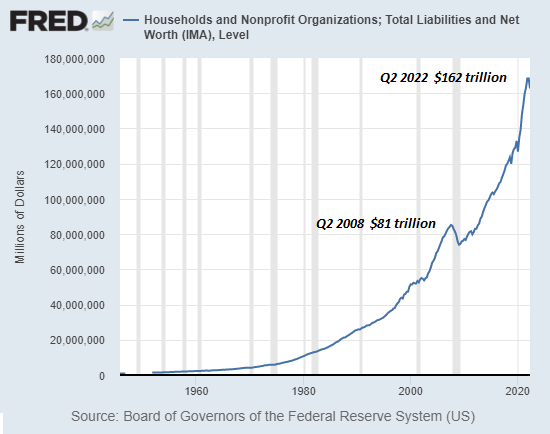
Sorry, but global bankruptcy is already baked in. Too much debt has been piled on phantom-collateral and income streams derived from bubble assets rising (for example, capital gains, development taxes, etc.). The asymmetry is now so extreme that even a modest decline in asset valuations/collateral due to a garden-variety business-cycle recession of tightening financial conditions will trigger the collapse of The Everything Bubble and the mountain of global debt resting on the wind-blown sands of phantom collateral.

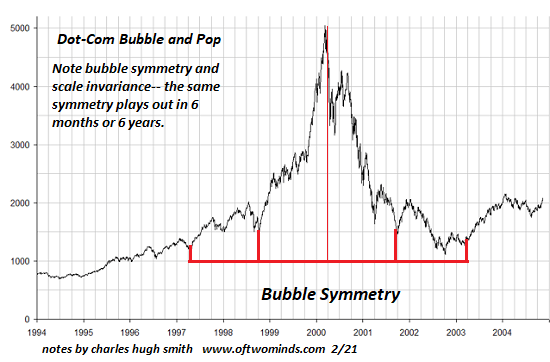
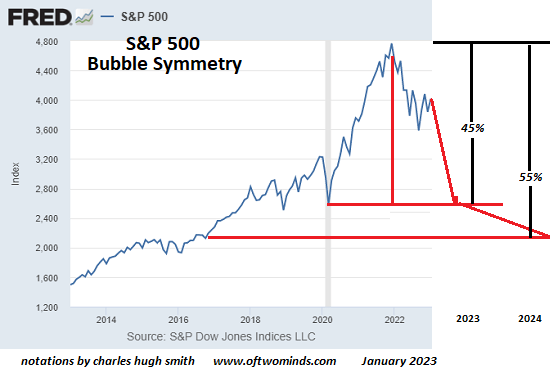
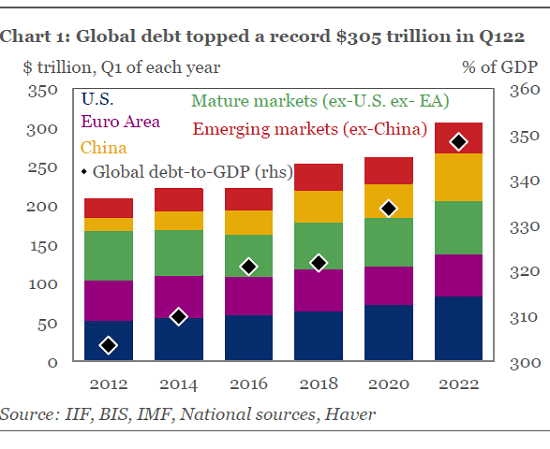
There are persuasive reasons to suspect global debt far exceeds the official level around $300 trillion, most saliently, the largely opaque shadow banking system. When assets roughly double in a few years, bubble symmetry suggests that valuations will decline back to the starting point of the bubble in roughly the same time span.

The resulting erosion of collateral will collapse the global credit bubble, a repricing/reset that will bankrupt the global economy and financial system.

Bull or Bear? The Ultimate Source of Market Instability

By Charles Hugh Smith

Source: Of Two Minds

Market commentators tend to focus on Bulls and Bears and Federal Reserve policies as drivers of stock market gyrations, but there’s a far more profound dynamic working beneath these veneers: the forces of adaptation and evolution transforming the economy and society as conditions change.

While the general expectation is that the post-Covid economy “should” revert to the stability of 2019, this ignores what was already unraveling in 2019. The global economy experienced fundamental shifts in technology, production, energy, capital flows, labor, currencies and geopolitics in the past 25 years, and all these forces are not just in motion but accelerating in ways that are destabilizing the status quo.

The necessity of adaptation and evolution can be summed up very simply: adapt or die. This is the natural state not just of Nature and species but of systems such as societies and economies. Those which cling on to failing models stagnate and decay, while those which embrace dissent, transparency and a constant churn of experimentation and trial-and-error will adapt and evolve and emerge stronger and more adaptable.

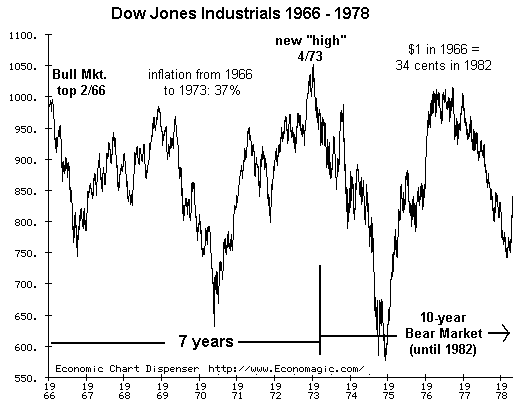
The US economy went through a comparable period of instability and forced adaptation in the 1970s, a dynamic I explored in The Forgotten History of the 1970s (January 13, 2023). Everyone benefiting from the status quo arrangements fought the much-needed changes tooth and nail, and so progress was uneven. Transitioning to a more efficient and responsive industrial base required tremendous capital investments and scaling up new technologies.

The transition is more costly and takes more time than we would like; the 1970s transition took about a decade. We can anticipate a similar scale of capital investment and time will be needed for this structural adaptation.

As the chart below illustrates, the 1970s was characterized by high inflation and big swings up and down in the stock market. Successful adaptations generated hope for quick recovery, while lagging adaptations tempered the hope with painful realities.

Again, it is likely that the decade ahead will track this same general dynamic of big swings generated by hope that the worst is over and the realities that progress is only partial and instability still reigns.

Everyone wants a trend they can trade for effortless gains. That may no longer be realistic.

The GATHERING Storm in Ukraine Spells Doom for the West

Photo by by Adam Brummett

By Col. Douglas MacGregor

Source: Information Clearing House

The crisis of American national power has begun. America’s economy is tipping over, and Western financial markets are quietly panicking. Imperiled by rising interest rates, mortgage-backed securities and U.S. Treasuries are losing their value. The market’s proverbial “vibes”—feelings, emotions, beliefs, and psychological penchants—suggest a dark turn is underway inside the American economy.

American national power is measured as much by American military capability as by economic potential and performance. The growing realization that American and European military-industrial capacity cannot keep up with Ukrainian demands for ammunition and equipment is an ominous signal to send during a proxy war that Washington insists its Ukrainian surrogate is winning.

Russian economy-of-force operations in southern Ukraine appear to have successfully ground down attacking Ukrainian forces with the minimal expenditure of Russian lives and resources. While Russia’s implementation of attrition warfare worked brilliantly, Russia mobilized its reserves of men and equipment to field a force that is several magnitudes larger and significantly more lethal than it was a year ago.

Russia’s massive arsenal of artillery systems including rockets, missiles, and drones linked to overhead surveillance platforms converted Ukrainian soldiers fighting to retain the northern edge of the Donbas into pop-up targets. How many Ukrainian soldiers have died is unknown, but one recent estimate wagers between 150,000-200,000 Ukrainians have been killed in action since the war began, while another estimates about 250,000.

Given the glaring weakness of NATO members’ ground, air, and air defense forces, an unwanted war with Russia could easily bring hundreds of thousands of Russian Troops to the Polish border, NATO’s Eastern Frontier. This is not an outcome Washington promised its European allies, but it’s now a real possibility.

In contrast to the Soviet Union’s hamfisted and ideologically driven foreign policymaking and execution, contemporary Russia has skillfully cultivated support for its cause in Latin America, Africa, the Middle East, and South Asia. The fact that the West’s economic sanctions damaged the U.S. and European economies while turning the Russian ruble into one of the international system’s strongest currencies has hardly enhanced Washington’s global standing.

Biden’s policy of forcibly pushing NATO to Russia’s borders forged a strong commonality of security and trade interests between Moscow and Beijing that is attracting strategic partners in South Asia like India, and partners like Brazil in Latin America. The global economic implications for the emerging Russo-Chinese axis and their planned industrial revolution for some 3.9 billion people in the Shanghai Cooperation Organization (SCO) are profound.

In sum, Washington’s military strategy to weaken, isolate, or even destroy Russia is a colossal failure and the failure puts Washington’s proxy war with Russia on a truly dangerous path. To press on, undeterred in the face of Ukraine’s descent into oblivion, ignores three metastasizing threats: 1. Persistently high inflation and rising interest rates that signal economic weakness. (The first American bank failure since 2020 is a reminder of U.S. financial fragility.) 2. The threat to stability and prosperity inside European societies already reeling from several waves of unwanted refugees/migrants. 3. The threat of a wider European war.

Inside presidential administrations, there are always competing factions urging the president to adopt a particular course of action. Observers on the outside seldom know with certainty which faction exerts the most influence, but there are figures in the Biden administration seeking an off-ramp from involvement in Ukraine. Even Secretary of State Antony Blinken, a rabid supporter of the proxy war with Moscow, recognizes that Ukrainian President Volodymyr Zelensky’s demand that the West help him recapture Crimea is a red line for Putin that might lead to a dramatic escalation from Moscow.

Backing down from the Biden administration’s malignant and asinine demands for a humiliating Russian withdrawal from eastern Ukraine before peace talks can convene is a step Washington refuses to take. Yet it must be taken. The higher interest rates rise, and the more Washington spends at home and abroad to prosecute the war in Ukraine, the closer American society moves toward internal political and social turmoil. These are dangerous conditions for any republic.

From all the wreckage and confusion of the last two years, there emerges one undeniable truth. Most Americans are right to be distrustful of and dissatisfied with their government. President Biden comes across as a cardboard cut-out, a stand-in for ideological fanatics in his administration, people that see executive power as the means to silence political opposition and retain permanent control of the federal government.

Americans are not fools. They know that members of Congress flagrantly trade stocks based on inside information, creating conflicts of interest that would land most citizens in jail. They also know that since 1965 Washington led them into a series of failed military interventions that severely weakened American political, economic, and military power.

Far too many Americans believe they have had no real national leadership since January 21, 2021. It is high time the Biden administration found an off-ramp designed to extricate Washington, D.C., from its proxy Ukrainian war against Russia. It will not be easy. Liberal internationalism or, in its modern guise, “moralizing globalism,” makes prudent diplomacy arduous, but now is the time. In Eastern Europe, the spring rains present both Russian and Ukrainian ground forces with a sea of mud that severely impedes movement. But the Russian High Command is preparing to ensure that when the ground dries and Russian ground forces attack, the operations will achieve an unambiguous decision, making it clear that Washington and its supporters have no chance to rescue the dying regime in Kiev. From then on, negotiations will be extremely difficult, if not impossible.

Related Video:

Send in the Clowns

Yellen and Garland perform back-to-back surprise visits to Ukraine

By Philip Giraldi

Source: The Unz Review

Sometimes I think that the script being used by the Biden Administration to manage its foreign and national security policies has been written by George Orwell, though I am not sure if it based on 1984 or Animal Farm. Maybe it is a combination of the two. Either way, it would help explain why there is something seriously wrong here. For example, at the end of February Congress, confronted by a debt ceiling, began discussing cutting Medicare and Social Security while more recently a banking sector crisis seems to be developing so Treasury Secretary Janet Yellen decided to go off doing photo-ops in Kiev embracing Ukraine’s President Volodymyr Zelensky shortly after handing him the keys to the US economy. She explained to Zelensky how the White House had approved an additional $12 billion in aid to Ukraine during the previous week, including $2 billion for the military and $10 billion to support Zelensky’s government and other infrastructure needs. The US Treasury is now de facto the source of the Ukraine government’s entire annual budget. In addition, Yellen described glowingly how the Treasury and State Departments will implement a new round of sanctions against more than 200 entities and individuals with ties to Russia’s military, high-technology industries, and its metals and mining sectors. The US Department of Commerce is also enforcing export restrictions on materials and technology, including semiconductors, sold by American companies to customers in Russia and China.

In defense of her grand mission, Yellen penned an op-ed for the always compliant New York Times explaining the importance of Ukraine to the United States. She wrote how in Ukraine “…Russia’s barbaric attacks continue — but Kyiv stands strong and free. Ukraine’s heroic resistance is the direct product of the courage and resilience of Ukraine’s military, leadership and people. But President Volodymyr Zelensky and the Ukrainians would be the first to admit that they can’t do this alone — and that international support is crucial to sustaining their resistance. I’m in Kyiv to reaffirm our unwavering support of the Ukrainian people. Mr. Putin is counting on our global coalition’s resolve to wane, which he thinks will give him the upper hand in the war. But he is wrong. As President Biden said here last week, America will stand with Ukraine for as long as it takes… Ukrainians are fighting for their lives on the front lines of the free world. Today, and every day, they deserve America’s unyielding support.”

The Yellen op-ed drones on with a lie so large that it is astonishing that the New York Times would even print it: “When confronted with scenes of brutality and oppression, Americans have always been quick to stand up and do the right thing. Our strength as a nation comes from our commitment to our ideals — and our capacity to see in others the same desires that animated our own struggles for freedom and justice.” But then she tops that with assurances from “President Zelensky, [who] has pledged to use these funds in the ‘most responsible way.’ We welcome this commitment, as well as his longstanding agenda to strengthen good governance in Ukraine.” Huh?

And here is Yellen’s version of “Why We Fight!”: “Our support is motivated, first and foremost, by a moral duty to come to the aid of a people under attack. We also know that, as President Zelensky has said, our assistance is not charity. It’s an investment in ‘global security and democracy.’ Let’s look at the strategic impact of our support for Ukraine so far. Mr. Putin’s war poses a direct threat to European security, as well as to the laws and values that underpin the rules-based international system.”

So, Americans have a “moral duty” apparently up to and including sending their sons and daughters to die supporting Ukraine. And ah yes, it’s all about the “free” world, democracy and the notorious rules based international system! Has anyone yet cited Hegel’s observation that the President Joe Biden Administration’s foreign policy has already “repeated itself, first as a tragedy in Afghanistan, second as a farce”? Meanwhile one suspects Zelensky was laughing all the way to the bank as Yellen disappeared over the horizon to come up with the cash, as that old expression goes, and he probably already has one of his buddies shopping for a new villa on the French Riviera to supplement his other real estate! But wait! The story became even more exciting the following week, involving another visit to Mr. Z by America’s nearly invisible Attorney General Merrick Garland, a man who can literally look Z in the eye as they are both very short. Garland is generally engaged in chasing white supremacists and requiring all new FBI hires to learn all about how to identify and pursue antisemites, but he has made two trips to Kiev to meet mano-a-mano with the brave olive drab t-shirt clad warrior who is already being beatified as the twenty-first century’s Winston Churchill.

Garland was in town to do the other thing the engages his sense of law and order, which is to set up a tribunal to arrest, prosecute and punish Russian war criminals after Ukraine emerges triumphant from its conflict with the unimaginably evil President Vladimir Putin. It would be modeled on the Nuremberg Tribunals that tried leading Nazis after the Second World War, and Garland has cited his family’s escape from the so-called holocaust to explain why he is intent on personally being involved in delivering what he describes as “justice.” A Justice Department spokeswoman described Garland’s mission as being in Kiev to personally “reaffirm America’s commitment to help hold Russia responsible for war crimes committed in its unjust and unprovoked invasion against its sovereign neighbor.”

Garland had several meetings with President Volodymyr Zelensky and foreign law enforcement officials including Ukrainian Prosecutor General Andriy Kostin while attending what was billed as the “United for Justice Conference.” Zelensky elaborated that the purpose of the conference was to hold Russia’s leadership accountable for the alleged atrocities carried out by its army. “The main issue of all these meetings is accountability,” he said. The US Justice Department is reportedly actively engaged in the gathering of evidence to indict the Russians. During Garland’s first visit to Ukraine in June 2022 he announced the appointment of Eli Rosenbaum, an Office of Special Investigations prosecutor best known for going after former Nazis, to direct American efforts to identify and track Russian war criminals.

Garland laid it on thick, as was expected from someone responsible for prosecuting the rest of the world when it steps out of line. He told his hosts that “Just over twelve months ago, invading Russian forces began committing atrocities at the largest scale in any armed conflict since the Second World War. We are here today in Ukraine to speak clearly, and with one voice: the perpetrators of those crimes will not get away with them. In addition to our work in partnership with Ukraine and the international community, the United States has also opened criminal investigations into war crimes in Ukraine that may violate US law.” He concluded by throwing out the complete bullshit party line much beloved by Joe Biden and Tony Blinken, that “The United States recognizes that what happens here in Ukraine will have a direct impact on the strength of our own democracy.”

Of course, there is more than a little bit of irony in all this, not to mention top level hypocrisy, as the United States has killed more people directly or indirectly while committing more crimes against humanity dished out in various ways over the past twenty years than any other country, except, predictably, Israel, which currently is committing crimes against humanity on a nearly daily basis. Curiously, however, the normally tone-deaf White House and Pentagon seem to understand, on a certain level, that opening up Pandora’s box might not be a good idea when it comes to war crimes. Last week Secretary of Defense Lloyd Austin refused to share US information on alleged Russian crimes with the International Criminal Court (ICC) in the Hague. The Pentagon is blocking the Biden administration from sharing evidence with the ICC collected by American intelligence agencies regarding Russian activities in Ukraine because helping the court investigate Russians might set a precedent that could help pave the way for it to prosecute Americans. Washington does not recognize the ICC, fearing that it might well seek to examine the sorry record of US military crimes in Asia and Africa. Israel similarly does to recognize the court for roughly the same reason.

So here we are, two top level officials from the Biden regime sneak into Kiev to give an arch crook money and unlimited moral support, together with a pledge that more cash is on the way as are arms and war crimes tribunals await those nasty Russians. And guess what? It is all packaged as being good for America! This sounds like a song that was sung previously in places like Vietnam, Iraq and Afghanistan and it was a tissue of lies then just as it is now. Yellen ought to have stayed home to tend to the banking system and should be giving the billions of dollars earmarked for Zelensky back to the American people. If Garland wants to investigate anyone it should be the Pentagon, the intelligence agencies, and Congress. And yes, his own FBI! And don’t forget how the Bidens and Clintons became multi-millionaires! And then there is the destruction of Nord Stream. Funny how every time one turns over a rock in and around the US government something really smelly surfaces.

A Fed-Issued Digital Currency: The Mark of the Beast

A Fed-issued digital currency would be no more in our interests than the current dollar system.

By Jeremy R. Hammond

Source: Jeremy R. Hammond Blog

China’s ‘Social Credit’ System

“And he causeth all, both small and great, rich and poor, free and bond, to receive a mark in their right hand, or in their foreheads: And that no man might buy or sell, save he that had the mark, or the name of the beast, or the number of his name.” — Revelation 13:16-17

In China, as you have likely heard, the government has been experimenting with a “social credit” system aimed at giving politicians even greater control over people’s behavior. China was, of course, also the country whose authoritarian “lockdown” response to the outbreak of SARS‑CoV‑2—the coronavirus that causes COVID‑19 and was likely engineered in a Chinese lab with US government funding—was pointed to as a model for the rest of the world to follow by the World Health Organization (WHO).

The WHO has since been aiming to acquire even more centralized global authority to issue diktats in the event of another pandemic, such as implementation of “lockdown” measures that might include travel restrictions, prevention of employment, and vaccine mandates or passport systems.

As of December 2020, around the time of the initial outbreak of the virus in Wuhan, China, social credit laws and regulations had been implemented in an estimated 80 percent of the country.

Naturally, the system is characterized by its proponents as a benevolent means to reward socially responsible people while denying privileges to unsavory and untrustworthy characters and businesses. But you and I both recognize the grave threat posed by politicians wielding this type of power and control over the population. It is an obvious threat to privacy and liberty.

The people of China regrettably but unsurprisingly appear to have welcomed this system, although the perception of public approval might be largely an artifact of people being afraid to publicly criticize the system lest their names be placed on one of the government’s “blacklists”.

As with any law or government policy, we should view it through the lens of how such power could be used as opposed to how politicians say they intend to use it.

A glimpse of how it could be used is the city of Rongcheng’s prohibition on “spreading harmful information”, violations of which could result in subtraction of points off residents’ social credit scores.

Such prohibitions must be seen in light of how governments are in the habit of interpreting “harmful information” as any information that does not align with the adopted political agenda. In the US during the COVID‑19 pandemic, there has been no greater purveyor of misinformation than the US government itself.

According to MIT Technology Review, the central government actually pressed the city to scale back the threat to individual liberty posed by its social credit system, such as enabling residents to opt-out. “The Chinese government did emphasize that all social-credit-related punishment has to adhere to existing laws,” the Review states, “but laws themselves can be unjust in the first place.”

The takeaway from that article is that “the social credit system does not (yet) exemplify abuse of advanced technologies like artificial intelligence”. But that’s no reason for the citizenry to consent to the implementation of systems that are conducive to extreme governmental abuses of authority.

A July 2019 article in Wired magazine related the example of Liu Hu, a journalist who was arrested, fined, and blacklisted, reportedly for writing about censorship and government corruption. He found himself on a “List of Dishonest Persons Subject to Enforcement by the Supreme People’s Court as ‘not qualified’ to buy a plane ticket, and banned from travelling some train lines, buying property, or taking out a loan.”

A more recent Newsweek article appropriately describes the system this way:

On an individual level, the government seeks to instill in the public an increased sense of morality to discourage everything from fraud and plagiarism to counterfeit goods and petty crime. But a system to make individual actions more transparent would necessitate the creation of tools to monitor all aspects of life. Social control, if not the original aim, could be an inevitable consequence, researchers say.

. . . While China’s vision of the system has yet to emerge as a dystopian tool for control driven by big data, there are real concerns about the way personal information is to be collected and processed to create social credit profiles, which could have lasting implications for individuals.

An untrustworthy government has no place dictating to its citizens what types of behaviors should be regarded as creating or breaking trust.

Human Rights Watch provides the example of lawyer Li Xioaolin, who was denied a plane ticket home while away on a work trip inside China because his name was on a blacklist of “untrustworthy” people in relation to a years-old court-related issue that he thought he had resolved.

According to Human Rights Watch, journalist Liu Hu was punished not for criticizing the government and exposing corruption but for having offered an apology that the government deemed “insincere” after losing a defamation case for publishing an article alleging that someone was an extortionist. Still, the organization notes, in both cases, “penalties were exacted in wildly arbitrary and unaccountable manners.” Additionally, “the courts failed to notify them, leaving them no chance to contest their treatment.”

According to the human rights organization, between 2013 and 2017, the Chinese government imposed more than seven million punishments to people for failing to carry out local court orders, which punishments have included publicly naming and shaming individuals and barring them from flights and trains.

After experiencing the totalitarianism of the disastrously harmful lockdown regimes and the accompanying efforts to coerce the population into accepting COVID‑19 vaccines and to censor truths countering the government’s incessant lies (I was permanently banned from LinkedIn, for example, for accurately reporting that the CDC’s claim that COVID‑19 vaccines provide greater protection against SARS‑CoV‑2 infection than natural immunity was a bald-faced lie), it should not be too difficult to imagine such a system being dangerously used to silence critics and punish dissenters so that whatever ruling regime can continue its crimes against humanity unobstructed.

The idea of a “social credit” score, of course, is inherently tied to the idea of central banking. In the US, the central bank is the Federal Reserve, a government-legislated private monopoly over the supply of currency. Increasingly, there is talk of a central bank digital currency, heightening concerns about the government having the means to exercise power over us and control our behavior.

“Project Hamilton”

As an example of how the Fed is exploring the idea of adopting a digital currency, the Massachusetts Institute of Technology (MIT) has teamed up with the Federal Reserve Bank of Boston under the appropriately named “Project Hamilton”.

Alexander Hamilton, of course, was instrumental in the adoption of central banking by the US government, famously at odds with Thomas Jefferson, who rightly opposed the idea and warned about the dangers inherent in such an institution. Jefferson appeared to hold the view that the means of exchange and interest rates ought to be determined by the market as opposed to being determined by fiat by a roomful of central planners.

Jefferson accurately foresaw how the government would use the central bank to pay for its spending as an alternative to raising taxes directly, and how the debt that would consequently be incurred by this uncontrolled spending would ultimately be borne by future generations.

In a letter to John Wayles Eppes in 1813, for example, Jefferson wrote:

I have said that the taxes should be continued by annual or biennial re-enactments; because a constant hold, by the nation, of the strings of the public purse, is a salutary restraint, from which an honest government ought not to wish, nor a corrupt one to be permitted, to be free. No tax should ever be yielded for longer than that of the Congress granting it, except when pledged for the reimbursement of a loan.

. . . Bank-paper must be suppressed, and the circulating medium must be restored to the nation to whom it belongs. . . . Treasury bills, bottomed on taxes, bearing, or not bearing interest, as may be found necessary, thrown into circulation, will take the place of so much gold & silver, which last, when crouded, will find an efflux into other countries, and thus keep the quantum of medium at its salutary level.

In a letter to John Taylor in 1816, Jefferson described central banking as rightly “reprobated” and as “a blot left in all our constitutions, which, if not covered, will end in their destruction”. He wrote, “And I sincerely believe with you, that banking establishments are more dangerous than standing armies; & that the principle of spending money to be paid by posterity, under the name of funding, is but swindling futurity on a large scale”.

Jefferson viewed the federal government as having no authority to institute a central banking system. As he wrote in 1791, “The incorporation of a bank, and the powers assumed by this bill, have not, in my opinion, been delegated to the United States, by the Constitution.”

The stated aim of Project Hamilton “is to investigate the technical feasibility of a general purpose central bank digital currency (CBDC) that could be used by an economy the size of the United States and to gain a hands-on understanding of a CBDC’s technical challenges, opportunities, risks, and tradeoffs.”

The project is part of MIT’s “Digital Currency Initiative”, which is aimed at bringing minds together “to conduct the research necessary to support the development of digital currency and blockchain technology.”

The aim of the collaboration with the Federal Reserve Bank of Boston has been “to develop a hypothetical CBDC.” MIT describes the possibility of a “central-bank-issued digital currency” as “a unique opportunity to address challenges in our existing payments system and design an economy that is more resilient, participatory, and open.”

We can reasonably assume that Thomas Jefferson, were he alive today, would disagree and view the idea as anathema to both a sound economy and a free society.

Noting that it was Alexander Hamilton “who laid the foundation for a U.S. central bank”, a project white paper published in February 2022 concluded that it is “critical” for research to continue for “achieving goals for a CBDC.” That is, it is not a question of whether the Fed should adopt a digital currency but how and when.

Biden’s Executive Order and Project Lithium

In January 2022, the Federal Reserve Board of Governors similarly published a paper titled “Money and Payments: The U.S. Dollar in the Age of Digital Transformation”, the aim of which was “to foster a broad and transparent public dialogue about CBDCs in general, and about the potential benefits and risks of a U.S. CBDC.”

Then in March 2022 President Joe Biden signed an “Executive Order on Ensuring Responsible Development of Digital Assets”, which declares the supposed need for the US government to “regulate” digital assets, including for the purpose of preventing circumvention of its sanctions regimes—in which context we might remember the US government’s criminal sanctions regime against Iraq in the 1990s and how Secretary of State Madeleine Albright insisted that the “price” of half-a-million dead Iraqi children was “worth it”.

The executive order, number 14067, describes how the government has an interest in maintaining the US dollar’s “central role” in “the global financial system”, which refers to the use of the dollar as a reserve currency. To that end, the order states, the Biden administration “places the highest urgency on research and development efforts into the potential design and deployment options of a United States CBDC.”

The White House is intent on determining what actions would be required to launch such a currency “if doing so is deemed to be in the national interest”. Of course, as the example of half a million excess childhood deaths in Iraq due to sanctions once again illustrates, determining just what is in the “national interest” is not a task that government policymakers seem particularly good at.

The lockdown measures, which utterly failed to project those at highest risk from COVID-19 while causing devastating harms globally, are another useful example of the ineptitude of policymakers when it comes to making decision that are in our best interests.

Following Biden’s executive order, in April 2022, the Depository Trust & Clearing Corporation (DTCC) announced “the development of the first prototype to explore how a CBDC might operate”. This endeavor was given the name “Project Lithium”, on which the DTCC is collaborating with The Digital Dollar Project (DDP), an organization that advocates US leadership “in advancing a CBDC” and encourages the executive branch of government “to support appropriate legislation” to authorize further research and development of such a currency.

The DDP published a white paper in May 2020 concluding that the US government “should, and must, take a leadership role in this new wave of digital innovation” and preserve the dollar’s role as “the world’s primary reserve currency” by working toward “the launch of a tokenized digital dollar”.

End the Fed!

Naturally, advocates of a central bank digital currency describe the aims of such a development as benign, just as the Federal Reserve system was originally established on the pretext that having a more centrally controlled economy would benefit all.

In truth, the Federal Reserve system serves the interests of the financially and political elite at the expense of the rest of us. Central banking itself, whatever the form of currency issued, is harmful to the economy because central banks essentially exist to effect a transfer of wealth upward. Schools of economic thought like Keynesianism and Modern Monetary Theory (MMT), which I like to refer to as “Keynesianism 2.0”, exist to justify the existence of central banks.

The Fed, a government-legislated private monopoly over the currency supply, enables the government to spend on whatever, including endless wars (euphemistically called “defense” spending), but the means of paying for it all, the creation of “money” out of thin air, results in upward wealth transfer. The elite classes who receive the newly created dollars first are able to spend it for purchasing assets prior to the resulting devaluation that manifests in the form of higher prices for goods and services.

Monetary inflation robs us of our purchasing power and so serves as a hidden tax. It also causes widespread malinvestment and major economic distortions like the housing bubble that burst in 2007 and precipitated the 2008 financial crisis, not to mention the current housing bubble and general asset inflation. (For more on that, see my book Ron Paul vs. Paul Krugman: Austrian vs. Keynesian Economics in the Financial Crisis.)

We are meant to believe we need centralized control over the currency supply for economic growth, but central banks instead serve to impede real economic growth in favor of enabling the government’s endlessly wasteful and harmful spending.

The chief appeal of a cryptocurrency like Bitcoin is that it is a decentralized medium of exchange that serves to compete with central-bank-issued currency and potentially enables people to opt-out of the exploitative dollar system. The idea of a “legal tender” digital currency in the hands of the bankers and politicians is anathema to the whole concept of a peer-to-peer electronic cash system.

One might argue that the replacement of print dollars with a centrally controlled cryptocurrency is just a natural evolution from the current system, in which exchange of actual cash is becoming less frequent and most transactions occur digitally anyway. We should keep up with the times and adapt to advancements in technology, the argument goes.

However, this overlooks the more fundamental issue that we should not have central banks in the first place. The way I see it, the movement towards replacing the US dollar with a Fed-issued cryptocurrency is far from benign. We have seen in the past few years just how far government policymakers are willing to go to exercise authoritarian control over us.

To illustrate, remember how businesses deemed “non-essential” were shut down by clueless bureaucrats under threat of punishment, and how coercive measures including mandates and travel restrictions were used to get people to accept COVID‑19 vaccinations?

With the World Economic Forum (WEF) having announced its “Great Reset” agenda, which ties directly into the global mass vaccination agenda, the advocates of greater centralized control over society do not deserve the benefit of our doubt about their intentions. It would be naïve to think that if the authoritarians in government had even greater means to penalize citizens for disobedience to the regime that they would not attempt to use it. It is safer to assume that if they can utilize a digital currency to control our behavior, they will.

It seems therefore imperative to oppose a centralized digital currency, but we also need to go further than that and oppose the existence of the Federal Reserve altogether. Whatever the form of currency, centralized economic planning is an abomination and anathema to the principle of a free market.

“And I heard another voice from heaven, saying, Come out of her, my people, that ye be not partakers of her sins, and that ye receive not of her plagues.” — Revelation 18:4

How Covid lockdowns primed the current financial crisis

By Christian Parenti

Source: The Grayzone

The lockdowns and the stimulus required to keep the economy alive helped drive inflation. Then the Fed jacked up interest rates. And all hell broke loose.

On Friday March 10th, 2023, Silicon Valley Bank (SVB) died of Covid. Alright, it’s a little more complicated than that, but Covid lockdowns followed by massive government stimulus were a critical – and massively under-acknowledged – factor in propelling the bank’s demise.

At the heart of the crisis is the gigantic pile of low-interest debt that was issued during the height of the pandemic. While private-sector pandemic-era debt like corporate bonds also soared, US government debt like Treasury bonds piled up.

In a nutshell, during the pandemic the government issued enormous amounts of extremely low interest government debt — about $4.2 trillion of it. But now interest rates, including on government debt, are higher than they have been in 15 years and investors are dumping their old low-interest debt. As they dump, the resale price of the old debt goes down. The more it declines, the more investors want to dump. And thus, a panic is born. 

To understand the problem fully, the question of US government debt has to be put into its larger context, which is: the pandemic response as a whole.

When news of the Covid virus first broke in December 2019, the 2 Year Treasury bond was being offered at 1.64% interest; the 10 year was at about 1.80%, and the resale value of such bonds on secondary markets was strong. Then, in March 2020, as Covid cases and deaths spiked, the US began to shutter its economy with panicked lockdowns that were supposed to “flatten the curve” or slow the spread of the virus and thus protect the hospitals. But Covid was politicized and the lockdowns were extended.  

As the lockdowns dragged on, the US economy began to collapse, shrinking at a record-shattering annualized rate of 31.4% during the second quarter of fiscal year 2020.

To avoid total economic devastation, the federal government began massive debt-financed spending. In March 2020, Trump signed into law the $2.2 trillion economic stimulus bill the CARES Act, or Coronavirus Aid, Relief, and Economic Security. Then, in March 2021, Biden signed the American Rescue Plan Act which contained $1.9 trillion more in Covid relief. Finally, in April 2021, another trillion or so of Covid relief arrived in the Consolidated Appropriations Act. 

Thanks to these laws, every industry and most people received public money. There was increased and extended unemployment payments, as well as the so-called “stimmy checks” or stimulus payments to everyone earning under $75,000 a year (about half the population). The Paycheck Protection Program spent almost a trillion dollars. The Provider Relief Fund doled out $178 billion to the healthcare system. 

All this debt spending kept millions of people in their homes, and helped feed, employ, and care for millions more. The measures allowed hundreds of thousands of businesses to stay afloat even as many thousands of others went under. The impact of the spending on Americans’ well-being was generally positive. For a moment, the US child poverty rate was cut in half, falling to 5.2%. 

But the economically destructive lockdowns were not necessary and did not work. Covid fanatics maintain that the lockdowns were unavoidable because the virus is so deadly. That, however, is uninformed. Last year I explained in detail how the Lockdown Left got the Covid crisis wrong. Not a single critic has challenged any of the facts I presented so there is little point in rehashing them all here. 

Those who advocated an alternative to ham-fisted lockdowns, like the authors of the Great Barrington Declaration, which called for “focused protection” of vulnerable groups like the elderly, were viciously targeted in a reputation destruction campaign covertly orchestrated by former NIH director Francis Collins and de facto Covid czar Anthony Fauci. Never mind that the document’s authors were three eminently qualified scientists: Sunetra Gupta, professor of Theoretical Epidemiology at Oxford University; Jay Bhattacharya, professor of medicine at Stanford; and Martin Kulldorff, formerly a professor of medicine and biostatistics at Harvard. They were portrayed as far-right cranks who were almost eager to see millions die. But now, they have been vindicated.

Ultimately, the federal government spent $4.2 trillion propping up the economy that it was simultaneously choking to death with lockdowns. These two contradictory pressures laid the groundwork for the recent bank failures. Government mandated lockdowns hit the economy like a body blow. Factories closed, small businesses went under, ports and logistic hubs reduced operations, and about 2 million mostly older workers simply resigned. But at the same time, the federal government injected vast amounts of purchasing power into the economy, thus boosting consumption.

These two, contradictory government moves imposed almost unbearable pressure on supply chains. As shortages mounted, prices began to surge. Put simply: lockdowns plus stimulus equaled inflation.

Consider just one of the most important bottlenecks in the whole economy. During lockdown, many commercial driving license schools were closed. This helped create a shortage of about 80,000 truckers. If trucks do not roll supplies run low and prices go up.

At first, the official line on inflation – parroted by the Lockdown Left – maintained that inflation was “transitory.” But it was not. Inflation peaked at 9.1% in June 2022 while wage growth lagged at about 5%. In April 2020 during the worst of the lockdown, the Federal Reserve’s Federal Funds Rate sank to 0.5%. By February 2022, it had only risen to 0.8%.  

Meanwhile, inflation was surging. By February 2022, inflation had reached 7.9%. Only then did the Fed, in an effort to tamp down prices, begin raising interest rates at the fastest pace rate in its history. The federal Funds rate was around 4.57% when SVB went under. Perhaps a massive wave of taxation could have soaked up enough liquidity to have helped cool prices, but that was a political impossibility. The more politically palatable response in Washington was for the Federal Reserve to raise interest rates. 

Herein lies the problem. During the height of the lockdowns, banks bought up enormous amounts of government debt. As the Wall Street Journal put it: “U.S. banks are suffering the aftereffects of a Covid-era deposit boom that left them awash in cash that they needed to put to work. Domestic deposits at federally insured banks rose 38% from the end of 2019 to the end of 2021, FDIC data show. Over the same period, total loans rose 7%, leaving many institutions with large amounts of cash to deploy in securities as interest rates were near record lows.” Awash in deposits with not enough demand for loans, the banks bought US government securities. Their purchases surged 53% between 2019 and the end of 2021, to a total of $4.58 trillion, according to Fed data reported by the Wall Street Journal.

Because so much debt was being issued, it carried super-low interest rates. For example, on July 27, 2020, the 10 Year Treasury was offered at an annual interest rate of only 0.55%. This is fine if you are the borrower of money, but if you are the lender (that is to say, a bank giving the federal government money in exchange for a Treasury bond), it means your income stream will be reduced to a mere trickle. If inflation rises, it essentially disappears. 

As the yield on new government debt reached toward 5% and inflation hung stubbornly at around 6.4%, all of that old, low-interest, pandemic-era debt started to look like garbage and banks began unloading it. The more that banks dumped old debt, the less value that debt had on resale markets. The lower its resale value, the more the banks wanted to dump it. SVB lost almost $2 billion selling off Government securities. And when they announced the loss, their stock price plunged by 60%. 

At the same time, many of SVB’s clients were withdrawing money. This was in part because rising interest rates made borrowing new money more expensive and thus incentivized the use of savings in day-to-day business operations. Also, higher inflation and higher interest rates made low-earning bank deposits less attractive and compelled depositors to redeploy their surplus capital towards higher-earning investments. So, just as SVB needed cash, deposits were evaporating.

By the end of the week of March 10, the four biggest banks in the United States had lost $51 billion because of their panicked dumping of pandemic-era debt. Right after SVB was taken under government control, state regulators closed the New York-based Signature Bank. Before the weekend was over the Federal Reserve announced the creation of a new lending facility that would ensure that “banks have the ability to meet the needs of all their depositors.” Furthermore, the Fed said it was “prepared to address any liquidity pressures that may arise.”

It would seem that the federal government is ready to execute another de facto partial nationalization of US banking, just as they did in 2008 via emergency “cash injections” and then the Troubled Assets Relief Program (TARP). In this current crisis, banks can avoid losses on their low-interest debt if they do not sell it before its maturity. For that to happen, the banks need money. The Fed has said it will pour enormous amounts of money into the banks while all of the relevant officials have proclaimed that the banking system will somehow pay for this. All of this will almost certainly mean even more government debt will be issued. 

Already, interest payments on the federal debt are one of the largest single items in the US budget – set to reach $400 billion this year. That is almost half as much as the grotesquely overdeveloped military budget. By comparison, federal spending on housing is only $78 billion.

Shoring up the banking system is necessary because if it collapses, the whole economy goes with it. At least in the short term, Americans are hostages of the US financial system. But government intervention without any new regulations and taxes upon the financial sector will likely mean more inflation and a bigger financial bubble. By refusing to properly tax the top 1%, the federal government also commits itself to more austerity for the many and more welfare for the rich, because rising government debt means a rising portion of our taxes must go toward interest payments. 

This system of crisis-prone, hyper-financialized capitalism seems ever more like a junkie. If it doesn’t get its regular fix of public sector help, it will simply collapse and die. 

Even if the federal government can stanch the current crisis, the pandemic debt story is global and very likely to cause trouble for some time to come. As a 2021 report by the World Bank put it: “The debt buildup during the pandemic-induced global recession of 2020 was the largest in several decades. This was true for all types of debt—total, government, and private debt; and advanced-economy and EMDE [emerging market and developing economy] debt; external and domestic debt. In 2020, total global debt reached 263 percent of GDP and global government debt 99 percent of GDP, their highest levels in half a century.” 

The US intelligentsia and its media elites are finally beginning to reckon with the impact of misguided and authoritarian lockdowns on student learning and the psychological and physical health of millions. But in all the discussion of the current bank runs, the pivotal role of lockdowns in priming the crisis remains overlooked.

Silicon Valley Bank Crisis: The Liquidity Crunch We Predicted Has Now Begun

A worker, middle, tells customers that the Silicon Valley Bank headquarters is closed on Friday, March 10, 2023, in Santa Clara, California. Silicon Valley Bank was shut down on Friday morning by California regulators and was put in control of the U.S. Federal Deposit Insurance Corporation. (Justin Sullivan/Getty Images/TNS)

By Brandon Smith

Source: Alt-Market.us

There has been an avalanche of information and numerous theories circulating the past few days about the fate of a bank in California know as SVB (Silicon Valley Bank). SVB was the 16th largest bank in the US until it abruptly failed and went into insolvency on March 10th. The impetus for the collapse of the bank is tied to a $2 billion liquidity loss on bond sales which caused the institution’s stock value to plummet over 60%, triggering a bank run by customers fearful of losing some or most of their deposits.

There are many fine articles out there covering the details of the SVB situation, but what I want to talk about more is the root of it all. The bank’s shortfalls are not really the cause of the crisis, they are a symptom of a wider liquidity drought that I predicted here at Alt-Market months ago, including the timing of the event.

First, though, let’s discuss the core issue, which is fiscal tightening and the Federal Reserve. In my article ‘The Fed’s Catch-22 Taper Is A Weapon, Not A Policy Error’, published in December of 2021, I noted that the Fed was on a clear path towards tightening into economic weakness, very similar to what they did in the early 1980s during the stagflation era and also somewhat similar to what they did at the onset of the Great Depression. Former Fed Chairman Ben Bernanke even openly admitted that the Fed caused the depression to spiral out of control due to their tightening policies.

In that same article I discussed the “yield curve” being a red flag for an incoming crisis:

…The central bank is the largest investor in US bonds. If the Fed raises interest rates into weakness and tapers asset purchases, then we may see a repeat of 2018 when the yield curve started to flatten. This means that short term treasury bonds will end up with the same yield as long term bonds and investment in long term bonds will fall.”

As of this past week the yield curve has been inverted, signaling a potential liquidity crunch. Both Jerome Powell (Fed Charman) and Janet Yellen (Treasury Secretary) have indicated that tightening policies will continue and that reducing inflation to 2% is the goal. Given the many trillions of dollars the Fed has pumped into the financial system in the past decade as well as the overall weakness of general economy, it would not take much QT to crush credit markets and by extension stock markets.

As I also noted in 2021:

We are now at that stage again where price inflation tied to money printing is clashing with the stock market’s complete reliance on stimulus to stay afloat. There are some that continue to claim the Fed will never sacrifice the markets by tapering. I say the Fed does not actually care, it is only waiting for the right time to pull the plug on the US economy.”

But is that time now?  I expanded on this analysis in my article ‘Major Economic Contraction Coming In 2023 – Followed By Even More Inflation’, published in December of 2022. I noted that:

This is the situation we are currently in today as 2022 comes to a close. The Fed is in the midst of a rather aggressive rate hike program in a “fight” against the stagflationary crisis that they created through years of fiat stimulus measures. The problem is that the higher interest rates are not bringing prices down, nor are they really slowing stock market speculation. Easy money has been too entrenched for far too long, which means a hard landing is the most likely scenario.”

I continued:

In the early 2000s the Fed had been engaged in artificially low interest rates which inflated the housing and derivatives bubble. In 2004, they shifted into a tightening process. Rates in 2004 were at 1% and by 2006 they rose to over 5%. This is when cracks began to appear in the credit structure, with 4.5% – 5.5% being the magic cutoff point before debt became too expensive for the system to continue the charade. By 2007/2008 the nation witnessed an exponential implosion of credit…”

Finally, I made my prediction for March/April of 2023:

Since nothing was actually fixed by the Fed back then, I will continue to use the 5% funds rate as a marker for when we will see another major contraction…The 1% excise tax added on top of a 5% Fed funds rate creates a 6% millstone on any money borrowed to finance future buybacks. This cost is going to be far too high and buybacks will falter. Meaning, stock markets will also stop, and drop. It will likely take two or three months before the tax and the rate hikes create a visible effect on markets. This would put our time frame for contraction around March or April of 2023.”

We are now in the middle of March and it appears that the first signs of liquidity crisis are bubbling to the surface with the insolvency of SVB and the shuttering of another institution in New York called Signature Bank.

Everything is tied back to liquidity. With higher rates, banks are hard-pressed to borrow from the Fed and companies are hard-pressed to borrow from banks. This means companies that were hiding financial weakness and exposure to bad investments using easy credit no longer have that option. They won’t be able to artificially support operations that are not profitable, they will have to abandon stock buybacks that make their shares appear valuable and they will have to initiate mass layoffs in order to protect their bottom line.

SVB is not quite Bear Stearns, but it is likely a canary in the coal mine, telling us what is about to happen on a wider scale. Many of their depositors were founded in venture capital fueled by easy credit, not to mention all the ESG related companies dependent on woke loans. That money is gone – It’s dead. Those businesses are quietly but quickly crumbling which also conjured a black hole for deposits within SVB. It’s a terribly destructive cycle. Surely, there are numerous other banks in the US in the same exact position.

I believe this is just the beginning of a liquidity and credit crisis that will combine with overt inflation to produce perhaps the biggest economic crash America has ever seen. SVB’s failure may not be THE initiator, only one among many. I suspect that in this scenario larger US banks may avoid the kind of credit crash that we saw with Bear Stearns and Lehman Brothers in 2008. But, contagion could still strike multiple mid-sized banks and the effects could be similar in a short period of time.

With all the news flooding the wire on SVB it’s easy to forget that all of this boils down to a single vital issue: The Fed’s stimulus measures created an economy utterly addicted to easy and cheap liquidity. Now, they have taken that easy money away. In light of the SVB crash, will the central bank reverse course on tightening, or will they continue forward and risk contagion?

For now, Janet Yellen and the Fed have implemented a limited backstop and a guarantee on deposits at SVB and Signature. This will theoretically prevent a “haircut” on depositor accounts and lure retail investors with dreams of endless stimulus.  It is a half-measure, though – Central bankers have to at least look like they are trying. 

SVB’s assets sit at around $200 billion and Signature’s assets are around $100 billion, but what about interbank exposure and what about the wider implications?  How many banks are barely scraping by to meet their liquidity obligations, and how many companies have evaporating deposits?  The backstop will do nothing to prevent a major contagion.

There are many financial tricks that might slow the pace of a credit crash, but not by much.  And, here’s the kicker – Unlike in 2008, the Fed has created a situation in which there is no escape. If they do pivot and return to systemic bailouts, stagflation will skyrocket even more. If they don’t use QE, then banks crash, companies crash and even bonds become untenable, which puts the world reserve status of the Dollar under threat. What does that lead to? More stagflation. In either case, rapidly rising prices on most necessities will be the consequence.

How long will this process take? It all depends on how the Fed responds. They might be able to drag the crash out for a few months with various stop-gaps. If they go back to stimulus then the banks will be saved along with equities (for a while) but rising inflation will suffocate consumers in the span of a year and companies will still falter. My gut tells me that they will rely on contained interventions but will not reverse rate hikes as many analysts seem to expect.

The Fed will goose markets up at times using jawboning and false hopes of a return to aggressive QE or near-zero rates, but ultimately the trend of credit markets and stocks will be steady and downward.  Like a brush fire in a wind storm, once the flames are sparked there is no way to put things back the way they were.  If their goal was in fact a liquidity crunch, well, mission accomplished.  They have created that exact scenario.  Read my articles linked above to understand why they might do this deliberately.

In the meantime, it appears that my predictions on timing are correct so far. We will have to wait and see what happens in the coming weeks. I will keep readers apprised of events as new details unfold.  The situation is rapidly evolving.