Saturday Matinee: Everything Everywhere All at Once

“Everything Everywhere All at Once” Review — Don’t Forget To Breathe

By Sergiu Inizian

Source: Medium

In 2016, Daniel Scheinert and Daniel Kwan (known collectively as Daniels) premiered their feature debut at the Sundance Film Festival. Swiss Army Man stunned audiences with a bizarre premise and is still one of the oddest films to come out of the prestigious festival.

It is a movie in which the emotional weight gets swallowed by a nevertheless entertaining childish cinematic approach. But it’s also a test run for Everything Everywhere All at Once, a whirlwind of a movie that brings so much more to the screen than downright weirdness.

The Daniels tell the story of Evelyn (Michelle Yeoh), a Chinese-American woman who runs a laundromat with her easy-going husband, Waymond (Ke Huy Quan). She is discouraged by life, has marital problems, and is unable to communicate with her daughter, Joy (Stephanie Hsu). On top of it all, she is at a loss when trying to challenge her father (James Hong) about past trauma or present issues.

Yeoh infuses so much dignity into Evelyn, a struggling mother who quietly looks for answers to her personal problems while trying to put the family business in order. Her two priorities are organizing a Chinese New Year party and successfully dealing with an IRS audit.

But, in the IRS building, a wholly changed Waymond introduces her to the Multiverse, a collection of realities that hosts endless versions of Evelyn. This is revealed to her because she is the one powerful enough to combat an entity that desires to destroy the fabric of reality.

What ensues next is a kaleidoscopic montage of possibility that showcases the protagonist’s alternate lives with gripping vigor. This interdimensional music video entertains through dynamic genre mashups, marvelous colors, and an eclectic Son Lux soundtrack. The directors decorate their psychedelic narrative with an abundance of references that range from arthouse drama to “Avengers-style” heroics and to completely silly antics.

At the center of the polychromatic experience, Evelyn is tasked to make sense of it all. Michelle Yeoh is fearless in her multifaceted role, bringing nuance and honesty to a captivating madhouse of a film. Within the Multiverse, Yeoh’s wide-open eyes pierce through all the outlandish embroidery and stand as the film’s brightest marvels.

Underneath the sci-fi-infused cinematic experience, the Daniels reveal an attentive treatment of sorrow, generational conflict, and reconciliation. The portrayal of familial disconnect especially absorbed me: Evelyn is both a mother and daughter and yet she finds herself in the middle of a discord that spans three generations. In Everything Everywhere All at Once, the fractures of reality pale in comparison to the emotional ruptures that define Evelyn’s family.

While the visual experience of the massive Multiverse can be overwhelming at times, the directors know when to hit the pause button and insert quiet moments, allowing the characters to shine. Ke Huy Quan steals the show in these scenes, especially in the universe in which Evelyn is a famous actress. He brings so much authenticity to the kind, hopeful Waymond and his presence is a fitting companion to Yeoh’s mesmerizing performance.

In Everything Everywhere All at Once, the Daniels create so many layers for the seemingly mundane story of Evelyn. It’s a breathtaking journey that deals with life’s “what-ifs” and entertains through sheer ambition. It also embraces a charming message which showcases the wonder of cinema and the craft of the quirky directorial pair: regardless of how seemingly ordinary a destiny is, it always involves plenty of fantasy, mystery, and hope.

____________________

Watch Everything Everywhere All at Once on Hoopla here: https://www.hoopladigital.com/movie/everything-everywhere-all-at-once-michelle-yeoh/16497128

Saturday Matinee: Greener Grass

By Sheila O’Malley

Source: RogerEbert.com

There’s a scene in “Greener Grass,” written and directed by Jocelyn DeBoer and Dawn Luebbe (who also co-star), where four families in golf carts sit at a four-way intersection. Everyone gestures at everybody else: “You go,” “Oh, no, you go, I insist…” And so they sit at the intersection forever, smiles frozen on their faces, in a standoff of psychotic politeness. If you’re at a four-way intersection, someone has to go first, someone has to allow themselves to be waved on through. In “Greener Grass,” nobody dares.

DeBoer and Luebbe have created a psychotic suburban world where surface conformity is all, where everyone strives to look and be the same. The smiling faces perch on top of roiling emotions, not even necessarily anti-social emotions, just regular ones, like need, loss, pain. “Keeping up with the Joneses” is pushed to its most surreal extreme. Everyone in the town has braces. Everyone dresses the same, in pinks and light blues and light purples. Everyone drives golf carts. It’s like they live in a mini village placed on a country club golf course somewhere. 

The golf cart scene is an excellent example of what “Greener Grass” is attacking, and it’s a sharp and subversive critique: it would be great to live in a more civil world, but too much civility leads to golf carts stalled at a four-way intersection. In another scene, when two meals end up on the ground after a collision between two waiters, the patrons hasten to eat the food off the floor. To say, “Please bring me another meal” would just not be done. Every single interaction in “Greener Grass” is “competitive,” but it’s competition tamped down by friendly beaming smiles. These people live in an agony of one-upmanship.

“Greener Grass” starts out strong and strange in the first scene. Lisa (Luebbe) and Jill (DeBoer) sit in a group of parents on a blazing sunny day, watching their kids play soccer. Both women are immaculately dressed and made up, braces on their teeth. Jill holds a newborn baby and Lisa compliments the baby on being “cute.” Jill immediately hands the baby over to Lisa. Nobody seems to find this strange, not even Jill’s husband (Beck Bennett). Lisa wanted the baby, and so it’s polite to hand it over, it would be selfish to hang onto it. Later on, a neighbor (Mary Holland) expresses resentment that Jill didn’t give the baby to her. Jill clearly has mixed feelings about what she has done, and yet “mixed feelings” are not allowed in the world of “Greener Grass.” Jill’s remaining son (Julian Hilliard) is a handful, a bedwetter and a perceptive observer. His surprising transformation is matched by Jill’s total personality-disintegration.

Both DeBoer and Luebbe have performed with the improv comedy troupe Upright Citizens Brigade for over a decade. They bring that experience to their creation of this alternate universe, an unholy mix of “Blue Velvet,” “Invasion of the Body Snatchers,” and “The Stepford Wives.” The characters in “Greener Grass” watch a lot of television and DeBoer and Luebbe have a lot of fun creating these alternate-history shows, fake commercials, fake reality shows and soap operas. “Greener Grass” displays its sketch comedy origins, and sometimes the “bits” stand out as not fitting altogether properly, maybe not as fleshed out as they should be. This is a very unsettling film, with a color palette that manages to be blazing-vivid and dreary-muted at the same time, as though it’s all a regurgitated idea of an already-regurgitated idea. (That idea of regurgitation is made explicit in one of the fake television commercials.)

There are very funny details throughout. Pay close attention to the production design. The houses all look like toy houses, with interchangeable decor. People are just “playing house,” they don’t actually live there. In the grocery store, a sign is placed in a prominent position: “Not responsible for stolen lives.” In one surreal moment, Jill and Lisa make out with each others’ husbands, not even realizing their mistake. “Greener Grass” feels a little bit like a comedy sketch drawn out past its capabilities, but the film’s target is always clear.

Like all good satires, “Greener Grass” trucks in exaggeration. Anyone “getting ahead” of anyone else is looked on with suspicion. Personal relationships have a generic quality because if you say you’re “best friends” with someone, someone else might feel left out. Being “unselfish” can be a competition, especially when done performatively. In the leveling world of “Greener Grass,” “standing out” is terrifying. It’s Tall Poppy Syndrome on amphetamines. Even as Jill deteriorates, there’s no sense here of a possible escape to another place where things are different. In “Greener Grass,” Sylvia Plath’s suffocating “bell jar” covers the whole world.

Saturday Matinee: The Wandering Earth II

By Simon Abrams

Source: RogerEbert.com

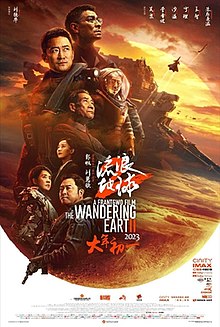
Time runs out in carefully marked units in the mainland Chinese sci-fi disaster pic “The Wandering Earth II,” a sturdy prequel to the record-smashing adaptation of Liu Cixin’s novel. In “The Wandering Earth II,” the apocalyptic problems faced by this movie’s Chinese characters—along with their international peers from the United Earth Government (UEG)—have already happened. Because in “The Wandering Earth,” the planet has already left its orbit thanks to some high-powered rocket engines, which have pushed the Earth out of harm’s way (aka a crash course with the Sun). Set in the near-future—a range of dates that includes 2044, 2058, and 2065—“The Wandering Earth II” follows China’s men and women of action as they lead the planet out of the solar system and into the previous movie.

Both “The Wandering Earth” and its sequel are flashy, state-approved cornball spectacles about humanity’s resilience (especially the Chinese). Both movies were produced with gargantuan budgets that would make even James Cameron blink, and they both look fantastic thanks to director Frant Gwo’s eye for panoramic scope and paperback cover-worthy details. The main difference between these two blockbusters is that the protagonists of “The Wandering Earth II” must repeatedly choose to be hopeful despite perpetually impending disasters, each one of which is neatly labeled and foregrounded with pulpy on-screen text like “The Lunar Crisis in 12 hours” and “Nuclear explosion in 3 hours.”

In this way, Gwo (“The Sacrifice”) and his five credited co-writers succeed in refocusing our attention on scenes of ticking-clock suspense, sandwiched between syrupy—and mostly satisfying—melodramatic interludes, where square-jawed astronauts and UEG diplomats struggle to do what we know is a foregone conclusion.

Most of “The Wandering Earth II” follows the superhuman efforts needed to jumpstart the Moving Mountain Project, the mission to first build and then deploy the globe-shifting engines needed to push the Earth out of harm’s way. The UEG’s Chinese delegation, led by the paternal diplomat Zhezhi Zhou (Li Xuejian), recommends prioritizing the Moving Mountain Project instead of the Digital Life Project. This radical initiative would transfer human participants’ consciousnesses into artificially intelligent computer programs. Some Digital Life supporters try to sabotage the Moving Mountain Project, including a deadly attack on the Space Elevator transportation ships that send UEG representatives from the Earth to the Moon.

Nobody living through the events of “The Wandering Earth II” knows what we know: That the Moving Mountain project succeeds and eventually becomes the Wandering Earth project, which comes under threat by a HAL 9000-esque artificial intelligence (A.I.) named MOSS in the first film. Still, multiple scientists, government officials, and space adventurers—mostly Chinese—believe in their work’s vital necessity, whether they’re punching out saboteurs or detonating one of a couple hundred nuclear devices scattered around the moon. There’s a lot of hand-wringing and teeth-gnashing along the way, mostly from English and Russian-speaking UEG members, all of whom speak in stilted, poorly dubbed dialogue. But Chinese astronauts, like “The Wandering Earth” co-leads Liu Peiqiang (“Wolf Warrior 2” star Wu Jing) and Han Duoduo (Wang Zhi), always prove Zhou’s slogan-simple maxim: “In times of crisis, unity above all.”

Some melancholic (and occasionally maudlin) flashbacks and dialogue emphasize the personal motives of one-note characters who, in the movie’s best scenes, are just parts of a beautiful post-human landscape. Liu remembers his wife and young daughter while melancholic scientist Tu Hengyu (Andy Lau) talks with his dead child after he uploads her personality into an experimental A.I. program; she cries a lot and sometimes responds with existentially troubling questions like, “Where am I, daddy? I want to get out.” We’re then periodically reminded of the next impending crisis—“the moon disintegrates in 50 hours”—in between solar storms and nuclear explosions. Somehow, “The Wandering Earth II” never feels tonally unbalanced or narratively convoluted, partly because Gwo and his collaborators keep their movie’s plot focused on feats of action-adventure heroism.

“The Wandering Earth II” only seems relatively unambitious because it’s more focused on sap-happy human emotions than on dystopian intrigue. Both movies are still essentially showcases for beautiful and expensive-looking computer graphics. But “The Wandering Earth II”—a brittle and, at heart, old-fashioned space opera—would be insufferable if Gwo and his ensemble cast members didn’t sell you on the possibility that someday, people who are as selfless, monomaniacal, and capable as Liu and Tu could exist.

“The Wandering Earth II” is also like “The Wandering Earth” because it’s just the right mix of silly and somber. Hurt, scared people wonder about the recent past, but always from a rare position of forward-thinking emotional clarity. (“She’s dead, and that’s it. That’s the reality.”) So when humanity must inevitably save the day, their accomplishments are appropriately surreal and awesome. 

Saturday Matinee: Riders of Justice

By Matt Zoller Seitz

Source: RogerEbert.com

Brutal, sad, funny, and disarmingly sweet-natured, “Riders of Justice” is not so much a revenge movie as a movie about revenge. That might seem like a distinction without a difference until you get to the end of this surprising feature from writer/director Anders Thomas Jensen (“After the Wedding,” “Red Road,” “The Salvation“) and look back on every place that it has taken you. 

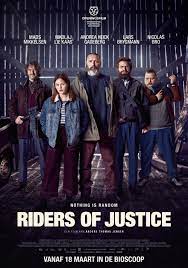
The story starts a few days before Christmas in Estonia. A girl walking along a holiday-decorated street with her grandfather spots a red bicycle offered for sale by a street vendor but asks for a blue one instead. The vendor is part of a crime ring and calls an associate, who steals a blue bike belonging to Mathilde (Andrea Heick Gadeberg), which causes Mathilde’s mother Emma (Anne Birgitte Lind) to have to pick her up at the train station, only to have their car fail to start, which causes them to take a commuter train home. A statistics and probability expert named Otto (Nikolaj Lie Kaas) gives the girl’s mother his seat, and shortly after that, a freight train smashes into the commuter train and several passengers are killed, including Mathilde’s mother and a tattooed, bald, scowling fellow who was supposed to testify against a fearsome gang, Riders of Justice. Otto saw another man get off the train before the crash, oddly dropping a full beverage and a nearly uneaten sandwich in the trash on his way out, and becomes convinced that the crash was an assassination and the other victims were collateral damage. As it happens, Mathilde’s father is a stony-faced soldier named Markus (Mads Mikkelsen, a frequent leading man for the writer/director). 

If this were almost any other movie, you’d be able to write the rest of this review yourself. But you soon  figure out that this is not the sort of film that sets up the standard elements and switches to autopilot. For one thing, Jensen makes Otto not merely the messenger who sets the tale in motion and then disappears, but a crucial second lead, and part of a trio filled out by a fellow probability expert named Lennart (Lars Brygmann), whose secret manias and aversions are a constant source of plot complications; and a tightly wound, emotional computer hacker named Emmenthaler (Nicolas Bro). All three characters are written and performed with such skill that they form a comedy trio: a motor-mouthed intellectual answer to the Three Stooges. Like Mathilde, Markus, and everyone else who passes in front of Jensen’s viewfinder, Otto, Lennart and Emmenthaler are given endearing backstories that feed into the script’s fascination with fate, chance, justice, karma, and other subjects rarely discussed in films where the hero is a scary bald dude who can snap a man’s neck like a shingle.

“All events are products of a series of preceding events,” Otto tells an assembled panel of corporate clients who reject an algorithm he and Lennart are trying to sell them. “Because we often have insufficient data, we categorize events as coincidences.” His statement echoes through later scenes, including the church service where Mathilde’s mother and Markus’s wife is laid to rest. “When miracles happen,” the priest says, “we often attribute a divine character to them. However, when lightning strikes, when tragedy becomes reality, we have a hard time assigning a return address, and thus we refer to it as coincidence.” Once the stooges enter Markus’ life, bloodshed follows, but not in a lockstep, predictable way, thanks to the pinball-machine collisions of all the strong personalities involved (particularly Markus’s; he’s both hot-tempered and lethal, not an ideal combination).

The big question here is whether the train crash was a premeditated crime or the culmination of a series of things that quite simply happened. A large part of the charm of “Riders of Justice” (what an ironic title, in retrospect!) comes from the way that it keeps us guessing as to what side of the equation, so to speak, it’ll come down on, or whether it’ll take a position at all. What are we to make, for instance, of a seemingly precise calculation by Otto that the odds of that crash with that outcome were 234,287,121 to one? Or, for that matter, the movie’s wry awareness that no matter how bad things get, they could always be worse? “Only thing is, after all this crap, it’s unlikely more is going to happen,” Mathilde tells Otto. “That’s not how things work,” Otto replies. “A lot of awful things can happen in your life.” 

Plots like the one that drive “Riders of Justice” tend to appear in crash-and-burn action thrillers wherein a curtain-raising death or atrocity is there to give the hero (or heroes) a pretext to embark on a spectacular and largely guilt-free rampage, stacking up bodies like firewood. Jensen and his cast and crew go in a different direction, creating a cast of main characters (and several colorful minor characters) with complex, contradictory psychologies that are unveiled a layer at a time, each revelation informing our understanding of what they did in a prior scene, or what they may be capable of later on. It’s hard to imagine the improvisatory, digressive, character-focused filmmaker Mike Leigh (“Secrets and Lies“) making a revenge thriller, but if he did, it might look like this. Sometimes the tangents are so out-of-nowhere, and are developed in such detail, that you and the characters sorta forget about the vengeance thing, which is the entire point.

This is a film that teaches you how to watch it. Once you’ve gotten acclimated, you understand that when a major character makes a decision that seems massively stupid—or simply counter to their self-interest—it’s always rooted in a traumatic past incident or secret, and they had no conscious control over it: it was something that had to happen, thanks to how they’re wired. Mikkelsen, the most still and reactive performer, seems a granite-faced question mark until you spend a bit of time with his character and understand the origins of his stoicism as well as his eruptions of fury. Unexpected connection points are made between him and the stooges and, more pointedly, between Mathilde and Emmenthaler, who are both sensitive about their weight; and Mathilde, Otto and Markus, who have a specific type of loss in common, and fill voids in each other’s lives. 

Any of these characters could’ve been the main character in his or her own project, so attentive is the screenplay to the nuances of personality. Emmenthaler, especially, is one of the great secondary characters in action thrillers, up there with Al Powell from the original “Die Hard“—a sensitive man who sheds an angry tear when a friend makes fun of his weight, and has clearly been carrying around an unexploded bomb of suppressed rage throughout his life. He’s the first of the stooges to ask for weapons training.  

But even that thread doesn’t go the way you anticipate, because this is a genre picture in which story is driven by characterization rather than the other way around. Not only are there no easy answers, the film goes out of its way to make you think it’s going to tie something off neatly, only to confound you by asking, “What would happen if these characters actually existed?” and doing that instead. 

“Did a therapist write this?” is not a sentence once expects to see in one’s notes on a movie where Mads Mikkelsen guns men down with an assault rifle. But it’s consistent with the apparent mission statement of this odd, beguiling film, which is filled with philosophical, theological, moral, and ethical notions (and takes care to distinguish between them) and that weaves images of churches and snippets of religious chorales throughout its running time, as if to remind us of the Christian ideals of grace, healing, and redemption that, for many characters, remain just out of reach. The movie’s contextual scaffolding is constructed with such care that when a character insists that chess is the only game ever invented where luck isn’t a factor, your instinct is to think, “Is that true?” It is, and it isn’t. The closest Jensen gets to summing everything up is Mathilde’s statement that life “is just easier when there’s someone you can get mad at.” 

What are we left with? In the best of all possible worlds, a line from Otto, offered when the gang is en route to a bloody showdown: “Let’s get this over with as a team so we can go home and eat banana cake.”

____________________

Watch Riders of Justice on Kanopy here: https://www.kanopy.com/en/product/12898202

Saturday Matinee: Breathing Happy

‘Breathing Happy’ Is A Fantastical Look At Addiction and Grief Perfect For The Holiday Seasons

By Sharai Bohannon

Source: Dread Central

Breathing Happy is a weird Christmas redemption story that defies genre. Writer-director-actor Shane Brady manages to give us a mind-bending story about recovery, redemption, and grief with a pinch of magic for good measure. Brady plays Dylan in the movie. Dylan is hours away from achieving a year of sobriety. However, his past comes back to haunt him, in the literal sense, making those last few hours even harder than he could’ve predicted. 

The holidays are difficult for all of us, but I imagine it’s even harder for our sober friends. We also find ourselves instantly rooting for Dylan even before getting the full story. Brady captures something profoundly human in a guy just trying to hold on that is so very relatable. Having his first anniversary on Christmas day raises the stakes even before his inner demons come out to play. Throughout the movie, we watch flashbacks of all the Christmases Dylan ruined because of his addiction. We also see how this has impacted his relationships with his family. Which answers the question of why he’s alone this year for such a big milestone.

Breathing Happy is a stylistic mindfuck. As we’re watching Dylan get into fights with talking doors, and we’re being thrown into flashbacks via VHS tapes, the narrative becomes a little dizzying. However, before I could get too annoyed, everything started to gel in a way that proved this was the only way to tell a story of this magnitude. The road to recovery isn’t a direct route. The same is true for the bumpy road that is the grieving process. As we discover these VHS moments are filling us in on Dylan’s dead dad, pieces fall into place. This leaves us realizing that this Christmas and sobriety anniversary is even heavier than we assumed at first glance.

Memories are tricky, and the fragmented way this movie gives us these moments makes it hard to not empathize with everyone involved. We feel bad for Dylan’s adopted mom and sisters, but we also are frustratingly sad for Dylan. Anyone close to an addict knows it’s a complicated relationship and that there is no right way to support them. You can try tough love, you can try being too kind, you can try combos of everything at your disposal, but it’s a helpless feeling because nothing you can do is going to magically cure this disease. Breathing Happy does a good job of reminding the viewers that there are no villains even when it looks like self-sabotage on Dylan’s part. There are bigger issues at play, and I think this is part of what works for this movie.

Breathing Happy is a messy story about being human and having emotions bigger than ourselves. Not all of the humor lands, but it does manage to pull at all the right heartstrings. I’m a magical realism girl, but I can also see this drama not being the holiday movie most genre fans are hunting for at this time of year. However, if you do catch it, you’ll probably agree that Brady has captured a lot more than the advertising for the film lets on. 

___________________

Watch Breathing Happy on Hoopla here: https://www.hoopladigital.com/title/15503415

Saturday Matinee: Wrong is Right

(An updated repost from June 29, 2019)

“Wrong is Right” (1982) is an alarmingly prescient political satire directed by Richard Brooks and based on the novel ”The Better Angels” by Charles McCarry. Sean Connery stars as Patrick Hale, a popular television journalist who becomes entangled in a conspiracy after an assignment in the Middle East to interview a patriarch of a royal family. Powerful factions involved include the American president (George Grizzard), a high-powered arms dealer, the CIA, a rising right-wing populist presidential contender, a terrorist group and various military/corporate interests who collectively ignite a geopolitical powder keg.

Key to enjoying this Strangelovian comedy is to look past the obvious budgetary constraints or view them as metacommentary on the often flimsy narratives manufactured by the figures and institutions which happen to be the main targets of the film’s satire. Despite the inconsistent acting from the large and varied cast, Wrong is Right is notable for Sean Connery’s greatest underrated performance and a brief but chilling cameo by a young Jennifer Jason Leigh four minutes into the film. Also noteworthy is the acerbic rapidfire dialogue and labyrinthine plot which plays like a mash-up of the decades since the film’s release to our current moment processed through a fever dream.

Watch Wrong is Right on Tubi here: https://tubitv.com/movies/690775/wrong-is-right

Saturday Matinee: Aze Avora Short Double Feature

By Aze Avora

Source: YouTube

Observers: An AI Short Horror Film. Deep within the 12th dimension dwells observers of inconceivable complexity, silently manipulating our lives. An ode to my love for cosmic horror. Inspired by the dark side of psychedelics.

Prompted, Written & Directed by: Aze Avora

Visuals By: Midjourney & GEN 2

Capitol of Conformity: Welcome to the future! Where the pursuit of unending joy comes with hidden costs. This retro futuristic metropolis has many hidden wonders you won’t want to miss out on!

Patreon:   / azeavora  

Prompted, Written & Directed by: Aze Avora

Visuals Assisted By: Midjourney, @Pika_Labs & GEN 2

SOCIALS –https://X.com/AzeAvora  / aze.avora  

MUSIC:

Thais Meditation – Mischa Elman

You Didn’t Want Me When You Had Me – Henry Burr

Saturday Matinee: Kurt Vonnegut: Unstuck in Time

By Matt Zoller Seitz

Source: RogerEbert.com

“Kurt Vonnegut: Unstuck in Time” is messy in the way that wakes for dear friends are messy.

Some speakers go on too long, and there are others that you may wish you’d heard from at greater length, or at all. And the raw sentiment coursing through every moment of the affair, however heartfelt, can be overwhelming, especially if you didn’t know the deceased as well as the folks memorializing him. 

The deceased here is Kurt Vonnegut, and the person who planned, executed and hosted this cinematic wake, director Robert B. Weide (a veteran documentarian and an Emmy-winning director for “Curb Your Enthusiasm”), was a friend of Vonnegut’s throughout the final 25 years of his life. This movie, co-directed by Don Argott, runs over two hours. Thematic and structural ideas are introduced, nurtured, forgotten, then reintroduced awkwardly. Weide himself is a major character—as well he should be, considering that Vonnegut essentially made Weide his personal archivist, sending him letters and manuscripts and faxes and video and audio tapes, and this film is as much a portrait of a friendship as it is the warts-and-all record of a great writer’s life—but sometimes the proportions feel off. When Weide disappears for long stretches, I don’t know that it’s exactly a slam to say that you don’t miss him, because people are mainly here for Vonnegut, one of the most important American writers of the 20th century, and a fount of charisma even at his lowest depths of sour narcissism in the 1970s. 

Vonnegut fans know that he specialized in slim, nimbly written books, with short chapters and short paragraphs that jumped wherever Vonnegut’s consciousness happened to take him. “Unstuck in Time” lets us know that it is consciously modeling its structure on Vonnegut’s writing, in particular his widest-read work, the nonlinear novel/memoir “Slaughterhouse Five,” from whence the documentary’s subtitle is drawn (“Billy Pilgrim came unstuck in time,” it starts); and to a lesser extent, Vonnegut’s late-career bestseller “Timequake,” a fragmented, self-aware book that is partly about the difficulty of writing “Timequake.” 

There are also cinematic allusions to Vonnegut’s literary alter-ego, Kilgore Trout, in the way that Weide and Argott and three credited film editors weave together the relationship between Vonnegut and Weide. Weide first meets Vonnegut in 1982 at age 23 after writing him a fan letter inquiring about the possibility of making a documentary about his life, and he holds onto that youthful starstruck quality even in reminiscences shot long after Vonnegut’s death in 2007. Over time, the pupil gains the master’s respect, to the point where Weide writes and coproduces a feature-length adaptation of Vonnegut’s novel “Mother Night,” starring Nick Nolte and directed by actor-filmmaker Keith Gordon, who as luck would have it played Rodney Dangerfield’s son in “Back to School,” a comedy in which Vonnegut played himself.

This may all sound as if it’s articulated more cleanly and effectively than it is. The filmmakers have committed simultaneously and with equal enthusiasm to a couple of filmmaking approaches that are at odds. One is the detached, clinical-mathematical, unsentimental, science-fictional, time-tripping biography, a la “Slaughterhouse Five” and “Timequake,” represented here by inventive cutting from image to image and idea to idea, sometimes lingering on signifiers of creative self-awareness. These include closeups of the timeline on an editor’s computer screen, montages of Vonnegut doing or saying the same thing in different decades of his life, snippets of films based on Vonnegut’s writing, and animated sequences modeled on Vonnegut’s drawings, which were as distinctive as his prose.

The other approach is more straightforward: Weide and Argott are making a straightforward PBS-style documentary about an artist’s life, supervised by a director and fan who knew him intimately, and tghat draws on footage ranging from childhood through old age. The latter might jump around in time in terms of the years in which it was created, but it ultimately tells Vonnegut’s story in a far more conventional way that the movie promises to do in its opening minutes.

This is fine; in fact it’s more than fine, because as Vonnegut and various experts on his work point out, Vonnegut remains readable and relevant in large part because he expressed himself in a direct way, drawing upon what’s described here as a journalistic writing style. Correspondingly, the most moving scenes and moments in “Unstuck in Time” are unmannered accounts of events. These range in emotional character from elating (Vonnegut’s commercial and critical success with “Slaughterhouse Five” after years of financial struggle) to vexing (after that success, he left his first wife, Jane, who’d been by his side during the lean years, moved to Manhattan, and married his mistress) to tragic (Vonnegut’s brother-in-law dying in a train wreck just two days before Vonnegut’s older sister died of cancer) to inspirational (Vonnegut unhesitatingly raising his late sister’s four sons alongside the three kids he had with Jane).

All of this material is fascinating, and articulated in vivid detail thanks to Weide’s trove of material. There are closeups of typewritten revisions of Vonnegut classics, each alteration indicated in pencil or pen, and letters and answering machine messages covering every imaginable life event. The filmmakers lay it all out so elegantly that whenever the movie seems to forget that it’s also about Weide and suddenly interrupts the flow to insert a reference to one of Weide’s own milestone events (such as his wife’s own battle with a debilitating illness and his Emmy win for “Curb,” which seems to be in there so that he can include Vonnegut’s answering machine message congratulating him) it’s awkward because Weide is clearly still grieving, too, and the viewer is torn between wanting to bear witness to Weide’s miseries and triumphs and wanting him to get back to Kurt Vonnegut as quickly as possible.

There is, nevertheless, something to be said for a documentary that tries to do something different and perhaps impossible, even if it doesn’t quite get there. And in the end, any flaws or missed opportunities are subsumed by the movie’s sincerity and wealth of insight. Its analysis of the role that Vonnegut’s World War II experience played in his demeanor as well as his fiction is fascinating and on-point, and the editors bring it all back at the end when Vonnegut, outraged by the second Bush administration’s invasion of Iraq and weaponizing of patriotism, writes a series of columns for “In These Times” magazine that will ultimately be collected in 2005’s “A Man Without a Country,” arguably his last major work.

Weide himself comes across as a sardonic and compassionate witness and guide, often taking the piss out of his own reverence for Vonnegut just when things threaten to get a bit moist. The devotion he displays towards Vonnegut throughout the second half of the writer’s life is as inspiring as Vonnegut’s own high points as a human being. We should all be lucky enough to have a friend who will tell our story.

____________________

Watch Kurt Vonnegut: Unstuck in Time on Kanopy here: https://www.kanopy.com/en/product/13799154