

A study from the National Oceanic and Atmospheric Administration, published last week in the peer-reviewed journal Environmental Science and Technology, produced the strongest evidence to date linking mass dolphin deaths in the Gulf of Mexico to petroleum hydrocarbon exposure and toxicity. The focus of the study, 29 dolphins from Barataria Bay (an area heavily oiled during the BP spill), were found to have lung disease, abnormally low levels of adrenal gland hormones, liver problems and other health effects which are rare but consistent with exposure to oil.
A quarter of the dolphin subjects were found to be significantly underweight, 48 percent were given a guarded prognosis, and 17 percent were in poor or grave condition, meaning they were expected to die soon. The study concludes that the health effects seen in the Barataria Bay dolphins are significant and likely will lead to reduced survival and ability to reproduce.
In an earlier NOAA study in 2011, preliminary research findings indicated oil and Corexit physically stressed Gulf dolphins to death by decreasing their immunity and making them more susceptible to diseases such as brucella and morbillivirus. Morbillivirus was found to be the cause of a majority of dolphin deaths in a recent die off pattern along the Eastern Seaboard throughout the year.
According to a New York Times piece from last Sunday, in the past year at least 1,000 bottlenose dolphin carcasses (eight times the historical average) washed up on beaches in New York, Virginia, the Carolinas, Georgia and Florida. In Florida, 80 dolphins who live permanently in the state’s polluted Indian River Lagoon estuary have died while 233 were reported dead in the northern Gulf of Mexico this year.
While effects of the BP oil spill and corexit haven’t been ruled out as a factor in the East Coast dolphin deaths, research on some of the dead dolphins in the Florida estuary found high levels of mercury, fungal diseases, antibiotic-resistant bacteria, oral-genital tumors and emaciation, most likely a result of environmental pollution.
12/11 A short but informative primer on the TPP:
12/11 Abby Martin critiques a New York Magazine article distorting and dismissing CIA drug smuggling operations:
12/12 Retired Marine General Michael Lehnert on why Guantanamo is a mistake and should be shut down:
12/12 Activist pranksters hijack a Shell Oil greenwashing event in Berlin (click “CC” icon for subtitles):
12/13 Joy Camp selling RFID chips in the style of a pharmaceutical commercial:
12/13 James Corbett on how to nullify the NSA and other tyrannical government agencies:
12/14 We Are Change interviews the Florida cop arrested for refusing to remove a Guy Fawkes mask:
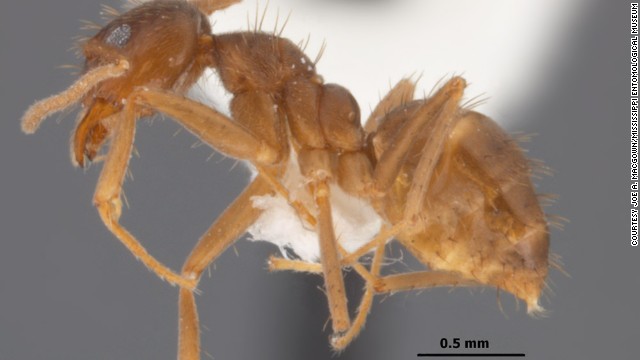


The New York Times Magazine recently featured a story by Jon Mooallem on a new invasive ant species that seems straight out of a nightmare or horror film. From the article:
Entomologists report that the crazy ants, like other ants, seem drawn to electronic devices — car stereos, circuit boxes, machinery. But with crazy ants, so many will stream inside a device that they form a single, squirming mass that completes a circuit and shorts it. Crazy ants have ruined laptops this way and, according to one exterminator, have also temporarily shut down chemical plants. They are most likely climbing into these cavities to investigate possible nesting sites. But as David Oi, a research entomologist at the Department of Agriculture, told me, the science-fiction-ish theory that the bugs are actually attracted to the electricity itself can’t be ruled out.
Rasberry crazy ants do not have a painful bite, but they effectively terrorize people by racing up their feet and around their bodies, coursing everywhere in their impossibly disordered orbits. (They’re called crazy ants because their behavior seems psychotic.) Some people in Texas have become so frustrated with crazy ants that they have considered selling their houses or been driven to the verge of divorce. “Usually, the husband doesn’t think it’s such a big deal, and the wife is going batty,” one exterminator explained. An attorney living on an infested farm south of Houston told me: “It reminds me of the scenes in Africa, where you see flies crawling all over people. Occasionally they’ll knock one off, but for the most part they’re so accustomed to it that they finally give up.”
Crazy ants decimate native insects. They overtake beehives and destroy the colonies. They may smother bird chicks struggling to hatch. In South America, where scientists now believe the ants originated, they have been known to obstruct the nasal cavities of chickens and asphyxiate the birds. They swarm into cows’ eyes.
So far, there is no way to contain them. In the fall, when the temperature drops, the worker ants are subject to magnificent die-offs, but the queens survive, and a new, often larger crop of crazy ants pours back in the following spring. Rasberry crazy ants were first discovered in Texas by an exterminator in 2002. Within five years, they appeared to be spreading through the state much faster than even the red imported fire ant has. The fire ant is generally considered one of the worst invasive species in the world. The cost of fire ants to Texas has been estimated at more than $1 billion a year.
Rasberry crazy ants are now in 27 different counties in Texas and have also been spotted in Louisiana, Mississippi, Florida and Georgia…
…Edward LeBrun, an ecologist at the University of Texas at Austin who has been studying the area, believes a single “supercolony” of crazy ants occupies as many as 4,200 acres in Iowa Colony and is spreading 200 meters a year in all directions.
The reporter gave the following horror-inducing account of his first encounter with the ants in Iowa Colony, a rural area south of Houston:
“See! See! See!” the Dukes kept telling me. Wherever they pointed, there were ants: under the door of a microwave oven, crawling out of the electrical outlets, heaped in the flower beds where I mistook them for fresh topsoil. It was shocking, and the Dukes seemed vindicated by my shock. “You don’t feel them crawling up your clothes?” Melvin’s wife, Sharlene, asked me at one point. She was walking around barefoot and in shorts, and I could see ants trickling across her feet and ankles and legs — spelunking between her toes. She clutched a can of a pesticide called Enforcer Instant Knockdown to her chest, more as a security blanket than as a weapon, and constantly swept her hands over her calves.
Soon ants were spiraling up the tongues of my sneakers, onto my sock. I tried to shake them off, but nothing I did disturbed them. Before long, I was sweeping them off my own calves. I kept instinctively taking a step back from some distressing concentration of ants, only to remember that I was standing in the center of an exponentially larger concentration of ants. There was nowhere to go. The ants were horrifying — as in, they inspired horror. Eventually, I scribbled in my notebook: “Holy [expletive] I can’t concentrate on what anyone’s saying. Ants all over me. Phantom itches. Scratching hands, ankles, now my left eye.” Then I got in my car and left.
Of course worse things happen to people, but there’s something uniquely unsettling about the feeling of being overtaken by insects. This type of fear is explored in the following passage from the article:
The Hungarian-born philosopher Aurel Kolnai gave the horrifying qualities of bugs some serious thought. Kolnai ultimately decided that what upsets us is “their pullulating squirming, their cohesion into a homogeneous teeming mass” and their “interminable, directionless sprouting and breeding.” That is, it’s the quantity of crazy ants that’s so destabilizing. As the American psychologist James Hillman argued, an endless swarm of bugs flattens your perception of yourself as precious and meaningful. It instantly reduces your individual consciousness to a “merely numerical or statistical level.”
While there’s definitely some truth to this, I think there’s a little more to it. Though we may instinctively avoid things which could possibly sting or bite, because bugs are also associated with the natural process of decomposition, a reflexive revulsion towards contact with insects (for most people) may also be an expression of the fear of death. Insects might also tap into a xenophobia towards creatures that are most unlike ourselves physically and behaviorally, though we might not be as different from insects like ants as we’d like to believe. Just like humans, the crazy ants can dominate an environment to such an extent that it becomes inhospitable to most other insects and animals. And while we all have the potential ability to think independently, there’s also the potential to adopt a “hive mind” or herd mentality. Perhaps it’s the subconscious awareness of such negative aspects we share with insects that horrify us as much as the differences.
Via Adbusters:

Today, humanity faces a stark choice: save the planet and ditch capitalism, or save capitalism and ditch the planet.
– Fawzi Ibrahim
Freedom is having time to live.
– Uruguay’s president, Jose Mujica
Here it comes again. Another Black Friday of shoppers being trampled to death at the entrance of Target, Bed Bath & Beyond and Walmart. And then, hallelujah! … the Christmas shopping season begins.
This year, let’s rise above it! It’s time to start challenging the entrenched values of capitalism, which have hijacked our lives and our cultural rituals for far too long. ’Tis the season to make a pact with ourselves … to start changing our own lives so that we can collectively face the gigantic psycho-financial-eco crises of our time.The journey toward a sane sustainable future begins on a deeply personal and individual level with a single, voluntary step: make a vow to yourself to go cold turkey on consumption this Friday (in North America – Saturday for the rest of the world). Do not buy anything for 24 hours … and watch what happens … you just might have an unexpected, emancipatory epiphany!
Buy Nothing Day is legendary for instigating this type of personal transformation. As you suddenly remember what real living is all about, you may sense an upsurge of radical empowerment and feel a strange magic creeping back into your life.
Join millions of us in over 80 countries on November 29/30 and find out for yourself what it feels like.
And why not play some jazz while you are at it!? Put up Buy Nothing Day posters in your office, neighborhood, on campus … organize a credit card cut up, pull off a Whirl-mart at a box store, or put on an anonymous mask and walk zombie-like through your local mall.
Then, if you feel inspired, take the next step … for generations, the holidays have been hijacked by commercial forces … this year, why not take the season back? Have a heart to heart with your family and decide to celebrate Christmas, Chanukkah and Kwanzaa in a whole new way. Go for it!
This year, let’s throw a well-honed, fun-filled monkey wrench into the doomsday machine!


Though the Drug War’s disproportionately harmful effects on the poor and people of color seem to have been one of its major functions from the start, it has also been a war against cognitive liberty for everyone. On the DoseNation podcast, chemist Casey William Hardison shares an inspiring personal account of how psychedelics transformed his life for the better, and how he successfully fought a system which imprisoned him for pursuing his passion:
If the state was truly concerned for the health and safety of drug users, they would do more to give accurate information to the public and make treatment of addictions accessible (including addictions to alcohol, cigarettes, and pharmaceutical drugs). Instead, the state seems particularly concerned about drugs which can potentially lead to an expansion of consciousness. But why is cognitive liberty such a threat? Terence McKenna shares his thoughts on the revolutionary potential of the psychedelic movement in this excerpt of a speech delivered at the Esalen Institute in 1989:
The provisional model (psychedelic/open-ended partnership) way of doing things is the only style that can perhaps seize the controls of this sinking submarine and get it back to the surface so that we can figure out what should be done. If we continue as we have, then we’re doomed. And the judgement of some higher power on that will be: “They didn’t even struggle. They went to the boxcars with their suitcases and they didn’t even struggle.” This is too nightmarish to contemplate. We’re talking about the fate of a whole planet.
Why are people so polite? Why are they so patient? Why are they so forgiving of gangsterism and betrayal? It’s very difficult to understand. I believe it’s because the dominator culture is increasingly more and more sophisticated in its perfection of subliminal mechanisms of control. And I don’t mean anything grandiose and paranoid. I just mean that through press releases and soundbites and the enforced idiocy of television, the drama of a dying world has been turned into a soap opera for most people. And they don’t understand that it’s their story and that they will eat it in the final act if somewhere between here and the final act they don’t stand up on their hind legs and howl.
So this whole effort to bring the psychedelic experience back into prominence is an effort to empower individuals and to get them to see that we are bled of our authenticity by vampirish institutions that will never of their own accord leave us alone. There must be a moment when the machinery and the working of the machinery become so odious that people are willing to strive forward and throw sand on the track and force a reevaluation of the situation. And it’s not done through organizing. It’s not done through vanguard parties or cadres of intellectual elites. It’s done through just walking away from all of that. Claiming your identity, claiming your vision, your being, your intuition, and then acting from that without regret. Cleanly, without regret.
While I think the value of organizing should not be underestimated, he speaks eloquently for cognitive empowerment and inner transformation as a path towards cultural and systemic change.
Listen to the full speech at the Psychedelic Salon podcast:
More info on why drug prohibition does nothing to curb drug use and addiction and actually increases societal harm:
Via: Higher Perspectives

An international group of prominent scientists has signed The Cambridge Declaration on Consciousness in which they are proclaiming their support for the idea that animals are conscious and aware to the degree that humans are — a list of animals that includes all mammals, birds, and even the octopus. But will this make us stop treating these animals in totally inhumane ways?

While it might not sound like much for scientists to declare that many nonhuman animals possess conscious states, it’s the open acknowledgement that’s the big news here. The body of scientific evidence is increasingly showing that most animals are conscious in the same way that we are, and it’s no longer something we can ignore.
What’s also very interesting about the declaration is the group’s acknowledgement that consciousness can emerge in those animals that are very much unlike humans, including those that evolved along different evolutionary tracks, namely birds and some cephalopods.
“The absence of a neocortex does not appear to preclude an organism from experiencing affective states,” they write, “Convergent evidence indicates that non-human animals have the neuroanatomical, neurochemical, and neurophysiological substrates of conscious states along with the capacity to exhibit intentional behaviors.”
Consequently, say the signatories, the scientific evidence is increasingly indicating that humans are not unique in possessing the neurological substrates that generate consciousness.

The group consists of cognitive scientists, neuropharmacologists, neurophysiologists, neuroanatomists, and computational neuroscientists — all of whom were attending the Francis Crick Memorial Conference on Consciousness in Human and Non-Human Animals. The declaration was signed in the presence of Stephen Hawking, and included such signatories as Christof Koch, David Edelman, Edward Boyden, Philip Low, Irene Pepperberg, and many more.
The declaration made the following observations:
- The field of Consciousness research is rapidly evolving. Abundant new techniques and strategies for human and non-human animal research have been developed. Consequently, more data is becoming readily available, and this calls for a periodic reevaluation of previously held preconceptions in this field. Studies of non-human animals have shown that homologous brain circuits correlated with conscious experience and perception can be selectively facilitated and disrupted to assess whether they are in fact necessary for those experiences. Moreover, in humans, new non-invasive techniques are readily available to survey the correlates of consciousness.
- The neural substrates of emotions do not appear to be confined to cortical structures. In fact, subcortical neural networks aroused during affective states in humans are also critically important for generating emotional behaviors in animals. Artificial arousal of the same brain regions generates corresponding behavior and feeling states in both humans and non-human animals. Wherever in the brain one evokes instinctual emotional behaviors in non-human animals, many of the ensuing behaviors are consistent with experienced feeling states, including those internal states that are rewarding and punishing. Deep brain stimulation of these systems in humans can also generate similar affective states. Systems associated with affect are concentrated in subcortical regions where neural homologies abound. Young human and nonhuman animals without neocortices retain these brain-mind functions. Furthermore, neural circuits supporting behavioral/electrophysiological states of attentiveness, sleep and decision making appear to have arisen in evolution as early as the invertebrate radiation, being evident in insects and cephalopod mollusks (e.g., octopus).
- Birds appear to offer, in their behavior, neurophysiology, and neuroanatomy a striking case of parallel evolution of consciousness. Evidence of near human-like levels of consciousness has been most dramatically observed in African grey parrots. Mammalian and avian emotional networks and cognitive microcircuitries appear to be far more homologous than previously thought. Moreover, certain species of birds have been found to exhibit neural sleep patterns similar to those of mammals, including REM sleep and, as was demonstrated in zebra finches, neurophysiological patterns, previously thought to require a mammalian neocortex. Magpies in articular have been shown to exhibit striking similarities to humans, great apes, dolphins, and elephants in studies of mirror self-recognition.
- In humans, the effect of certain hallucinogens appears to be associated with a disruption in cortical feedforward and feedback processing. Pharmacological interventions in non-human animals with compounds known to affect conscious behavior in humans can lead to similar perturbations in behavior in non-human animals. In humans, there is evidence to suggest that awareness is correlated with cortical activity, which does not exclude possible contributions by subcortical or early cortical processing, as in visual awareness. Evidence that human and nonhuman animal emotional feelings arise from homologous subcortical brain networks provide compelling evidence for evolutionarily shared primal affective qualia.
Read more about this here and here.
A short feature on the mysterious and amazing abilities of cephalopods:
Via: Anonymous

The modern paradigm may still seem insurmountable “because it possesses an outward front, the work of a long past, but is in reality an edifice crumbling to ruin and destined to fall in at the first storm.”
— Gustave Le Bon, The Crowd: A Study of the Popular Mind
The decentralized movement toward freedom is raging across the world. It cannot be stopped. The tipping point is near. Despite the lack of coverage in the mainstream media, actions are springing up on an increasing basis. A wave of transformation is rising. The zeitgeist is shifting in our direction.
At this point, given all the nonviolent direct actions that are currently being planned, it makes strategic sense for us to organize them, in a decentralized way, in a way that the mainstream media cannot ignore. A slightly more coordinated approach is all it will take.
The Awakening Wave
The last time we all rallied together in a loosely knit collective fashion, the Occupy movement was born and the 99% meme brought the corruption of our political and economic system, along with the grotesque inequality of wealth, into mass consciousness in a profound and lasting way. It was the opening act, the awakening wave.
Since the Occupy camps were crushed by brutal police state force, the movement has splintered in many different directions. This is now proving to have been a blessing in disguise. It gave us time to learn from our mistakes, figure out what worked best and forced us back into the autonomous actions that built the movement in the first place. We have now experimented with different tactics and thought through longer-term strategies.
Meanwhile, the repressive conditions that inspired Occupy in the first place have become even more oppressive. Now more than ever, governments no longer have the consent of the governed. A critical mass has lost faith and trust in our existing institutions. The present paradigm has outlived its usefulness. It has been overrun with corruption and rendered obsolete. Our political, economic and legal systems are doing much more to limit our potential than enhance it.
It’s Time For A Worldwide Wave of Transformation
Let’s pick a three-month span, perhaps throughout this coming spring, and unite our collective actions into an unprecedented Worldwide Wave that cannot be ignored by anyone.
Let’s crowdsource a relentless global wave of action that protests the corrupt, while also rallying around and celebrating effective alternatives and solutions to the vast problems we are confronted by. Imagine thousands of nonviolent guerrilla armies swarming corrupt targets and rallying for viable solutions for a sustained three-month cycle. If we begin preparing now, a massive spring offensive can lead to a summer of transformation.
Staying true to the vital nature of the movement, you lead, in your own way. Pick whatever issues concern you most and run with them, knowing that likeminded people throughout the world will also be fighting in solidarity, in whatever way they can, at the same time you are.
Not Focused Enough?
In an attempt to dismiss and undermine us, status quo propagandists will once again criticize us by saying that our message of systemic change is not focused enough or lacks coherent goals. This feeble attempt to keep people from joining in with us will be overcome by our widespread and consistent actions, which will lead by example and inspire the cultural shift in mass consciousness that we urgently need. Our diverse crowdsourced actions will boldly demonstrate our will to expose, fight and overcome tyrannical systems. By rallying around viable solutions and protesting what we are against, the goals and freedoms that we aspire to will organically become self-evident to all.
Throughout history, when people have fought against tyranny and oppression, they didn’t have one perfect utopian model outcome agreed upon beforehand. They just knew that the invading and old systems were detrimental to their wellbeing and had to go. We are now in that position.
Don’t let the propagandists fool you. We do not need corrupt corporations or aristocratic government rulers anymore. They are obsolete. People throughout this interconnected technological world have already come up with much more effective systems to replace the tyrannical one that is currently dominating our lives. There are already many effective solutions to our problems, solutions that are held back by the entrenched forces of shortsighted greed. Once a small percentage of us withdraw our participation from corrupt entities and opt out of tyranny, the old and obsolete systems of rule will quickly fall away.
Extensive empirical evidence demonstrates that nonviolent movements toward freedom result in positive outcomes. Research has proven that it only takes approximately 3% of the population engaging in various forms of nonviolent action to create significant meaningful change, for the betterment of society. We now have the necessary critical mass of aware people who are ready, willing and capable.
Guerrilla Tactics
This time the police state will not be able to crush us. We will not have stationary targets. We will be everywhere, fluid and evasive. The movement will be an unstoppable crowdsourced, decentralized and autonomous revolutionary force.
We will engage in a diversity of nonviolent tactics, from large-scale mobilizations to small daily acts. Most of you already know the actions and tactics that are needed. Without revealing too much strategic information, here are a few basic actions to get a fire going in your mind:
-Mass gatherings, demonstrations;
-Marches, parades;
-Flash mobs, swarms;
-Shutdown harmful corporate and governmental operations;
-Worker Strikes;
-Hunger strikes;
-Sit-ins;
-Strategic defaults, debt strikes;
-Foreclosure prevention;
-Boycotting corrupt corporations;
-Monkeywrench corrupt corporations;
-Move your money out of the big banks and the stock market;
-Use alternative currencies and economic systems;
-Cancel your cable television and support independent media;
-Use independent online tools that don’t sell your info and protect your privacy;
-Online civil disobedience, Anonymous operations;
-Leak information on corruption;
-Use alternative energy;
-Build your own urban and hydroponic farms, or get your food from them;
-Support local businesses;
-Join local community organizations;
-Take part in food banks and help develop community support systems;
-Start or join intentional and autonomous communities;
-Experiment with new governing systems, Liquid Democracy;
-Create Temporary Autonomous Zones
-Host teach-ins;
-Organize socially conscious events;
-Make conscious media;
-Guerrilla theater;
-Guerrilla gardening;
-Guerrilla postering, messages on money;
-Help inspiring groups and organizations spread their message;
-Random acts of kindness and compassion;
-Mass meditations, prayer sessions and spiritual actions.
The list goes on and on. You know what you can do to play a part. Do whatever you feel inspired to do. Amplify what you are already doing. Think about what you are willing to do to be the change that we urgently need to see in the world, and then do it.
Don’t get bogged down in infighting and caught up in negativity. Ignore the saboteurs. Collaborate with people who inspire you. Keep moving forward with an indomitable will, a compassionate spirit and radiate a positive attitude. Moods are contagious. Be passionate and have fun!
Our ability to take part in civil disobedience is multiplied by our ability to easily record the actions on video and spread them throughout the Internet. By flooding social media with these inspiring videos, we will create a positive feedback loop that translates into more action on the ground.
Radical change is urgently needed, so let’s make transforming the world the cool thing to do. Let’s create a culture of transformation. Let’s blaze a contagious nonviolent wave of action through mass consciousness, signaling the end of the old world, ushering in a new paradigm.
Now is the time.
Ride the Worldwide Wave of Transformation
001101000010111000110100001011100011000100110100
#www
Tweak this meme! This is a draft call to action, a work in progress. Feel free to make changes to it and spread it around however you see fit.
INDIAN COUNTRY NEWS
"It is the duty of every man, as far as his ability extends, to detect and expose delusion and error"..Thomas Paine
Human in Algorithms
From the Roof Top
I See This
blog of the post capitalist transition.. Read or download the novel here + latest relevant posts
अध्ययन-अनुसन्धानको सार
 After the Crash