Hillary Clinton: The International Neocon Warmonger

06

By Webster G. Tarpley

Source: Voltaire.net

Hillary Clinton has announced her candidacy for President of the United States. While the European press showers her with praise without thinking, Webster G. Tarpley recalls her balance sheet: in all circumstances, she supported war and corporate interests.

As the National Journal reported in 2014, even the pathetically weak anti-war left is not ready to reconcile with Hillary given her warmongering as Secretary of State. And with good reason. Scratching just lightly beneath the surface of Hillary Clinton’s career reveals the empirical evidence of her historic support for aggressive interventions around the globe.

Beginning with Africa, Hillary defended the 1998 cruise missile strike on the El Shifa pharmaceutical plant in the Sudanese capital of Khartoum, destroying the largest producer of cheap medications for treating malaria and tuberculosis and provided over 60% of available medicine in Sudan. In 2006 she supported sending United Nations troops to Darfur with logistical and technical support provided by NATO forces. Libyan leader Moammar Qaddafi was outspoken in his condemnation of this intervention, claiming it was not committed out of concern for Sudanese people but “…for oil and for the return of colonialism to the African continent.”

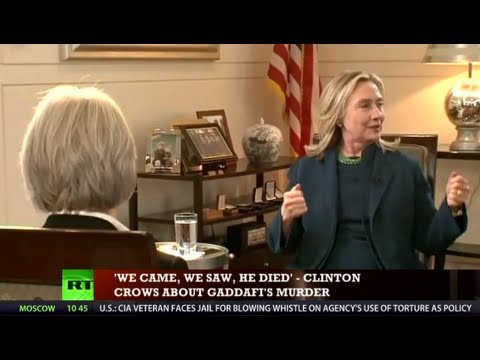
This is the same leader who was murdered in the aftermath of the 2011 NATO bombing of Libya; an attack promoted and facilitated with the eager support of Mrs. Clinton. In an infamous CBS news interview, said regarding this international crime: “We came, we saw, he died.” As Time magazine pointed out in 2011, the administration understood removing Qaddafi from power would allow the terrorist cells active in Libya to run rampant in the vacuum left behind. Just last month the New York Times reported that Libya has indeed become a terrorist safe haven and failed state— conducive for exporting radicals through “ratlines” to the conflict against Assad in Syria.

Hillary made prompt use of the ratlines for conflicts in the Middle East. In the summer of 2012, Clinton privately worked with then CIA director and subversive bonapartist David Petraeus on a proposal for providing arms and training to death squads to be used to topple Syria just as in Libya. This proposal was ultimately struck down by Obama, reported the New York Times in 2013, but constituted one of the earliest attempts at open military support for the Syrian death squads.

Her voting record on intervening in Afghanistan and Iraq is well known and she also has consistently called for attacking Iran. She even told Fareed Zakaria the State Department was involved “behind the scenes” in Iran’s failed 2009 Green Revolution. More recently in Foreign Policy magazine David Rothkopf wrote on the subject of the Lausanne nuclear accord, predicting a “snap-back” in policy by the winner of the 2016 election to the foreign policy in place since the 1980s. The title of this article? “Hillary Clinton is the Real Iran Snap-Back.” This makes Hillary the prime suspect for a return to the madcap Iranian policies that routinely threaten the world with a World War 3 scenario.

Hillary Clinton is not only actively aggressing against Africa and the Middle East. She was one of the loudest proponents against her husband’s hesitancy over the bombing of Kosovo, telling Lucina Frank: “I urged him to bomb,” even if it was a unilateral action.

While no Clinton spokesperson responded to a request by the Washington Free Beacon regarding her stance on Ukraine, in paid speeches she mentioned “putting more financial support into the Ukrainian government”. When Crimea decided to choose the Russian Federation over Poroshenko’s proto-fascist rump state, Hillary anachronistically called President Putin’s actions like “what Hitler did in the ‘30s.” As a leader of the bumbled ”reset” policy towards Russia, Hillary undoubtedly harbors some animus against Putin and will continue the destabilization project ongoing in Ukraine.

Not content with engaging in debacles in Eastern Europe, she has vocally argued for a more aggressive response to what she called the “rollback of democratic development and economic openness in parts of Latin America.” This indicates her willingness to allow the continuation of CIA sponsored efforts at South American destabilization in the countries of Venezuela, Bolivia, Ecuador, Argentina and Brazil.

It is one of the proud prerogatives of the Tax Wall Street Party to push out into the light the Wall Street and foundation-funded Democrats. The final blow to Hillary’s clumsy façade comes directly from arch-neocon Robert Kagan. Kagan worked as a foreign policy advisor to Hillary along with his wife, Ukraine madwoman Victoria Nuland, during Hillary’s term as Secretary of State. He claimed in the New York Times that his view of American foreign policy is best represented in the “mainstream” by the foreign policy of Hillary Clinton; a foreign policy he obviously manipulated or outright crafted. Kagan stated: “If she pursues a policy which we think she will pursue…it’s something that might have been called neocon, but clearly her supporters are not going to call it that; they are going to call it something else.” What further reason could any sane person need to refute Hillary? A vote for Hillary is a vote for the irrational return to war.

The “Giant Sucking Sound”: Clinton Gave US NAFTA and Other Free Trade Sellouts

“There is no success story for workers to be found in North America 20 years after NAFTA,” states AFL-CIO president Richard Trumka. Unlike other failures of his Presidency, Bill Clinton can not run from NAFTA. It was Vice President Al Gore, not a veto-proof Republican congress, who lobbied to remove trade barriers with low-wage Mexico.

The record of free trade is clear. Multinational corporations and Wall Street speculators realize incredible profits, wages remain stagnant in the US, poverty persists in the developing world, and the remaining industrial corporations in America and Canada are increasingly owned by Chinese, Indian and other foreign interests.

America’s free trade policy is upside down. Besides Canada, Australia and Korea, most of our “free” trade partners are low-wage sweatshop paradises like Mexico, Chile, Panama, Guatemala, Bahrain and Oman. The US does in fact apply tariffs on most goods and on most nations of origin – rates are set by the US International Trade Commission (USTIC), a quasi-public federal agency.

Since a German- or Japanese-made automobile would under USITC’s schedule be taxed 10% upon importation, Volkswagen and Toyota can circumvent taxation by simply building their auto assembly plants for the US market in Mexico. In Detroit, an auto assembly worker is paid between $14 and $28/hour, ($29,120-$58,240/yr); hard work for modest pay. In Mexico, the rate varies from $2-5/hour.

In China, all automobile imports regardless of origin are tariffed as high as 25%. This allows the Chinese to attract joint ventures with Volkswagen and Toyota, and to paraphrase Abraham Lincoln, “keep the jobs, the cars and the money.”

NAFTA-related job loss is not a question of productivity, currency manipulation, “fair trade,” environmental standards, etc. While these issues are not trivial, free trade – as Lincoln’s advisor Henry C. Carey proved – is a matter of simple accounting. Can an American family survive on $4,160/year ($2/hr)? If not, cars and their components will be built in Mexico. If we want cars built in the United States, the only solution is a general tariff (import tax) reflecting the difference between those wage standards, like the very tariffs repealed by Bill Clinton.

In the United States the “runaway shop” under NAFTA and CAFTA has sent trade deficits and unemployment soaring while wages drop relative to the cost of living. Yet Mexico and other “partners” receive no benefit either. Many manufacturing sectors in Mexico pay wages lower than the equivalent sector in China. Mexico is now the world leader in illegal narcotics exportation and weapons importation. The poverty level between 1994 and 2009 remained virtually identical. (52.4% – 52.3%). The shipping of raw materials to Mexico comprise the majority of so called American “exports”. The finished products from these exports are assembled and sold back to the United States at slave labor prices.

Don’t expect Hillary to behave differently with the coming “Trans-Pacific Partnership,” which seeks to replace an ascendant China with less-developed Vietnam and Malaysia. Vietnam would overtake India-allied Bangladesh in the global apparel trade, and Malaysia has a high-tech manufacturing sector poised to rival China’s. With America’s manufacturing economy in shambles, the Clinton machine can now be redirected to geopolitical maneuvers.

 

When It Becomes Serious, First They Lie–When That Fails, They Arrest You

ost2

By Charles Hugh Smith

Source: Of Two Minds

When lying is no longer enough to gain compliance, then the organs of security are unleashed on dissent and resistance.

“When it becomes serious, you have to lie.” Jean-Claude Juncker simply gave voice to what the world’s leaders practice on a daily basis, because now it’s always serious.


And why is it now serious? Persuading tax donkeys and debt serfs that everything is going their way is now impossible without lies. Persuading the populace that the leadership is working on their behalf was jettisoned in the wake of the 2008 bailout of bankers and parasites.

Stripped of the artifice that they care about anything other than preserving the wealth of their cronies, global political leaders now rely on propaganda: narratives designed to manage expectations and perceptions, bolstered by carefully tailored official statistics.

Reliance on lies erodes legitimacy. As the rich get richer and the burdens on tax donkeys and debt serfs increase, the gulf between the official happy-story narrative and reality widens to the breaking point, and faith in the narrative and the leadership espousing it declines.

When 20% of the populace no longer believe the lies and begins questioning the state’s enforcement of the status quo, the government devotes its resources to punishing dissenters and resisters. Whistleblowers are charged with trumped-up crimes; those publicly refuting the status quo’s narrative of lies are harassed and discredited, and those who resist state enforcement of parasitic cronyism are set up, beaten, entrapped, investigated, interrogated and arrested once suitably Kafkaesque charges can be conjured up by the apparatchiks of enforcement.

Why 20%? It’s the Pareto Distribution (the 80/20 rule): the 20% of any populace that accepts a new trend, technology or narrative has an outsized influence over the other 80%.

Governments operate on the premise that propaganda and threats will always be enough to cow their populaces into compliance and bribes will induce complicity. When lies, bribes and threats no long work, the state unleashes its full pathological powers on dissent.

The last mass campaign of political suppression in the U.S. occurred in the late 1960s and early 1970s, when resistance to the war of choice in Vietnam reached mainstream proportions.

The U.S. government was accustomed to manipulating and managing the populace with very simple propaganda: Communism is our deadly enemy, we must fight it everywhere on the planet, etc. But when thousands of American service personnel started coming home in body bags from the latest “we must fight Communism everywhere because it’s dangerous to us” war in East Asia, this simplistic justification made no sense: what existential threat to the U.S. did a Communist Vietnam pose?

The U.S. has faced only two existential threats to its sovereignty since 1860: World War II (1941-45) and the potential for a nation-destroying nuclear war with the Soviet Union. The idea that the U.S. was existentially threatened by falling dominoes in East Asia was always ludicrous, and the U.S. status quo (the political leadership, the Deep State, private industry profiting from war, etc.) soon abandoned the absurd justification.

Vietnam was always more of a domestic-politics issue than a geopolitical one: the Democrats feared being perceived as being “weak on Communism” because that impacted the results of elections. Throwing treasure and American lives away in Vietnam was pure domestic politics from 1961-68 (once mired, Democrats feared being tagged as the party that “lost Vietnam”), and thereafter the treasure and lives were sacrificed on the equally contrived Nixon-Kissinger policy of avoiding losing geopolitical face with a withdrawal that amounted to surrender.

Though it is not well known, the Federal Bureau of Investigation (FBI) was ordered to devote essentially all its resources to suppressing dissent in these years. Teams assigned to organized crime were reassigned to track down draft resisters and other political malcontents. COINTELPRO was a vast program devoted to illegally entrapping, beating up and undermining any and all political resistance to the war and the government’s increasingly heavy-handed oppression of dissent.

For more on COINTELPRO, please read War at Home: Covert action against U.S. activists and what we can do about it.

Simply put: when lies no longer work, governments freak out and devote their resources not to eliminating wars of choice, cronyism and corruption but to suppressing dissent and resistance to those policies.

The U.S. government has always been free to pursue wars of choice with its professional military, with little risk of widespread political blowback. A variety of “splendid little wars” have been waged, generally for conquest or enforcement of hemispheric hegemony. The government’s success in rallying the nation during World War II instilled a false confidence that merely raising the flag of existential threat would be enough to eliminate dissent and elicit compliance in the masses.

Vietnam was the first time the American public went through the process of buying the usual “threat” justification for war, questioning the threat and eventually rejecting the state’s narrative. The government responded by lashing out at its own citizenry, engaging in a full spectrum of illegal and blatantly immoral actions designed not to right wrongs or fix broken policies, but to suppress dissent and resistance to destructive policies and broken systems.

The U.S. government is not unique in this; on the contrary, all governments, by their very nature as concentrations of coercive power, will pursue the same path. Rather than confess the government is operated by cronies, for cronies, the machinery of the state will increasingly be turned on its citizenry.

Rendering unto Caesar that which is Caesar’s is no longer enough; abiding by the laws of the land are no longer enough. What the state demands is not just compliance with its countless laws and regulations, but absolute obedience to its narratives and policies.


Anyone who withholds obedience is quickly deemed a traitor–not to the nation or its Constitution, but to the state itself, which is ultimately a collection of cronies and self-serving vested interests protecting their fiefdoms at the expense of the citizenry.

When lying is no longer enough to gain compliance, then the organs of security are unleashed on dissent and resistance. This process is well under way in nation-states around the world.

If I had to pick the two key operative dynamics of the next 20 years, I would choose:

1. The over-expansion and implosion of credit/debt bubbles.

2. The over-reach of the central state as it seeks to win the hearts and minds of its people by ruthlessly suppressing dissent.

The two dynamics are of course causally connected. Central states depend entirely on credit bubbles for their financial survival, and on enforcing increasingly untenable official narratives for their legitimacy.

Both are unraveling, and will continue to unravel, no matter how many state resources are thrown at the symptoms of political illegitimacy, rather than at the root causes of that illegitimacy.


Judith Miller’s Blame-Shifting Memoir

Judy Miller 409By Veteran Intelligence Professionals for Sanity

Source: Consortium News

U.S. intelligence veterans recall the real story of how New York Times reporter Judith Miller disgraced herself and her profession by helping to mislead Americans into the disastrous war in Iraq. They challenge the slick, self-aggrandizing rewrite of history in her new memoir.

MEMORANDUM FOR: Americans Malnourished on the Truth About Iraq

FROM: Veteran Intelligence Professionals for Sanity (VIPS)

SUBJECT: A New “Miller’s Tale” (with apologies to Geoffrey Chaucer)

On April 3, former New York Times journalist Judith Miller published an article in the Wall Street Journal entitled “The Iraq War and Stubborn Myths: Officials Didn’t Lie, and I Wasn’t Fed a Line.” If this sounds a bit defensive, Miller has tons to be defensive about.

In the article, Miller claims, “false narratives [about what she did as a New York Times reporter] deserve, at last, to be retired.” The article appears to be the initial salvo in a major attempt at self-rehabilitation and, coincidentally, comes just as her new book, The Story: A Reporter’s Journey, is to be published today.

In reviewing Miller’s book, her “mainstream media” friends are not likely to mention the stunning conclusion reached recently by the Nobel Prize-winning International Physicians for the Prevention of Nuclear War and other respected groups that the Iraq War, for which she was lead drum majorette, killed one million people. One might think that, in such circumstances – and with bedlam reigning in Iraq and the wider neighborhood – a decent respect for the opinions of mankind, so to speak, might prompt Miller to keep her head down for a while more.

In all candor, after more than a dozen years, we are tired of exposing the lies spread by Judith Miller and had thought we were finished. We have not seen her new book, but we cannot in good conscience leave her WSJ article without comment from those of us who have closely followed U.S. policy and actions in Iraq.

Miller’s Tale in the WSJ begins with a vintage Miller-style reductio ad absurdum: “I took America to war in Iraq. It was all me.” Since one of us, former UN inspector Scott Ritter, has historical experience and technical expertise that just won’t quit, we asked him to draft a few paragraphs keyed to Miller’s latest tale. He shared the following critique:

Miller’s Revisionist History

“Judith Miller did not take America to war in Iraq. Even a journalist with an ego the size of Ms. Miller’s cannot presume to usurp the war power authorities of the President of the United States, or even the now-dormant Constitutional prerogatives of Congress. What she is guilty of, however, is being a bad journalist.

“She can try to hide this fact by wrapping herself in a collective Pulitzer Prize, or citing past achievements like authoring best-selling books. But this is like former Secretary of State Colin Powell trying to remind people about his past as the National Security Advisor for President Reagan or Chairman of the Joint Chiefs of Staff under Presidents George H. W. Bush and Bill Clinton.

“At the end of the day Mr. Powell will be judged not on his previous achievements, but rather on his biggest failure – his appearance before the United Nations Security Council touting an illusory Iraqi weapons-of-mass-destruction threat as being worthy of war. In this same vein, Judith Miller will be judged by her authoring stories for the ‘newspaper of record’ that were questionably sourced and very often misleading. One needs only to examine Ms. Miller’s role while embedded in U.S. Army Mobile Exploitation Team Alpha, hunting for weapons of mass destruction during the 2003 invasion, for this point to be illustrated.

“Miller may not have singlehandedly taken America and the world to war, but she certainly played a pivotal role in building the public case for the attack on Iraq based upon shoddy reporting that even her editor at the New York Times has since discredited – including over reliance on a single-source of easy virtue and questionable credibility – Ahmed Chalabi of the Iraqi National Congress. The fact that she chose to keep this ‘source’ anonymous underscores the journalistic malfeasance at play in her reporting.

“Chalabi had been discredited by the State Department and CIA as a reliable source of information on Iraq long before Judith Miller started using him to underpin her front-page ‘scoops’ for the New York Times. She knew this, and yet chose to use him nonetheless, knowing that then Secretary of Defense Donald Rumsfeld was fully as eager to don the swindlers’ magic suit of clothes, as was the king in Hans Christian Anderson’s fairy tale. In Ms. Miller’s tale, the fairy-tale clothes came with a WMD label and no washing instructions.

“Ms. Miller’s self-described ‘newsworthy claims’ of pre-war weapons of mass destruction stories often were – as we now know (and many of us knew at the time) – handouts from the hawks in the Bush administration and fundamentally wrong.

“Like her early reporting on Iraq, Ms. Miller’s re-working of history to disguise her malfeasance/misfeasance as a reporter does not bear close scrutiny. Her errors of integrity are hers and hers alone, and will forever mar her reputation as a journalist, no matter how hard she tries to spin the facts and revise a history that is highly inconvenient to her. Of course, worst of all, her flaws were consequential – almost 4,500 U.S. troops and 1,000,000 Iraqis dead.”

Relying on the Mistakes of Others

In her WSJ article, Miller protests that “relying on the mistakes of others and errors of judgment are not the same as lying.” It is almost as though she is saying that if Ahmed Chalabi told her that, in Iraq, the sun rises in the west, and she duly reported it, that would not be “the same as lying.”

Miller appears to have worked out some kind of an accommodation with George W. Bush and others who planned and conducted what the post-World War II Nuremburg Tribunal called the “supreme international crime,” a war of aggression. She takes strong issue with what she calls “the enduring, pernicious accusation that the Bush administration fabricated WMD intelligence to take the country to war.”

Does she not know, even now, that there is abundant proof that this is exactly what took place? Has she not read the Downing Street Memorandum based on what CIA Director George Tenet told the head of British Intelligence at CIA headquarters on July 20, 2002; i. e., that “the intelligence and facts were being fixed around the policy” of making war for “regime change” in Iraq?

Does she not know, even at this late date, that the “intelligence” served up to “justify” attacking Iraq was NOT “mistaken,” but outright fraud, in which Bush had the full cooperation of Tenet and his deputy John McLaughlin? Is she unaware that the Assistant Secretary of State for Intelligence at the time, Carl Ford, has said, on the record, that Tenet and McLaughlin were “not just wrong, they lied … they should have been shot” for their lies about WMD? (See Hubris: The Inside Story of Spin, Scandal, and the Selling of the Iraq War by Michael Isikoff and David Corn.)

Blame Blix

Miller’s tale about Hans Blix in her WSJ article shows she has lost none of her edge for disingenuousness: “One could argue … that Hans Blix, the former chief of the international inspectors, bears some responsibility,” writes Miller. She cherry-picks what Blix said in January 2003 about “many proscribed weapons and items,” including 1,000 tons of chemical agent, were still “not accounted for.”

Yes, Blix said that on Jan. 27, 2003. But Blix also included this that same day in his written report to his UN superiors, something the New York Times, for some reason, did not include in its report:

“Iraq has on the whole cooperated rather well so far with UNMOVIC in this field. The most important point to make is that access has been provided to all sites we have wanted to inspect and with one exception it has been prompt. We have further had great help in building up the infrastructure of our office in Baghdad and the field office in Mosul. Arrangements and services for our plane and our helicopters have been good. The environment has been workable.

“Our inspections have included universities, military bases, presidential sites and private residences. Inspections have also taken place on Fridays, the Muslim day of rest, on Christmas day and New Years day. These inspections have been conducted in the same manner as all other inspections.” [See “Steve M.” writing (appropriately) for “Crooks and Liars” as he corrected the record.]

Yes, there was some resistance by Iraq up to that point. Blix said so. However, on Jan. 30, 2003, Blix made it abundantly clear, in an interview published in The New York Times, that nothing he’d seen at the time justified war. (The byline was Judith Miller and Julia Preston.)

The Miller-Preston report said: “Mr. Blix said he continued to endorse disarmament through peaceful means. ‘I think it would be terrible if this comes to an end by armed force, and I wish for this process of disarmament through the peaceful avenue of inspections,’ he said. …

“Mr. Blix took issue with what he said were Secretary of State Colin L. Powell’s claims that the inspectors had found that Iraqi officials were hiding and moving illicit materials within and outside of Iraq to prevent their discovery. He said that the inspectors had reported no such incidents. …

“He further disputed the Bush administration’s allegations that his inspection agency might have been penetrated by Iraqi agents, and that sensitive information might have been leaked to Baghdad, compromising the inspections. Finally, he said, he had seen no persuasive indications of Iraqi ties to Al Qaeda, which Mr. Bush also mentioned in his speech. ‘There are other states where there appear to be stronger links,’ such as Afghanistan, Mr. Blix said, noting that he had no intelligence reports on this issue.”

Although she co-authored that New York Times report of Jan. 30, 2003, Judith Miller remembers what seems convenient to remember. Her acumen at cherry picking may be an occupational hazard occasioned by spending too much time with Chalabi, Rumsfeld and other professional Pentagon pickers.

Moreover, Blix’s February 2003 report showed that, for the most part, Iraq was cooperating and the process was working well:

“Since we arrived in Iraq, we have conducted more than 400 inspections covering more than 300 sites. All inspections were performed without notice, and access was almost always provided promptly. In no case have we seen convincing evidence that the Iraqi side knew in advance that the inspectors were coming. …

“The inspections have taken place throughout Iraq at industrial sites, ammunition depots, research centres, universities, presidential sites, mobile laboratories, private houses, missile production facilities, military camps and agricultural sites. …

“In my 27 January update to the Council, I said that it seemed from our experience that Iraq had decided in principle to provide cooperation on process, most importantly prompt access to all sites and assistance to UNMOVIC in the establishment of the necessary infrastructure. This impression remains, and we note that access to sites has so far been without problems, including those that had never been declared or inspected, as well as to Presidential sites and private residences. …

“The presentation of intelligence information by the US Secretary of State suggested that Iraq had prepared for inspections by cleaning up sites and removing evidence of proscribed weapons programmes.

“I would like to comment only on one case, which we are familiar with, namely, the trucks identified by analysts as being for chemical decontamination at a munitions depot. This was a declared site, and it was certainly one of the sites Iraq would have expected us to inspect.

“We have noted that the two satellite images of the site were taken several weeks apart. The reported movement of munitions at the site could just as easily have been a routine activity as a movement of proscribed munitions in anticipation of imminent inspection.”

Blix made it clear that he needed more time, but the Bush administration had other plans. In other words, the war wasn’t Blix’s fault, as Judy Miller suggests. The fault lay elsewhere.

When Blix retired at the end of June 2004, he politely suggested to the “prestigious” Council on Foreign Relations in New York the possibility that Baghdad had actually destroyed its weapons of mass destruction after the first Gulf War in 1991 (as Saddam Hussein’s son-in-law, Hussein Kamel, who had been in charge of the WMD and rocket programs assured his debriefers when he defected in 1995). Blix then allowed himself an undiplomatic jibe:

“It is sort of fascinating that you can have 100 per cent certainty about weapons of mass destruction and zero certainty of about where they are.”

For the Steering Group, Veteran Intelligence Professionals for Sanity (VIPS)

William Binney, former Technical Director, National Security Agency (ret.)

Thomas Drake, former Senior Executive, NSA

Daniel Ellsberg, former State and Defense Department official, associate VIPS

Frank Grevil, former Maj., Army Intelligence, Denmark, associate VIPS

Katharine Gun, former analyst, GCHQ (the NSA equivalent in the UK), associate VIPS

Matthew Hoh, former Capt., USMC, Iraq & Foreign Service Officer, Afghanistan, associate VIPS

Brady Kiesling, former Political Counseler, U.S. Embassy, Athens, resigned in protest before the attack on Iraq, associate VIPS.

Karen Kwiatkowski, former Lt. Col., US Air Force (ret.), at Office of Secretary of Defense watching the manufacture of lies on Iraq, 2001-2003.

Annie Machon, former officer, MI5 (the CIA equivalent in the UK), associate VIPS

David MacMichael, former Capt., USMC & senior analyst, National Intelligence Council (ret.)

Ray McGovern, former Capt., Army Infantry/Intelligence & CIA presidential briefer (ret.)

Elizabeth Murray, former Deputy National Intelligence Officer for the Near East, National Intelligence Council (ret.)

Todd E. Pierce, Maj., former U.S. Army Judge Advocate (ret.)

Scott Ritter, former Maj., USMC, former UN Weapon Inspector, Iraq

Coleen Rowley, Division Council & Special Agent, FBI (ret.)

Greg Thielmann, former Office Director for Strategic, Proliferation, and Military Affairs in the State Department’s Bureau of Intelligence and Research

Peter Van Buren, former diplomat, Department of State, associate VIPS

Ann Wright, Col., US Army (ret.) & US diplomat (resigned in March, 2003 in opposition to the war on Iraq)

Ferguson and the Logic of Neoliberalism

Ferguson-RiotA Political Economy Premised on Exploitation and Social Repression

By Rob Urie

Source: Counterpunch.org

While the U.S. Department of Justice report on racist policing practices in Ferguson, Missouri provides direct evidence for skeptical Whites that institutional racism is fact, limiting the investigation to Ferguson implausibly delimits the scope of race based repression in the U.S. Additionally, from slavery to convict leasing to funding the Ferguson city budget with fines and penalties overwhelmingly extracted from poor and middle class Blacks, the economic basis of police repression is isolated in an improbable present. And in fact, the ‘tricks and traps’ used by the Ferguson police for economic extraction closely resembles corporate practices of using contract law, state institutions and monopoly power to take economic resources from those who lack the social power to resist.

A cognitive challenge for White Americans (and ‘conservative’ Blacks) is the distance between facts like police repression in Ferguson and the mythology of capitalist democracy that we live by. Use of the police for economic extraction in Ferguson, for funding the town budget through racial repression, ties state power to economic power within the particular circumstances of American racial and economic history. In a most basic sense this integration reframes state-market relations claimed to relate capitalism to democracy. More broadly, the TPP and TIPP ‘trade’ deals being pushed by President Obama are a variation on the racist shakedown in Ferguson. Their intent is to replace state power with corporate power while leaving Western states intact to provide state services for the benefit of corporations and the illusion of democratic control.

Discovery of a police ‘black site’ in Chicago, the prevalence of racist violence by the police across the U.S., the return of debtor’s prisons and ‘civil forfeiture’ laws that allow the police to take belongings without evidence of a crime illustrate the growing lawlessness of the police. When tied to illegal surveillance carried out by the NSA, DEA and FBI against citizens and non-citizens alike and the extra-judicial powers claimed by Mr. Obama a picture of widespread state lawlessness emerges. When considered in the context of no criminal prosecutions for war crimes against the (George W) Bush administration or against prominent bankers in the financial and economic debacle of the last decade a picture of widespread elite lawlessness emerges. Clearly the state, including local police departments, exists for purposes other than enforcing fealty to the law.

Based on supporting economic theories it is superficially ironic that the resurgence of neo-liberalism since the 1970s is coincident with this growing integration of state and ‘private’ power. Premised on clearly delineated state and market roles, neo-liberalism was / is in theory the economic realm unhindered by state restrictions. This state-market delineation facilitates the facade that capitalism is related to democracy— political freedom in the realm of the political and economic freedom in the realm of the economic. As fact and metaphor the role of the Ferguson police using asymmetrical social power to take economic wealth from vulnerable citizens demonstrates the implausibility of this theorized differentiation in the realm of the political. And new debtor’s prisons (link above) have police and the prison system acting as collection agents for Payday Lenders.

The TPP and TTIP trade deals being pushed by Mr. Obama are designed with analogous levers for extorting wealth. The investor resolution clauses in TTIP have a supranational judiciary ruling on ‘investor’ lawsuits against governments for hypothetical lost profits and taxpayers on the hook for adverse rulings. The relative absence of remaining trade restrictions and tariffs is well covered territory. What remains to be accomplished with these ‘agreements’ is the consolidation of economic power as the power to extract wealth. As with proposals for tradable carbon credits, the ‘product’ of the agreements combines the right to extort by putting forward projects never intended to be built with guarantees against adverse economic developments.

The police in Ferguson used a particular social lever, the residual of slavery, for gratuitous racial repression and for economic extraction. Slavery is a social institution, but it most particularly is an economic institution. It is a social mechanism for accruing the product of slave labor to the slave master. And slavery in the U.S. was ‘legal’ until it wasn’t. Convict leasing was explicit use of ‘the law’ and the judicial system to force poor Blacks to work for little or no pay. ‘The law’ was used as an instrument of economic exploitation and extraction. The push back from Whites and conservative Blacks that the murdered Mike Brown was a criminal because he likely stole a box of cigars takes this same law at face value. This view of the law depends on a similarly improbable separation of political and economic realms as neo-liberal theory.

As political theory might have it, if all of the citizens of Ferguson were intended to benefit from city resources while poor and middle class Blacks were disproportionately forced to pay for them that represents economic taking by some citizens for the benefit of others. The racial character of this taking places it in history. The history of Western colonialism, neo-colonialism and imperialism places it in broader internal and external context. And this history is evidence that distinct realms of the economic and the political never described existing circumstance. The practical relevance is that it places the actions of the police in Ferguson, past and pending ‘trade’ agreements and global economic relations in the space where economic and political power act in an integrated social dimension.

The effect is to reframe ‘the law’ in terms of who is committing particular acts rather than the acts being committed. The police in Ferguson can murder with impunity and shake down citizens at their discretion to fund the city budget (and their paychecks) while poor and middle class Blacks are disproportionately murdered and sent to prison for similar acts. What is legal and what isn’t is determined by who has social power, not by the acts themselves. In a racist and classist society the law is codification of class and race interests. If a black citizen of Ferguson puts a gun to someone’s head and demands their valuables they are a criminal but if the same act is committed by a cop it is within the law. Here events in Ferguson are fact and metaphor— overwhelming evidence (links above) suggests that similar social relations exist across much of the country.

This view of the law has precedence in Richard Nixon’s contention that “when the President does it that means that it is not illegal.” Earlier precedence can be found in Nazi law and in the laws of fascist Italy in the 1930s and 1940s. This isn’t to call anyone who isn’t a self-proclaimed Nazi a Nazi. The precedence lies in the view that the law is the will of a leadership class, be it the Nazi leadership in Germany or city government in Ferguson. One problem with this theory is that it makes the law capricious and ultimately impossible to follow. Race based law enforcement criminalizes race, not nominally proscribed acts. Stories of the Chicago police department’s black site (link above) have political protesters and poor Blacks accused of no crimes taken there. If people can be arrested without evidence that a crime was committed then what is the difference in outcomes between committing and not committing crimes?

A relation of neo-liberalism to fascism can be made through replacement of civil governance with corporate governance that subordinates the rights and privileges of civil society to corporate interests. The investor-state dispute mechanisms (link above) being broadened and formally codified in the TTIP trade deal will be used to demand compensation for environmental regulations that keep drinking water safe and limit greenhouse gas emissions, the metaphorical equivalent of threatening to end the planet if we don’t pay up. Civil forfeiture has the police taking valuables they might want at the point of a gun if necessary. The Ferguson police shake down poor Blacks using the law as a weapon. At the same time a ruling elite has immunity from prosecution for well documented crimes.

Much of what is written here was well understood in the 1950s, 1960s and 1970s. It hardly seems an accident that this collective memory was lost to narrow ideological dogma. Across the country property taxes are being cut with partial differences made up through regressive fees and penalties. This fits the neo-liberal preference for property over labor incomes. And neo-liberal theory has no place for history because all acts within it take place in a temporally isolated present. This dissociates racist policing in Ferguson, Chicago, New York, Detroit and Philadelphia from the roles of the legislature, judiciary, police and prisons in reconstituting the economic exploitation of slavery under the guise of free choice in capitalist democracy. Race is the particular case in America; class is the broader expression of economic power.

The tension between the DOJ report (link above) on racist policing in Ferguson and the Obama administration’s broad support for neo-liberal policies will likely produce a tight circle drawn around events in Ferguson. Already supporters of police repression are raising the argument that the words “hands up, don’t shoot” never transpired. What bearing does precise wording have on a Black child being murdered by the police? And why wouldn’t Black youth have a right to be hostile to police who, as the DOJ reports concludes, are running a racist shakedown operation to force poor and middle class Blacks to fund city government? How would White readers react to being harassed, intimidated, disproportionately jailed and forced to pay for the privilege? Ultimately the problem is larger than Ferguson and social accountability should address political economy premised in exploitation and social repression.

Rob Urie is an artist and political economist. His book Zen Economics is written and awaiting publication.


The Real American Exceptionalism

6834773008_e885e32526_b-700x394

From Torture to Drone Assassination, How Washington Gave Itself a Global Get-Out-of-Jail-Free Card

By Alfred W. McCoy

Source: TomDispatch.com

“The sovereign is he who decides on the exception,” said conservative thinker Carl Schmitt in 1922, meaning that a nation’s leader can defy the law to serve the greater good. Though Schmitt’s service as Nazi Germany’s chief jurist and his unwavering support for Hitler from the night of the long knives to Kristallnacht and beyond damaged his reputation for decades, today his ideas have achieved unimagined influence. They have, in fact, shaped the neo-conservative view of presidential power that has become broadly bipartisan since 9/11. Indeed, Schmitt has influenced American politics directly through his intellectual protégé Leo Strauss who, as an émigré professor at the University of Chicago, trained Bush administration architects of the Iraq war Paul Wolfowitz and Abram Shulsky.

All that should be impressive enough for a discredited, long dead authoritarian thinker. But Schmitt’s dictum also became a philosophical foundation for the exercise of American global power in the quarter century that followed the end of the Cold War. Washington, more than any other power, created the modern international community of laws and treaties, yet it now reserves the right to defy those same laws with impunity. A sovereign ruler should, said Schmitt, discard laws in times of national emergency. So the United States, as the planet’s last superpower or, in Schmitt’s terms, its global sovereign, has in these years repeatedly ignored international law, following instead its own unwritten rules of the road for the exercise of world power.

Just as Schmitt’s sovereign preferred to rule in a state of endless exception without a constitution for his Reich, so Washington is now well into the second decade of an endless War on Terror that seems the sum of its exceptions to international law: endless incarceration, extrajudicial killing, pervasive surveillance, drone strikes in defiance of national boundaries, torture on demand, and immunity for all of the above on the grounds of state secrecy. Yet these many American exceptions are just surface manifestations of the ever-expanding clandestine dimension of the American state. Created at the cost of more than a trillion dollars since 9/11, the purpose of this vast apparatus is to control a covert domain that is fast becoming the main arena for geopolitical contestation in the twenty-first century.

This should be (but seldom is considered) a jarring, disconcerting path for a country that, more than any other, nurtured the idea of, and wrote the rules for, an international community of nations governed by the rule of law. At the First Hague Peace Conference in 1899, the U.S. delegate, Andrew Dickson White, the founder of Cornell University, pushed for the creation of a Permanent Court of Arbitration and persuaded Andrew Carnegie to build the monumental Peace Palace at The Hague as its home. At the Second Hague Conference in 1907, Secretary of State Elihu Root urged that future international conflicts be resolved by a court of professional jurists, an idea realized when the Permanent Court of International Justice was established in 1920.

After World War II, the U.S. used its triumph to help create the United Nations, push for the adoption of its Universal Declaration of Human Rights, and ratify the Geneva Conventions for humanitarian treatment in war. If you throw in other American-backed initiatives like the World Health Organization, the World Trade Organization, and the World Bank, you pretty much have the entire infrastructure of what we now casually call “the international community.”

Breaking the Rules

Not only did the U.S. play a crucial role in writing the new rules for that community, but it almost immediately began breaking them. After all, despite the rise of the other superpower, the Soviet Union, Washington was by then the world sovereign and so could decide which should be the exceptions to its own rules, particularly to the foundational principle for all this global governance: sovereignty. As it struggled to dominate the hundred new nations that started appearing right after the war, each one invested with an inviolable sovereignty, Washington needed a new means of projecting power beyond conventional diplomacy or military force. As a result, CIA covert operations became its way of intervening within a new world order where you couldn’t or at least shouldn’t intervene openly.

All of the exceptions that really matter spring from America’s decision to join what former spy John Le Carré called that “squalid procession of vain fools, traitors… sadists, and drunkards,” and embrace espionage in a big way after World War II. Until the creation of the CIA in 1947, the United States had been an innocent abroad in the world of intelligence. When General John J. Pershing led two million American troops to Europe during World War I, the U.S. had the only army on either side of the battle lines without an intelligence service. Even though Washington built a substantial security apparatus during that war, it was quickly scaled back by Republican conservatives during the 1920s. For decades, the impulse to cut or constrain such secret agencies remained robustly bipartisan, as when President Harry Truman abolished the CIA’s predecessor, the Office of Strategic Services (OSS), right after World War II or when President Jimmy Carter fired 800 CIA covert operatives after the Vietnam War.

Yet by fits and starts, the covert domain inside the U.S. government has grown stealthily from the early twentieth century to this moment. It began with the formation of the FBI in 1908 and Military Intelligence in 1917. The Central Intelligence Agency followed after World War II along with most of the alphabet agencies that make up the present U.S. Intelligence Community, including the National Security Agency (NSA), the Defense Intelligence Agency (DIA), and last but hardly least, in 2004, the Office of the Director of National Intelligence. Make no mistake: there is a clear correlation between state secrecy and the rule of law — as one grows, the other surely shrinks.

World Sovereign

America’s irrevocable entry into this covert netherworld came when President Truman deployed his new CIA to contain Soviet subversion in Europe. This was a continent then thick with spies of every stripe: failed fascists, aspirant communists, and everything in between. Introduced to spycraft by its British “cousins,” the CIA soon mastered it in part by establishing sub rosa ties to networks of ex-Nazi spies, Italian fascist operatives, and dozens of continental secret services.

As the world’s new sovereign, Washington used the CIA to enforce its chosen exceptions to the international rule of law, particularly to the core principle of sovereignty. During his two terms, President Dwight Eisenhower authorized 104 covert operations on four continents, focused largely on controlling the many new nations then emerging from centuries of colonialism. Eisenhower’s exceptions included blatant transgressions of national sovereignty such as turning northern Burma into an unwilling springboard for abortive invasions of China, arming regional revolts to partition Indonesia, and overthrowing elected governments in Guatemala and Iran. By the time Eisenhower left office in 1961, covert ops had acquired such a powerful mystique in Washington that President John F. Kennedy would authorize 163 of them in the three years that preceded his assassination.

As a senior CIA official posted to the Near East in the early 1950s put it, the Agency then saw every Muslim leader who was not pro-American as “a target legally authorized by statute for CIA political action.” Applied on a global scale and not just to Muslims, this policy helped produce a distinct “reverse wave” in the global trend towards democracy from 1958 to 1975, as coups — most of them U.S.-sanctioned — allowed military men to seize power in more than three-dozen nations, representing a quarter of the world’s sovereign states.

The White House’s “exceptions” also produced a deeply contradictory U.S. attitude toward torture from the early years of the Cold War onward. Publicly, Washington’s opposition to torture was manifest in its advocacy of the U.N. Universal Declaration of Human Rights in 1948 and the Geneva Conventions in 1949. Simultaneously and secretly, however, the CIA began developing ingenious new torture techniques in contravention of those same international conventions. After a decade of mind-control research, the CIA actually codified its new method of psychological torture in a secret instructional handbook, the “KUBARK Counterintelligence Interrogation” manual, which it then disseminated within the U.S. Intelligence Community and to allied security services worldwide.

Much of the torture that became synonymous with the era of authoritarian rule in Asia and Latin America during the 1960s and 1970s seems to have originated in U.S. training programs that provided sophisticated techniques, up-to-date equipment, and moral legitimacy for the practice. From 1962 to 1974, the CIA worked through the Office of Public Safety (OPS), a division of the U.S. Agency for International Development that sent American police advisers to developing nations. Established by President Kennedy in 1962, in just six years OPS grew into a global anti-communist operation with over 400 U.S. police advisers.  By 1971, it had trained more than a million policemen in 47 nations, including 85,000 in South Vietnam and 100,000 in Brazil.

Concealed within this larger OPS effort, CIA interrogation training became synonymous with serious human rights abuses, particularly in Iran, the Philippines, South Vietnam, Brazil, and Uruguay. Amnesty International documented widespread torture, usually by local police, in 24 of the 49 nations that had hosted OPS police-training teams. In tracking torturers across the globe, Amnesty seemed to be following the trail of CIA training programs. Significantly, torture began to recede when America again turned resolutely against the practice at the end of the Cold War.

The War on Terror 

Although the CIA’s authority for assassination, covert intervention, surveillance, and torture was curtailed at the close of the Cold War, the terror attacks of September 2001 sparked an unprecedented expansion in the scale of the intelligence community and a corresponding resurgence in executive exceptions.  The War on Terror’s voracious appetite for information produced, in its first decade, what the Washington Post branded a veritable “fourth branch” of the U.S. federal government with 854,000 vetted security officials, 263 security organizations, over 3,000 private and public intelligence agencies, and 33 new security complexes — all pumping out a total of 50,000 classified intelligence reports annually by 2010.

By that time, one of the newest members of the Intelligence Community, the National Geospatial-Intelligence Agency, already had 16,000 employees, a $5 billion budget, and a massive nearly $2 billion headquarters at Fort Belvoir, Virginia — all aimed at coordinating the flood of surveillance data pouring in from drones, U-2 spy planes, Google Earth, and orbiting satellites.

According to documents whistleblower Edward Snowden leaked to the Washington Post, the U.S. spent $500 billion on its intelligence agencies in the dozen years after the 9/11 attacks, including annual appropriations in 2012 of $11 billion for the National Security Agency (NSA) and $15 billion for the CIA. If we add the $790 billion expended on the Department of Homeland Security to that $500 billion for overseas intelligence, then Washington had spent nearly $1.3 trillion to build a secret state-within-the-state of absolutely unprecedented size and power.

As this secret state swelled, the world’s sovereign decided that some extraordinary exceptions to civil liberties at home and sovereignty abroad were in order. The most glaring came with the CIA’s now-notorious renewed use of torture on suspected terrorists and its setting up of its own global network of private prisons, or “black sites,” beyond the reach of any court or legal authority. Along with piracy and slavery, the abolition of torture had long been a signature issue when it came to the international rule of law. So strong was this principle that the U.N. General Assembly voted unanimously in 1984 to adopt the Convention Against Torture. When it came to ratifying it, however, Washington dithered on the subject until the end of the Cold War when it finally resumed its advocacy of international justice, participating in the World Conference on Human Rights at Vienna in 1993 and, a year later, ratifying the U.N. Convention Against Torture.

Even then, the sovereign decided to reserve some exceptions for his country alone. Only a year after President Bill Clinton signed the U.N. Convention, CIA agents started snatching terror suspects in the Balkans, some of them Egyptian nationals, and sending them to Cairo, where a torture-friendly autocracy could do whatever it wanted to them in its prisons. Former CIA director George Tenet later testified that, in the years before 9/11, the CIA shipped some 70 individuals to foreign countries without formal extradition — a process dubbed “extraordinary rendition” that had been explicitly banned under Article 3 of the U.N. Convention.

Right after his public address to a shaken nation on September 11, 2001, President George W. Bush gave his staff wide-ranging secret orders to use torture, adding (in a vernacular version of Schmitt’s dictum),“I don’t care what the international lawyers say, we are going to kick some ass.” In this spirit, the White House authorized the CIA to develop that global matrix of secret prisons, as well as an armada of planes for spiriting kidnapped terror suspects to them, and a network of allies who could help seize those suspects from sovereign states and levitate them into a supranational gulag of eight agency black sites from Thailand to Poland or into the crown jewel of the system, Guantánamo, thus eluding laws and treaties that remained grounded in territorially based concepts of sovereignty.

Once the CIA closed the black sites in 2008-2009, its collaborators in this global gulag began to feel the force of law for their crimes against humanity. Under pressure from the Council of Europe, Poland started an ongoing criminal investigation in 2008 into its security officers who had facilitated the CIA’s secret prison in the country’s northeast. In September 2012, Italy’s supreme court confirmed the convictions of 22 CIA agents for the illegal rendition of Egyptian exile Abu Omar from Milan to Cairo, and ordered a trial for Italy’s military intelligence chief on charges that sentenced him to 10 years in prison. In 2012, Scotland Yard opened a criminal investigation into MI6 agents who rendered Libyan dissidents to Colonel Gaddafi’s prisons for torture, and two years later the Court of Appeal allowed some of those Libyans to file a civil suit against MI6 for kidnapping and torture.

But not the CIA. Even after the Senate’s 2014 Torture Report documented the Agency’s abusive tortures in painstaking detail, there was no move for either criminal or civil sanctions against those who had ordered torture or those who had carried it out. In a strong editorial on December 21, 2014, the New York Times asked “whether the nation will stand by and allow the perpetrators of torture to have perpetual immunity.” The answer, of course, was yes. Immunity for hirelings is one of the sovereign’s most important exceptions.

As President Bush finished his second term in 2008, an inquiry by the International Commission of Jurists found that the CIA’s mobilization of allied security agencies worldwide had done serious damage to the international rule of law. “The executive… should under no circumstance invoke a situation of crisis to deprive victims of human rights violations… of their… access to justice,” the Commission recommended after documenting the degradation of civil liberties in some 40 countries. “State secrecy and similar restrictions must not impede the right to an effective remedy for human rights violations.”

The Bush years also brought Washington’s most blatant repudiation of the rule of law. Once the newly established International Criminal Court (ICC) convened at The Hague in 2002, the Bush White House “un-signed” or “de-signed” the U.N. agreement creating the court and then mounted a sustained diplomatic effort to immunize U.S. military operations from its writ. This was an extraordinary abdication for the nation that had breathed the concept of an international tribunal into being.

The Sovereign’s Unbounded Domains

While Presidents Eisenhower and Bush decided on exceptions that violated national boundaries and international treaties, President Obama is exercising his exceptional prerogatives in the unbounded domains of aerospace and cyberspace.

Both are new, unregulated realms of military conflict beyond the rubric of international law and Washington believes it can use them as Archimedean levers for global dominion. Just as Britain once ruled from the seas and postwar America exercised its global reach via airpower, so Washington now sees aerospace and cyberspace as special realms for domination in the twenty-first century.

Under Obama, drones have grown from a tactical Band-Aid in Afghanistan into a strategic weapon for the exercise of global power. From 2009 to 2015, the CIA and the U.S. Air Force deployed a drone armada of over 200 Predators and Reapers, launching 413 strikes in Pakistan alone, killing as many as 3,800 people. Every Tuesday inside the White House Situation Room, as the New York Times reported in 2012, President Obama reviews a CIA drone “kill list” and stares at the faces of those who are targeted for possible assassination from the air.  He then decides, without any legal procedure, who will live and who will die, even in the case of American citizens. Unlike other world leaders, this sovereign applies the ultimate exception across the Greater Middle East, parts of Africa, and elsewhere if he chooses.

This lethal success is the cutting edge of a top-secret Pentagon project that will, by 2020, deploy a triple-canopy space “shield” from stratosphere to exosphere, patrolled by Global Hawk and X-37B drones armed with agile missiles.

As Washington seeks to police a restless globe from sky and space, the world might well ask: How high is any nation’s sovereignty? After the successive failures of the Paris flight conference of 1910, the Hague Rules of Aerial Warfare of 1923, and Geneva’s Protocol I of 1977 to establish the extent of sovereign airspace or restrain aerial warfare, some puckish Pentagon lawyer might reply: only as high as you can enforce it.

President Obama has also adopted the NSA’s vast surveillance system as a permanent weapon for the exercise of global power. At the broadest level, such surveillance complements Obama’s overall defense strategy, announced in 2012, of cutting conventional forces while preserving U.S. global power through a capacity for “a combined arms campaign across all domains: land, air, maritime, space, and cyberspace.” In addition, it should be no surprise that, having pioneered the war-making possibilities of cyberspace, the president did not hesitate to launch the first cyberwar in history against Iran.

By the end of Obama’s first term, the NSA could sweep up billions of messages worldwide through its agile surveillance architecture. This included hundreds of access points for penetration of the Worldwide Web’s fiber optic cables; ancillary intercepts through special protocols and “backdoor” software flaws; supercomputers to crack the encryption of this digital torrent; and a massive data farm in Bluffdale, Utah, built at a cost of $2 billion to store yottabytes of purloined data.

Even after angry Silicon Valley executives protested that the NSA’s “backdoor” software surveillance threatened their multi-trillion-dollar industry, Obama called the combination of Internet information and supercomputers “a powerful tool.” He insisted that, as “the world’s only superpower,” the United States “cannot unilaterally disarm our intelligence agencies.” In other words, the sovereign cannot sanction any exceptions to his panoply of exceptions.

Revelations from Edward Snowden’s cache of leaked documents in late 2013 indicate that the NSA has conducted surveillance of leaders in some 122 nations worldwide, 35 of them closely, including Brazil’s president Dilma Rousseff, former Mexican president Felipe Calderón, and German Chancellor Angela Merkel. After her forceful protest, Obama agreed to exempt Merkel’s phone from future NSA surveillance, but reserved the right, as he put it, to continue to “gather information about the intentions of governments… around the world.” The sovereign declined to say which world leaders might be exempted from his omniscient gaze.

Can there be any question that, in the decades to come, Washington will continue to violate national sovereignty through old-style covert as well as open interventions, even as it insists on rejecting any international conventions that restrain its use of aerospace or cyberspace for unchecked force projection, anywhere, anytime? Extant laws or conventions that in any way check this power will be violated when the sovereign so decides. These are now the unwritten rules of the road for our planet.  They represent the real American exceptionalism.

Alfred W. McCoy is professor of history at the University of Wisconsin-Madison. A TomDispatch regular, he is the author of Torture & Impunity: The U.S. Doctrine of Coercive Interrogation, among other works.

Gates Foundation’s Seed Agenda in Africa ‘Another Form of Colonialism,’ Warns Protesters

Screen-Shot-2015-03-24-at-8.27.09-AM

‘This neoliberal agenda of deregulation and privatization poses a serious threat to food sovereignty and the ability of food producers and consumers to define their own food systems and policies,’ says campaigners

By Lauren McCauley

Source: CommonDreams.org

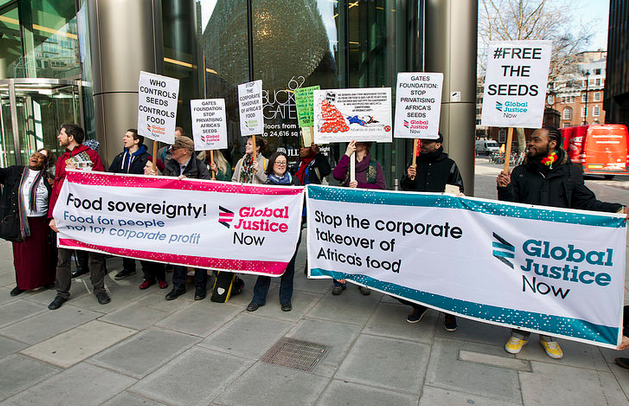
Food sovereignty activists are shining a light on a closed-door meeting between the Bill and Melinda Gates Foundation (BMGF) and the United States Agency for International Development (USAID), which are meeting in London on Monday with representatives of the biotechnology industry to discuss how to privatize the seed and agricultural markets of Africa.

Early Monday, protesters picketed outside the Gates Foundation’s London offices holding signs that called on the foundation to “free the seeds.” Some demonstrators handed out packets of open-pollinated seeds, which served as symbol of the “alternative to the corporate model promoted by USAID and BMGF.” Others smashed a piñata, which they said represented the “commercial control of seed systems;” thousands of the seeds which filled the pinata spilled across the office steps. A similar protest is expected later Monday in Seattle, Washington, where BMGF is headquartered.

The meeting was convened to discuss a report put forth by Monitor-Deloitte, which was commissioned by BMGF and USAID to develop models for the commercialization of seed production in Africa, especially “early generation seed,” and to identify ways in which the African governmental sectors could facilitate private involvement in African seed systems. The study was conducted in Ethiopia, Ghana, Nigeria, Tanzania and Zambia on maize, rice, sorghum, cowpea, common beans, cassava and sweet potato.

However, food sovereignty activists are sounding the alarm over the secret meeting. Heidi Chow, food sovereignty campaigner with Global Justice Now, which organized Monday’s protest, warned that the agenda being promoted by these stakeholders will only increase corporate control over seeds.

“This is not ‘aid’ – it’s another form of colonialism,” said Chow. “We need to ensure that the control of seeds and other agricultural resources stay firmly in the hands of small farmers who feed the majority of the population in Africa, rather than allowing big agribusiness to dominate even more aspects of the food system.”

In a blog post, Chow further explained:

For generations, small farmers have been able to save and swap seeds. This vital practice enables farmers to keep a wide range of seeds which helps maintain biodiversity and helps them to adapt to climate change and protect from plant disease. However, this system of seed saving is under threat by corporations who want to take more control over seeds. Big seed companies are keen to grow their market share of commercial seeds in Africa and alongside philanthropic organizations like the Gates Foundation and aid donors, they are discussing new ways to increase their market penetration of commercial seeds and displacing farmers own seed systems.

Corporate-produced hybrid seeds often produce higher yields when first planted, but the second generation seeds will produce low yields and unpredictable crop traits, making them unsuitable for saving and storing. This means that instead of saving seeds from their own crops, farmers who use hybrid seeds become completely dependent on the seed companies that sell them.

Further, many of the seeds produced by these biotechnology giants are sold alongside chemical fertilizer and pesticides, manufactured by the very same companies, the use of which often leads to widespread environmental destruction and other health problems.

As others noted, while the meeting attendees included representatives from the World Bank and Syngenta, the world’s third biggest seed and biotechnology company, no farmers or farming organizations were represented at the talks.

“Seeds are vital for our food system and our small farmers have always been able to save and swap seeds freely,” Ali-Masmadi Jehu-Appiah, chair of Food Sovereignty Ghana, said in a press statement. “Now our seed systems are increasingly under threat by corporations who are looking to take more control over seeds in their pursuit of profit. This meeting will push this corporate agenda to hand more control away from our small farmers and into the hands of big seed companies.”

Reporting on the Monitor-Deloitte study, Ian Fitzpatrick, a food sovereignty researcher for Global Justice Now, said that documents circulated ahead of the meeting revealed a neo-liberal agenda “laid bare.”

Fitzpatrick writes:

The report recommends that in countries where demand for patented seeds is weaker (i.e. where farmers are using their own seed saving networks), public-private partnerships should be developed so that private companies are protected from ‘investment risk’. It also recommends that that NGOs and aid donors should encourage governments to introduce intellectual property rights for seed breeders and help to persuade farmers to buy commercial, patented seeds rather than relying on their own traditional varieties.

Finally, in line with the broader neoliberal agenda of agribusiness companies across the world, the report suggests that governments should remove regulations (like export restrictions) so that the seed sector is opened up to the global market.

“This neoliberal agenda of deregulation and privatization, currently promoted in almost every sphere of human activity—from food production to health and education—poses a serious threat to food sovereignty and the ability of food producers and consumers to define their own food systems and policies,” Fitzpatrick adds.

AGRA Watch, a program of the grassroots group Community Alliance for Global Justice, notes that the BMGF-USAID commercial seed agenda further “extends U.S. foreign policy into Africa on behalf of corporate interests.”

Phil Bereano, food sovereignty campaigner with AGRA Watch and an Emeritus Professor at the University of Washington added: “This is an extension of what the Gates Foundation has been doing for several years—working with the US government and agribusiness giants like Monsanto to corporatize Africa’s genetic riches for the benefit of outsiders. Don’t Bill and Melinda realize that such colonialism is no longer in fashion? It’s time to support African farmers’ self-determination.”

The Real Story Behind the Republicans’ Iran Letter

images

By Gareth Porter

Source: Middle East Eye

The “open letter” from Senator Tom Cotton and 46 other Republican Senators to the leadership of Iran, which even Republicans themselves admit was aimed at encouraging Iranian opponents of the nuclear negotiations to argue that the United States cannot be counted on to keep the bargain, has created a new political firestorm. It has been harshly denounced by Democratic loyalists as “stunning” and “appalling”, and critics have accused the signers of the letter of being “treasonous” for allegedly violating a law forbidding citizens from negotiating with a foreign power.

But the response to the letter has primarily distracted public attention from the real issue it raises: how the big funders of the Likud Party in Israel control Congressional actions on Iran.

The infamous letter is a ham-handed effort by Republican supporters of the Netanyahu government to blow up the nuclear negotiations between the United States and Iran. The idea was to encourage Iranians to conclude that the United States would not actually carry out its obligations under the agreement – i.e. the lifting of sanctions against Iran. Cotton and his colleagues were inviting inevitable comparison with the 1968 conspiracy by Richard Nixon, through rightwing campaign official Anna Chenault, to encourage the Vietnamese government of President Nguyen Van Thieu to boycott peace talks in Paris.

But while Nixon was plotting secretly to get Thieu to hold out for better terms under a Nixon administration, the 47 Republican Senators were making their effort to sabotage the Iran nuclear talks in full public scrutiny. And the interest served by the letter was not that of a possible future president but of the Israeli government.

The Cotton letter makes arguments that are patently false. The letter suggested that any agreement that lacked approval of Congress “is a mere executive agreement”, as though such agreements are somehow of only marginal importance in US diplomatic history. In fact, the agreements on withdrawal of US forces from both the wars in Vietnam and in Iraq were not treaties but executive agreements.

Equally fatuous is the letter’s assertion that “future Congresses could modify the terms of the agreement at any time”. Congress can nullify the agreement by passing legislation that contradicts it but can’t renegotiate it. And the claim that the next president could “revoke the agreement with the stroke of a pen”, ignores the fact that the Iran nuclear agreement, if signed, will become binding international law through a United Nations Security Council resolution, as Iranian Foreign Minister Mohammad Javad Zarif has pointed out.

The letter has provoked the charge of “treason” against the signers and a demand for charges against them for negotiating with a foreign government in violation of the Logan Act. In a little over 24 hours, more than 200,000 people had signed a petition on the White House website calling such charges to be filed.

But although that route may seem satisfying at first thought, it is problematic for both legal and political reasons. The Logan Act was passed in 1799, and has never been used successfully to convict anyone, mainly because it was written more than a century before US courts created legal standards for the protection of first amendment speech rights. And it is unclear whether the Logan Act was even meant to apply to members of Congress anyway.

AIPAC marching orders

The more serious problem with focusing on the Logan Act, however, is that what Cotton and his Republican colleagues were doing was not negotiating with a foreign government but trying to influence the outcome of negotiations in the interest of a foreign government. The premise of the Senate Republican reflected in the letter – that Iran must not be allowed to have any enrichment capacity whatever – did not appear spontaneously. The views that Cotton and the other Republicans have espoused on Iran were the product of assiduous lobbying by Israeli agents of influence using the inducement of promises of election funding and the threat of support for the members’ opponents in future elections.

Those members of Congress don’t arrive at their positions on issues related to Iran through discussion and debate among themselves. They are given their marching orders by AIPAC lobbyists, and time after time, they sign the letters and vote for legislation or resolution that they are given, as former AIPAC lobbyist MJ Rosenberg has recalled. This Israeli exercise of control over Congress on Iran and issues of concern to Israel resembles the Soviet direction of its satellite regimes and loyal Communist parties more than any democratic process, but with campaign contributions replacing the inducements that kept its bloc allies in line.

Cotton’s loyalty to Israel

Rosenberg has reasoned that AIPAC must have drafted the letter and handed it to Senator Cotton. “Nothing happens on Capitol Hill related to Israel,” he tweets, “unless and until Howard Kohr (AIPAC chief) wants it to happen. Nothing.” AIPAC apparently supported the letter, but there may be more to the story. Senator Cotton just happens to be a protégé of neoconservative political kingpin Bill Kristol, whose Emergency Committee on Israel gave him nearly a million dollars late in his 2014 Senate campaign and guaranteed that Cotton would have the support of the four biggest funders of major anti-Iran organisations.

Cotton proved his absolute fealty to Likudist policy on Iran by sponsoring an amendment to the Nuclear Iran Prevention Act of 2013 that would have punished violators of the sanctions against Iran with prison sentences of up to 20 years and extended the punishment to “a spouse and any relative, to the third degree” of the sanctions violator. In presenting the amendment in the House Foreign Affairs Committee, Cotton provided the useful clarification that it would have included “parents, children, aunts, uncles, nephews, nieces, grandparents, great grandparents, grandkids, great grandkids”.

That amendment, which he apparently believed would best reflect his adoption of the Israeli view of how to cut Iran down to size, was unsuccessful, but it established his reliability in the eyes of the Republican Likudist kingmakers. Now Kristol is grooming him to be the vice-presidential nominee in 2016.

So the real story behind the letter from Cotton and his Republican colleagues is how the enforcers of Likudist policy on Iran used an ambitious young Republican politician to try to provoke a breakdown in the Iran nuclear negotiations. The issue it raises is a far more serious issue than the Logan Act, but thus far major news organisations have steered clear of that story.

– Gareth Porter is an independent investigative journalist and winner of the 2012 Gellhorn Prize for journalism. He is the author of the newly published Manufactured Crisis: The Untold Story of the Iran Nuclear Scare.


The ISIS Truth We Hide From

Isis fighters, pictured on a militant website verified by AP.

By Bob Hennelly

Source: WhoWhatWhy

Identifying Terrorist Enemy No. 1—the Islamic State militants—is easy now, after a spate of horrific videos of beheadings and burnings.

But what’s hard for Western governments and the mainstream media is figuring out the popularity of this terror group among young western Muslims. Why do these people choose to leave the relative comforts of home and take up arms with IS militants? It’s as if these young people are from another planet.

Even after President Obama’s three-day White House Summit on Violent Extremism, few establishment “experts” and commentators seem ready to consider one possible answer: that it is the extreme militarism of the U.S. and its allies that helped spawn IS, and al Qaeda before that.

On the PBS NewsHour segment covering the White house confab, panelists were asked “why people are drawn to the kind of extremism we are seeing today?” The assembled pundits identified “local grievances” like “access to education and job opportunities” and faulted recruiting for “extreme ideology through books and social media.”

Yet there was no mention of U.S. drone strikes, prisoner rendition, torture, and the thousands of dead and wounded Muslim civilians. All of those factors have been exploited by ISIS and other violent groups to make their case that the U.S. is waging a war on Islam.

After several decades of self-proclaimed “nation building” and “exporting democracy” in the Middle East and its environs, the results are all too clear. There are shattered nations in Iraq and Afghanistan, failed states in Yemen, Libya and Syria, and more than a dozen African nations that the U.S. State Department concedes are under constant threat of attack by well-armed and organized terrorists.

Is it possible that what the U.S. has actually been doing in these hot spots is “terrorism building” and “exporting chaos”? Is this the awful truth the United States cannot bring itself to admit?

Massaging History

It would seem so, since instead of changing course, the U.S. is in the process of doubling down on its mistakes. How else to explain that the new GOP presidential hopeful, Jeb Bush, nonchalantly told the Chicago Council on Global Affairs that “mistakes were made” in Iraq. He then proceeded to lay out his own plan for becoming the new global sheriff in town.

Here’s a jaw-dropping statement from that speech:

There were mistakes made in Iraq, for sure. Using the intelligence capability that everybody embraced about weapons of mass destruction was not—turns out not to be accurate.

Watching his brother’s back, Jeb wove out of thin air a phony consensus that “everybody” signed on for the rationale for the Iraq war. That’s despite a vote in Congress in which 23 U.S. Senators and 133 House members opposed it.

You see, if “everybody” was wrong, then nobody was right. It should come as no surprise that Jeb’s team of policy wise men includes many Bush II veterans, among them the unrepentant Iraq war architect Paul Wolfowitz.

His Own Man, With an Old Plan

As much as Jeb Bush insists he is his own man, the audience in Chicago could hear echoes of his brother George’s cowboy-like approach. When Jeb was asked about how he would handle IS, he said he would develop a “global strategy” that would “tighten the noose” so he and the posse could “take them out.”

During Bush’s remarks, he took aim at the Obama administration for being too quick to disengage from the world and Iraq. He blamed Obama for creating a power vacuum that set the stage for the rise of IS and Iranian influence.

Yet an examination of President Obama’s new National Security Strategy, his proposed military budget and his request for his own War Powers re-authorization all indicate an administration that is prosecuting a global war on terror with unfettered latitude as to where and whom it targets.

Could it be that this “global war on terror,” whether it be the Bush 1.0 or Obama 2.0 version, may actually be what is proliferating the very thing it was aimed to eradicate?

One policy expert who dares to look deeper is Graham Fuller, a career CIA agent and analyst who was vice-chairman of the CIA’s National Intelligence Council. Fuller says it was the U.S. invasion of Iraq in 2003 that set the stage for IS. By creating an endemically corrupt central government in Baghdad, notes Fuller, the American occupation provided a focal point to unite disparate opposition groups. As for the high-profile effort to train a new Iraqi army, that “security” force collapsed the moment its U.S. handlers left. (In an odd twist to an already bizarre security meta-narrative, Fuller’s former son-in-law is the uncle of accused Boston Marathon Bombers Tamerlan and Dzhokhar Tsarnaev.)

***

In linking Washington’s Middle Eastern policies to the rise of terrorist groups in the region, MIT professor Noam Chomsky takes it even further back. He says the roots start with the U.S. support of Iraq in its brutal war with Iran in the 1980s, and include the draconian economic sanctions that followed Saddam Hussein’s 1990 invasion of Kuwait. In Chomsky’s view, these sanctions punished Iraqi civilians while reinforcing Saddam’s dictatorial control.

In his 2006 book Devil’s Game: How the U.S. Helped Unleash Fundamentalist Islam, longtime Nation correspondent Robert Dreyfuss documents how the U.S., as early as the 1950s, backed the Muslim Brotherhood in exchange for help fighting communism.

Peace’s Deadliest Year

One way to justify failed policies is to pretend that they have worked as advertised. Nowhere was this disconnect between rhetoric and reality more on display than in President Obama’s updating this month of his National Security Strategy.

In presenting this new security game-plan, the president exhibited excessive confidence in declaring that the United States was heading “home” and “moving beyond” ground wars in Iraq and Afghanistan. In his mini-version of Bush’s infamous ‘Mission Accomplished’ statement, he asserted that “the threat of catastrophic attacks” against the U.S. had “diminished.”

But even as the president describes a winding-down of combat operations, anything but peace is taking hold in those places.

The sectarian violence has resulted in record numbers of civilian deaths and injuries. The UN reported last month that more than 12,000 civilians were killed in Iraq in 2014, the deadliest year for noncombatants since 2008. In Afghanistan, the UN Assistance Mission counted close to 3,200 civilians killed and more than 6,400 wounded, the deadliest year since America’s longest war started.

Providing a sharp contrast to the president’s own assertion that peace is almost at hand, he has sent troops back into Iraq. And just a few days ago, his new Secretary of Defense, Ashton Carter, said the U.S. might end up sticking around in Afghanistan after all.

What the Administration and a cheerleading media refuse to acknowledge is that the two U.S. wars in Afghanistan and Iraq, aimed at ending terrorist threats in the region, have done the exact opposite. They not only caused tens of thousands of civilian casualties but hardened the resolve of yet another generation to seek revenge against their perceived Western oppressors.

Bottom Line

While details of how the president plans to use his refreshed war powers are still vague, the price tag is not.

In the name of defending the country and fighting terrorism, the president’s proposed 2016 budget calls for adding $38 billion in regular defense spending and another $58 billion for so-called “Overseas Contingency Operations.” These expanded outlays would come on top of the more than half a trillion dollars the U.S. is already spending on the military.

Even under the sequester restrictions, says one specialist, U.S. military spending was already quite robust and shamefully under-scrutinized.

“If you can’t protect the nation with $500 billion dollars,” then something is amiss, according to Veronique deRugy of George Mason University’s Mercatus Center. She notes that even under the sequester restrictions, U.S. military spending was already quite robust and shamefully under-scrutinized.

The failures are especially pronounced, says deRugy, when one takes into account that in the years since 9/11, Washington’s extra expenditures, labeled “emergency” war funding, have topped Pentagon budgets by tens of billions annually.

And so under presidents from both parties, who were supposedly ‘conservative’  and ‘liberal’,  the “emergency” continues to spread.