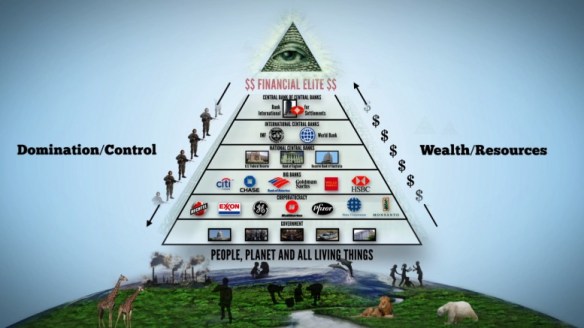
How Does Corporate Media Manufacture False Narratives?

aa-corporate-media-very-good-poster

By Nauman Sadiq

Source: RINF

What bothers me is not that we are unable to find the solution to our problems, what bothers me more is the fact that neoliberals are so utterly unaware of the real structural issues that their attempts to sort out the tangential issues will further exacerbate the main issues. Religious extremism, militancy and terrorism are not the cause but the effect of poverty, backwardness and disenfranchisement.

Empirically speaking, if we take all the other aggravating factors out: like poverty, backwardness, illiteracy, social injustice, disenfranchisement, conflict, instability, deliberate training and arming of certain militant groups by the regional and global players, and more importantly grievances against the duplicitous Western foreign policy, I don’t think that Islamic State, al-Qaeda and the likes would get the abundant supply of foot soldiers that they are getting now in the troubled regions of Middle East, North Africa and South Asia.

Moreover, I do concede that the rallying cry of “Jihad in the way of God” might have been one reason for the abundant supply of foot soldiers to the jihadists’ cause, but on an emotional level it is the self-serving and hypocritical Western interventionist policy in the energy-rich Middle East that adds fuel to the fire. When Muslims all over the Islamic countries see that their brothers-in-faith are dying in Palestine, Syria, Iraq, Libya, Yemen and Afghanistan, on an emotional level they feel outraged and seek vengeance and justice.

This emotional outrage, in my opinion, is a far more potent factor than the sterile rational argument of God’s supposed command to fight holy wars against the infidels. If we take all the other contributing factors, that I have mentioned in the second paragraph out of the equation, I don’t think that Muslims are some “exceptional” variety of human beings who are hell-bent on killing the heretics all over the world.

Notwithstanding, it’s very easy to distinguish between the victims of structural injustices and the beneficiaries of the existing neocolonial economic order all over the world. But instead of using words that can be interpreted subjectively I’ll let the figures do the talking. Pakistan’s total GDP is only $270 billion and with a population of 200 million it amounts to a per capita income of only $1400. While the US’ GDP is $18 trillion and per capita income is in excess of $50,000. Similarly the per capita income of most countries in the Western Europe is also around $40,000. That’s a difference of 40 to 50 TIMES between the incomes of Third World countries and the beneficiaries of neocolonialism, i.e. the Western powers.

Only the defense budget of the Pentagon is $600 billion, which is three times the size of Pakistan’s total GDP. A single multi-national corporation based in the Wall Street and other financial districts of the Western world owns assets in excess of $200 billion which is more than the total GDP of many developing economies. Examples of such business conglomerates are: Investment banks – JP Morgan, Goldman Sachs, Barclays, HSBC, BNP Paribas; Oil majors – Exxon Mobil, Chevron, BP, RDS, Total, Vitol; Manufacturers – Apple, Microsoft and Google.

On top of that, semi-legit wealth from all over the world flows into the Western commercial and investment banks: last year there was a report that the Russian oligarchs have deposited $800 billion in the Western banks, while the Chinese entrepreneurs have deposited $1.5 trillion in the Western financial institutions.

Moreover, in April this year the Saudi finance minister threatened that the Saudi kingdom would sell up to $750 billion in Treasury securities and other assets if Congress passed a bill that would allow the Saudi government to be held responsible for any role in the September 11, 2001 terror attacks. And $750 billion is only the Saudi investment in the US, if we add up Saudi investment in Western Europe, and the investments of UAE, Kuwait and Qatar in the Western economies, the sum total would amount to trillions of dollars of Gulf’s investment in the US and Western Europe.

The first and foremost priority of the Western powers is to save their Corporate Empire, and especially their financial institutions, from collapsing; everything else like eliminating terrorism, promoting democracy and “responsibility to protect” are merely arranged side shows to justify their interventionist foreign policy, especially in the energy-rich Middle East.

Additionally, the irony is that the neoliberal dupes of the mainstream media justify and validate the unfair practices of the neocolonial powers and hold the victims of structural injustices responsible for their misfortunes. If a Third World’s laborer has been forced to live on less than $5 a day and a corporate executive sits in the Wall Street on top of $18 trillion business empire, neoliberals are okay with this travesty.

However, we need to understand that how does a neoliberal mindset is structured? As we know that mass education programs and mass media engender mass ideologies. We like to believe that we are free to think, but we aren’t. Our narratives aren’t really “our” narratives. These narratives of injustice and inequality have been constructed for the public consumption by the corporate media, which is nothing more than the mouthpiece of the Western political establishments and the business interests.

Media is our eyes and ears through which we get all the inputs and it is also our brain through which we interpret raw data. If media keeps mum over some vital structural injustices and blows out of proportion some isolated incidents of injustice and violence, we are likely to forget all about the former and focus all of our energies on the tangential issues which the media portrays as the “real” ones.

Monopoly capitalism and the global neocolonial economic order are the real issues while Islamic radicalism and terrorism are the secondary issues and itself an adverse reaction to the former. That’s how the mainstream media constructs artificial narratives and dupes its audience into believing the absurd: during the Cold War it created the “Red Scare” and told us that communism is an existential threat to the free world and the Western way of life. We bought this narrative.

Then the West and its Saudi and Pakistani collaborators financed, trained and armed the Afghan so-called “freedom fighters” and used them as their proxies against the Soviets. After the collapse of the Soviet Union they declared the former “freedom fighters” to be terrorists and another existential threat to the “free world” and the Western way of life. We again bought this narrative.

And finally, during the Libyan and Syrian proxy wars the former terrorists once again became freedom fighters – albeit in a more nuanced manner, this time around the corporate media sells them as “moderate rebels.” And the lobotomized neoliberal audience of the mainstream media is once again willing to buy this narrative, how ironic?


Nauman Sadiq is an Islamabad-based attorney, columnist and geopolitical analyst focused on the politics of Af-Pak and MENA regions, neocolonialism and Petroimperialism.

Cutting the Cords of Empire: The Spectacle of US Elections

the-powers-that-be-deep-state

By William Hawes

Source: Global Research

“The more powerful the class, the more it claims not to exist.” -Guy Debord, The Society of the Spectacle

It’s almost time for our quadrennial political distraction, masquerading as the US presidential election. As opposed to previous elections, this one feels quite different. Even with Obama/Romney in 2012, important, basic economic issues were discussed, health care reform was questioned, and foreign policy was given its due.

However, this time, the spectacle of the personalities seems to dominate the conversation: Mrs. Clinton is somehow on a feminist crusade, an inspiration for women everywhere. Going unmentioned are her irredeemable backers, such as the genocidal Henry Kissinger and Madeleine Albright. As for Trump, his version of America is as naïve, narrow-minded, and delusional as a Leave It to Beaver episode, or a Captain America comic book. In the background, the monstrosity of global capitalism goes unquestioned, and the cries from victims of US institutional racism and structural violence go unheard.

Global warming, broad economic policy, and nuanced foreign policy are simply too much to ask of these candidates. Their stupidity knows no end; their corruption and depravity know no bounds, and many of both of their supporters, as well as media, political, and corporate backers and sycophants can be considered “deplorable”. Many supporters of the two-party system do not bother to think about the damage either potential president would do to people outside the US. Many backers of Trump and Clinton have little to no basic knowledge of world cultures and history.

What are the cords that connect us to these “leaders”, to our American Empire? They are the same ones that the Industrial Revolution, the basis of our civilization, has implanted in each of us since birth, as Alvin Toffler explains in The Third Wave. As our social world became modeled on the factory floors developed in the 18th and 19th centuries, a set of unspoken principles were ironed out, and transferred to the political, social, and economic realms. (1)  As we shall see, these principles spread unchecked, and have infiltrated political discourse and social hierarchies. Toffler identifies these implicit rules as:

1) Standardization: Industry, production, and factory life revolved around endless loops and inputs of metals, fabrics, coal, oil, and specialized parts for trains, cars, etc. The simplification and standard mechanical parts used were mirrored and reflected in the culture at large: eventually, markets, the media, radio and TV, and even great art and literature succumbed to commoditization and homogenization. We now have mass marketing, public relations, and “electioneering”, where our duopoly controls all branches of government.

2) Specialization: With the explosion in the fields of science and engineering, specialized techniques were taught to develop, invent, and maintain mechanical and electric equipment. Yet again, this philosophy infected the general society:  only bureaucrats are able to work in the halls of power, only industrial experts are able to administer federal agencies, creating the disgraceful revolving door phenomena in Washington.

3) Synchronization: As more people flocked into cities with gleaming promises of steady, factory jobs, time and punctuality became of prime importance. Punching timecards and meeting quotas were necessary: there was no room for leeway, as assembly lines demanded strict timelines. The time demands of labor leaked into white-collar work as well: in banking and finance, railroads, time zones, and office jobs, advanced scheduling became the norm. Eventually, synchronization of the political system gained traction, and the imperial system came to resemble a deathly machine, marching in time to bloody footsteps: military, immoral diplomacy and ideology, and industry worked together to lord over Latin America with the Monroe Doctrine, annihilate Native Americans using Manifest Destiny, even as today, the excuse of the “War on Terror” is used to exterminate entire populations in Afghanistan, Iraq, Syria, Libya, and elsewhere.

4) Concentration: Think of the vast oil and coal stored underground for millions of years, only to be strip-mined, taken up by rigs, and transported by rail and tanker into vast refineries: concentration of energy. Further, every class of people became absorbed and intensified in the industrial system: workers into factories, children into schools, mentally ill into institutions, finance concentrated into New York, London, and Paris. Mega-mergers of corporations: today, it is the Apple, Google, Shell, and BP’s of the world who have coffers of blood money held tidily in banks throughout the world. Further, the concentration of technocrats who we supposedly need to run our societies: in the West, the military-industrialists, just as the Soviets were once told the nomenklatura was necessary.

5) Maximization: Firms were encouraged to grow as large as possible, and expand into as many fields as possible. Companies in Japan in the mid-twentieth century would actually have workers sing of the glory and greatness of their employer. Today, 62 people have the same wealth as half the world’s population. This is concentration and maximizing at its most obscene. Of course, you won’t hear Clinton, Trump, or anyone in Washington talking about this. Maximizing GDP, corporate profits, fossil fuel use, and flexing imperial muscle is what the Feds do best.

6) Centralization: Connected to the first five rules of empire stated above, centralizing power, wealth, and using knowledge for private gain is required to uphold the industrial state. Taxation, subsidies for industry, political debates via the sham Committee on Presidential Debates, the backroom shenanigans of the DNC and RNC, and cloak and dagger lobbying and bribery now dominate our system of government. Further, the Leviathan of state-sanctioned violence now lords over the world from the Pentagon and NATO, and the centralization of information runs through fiber-optic cables straight to the infernal, yet temperature-controlled offices of the CIA and NSA.

The elections have adopted all the patterns of the industrial, imperial state: we have standardized TV, scripted questions, airbrushed candidates, and childlike debates. We’ve seen specialized tactics of gerrymandering, vote-rigging, PR bullshit, and strategists whose careers accomplish nothing for the public good. We all know of the synchronization of Wall Street, defense and oil companies. The concentration of power in the hands of the few hardly needs mention: here’s the study by Princeton and Northwestern professors who conclude that the US is an oligarchy, not a democracy. We’ve witnessed the maximization of endless primaries, debates, press conferences, and town-hall meetings ad infinitum. The centralization of political ideology (triangulation in Clintonite terms, Machiavellian to a rational person) and the limitations of discourse that our candidates display are all too clear.

These are the iron chains holding us down, shackling us in Plato’s cave: our candidates are figureheads, shadows on the wall; they are puppets of the super-elite. The central position they carve out in the mainstream is really a pit, an abyss: one that we all find ourselves in, as we continue to vote for those who don’t fight for our interests.

The two best options for this election seem to be: voting for Jill Stein, or boycotting the election, as Joel Hirschhorn advocates. As for our obscene election cycles, I believe Zach de la Rocha summed it up best:

  A spectacle monopolized

The camera’s eyes on choice disguised

Was it cast for the mass who burn and toil?

Or for vultures who thirst for blood and oil?

William Hawes is a writer specializing in politics and environmental issues. His articles have appeared online at Global Research, Counterpunch, Dissident Voice, The World Financial Review, Gods & Radicals, and Countercurrents. He is author of the e-book Planetary Vision: Essays on Freedom and EmpireYou can reach him at wilhawes@gmail.com

Notes:

1.) Alvin Toffler. The Third Wave. Bantam, 1980. p. 46-60.


Hillary and the Clinton Foundation: Exemplars of America’s Political Rot

Clinton

By Eric Draitser

Source: CounterPunch

Hillary Clinton may be enjoying a comfortable lead in national polls, but she is far from enjoying a comfortable night’s sleep given the ever-widening maelstrom of scandals engulfing her presidential bid.  And while Clinton delights in bloviating about a decades-long “vast, right wing conspiracy” against her, the fact is that it’s the Clinton political machine’s long and storied track record of criminality, duplicity, and corruption that haunts her like Lincoln’s ghost silently skulking through White House bedrooms.

The latest in a string of embarrassing scandals is centered on the powerful Clinton Foundation, and the obvious impropriety of its acceptance of large donations from foreign governments (and wealthy individuals connected to them), especially those governments universally recognized as oppressive dictatorships whose foreign policy orientation places them squarely in the US orbit.

Of particular note are the Gulf monarchies such as Saudi Arabia and Qatar whose massive donations belie the fact that their oppression of women runs contradictory to Clinton’s self-styled ‘feminism’ and belief “that the rights of women and girls is the unfinished business of the 21st Century.”  Is collaborating with feudal monarchies whose subjugation of women is the stuff of infamy really Clinton’s idea of feminism?  Or, is it rather that Clinton merely uses issues such as women’s rights as a dog whistle for loyal liberals while groveling before the high councilors of the imperial priesthood?

What the Clinton Foundation hullabaloo really demonstrates is that Clinton’s will to power is single-minded, entirely simpatico with the corruption of the military-industrial-financial-surveillance complex; that she is a handmaiden for, and member of, the ruling establishment; that Clinton represents the marriage of all the worst aspects of the political class.  In short, Clinton is more than just corrupt, she is corruption personified.

Clinton’s Dirty Dealing and Even Dirtier Laundry

In a hilariously pig-headed, but rather telling, statement, former President Bill Clinton responded to allegations of impropriety with the Clinton Foundation by saying, “We’re trying to do good things…If there’s something wrong with creating jobs and saving lives, I don’t know what it is. The people who gave the money knew exactly what they were doing. I have nothing to say about it except that I’m really proud.”

Leaving aside the fact that such an arrogant comment demonstrates Bill Clinton’s complete contempt for ethics and the basic standards of proper conduct, the salient point is that the argument from the Clintons is that the foundation is inherently good, that it helps people around the world, and that, as such, it can’t possibly be corrupt and unethical.  Where there’s smoke, there’s fire – except when it comes to the Clintons who stand proudly enveloped in billowing clouds of smoke swearing up and down that not only is there no fire, but anyone who mentions the existence of flames is both a sexist and Trump-loving Putin stooge.

But indeed there is a fire, and it is raging on the American political scene.  And nowhere is the heat more palpable than in the deserts of the Middle East where wealthy benefactors write massive checks for access to America’s 21st Century Queen of Mean (apologies to Leona Helmsley).

Consider the 2011 sale of $29 billion worth of advanced fighter jets to Saudi Arabia, a gargantuan deal that made the feudal monarchy into an overnight air power.  Were there any doubts as to the uses of the hardware, look no further than the humanitarian nightmare that is Yemen, a country under relentless air war carried out by the Saudis.  And, lo and behold, the Saudis had been major contributors to the Clinton Foundation in the years leading up to the sale. And it should be equally unsurprising that just weeks before the deal was finalized, Boeing, the manufacturer of the F-15 jets that were the centerpiece of the massive arms deal, donated $900,000 to the Foundation.

Of course, according to Bubba and Hil, it’s all conspiracy theory to suggest that the Clinton Foundation is essentially a pay-for-play scheme in which large sums of money translate into access to the uppermost echelons of state power in the US.  As the International Business Times noted:

The Saudi deal was one of dozens of arms sales approved by Hillary Clinton’s State Department that placed weapons in the hands of governments that had also donated money to the Clinton family philanthropic empire…Under Clinton’s leadership, the State Department approved $165 billion worth of commercial arms sales to 20 nations whose governments have given money to the Clinton Foundation…That figure — derived from the three full fiscal years of Clinton’s term as Secretary of State (from October 2010 to September 2012) — represented nearly double the value of American arms sales made to the those countries and approved by the State Department during the same period of President George W. Bush’s second term.

The Clinton-led State Department also authorized $151 billion of separate Pentagon-brokered deals for 16 of the countries that donated to the Clinton Foundation, resulting in a 143 percent increase in completed sales to those nations over the same time frame during the Bush administration. These extra sales were part of a broad increase in American military exports that accompanied Obama’s arrival in the White House. The 143 percent increase in U.S. arms sales to Clinton Foundation donors compares to an 80 percent increase in such sales to all countries over the same time period.

Additionally, as Glenn Greenwald explained earlier this year,

The Saudi regime by itself has donated between $10 million and $25 million to the Clinton Foundation, with donations coming as late as 2014, as she prepared her presidential run. A group called “Friends of Saudi Arabia,” co-founded “by a Saudi Prince,” gave an additional amount between $1 million and $5 million. The Clinton Foundation says that between $1 million and $5 million was also donated by “the State of Qatar,” the United Arab Emirates, and the government of Brunei. “The State of Kuwait” has donated between $5 million and $10 million.

The sheer dollar amounts are staggering.  Perhaps then it comes as no surprise just why nearly every single influential figure in the military-industrial-financial-surveillance complex – from General John Allen to death squad coordinator extraordinaire John Negroponte, from neocon tapeworms such as Max Boot, Robert Kagan, and Eliot Cohen to billionaire barbarocrats like the Koch Brothers, George Soros, and Warren Buffett – is backing Hillary Clinton.  Not only is she good for Empire, she’s good for business.  And ultimately, that’s what this is all about, isn’t it?

But of course, Hillary’s devotion to the oil oligarchs of Saudi Arabia and the Gulf goes much deeper than simply an exchange of money for weapons.  In fact, Hillary is deeply committed to the Saudi royal family’s foreign policy outlook and tactics, in particular the weaponization of terrorism as a means of achieving strategic objectives.

Libya provides perhaps the paragon of Clintonian-Saudi strategy: regime change by terrorism.  Using terror groups linked to Al Qaeda and backed by Saudi Arabia, Clinton’s State Department and the Obama Administration managed to topple the government of Muammar Gaddafi, thereby throwing the former “jewel of Africa” into turmoil and political, economic, and social devastation.   To be fair, it was not the Saudis alone involved in fomenting war in Libya, as Hillary’s brothers-from-other-mothers in Qatar and the United Arab Emirates were also directly involved in sowing the seeds of the current chaos in the country.

And of course, this strategic partnership between Clinton and the Gangsters of the Gulf extends far beyond Libya.  In Syria, Clinton’s stated policies of regime change and war are aligned with those of Riyadh, Doha, and Abu Dhabi.  And, of course, it was during Clinton’s tenure at the State Department that US intelligence was involved in funneling weapons and fighters into Syria in hopes of doing to Syria what had already been done to Libya.

Huma Abedin: Clinton’s Woman in Riyadh

Just in case all the political and financial ties between Clinton and the Gulf monarchies wasn’t enough to make people stop being #WithHer, perhaps the role of her closest adviser might do the trick.  Huma Abedin, Clinton’s campaign chief of staff, has long-standing ties to Saudi Arabia, the country where Huma spent her childhood from the age of two.  As a Vanity Fair exposé revealed earlier this year:

When Abedin was two years old, the family moved to Jidda, Saudi Arabia, where, with the backing of Abdullah Omar Nasseef, then the president of King Abdulaziz University, her father founded the Institute of Muslim Minority Affairs, a think tank, and became the first editor of its Journal of Muslim Minority Affairs…After [Abedin’s father] Syed died, in 1993, his wife succeeded him as director of the institute and editor of the Journal, positions she still holds… Abdullah Omar Nasseef, the man who set up the Abedins in Jidda…is a high-ranking insider in the Saudi government and sits on the king’s Shura Council, there are claims that Nasseef once had ties to Osama bin Laden and al-Qaeda—a charge that he has denied through a spokesman—and that he remains a “major” figure in the Muslim Brotherhood. In his early years as the patron of the Abedins’ journal, Nasseef was the secretary-general of the Muslim World League, which Andrew McCarthy, the former assistant U.S. attorney who prosecuted the “Blind Sheik,” Omar Abdel Rahman, in the wake of the 1993 World Trade Center bombing, claims “has long been the Muslim Brotherhood’s principal vehicle for the international propagation of Islamic supremacist ideology.”

Consider the implications of this information: Clinton’s closest adviser comes from a family connected at the highest levels with the Saudi royal family as well as the Muslim Brotherhood.  While right wing pundits portray the Muslim Brotherhood as some sort of straightforward international terror organization, the reality is much more complex as the Brotherhood is more an international political movement whose tentacles stretch into nearly every corner of the Muslim world. Its vast reserves of cash and political influence, backed by Gulf monarchies such as Qatar, allows the Brotherhood to peddle influence throughout the West, while also being connected to more radical salafist elements.  An obvious two-for-one for Clinton.

In effect then, Abedin represents a bridge connecting Hillary with both the ruling elites in Riyadh, as well as influential clerics, businesspeople, and political leaders throughout the Middle East. Perhaps then it makes sense why Abedin, in contravention of every standard of ethics, was employed by Teneo Holdings – a pro-Clinton consultancy founded by former Clinton aide Doug Band – while also working for the State Department.  Such ethical violations are as instinctive for Hillary as breathing, or calling children superpredators.

Trump, Assange, Putin, and Clinton’s Sleight of Hand

Despite being embroiled in multiple scandals, any one of which being enough to sink the campaign of most other candidates, Clinton and her army of fawning corporate media sycophants, have attempted to deflect attention away from her own misdeeds, corruption, and nefarious ties by instead portraying everyone who opposes them as puppets, stooges, and useful idiots.

Let’s begin with Republican nominee and gasbag deluxe, Donald Trump, who Clinton trolls have attempted to portray as a stooge of Russian President Putin.   While it’s indeed quite likely that the Kremlin sees Trump as far less of a threat to Russia’s interests than Clinton – just look at Clinton’s roster of neocon psychopath supporters to see that Putin has a point – the notion that Trump is somehow a creation of Putin, or at the very least is working for him is utterly absurd.

And the “evidence”? Trump’s connections with wealthy Russian oligarchs.  I suppose those who have made their homes under rocks these last 25 years might not know this, but nearly every billionaire investor has gone to Russia in that time, forged ties with influential Russians, and attempted to make money by stripping clean the bones of what was once the Soviet Union.  Sorry Naomi Klein, I guess the Clintonistas expect no one to have read Shock Doctrine which details the sort of disaster capitalism run amok that took place in Russia in the 1990s.

And then, of course, there’s that great confabulator Julian Assange who has also been smeared as a Putin puppet by the #ImWithHer media somnambulists.  I guess the lords of corporate capital didn’t like the fact that Assange and WikiLeaks have managed to expose countless dirty deeds by Clinton’s Tammany Hall of the 21stCentury.  From using the DNC as a political appendage of the Clinton campaign (as revealed by the WikiLeaks dump of DNC emails) to his recent promise to make public the “most interesting and serious” dirt on Hillary, Assange has become a thorn in the side – or thumb in the eye, as it were – for Hillary.

And what would a rundown of the specters haunting Clinton’s dreams be without mention of the rabid bear of Russia, big bad Vlad?  Clinton recently referred to Putin as the “grand godfather of this global brand of extreme nationalism.”  Leaving aside the asinine phraseology, Clinton’s attacks on Putin reveal the weakness of the Democratic nominee, the hollowness of her arguments, and the unmitigated gall of a hypocrite for whom casting stones in glass houses is second nature.

For, at the very moment that she takes rhetorical swipes at Putin, Clinton herself is implicated in a worldwide network of extremism that promotes terrorism, rains death and destruction on millions of innocent civilians, and moves the world closer to global conflict.  If Putin represents the éminence grise of a “global brand of extreme nationalism,” then Clinton is the fairy godmother of global extremism and terror.  It’s a good thing she has access to the best personal grooming products Goldman Sachs money can buy as it is not easy to wash decades-worth of blood off your hands.

And so, the quadrennial danse macabre that is the US presidential election has turned into an embarrassing sideshow of dull-witted infantilism.  But amid the idiocy there is wanton criminality and corruption to be exposed before the world.  For while Trump is undoubtedly the bearded lady of America’s freak show, Hillary is the carnival barker.

She knows the ring toss and other games are rigged, but she coaxes the feeble-minded to play nonetheless.  She knows the carnies are drunk and reckless, but she urges the children to pay for another ride anyway.  She understands that her job is to sell a rigged game, and to call security when someone challenges her lies. And, unfortunately, whether you want it or not, the Hillary Roadshow is coming to a town, or country, near you.

Eric Draitser is the founder of StopImperialism.org and host of CounterPunch Radio. He is an independent geopolitical analyst based in New York City. You can reach him at ericdraitser@gmail.com.

The Great Ponzi Scheme of the Global Economy

FollowTheMoney-Bank-Pyramid

By Michael Hudson and Chris Hedges

Source: CounterPunch

CHRIS HEDGES: We’re going to be discussing a great Ponzi scheme that not only defines not only the U.S. but the global economy, how we got there and where we’re going. And with me to discuss this issue is the economist Michael Hudson, author of Killing the Host: How Financial Parasites and Debt Destroy the Global Economy. A professor of economics who worked for many years on Wall Street, where you don’t succeed if you don’t grasp Marx’s dictum that capitalism is about exploitation. And he is also, I should mention, the godson of Leon Trotsky.

I want to open this discussion by reading a passage from your book, which I admire very much, which I think gets to the core of what you discuss. You write,

“Adam Smith long ago remarked that profits often are highest in nations going fastest to ruin. There are many ways to create economic suicide on a national level. The major way through history has been through indebting the economy. Debt always expands to reach a point where it cannot be paid by a large swathe of the economy. This is the point where austerity is imposed and ownership of wealth polarizes between the One Percent and the 99 Percent. Today is not the first time this has occurred in history. But it is the first time that running into debt has occurred deliberately.” Applauded. “As if most debtors can get rich by borrowing, not reduced to a condition of debt peonage.”

So let’s start with the classical economists, who certainly understood this. They were reacting of course to feudalism. And what happened to the study of economics so that it became gamed by ideologues?

HUDSON: The essence of classical economics was to reform industrial capitalism, to streamline it, and to free the European economies from the legacy of feudalism. The legacy of feudalism was landlords extracting land-rent, and living as a class that took income without producing anything. Also, banks that were not funding industry. The leading industrialists from James Watt, with his steam engine, to the railroads …

HEDGES: From your book you make the point that banks almost never funded industry.

HUDSON: That’s the point: They never have. By the time you got to Marx later in the 19th century, you had a discussion, largely in Germany, over how to make banks do something they did not do under feudalism. Right now we’re having the economic surplus being drained not by the landlords but also by banks and bondholders.

Adam Smith was very much against colonialism because that lead to wars, and wars led to public debt. He said the solution to prevent this financial class of bondholders burdening the economy by imposing more and more taxes on consumer goods every time they went to war was to finance wars on a pay-as-you-go basis. Instead of borrowing, you’d tax the people. Then, he thought, if everybody felt the burden of war in the form of paying taxes, they’d be against it. Well, it took all of the 19th century to fight for democracy and to extend the vote so that instead of landlords controlling Parliament and its law-making and tax system through the House of Lords, you’d extend the vote to labor, to women and everybody. The theory was that society as a whole would vote in its self-interest. It would vote for the 99 Percent, not for the One Percent.

By the time Marx wrote in the 1870s, he could see what was happening in Germany. German banks were trying to make money in conjunction with the government, by lending to heavy industry, largely to the military-industrial complex.

HEDGES: This was Bismarck’s kind of social – I don’t know what we’d call it. It was a form of capitalist socialism…

HUDSON: They called it State Capitalism. There was a long discussion by Engels, saying, wait a minute. We’re for Socialism. State Capitalism isn’t what we mean by socialism. There are two kinds of state-oriented–.

HEDGES: I’m going to interject that there was a kind of brilliance behind Bismarck’s policy because he created state pensions, he provided health benefits, and he directed banking toward industry, toward the industrialization of Germany which, as you point out, was very different in Britain and the United States.

HUDSON: German banking was so successful that by the time World War I broke out, there were discussions in English economic journals worrying that Germany and the Axis powers were going to win because their banks were more suited to fund industry. Without industry you can’t have really a military. But British banks only lent for foreign trade and for speculation. Their stock market was a hit-and-run operation. They wanted quick in-and-out profits, while German banks didn’t insist that their clients pay as much in dividends. German banks owned stocks as well as bonds, and there was much more of a mutual partnership.

That’s what most of the 19th century imagined was going to happen – that the world was on the way to socializing banking. And toward moving capitalism beyond the feudal level, getting rid of the landlord class, getting rid of the rent, getting rid of interest. It was going to be labor and capital, profits and wages, with profits being reinvested in more capital. You’d have an expansion of technology. By the early twentieth century most futurists imagined that we’d be living in a leisure economy by now.

HEDGES: Including Karl Marx.

HUDSON: That’s right. A ten-hour workweek. To Marx, socialism was to be an outgrowth of the reformed state of capitalism, as seemed likely at the time – if labor organized in its self-interest.

HEDGES: Isn’t what happened in large part because of the defeat of Germany in World War I? But also, because we took the understanding of economists like Adam Smith and maybe Keynes. I don’t know who you would blame for this, whether Ricardo or others, but we created a fictitious economic theory to praise a rentier or rent-derived, interest-derived capitalism that countered productive forces within the economy. Perhaps you can address that.

HUDSON: Here’s what happened. Marx traumatized classical economics by taking the concepts of Adam Smith and John Stuart Mill and others, and pushing them to their logical conclusion. Progressive capitalist advocates – Ricardian socialists such as John Stuart Mill – wanted to tax away the land or nationalize it. Marx wanted governments to take over heavy industry and build infrastructure to provide low-cost and ultimately free basic services. This was traumatizing the landlord class and the One Percent. And they fought back. They wanted to make everything part of “the market,” which functioned on credit supplied by them and paid rent to them.

None of the classical economists imagined how the feudal interests – these great vested interests that had all the land and money – actually would fight back and succeed. They thought that the future was going to belong to capital and labor. But by the late 19th century, certainly in America, people like John Bates Clark came out with a completely different theory, rejecting the classical economics of Adam Smith, the Physiocrats and John Stuart Mill.

HEDGES: Physiocrats are, you’ve tried to explain, the enlightened French economists.

HUDSON: The common denominator among all these classical economists was the distinction between earned income and unearned income. Unearned income was rent and interest. Earned incomes were wages and profits. But John Bates Clark came and said that there’s no such thing as unearned income. He said that the landlord actually earns his rent by taking the effort to provide a house and land to renters, while banks provide credit to earn their interest. Every kind of income is thus “earned,” and everybody earns their income. So everybody who accumulates wealth, by definition, according to his formulas, get rich by adding to what is now called Gross Domestic Product (GDP).

HEDGES: One of the points you make in Killing the Host which I liked was that in almost all cases, those who had the capacity to make money parasitically off interest and rent had either – if you go back to the origins – looted and seized the land by force, or inherited it.

HUDSON: That’s correct. In other words, their income is unearned. The result of this anti-classical revolution you had just before World War I was that today, almost all the economic growth in the last decade has gone to the One Percent. It’s gone to Wall Street, to real estate …

HEDGES: But you blame this on what you call Junk Economics.

HUDSON: Junk Economics is the anti-classical reaction.

HEDGES: Explain a little bit how, in essence, it’s a fictitious form of measuring the economy.

HUDSON: Well, some time ago I went to a bank, a block away from here – a Chase Manhattan bank – and I took out money from the teller. As I turned around and took a few steps, there were two pickpockets. One pushed me over and the other grabbed the money and ran out. The guard stood there and saw it. So I asked for the money back. I said, look, I was robbed in your bank, right inside. And they said, “Well, we don’t arm our guards because if they shot someone, the thief could sue us and we don’t want that.” They gave me an equivalent amount of money back.

Well, imagine if you count all this crime, all the money that’s taken, as an addition to GDP. Because now the crook has provided the service of not stabbing me. Or suppose somebody’s held up at an ATM machine and the robber says, “Your money or your life.” You say, “Okay, here’s my money.” The crook has given you the choice of your life. In a way that’s how the Gross National Product accounts are put up. It’s not so different from how Wall Street extracts money from the economy. Then also you have landlords extracting …

HEDGES: Let’s go back. They’re extracting money from the economy by debt peonage. By raising …

HUDSON: By not playing a productive role, basically.

HEDGES: Right. So it’s credit card interest, mortgage interest, car loans, student loans. That’s how they make their funds.

HUDSON: That’s right. Money is not a factor of production. But in order to have access to credit, in order to get money, in order to get an education, you have to pay the banks. At New York University here, for instance, they have Citibank. I think Citibank people were on the board of directors at NYU. You get the students, when they come here, to start at the local bank. And once you are in a bank and have monthly funds taken out of your account for electric utilities, or whatever, it’s very cumbersome to change.

So basically you have what the classical economists called the rentier class. The class that lives on economic rents. Landlords, monopolists charging more, and the banks. If you have a pharmaceutical company that raises the price of a drug from $12 a shot to $200 all of a sudden, their profits go up. Their increased price for the drug is counted in the national income accounts as if the economy is producing more. So all this presumed economic growth that has all been taken by the One Percent in the last ten years, and people say the economy is growing. But the economy isn’t growing …

HEDGES: Because it’s not reinvested.

HUDSON: That’s right. It’s not production, it’s not consumption. The wealth of the One Percent is obtained essentially by lending money to the 99 Percent and then charging interest on it, and recycling this interest at an exponentially growing rate.

HEDGES: And why is it important, as I think you point out in your book, that economic theory counts this rentier income as productive income? Explain why that’s important.

HUDSON: If you’re a rentier, you want to say that you earned your income by …

HEDGES: We’re talking about Goldman Sachs, by the way.

HUDSON: Yes, Goldman Sachs. The head of Goldman Sachs came out and said that Goldman Sachs workers are the most productive in the world. That’s why they’re paid what they are. The concept of productivity in America is income divided by labor. So if you’re Goldman Sachs and you pay yourself $20 million a year in salary and bonuses, you’re considered to have added $20 million to GDP, and that’s enormously productive. So we’re talking in a tautology. We’re talking with circular reasoning here.

So the issue is whether Goldman Sachs, Wall Street and predatory pharmaceutical firms, actually add “product” or whether they’re just exploiting other people. That’s why I used the word parasitism in my book’s title. People think of a parasite as simply taking money, taking blood out of a host or taking money out of the economy. But in nature it’s much more complicated. The parasite can’t simply come in and take something. First of all, it needs to numb the host. It has an enzyme so that the host doesn’t realize the parasite’s there. And then the parasites have another enzyme that takes over the host’s brain. It makes the host imagine that the parasite is part of its own body, actually part of itself and hence to be protected.

That’s basically what Wall Street has done. It depicts itself as part of the economy. Not as a wrapping around it, not as external to it, but actually the part that’s helping the body grow, and that actually is responsible for most of the growth. But in fact it’s the parasite that is taking over the growth.

The result is an inversion of classical economics. It turns Adam Smith upside down. It says what the classical economists said was unproductive – parasitism – actually is the real economy. And that the parasites are labor and industry that get in the way of what the parasite wants – which is to reproduce itself, not help the host, that is, labor and capital.

HEDGES: And then the classical economists like Adam Smith were quite clear that unless that rentier income, you know, the money made by things like hedge funds, was heavily taxed and put back into the economy, the economy would ultimately go into a kind of tailspin. And I think the example of that, which you point out in your book, is what’s happened in terms of large corporations with stock dividends and buybacks. And maybe you can explain that.

HUDSON: There’s an idea in superficial textbooks and the public media that if companies make a large profit, they make it by being productive. And with …

HEDGES: Which is still in textbooks, isn’t it?

HUDSON: Yes. And also that if a stock price goes up, you’re just capitalizing the profits – and the stock price reflects the productive role of the company. But that’s not what’s been happening in the last ten years. Just in the last two years, 92 percent of corporate profits in America have been spent either on buying back their own stock, or paid out as dividends to raise the price of the stock.

HEDGES: Explain why they do this.

HUDSON: About 15 years ago at Harvard, Professor Jensen said that the way to ensure that corporations are run most efficiently is to make the managers increase the price of the stock. So if you give the managers stock options, and you pay them not according to how much they’re producing or making the company bigger, or expanding production, but the price of the stock, then you’ll have the corporation run efficiently, financial style.

So the corporate managers find there are two ways that they can increase the price of the stock. The first thing is to cut back long-term investment, and use the money instead to buy back their own stock. But when you buy your own stock, that means you’re not putting the money into capital formation. You’re not building new factories. You’re not hiring more labor. You can actually increase the stock price by firing labor.

HEDGES: That strategy only works temporarily.

HUDSON: Temporarily. By using the income from past investments just to buy back stock, fire the labor force if you can, and work it more intensively. Pay it out as dividends. That basically is the corporate raider’s model. You use the money to pay off the junk bond holders at high interest. And of course, this gets the company in trouble after a while, because there is no new investment.

So markets shrink. You then go to the labor unions and say, gee, this company’s near bankruptcy, and we don’t want to have to fire you. The way that you can keep your job is if we downgrade your pensions. Instead of giving you what we promised, the defined benefit pension, we’ll turn it into a defined contribution plan. You know what you pay every month, but you don’t know what’s going to come out. Or, you wipe out the pension fund, push it on to the government’s Pension Benefit Guarantee Corporation, and use the money that you were going to pay for pensions to pay stock dividends. By then the whole economy is turning down. It’s hollowed out. It shrinks and collapses. But by that time the managers will have left the company. They will have taken their bonuses and salaries and run.

HEDGES: I want to read this quote from your book, written by David Harvey, in A Brief History of Neoliberalism, and have you comment on it.

“The main substantive achievement of neoliberalism has been to redistribute rather than to generate wealth and income. [By] ‘accumulation by dispossession’ I mean … the commodification and privatization of land, and the forceful expulsion of peasant populations; conversion of various forms of property rights (common collective state, etc.) into exclusive private property rights; suppression of rights to the commons; … colonial, neocolonial, and the imperial processes of appropriation of assets (including natural resources); … and usury, the national debt and, most devastating at all, the use of the credit system as a radical means of accumulation by dispossession. … To this list of mechanisms, we may now add a raft of techniques such as the extraction of rents from patents, and intellectual property rights (such as the diminution or erasure of various forms of common property rights, such as state pensions, paid vacations, and access to education, health care) one through a generation or more of class struggle. The proposal to privatize all state pension rights, pioneered in Chile under the dictatorship is, for example, one of the cherished objectives of the Republicans in the US.”

This explains the denouement. The final end result you speak about in your book is, in essence, allowing what you call the rentier or the speculative class to cannibalize the entire society until it collapses.

HUDSON: A property right is not a factor of production. Look at what happened in Chicago, the city where I grew up. Chicago didn’t want to raise taxes on real estate, especially on its expensive commercial real estate. So its budget ran a deficit. They needed money to pay the bondholders, so they sold off the parking rights to have meters – you know, along the curbs. The result is that they sold to Goldman Sachs 75 years of the right to put up parking meters. So now the cost of living and doing business in Chicago is raised by having to pay the parking meters. If Chicago is going to have a parade and block off traffic, it has to pay Goldman Sachs what the firm would have made if the streets wouldn’t have been closed off for a parade. All of a sudden it’s much more expensive to live in Chicago because of this.

But this added expense of having to pay parking rights to Goldman Sachs – to pay out interest to its bondholders – is counted as an increase in GDP, because you’ve created more product simply by charging more. If you sell off a road, a government or local road, and you put up a toll booth and make it into a toll road, all of a sudden GDP goes up.

If you go to war abroad, and you spend more money on the military-industrial complex, all this is counted as increased production. None of this is really part of the production system of the capital and labor building more factories and producing more things that people need to live and do business. All of this is overhead. But there’s no distinction between wealth and overhead.

Failing to draw that distinction means that the host doesn’t realize that there is a parasite there. The host economy, the industrial economy, doesn’t realize what the industrialists realized in the 19th century: If you want to be an efficient economy and be low-priced and under-sell competitors, you have to cut your prices by having the public sector provide roads freely. Medical care freely. Education freely.

If you charge for all of these, you get to the point that the U.S. economy is in today. What if American factory workers were to get all of their consumer goods for nothing. All their food, transportation, clothing, furniture, everything for nothing. They still couldn’t compete with Asians or other producers, because they have to pay up to 43% of their income for rent or mortgage interest, 10% or more of their income for student loans, credit card debt. 15% of their paycheck is automatic withholding to pay Social Security, to cut taxes on the rich or to pay for medical care.

So Americans built into the economy all this overhead. There’s no distinction between growth and overhead. It’s all made America so high-priced that we’re priced out of the market, regardless of what trade policy we have.

HEDGES: We should add that under this predatory form of economics, you game the system. So you privatize pension funds, you force them into the stock market, an overinflated stock market. But because of the way companies go public, it’s the hedge fund managers who profit. And it’s those citizens whose retirement savings are tied to the stock market who lose. Maybe we can just conclude by talking about how the system is fixed, not only in terms of burdening the citizen with debt peonage, but by forcing them into the market to fleece them again.

HUDSON: Well, we talk about an innovation economy as if that makes money. Suppose you have an innovation and a company goes public. They go to Goldman Sachs and other Wall Street investment banks to underwrite the stock to issue it at $40 a share. What’s considered a successful float is when, immediately, Goldman and the others will go to their insiders and tell them to buy this stock and make a quick killing. A “successful” flotation doubles the price in one day, so that at the end of the day the stock’s selling for $80.

HEDGES: They have the option to buy it before anyone else, knowing that by the end of the day it’ll be inflated, and then they sell it off.

HUDSON: That’s exactly right.

HEDGES: So the pension funds come in and buy it at an inflated price, and then it goes back down.

HUDSON: It may go back down, or it may be that the company just was shortchanged from the very beginning. The important thing is that the Wall Street underwriting firm, and the speculators it rounds up, get more in a single day than all the years it took to put the company together. The company gets $40. And the banks and their crony speculators also get $40.

So basically you have the financial sector ending up with much more of the gains. The name of the game if you’re on Wall Street isn’t profits. It’s capital gains. And that’s something that wasn’t even part of classical economics. They didn’t anticipate that the price of assets would go up for any other reason than earning more money and capitalizing on income. But what you have had in the last 50 years – really since World War II – has been asset-price inflation. Most middle-class families have gotten the wealth that they’ve got since 1945 not really by saving what they’ve earned by working, but by the price of their house going up. They’ve benefited by the price of the house. And they think that that’s made them rich and the whole economy rich.

The reason the price of housing has gone up is that a house is worth whatever a bank is going to lend against it. If banks made easier and easier credit, lower down payments, then you’re going to have a financial bubble. And now, you have real estate having gone up as high as it can. I don’t think it can take more than 43% of somebody’s income to buy it. But now, imagine if you’re joining the labor force. You’re not going to be able to buy a house at today’s prices, putting down a little bit of your money, and then somehow end up getting rich just on the house investment. All of this money you pay the bank is now going to be subtracted from the amount of money that you have available to spend on goods and services.

So we’ve turned the post-war economy that made America prosperous and rich inside out. Somehow most people believed they could get rich by going into debt to borrow assets that were going to rise in price. But you can’t get rich, ultimately, by going into debt. In the end the creditors always win. That’s why every society since Sumer and Babylonia have had to either cancel the debts, or you come to a society like Rome that didn’t cancel the debts, and then you have a dark age. Everything collapses.


Michael Hudson’s new book, Killing the Host is published in e-format by CounterPunch Books and in print by Islet. He can be reached via his website, mh@michael-hudson.com. Chris Hedges’s latest book is Days of Destruction, Days of Revolt, illustrated by Joe Sacco.

Hillary and Tim Kaine: a Match Made on Wall Street

Hillary-Clinton-likely-to-pick-Virginia-Sen-Tim-Kaine-for-VP

B

Source: CounterPunch

Earlier this week, Bernie Sanders warned that Hillary Clinton’s eventual vice presidential pick must not be someone from the milieu of Wall Street and Corporate America. And while Sanders is still fighting to win the Democratic Party nomination in what many have argued is a rigged system with a foregone conclusion, it appears that Sanders is also intent on influencing the course of the Clinton campaign and the party itself.

In a thinly veiled demand that Clinton embrace the core principles of the Sanders campaign in order to secure the support of Sanders’s political base, the insurgent Democratic candidate hoped aloud “that the vice-presidential candidate will not be from Wall Street, will be somebody who has a history of standing up and fighting for working families, taking on the drug companies…taking on Wall Street, taking on corporate America, and fighting for a government that works for all of us, not just the 1%.”

And while that description may sound positive for its sheer idealism, it does not seem to account for the fact that banks and corporations effectively own both major parties, and that nearly every top Democrat is in various ways connected to the very same entities. In any event, it is useful still to examine a few of the potential Clinton running mates in order to assess just what sort of forces are going to be put in motion to help deliver a Clinton presidency.

The Actors on the Playbill

Beltway pundits are fond of remarking that Tim Kaine, the underwhelming centrist Democrat senator (and former Governor) from Virginia, is at the top of the list for Clinton. He’s safe. He’s experienced. He’s safe. He’s a Democratic Party loyalist with experience fundraising. Oh, and did I mention that he’s safe? Such is the general tenor of the conversation around Kaine, a politician with a long track record and a mostly forgettable personality known more to DC insiders than to the general voting public.

What could be better for Hillary Clinton, perhaps the least liked Democratic (presumptive) nominee in decades, than to have a party establishment insider who represents the status quo as her running mate in an election year that will undoubtedly be remembered for the ostensibly anti-establishment candidates and rhetoric on display throughout?

To be fair, Kaine does represent Virginia, a swing state that is crucial for Donald Trump, and which could spell victory for Clinton should she carry it.  And of course, Kaine can also posture as “tough on Wall Street” from his days as DNC Chairman and party mouthpiece during the passage of the so-called “Wall Street reform” bill.  Despite nothing substantive coming out of the bill, Kaine is still able to cash in the political currency derived from that bill, and perhaps meekly shield Clinton from continued attacks vis-à-vis her connections to Wall Street.

Of course Kaine also comes with his own baggage, including his anti-abortion stance which earned him the ire of many pro-choice activists in Virginia when he was Governor.  Considering the shameless droning from Clinton and her backers about being “the first woman president,” it would certainly raise serious questions – and open up an obvious angle of attack for Trump – were she to sport her feminism and focus on women’s reproductive rights by selecting a man with an anti-abortion record.

A look down the list of other potential choices reveals that Clinton truly has very little to choose from.  Both Housing and Urban Development (HUD) Secretary Julian Castro, as well as Labor Secretary Tom Perez, have both had their names bandied around as Clinton seeks to solidify the Latino vote in an election where the Republican candidate has worked tirelessly to alienate that all-important demographic as much as possible.  But of course, the obvious question to be asked in response to either of these potential selections would be “Who?” Neither Castro nor Perez is well known nationally, nor have either of them won major elections or really done anything of note in their tenure in Obama’s cabinet.  Despite being Latinos, they are utterly forgettable, and unlikely to bring significant returns to Clinton.

While other names such as New Jersey junior senator Cory Booker, as well as Ohio senator Sherrod Brown, have been discussed, both men hail from states with Republican governors, meaning that were they to accept a VP slot, their senate vacancies would be likely filled by Republicans, a scenario that Senate Minority Leader Harry Reid has already said “Hell no!” to, vowing to “yell and scream to stop that.”

Who Else Is “Ready for Hillary”?

So that then leaves the two most interesting potential running mates: Elizabeth Warren and Bernie Sanders himself. Warren, who conspicuously refused to endorse Clinton over Sanders, has tremendous upside for Clinton as she has been perhaps the Democratic Party’s most vehement opponent of Wall Street, having led many high profile attacks on the major banks in her tenure in the Senate.  From a public relations branding perspective, she is essentially the female Bernie Sanders, a progressive Democrat who presents herself as an ally of working people and an enemy of bankers. For Clinton, Warren would also round out the “First Woman…” card, allowing the Clinton campaign to quite literally become a campaign about breaking the glass ceiling in US politics. The stump speeches almost write themselves.

Finally, there’s Mr. #FeelTheBern himself. His latest comments (mentioned above) certainly do have a subtext that implies his willingness to accept a running mate slot.  Having fashioned himself as the champion of the middle class and threat to the Washington establishment, Bernie would provide much in the way of credibility to a lackluster Clinton campaign which has failed to excite even many ardent Democrats.  Sanders would also guarantee a unified Democratic Party ticket, and provide much needed defense of Clinton’s left flank.  In short, Sanders, like Warren, would give anti-Clinton progressives the pretext many of them need to justify their voting for the much-hated Clinton.

Never mind the fact that neither Sanders nor Warren would actually do anything to combat Wall Street finance capital as Vice President.  Never mind the fact that no one on Wall Street is particularly scared of either politician being given the ceremonial power that comes with the Vice Presidency.  These are just the kind of uncomfortable, but inescapable, facts that progressives must choose to ignore.

The difficulty for either Sanders or Warren is the marketing of their decision to left progressives, some of whom would see collaboration with Clinton and the Clinton political machine as a betrayal and a complete sell-out.  However, aside from driving a some relatively small number of progressives to vote for Jill Stein and the Green Party (or stay home entirely), it is unlikely that the negative impact in the progressive base would amount to anything more than some hurt feelings followed by the usual acquiescence to the Democratic Party line.

If such an analysis sounds cynical and jaded, that’s because it is. Perhaps a better descriptor would be disdainful.  Indeed, as someone who watched with bemused melancholy as progressives lined up to support Al Gore in 2000, John Kerry in 2004, and Barack Obama in 2008 and 2012, my position on support for ANY Democrat is the same as Harry Reid’s position on swing state senator VP picks: Hell no!

Indeed, the very notion of collaboration with a war criminal and Wall Street puppet such as Clinton is anathema to everything the left and “progressives” are supposed to stand for.

Of course, there is also the elephant (and donkey) in the room: both major parties are wholly owned subsidiaries of finance capital and the corporations that rule over us. This is the realization that millions of Americans have already made, and which millions more are making.  This is the realization that keeps Democratic and Republican apparatchiks up at night.  And this critical revelation is what Bernie, Liz, & Co. are there to suppress.

Eric Draitser is the founder of StopImperialism.org and host of CounterPunch Radio. He is an independent geopolitical analyst based in New York City. You can reach him at ericdraitser@gmail.com.

$1,400,000,000,000: Oxfam Exposes the Great Offshore Tax Scam of US Companies

Screen-Shot-2016-04-01-at-3.34.42-PM

By Andrea Germanos

Source: AntiMedia

Using an “opaque and secretive network” of subsidiaries in tax havens, top American corporations have stashed $1.4 trillion offshore, a new report from Oxfam shows.

With “a range of tricks, tools, and loopholes,” for tax avoidance, the 50 largest U.S. companies, including well-known names like Goldman Sachs, Verizon Communications, Apple, Coca-Cola, IBM, and Chevron, raked in $4 trillion in profits globally between 2008 and 2014, are contributing to inequality, the anti-poverty group said.

The report, Broken at the Top (pdf), states that such tax dodging is one of the “profit-making strategies of many multinational corporations.”

As noted in the report,

  • From 2008 – 2014 the 50 largest U.S. companies collectively received $27 in federal loans, loan guarantees and bailouts for every $1 they paid in federal taxes.
  • From 2008 – 2014 these 50 companies spent approximately $2.6 billion on lobbying while receiving nearly $11.2 trillion in federal loans, loan guarantees and bailouts.

Explaining part of their strategy to lower their overall tax rate, the report states: “As a group, U.S. multinationals report that 43 % of their foreign earnings come from five tax haven jurisdictions, yet these countries accounted for only 4 % of the companies’ foreign workforces and just 7 % of their foreign investment.”

Take Bermuda, for example. The report states that U.S. companies reported $80 billion of profits in 2012 in the archipelago—but that’s more than the companies’ reported profits in Japan, China, Germany, and France combined. In other words, it “clearly does not reflect the real economic activity taking place in Bermuda.”

A point highlighted by the report: “We should not lose sight of why tax dodging matters to average people.”

It notes: “Fair tax systems are vital to finance well-functioning and efficient states and to enable governments to fulfill their obligations to uphold citizens’ rights to essential services such as healthcare, education, and social protection for low income families.”

Look no farther than Flint, Michigan—a city facing “falling tax revenues and budget cuts” that took the purported cost-reducing strategies of installing an emergency manager and switching the water system to the Flint River from the Detroit water system, which lead to thousands of children being exposed to lead contamination.

As the report was released in the wake of the Panama Papers, a massive leak that exposed how the world’s rich and powerful use tax havens to hide their wealth, Robbie Silverman, Senior Tax Advisor at Oxfam, said, “Yet again we have evidence of a massive systematic abuse of the global tax system.”

“When corporations don’t pay their fair share of taxes governments are forced to cut back on essential services or levy higher taxes on the rest of us. It’s time governments stopped pandering to big business and started working for the good of their citizens.

“We can’t go on with a situation where the rich and powerful are not paying their fair share of tax, leaving the rest of us to foot the bill. Governments across the globe must come together now to end the era of tax havens,” Silverman said.

The Federal Reserve and the Global Fracture

Octopus 1912

An Interview with Finnish Journalist Antti J. Ronkainen

Michael Hudson

Source: The Unz Review

Antti J. Ronkainen: The Federal Reserve is the most significant central bank in the world. How does it contribute to the domestic policy of the United States?

Michael Hudson: The Federal Reserve supports the status quo. It would not want to create a crisis before the election. Today it is part of the Democratic Party’s re-election campaign, and its job is to serve Hillary Clinton’s campaign contributors on Wall Street. It is trying to spur recovery by resuming its Bubble Economy subsidy for Wall Street, not by supporting the industrial economy. What the economy needs is a debt writedown, not more debt leveraging such as Quantitative Easing has aimed to promote. But the Fed is in a state of denial that the U.S. and European economies are plagued by debt deflation.

The Fed uses only one policy: influencing interest rates by creating bank reserves at low give-away charges. It enables banks too make easy gains simply by borrowing from it and leaving the money on deposit to earn interest (which has been paid since the 2008 crisis to help subsidize the banks, mainly the largest ones). The effect is to fund the asset markets – bonds, stocks and real estate – not the economy at large. Banks also are heavy arbitrage players in foreign exchange markets. But this doesn’t help the economy recover, any more than the ZIRP (Zero Interest-Rate Policy) since 2001 has done for Japan. Financial markets are the liabilities side of the economy’s balance sheet, not the asset side.

The last thing either U.S. party wants is for the election to focus on this policy failure. The Fed, Treasury and Justice Department will be just as pro-Wall Street under Hillary. There would be no prosecutions of bank fraud, there would be another bank-friendly Attorney General, and a willingness to subsidize banks now that the Dodd-Frank bank reform has been diluted from what it originally promised to be.


So let’s go back to beginning. When the Great Financial Crisis escalated in 2008 the Fed’s response was to lower its main interest rate to nearly zero. Why?

The aim of lowering interest rates was to provide banks with cheap credit. The pretense was that banks might lend to help the economy get going again. But the Fed’s idea was simply to re-inflate the Bubble Economy. It aimed at restoring the value of the mortgages that banks had in their loan portfolios. The hope was that easy credit would spur new mortgage lending to bid housing prices back up – as if this would help the economy rather than simply raising the price of home ownership.

But banks weren’t going to make mortgage loans to a housing market that already was over-lent. Instead, homeowners had to start paying down the mortgages they had taken out. Banks also reduced their credit-card exposure by a few hundred billion dollars. So instead of receiving new credit, the economy was saddled with having to repay debts.

Banks did make money, but not by lending into the “real” production and consumption economy. They mainly engaged in arbitrage and speculation, and lending to hedge funds and companies to buy their own stocks yielding higher dividend returns than the low interest rates that were available.


In addition to the near zero interest rates, the Fed bought US Treasury bonds and mortgage backed securities (MBS) with almost $4 trillion during three rounds of Quantitative Easing stimulus. How have these measures affected the real economy and financial markets?

In 2008 the Federal Reserve had a choice: It could save the economy, or it could save the banks. It might have used a fraction of what became the vast QE credit – for example $1 trillion – to pay off the bad mortgages and write them down. That would have helped save the economy from debt deflation. Instead, the Fed simply wanted to re-inflate the bubble, to save banks from having to suffer losses on their junk mortgages and other bad loans.

Keeping these debts on the books, in full, let banks foreclose on defaulting homeowners. This intensified the debt-deflation, pushing the economy into its present post-2008 depression. The debt overhead is keeping it depressed.

One therefore can speak of a financial war waged by Wall Street against the economy. The Fed is a major weapon in this war. Its constituency is Wall Street. Like the Justice and Treasury Departments, it has been captured and taken hostage.

Federal Reserve chairwoman Janet Yellen’s husband, George Akerlof, has written a good article about looting and fraud as ways to make money. But instead of saying that looting and fraud are bad, the Fed has refused to regulate or move against such activities. It evidently recognizes that looting and fraud are what Wall Street is all about – or at least that the financial system would come crashing down if an attempt were made to clean it up!

So neither the Fed nor the Justice Department or other U.S. Government agencies has sanctioned or arrested a single banker for the trillions of dollars of financial fraud. Just the opposite: The big banks where the fraud was concentrated have been made even larger and more dominant. The effect has been to drive out of business the smaller banks not so involved in derivative bets and other speculation.

The bottom line is that banks made much more by getting Alan Greenspan and the Clinton-Bush Treasury officials to deregulate fraud than they could have made by traditional safe lending. But their gains have increased the economy’s overhead.


Do you believe Mike Whitney’s argument that QE was about a tradeoff between the Fed and the government: the Fed pumped the new bubble and saved the banks that the government didn’t need to bail out more banks. The government’s role was to impose austerity so that inflation and employment didn’t rise – which would have forced the Fed to raise interest rates, ending its QE program? source: http://www.counterpunch.org/2016/01/15/the-chart-that-explains-everything/]

That was a great chart that Mike put up from Richard Koo, and you should reproduce it here. It shows that the Fed’s enormous credit creation had zero effect on raising commodity prices or wages. But stock market prices doubled in just six years, 2008-15, and bond prices rose to new peaks. Banks left much of the QE credit on deposit with the Fed, earning an interest giveaway premium.

(Richard Koo: “The struggle between markets and central banks has only just begun,”

http://www.businessinsider.com/richard-koo-struggle-between-markets-and-central-banks-has-only-just-begun-2015-9?r=UK&IR=T

The important point is that the Fed (backed by the Obama Administration) refused to use this $4 trillion to revive the production-and-consumption economy. It claimed that such a policy would be “inflationary,” by which it meant raising employment and wage levels. The Fed thus accepted the neoliberal junk economics proposing austerity as the answer to any problem – austerity for the industrial economy, not the Fed’s own Wall Street constituency.


According to a Fed staff report, QE would lower the exchange rate of dollar to the other currencies causing competitiveness boost for the U.S. firms. Former finance minister of Brazil Guido Mantega, as well as the chairman of Central Bank of India Raghuram Rajan, have described the Fed’s QE as a “currency war.” What’s your take?

The Fed’s aim was simply to provide banks with low-interest credit. Banks lent to hedge funds to buy securities or make financial bets that yielded more than 0.1 percent. They also lent to companies to buy their own stock, and to corporate raiders for debt-financed mergers and acquisitions. But banks didn’t lend to the economy at large, because it already was “loaned up,” and indeed, overburdened with debt.

Lower interest rates did spur the “carry trade,” as they had done in Japan after 1990. Banks and hedge funds bought foreign bonds paying higher rates. The dollar drifted down as bank arbitrageurs could borrow from the Fed at 0.1 percent to lend to Brazil at 9 percent. Buying these foreign bonds pushed up foreign exchange rates against the dollar. That was a side effect of the Fed’s attempt to help Wall Street make financial gains. It simply didn’t give much consideration to how its QE flooding the global economy with surplus dollars would affect U.S. exports – or foreign countries.

Exchange rate shifts don’t affect export trends as much as textbook models claim. U.S. arms exports to the Near East, and many technology exports are non-competitive. However, a looming problem for most countries is what may happen when ending QE increases the dollar’s exchange rate. If U.S. interest rates go back up, the dollar will strengthen. That would increase the cost to foreign countries of paying dollar-denominated debts. Countries that borrowed all dollars at low interest will need to pay more in their own currencies to service these debts. Imagine what would happen if the Federal Reserve let interest rates rise back to a normal level of 4 or 5 percent. The soaring dollar would push debtor economies toward depression on capital account much more than it would help their exports on trade account.


You have said that QE is fracturing the global economy. What do you mean by that?

Part of the flood of dollar credit is used to buy shares of foreign companies yielding 15 to 20 percent, and foreign bonds. These dollars are turned over to foreign central banks for domestic currency. But central banks are only able to use these dollars to buy U.S. Treasury securities, yielding about 1 percent. When the People’s Bank of China buys U.S. Treasury bonds, it’s financing America’s dual budget and balance-of-payment deficits, both of which stem largely from military encirclement of Eurasia – while letting U.S. investors and the U.S. economy get a free ride.

Instead of buying U.S. Treasury securities, China would prefer to buy American companies, just like U.S. investors are buying Chinese industry. But America’s government won’t permit China even to buy gas station companies. The result is a double standard. Americans feel insecure having Chinese ownership in their companies. It is the same attitude that was directed against Japan in the late 1980s.

I wrote about this financial warfare and America’s free lunch via the dollar standard in Super Imperialism (2002) and The Bubble and Beyond (2012), and about how today’s New Cold War is being waged financially in Killing the Host (2015).


The Democrats loudly criticized the Bush administration’s $700 billion TARP-program, but backed the Fed’s QE purchases worth of almost $4 trillion during the Obama administration. How does this relate to the fact that officially, QE purchases were intended to support economic recovery?

I think you’ve got the history wrong. My Killing the Host describes how the Democrats supported TARP, while the Republican Congress opposed it on populist grounds. Republican Treasury Secretary Hank Paulson offered to use some of the money to aid over-indebted homeowners, but President-elect Obama blocked that – and then appointed Tim Geithner as Treasury Secretary. FDIC head Sheila Bair and by SIGTARP head Neil Barofsky have written good books about Geithner’s support for Wall Street (and especially for Citigroup and Goldman Sachs) against the interests of the economy at large.

If you are going to serve Wall Street – your major campaign contributors – you are going to need a cover story pretending that this will help the economy. Politicians start with “Column A”: their agenda to reimburse their campaign contributors – Wall Street and other special interests. Their public relations team and speechwriters then draw up “Column B”: what public voters want. To get votes, a rhetorical cover story is crafted. I describe this in my forthcoming J is for Junk Economics, to be published in March. It’s a dictionary of Orwellian doublethink, political and economic euphemisms to turn the vocabulary around and mean the opposite of what actually is meant.


How do TARP and QE relate to the Federal Reserve’s mandate about price stability?

There are two sets of prices: asset prices and commodity prices and wages. By “price stability” the Fed means keeping wages and commodity prices down. Calling depressed wage levels “price stability” diverts attention from the phenomenon of debt deflation – and also from the asset-price inflation that has increased the advantages of the One Percent over the 99 Percent. From 1980 to the present, the Fed has inflated the largest bond rally in history as a result of driving down interest rates from 20 percent in 1980 to nearly zero today, as you have noted.

Chicago School monetarism ignores asset prices. It pretends that when you increase the money supply, this increases consumer prices, commodity prices and wages proportionally. But that’s not what happens. When banks created credit (money), they don’t lend much to people to buy goods and services or for companies to make capital investments to employ more workers. They lend money mainly to transfer ownership of assets already in place. About 80 percent of bank loans are mortgages, and the rest are largely for stocks and bond purchases, including corporate takeovers and stock buybacks or debt-leveraged purchases. The effect is to bid up asset prices, while loading down the economy with debt in the process. This pushes up the break-even cost of doing business, while imposing debt deflation on the economy at large.

Wall Street isn’t so interested in exploiting wage labour by hiring it to produce goods for sale, as was the case under industrial capitalism in its heyday. It makes its gains by riding the wave of asset inflation. Banks also gain by making labour pay more interest, fees and penalties on mortgages, and for student loans, credit cards and auto loans. That’s the postindustrial financial mode of exploiting labor and the overall economy. The Fed’s QE program increases the price at which stocks, bonds and real estate exchange for labour, and also promotes debt leverage throughout the economy.


Why don’t economists distinguish between asset-price and commodity price inflation?

The economics curriculum has been turned into an exercise for students to pretend that a hypothetical parallel universe exists in which the rentier classes are job creators, necessary to help economies recover. The reality is that financial modes of getting rich by debt leveraging creates a Bubble Economy – a Ponzi scheme leading to austerity and shrinking markets, which always ends in a convulsion of bankruptcy.

The explanation for why this is not central to today’s economic theory is that the discipline has been captured by this neoliberal tunnel vision that overlooks the financial sector’s maneuvering to make quick trading profits in stocks, bonds, mortgages and derivatives, not to take the time and effort to develop long-term markets. Rentiers seek to throw a cloak of invisibility around how they make money. They know that if economists don’t measure their wealth and the public does not see it, voters will be less likely to bring pressure to regulate and tax it.

Today’s central economic problem is that inflating asset prices by debt leveraging extracts more interest and financial charges. When the resulting debt deflation ends up hollowing out the economy, creditors try to blame labour, or government spending (except for bailouts and QE to help Wall Street). It is as if debtors are exploiting their creditors.


If there is a new class war, what is the current growth model?

It’s an austerity model, as you can see from the eurozone and from the neoliberal consensus that cites Latvia as a success story rather than a disaster leading to de-industrialization and emigration. In real democracies, if economies polarize like they are doing today, you would expect the 99 Percent to fight back by electing representatives to enact progressive taxation, regulate finance and monopolies, and make public investment to raise wages and living standards. In the 19th century this drive led parliaments to rewrite the tax rules to fall more on landlords and monopolists.

Industrial capitalism plowed profits back into new means of production to expand the economy. But today’s rentier model is based on austerity and privatization. The main way the financial sector always has obtained wealth has been by privatizing it from the public domain by insider dealing and indebting governments.

The ultimate financial business plan also is to lend with an eye to end up with the debtor’s property, from governments to companies and families. In Greece the European Central Bank, European Commission and IMF demanded that if the nation’s elected representatives did not sell off the nation’s ports, land, islands, roads, schools, sewer systems, water systems, television stations and even museums to reimburse the dreaded austerity troika for its bailout of bondholders and bankers, the country would be isolated from Europe and faced with a crash. That forced Greece to capitulate.

What seems at first glance to be democracy has been hijacked by politicians who accept the financial class war ideology that the way for an economy to get rich is by austerity. That means lowering wages, unemployment, and dismantling government by turning the public domain over to the financial sector.

By supporting the banking sector even in its predatory and outright fraudulent behavior, U.S. and European governments are reversing the trajectory along which 19th-century progressive industrial capitalism and socialism were moving. Today’s rentier class is not concerned with long-term tangible investment to earn profits by hiring workers to produce goods. Under finance capitalism, an emerging financial over-class makes money by stripping income and assets from economies driven deeper into debt. Attacking “big government” when it is democratic, the wealthy are all in favor of government when it is oligarchic and serves their interests by rolling back the past two centuries of democratic reforms.


Does the Fed realize global turbulences what its unconventional policies have caused?

Sure. But the Fed has painted itself in a corner: If it raises interest rates, this will cause the stock and bond markets to go down. That would reverse the debt leveraging that has kept these markets up. Higher interest rates also would bankrupt Third World debtors, which will not be able to pay their dollar debts if dollars become more expensive in their currencies.

But if the Fed keeps interest rates low, pension funds and insurance companies will have difficulty making the paper gains that their plans imagined could continue exponentially ad infinitum. So whatever it does, it will destabilize the global economy.


China’s stock market has crashed, western markets are very volatile, and George Soros has said that the current financial environment reminds him of the 2008 crash. Should we be worried?

News reports make it sound as if debt-ridden capitalist economies will face collapse if the socialist countries don’t rescue them from their shrinking domestic markets. I think Soros means that the current financial environment is fragile and highly debt-leveraged, with heavy losses on bad loans, junk bonds and derivatives about to be recognized. Regulators may permit banks to “extend and pretend” that bad loans will turn good someday. But it is clear that most government reports and central bankers are whistling in the dark. Changes in any direction may pull down derivatives. That will cause a break in the chain of payments when losers can’t pay. The break may spread and this time public opinion is more organized against 2008-type bailouts.

The moral is that debts that can’t be paid, won’t be. The question is, how won’t they be paid? By writing down debts, or by foreclosures and distress sell-offs turning the financial class into a ruling oligarchy? That is the political fight being waged today – and as Warren Buffet has said, his billionaire class is winning it.


That’s all for now. Thank you Michael!

Leviathan and Behemoth

images

By Chris Shaw

Source: Center for a Stateless Society

Introduction

The capitalist economy has gone through another shock, and the potential for another, larger one is on the horizon. While it’s seemingly in its death throes, capitalism continues to fuel growth. Under such a system we have seen a vast improvement in general living standards across the globe, despite rigged markets and the omnipresent power of the state. However, who is this growth for? While absolute poverty has been rolled back, and in many Western nations completely eliminated, we still see a large, indebted underclass, a Global South regularly sold out to the interests of capital and a system of vast wealth that only seems accessible to a privileged few. Economists may say that if we look at BRIC countries we see an equalisation of wealth and growth with the West, but these BRIC markets are used as cogs in a hegemonic state-corporate machine. Third World entrepreneurship isn’t encouraged, but rather sidelined for corporate dominance. This is a system that needs to end. The debt economy, big government, the corporate-state partnership and modern globalisation all need to end. In their place we need truly free markets, where cooperation and exchange are paramount and aren’t controlled by corporate or government interests.

Our neoliberal society is composed of corporate hegemony backed by state power. By corporate hegemony I mean the power modern capital has over governance. This isn’t just found within corporations, but within guild-like occupational boards (Lawyers and Doctors and their licencing requirements) and corporate trade unions that support the maintenance of wage labour at the expense of worker independence from the structure of capital. Any markets we see are rigged in favour of corporate interests. The major monopolies of government control make sure that markets are a tool of big business and the ability of workers to break free from this paradigm is limited if not impossible. The entry barriers to markets, the restrictions on self-employment and the continued lobbying of government for patronage and favourable legislation leads to a corrupt, crony system that relies on the indenture of the poor in favour of employers and business.

There are many libertarians who unfortunately see this system as just and fair. They see sweatshop labour as an excellent solution to Third World poverty. The idea of growth is given religious prescience, without realising cultural antecedents and the importance of community within the realm of the individual. They don’t understand the power dynamics at play, and the continued collusion of corporate and state interests. They fail to see the monopolisation of social institutions and the commodification of culture and life. The destruction of livelihoods all in the name of GDP growth. This is not a free market, but rather capitalism at work. To move away from this we need to understand that free, or freed, markets are economic organisations free from coercive control, where the individual and community are the key players and profit is not reliant on its exploitative features, but rather the ability to meet real demand.

We need to look at the current capitalist system from the anarchist perspective that I put forward in this paper. Modern capitalism is a state-based system, reliant on enforced hierarchies and the provision of false choice. Real choice would confer power on individuals and communities, while under today’s system real choice is in the hands of bureaucrats and corporate oligarchies. Chartier’s definitions of capitalism, “capitalism: an economic system that features a symbiotic relationship between big business and government”[1] and “capitalism: rule—of workplaces, society, and (if there is one) the state—by capitalists (that is, by a relatively small number of people who control investable wealth and the means of production)”[2] shines light on this conception. Rather than capitalism being a system of free markets as posited by some libertarians (Block, Mises, Hayek, etc.) it is instead a system reliant on big government and its institutions and the control of said institutions via capital.

The vulgar libertarians who view the capitalist economy as some form of free market do not understand the forms of power present. If a worker wants to start a collectively-owned business, can he? Not without huge capital requirements and regulatory hoops to jump through. How about setting up a mutual credit system with a different currency? Well there are legal tender laws that in the United State are enforced with more brutality than the punishments given for heinous crimes[3]. When talking of free markets, we need to understand that freedom is only relative to where the power lies. If it lies with the state and its subsidiaries, then freedom is conferred on large employers and corporate unions whom receive forms of state funding and favourable regulation. If it lay with individuals and communities, we would most likely see a move away from one-size-fits-all regulation, the processes of commodification through rentierism and arbitrary entry barriers.

The Regulatory Apparatus

The regulatory apparatuses found within the economy also benefit the capitalist structure. While generally seen as a bulwark against corporate power, the regulations found in an economy create entry barriers to markets and a form of implicit subsidy to big business, as these businesses rent-seek government for more regulation, allowing for a monopoly within particular economic sectors. We can see in the banking, energy, manufacturing and retail sectors that this is the case. Childs noted this in relation to the development of monopoly power in American business during the late 19th and early 20th centuries. He states “this, then, was the basic context of big business; these were the problems that it faced. How did it react? Almost unanimously, it turned to the power of the state to get what it could not get by voluntary means”[4]. In particular Childs saw this occurring in the rail industry in America during the late 19th century. Massive competition had begun in the rail industry, which massively sunk profits for established companies and encouraged many start ups and smaller competitors. As large rail companies weren’t competitive enough in this environment, they came to rely on government intervention, where regulatory boards were created staffed mostly by executives from the large rail companies.

This is what regulation is really about. It isn’t a way of protecting the hapless consumer from the ravages of a free market, but is rather a tool of corporate power that forms entry barriers and enforces particular dichotomies of ownership and organisation in an economy. Capitalism becomes a system of patronage, where corporations gain favour due to their money and power, which itself comes from the state in the first place. As Paul notes “the rich are more than happy to secure for themselves a share of the loot – for example, in the form of subsidised low-interest loans…bailouts when their risky loans go sour, or regulatory schemes that hurt their smaller competitors”[5]. Rifkin shows a similar process, describing how “the critical industries that made up the infrastructure…banded together in a mega lobby to ensure…financial underwriting, as well as industry-friendly codes, regulations, and standards to ensure market success”[6].

The regulatory apparatuses also have the effect of distorting economies of scale, decoupling supply from demand and favouring largesse in business and ownership models. Thus we see the development of high overhead costs which restrict market entry to best capitalised of entrepreneurs. By limiting competition, we see perverse operations occurring that favour the interests of business over the worker and consumer. Thus things like planned obsolescence, guaranteed markets and a continuation of private gain and socialised loss. As had been noted by Childs, private cartels were difficult to maintain. Even the rail trusts, themselves built in contrived, government-produced markets, were ravaged by competition from smaller rail providers[7] that favoured more local economies of scale. So these corporations looked to the government, who enshrined their demands into acts and legislation which created cartels that were much more easily enforced. We just need to look where wage laws, licensure laws and planning/zoning laws are coming from and who lobbies for them. Invariably its dome by corporations and their lobbying arms. We also forms of legal privilege, as in the case of limited liability and corporate personhood, which are really only accessible with very high capital costs and a developed shareholder clientele. These systems are purely artificial, and whether they would work voluntarily is not the question. Rather it is, if they are efficient, why do they need the government to provide these privileges and apparatuses. The answer is simple, they aren’t efficient.

Even when there are laws supposedly to ameliorate the effects of marketisation, as in the case of welfare and government-provided services, they are usually built on the back of resilient communities who developed their own systems, and usually end up allowing employers to pay subpar wages and benefits and lessen the strength of community relations. It builds layers onto a poor foundation. Or to put it another way, the corporate-state nexus is putting a cinderblock on toothpicks. Bureaucrats don’t fully understand the problem with this but realise it is unstable. So to stabilise it, they put more toothpicks under the cinderblock, thinking it will stabilise. However, the system is inherently unstable and propping it up denies the inevitable.

This assurance of market success shows that under a truly free market they wouldn’t exist, or if they did it would be on a much smaller scale. The regulatory web is just another power dynamic that allows for capture and control. To describe this as a free market is laughable. These processes are completely involuntary, reliant on extortion through taxation and allow for the redistribution of wealth from the poor and middle class to the rich and privileged.

The Money Monopoly

While regulation, which “far from coming against the wishes of the regulated interests, was openly welcomed by them in nearly every case”[8], is an important part of the corporate state, the original four legal monopolies (as identified by Tucker), money, land, tariffs and patents, allowed for the development of rent-seeking corporations. These four monopolies, or as I see them structural monopolies as they create the structure of the socio-economic paradigm, are fundamentals of capitalism.

The money monopoly allows for the restriction of credit and the development of debt-based models that destroy stores of value and make individuals slaves to the desires of governments and banks through modern forms of debt peonage. As Dowd notes, over the 20th century “the US dollar has lost almost 85 per cent of its purchasing power even by official government statistics; for its part, sterling has lost 98 per cent of its value over the last century”[9]. The restriction of credit coupled with the inflationary tendencies of modern fiat currencies mean the poorest are effectively forced into wage labour, as they rely on pitiable increases in nominal wages and are unable to gain any real credit for self-employment or collective worker-owned enterprises. What happens is a redistribution of wealth from the poorest to the richest. Long shows that “inflationary monetary policies on the part of central banks also tend to benefit those businesses that receive the inflated money first in the form of loans and investments, when they are still facing the old, lower prices”[10]. The pre-inflation money allows investors and banks to capitalise on new production and investment while the poorer elements of a society receive minimal benefits as the inflationary course makes its run, with prices rising and wages following later.

This also leads to massive levels of debt found currently throughout the globe, as credit instruments are used to make up for stagnant wages that can’t afford increasing land prices and subsequently rent prices, as well as an increase in the price of consumer goods that are a significant chunk of working people’s wages. The process of rent extraction via high interest rates follows from this, as “the money monopoly also includes entry barriers against cooperative banks and prohibitions against private issuance of banknotes, by which access to finance capital is restricted and interest rates are kept artificially high”[11]. Carson notes further that the elimination of controlled interest rates would lead to “significant numbers (of workers) retiring in their forties or fifties, cutting back to part-time, or starting businesses; with jobs competing for workers, the effect on bargaining power would be revolutionary”[12]. The current banking system leads to the necessitation of wage labour through restricted credit dissemination and debt-based forms of finance.

The Land Monopoly

The land monopoly is another lynchpin of capitalism. Most modern land is either nationalised or corporatised through state structures, leading to massive land centralisation and the process of land expropriation that is visible in much of the Third World. Alternative land arrangements, such as those organised by tribes and local networks, are swallowed up in this process. Many commons regimes that have existed for centuries are being eliminated in favour of the interests of capital. This process of enclosure of common lands began at “the end of the Medieval Age, when royal and feudal landowners began to enclose common lands, especially in Tudor England and Trastamara Spain. Through legal and political manoeuvres, wealthy landowners marked and hedged off sections of the commons for their own profits, impoverishing many villagers and ultimately destroying their communitarian way of life”[13]. The enclosures have continued into the 20th century, where “common lands have suffered a third, global wave of commodification and enclosure, ‘land grabbing’ spurred by the dominant neoliberal doctrine and competition for non-renewable natural resources and supported now by the evolutionary theory of land rights”[14]. The modern enclosures of land occur most noticeably in Africa and South America. We see the elimination of common land owned by native tribes and the raping of natural resources. The Niger Delta and its oil reserves show this acutely, with oil spills being common and almost no compensation to the farmers and workers who rely on the Delta for their livelihoods.

In effect this is a process of neo-colonialism pushed through via the Washington Consensus that is epitomised in international groups like the IMF and WTO. The plight of Bangladeshi workers is caused by this problem of neocolonial practices. In Bangladesh “wealthy and influential people have encroached on public lands…, often with help of officials in land-administration and management departments”[15] which has led to a result of “Many of the rural poor in Bangladesh are landless, have only small plots of land, are depending on tenancy, or sharecropping”[16]. What follows is a continuation of the development of a landless mass of cheap labour as a result of the nationalisation and corporatisation of land.

Then there are planning and zoning laws and property laws which act as a form of implicit land nationalisation in many Western countries. Among their many effects, they artificially inflate land prices, which has a knock on effect of making housing unaffordable and making the purchase of land extremely difficult for small businesses. This further encourages the process of rentierism and indebtedness as individuals have to get out mortgages or rent accommodation, and individuals looking to start a business are priced out, thus favouring large corporations. If you want to self-build a home or business, it becomes impossible. Instead a series of state-favoured land developers are able to land bank and rent out at extortionate rates. They aren’t subject to competition and making new land isn’t possible, so you create a system of patronage and favouritism, simply adding to the enforced necessitation of wage labour.

These processes of land appropriation lead to the development of land speculation via government-favoured industries, creating artificially high land prices which price out small businesses, community groups and anyone who isn’t able seek rent from the state. This speculation also fuels boom-bust cycles, with much of the credit used by investors and businesses being put into the easy investments of land and housing. This creates economic bubbles through the wide diffusion of mortgages and an increase in house and infrastructure building that isn’t necessarily needed. In London, we see this playing out with high-price apartments and high-rises that don’t address the needs of the wider population and are fueled, at least partially, via QE-induced credit. The development of a rentier society occurs. With land prices held artificially high, rich landowners are able to rent out their properties at high prices, creating economic precarity and stimulating the larger wage labour monopoly that is caused by a combination of this monopoly and the money monopoly.

The Larger Wage Labour Monopoly

As previously mentioned, credit is restricted thus funding options are limited for workers. Add to this high land prices, and the ability to buy a house or develop a business are severely restricted, developing the large pool of wage labour seen today. This obviously favours large-scale employers such as corporations who are able develop to their current size due to this wage labour monopoly. It leads to a means of surplus value, or rent, extraction. As Solow notes “one important reason for the failure of real wages to keep up with productivity is that the division of rent in industry has been shifting against the labor side for several decades”[17].

Alongside the two monopolies, the increase in precarious wage labour is compounded by the restriction of collective action and the development of monopolist unions that complement the centralised economic actors. The legislation governing strikes and the ability to make a union add to this problem, making it difficult for freelance workers to unionise and stopping the development of radical trade unions and company unions. Thatcher’s trade union reforms in the UK created such a problem as the majority of private sector unions are part of the corporate system of economic centralisation. The final nail in the coffin is the minimum wage. This creates a wage ceiling and simply allows corporations to price smaller competitors out of the market while subsequently limiting the hours and benefits workers receive. As most minimum wages aren’t enough to live on, many workers rely on debt-based credit which pushes individuals further into wage labour, creating debt-led wage slavery and maintaining a massive, centralising economic monopoly on the choice of workers.

As Solow explains, in the US “in the past 10 years productivity has increased 12.3 percent in the non-farm business sector of our economy while real compensation of labor has increased by only 5.1 percent”[18]. So what we see is a form of surplus value extraction, whereby the excess product of labour is captured by the interests of capital and removed from the compensation of labour. This can’t simply be explained away by using the marginalist critique. The value of a product is at least partially informed by its labour input. Marshall’s analysis shows that “price was determined, at any given time, by the balance between the demand and supply that actually existed at that moment. As the time factor came into play…price approached closer and closer to cost”[19] thus showing that the equilibrium of supply to demand moves from subjective criteria of value toward the input of labour in that value. Again looking at Solow’s productivity figures, the compensation of labour isn’t in proportion to production.

Hodgskin’s idea of a market artificially privileged with rents, profits and interest becomes a reality in the modern context. The increase in freelancing and labour market individuation means the expropriation of rent and the limitation of choice, particularly as unions are simply a representation of the corporate interest, particularly since the Wagner Act in America and the trade union reforms in Britain. The individualisation of labour serves to increase these artificial privileges, meaning can be paid less and thus become more reliant on debt instruments such as mortgages and credit cards to simply earn a living and have a roof over their head. This system is even more acute in the Global South, with the restriction of choice via the structural monopolies being almost explicitly enforced via the government as land in enclosed and regulations used to restrict microeconomic activity that doesn’t serve the interests of global value chains. Their human capital is monopolised, wages restricted, collective action completely banned and working conditions extremely poor. The main profit garnered from this is simply the mark-up created by internal tariffs and intellectual property (to be discussed later in this paper), which limits domestic market production and serves only the interests of capital and big business, as both the workers and consumers are given low wages and higher prices respectively.

What happens then is the construction of a monopsony situation in wages and labour, where the product of labour isn’t adequately paid, becoming widespread due to companies paying below this level. This is compounded by wage laws favoured by corporate interests, and an inability for the worker to capture this value through collective bargaining or through the means of owning one’s productive capacities due to market entry barriers that restrict self-employment and worker or community ownership. It constrains the real choice of workers and puts the power dynamics upon employers and bureaucrats.

Tariffs

The next two monopolies that Tucker highlighted further the centralisation of economic power toward corporations. Tariffs are simply a form of direct state intervention to favour domestic industry over foreign competitors. There are arguments favourable to this position, such as those by List and Chang. However, there is a significant time limit on the ability of tariffs to produce any sort of growth (usually artificially induced by state policies), and eventually many of the protected industries become bloated and begin to rely on further government subsidy.

The use of tariffs today is much more limited than it was during the mercantile years of the 17th and 18th centuries. However, one area where tariffs are still largely used is modern agriculture in the West, particularly the US and the EU. The Farm Bill in the US creates price distortions within food markets that favours large agribusiness over small, family farms. As Reitzig explains “the farm bill perpetuates the myth of cheap food. It subsidizes Big Ag so that BA can sell its food to the market cheap and you find it at the grocery store for less than you’d pay for it from your local farmer”[20]. However as “it costs the small local farmer about the same to produce the same food as the Big Ag farmer”[21], all the Farm Bill does is redistribute tax money toward large agricultural firms. The economies of scale thus get changed, with farmers forced into retail sector bulk sell offs that are increasingly inefficient and perpetuate the agricultural tariffs and subsidies.

There also forms of internal tariffs that protect large industry through direct subsidisation. For example “between 1973 and 2003, the US government paid out $74 billion in energy subsidies to promote R&D in fossil fuels and nuclear power”[22]. This was despite these companies having huge profit margins, which shows the actual profitability of these industries. They are reliant on institutions of theft to simply develop critical infrastructure as a result of their internal unproductiveness and their falling foul of the economic calculation problem. It creates a system of perverse incentives as these firms aren’t induced to work and develop in smarter, cleaner ways and instead produce the same limited output. This is corporatism at its finest, with government purposefully favouring large firms over small firms, and thus encouraging wasteful practices. Returning to farming, the EU holds similar policies, which in many ways restrict crop diversification and mean that certain farmers are favoured over others. This leads to artificially low prices which allows for retail monopolisation due to farmers being unable to sell their own product due to EU regulations which create this system. It is a continuation of the obstinate incentives that leads to overproduction, false demand and the entrenchment of economic disadvantages and inefficiencies.

Patents

Patents act in a similar way. They privilege large businesses in rigged markets and allow for centralisation and monopolisation. “The patent privilege has been used on a massive scale to promote concentration of capital, erect entry barriers, and maintain a monopoly of advanced technology in the hands of western corporations. It is hard even to imagine how much more decentralized the economy would be without it”[23]. Patents act to lock up innovation in a legal quagmire. It puts new technology into the hands of capital, limiting its distribution and creating a rentier system, where the privilege to use new technology and even knowledge is commodified by large corporations in collusion with the state.

This inability to access new technologies and knowledge creates a form of entry barrier, with smaller competitors being unable to afford this access. Most modern tech companies (Google, Apple, Microsoft) are in effect monopolists of knowledge and technology, limiting its accessibility and collecting the rent they charge on these products. Their market position becomes entrenched with restrictive data laws and copyrights that mean the passage of information is blocked by virtual, artificial toll gates that wouldn’t exist if not for coercive legislation.

Then there is the direct government subsidisation of research and development (R&D) spending that allows for large companies to reap “monopoly profits from technology it didn’t spend a penny to develop”[24]. Modern tech companies then are not only monopolists of patented of knowledge but also rentiers of technology they had no real part in developing. So while small inventors and start ups toil away trying to create a product that can only be sold on a rigged market, large firms benefit purely because of their power and the revolving door of government benefaction. Similar processes occur in military-based R&D spending, where corporations are given large grants and procurement contracts to develop military hardware and weaponry that on a freed market would not even necessarily be required by any customer or business. As Chomsky notes, in the US “the Pentagon system has long been the country’s biggest welfare program, transferring massive public funds to high-tech industry on the pretext of defense and security”[25]. These companies’ profits and growth are not then created in a market mechanism of competition and demand-led supply, but rather in a bubble of government-led protection, where they ride on the coattails of stolen innovation and forms of theft AKA patents and taxation respectively. “If they had to face the market, they’d be out selling rags or something, but they need a nanny state, a powerful nanny state to pour money into their pockets”[26].

Further, this process of patenting becomes a pure form of commodification as they remove products and ideas from their cultural origins. For example, the Human Genome Diversity Project used DNA from certain indigenous tribes in Central and South America. Some of this DNA was patented, and thus removed from the culture it came from without any sort of compensation by the HGDP and the beneficiaries of this knowledge. Biocolonialism and biopiracy are the best terms for this occurrence. By extracting culturally sensitive information and knowledge, a process of commodification occurs, and the whole concept of property, that of the sovereign ownership of the individual or collective, becomes redundant. Further the innovative capacities that supposedly come from intellectual property are limited if not completely negative. In fact the information that was patented was found to be 30% less innovative than the information released for full public use[27].

This analysis is backed by evidence from Scherer, who showed “a survey of 91 companies in which only seven ‘accorded high significance to patent protection as a factor in their R & D investments.’ Most of them described patents as “the least important of considerations.’ Most companies considered their chief motivation in R & D decisions to be ‘the necessity of remaining competitive, the desire for efficient production, and the desire to expand and diversify their sales”[28]. Thus patents and intellectual property “eliminate ‘the competitive spur for further research’ because incremental innovation based on others’ patents is prohibited, and because the holder can ‘rest on his laurels for the entire period of the patent.’ with no fear of a competitor improving his invention”[29].

Transport Subsidies

The fifth monopoly, transport subsidies, is one that has been identified by Carson. As Carson describes, “spending on transportation and communications networks from general revenues, rather than from taxes and user fees, allows big business to ‘externalize its costs’ on the public, and conceal its true operating expenses”[30]. These transportation subsidies allow for the development of large business operations, particularly in the retail and manufacturing sectors. By subsidising the movement of goods by heavy duty vehicles, it means they are given a state-based competitive advantage against smaller, local competitors.

Companies like Wal-Mart and Tesco are able to price their goods artificially cheaply as a result of not adding the transportation costs. Many of these companies actively lobbied for such infrastructure projects. When the interstate system was being built, it “had both an immediate stimulus effect on the industries that participated…oil companies, general contractors, cement manufacturers, steel companies…were among the dozens of industries involved in the building of the great interstate highway system”[31] showing the degree of corporate-state cooperation. It was because these infrastructure projects benefitted their products and models that they lobbied for them.

Of course Carson’s view of this quite US-centric. In much of Europe, particularly the UK, we see other regulations that create a very different kind of transport subsidy. While these nations do subsidise transport via taxation to pay for roads rather than using user fees or road pricing, they also have high fuel duties and regulation on forms of transport, such as regulations on truck design and usage. The fuel duties act as a subsidy in the sense that they destroy small transport firms and simply monopolise the transport industry as only larger companies can afford the higher prices. The forms of regulation mentioned mean that innovation into new vehicle design and competition between firms is limited and simply continues the dominance of particular transport and production companies that aren’t subject to market competition. Thus what we see are two different types of transport subsidies that both act to continue the current economic paradigm.

These subsidies serve to amplify economies of scale, creating national and international markets largely in the control of corporate interests. These large markets create systems of disequilibrium, with monopoly interests being able to develop oligopoly markets from which rents can be extracted. A modern example of this is the creation of HS2 in the UK. It serves as a vanity project for political and bureaucratic elites, who can gain well-paying jobs as political advisors and construction directors. It also allows for the continuation of the North-South divide, with large London-centric firms sucking out talent from the North and Midlands, at little expense to themselves. As Wellings describes it, it’s an example of externalised costs and internalised benefits, with vested interests serving to gain[32]. Economies of scale are created artificially, with competition in local markets suffering due to a project only favourable to London-based businesses. Local economies of scale, which are more natural and more open to individual considerations and supply and demand, are priced out by government intervention. Local transport projects, like roads linking market towns and local rail infrastructure, are ignored due to a lack of political prestige for politicians and their donors and lobbyists.

Road and rail subsidised by the state leads to the current economies of scale that favour large, centralised business entities. It also prices out and discourages private infrastructure projects that could actually make an economic difference by increasing competition and lowering prices, while maintaining local economies of scale which benefit large swathes of areas that currently don’t benefit from the subsidised corporate model. These three monopolies further the wage labour monopoly, by erecting entry barriers against small business and self-employment and by creating feudalistic patent regimes and transport systems that create favourable economies of scale. National markets serve larger companies and hierarchical organisation, and international markets continue to serve and enlarge this. It pushes real costs onto the consumer/taxpayer, and further creates illegitimate profits taken from oligopoly markets.

The Corporate Infrastructure

This wage labour monopoly, with the five structural monopolies feeding it, is the basis of the modern corporate dominated economy. As a result, modern corporations act as oppressive actors on the world stage, using wage slaves and forms of indebtedness to develop the massive growth seen in the 20th and 21st centuries. As Carson states “in a very real sense, every subsidy and privilege described above is a form of slavery. Slavery, simply put, is the use of coercion to live off of someone else’s labor. For example, consider the worker who pays $300 a month for a drug under patent, that would cost $30 in a free market. If he is paid $15 an hour, the eighteen hours he works every month to pay the difference are slavery. Every hour worked to pay usury on a credit card or mortgage is slavery. The hours worked to pay unnecessary distribution and marketing costs (comprising half of retail prices), because of subsidies to economic centralization, is slavery. Every additional hour someone works to meet his basic needs, because the state tilts the field in favor of the bosses and forces him to sell his labor for less than it is worth, is slavery”[33].

Then there is the system of incentives created by this corporate-state monopoly. Infrastructures are developed that maintain the inefficiencies. Rifkin’s analysis of a series of Industrial Revolutions shows this to be the case. The Second Industrial Revolution, the current economic system we live in according to Rifkin, is reliant on state-invested infrastructure and subsidisation[34]. The subsidisation of natural capital is one example of this. Roberts shows that “the total unpriced natural capital consumed by the more than 1,000 “global primary production and primary processing region-sectors” amounts to $7.3 trillion a year — 13 percent of 2009 global GDP”[35]. The term natural capital is obviously a broad, all-encompassing term. The specifics are those of the production of pollutants that is subsidised by specific tax breaks and forms of limited liability. These follow from elements of the land monopoly which means pollution becomes an externalised cost upon taxpayers, furthering the inefficiencies of a particular economic paradigm, which Rifkin calls the Second Industrial Revolution but what I would call capitalism.

The maintenance of this system means most companies that are reliant on fossil fuels and the energy and transport infrastructures that follow from them have no incentive to divest into new market ventures, but instead have an interest in resource and capital accumulation. It creates ‘revolving door’ government, where lobbyists persist in convincing policy makers for subsidies here and tax breaks there all the while relying on the rent extraction they gain from state intervention.

This process within resource extraction and energy use is more widely seen in the general production processes of capitalism. The levels of overproduction and continued consumption are fed by the structural monopolies, as well as justifying the wage labour monopoly. To fund the levels of consumption needed to continue production means people are put into a paradigm of working longer to buy more things to enjoy. Its paradoxical as you spend more time at work, thus limiting the amount of time you have to actually enjoy consumer goods. Further, as goods become more expensive due to increasing cost mark-ups and inflationary policies, and housing prices and rents go up due to land speculation and monopoly ownership, more people become reliant on debt instruments to fund their everyday lives and their increasing consumer spending. This has created a precipitous debt bubble as Steve Keen’s work has shown. It has also meant that much of the current growth seen since the Great Recession has been on the back of consumer spending, as Blanchflower has documented.

Incentives are created which lead to increasing, unnatural growth and increasing levels of debt. In particular, levels of corporate debt have skyrocketed during the recession of 2008. This is due to systemic overproduction and waste that has developed due to mass production systems used by most multinationals. The structural subsidies create this system where large production facilities with forms of guaranteed profit are needed for massive market areas, usually on a national or international level. Carson has pointed out that modern markets are hardly an example of spontaneous order and aren’t reliant on supply and demand[36]. Rather the system is reliant on a system of planning, with codified relations between suppliers and distributors and systems of guaranteed consumption through external market control in the form of internal sales tariffs and the financialisation of the economy.

Internal sales tariffs limit what stores/areas products can be sold in, and are only viable as a result of intellectual property regimes that allow for increased costs and a further disconnect between production and consumption. Financialisation on the other hand simply maintains the production systems as well as processes of commodification. It makes corporate debt a commodity, and puts value into meaningless products, which allows for more accumulation and overproduction as business isn’t rewarded for genuine wealth production and creation, which comes from artificial processes, but is rewarded rather by debt financialisation, unsustainable growth in bureaucracy and the continued expropriation of surplus value, or human capital. This also represents a commodification process, as the social relation of debt, as identified by Graeber and Martin, is put into an economistic context, with debt serving the purposes of profit and capital. The debt relationship, that’s shaped by community relations and gift-giving and receiving[37], is taken as a value of capital. And this debt is allowed to build up and shape other economic activity. Consumer purchase after consumer purchase represents this. It is encouraged, and when it slows the government takes over and funds through quantitative easing programs, allowing for the construction of bigger, more complex bubbles. It shows that corporation and government are two sides of the same coin.

We have to remember that as much as governments, corporations are just as likely to be effected by the knowledge problem. To get around, every relationship and process is effectively planned. Business to business relations, as seen in distribution and supply chains, are maintained for decades by large manufacturers so as to continue guaranteed buyers of their products. In other cases, the supply and warehousing operations are subsumed by the manufacturer, owning every process from production to sale. Global value chains are an outgrowth of this hierarchalised control and planning, with much of their success being guaranteed by government. It is dictatorial governments in the Global South (who usually have the backing of the US government and its interests) that ban collective action among labourers through extraordinarily harsh measures, it is trade agreements with their backing by Western governments that maintain artificial property rights such as patents and it is government that externalises the cost of global transportation of these goods onto the taxpayer, thus distorting economies of scale to favour the large corporations and forms of state-corporate economic planning. In other the words, the commodification and Sovietisation of the economy.

Culture Under Capitalism

A paradigm that enforces this economic hierarchy is created, where life is work and your main identity is around the soul-crushing job you inhabit. Social relations are commodified and local economic activity is strangled. The whole idea of community in the 21st century is being replaced by a centralised state and economic activity that has no interest in that community, but is inward looking, determining profit margins rather building strong societal relations. The ability to escape this paradigm is extremely limited by the coercive hand of the state. It restricts collective organising, eliminates common and private property and develops extremely insufficient systems of economic organisation.

What we’ve seen is the disembedding of markets from their cultural and social origins[38]. Relations of debt and consumption, which were as much in political institutions and based around social relations, have been expropriated by capital. Thus instead of markets forming one of many different idea of economic organisation of which it could complement, we see the neoliberal discourse of praising markets and even seeing marketisation in what have been social relations up to this day. Thus public services such as health and energy are wrapped in discourses of competition and corporate ownership. However, markets aren’t actually like this. If we look to genuinely free markets, which are few and far between, we don’t see large production and corporate ownership. Instead we see markets crafted around local institutions and genuine demand for certain goods and services. Ownership is much more decentralised. However, due to government-based price and scale distortions, culture and its institutions are brought into the marketised economy, creating the marketised society.

 It leads to the development of modern consumerism, creating warped identities based around products. It kills culture and intelligence in favour of an advertised individual. Carson shows that “mass production divorces production from consumption. The rate of production is driven by the imperative of keeping the machines running at full capacity so as to minimize unit costs, rather than by customer orders. So in addition to contractual control of inputs, mass-production industry faces the imperative of guaranteeing consumption of its output by managing the consumer”[39]. The consumer is separated from the producer. Mass production means a consumer culture. Rather than supply meeting demand, demand is made to compensate for oversupply. It also creates forms of consumer inequality that mean Third World workers have almost no access to the products they help produce. The development of domestic markets in consumer goods is massively restricted via patents and tariffs.

Within the Western world there is similar consumer inequality, with a creation of an underclass who desire consumer goods that their limited wages can hardly afford. Bauman’s analysis of the London Riots in 2011 saw an element of this consumer yearning, with products like high-end trainers and flat-screen TVs being taken. Bauman notes that “from cradle to coffin we are trained and drilled to treat shops as pharmacies filled with drugs to cure or at least mitigate all illnesses and afflictions of our lives and lives in common. Shops and shopping acquire thereby a fully and truly eschatological dimension”[40]. The cultural backwater caused by modern consumerism creates a form of stigmatisation and symbol status, with haves and have nots developing into distinct classes in a consumer culture. As Bauman states “for defective consumers, those contemporary have-nots, non-shopping is the jarring and festering stigma of a life un-fulfilled — and of own nonentity and good-for-nothingness. Not just the absence of pleasure: absence of human dignity. Of life meaning”[41].

The processes of commodification amplify this systemic crisis. The divorcing of production from consumption leads to the most atomistic forms of individualism. It becomes a process of overconsumption and hoarding, without any appreciation of the product development. Cultural and societal obligations and considerations get uprooted by what is wanted and what can be bought. It puts value squarely into the hands of capital, with the determination of worth being decided in social hierarchies that follow from the enforced economic hierarchies of modern capitalism. It is a symptom of the false choice of employment or death, of work creating one’s value in life and of a market shaped not by workers, communities and cultures but by the interests capital and the state that props it up.

Conclusion

This system is massively unsustainable, and becomes more and more reliant on tax revenues to make it profitable. The price system becomes distorted, encouraging the mass production that “leads to ever-increasing demands on state services”[42]. This then shows the inefficiency of large corporations. They are as much subject to the economic calculation problem as the state. Their reliance on the theft of individual income via the taxation system means in anarchist society they are completely unviable. As a system of economic organisation “capitalism could not have survived at any point in its history without state intervention. Coercive state measures at every step have denied workers access to capital, forced them to sell their labor in a buyer’s market, and protected the centers of economic power from the dangers of the free market”[43].

In systems of anarchy, there would be an end to corporate dominance due to their inability to seek state rent and thus collapsing in their inefficiencies. As noted by Carson, there were two paths that could have been taken to organise industry and the economy. The one that was followed was “centralized production using expensive, product-specific machinery in large batches on a supply-push basis”[44]. However a better system was possible. One of “decentralized production for local markets, integrating general-purpose machinery into craft production and governed on a demand-pull basis with short production runs and frequent shifts between product lines”[45]. This would have required localised industry, networked communities and what Rifkin calls lateral, distributional, collaborative markets. Workers would be independent of capital, and have an ability to take back their surplus value. It would involve voluntary governance structures and self-organised communities. It would be an end to the corporate-state nexus.

By having this centralised system, we open the floodgates to the continuation of boom-bust cycles through monopoly government control. Since the delinking of production from consumption, there has been a development of mass production and the apparatuses that prop it up. Marx noted this particular phenomenon, with “the birth of large-scale industry this true proportion had to come to an end, and production is inevitably compelled to pass in continuous succession through vicissitudes of prosperity, depression, crisis, stagnation, renewed prosperity, and so on”[46]. This process in the end favours the capitalists. It destroys real value in an economy and allows for more government involvement. Further, it leads to capital accumulation through government subsidisation and the monopoly position many modern corporations hold within their respective markets.

It’s a process of artificial wealth accumulation and creation, backed by the five monopolies previously mentioned. High land prices, restrictive credit access and the use of interest rates to effectively distort the value of currency, the use of market entry barriers through regulations and patents and the use of transport subsidies all favour the main monopoly, that of wage labour. Because of the diminishing returns that many of these companies are finding, they are becoming increasingly reliant on the extraction of surplus value from their workers. As mentioned earlier, wage laws allow them to eliminate smaller competitors and the development of varied, precarious work contracts mean a diversification of their workforce, which allows them to reduce hours paid and thus reduce their labour costs. However, the compensation of a worker’s product isn’t necessarily met. Thus the accruing of capital simply means the extraction of rent from workers, which is enforced by the limitation of worker’s to pool their labour value and capital and develop their own industry in a truly free market.

Government is the glue which holds capitalism together. Without it, the economies of scale, the appropriation and centralisation of land and the distortion of inputs and outputs would be impossible. Without a central bank, the destructive tax of inflation wouldn’t be feasible in a competitive currency market. The redistribution of wealth and malinvestment couldn’t occur on the same scale as markets would act as a corrective against these activities. The use of tariffs and patents to lock up technology and create artificial wealth couldn’t happen without the state’s coercive power. Economic organisation is a fluid concept, that changes from place to place and people to people. What is right for one community or tribe is not what is necessarily right for another. A freed market would reflect this, as it would embed markets in pre-existing cultural/social structures and stop the developments of commodification and neo-colonialism that persist presently. This is a world free of state-action and corporate control. This is anarchism.

Bibliography

Bauman, Z. (2011). The London Riots – On Consumerism Coming Home To Roost. Available: http://www.socialeurope.eu/2011/08/the-london-riots-on-consumerism-coming-home-to-roost/. Last accessed 21st Sep 2015.

Carson, K (2007). Studies in Mutualist Political Economy. United States: BookSurge.

Carson, K. (2010). The Distorting Effects of Transportation Subsidies. Available: http://fee.org/freeman/the-distorting-effects-of-transportation-subsidies/. Last accessed 15th Sep 2015.

Carson, K (2010). The Homebrew Industrial Revolution. United States: BookSurge.

Carson, K. (2002). The Iron Fist Behind the Invisible Hand. Available: http://www.mutualist.org/id4.html. Last accessed 25th Sep 2015.

Chartier, G. (2010). Advocates of Freed Markets Should Embrace “Anti-Capitalism”. Available: http://c4ss.org/wp-content/uploads/2010/01/chartier.anticapitalism.pdf. Last accessed 14th Sep 2015.

Childs, R. (1971). Big Business and the Rise of American Statism. Available: http://praxeology.net/RC-BRS.htm. Last accessed 16th Sep 2015.

de Ugarte, D. (2015). Biomedical patents reduce innovation by 30%. Available: http://blog.p2pfoundation.net/biomedical-patents-reduce-innovation-by-30/2015/09/09. Last accessed 16th Sep 2015.

Dowd, K (2014). New Private Monies. London: Institute of Economic Affairs.

Long, R. (2008). Corporations versus the Market; or, Whip Conflation Now. Available: http://www.cato-unbound.org/2008/11/10/roderick-t-long/corporations-versus-market-or-whip-conflation-now. Last accessed 15th Sep 2015.

Martin, F (2013). Money: The Unauthorised Biography. London: Bodley Head.

Paul, R (2007). The Revolution: A Manifesto. 2nd ed. United States: Grand Central Publishing.

Polanyi, K (2002). The Great Transformation. 2nd ed. Boston: Beacon Press.

Reitzig, L. (2014). Farm Bill 2014 or “The Destruction of Small Family Farms”. Available: http://nourishingliberty.com/farm-bill-2014-just-how-bad-is-it/. Last accessed 21st Sep 2015.

Richman, S. (2013). Bangladeshi Workers Need Freed Markets. Available: http://fff.org/explore-freedom/article/bangladesh-needs-freed-markets/. Last accessed 16th Sep 2015.

Rifkin, J (2011). The Third Industrial Revolution. New York: Palgrave MacMillan.

Roberts, D. (2013). None of the world’s top industries would be profitable if they paid for the natural capital they use. Available: http://grist.org/business-technology/none-of-the-worlds-top-industries-would-be-profitable-if-they-paid-for-the-natural-capital-they-use/. Last accessed 16th Sep 2015.

Shorr, I. (1996). On US Military Budgets. Available: http://www.chomsky.info/interviews/19960211.htm. Last accessed 25th Sep 2015.

Solow, R. (2015). The Future of Work. Available: http://www.psmag.com/business-economics/the-future-of-work-why-wages-arent-keeping-up. Last accessed 16th Sep 2015.

StopHS2. (2013). “Classic Example” of Vested Interests. [Online Video]. 18 November. Available from: https://www.youtube.com/watch?v=r94VP3USOuE. [Accessed: 31 October 2015].

Vivero Pol, J. (2015). Transition towards a food commons regime. Available: http://poseidon01.ssrn.com/delivery.php?ID=9851100240740070870950101221090931190350100270460840350111130010740820980970930810660540551030481120240140671180910151151060840400590600730100851021250261111. Last accessed 15th Sep 2015.

Notes:

[1] Chartier, G. 2010, 1

[2] Chartier, G. 2010, 2

[3] Dowd, K. 2014

[4] Childs, R. 1971

[5] Paul, R. 2009, 70

[6] Rifkin, J. 2011, 134

[7] Childs, R. 1971

[8] Childs, R. 1971

[9] Dowd, K. 2014, 85-86

[10] Long, R. 2008

[11] Carson, K. 2002

[12] Carson, K. 2002

[13] Vivero Pol, L. 2015, 9

[14] Vivero Pol, L. 2015, 9

[15] Richman, S. 2013

[16] Richman, S. 2013

[17] Solow, R. 2015

[18] Solow, R. 2015

[19] Carson, K. 2007, 50

[20] Reitzig, L. 2014

[21] Reitzig, L. 2014

[22] Rifkin, J. 2011, 134

[23] Carson, K. 2002

[24] Carson, K. 2002

[25] Shorr, I. 1996

[26] Shorr, I. 1996

[27] de Ugarte, D. 2015

[28] Carson, K. 2002

[29] Carson, K. 2002

[30] Carson, K. 2002

[31] Rifkin, J. 2011, 134

[32] Wellings, R. https://www.youtube.com/watch?v=r94VP3USOuE

[33] Carson, K. 2002

[34] Rifkin, J. 2011

[35] Roberts, D. 2013

[36] Carson, K. 2010

[37] Martin, F. 2013

[38] Polanyi, K. 2002

[39] Carson, K. 2010, 50

[40] Bauman, Z. 2011

[41] Bauman, Z. 2011

[42] Carson, K. 2010, 111

[43] Carson, K. 2002

[44] Carson, K. 2010

[45] Carson, K. 2010

[46] Carson, K. 2010, 256