Internationally Banned Tear Gas: For Domestic Use Only

19-ferguson-gas.w529.h352.2x

By Abby Martin

Source: Media Roots

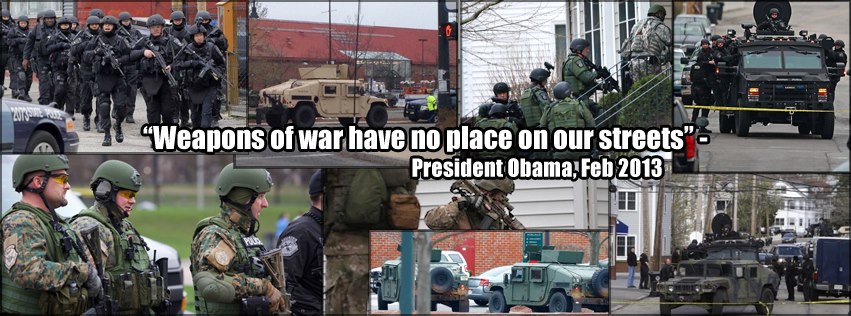
As unrest erupts from Oakland to Egypt, there’s one weapon of war that has come to define the militarized police state: tear gas.

And while a St. Louis judge ruled recently that limits must be placed on the use of tear gas in Ferguson, he didn’t rule that tear gas should only be implemented as a last resort.

Around the country, contingents of peaceful protesters are being confronted by assemblies of heavily militarized police officers that regularly use chemical agents to disperse crowds. But usually the act of getting doused with chemicals is so infuriating that it only incites chaos.

People have a good reason to be afraid of tear gas, considering it’s a banned agent of war under the 1993 Chemical Weapons Convention. Here’s the catch – there’s a clause in the treaty that includes an exception for domestic use. Yes, it’s illegal for the US military to use tear gas against ISIS, but cool to use against American citizens.

The US ensured the exception, claiming it was afraid the convention may prohibit lethal injection. Because of this caveat for riot control, countries around the world regularly and irresponsibly use chemical agents against their own populations. In American cities like Ferguson, police deploy tear gas at the drop of a hat, often at cameramen and journalists.

Despite all of the apocalyptic imagery associated with the weapon, government officials maintain tear gas is perfectly safe, including Ferguson police chief Tom Jackson, who said ”There are complaints about the response from some people… but to me, nobody got hurt seriously, and I’m happy about that.”

He forgot to say yet, considering how Ferguson police are using tear gas canisters from the Cold War era and are so old, there’s a severe risk of shrapnel flying into crowds. Make no mistake, this “less than lethal” weapon can actually be quite deadly. Look no further than Palestine, where a man was killed from a tear gas canister hitting him at close range in 2011. Or in Egypt, when a policeman shot tear gas into a caravan holding  37 protesters, choking and killing them all.

Horrifyingly, tear gas also causes amputations and miscarriages. In Bahrain, Physicians for Human Rights reported that many pregnant women had miscarriages after exposure with the chemical agent. Officials assure there are no long term health effects, but that hasn’t been proven given the lack of long term studies. Sven-Eric Jordt, a leading expert in tear gas, says

“I frankly think that we don’t know much about the long-term effects, especially in civilian exposure…There’s very few follow-up studies. These are very active chemicals that can cause quite significant injury. I’m very concerned that, as use has increased, tear gas has been normalized. The attitude now is like, this is safe and we can use it as much as we want.”

And boy, do we. As the world’s leading military and arms supplier, the US is also the biggest producer of less than lethal weaponry. During Egypt’s revolution, while police gunned down protesters and made mass arrests, they liberally used tear gas that read “Made in the USA” (at a little place called Combined Systems International of Jamestown, Pennsylvania). According to VisionGain, the non-lethal weapons market has exploded over the last decade, and is worth a whopping 1.6 billion dollars this year.

Somehow the government has convinced the American people that using tear gas is perfectly harmless, despite stark evidence to the contrary. So, next time it tries to sell us another war because *this leader gasses his own people*, remember that claim isn’t so far from home.

“Protect and Serve?” More like Hate and Fear

dyqniri

By Kevin Carson

Source: Center for a Stateless Society

The recent trajectory of events leading up to the shooting of NYPD officers Wenjian Liu and Rafael Ramos, and the nationwide police backlash afterward, have made it clearer than ever how police feel about the public they supposedly protect and serve: they’re terrified of us. For more than twenty years, the Drug War and associated police militarization encouraged an increasing tendency of urban police to see local populations as a dangerous occupied enemy. In Radley Balko’s Rise of the Warrior Cop they admit to stopping and exiting patrol cars randomly in non-white neighborhoods solely to make a show of force, reminding cowed residents who’s boss. And thanks to the mushroom proliferation of SWAT teams (originally designed for use in rare situations like hostage crises) even in small towns, and the enormous flow of surplus military equipment to local police forces like Ferguson, that hostile and fearful attitude towards the local population has spread downward into suburbs and towns.

Meanwhile internal police culture has taken on the same paranoid coloring that caused Lt. Calley and his men to snap and massacre the population of My Lai. Since Hill Street Blues days, cops have commonly described their jobs patrolling the community using “Band of Brothers” rhetoric reminiscent of extended recon missions in Vietnam. But these self-perceptions are utterly detached from reality. Soldiers in Vietnam actually had a high risk of getting killed. But police on-duty casualty rates have fallen steadily for decades. Policing is the ninth-most dangerous job (the top two are logging and fishing); sanitation work is twice as deadly.

That embattled self-image has been the police norm, to an increasing extent, for the past twenty years or more. In recent years police resentment ratcheted further upward over the “chilling effect” of widespread citizen recording of brutality with smart phones, and social media criticism after the Occupy camp shutdowns. But internal police culture went into full-blown panic mode in response to protests over the shooting of Michael Brown, and to the nationwide #WeCantBreathe and #BlackLivesMatter demonstrations after the verdicts in the Michael Brown and Eric Garner shootings.

On police-only message boards, off-duty cops feel free to admit how they really see us: a bunch of sniveling ingrates too spoiled to appreciate the “thin blue line” protecting them from chaos.  Virtually any unarmed non-white person killed by a cop is referred to in such venues as a “criminal” or “thug.” Police apologists go frantically to work digging up dirt on the victims. They depict the victims in language appealing to the most bestial, menacing stereotypes of black men (like the fixation on 12-year-old Tamir Rice’s height and the description of Michael Brown as a hulking linebacker grunting like an animal).

Poul Anderson once wrote that government is the only institution that’s entitled to kill you for disobeying it. That comes through loud and clear with the police — especially the “entitled” part. A police union spokesman flat-out said, if you don’t want to get killed, obey police orders without question. (As if even that were a sufficient guarantee, considering the people having epileptic seizures or in diabetic comas who were killed for “resisting arrest.”) Among the general public “Stop resisting! Stop resisting!” is a punchline, but police even joke among themselves about literally getting away with murder (for example those “We Show Up Early to Beat the Crowds” t-shirts).

To police any criticism at all, even a suggestion that police may sometimes engage in racial profiling or excessive force, is seen as an existential threat. Those same police message boards mentioned above were rife with complaints that protests over the Brown and Garner verdicts were creating an “open season” on cops. The NYPD union gave Mayor Bill de Blasio notice, after he mentioned warning his biracial son to be especially careful around cops, that he would not be welcome at police funerals.

Police paranoia increased its simmer to a boil in response to the protests over Brown’s death and the verdicts; the shooting of Liu and Ramos made it an exploding pressure cooker. Internal NYPD emails accused de Blasio of having “blood on his hands” for his remarks, and implicated protestors as accomplices. Police nationwide have echoed the sentiments.

In short, the cops blame everyone for the hostility that led to Liu’s and Ramos’s death except themselves. Police are professionals at playing the victim card.

The NYPD now considers itself at war. Cops only patrol in pairs, serving warrants and summonses only when absolutely necessary to make an arrest. After decades of asserting how inconceivably dangerous their jobs are, the NYPD responds to two line-of-duty deaths in a force of thousands — the first in THREE YEARS — like it was Pearl Harbor. That speaks volumes about how privileged and entitled they really are.

We can safely assume that, NYPD officers minimize interactions with the public to when an arrest is absolutely necessary, rates of crime by both the public and the cops themselves can only decrease. While they’re at it, maybe they can go on strike — another phenomenon that’s historically associated with drastic drops in the crime rate. That’s one good way of taking criminals off the street.

Michael Brown was Killed Because He Didn’t Prostrate Himself to Police Authority

darren-wilson-5hqdefault

This Killing, in Combat, Would Have Been a War Crime

by DAVE LINDORFF

Source: This Can’t Be Happening

What’s wrong with Ferguson Police Officer Darren Wilson’s killing of the unarmed 18-year-old black teenager, Michael Brown, and with a Grand Jury decision not to indict him for that outrageous slaying, is what is wrong with American law enforcement and American “justice” in general.

Both actions were permeated not only with racism, which clearly played a huge rule in both the verdict rendered by a Grand Jury composed of nine whites and only three blacks, and in this tragic police killing by a white cop of a black child, but also by a mentality on the part of police — and apparently by at least a majority of the citizen jurors on a panel evaluating Wilson’s actions — that cops are authorities who must be obeyed without question, on pain of death.

Let’s recall the most crucial evidence in this killing: According to the New York Times it was two shots into the top of the head by Officer Wilson that killed Brown — shots that multiple witnesses confirm were fired after the unarmed Brown was on his knees, already seriously wounded by four other apparently non-lethal shots to arm, neck and upper right chest, with his hands raised and pleading “Don’t shoot.” The Times also reports that those shots, apparently fired when Brown’s head was leaning forward, or from a position above him, appeared to have been fired “not from close range,” a determination based upon an absence of gun powder residue around the area of the entry wounds.

It should not matter in the slightest whether or not Brown had first struck Officer Wilson inside his squad car during a scuffle, as claimed by the cop, or even that the officer, as he testified in an unusual appearance before jurors, “felt terrified” at that time. Nor does it matter, beyond being evidence of an inherent racism, that Wilson says he thought that Brown, approaching him at his car initially, “looked like a demon.” If the non-lethal shots that first hit Brown in arm, neck and upper chest had been fired at that early point, perhaps Wilson would have been justified in firing them in self defense, but it’s what happened after Brown tried to leave the scene that matter.

Dave Lindorff is a founding member of ThisCantBeHappening!, an online newspaper collective, and is a contributor to Hopeless: Barack Obama and the Politics of Illusion (AK Press).

Onion Dispatches from Ferguson

1416945465-covernytevawfSource: The Onion

Nation Doesn’t Know If It Can Take Another Bullshit Speech About Healing

In the wake of a grand jury’s divisive decision not to charge Ferguson, MO police officer Darren Wilson in the shooting death of unarmed black teenager Michael Brown, a weary American populace told reporters Tuesday that they are not sure if they can take another bullshit speech about healing. “If I have to watch some politician, law enforcement official, or pretty much anyone regurgitate the same meaningless platitudes about setting aside our differences and coming together as a nation, I might just lose it,” said Atlanta resident Samantha Hubbard, echoing the sentiment of hundreds of millions of Americans who are uncertain if they can stomach even a single empty call for respect and civility. “I honestly don’t know if I’m physically capable of listening to another community leader recite the same unbearable garbage about how it’s time for an open and honest dialogue. I swear to God, if I hear even one goddamn person assert there’s more that unites us than divides us, I will immediately blow my brains out.” At press time, the nation was particularly apprehensive at the prospect of a bullshit speech that declared words were not enough.


Ferguson Decision Reaffirms Right Of Police To Use Deadly Force When They Feel Sufficiently Inclined

Following a legal precedent established over the course of decades, the St. Louis County grand jury decision Monday to not indict officer Darren Wilson in the shooting death of an unarmed teen reportedly reaffirmed the right of police to use deadly force whenever they feel sufficiently inclined. “The outcome of this grand jury investigation further supports a police officer’s right to shoot to kill if, and only if, he feels absolutely willing to do so and it suits his purposes,” said Georgetown law professor Adrienne Hoffman, adding that reasonable suspicion to use lethal force is 100 percent optional when an officer fires on a suspect, regardless of circumstances. “This decision makes it completely clear that, when confronted in the line of duty, police are legally justified in using extreme force against a suspect whenever they need to or just feel like it.” Hoffman added that the decision further asserts an officer’s right to claim self-defense against anyone within range of his weapon.


Heavy Police Presence In Ferguson To Ensure Residents Adequately Provoked

FERGUSON, MO—Ahead of a grand jury’s decision over whether to indict officer Darren Wilson in the shooting death of unarmed black teenager Michael Brown, police in the city of Ferguson have reportedly heavily increased their presence this week to ensure residents are adequately provoked. “We’ve deployed additional officers throughout Ferguson in order to make absolutely certain that residents feel sufficiently harassed and intimidated,” said St. Louis County police chief Jon Belmar, assuring locals that officers in full riot gear will be on hand to inflame members of the community for as long as is necessary. “It’s absolutely essential that the people of Ferguson have full confidence that law enforcement is committed to antagonizing them every step of the way.” At press time, the Missouri National Guard was on standby with tanks and urban assault vehicles in case Ferguson residents required additional incitement.

Darren Wilson Wasn’t the First: A Short History of Killer Cops Let Off the Hook

michael-brown-darren-wilson

The U.S. has a long history of allowing police to walk free after vicious racist violence.

By Flint Taylor

Source: In These Times

The Ferguson grand jury’s decision not to indict Ferguson police officer Darren Wilson for the killing of African-American teenager Michael Brown is heartless but unsurprising. But it is important to place the case in context with the history of police violence investigations and prosecutions in high profile cases—and the systemic and racist police brutality that continues to plague the nation. In doing so, there are lessons for the movement for justice in the Michael Brown case, as well as for those who are engaged in the broader struggle against law enforcement violence.

What follows, then, is a brief history of similar high profile cases where public outrage compelled the justice system to confront acts of racially motivated police violence—with, to say the least, less than satisfactory results.

Chicago

Over the past 45 years, Chicago has been a prime example of official indifference and cover-up when it comes to prosecuting the police for wanton brutality and torture.

On December 4, 1969, Black Panther leaders Fred Hampton and Mark Clark were slain in a police raid that implicated the Cook County State’s Attorney and the FBI’s Cointelpro program. A public outcry led to a Federal Civil Rights investigation. Despite finding that the raiding police fired more than 90 shots to one by the Panthers, the Grand Jury in 1970 did not indict, but rather issued a report that equally blamed the police perpetrators and the Panther victims.

Outrage at this decision led to the appointment of a Special Prosecutor who, in the face of extreme official resistance, obtained an indictment against the police and the State’s Attorneys who planned and executed the raid—not for murder and attempted murder, but rather for obstruction of justice.

The case came to trial in front of a politically connected judge who dismissed the case without even requiring that the charged officials put on a defense. Again, the outrage, particularly in the African-American community was so extreme that the chief prosecutor, Edward V. Hanrahan, was voted out of office a week after the verdict was rendered in 1972.

The Jon Burge police torture scandal provides another stark example. Evidence that had been unearthed over the years demonstrated that a crew of predominately white Chicago police detectives, led by Jon Burge, tortured at least 120 African-American men from 1972 to 1991.

Cook County State’s Attorney Richard M. Daley was tendered powerful evidence of this torture as early as 1982, but did not investigate or prosecute Burge and his men. Daley’s office continued to use confessions tortured from the victims to send scores of them to prison—10 of whom went to death row, though they were later saved by a death penalty moratorium in 2000 and by a grant of clemency in 2003 by then-Governor George Ryan—during the next seven years.

In 1989, the local U.S. Attorneys’ office declined to prosecute, as did the Department of Justice in 1996 and Cook County State’s Attorney Richard Devine for the five years directly thereafter. In 2001, due to continuing public pressure, a politically connected Special Prosecutor was appointed to investigate the torture. But after a four year, $7 million investigation, he too refused to indict, instead issuing what is widely considered to be a whitewash report that absolved Daley, Devine, and numerous high Chicago police officials.
Finally, in 2008 the U.S. Attorney indicted Burge for perjury and obstruction of justice, and he was convicted in 2010, and sentenced to 4 ½ years in prison. However, the U.S. Attorney has subsequently declined to prosecute Burge’s confederates for similar offenses.

New Orleans

Chicago is by no means an isolated example of how difficult it is to obtain justice for wanton police violence through the judicial system. In New Orleans, a crew of white detectives responded to the killing of a white police officer in 1980 by terrorizing the black community of Algiers, killing four innocent people and torturing numerous others by “booking and bagging” them: beating suspects with telephone books and suffocating them with bags over their heads.

Seven officers were indicted by the Department of Justice for civil rights violations arising from the torture of one of the victims and three were convicted.  No officers were charged for the four killings or for the other acts of torture.

In 2005, in the wake of Hurricane Katrina, an NOPD officer fatally shot an unarmed black man named Henry Glover, then several of his fellow officers burned his body to cover-up their crime. NOPD officers also shot and killed two unarmed black men on the Danziger Bridge.

After state authorities botched their investigation, the Civil Rights Division of the Justice Department indicted the officers involved in the two cases and obtained convictions of some of the main police actors. However, the Court of Appeals for the Fifth Circuit overturned the verdict in the Glover case, and the trial judge, citing government misconduct, took the extraordinary step of granting the convicted officers a new trial in the Danziger case. 

New York

In 1997, an NYPD officer sexually assaulted a Haitian-American man named Abner Louima in a precinct station bathroom by shoving a broken broomstick up his rectum. Louima’s attacker was subsequently charged with federal civil rights violations, while three of his police accomplices were charged with covering up the crimes.

After Louima’s attacker pleaded guilty, his accomplices were convicted, but the Second Circuit Court of Appeals overturned their convictions on the grounds that the lawyers who represented the officers had a conflict of interest. After they were convicted a second time, the Appeals Court again overturned their convictions—this time on the basis that there was insufficient evidence of intent.

In 1999, four officers from the NYPD’s Street Crimes Unit fired 41 shots at Amadou Diallo, a Guinean immigrant who was reaching for his wallet, hitting him 19 times. The officers were indicted for second degree murder and the case was moved to upstate New York, where a jury acquitted the officers. 

In July of this year, NYPD officers arrested an African-American man named Eric Garner, allegedly for selling untaxed cigarettes. They put a prohibited chokehold on him, forced him to the ground face first with his hands behind his back, and shoved his face into the pavement, where he died a few minutes later of a heart attack. The deadly assault, which was captured on videotape, is now under investigation by a Special Grand Jury empaneled by the District Attorney’s Office.

Los Angeles

Among the most notorious cases was the brutal 1991 beating of Rodney King by five LAPD officers. A videotape captured most of the brutality and also showed several other officers standing by and doing nothing to stop the pummeling of a defenseless black man.

Four officers were charged at the state level with assault with a deadly weapon and use of excessive force. The trial was moved to a predominantly white suburban county, and three of the officers were acquitted of all charges, while the fourth was acquitted of assault with a deadly weapon and other lesser charges. But the jury failed to reach a verdict on his use of excessive force.

After an angry uprising in the Africa- American community of Los Angeles that left 53 dead and around 2,000 injured, the U.S. Justice Department indicted the four officers, and a federal jury convicted two of them, while acquitting the other two.

This past August, LAPD officers fatally shot an unarmed mentally ill African-American man named Ezell Ford, who witnesses said was shot in the back while lying on the ground. Despite massive protests, there has been no grand jury investigation to date, the autopsy report is yet to be released, and the LAPD has not completed its investigation.

Oakland

In Oakland, California in the late 1990s, a unit of police officers dubbed the “Rough Riders” systematically beat, framed and planted narcotics on African Americans whom they claimed were dealing drugs. Four of the “Riders” were indicted by the District Attorney’s Office, and the trial was moved to a suburban county. The ringleader fled the country, and was tried in absentia.

After a year-long trial before a bitterly divided jury on which there were no blacks, the officers were acquitted of eight charges, and the jury was hung on the remaining 27 counts. At the urging of then-Mayor Jerry Brown, the officers were not re-tried.

Also in Oakland, in the early morning hours of New Years Day, 2009, a BART officer shot and killed a young black man named Oscar Grant, who was lying face down, unarmed,  in a busy transit station. The shooting was videotaped, and led to militant protests in Oakland.

Another jury with no black members rejected the charge of murder and instead found the officer guilty of involuntary manslaughter. As a result, Oscar Grant’s killer spent less than a year behind bars. The Department of Justice subsequently opened a civil rights investigation, but no charges were brought.

Milwaukee

From 2007-2012 in Milwaukee, a unit of white police officers, spurred on by the Department’s CompStat program of aggressive policing, stopped and illegally body cavity searched more than 70 African-American men whom they claimed to be investigating for drug dealing. In conducting these searches, most commonly performed on the street, the searching officer reached inside the men’s underwear, and probed their anuses and genitals.

After this highly illegal practice came to light, the unit’s ringleader, Michael Vagnini, was indicted by the Milwaukee County District Attorney on numerous counts of sexual assault, illegal searches, and official misconduct, while three of the other unit officers were also charged for participating in two of the searches. The unit’s sergeant and several other members of the unit, all of whom were present for many of the searches, were not charged.

The charged officers were permitted to plead guilty to the lesser included offenses of official misconduct and illegal strip searches, with Vagnini receiving a 36-month sentence while the other three received sentences that totaled, collectively, less than a month in jail. By pleading guilty, they also received promises that they would not be charged with federal civil rights violations.

Pattern and Practice Investigations

These high profile cases represent only the tip of the iceberg when it comes to cases where racist police violence has not been subjected to equal justice under the law.

Recently, the Justice Department declined to prosecute Little Rock, Arkansas, officers who shot and killed Eugene Ellison, an elderly African American man who was walking out of his home with a cane in his hand, while there have been documented reports of unarmed black men recently being shot down by the police in Chicago; Houston; San Antonio; Beaver Creek, Ohio; and Sarasota, Florida.

In 1994, the United States Congress, recognizing that police misconduct and violence was systemic in many parts of the country, passed 42 U.S. Code Section 14141, which empowered the Justice Department to file suit against police departments alleging patterns and practices of unconstitutional conduct, and to obtain wide ranging court orders, consent decrees, and independent monitors in order to implement reforms to those practices.

Although understaffed, the Pattern and Practice Unit of the Justice Department has attacked systemic and discriminatory deficiencies in police hiring, supervision, and monitoring in numerous police departments over the past 20 years.  A particularly egregious act or series of acts of police violence often prompts the Unit to initiate an investigation, and its lawyers have obtained consent decrees or court orders in Cincinnati, Pittsburgh, Steubenville, Ohio, New Orleans, Puerto Rico, Oakland, and Miami.

Last month, lawyers handling the Little Rock cases requested that the DOJ do a pattern and investigation of the LRPD, and the Unit is reportedly now investigating the practices of the Ferguson Police Department. While these investigations are not a panacea, they offer a mechanism for exposing and reforming blatantly unconstitutional police practices, and have also demonstrated how pervasive the problem systemic police violence continues to be.

In light of this history, the pre-ordained failure of a biased local prosecutor to obtain an indictment against Darren Wilson should not surprise us. But the movement for justice for Michael Brown has brought widespread attention to the nationwide problem of systemic and racist police violence and highlighted the movement that has come together to battle against it.

Just two weeks ago, the Brown case, along with the Burge torture cases, was presented to the United Nations Committee Against Torture in Geneva. The movement should now turn its attention to the Department of Justice, demanding a federal civil rights indictment against Wilson a full scale pattern and practice investigation of the Ferguson Police Department, and, more broadly, an end to systemic and racist police violence.

As the history of the battle against racist police violence so pointedly teaches, the public outcry and agitation must continue not only in Ferguson but across the nation. Because as Frederick Douglas rightly stated many years ago, power concedes nothing without a demand.
Flint Taylor is one of the lawyers for the families of slain Black Panther leaders Fred Hampton and Mark Clark and together with his law partner Jeffrey Haas was trial counsel in the marathon 1976 civil trial. For more information on the Hampton/Clark case, the history of Black Panther Party, and the FBI’s Program to destroy it, visit peopleslawoffice.com.

 

Grooming Students for A Lifetime of Surveillance

index

The same technologists who protest against the NSA’s metadata collection programs are the ones profiting the most from the widespread surveillance of students.

By Jessy Irwin

Source: Model View Culture

Since 2011, billions of dollars of venture capital investment have poured into public education through private, for-profit technologies that promise to revolutionize education. Designed for the “21st century” classroom, these tools promise to remedy the many, many societal ills facing public education with artificial intelligence, machine learning, data mining, and other technological advancements.

They are also being used to track and record every move students make in the classroom, grooming students for a lifetime of surveillance and turning education into one of the most data-intensive industries on the face of the earth. The NSA has nothing on the monitoring tools that education technologists have developed in to “personalize” and “adapt” learning for students in public school districts across the United States.

(Mega)data Collection + Analysis

“Adaptive”, “personalized” learning platforms are one of the most heavily-funded verticals in education technology. By breaking down learning into a series of tasks, and further distilling those tasks down to a series of clicks that can be measured and analyzed, companies like Knewton (which has raised $105 million in venture capital), or the recently shuttered inBloom (which raised over $100 million from the Gates Foundation) gather immense amounts of information about students into a lengthy profile containing personal information, socioeconomic status and other data that is mined for patterns and insights to improve performance. For students, these clickstreams and data trails begin when they are 5 years old, barely able to read much less type in usernames and passwords required to access their online learning portals.

Data collection and number crunching aren’t the only technologies being explored to revolutionize education– technology billionaire and philanthropist Bill Gates funded a $1.1 million project to fit middle-school students with biometric sensors to monitor their response and engagement levels during lessons, and advocated a $5 billion program to install video cameras in every classroom to record teachers for evaluation.

The Family Educational Rights and Privacy Act, a law put in place in 1974 to protect student academic records, does nothing to protect student data when it is in the hands of education technology companies. Instead, FERPA threatens to take federal funding away from schools who are found to have breached student privacy while it fails to mandate bare minimum security standards for the storage and transmission of student data. In fact, a recent revision of FERPA increased the power that companies have to collect and mine student data.  Though lawmakers and privacy advocates are regularly outraged at the immense volume of student data freely floating through the web, the repeated failure to create legislation that protects student data from being used for profit is astounding.

One thing is clear: those who have the power to protect student privacy will not do so as long as they can continue to subsidize the cost of public education with student data.

Internet Censorship in Schools

In most educational institutions, the vast majority of IT operations are focused on monitoring, filtering and blocking web traffic instead of building secure networks that safeguard student records and sensitive behavioral data. Nowhere is this more apparent than in the widespread adoption of web filtering software tools in K-12 schools. Usage of these technologies is required for compliance with programs like E-Rate, which grant federal money to schools to fund internet access for their students.

To be eligible for funding from the E-Rate program, schools are required to comply with federal regulations that ban access to websites displaying pornography, graphic material, or any other that could otherwise be judged as immoral, improper or lewd. More often than not, this subjective criteria is determined by the opinions and belief systems of school administrators under political pressure to deny students access to content on controversial issues about topics like evolution, birth control and sex education. These decisions disproportionately affect young girls and LGBTQ students by denying them access to sites that provide important information about their rights, their developing bodies, their sexuality and their access to contraceptives. In the case of Securly, the first filtering tool designed for schools, the controls set by IT and administration for web access can extend far beyond the walls of the school and determine what content students can access while using school- issued machines from their home internet connections.

Despite the many positive contributions of the internet in the distribution and dissemination of knowledge across the planet, students are regularly denied access to valuable information that could positively impact their learning… all to safeguard a small percentage of federal budget money granted to their schools. The implications of this are particularly severe for low-income students who do not have access to the Internet at home; without the ability to freely access the web on their own terms, their digital literacy skills lag behind those of their affluent peers. Though teachers request better and broader internet access for students in their classrooms, administrator-imposed blocks and filters on school internet leave most students woefully unprepared to navigate the realities of the web. When students do find a way around the tools used to limit their access to the outside world (this happened with a group of students who were given iPads in the Los Angeles United School district last year), they’re labelled as “hackers” or miscreants, and disciplined for using Tor, a tool popular among students for anonymous web browsing and circumventing blacklists that ban websites from school networks.

Social Media Surveillance

Schools are adopting many other surveillance technologies with unprecedented reach into the private communications and lives of students and their families. In Lower Merion, PA, a suburb outside of Philadelphia, educators engaged remote administration tools on students’ laptops to regularly spy on their activities while at home. In a case that made its way into federal courts, one student was punished by administrators who mistook candy pictured through his laptop’s camera for drugs. While the full extent of the spying was never exposed, parents and students have expressed concern about educators having the ability to watch young girls undress in the privacy of their homes, unaware that they were being watched through their school-issued computers.

In 2013, the Glendale Unified School District in Glendale, CA took a move straight from the NSA surveillance handbook by seeking out a $40,000 contract with Geo Listening, a social media monitoring company that charges schools to eavesdrop on student social media chatter. While the company claims to only access posts that are public in the school districts they work with, and says it works closely with school districts to tailor their monitoring programs to prevent cyberbullying, suicide and active shooter incidents, it is very easy— too easy, in fact— to use such technologies to identify and target students who have been labeled deviant or delinquent within their communities, or who are otherwise outspoken and critical of their teachers and schools.

Schools are also demanding access to students’ social media communications in ways that severely harm their constitutionally protected rights to free speech. In Minnewaska, MN, a female student who complained about a hall monitor’s behavior in a Facebook post was questioned and given in-school suspension. Later, when a parent reported the student for “sexting” over Facebook with a classmate, she was removed from class again as a group of educators and a police officer armed with a taser demanded that the student hand over her password. They then read private communications that took place outside of school through her Facebook account. After being pulled from class multiple times, suspended from school, and barred from attending a school field trip (the same punishment was not doled out to the male student involved in the messaging), the ACLU stepped in to defend the student’s right to privacy and free speech in communications outside of school property. Though the ruling in the case upheld students’ protection under the 1st and 4th amendments, school districts around the country continue to demand access to students’ social media accounts and threaten to mark students’ academic records to make it difficult to get into a desired university or to seek other avenues for continued education.

Physical Surveillance

In addition to the online monitoring taking place in schools, there are many surveillance mechanisms in place to enforce physical security in public schools. Since the shootings that took place at Virginia Tech in 2007, and again after those that took place in Sandy Hook, CT in 2012, technology companies have launched myriad tools designed to minimize the potential loss of life in the next active shooting incident at a school. Some of these technologies include:

By preying on the absolute worst fears of administrators and parents across the country, technology companies are earning millions of dollars selling security “solutions” that do not accurately address the threat model these tools claim to dispel. School districts that purchase these systems further perpetuate the farce of security theater and infringe on students’ rights to privacy and individual freedom.

A Lifetime of Surveillance

When we develop and use educational technologies that monitor a student’s every moment in school and online, we groom that student for a lifetime of surveillance from the NSA, from data brokers, from advertisers, marketers, and even CCTV cameras. By watching every move that students make while learning, we model to students that we do not trust them– that ultimately, their every move will be under scrutiny from others. When students recognize that they are being watched, they begin to act differently– and from that very moment they begin to cede one small bit of freedom at a time.

Though the education technology revolution continually promises a silver bullet that will be a great democratizing force for all of society’s ills, it categorically disregards the patriarchal power structures and biases that both legitimate and perpetuate discrimination against minorities and marginalized groups. Despite it being well within the scope of educational technology tools to track, identify and expose biases towards groups of students, technologists avoid implementing small changes that monitor educator performance and correct for unconscious biases that negatively affect student learning. Because the surveillance taking place in schools is typically based on qualitative criteria like morality, appropriateness and good behavior, these technologies extend current practices and prejudices that perpetuate injustices against marginalized groups.

There are few to no safeguards built into the online and offline monitoring systems to protect students from the abuse of these tools. Young female students who are active on social media can be unfairly targeted, slut-shamed and disciplined for suggestive language that takes place outside of school, while their male counterparts are not held equally accountable for participating in sexually charged online conversations. Youth of color, a group that is disproportionately stereotyped as angry, aggressive, and unpredictable by educators, can easily be monitored, disciplined, and entered into the juvenile justice system for any outburst that could vaguely be misinterpreted as a threat to a homogeneous caucasian school culture. Any student grappling with issues of abuse, depression, disability, gender identity or sexuality could easily be discovered by online surveillance tools, stigmatized and outed to their teachers, parents and wider community.

Education technologists also continue to widen the digital divide between affluent and economically oppressed. Despite an industry-wide insistence that technology is not being developed to replace educators in the classroom, many poor school districts faced with massive budget cuts are implementing experimental blended learning programs reliant on “adaptive” and “personalized” software as a way to mitigate the effect of large class sizes on student learning. This means that students who attend costly private schools or live within rich school districts that can afford to employ more educators and maintain smaller class sizes receive much more personalized instruction from their teachers. Instead of receiving much-needed interaction and personalized learning directly from educators, poor students living in disadvantaged communities receive instruction from educational software that collects their data (which is likely to be sold), and have less individual instruction time from teachers than their affluent counterparts.

By developing technologies that collect, track, record, analyze every move a student makes both online and off, technologists and investors and educators are ensuring that today’s students will have less privacy than any other generation that came before them, threatening to make privacy and anonymity unattainable for future generations. Though the surveillance mechanisms at play in education technologies affect the privacy of millions of students who pass through the education system each year, this system is a profound, persistent threat to the privacy and individual liberty of LGBTQ students, low-income students, and students of color who have already been so severely failed by the status quo.

Ironically, the same technologists and investors who protest against the NSA’s metadata collection programs are the ones profiting the most from the widespread surveillance of students across the country, by building educational tools with the same function.

Zombies are us: The walking dead in the American police state

zombies2_300x250

By John W. Whitehead

Source: Intrepid Report

Fear is a primitive impulse, brainless as hunger, and because the aim of horror fiction is the production of the deepest kinds of fears, the genre tends to reinforce some remarkably uncivilized ideas about self-protection. In the current crop of zombie stories, the prevailing value for the beleaguered survivors is a sort of siege mentality, a vigilance so constant and unremitting that it’s indistinguishable from the purest paranoia.—Terrence Rafferty, New York Times

Fear and paranoia have become hallmarks of the modern American experience, impacting how we as a nation view the world around us, how we as citizens view each other, and most of all how our government views us.

Nowhere is this epidemic of fear and paranoia more aptly mirrored than in the culture’s fascination with zombies, exacerbated by the hit television series The Walking Dead, in which a small group of Americans attempt to survive in a zombie-ridden, post-apocalyptic world where they’re not only fighting off flesh-eating ghouls but cannibalistic humans.

Zombies have experienced such a surge in popularity in recent years that you don’t have to look very far anymore to find them lurking around every corner: wreaking havoc in movie blockbusters such as World War Z, running for their lives in 5K charity races, battling corsets in Pride and Prejudice and Zombies, and even putting government agents through their paces in mock military drills arranged by the Dept. of Defense (DOD) and the Center for Disease Control (CDC).

We’ve been so hounded in recent years with dire warnings about terrorist attacks, Ebola pandemics, economic collapse, environmental disasters, and militarized police, it’s no wonder millions of Americans have turned to zombie fiction as a means of escapism and a way to “envision how we and our own would thrive if everything went to hell and we lost all our societal supports.” As Time magazine reporter James Poniewozik phrases it, the “apocalyptic drama lets us face the end of the world once a week and live.”

Writing for the New York Times, Terrence Rafferty notes:

In the case of zombie fiction, you have to wonder whether our 21st-century fascination with these hungry hordes has something to do with a general anxiety, particularly in the West, about the planet’s dwindling resources: a sense that there are too many people out there, with too many urgent needs, and that eventually these encroaching masses, dimly understood but somehow ominous in their collective appetites, will simply consume us. At this awful, pinched moment of history we look into the future and see a tsunami of want bearing down on us, darkening the sky. The zombie is clearly the right monster for this glum mood, but it’s a little disturbing to think that these nonhuman creatures, with their slack, gaping maws, might be serving as metaphors for actual people—undocumented immigrants, say, or the entire populations of developing nations—whose only offense, in most cases, is that their mouths and bellies demand to be filled.

Here’s the curious thing: while zombies may be the personification of our darkest fears, they embody the government’s paranoia about the citizenry as potential threats that need to be monitored, tracked, surveilled, sequestered, deterred, vanquished and rendered impotent. Why else would the government feel the need to monitor our communications, track our movements, criminalize our every action, treat us like suspects, and strip us of any means of defense while equipping its own personnel with an amazing arsenal of weapons?

For years now, the government has been carrying out military training drills with zombies as the enemy. In 2011, the DOD created a 31-page instruction manual for how to protect America from a terrorist attack carried out by zombie forces. In 2012, the CDC released a guide for surviving a zombie plague. That was followed by training drills for members of the military, police officers and first responders. As journalist Andrea Peyser reports:

Coinciding with Halloween 2012, a five-day national conference was put on by the HALO Corp. in San Diego for more than 1,000 first responders, military personnel and law enforcement types. It included workshops produced by a Hollywood-affiliated firm in . . . overcoming a zombie invasion. Actors were made up to look like flesh-chomping monsters. The Department of Homeland Security even paid the $1,000 entry fees for an unknown number of participants . . .

“Zombie disaster” drills were held in October 2012 and ’13 at California’s Sutter Roseville Medical Center. The exercises allowed medical center staff “to test response to a deadly infectious disease, a mass-casualty event, terrorism event and security procedures” . . .

[In October 2014], REI outdoor-gear stores in Soho and around the country are to hold free classes in zombie preparedness, which the stores have been providing for about three years.

The zombie exercises appear to be kitschy and fun—government agents running around trying to put down a zombie rebellion—but what if the zombies in the exercises are us, the citizenry, viewed by those in power as mindless, voracious, zombie hordes?

Consider this: the government started playing around with the idea of using zombies as stand-ins for enemy combatants in its training drills right around the time the Army War College issued its 2008 report, warning that an economic crisis in the U.S. could lead to massive civil unrest that would require the military to intervene and restore order.

That same year, it was revealed that the government had amassed more than 8 million names of Americans considered a threat to national security, to be used “by the military in the event of a national catastrophe, a suspension of the Constitution or the imposition of martial law.” The program’s name, Main Core, refers to the fact that it contains “copies of the ‘main core’ or essence of each item of intelligence information on Americans produced by the FBI and the other agencies of the U.S. intelligence community.”

Also in 2008, the Pentagon launched the Minerva Initiative, a $75 million military-driven research project focused on studying social behavior in order to determine how best to cope with mass civil disobedience or uprisings. The Minerva Initiative has funded projects such as “Who Does Not Become a Terrorist, and Why?” which “conflates peaceful activists with ‘supporters of political violence’ who are different from terrorists only in that they do not embark on ‘armed militancy’ themselves.”

In 2009, the Dept. of Homeland Security issued its reports on Right-wing and Left-wing Extremism, in which the terms “extremist” and “terrorist” were used interchangeably to describe citizens who were disgruntled or anti-government. Meanwhile, a government campaign was underway to spy on Americans’ mail, email and cell phone communications. Recent reports indicate that the U.S. Postal Service has handled more than 150,000 requests by federal and state law enforcement agencies to monitor Americans’ mail, in addition to photographing every piece of mail sent through the postal system.

Noticing a pattern yet? “We the people” or, more appropriately, “we the zombies” are the enemy.

So when presented with the Defense Department’s battle plan for defeating an army of the walking dead, you might find yourself giggling over the fact that a taxpayer-funded government bureaucrat actually took the time to research and write about vegetarian zombies, evil magic zombies, chicken zombies, space zombies, bio-engineered weaponized zombies, radiation zombies, symbiant-induced zombies, and pathogenic zombies.

However, I would suggest that you take at face value the DOD’s strategy, outlined in “CONOP 8888,” recognizing that, in an age of extreme government paranoia, what you’re really perusing is a training manual for the government in how to put down a citizen uprising or at least an uprising of individuals “infected” with dangerous ideas about freedom. Military strategists seized upon the zombie ruse as a way to avoid upsetting the public should the “fictional training scenario” be mistaken for a real plan. Of course, the tactics and difficulties involved are all too real, beginning with martial law.

As the DOD training manual states: “zombies [read: “activists”] are horribly dangerous to all human life and zombie infections have the potential to seriously undermine national security and economic activities that sustain our way of life. Therefore having a population that is not composed of zombies or at risk from their malign influence is vital to U.S. and Allied national interests.”

So how does the military plan to put down a zombie (a.k.a. disgruntled citizen) uprising?

The strategy manual outlines five phases necessary for a counter-offensive: shape, deter, seize initiative, dominate, stabilize and restore civil authority. Here are a few details:

Phase 0 (Shape): Conduct general zombie awareness training. Monitor increased threats (i.e., surveillance). Carry out military drills. Synchronize contingency plans between federal and state agencies. Anticipate and prepare for a breakdown in law and order.

Phase 1 (Deter): Recognize that zombies cannot be deterred or reasoned with. Carry out training drills to discourage other countries from developing or deploying attack zombies and publicly reinforce the government’s ability to combat a zombie threat. Initiate intelligence sharing between federal and state agencies. Assist the Dept. of Homeland Security in identifying or discouraging immigrants from areas where zombie-related diseases originate.

Phase 2 (Seize initiative): Recall all military personal to their duty stations. Fortify all military outposts. Deploy air and ground forces for at least 35 days. Carry out confidence-building measures with nuclear-armed peers such as Russia and China to ensure they do not misinterpret the government’s zombie countermeasures as preparations for war. Establish quarantine zones. Distribute explosion-resistant protective equipment. Place the military on red alert. Begin limited scale military operations to combat zombie threats. Carry out combat operations against zombie populations within the United States that were “previously” U.S. citizens.

Phase 3 (Dominate): Lock down all military bases for 30 days. Shelter all essential government personnel for at least 40 days. Equip all government agents with military protective gear. Issue orders for military to kill all non-human life on sight. Initiate bomber and missile strikes against targeted sources of zombie infection, including the infrastructure. Burn all zombie corpses. Deploy military to lock down the beaches and waterways.

Phase 4 (Stabilize): Send out recon teams to check for remaining threats and survey the status of basic services (water, power, sewage infrastructure, air, and lines of communication). Execute a counter-zombie ISR plan to ID holdout pockets of zombie resistance. Use all military resources to target any remaining regions of zombie holdouts and influence. Continue all actions from the Dominate phase.

Phase 5 (Restore civil authority): Deploy military personnel to assist any surviving civil authorities in disaster zones. Reconstitute combat capabilities at various military bases. Prepare to redeploy military forces to attack surviving zombie holdouts. Restore basic services in disaster areas.

Notice the similarities? Surveillance. Military drills. Awareness training. Militarized police forces. Martial law. What’s amazing is that the government is not being covert about any of this. As I point out in my book, A Government of Wolves: The Emerging American Police State, it’s all out in the open, for all to see, read and learn from.

If there is any lesson to be learned, it is simply this: whether the threat to national security comes in the form of actual terrorists, imaginary zombies or disgruntled American citizens infected with dangerous ideas about freedom, the government’s response to such threats remains the same: detect, deter and annihilate.

It’s time to wake up, America, before you end up with a bullet to the head—the only proven means of killing a zombie.

Constitutional attorney and author John W. Whitehead is founder and president of The Rutherford Institute. His new book “The Freedom Wars” (TRI Press) is available online at www.amazon.com. Whitehead can be contacted at johnw@rutherford.org. Information about The Rutherford Institute is available at www.rutherford.org.

We’re all criminals and outlaws in the eyes of the American police state

971022_267085910101343_1969177191_n

By John Whitehead

Source: Intrepid Report

“Never in the civilised world have so many been locked up for so little.”—“Rough Justice in America,” The Economist

Why are we seeing such an uptick in Americans being arrested for such absurd “violations” as letting their kids play at a park unsupervised, collecting rainwater and snow runoff on their own property, growing vegetables in their yard, and holding Bible studies in their living room?

Mind you, we’re not talking tickets or fines or even warnings being issued to these so-called “lawbreakers.” We’re talking felony charges, handcuffs, police cars, mug shots, pat downs, jail cells and criminal records.

Consider what happened to Nicole Gainey, the Florida mom who was arrested and charged with child neglect for allowing her 7-year-old son to visit a neighborhood playground located a half mile from their house.

For the so-called “crime” of allowing her son to play at the park unsupervised, Gainey was interrogated, arrested and handcuffed in front of her son, and transported to the local jail where she was physically searched, fingerprinted, photographed and held for seven hours and then forced to pay almost $4,000 in bond in order to return to her family. Gainey’s family and friends were subsequently questioned by the Dept. of Child Services. Gainey now faces a third-degree criminal felony charge that carries with it a fine of up to $5,000 and 5 years in jail.

For Denise Stewart, just being in the wrong place at the wrong time, whether or not she had done anything wrong, was sufficient to get her arrested.

The 48-year-old New York grandmother was dragged half-naked out of her apartment and handcuffed after police mistakenly raided her home when responding to a domestic disturbance call. Although it turns out the 911 call came from a different apartment on a different floor, Stewart is still facing charges of assaulting a police officer and resisting arrest.

And then there are those equally unfortunate individuals who unknowingly break laws they never even knew existed. John Yates is such a person. A commercial fisherman, Yates was sentenced to 30 days in prison and three years of supervised release for throwing back into the water some small fish which did not meet the Florida Fish and Wildlife Commission’s size restrictions. Incredibly, Yates was charged with violating a document shredding provision of the Sarbanes-Oxley Act, which was intended to prevent another Enron scandal.

The list of individuals who have suffered similar injustices at the hands of a runaway legal system is growing, ranging from the orchid grower jailed for improper paperwork and the lobstermen charged with importing lobster tails in plastic bags rather than cardboard boxes to the former science teacher labeled a federal criminal for digging for arrowheads in his favorite campsite.

As awful as these incidents are, however, it’s not enough to simply write them off as part of the national trend towards overcriminalization—although it is certainly that. Thanks to an overabundance of 4,500-plus federal crimes and 400,000 plus rules and regulations, it’s estimated that the average American actually commits three felonies a day without knowing it.

Nor can we just chalk them up as yet another symptom of an overzealous police state in which militarized police attack first and ask questions later—although it is that, too.

Nor is the problem that we’re a crime-ridden society. In fact, it’s just the opposite. The number of violent crimes in the country is down substantially, the lowest rate in 40 years, while the number of Americans being jailed for nonviolent crimes, such as driving with a suspended license, are skyrocketing.

So what’s really behind this drive to label Americans as criminals?

As with most things, if you want to know the real motives behind any government program, follow the money trail. When you dig down far enough, as I document in my book A Government of Wolves: The Emerging American Police State, you quickly find that those who profit from Americans being arrested are none other than the police who arrest them, the courts which try them, the prisons which incarcerate them, and the corporations, which manufacture the weapons and equipment used by police, build and run the prisons, and profit from the cheap prison labor.

Talk about a financial incentive.

First, there’s the whole make-work scheme. In the absence of crime, in order to keep the police and their related agencies employed, occupied, and utilizing the many militarized “toys” passed along by the Department of Homeland Security, one must invent new crimes—overcriminalization—and new criminals to be spied on, targeted, tracked, raided, arrested, prosecuted and jailed. Enter the police state.

Second, there’s the profit-incentive for states to lock up large numbers of Americans in private prisons. Just as police departments have quotas for how many tickets are issued and arrests made per month—a number tied directly to revenue—states now have quotas to meet for how many Americans go to jail. Having outsourced their inmate population to private prisons run by corporations such as Corrections Corp of America and the GEO Group, ostensibly as a way to save money, increasing numbers of states have contracted to keep their prisons at 90% to 100% capacity. This profit-driven form of mass punishment has, in turn, given rise to a $70 billion private prison industry that relies on the complicity of state governments to keep the money flowing and their privately run prisons full. No wonder the United States has the largest prison population in the world.

But what do you do when you’ve contracted to keep your prisons full but crime rates are falling? Easy. You create new categories of crime and render otherwise law-abiding Americans criminals. Notice how we keep coming full circle back to the point where it’s average Americans like you and me being targeted and turned into enemies of the state?

That brings me to the third factor contributing to Americans being arrested, charged with outrageous “crimes,” and jailed: the Corporate State’s need for profit and cheap labor. Not content to just lock up millions of people, corporations have also turned prisoners into forced laborers.

According to professors Steve Fraser and Joshua B. Freeman, “All told, nearly a million prisoners are now making office furniture, working in call centers, fabricating body armor, taking hotel reservations, working in slaughterhouses, or manufacturing textiles, shoes, and clothing, while getting paid somewhere between 93 cents and $4.73 per day.” Tens of thousands of inmates in U.S. prisons are making all sorts of products, from processing agricultural products like milk and beef, to packaging Starbucks coffee, to shrink-wrapping software for companies like Microsoft, to sewing lingerie for Victoria’s Secret.

What some Americans may not have realized, however, is that America’s economy has come to depend in large part on prison labor. “Prison labor reportedly produces 100 percent of military helmets, shirts, pants, tents, bags, canteens, and a variety of other equipment. Prison labor makes circuit boards for IBM, Texas Instruments, and Dell. Many McDonald’s uniforms are sewn by inmates. Other corporations—Microsoft, Victoria’s Secret, Boeing, Motorola, Compaq, Revlon, and Kmart—also benefit from prison labor.” The resulting prison labor industries, which rely on cheap, almost free labor, are doing as much to put the average American out of work as the outsourcing of jobs to China and India.

No wonder America is criminalizing mundane activities, arresting Americans for minor violations, and locking them up for long stretches of time. There’s a significant amount of money being made by the police, the courts, the prisons, and the corporations.

What we’re witnessing is the expansion of corrupt government power in the form of corporate partnerships which both increase the reach of the state into our private lives while also adding a profit motive into the mix, with potentially deadly consequences.

This perverse mixture of government authoritarianism and corporate profits is now the prevailing form of organization in American society today. We are not a nation dominated by corporations, nor are we a nation dominated by government. We are a nation dominated by corporations and government together, in partnership, against the interests of individuals, society and ultimately our freedoms.

If it sounds at all conspiratorial, the idea that a government would jail its citizens so corporations can make a profit, then you don’t know your history very well. It has been well documented that Nazi Germany forced inmates into concentration camps such as Auschwitz to provide cheap labor to BASF, Bayer, Hoechst, and other major German chemical and pharmaceutical companies, much of it to produce products for European countries.

Makes you wonder, doesn’t it, whether what we are experiencing right now is fascism, American style, or Auschwitz revisited?

Constitutional attorney and author John W. Whitehead is founder and president of The Rutherford Institute. His new book “The Freedom Wars” (TRI Press) is available online at www.amazon.com. Whitehead can be contacted at johnw@rutherford.org. Information about The Rutherford Institute is available at www.rutherford.org.

Related Podcast:


http://s39.podbean.com/pb/5665c5c51244adb1a2a1a2bd4c8c642e/53e29fdc/data2/blogs18/371244/uploads/PCH080514.mp3