The Deep State’s Dominant Narratives and Authority Are Crumbling

By Charles Hugh Smith

Source: Of Two Minds

This is why the Deep State is fracturing: its narratives no longer align with the evidence.

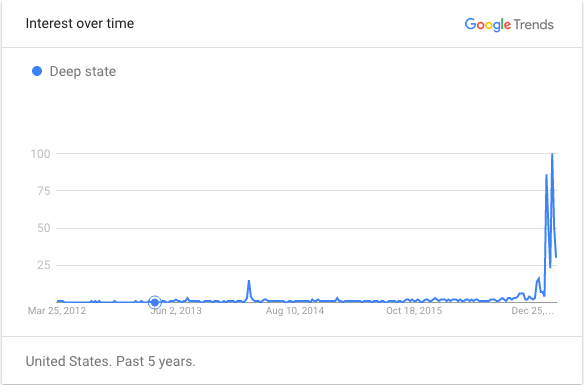
As this chart from Google Trends illustrates, interest in the Deep State has increased dramatically in 2017. The term/topic has clearly moved from the specialist realm to the mainstream. I’ve been writing about the Deep State, and specifically, the fractures in the Deep State, for years.

Amusingly, now that “Progressives” have prostituted themselves to the Security Agencies and the Neocons/Neoliberals, they are busy denying the Deep State exists. For example, There is No Deep State (The New Yorker).

In this risible view, there is no Deep State “conspiracy” (the media’s favorite term of dismissal/ridicule), just a bunch of “good German” bureaucrats industriously doing the Empire’s essential work of undermining democracies that happen not to prostrate themselves at the feet of the Empire, murdering various civilians via drone strikes, surveilling the U.S. populace, planting bugs in new iPhones, issuing fake news while denouncing anything that questions the dominant narratives as “fake news,” arranging sweetheart deals with dictators and corporations, and so on.

The New Yorker is right about one thing–the Deep State is not a “conspiracy:” it is a vast machine of control that is largely impervious to the views or demands of elected representatives or the American people. The key to understanding this social-political-economic control is to grasp that control of the narratives, expertise and authority is control of everything. Allow me to illustrate how this works.

The typical politician has a busy daily schedule of speaking at the National Motherhood and Apple Pie Day celebration, listening to the “concerns” of important corporate constituents, attending a lunch campaign fundraiser, meeting with lobbyists and party committees, being briefed by senior staff, and so on.

Senior administrators share similarly crowded schedules, minus the fundraising but adding budget meetings, reviewing employee complaints and multiple meetings with senior managers and working groups.

Both senior elected officials and senior state administrators must rely on narratives, expertise and authority because they have insufficient time and experience to do original research and assessment.

Narratives create an instant context that “makes sense” of various data points and events. Narratives distill causal factors into an explanatory story with an implicit teleology–because of this and that, the future will be thus and so.

For example: because Iraq has weapons of mass destruction (WMD), the future promises the terrible likelihood (more than a possibility, given Iraqi deployment of poison gas in the Iraq-Iran War) that America or its allies will be devastated by Iraqi weapons of mass destruction. This teleology leads to the inescapable need to eliminate Iraq’s weapons of mass destruction by any means necessary, and remove the political will to use them by removing Iraq’s leader from power.

Politicos and senior administrators rely on expertise and authority as the basis of deciding whether something is accurate and actionable. Professional specialists are assumed to have the highest available levels of expertise, and their position in institutions that embody the highest authority give their conclusions the additional weight of being authoritative. The experts’ conclusion doesn’t just carry the weight of expertise, it has been reviewed by senior officials of the institution, and so it also carries the weight of institutional authority.

So when the C.I.A. briefing by its experts claims Iraq has WMD, and the briefing includes various threads of evidence that the institution declares definitive, who is a non-expert to challenge this conclusion and teleology? On what technical basis does the skeptic reject the expertise and authority of the institution?

We can now define the Deep State with some precision. The Deep State is fundamentally the public-private centralized nodes that collect, archive and curate dominant narratives and their supporting evidence, and disseminate these narratives (and their implicit teleologies) to the public via the media and to the state agencies via formal and informal inter-departmental communication channels.

By gaining control of the narratives, evidence, curation and teleology, each node concentrates power. the power to edit out whatever bits contradict the dominant narrative is the source of power, for once the contradictory evidence is buried or expunged, it ceases to exist.

For example, the contradictory evidence in the Pentagon Papers was buried by being declared Top Secret. The bureaucratic means to bury skeptical (i.e. heretical) views or evidence are many. Sending the authors to figurative Siberia is remarkably effective, as is burying the heretical claims in a veritable mountain of data that few if any will ever survey.

Curation is a critical factor in maintaining control of the narrative and thus of control; the evidence is constantly curated to best support the chosen narrative which in turn supports the desired teleology, which then sets the agenda and the end-game.

The senior apparatchiks of the old Soviet Union were masters of curation; when a Soviet leader fell from favor, he was literally excised from the picture–his image was erased from photos.

This is how narratives are adjusted to better fit the evidence. Thus the accusation that “the Russians hacked our election” has been tabled because it simply doesn’t align with any plausible evidence. That narrative has been replaced with variants, such as “the Russians hacked the Democratic National Committee.” Now that this claim has also been shown to be false, new variants are popping up weekly, with equally poor alignment with evidence.

The primary claim of each Deep State node is that its expertise and authority cannot be questioned. In other words, while the dominant narrative can be questioned (but only cursorily, of course), the expertise and authority of the institutional node cannot be questioned.

This is why the Deep State is fracturing: the expertise and authority of its nodes are delaminating because its narratives no longer align with the evidence. If various Security Agencies sign off on the narrative that “Russia hacked our election” (a nonsense claim from the start, given the absurd imprecision of the “hacking”–hacking into what? Voting machines? Electoral tallies?), and that narrative is evidence-free and fact-free, i.e. false, then the expertise and authority of those agencies comes into legitimate question.

Once the legitimacy of the expertise and authority is questioned, control of the narrative is imperiled. The control of the narrative is control of the teleology, the agenda and the end-game–in other words, everything. If the institution loses control of the dominant narrative, it loses its hold on power.

This is why the Deep State is in turmoil–its narratives no longer make sense, or are in direct conflict with other nodes’ narratives or have been delegitimized by widening gaps between “definitive” claims and actual evidence.

There is indeed a Deep State, but its control of dominant narratives, and thus its source of control and power, is crumbling. The gap between the narratives and the evidence that supports them has widened to the point of collapse.


The U.S. Deep State Rules – On Behalf of the Ruling Class

By Glen Ford

Source: Black Agenda Report

“The U.S. Deep State is unlike any other, in that there is no other global superpower bent on world domination.”

The Deep State is busy denying that it exists, even as it savages a sitting president and brutally bitch-slaps its host society, demanding the nation embrace its role as global psycho thug and kick some Russian ass. The New York Times, always available to divert attention from the essential facts of who rules America, points to Egypt, Turkey and Pakistan as the natural habitats of Deep States. Apparently, Deep State-infected countries tend to be nations with majority Muslim populations, whose military-intelligence apparatus hovers over society and periodically seizes control of the civil government.

The Times quoted high-ranking operatives of the Deep State to prove that such structures are alien to the U.S. Michael V. Hayden, who ran the CIA under Democratic President Obama and Republican George Bush, recoiled at the term. He “would never use” the words Deep State in connection with his own country. “That’s a phrase we’ve used for Turkey and other countries like that, but not the American republic.”

Loren DeJonge Schulman, a former Obama National Security Council official, claimed to be repelled by the very idea of an American Deep State. “A deep state, when you’re talking about Turkey or Egypt or other countries, that’s part of government or people outside of government that are literally controlling the direction of the country no matter who’s actually in charge, and probably engaging in murder and other corrupt practices,” she said.

Apparently, Ms. Schulman did not consider it murder when Obama and his top national security advisors met every Tuesday at the White House to decide who would be assassinated by drone or other means. But she is “shocked” to hear “that kind of [Deep State-phobic] thinking from” President Trump “or the people closest to him.”

Once the Times had located the nexus of Deep Statism in the Muslim world, the lesser lights at The New Yorker endorsed the corporate media consensus that the U.S. is Deep State-free. Staff writer David Remnick admits that U.S. presidents “have felt resistance, or worse, from elements in the federal bureaucracies,” citing Eisenhower’s warnings against the military-industrial complex, Lyndon Johnson’s “pressure from the Pentagon,” and the “rebuke” of Obama’s Syria policy through the State Department’s “dissent channel.” However, he denies that any “subterranean web of common and nefarious purpose” threatens the orderly and transparent processes of the U.S. political system.

In reality, the U.S. Deep State is by far the world’s biggest and most dangerous version of the phenomenon; a monstrous and not-so subterranean “web of common and nefarious purpose” that is, by definition, truly global, since its goal is to rule the planet. Indeed, the Deep States of Turkey, Egypt and Pakistan — all nominal U.S. allies – are midgets in comparison and must operate in a global environment dominated by Washington’s Deep State apparatus. So vast is the imperial Deep State, that its counterparts in other nations exist largely to collaborate with, resist, or keep tabs on the U.S. behemoth, the predator that seeks to devour all the rest.

What is a Deep State? The U.S. Deep State is unlike any other, in that there is no other global superpower bent on world domination. (Washington’s political posture is also unique; no other nation claims to be “exceptional” and “indispensable” and thus not subject to the constraints of international law and custom.) Indeed, the U.S. is so proudly and publicly imperialist that much of what should be secret information about U.S. military and other capabilities is routinely fed to the world press, such as the 2011 announcement that the U.S. now has a missile that can hit any target on the planet in 30 minutes, part of the Army’s “Prompt Global Strike” program. Frightening the rest of the world into submission — a form of global terrorism — is U.S. public policy.

However, arming and training Islamic jihadist terrorists to subvert internationally recognized governments targeted by the U.S. for regime change is more than your usual variety of covert warfare: It is a policy that must forever be kept secret, because U.S. society would suffer a political breakdown if the facts of U.S. and Saudi nurturing of the international jihadist network were ever fully exposed. This is Deep State stuff of the highest order. The true nature of U.S. foreign policy in the 21st century, and the real character of the current wars in Syria and Iraq, must be hidden from the U.S. public at all cost. An alternative reality must be presented, through daily collaboration between corporate media, corporate universities, and the public and covert organs of the U.S. State.

What part of the New York Times coverage of the war against Syria is a lie? Damn near all of it. What role does the Deep State play in crafting the lies dutifully promulgated by the corporate media? That’s impossible to answer, because the Deep State is a network of relationships, not a clearly delineated zone or space or set of organizations. The best way to describe the imperial Deep State is: those individuals and institutions that are tasked with establishing the global supremacy of the corporate ruling class. Such activities must be masked, since they clash with the ideological position of the ruling class, which is that the bourgeois electoral system of the United States is the world’s freest and fairest. The official line is that the U.S. State is a work of near-perfection, with checks and balances that prevent any class, group or section from domination over the other. The truth is that an oligarchy rules, and makes war on whomever it chooses — internationally and domestically — for the benefit of corporate capital.

The Deep State and its corporate imperatives manifestly exists when corporate lobbyists and lawyers are allowed to draw up the Trans Pacific Partnership global “trade” agreement, but the contents are kept secret from the Congresspersons whose duty is to vote on the measure. The Deep State is where corporate power achieves its class aims outside the public processes of government. It’s where the most vicious class warfare takes place, whether on a foreign killing field, or in the corporate newsroom that erases or misrepresents what happened on that battlefield.

At this stage of capitalism, the U.S. ruling class has less and less use for the conventional operations of the bourgeois state. It cannot govern in the old way. More and more, it seeks to shape events through the levers of the collaborating networks of the Deep State. It’s number one global priority is to continue the military offensive begun in 2011, and to break Russia’s resolve to resist that offensive. The ruling class and its War Party, now consolidated within the Democratic Party and regrouping among Republicans, have effectively neutralized a sitting president whose party controls both Houses of Congress, less than two months into his term.

Only a Deep State could pull that off.


BAR executive editor Glen Ford can be contacted at Glen.Ford@BlackAgendaReport.com.

Glen Ford’s blog

The Misguided ‘Vault 7’ Whodunit

By Jesselyn Radack

Source: Expose Facts

It is the leakiest of times in the Executive Branch. Last week, Wikileaks published a massive and, by all accounts genuine, trove of documents revealing that the CIA has been stockpiling, and lost control of, hacking tools it uses against targets. Particularly noteworthy were the revelations that the CIA developed a tool to hack Samsung TVs and turn them into recording devices and that the CIA worked to infiltrate both Apple and Google smart phone operating systems since it could not break encryption. No one in government has challenged the authenticity of the documents disclosed.

We do not know the identity of the source or sources, nor can we be 100% certain of his or her motivations. Wikileaks writes that the source sent a statement that policy questions “urgently need to be debated in public, including whether the CIA’s hacking capabilities exceed its mandated powers and the problem of public oversight of the agency” and that the source “wishes to initiate a public debate about the security, creation, use, proliferation and democratic control of cyber-weapons.”

The FBI has already begun hunting down the source as part of a criminal leak investigation. Historically, the criminal justice system has been a particularly inept judge of who is a whistleblower. Moreover, it has allowed the use of the pernicious Espionage Act—an arcane law meant to go after spies—to go after whistleblowers who reveal information the public interest. My client, former NSA senior official Thomas Drake, was prosecuted under the Espionage Act, only to later be widely recognized as a whistleblower. There is no public interest defense to Espionage Act charges, and courts have ruled that a whistleblower’s motive, however salutary, is irrelevant to determining guilt.

The Intelligence Community is an equally bad judge of who is a whistleblower, and has a vested interest in giving no positive reinforcement to those who air its dirty laundry. The Intelligence Community reflexively claims that anyone who makes public secret information is not a whistleblower. Former NSA and CIA Director General Michael V. Hayden speculated that the recent leaks are to be blamed on young millennials harboring some disrespect for the venerable intelligence agencies responsible for mass surveillance and torture. Not only is his speculation speculative, but it’s proven wrong by the fact that whistleblowers who go to the press span the generational spectrum from Pentagon Papers whistleblower Daniel Ellsberg to mid-career and senior level public servants like CIA torture whistleblower John Kiriakou and NSA whistleblower Thomas Drake to early-career millennials like Army whistleblower Chelsea Manning and NSA whistleblower Edward Snowden. The lawbreaker does not get to decide who is a whistleblower.

Not all leaks of information are whistleblowing, and the word “whistleblower” is a loaded term, so whether or not the Vault 7 source conceives of him or herself as a whistleblower is not a particularly pertinent inquiry. The label “whistleblower” does not convey some mythical power or goodness, or some “moral narcissism,” a term used to describe me when I blew the whistle. Rather, whether an action is whistleblowing depends on whether or not the information disclosed is in the public interest and reveals fraud, waste, abuse, illegality or dangers to public health and safety. Even if some of the information revealed does not qualify, it should be remembered that whistleblowers are often faulted with being over- or under-inclusive with their disclosures. Again, it is the quality of the information, not the quantity, nor the character of the source.

Already, the information in the Vault 7 documents revealed that the Intelligence Community has misled the American people. In the wake of Snowden’s revelations, the Intelligence Community committed to avoid the stockpiling of technological vulnerabilities, publicly claiming that its bias was toward “disclosing them” so as to better protect everyone’s privacy. However, the Vault 7 documents reveal just the opposite: not only has the CIA been stockpiling exploits, it has been aggressively working to undermine our Internet security. Even assuming the CIA is using its hacking tools against the right targets, a pause-worthy presumption given the agency’s checkered history, the CIA has empowered the rest of the hacker world and foreign adversaries by hoarding vulnerabilities, and thereby undermined the privacy rights of all Americans and millions of innocent people around the world. Democracy depends on an informed citizenry, and journalistic sources—whether they call themselves whistleblowers or not—are a critical component when the government uses national security as justification to keep so much of its activities hidden from public view.

As we learn more about the Vault 7 source and the disclosures, our focus should be on the substance of the disclosures. Historically, the government’s reflexive instinct is to shoot the messenger, pathologize the whistleblower, and drill down on his or her motives, while the transparency community holds its breath that he or she will turn out to be pure as the driven snow. But that’s all deflection from plumbing the much more difficult questions, which are: Should the CIA be allowed to conduct these activities, and should it be doing so in secret without any public oversight?

These are questions we would not even be asking without the Vault 7 source.

Let’s Give the CIA the Credit It Deserves

By Norman Solomon

Source: OpEdNews.com

For months now, our country has endured the tacit denigration of American ingenuity. Countless statements — from elected officials, activist groups, journalists and many others — have ignored our nation’s superb blend of dazzling high-tech capacities and statecraft mendacities.

Fortunately, this week the news about release of illuminating CIA documents by WikiLeaks has begun to give adequate credit where due. And not a moment too soon. For way too long, Russia has been credited with prodigious hacking and undermining of democracy in the United States.

Many Americans have overlooked the U.S. government’s fantastic hacking achievements. This is most unfair and disrespectful to the dedicated men and women of intelligence services like the CIA and NSA. Far from the limelight, they’ve been working diligently to undermine democracy not just overseas but also here at home.

Today, the massive new trove of CIA documents can help to put things in perspective. Maybe now people will grasp that our nation’s undermining of democracy is home-grown and self-actualized. It’s an insult to the ingenious capacities of the United States of America to think that we can’t do it ourselves.

Contrary to all the public relations work that U.S. intelligence agencies have generously done for them, the Russians don’t even rank as peripheral to the obstacles and prospects for American democracy. Rest assured, throughout the long history of the United States, we haven’t needed foreigners to get the job done.

In our current era, can Vladimir Putin take any credit for purging huge numbers of African Americans, Latinos and other minority citizens from the voter rolls? Of course not.

Did Putin create and maintain the barriers that prevented many low-income people from voting on November 8? Only in his dreams.

Can the Kremlin hold a candle to the corporate-owned cable TV channels that gave Donald Trump umpteen free hours of uninterrupted air time for speeches at his campaign rallies? Absolutely not.

Could any Russian operation claim more than a tiny sliver of impact compared to the handiwork of FBI Director James Comey as he boosted Donald Trump’s prospects with a pair of gratuitous announcements about a gratuitously re-opened probe of Hillary Clinton’s emails during the last days of the 2016 campaign? No way.

Is Putin anything but a miniscule lightweight in any efforts to manipulate the U.S. electorate compared to “dark money” American billionaires like the Koch brothers? Give us a break.

And how about the Fourth Amendment of the U.S. Constitution? The Kremlin can only marvel at the way that the CIA, the NSA and the bipartisan leadership in Washington have shredded the Fourth Amendment while claiming to uphold it.

To sum up: The CIA’s efforts to tout Russia add up to jaw-dropping false modesty! The humility of “deep state” leaders in Langley is truly awesome.

Let’s get a grip. Overwhelmingly, the achievements of thwarting democracy in America have been do-it-yourself operations. It’s about time that we give adequate credit to the forces perpetuating this country’s self-inflicted wounds to American democracy.

To loosely paraphrase the beloved comic-strip character Pogo, when the subject is grievous damage to democracy at home, “We have met the ingenuity and it is U.S.” But we’re having a terrible time recognizing ourselves.

Trump proposes huge hike in military and police spending

discretionary_spending_pie_2015_enacted

By Patrick Martin

Source: WSWS.org

The Trump administration sent instructions to federal agencies Monday proposing a $54 billion increase in spending for the Pentagon, the intelligence agencies and the Department of Homeland Security, to be offset by $54 billion in cuts for other agencies, mainly those involved in domestic social services and regulation of business.

Trump’s budget outline sets the stage for his first address to Congress on Tuesday. It provides further evidence that the Trump administration will be dedicated to radically rolling back social spending to finance a dramatic escalation of military operations, both in the neo-colonial wars in the Middle East and against the United States’ ‘great power’ rivals: China and Russia.

Federal departments are being told to file budget requests for the fiscal year that begins October 1, 2017 based on the numbers they were given by the Office of Management and Budget. Each agency will be responsible for working out the cuts required to meet proposed reductions, while the Pentagon, CIA and DHS will propose expanded operations with the additional funds they are to be awarded.

There were no details made public about the exact budget ceilings given to each federal department, but White House officials made it clear that foreign aid programs in the State Department and anti-pollution regulation through the Environmental Protection Agency (EPA) would suffer some of the largest cuts.

The total budget of the EPA is only $9 billion, so many other domestic programs are certain to be hard-hit, involving such departments as Education, Labor, Transportation, Agriculture (which includes food stamps), Housing and Urban Development and Health and Human Services.

The biggest federal social programs, Social Security, Medicare and Medicaid, are not affected by the budget order, which involves only funding for so-called discretionary programs, those financed through annual congressional appropriations. Entitlement programs, where benefits are paid out automatically to those who establish their eligibility, are covered by a separate budget process.

OMB Director Mick Mulvaney appeared at the White House press briefing Monday afternoon to explain the action taken by the Trump administration. He emphasized that setting what he called the “top-line budget number” for each department was only the start of a protracted process.

The OMB will use the figures from each department and agency to prepare a budget outline to be submitted to Congress on March 16. A full budget will not be ready until sometime in May, Mulvaney said. He also indicated that while spending on Social Security, Medicare and Medicaid were not addressed in the action taken Monday, “entitlement reform”—i.e., cuts in these critical programs—would be a subject of discussion with congressional leaders later in the budget process.

Press reports identified the three White House officials who have played the main roles in the initial budgeting: Mulvaney, who was confirmed on February 16 as budget director; National Economic Council Director Gary Cohn, the former president of Goldman Sachs, the huge investment bank; and Stephen K. Bannon, Trump’s chief strategist, the former chief executive of the fascistic Breitbart News site, who exercises increasingly broad sway over all White House policy decisions.

While no details have yet been released of what the $54 billion increase in military-police spending will pay for, the scale of the increase, in and of itself, shows the real character of the Trump administration. This is to be a government of war abroad and mass repression at home.

Trump himself touched on this theme in typically rambling and unfocused remarks to a meeting of the National Governors Association Monday. “We never win a war,” he said. “We never win. And we don’t fight to win. We don’t fight to win. So we either got to win, or don’t fight at all.”

He continued, telling the governors, “My first budget will be submitted to the Congress next month. This budget will be a public safety and national security budget, very much based on those two with plenty of other things, but very strong. And it will include a historic increase in defense spending to rebuild the depleted military of the United States of America at a time we most need it.”

Additional money for the Pentagon is likely to go to a dramatically increased tempo of operations in Iraq and Syria. Defense Secretary James Mattis delivered proposals to the White House Monday for an offensive against Islamic State in Iraq and Syria (ISIS), as required by an executive order issued by Trump last month. No details are available yet, but any acceleration of the bombing campaign, let alone the deployment of significant numbers of the US ground troops, would increase the cost of that war by many billions.

The $54 billion increase would also presumably include funds for the construction of Trump’s planned wall on the US-Mexico border, as well as a massive increase in spending on detention facilities for the hundreds of thousands of immigrants to be rounded up under the executive orders already issued by the White House.

The federal budget is operating under the constraints imposed by the 2011 Budget Control Act, the bipartisan legislation negotiated by the Obama White House, the Republican-controlled House of Representatives, and a Democratic-controlled Senate. This set up the so-called sequester process, under which all discretionary spending is subject to a budget freeze, for both domestic and military programs.

Each year, increased spending for programs under the sequester has been worked out on the basis of roughly equal increases for domestic and military programs. Last year, for fiscal year 2016, Congress approved $543 billion for domestic discretionary programs and $607 billion for the military. The Trump White House plan would thus represent a cut of about 10 percent for domestic programs, and an increase of nearly that amount for the military.

Any significant change in the sequester process would require support from congressional Democrats, particularly in the Senate, where the Republican party holds only a narrow 52-48 edge, and any major legislation would require a 60-vote majority to pass.

Several congressional Republican leaders criticized the White House plan as insufficiently skewed to the military. House Armed Services Committee Chairman Mac Thornberry of Texas issued a statement criticizing the “low budget number” and adding, “The administration will have to make clear which problems facing our military they are choosing not to fix.”

Senator John McCain of Arizona, chairman of the Senate Armed Services Committee, declared that the Trump plan is “a mere 3 percent above President Obama’s defense budget, which has left our military underfunded, undersized and unready.”

For all the statements by Trump and the Republicans bemoaning the supposedly “depleted” state of the US military, the United States spends more on its armed forces than the next 15 countries in the world combined. The military budget is only inadequate if the mission of the US military is assumed to be the conquest of the entire planet and the subduing of all armed resistance from any quarter—which is actually the perspective of the American ruling elite.

Vault 7: CIA Hacking Tools Revealed

Source: WikiLeaks

Press Release

Today, Tuesday 7 March 2017, WikiLeaks begins its new series of leaks on the U.S. Central Intelligence Agency. Code-named “Vault 7” by WikiLeaks, it is the largest ever publication of confidential documents on the agency.

The first full part of the series, “Year Zero”, comprises 8,761 documents and files from an isolated, high-security network situated inside the CIA’s Center for Cyber Intelligence in Langley, Virgina. It follows an introductory disclosure last month of CIA targeting French political parties and candidates in the lead up to the 2012 presidential election.

Recently, the CIA lost control of the majority of its hacking arsenal including malware, viruses, trojans, weaponized “zero day” exploits, malware remote control systems and associated documentation. This extraordinary collection, which amounts to more than several hundred million lines of code, gives its possessor the entire hacking capacity of the CIA. The archive appears to have been circulated among former U.S. government hackers and contractors in an unauthorized manner, one of whom has provided WikiLeaks with portions of the archive.

“Year Zero” introduces the scope and direction of the CIA’s global covert hacking program, its malware arsenal and dozens of “zero day” weaponized exploits against a wide range of U.S. and European company products, include Apple’s iPhone, Google’s Android and Microsoft’s Windows and even Samsung TVs, which are turned into covert microphones.

Since 2001 the CIA has gained political and budgetary preeminence over the U.S. National Security Agency (NSA). The CIA found itself building not just its now infamous drone fleet, but a very different type of covert, globe-spanning force — its own substantial fleet of hackers. The agency’s hacking division freed it from having to disclose its often controversial operations to the NSA (its primary bureaucratic rival) in order to draw on the NSA’s hacking capacities.

By the end of 2016, the CIA’s hacking division, which formally falls under the agency’s Center for Cyber Intelligence (CCI), had over 5000 registered users and had produced more than a thousand hacking systems, trojans, viruses, and other “weaponized” malware. Such is the scale of the CIA’s undertaking that by 2016, its hackers had utilized more code than that used to run Facebook. The CIA had created, in effect, its “own NSA” with even less accountability and without publicly answering the question as to whether such a massive budgetary spend on duplicating the capacities of a rival agency could be justified.

In a statement to WikiLeaks the source details policy questions that they say urgently need to be debated in public, including whether the CIA’s hacking capabilities exceed its mandated powers and the problem of public oversight of the agency. The source wishes to initiate a public debate about the security, creation, use, proliferation and democratic control of cyberweapons.

Once a single cyber ‘weapon’ is ‘loose’ it can spread around the world in seconds, to be used by rival states, cyber mafia and teenage hackers alike.

Julian Assange, WikiLeaks editor stated that “There is an extreme proliferation risk in the development of cyber ‘weapons’. Comparisons can be drawn between the uncontrolled proliferation of such ‘weapons’, which results from the inability to contain them combined with their high market value, and the global arms trade. But the significance of “Year Zero” goes well beyond the choice between cyberwar and cyberpeace. The disclosure is also exceptional from a political, legal and forensic perspective.”

Wikileaks has carefully reviewed the “Year Zero” disclosure and published substantive CIA documentation while avoiding the distribution of ‘armed’ cyberweapons until a consensus emerges on the technical and political nature of the CIA’s program and how such ‘weapons’ should analyzed, disarmed and published.

Wikileaks has also decided to redact and anonymise some identifying information in “Year Zero” for in depth analysis. These redactions include ten of thousands of CIA targets and attack machines throughout Latin America, Europe and the United States. While we are aware of the imperfect results of any approach chosen, we remain committed to our publishing model and note that the quantity of published pages in “Vault 7” part one (“Year Zero”) already eclipses the total number of pages published over the first three years of the Edward Snowden NSA leaks.


Analysis

CIA malware targets iPhone, Android, smart TVs

CIA malware and hacking tools are built by EDG (Engineering Development Group), a software development group within CCI (Center for Cyber Intelligence), a department belonging to the CIA’s DDI (Directorate for Digital Innovation). The DDI is one of the five major directorates of the CIA (see this organizational chart of the CIA for more details).

The EDG is responsible for the development, testing and operational support of all backdoors, exploits, malicious payloads, trojans, viruses and any other kind of malware used by the CIA in its covert operations world-wide.

The increasing sophistication of surveillance techniques has drawn comparisons with George Orwell’s 1984, but “Weeping Angel”, developed by the CIA’s Embedded Devices Branch (EDB), which infests smart TVs, transforming them into covert microphones, is surely its most emblematic realization.

The attack against Samsung smart TVs was developed in cooperation with the United Kingdom’s MI5/BTSS. After infestation, Weeping Angel places the target TV in a ‘Fake-Off’ mode, so that the owner falsely believes the TV is off when it is on. In ‘Fake-Off’ mode the TV operates as a bug, recording conversations in the room and sending them over the Internet to a covert CIA server.

As of October 2014 the CIA was also looking at infecting the vehicle control systems used by modern cars and trucks. The purpose of such control is not specified, but it would permit the CIA to engage in nearly undetectable assassinations.

The CIA’s Mobile Devices Branch (MDB) developed numerous attacks to remotely hack and control popular smart phones. Infected phones can be instructed to send the CIA the user’s geolocation, audio and text communications as well as covertly activate the phone’s camera and microphone.

Despite iPhone’s minority share (14.5%) of the global smart phone market in 2016, a specialized unit in the CIA’s Mobile Development Branch produces malware to infest, control and exfiltrate data from iPhones and other Apple products running iOS, such as iPads. CIA’s arsenal includes numerous local and remote “zero days” developed by CIA or obtained from GCHQ, NSA, FBI or purchased from cyber arms contractors such as Baitshop. The disproportionate focus on iOS may be explained by the popularity of the iPhone among social, political, diplomatic and business elites.

A similar unit targets Google’s Android which is used to run the majority of the world’s smart phones (~85%) including Samsung, HTC and Sony. 1.15 billion Android powered phones were sold last year. “Year Zero” shows that as of 2016 the CIA had 24 “weaponized” Android “zero days” which it has developed itself and obtained from GCHQ, NSA and cyber arms contractors.

These techniques permit the CIA to bypass the encryption of WhatsApp, Signal, Telegram, Wiebo, Confide and Cloackman by hacking the “smart” phones that they run on and collecting audio and message traffic before encryption is applied.


CIA malware targets Windows, OSx, Linux, routers

The CIA also runs a very substantial effort to infect and control Microsoft Windows users with its malware. This includes multiple local and remote weaponized “zero days”, air gap jumping viruses such as “Hammer Drill” which infects software distributed on CD/DVDs, infectors for removable media such as USBs, systems to hide data in images or in covert disk areas ( “Brutal Kangaroo”) and to keep its malware infestations going.

Many of these infection efforts are pulled together by the CIA’s Automated Implant Branch (AIB), which has developed several attack systems for automated infestation and control of CIA malware, such as “Assassin” and “Medusa”.

Attacks against Internet infrastructure and webservers are developed by the CIA’s Network Devices Branch (NDB).

The CIA has developed automated multi-platform malware attack and control systems covering Windows, Mac OS X, Solaris, Linux and more, such as EDB’s “HIVE” and the related “Cutthroat” and “Swindle” tools, which are described in the examples section below.


CIA ‘hoarded’ vulnerabilities (“zero days”)

In the wake of Edward Snowden’s leaks about the NSA, the U.S. technology industry secured a commitment from the Obama administration that the executive would disclose on an ongoing basis — rather than hoard — serious vulnerabilities, exploits, bugs or “zero days” to Apple, Google, Microsoft, and other US-based manufacturers.

Serious vulnerabilities not disclosed to the manufacturers places huge swathes of the population and critical infrastructure at risk to foreign intelligence or cyber criminals who independently discover or hear rumors of the vulnerability. If the CIA can discover such vulnerabilities so can others.

The U.S. government’s commitment to the Vulnerabilities Equities Process came after significant lobbying by US technology companies, who risk losing their share of the global market over real and perceived hidden vulnerabilities. The government stated that it would disclose all pervasive vulnerabilities discovered after 2010 on an ongoing basis.

“Year Zero” documents show that the CIA breached the Obama administration’s commitments. Many of the vulnerabilities used in the CIA’s cyber arsenal are pervasive and some may already have been found by rival intelligence agencies or cyber criminals.

As an example, specific CIA malware revealed in “Year Zero” is able to penetrate, infest and control both the Android phone and iPhone software that runs or has run presidential Twitter accounts. The CIA attacks this software by using undisclosed security vulnerabilities (“zero days”) possessed by the CIA but if the CIA can hack these phones then so can everyone else who has obtained or discovered the vulnerability. As long as the CIA keeps these vulnerabilities concealed from Apple and Google (who make the phones) they will not be fixed, and the phones will remain hackable.

The same vulnerabilities exist for the population at large, including the U.S. Cabinet, Congress, top CEOs, system administrators, security officers and engineers. By hiding these security flaws from manufacturers like Apple and Google the CIA ensures that it can hack everyone &mdsh; at the expense of leaving everyone hackable.


‘Cyberwar’ programs are a serious proliferation risk

Cyber ‘weapons’ are not possible to keep under effective control.

While nuclear proliferation has been restrained by the enormous costs and visible infrastructure involved in assembling enough fissile material to produce a critical nuclear mass, cyber ‘weapons’, once developed, are very hard to retain.

Cyber ‘weapons’ are in fact just computer programs which can be pirated like any other. Since they are entirely comprised of information they can be copied quickly with no marginal cost.

Securing such ‘weapons’ is particularly difficult since the same people who develop and use them have the skills to exfiltrate copies without leaving traces — sometimes by using the very same ‘weapons’ against the organizations that contain them. There are substantial price incentives for government hackers and consultants to obtain copies since there is a global “vulnerability market” that will pay hundreds of thousands to millions of dollars for copies of such ‘weapons’. Similarly, contractors and companies who obtain such ‘weapons’ sometimes use them for their own purposes, obtaining advantage over their competitors in selling ‘hacking’ services.

Over the last three years the United States intelligence sector, which consists of government agencies such as the CIA and NSA and their contractors, such as Booz Allan Hamilton, has been subject to unprecedented series of data exfiltrations by its own workers.

A number of intelligence community members not yet publicly named have been arrested or subject to federal criminal investigations in separate incidents.

Most visibly, on February 8, 2017 a U.S. federal grand jury indicted Harold T. Martin III with 20 counts of mishandling classified information. The Department of Justice alleged that it seized some 50,000 gigabytes of information from Harold T. Martin III that he had obtained from classified programs at NSA and CIA, including the source code for numerous hacking tools.

Once a single cyber ‘weapon’ is ‘loose’ it can spread around the world in seconds, to be used by peer states, cyber mafia and teenage hackers alike.


U.S. Consulate in Frankfurt is a covert CIA hacker base

In addition to its operations in Langley, Virginia the CIA also uses the U.S. consulate in Frankfurt as a covert base for its hackers covering Europe, the Middle East and Africa.

CIA hackers operating out of the Frankfurt consulate ( “Center for Cyber Intelligence Europe” or CCIE) are given diplomatic (“black”) passports and State Department cover. The instructions for incoming CIA hackers make Germany’s counter-intelligence efforts appear inconsequential: “Breeze through German Customs because you have your cover-for-action story down pat, and all they did was stamp your passport”

Your Cover Story (for this trip)
Q: Why are you here?
A: Supporting technical consultations at the Consulate.

Two earlier WikiLeaks publications give further detail on CIA approaches to customs and secondary screening procedures.

Once in Frankfurt CIA hackers can travel without further border checks to the 25 European countries that are part of the Shengen open border area — including France, Italy and Switzerland.

A number of the CIA’s electronic attack methods are designed for physical proximity. These attack methods are able to penetrate high security networks that are disconnected from the internet, such as police record database. In these cases, a CIA officer, agent or allied intelligence officer acting under instructions, physically infiltrates the targeted workplace. The attacker is provided with a USB containing malware developed for the CIA for this purpose, which is inserted into the targeted computer. The attacker then infects and exfiltrates data to removable media. For example, the CIA attack system Fine Dining, provides 24 decoy applications for CIA spies to use. To witnesses, the spy appears to be running a program showing videos (e.g VLC), presenting slides (Prezi), playing a computer game (Breakout2, 2048) or even running a fake virus scanner (Kaspersky, McAfee, Sophos). But while the decoy application is on the screen, the underlaying system is automatically infected and ransacked.


How the CIA dramatically increased proliferation risks

In what is surely one of the most astounding intelligence own goals in living memory, the CIA structured its classification regime such that for the most market valuable part of “Vault 7” — the CIA’s weaponized malware (implants + zero days), Listening Posts (LP), and Command and Control (C2) systems — the agency has little legal recourse.

The CIA made these systems unclassified.

Why the CIA chose to make its cyberarsenal unclassified reveals how concepts developed for military use do not easily crossover to the ‘battlefield’ of cyber ‘war’.

To attack its targets, the CIA usually requires that its implants communicate with their control programs over the internet. If CIA implants, Command & Control and Listening Post software were classified, then CIA officers could be prosecuted or dismissed for violating rules that prohibit placing classified information onto the Internet. Consequently the CIA has secretly made most of its cyber spying/war code unclassified. The U.S. government is not able to assert copyright either, due to restrictions in the U.S. Constitution. This means that cyber ‘arms’ manufactures and computer hackers can freely “pirate” these ‘weapons’ if they are obtained. The CIA has primarily had to rely on obfuscation to protect its malware secrets.

Conventional weapons such as missiles may be fired at the enemy (i.e into an unsecured area). Proximity to or impact with the target detonates the ordnance including its classified parts. Hence military personnel do not violate classification rules by firing ordnance with classified parts. Ordnance will likely explode. If it does not, that is not the operator’s intent.

Over the last decade U.S. hacking operations have been increasingly dressed up in military jargon to tap into Department of Defense funding streams. For instance, attempted “malware injections” (commercial jargon) or “implant drops” (NSA jargon) are being called “fires” as if a weapon was being fired. However the analogy is questionable.

Unlike bullets, bombs or missiles, most CIA malware is designed to live for days or even years after it has reached its ‘target’. CIA malware does not “explode on impact” but rather permanently infests its target. In order to infect target’s device, copies of the malware must be placed on the target’s devices, giving physical possession of the malware to the target. To exfiltrate data back to the CIA or to await further instructions the malware must communicate with CIA Command & Control (C2) systems placed on internet connected servers. But such servers are typically not approved to hold classified information, so CIA command and control systems are also made unclassified.

A successful ‘attack’ on a target’s computer system is more like a series of complex stock maneuvers in a hostile take-over bid or the careful planting of rumors in order to gain control over an organization’s leadership rather than the firing of a weapons system. If there is a military analogy to be made, the infestation of a target is perhaps akin to the execution of a whole series of military maneuvers against the target’s territory including observation, infiltration, occupation and exploitation.


Evading forensics and anti-virus

A series of standards lay out CIA malware infestation patterns which are likely to assist forensic crime scene investigators as well as Apple, Microsoft, Google, Samsung, Nokia, Blackberry, Siemens and anti-virus companies attribute and defend against attacks.

“Tradecraft DO’s and DON’Ts” contains CIA rules on how its malware should be written to avoid fingerprints implicating the “CIA, US government, or its witting partner companies” in “forensic review”. Similar secret standards cover the use of encryption to hide CIA hacker and malware communication (pdf), describing targets & exfiltrated data (pdf) as well as executing payloads (pdf) and persisting (pdf) in the target’s machines over time.

CIA hackers developed successful attacks against most well known anti-virus programs. These are documented in AV defeats, Personal Security Products, Detecting and defeating PSPs and PSP/Debugger/RE Avoidance. For example, Comodo was defeated by CIA malware placing itself in the Window’s “Recycle Bin”. While Comodo 6.x has a “Gaping Hole of DOOM”.

CIA hackers discussed what the NSA’s “Equation Group” hackers did wrong and how the CIA’s malware makers could avoid similar exposure.

Examples

The CIA’s Engineering Development Group (EDG) management system contains around 500 different projects (only some of which are documented by “Year Zero”) each with their own sub-projects, malware and hacker tools.

The majority of these projects relate to tools that are used for penetration, infestation (“implanting”), control, and exfiltration.

Another branch of development focuses on the development and operation of Listening Posts (LP) and Command and Control (C2) systems used to communicate with and control CIA implants; special projects are used to target specific hardware from routers to smart TVs.

Some example projects are described below, but see the table of contents for the full list of projects described by WikiLeaks’ “Year Zero”.


UMBRAGE

The CIA’s hand crafted hacking techniques pose a problem for the agency. Each technique it has created forms a “fingerprint” that can be used by forensic investigators to attribute multiple different attacks to the same entity.

This is analogous to finding the same distinctive knife wound on multiple separate murder victims. The unique wounding style creates suspicion that a single murderer is responsible. As soon one murder in the set is solved then the other murders also find likely attribution.

The CIA’s Remote Devices Branch‘s UMBRAGE group collects and maintains a substantial library of attack techniques ‘stolen’ from malware produced in other states including the Russian Federation.

With UMBRAGE and related projects the CIA cannot only increase its total number of attack types but also misdirect attribution by leaving behind the “fingerprints” of the groups that the attack techniques were stolen from.

UMBRAGE components cover keyloggers, password collection, webcam capture, data destruction, persistence, privilege escalation, stealth, anti-virus (PSP) avoidance and survey techniques.


Fine Dining

Fine Dining comes with a standardized questionnaire i.e menu that CIA case officers fill out. The questionnaire is used by the agency’s OSB (Operational Support Branch) to transform the requests of case officers into technical requirements for hacking attacks (typically “exfiltrating” information from computer systems) for specific operations. The questionnaire allows the OSB to identify how to adapt existing tools for the operation, and communicate this to CIA malware configuration staff. The OSB functions as the interface between CIA operational staff and the relevant technical support staff.

Among the list of possible targets of the collection are ‘Asset’, ‘Liason Asset’, ‘System Administrator’, ‘Foreign Information Operations’, ‘Foreign Intelligence Agencies’ and ‘Foreign Government Entities’. Notably absent is any reference to extremists or transnational criminals. The ‘Case Officer’ is also asked to specify the environment of the target like the type of computer, operating system used, Internet connectivity and installed anti-virus utilities (PSPs) as well as a list of file types to be exfiltrated like Office documents, audio, video, images or custom file types. The ‘menu’ also asks for information if recurring access to the target is possible and how long unobserved access to the computer can be maintained. This information is used by the CIA’s ‘JQJIMPROVISE’ software (see below) to configure a set of CIA malware suited to the specific needs of an operation.


Improvise (JQJIMPROVISE)

‘Improvise’ is a toolset for configuration, post-processing, payload setup and execution vector selection for survey/exfiltration tools supporting all major operating systems like Windows (Bartender), MacOS (JukeBox) and Linux (DanceFloor). Its configuration utilities like Margarita allows the NOC (Network Operation Center) to customize tools based on requirements from ‘Fine Dining’ questionairies.

HIVE

HIVE is a multi-platform CIA malware suite and its associated control software. The project provides customizable implants for Windows, Solaris, MikroTik (used in internet routers) and Linux platforms and a Listening Post (LP)/Command and Control (C2) infrastructure to communicate with these implants.

The implants are configured to communicate via HTTPS with the webserver of a cover domain; each operation utilizing these implants has a separate cover domain and the infrastructure can handle any number of cover domains.

Each cover domain resolves to an IP address that is located at a commercial VPS (Virtual Private Server) provider. The public-facing server forwards all incoming traffic via a VPN to a ‘Blot’ server that handles actual connection requests from clients. It is setup for optional SSL client authentication: if a client sends a valid client certificate (only implants can do that), the connection is forwarded to the ‘Honeycomb’ toolserver that communicates with the implant; if a valid certificate is missing (which is the case if someone tries to open the cover domain website by accident), the traffic is forwarded to a cover server that delivers an unsuspicious looking website.

The Honeycomb toolserver receives exfiltrated information from the implant; an operator can also task the implant to execute jobs on the target computer, so the toolserver acts as a C2 (command and control) server for the implant.

Similar functionality (though limited to Windows) is provided by the RickBobby project.

See the classified user and developer guides for HIVE.

Frequently Asked Questions

Why now?

WikiLeaks published as soon as its verification and analysis were ready.

In Febuary the Trump administration has issued an Executive Order calling for a “Cyberwar” review to be prepared within 30 days.

While the review increases the timeliness and relevance of the publication it did not play a role in setting the publication date.

Redactions

Names, email addresses and external IP addresses have been redacted in the released pages (70,875 redactions in total) until further analysis is complete.

  1. Over-redaction: Some items may have been redacted that are not employees, contractors, targets or otherwise related to the agency, but are, for example, authors of documentation for otherwise public projects that are used by the agency.
  2. Identity vs. person: the redacted names are replaced by user IDs (numbers) to allow readers to assign multiple pages to a single author. Given the redaction process used a single person may be represented by more than one assigned identifier but no identifier refers to more than one real person.
  3. Archive attachments (zip, tar.gz, …) are replaced with a PDF listing all the file names in the archive. As the archive content is assessed it may be made available; until then the archive is redacted.
  4. Attachments with other binary content are replaced by a hex dump of the content to prevent accidental invocation of binaries that may have been infected with weaponized CIA malware. As the content is assessed it may be made available; until then the content is redacted.
  5. The tens of thousands of routable IP addresses references (including more than 22 thousand within the United States) that correspond to possible targets, CIA covert listening post servers, intermediary and test systems, are redacted for further exclusive investigation.
  6. Binary files of non-public origin are only available as dumps to prevent accidental invocation of CIA malware infected binaries.

Organizational Chart

The organizational chart corresponds to the material published by WikiLeaks so far.

Since the organizational structure of the CIA below the level of Directorates is not public, the placement of the EDG and its branches within the org chart of the agency is reconstructed from information contained in the documents released so far. It is intended to be used as a rough outline of the internal organization; please be aware that the reconstructed org chart is incomplete and that internal reorganizations occur frequently.

Wiki pages

“Year Zero” contains 7818 web pages with 943 attachments from the internal development groupware. The software used for this purpose is called Confluence, a proprietary software from Atlassian. Webpages in this system (like in Wikipedia) have a version history that can provide interesting insights on how a document evolved over time; the 7818 documents include these page histories for 1136 latest versions.

The order of named pages within each level is determined by date (oldest first). Page content is not present if it was originally dynamically created by the Confluence software (as indicated on the re-constructed page).

What time period is covered?

The years 2013 to 2016. The sort order of the pages within each level is determined by date (oldest first).

WikiLeaks has obtained the CIA’s creation/last modification date for each page but these do not yet appear for technical reasons. Usually the date can be discerned or approximated from the content and the page order. If it is critical to know the exact time/date contact WikiLeaks.

What is “Vault 7”

“Vault 7” is a substantial collection of material about CIA activities obtained by WikiLeaks.

When was each part of “Vault 7” obtained?

Part one was obtained recently and covers through 2016. Details on the other parts will be available at the time of publication.

Is each part of “Vault 7” from a different source?

Details on the other parts will be available at the time of publication.

What is the total size of “Vault 7”?

The series is the largest intelligence publication in history.

How did WikiLeaks obtain each part of “Vault 7”?

Sources trust WikiLeaks to not reveal information that might help identify them.

Isn’t WikiLeaks worried that the CIA will act against its staff to stop the series?

No. That would be certainly counter-productive.

Has WikiLeaks already ‘mined’ all the best stories?

No. WikiLeaks has intentionally not written up hundreds of impactful stories to encourage others to find them and so create expertise in the area for subsequent parts in the series. They’re there. Look. Those who demonstrate journalistic excellence may be considered for early access to future parts.

Won’t other journalists find all the best stories before me?

Unlikely. There are very considerably more stories than there are journalists or academics who are in a position to write them.

Mainstream Media’s ‘Victimhood’

aa-corporate-media-very-good-poster

By Robert Parry

Source: Consortium News

It’s heartwarming that The New York Times and The Washington Post are troubled that President Trump is loosely throwing around accusations of “fake news.” It’s nice and that they now realize that truth does not reliably come from the mouth of every senior government official or from every official report.

The Times is even taking out full-page ads in its own pages to offer truisms about truth: “The truth is hard. The truth is hidden. The truth must be pursued. The truth is hard to hear. The truth is rarely simple. The truth isn’t so obvious. …”  On Sunday, those truth truisms ran opposite an alarmist column by Jim Rutenberg entitled, “Will the Real Democracy Lovers Please Stand Up?” Meanwhile, The Washington Post launched its own melodramatic slogan, “Democracy Dies in Darkness.”

Yet, it was only weeks ago when the Post and Times were eagerly promoting plans for silencing or blacklisting independent news sites that didn’t toe the line on what the U.S. government and its allies were claiming was true.

On Nov. 20, the Times published a lead editorial calling on Facebook and other technology giants to devise algorithms that could eliminate stories that the Times deemed to be “fake.” The Times and other mainstream news outlets – along with a few favored Internet sites – joined a special Google-sponsored task force, called the First Draft Coalition, to decide what is true and what is not. If the Times’ editorial recommendations were followed, the disfavored stories and the sites publishing them would no longer be accessible through popular search engines and platforms, essentially blocking the public’s access to them. [See Consortiumnews.com’s “What to Do About ‘Fake News.’”]

On Thanksgiving Day, the Post ran a front-page story citing an anonymous group, called PropOrNot, blacklisting 200 Web sites, including Consortiumnews.com and other important sources of independent journalism, because we supposedly promoted “Russian propaganda.”

Although PropOrNot and the Post didn’t bother to cite any actual examples or to ask the accused for comment, the point was clear: If you didn’t march in lockstep behind the Official Narrative on, say, the Ukraine crisis or the war in Syria, you were to be isolated, demonized and effectively silenced. In the article, the Post blurred the lines between “fake news” – stories that are simply made up – and what was deemed “propaganda,” in effect, information that didn’t jibe with what the U.S. State Department was saying.

Back then, in November, the big newspapers believed that the truth was easy, simple, obvious, requiring only access to some well-placed government official or a quick reading of the executive summary from some official report. Over the last quarter century or so, the Times, in particular, has made a fetish out of embracing pretty much whatever Officialdom declared to be true. After all, such well-dressed folks with those important-sounding titles couldn’t possibly be lying.

That gullibility went from the serious, such as rejecting overwhelming evidence that Ronald Reagan’s Nicaraguan Contra rebels were deeply involved in drug trafficking, to the silly, trusting the NFL’s absurd Deflategate allegations against Tom Brady. In those “old” days, which apparently ended a few weeks ago, the Times could have run full-page ads, saying “Truth is whatever those in authority say it is.”

In 2002, when the George W. Bush administration was vouching for a motley crew of Iraqi “defectors” describing Saddam Hussein’s hidden WMDs, Iraq’s purchase of some “aluminum tubes” must have been for building nuclear bombs. In 2003, when Secretary of State Colin Powell showed some artist drawings of “mobile chemical weapons labs,” they must really exist – and anyone who doubted Powell’s “slam-dunk” testimony deserved only contempt and ridicule.

When the Obama administration issued a “government assessment” blaming the Syrian military for the sarin gas attack outside Damascus on Aug. 21, 2013, there was no need to scrutinize its dubious assertions or ask for actual proof. To do so made you an “Assad apologist.”

When a bunch of U.S. allies under the effective control of Ukraine’s unsavory SBU intelligence service presented some videos with computer-generated graphics showing Russians supplying the Buk missile that shot down Malaysia Airlines Flight 17 over eastern Ukraine on July 17, 2014, there was no need to examine the holes in the evidence or note that the realistic-looking graphics were fictional and based on dubious assumptions. To do so made you a “Moscow stooge.”

In other words, when the U.S. government was gluing black hats on an “enemy” and white hats on a U.S. “ally,” the Times never seemed to object. Nor did pretty much anyone else in the mainstream media. No one seemed to note that both sides usually deserved gray hats. With very few exceptions – when the State Department or other U.S. agencies were making the charges – the Times and its cohorts simply stopped applying responsible journalistic skepticism.

Of course, there is a problem with “fake news,” i.e., stories that are consciously made up for the purpose of making money from lots of clicks. There are also fact-free conspiracy theories that operate without evidence or in defiance of it. No one hates such bogus stories more than I do — and they have long been a bane of serious journalism, dating back centuries, not just to the last election.

But what the Times, the Post and the rest of the mainstream media have typically ignored is that there are many situations in which the facts are not clear or when there are alternative explanations that could reasonably explain a set of facts. There are even times when the evidence goes firmly against what the U.S. government is claiming. At those moments, skepticism and courage are necessary to challenge false or dubious Official Narratives. You might even say, “The truth is rarely simple. The truth isn’t so obvious…”

A Tough Transition

During the transition from the Obama administration to the Trump team, the Times, the Post and other mainstream media outlets got caught in their own transition from trusting whatever the outgoing officials said to distrusting whatever the incoming officials said. In those final days, big media accepted what President Obama’s intelligence agencies asserted about Russia supposedly interfering in the U.S. election despite the lack of publicly available evidence that could be scrutinized and tested.

Even something as squirrelly as the attack on Trump’s National Security Adviser Michael Flynn – with Obama holdovers citing the never-prosecuted Logan Act from 1799 as the pretext for ginning up some kind of criminal-sounding case that scared Trump into firing Flynn – was treated as legitimate, without serious questions asked. Since Obama officials were doing the feeding, the no-skepticism rule applied to the eating. But whatever statements came from Trump, even his few lucid moments explaining why war with nuclear-armed Russia wasn’t such a great idea, were treated as dangerous nonsense.

When Trump scolded the mainstream press for engaging in “fake news” and then applied the phrase “enemy of the people,” the Times, the Post and the rest went into full victimization-mode. When a few news companies were excluded from a White House news briefing, they all rushed to the barricades to defend freedom of the press. Then, Trump went even further – he rejected his invitation to the White House Correspondents Dinner, the black-tie/evening-gown event where mainstream media stars compete to attract the hottest celebrity guests and hobnob with important government officials, a walking-talking conflict-of-interest-filled evening, an orgy of self-importance.

So, the Times, the Post and their mainstream-media friends now feel under attack. Whereas just weeks ago they were demanding that Google, Facebook and other powerful information platforms throttle those of us who showed professional skepticism toward dubious claims from the U.S. government, now the Times, the Post and the others are insisting that we all rally around them, to defend their journalistic freedom. In another full-page ad on Sunday, the Times wrote: “Truth. It’s more important now than ever.”

I would argue that truth is always important, but especially so when government officials are leading countries toward war, when lives are at stake, whether in Iraq or Syria or Ukraine or the many other global hotspots. At those moments in the recent past, the Times did not treat truth – in all its subtlety and nuance – as important at all.

I would argue, too, that the stakes are raised even higher when propagandists and ideologues are risking the prospect of nuclear war that could kill billions and effectively end human civilization. However, in that case, the American people have seen little truly professional journalism nor a real commitment to the truth. Instead, it’s been much more fun to demonize Russian President Vladimir Putin and paint black-and-white pictures of the evil Russians.

At such moments, those New York Times’ truisms about truth are forgotten: “The truth is rarely simple. The truth isn’t so obvious. …”

Investigative reporter Robert Parry broke many of the Iran-Contra stories for The Associated Press and Newsweek in the 1980s. You can buy his latest book, America’s Stolen Narrative, either in print here or as an e-book (from Amazon and barnesandnoble.com).

Russ Baker on the Media’s Deep State Conversion Moment

index

By Russ Baker

Source: Who.What.Why.

The term “Deep State” has recently become as popular with the media as the term “#resistance.” It certainly wasn’t always that way.

For years, a lonely few have set out to enlighten people on the notion that, when it comes to affairs of state, there is usually more to the story than we are told.

I started WhoWhatWhy because I realized that the publications I worked for had no interest, no understanding of, could not fathom, or were just plain scared to explore the possibility that We, the People, were not in control of our destiny.

You can read most media all day long and you’d never get a sense, except fleetingly, that eight people have as much wealth as half of the world’s population. A handful of people can put their selected candidate in the White House, and the masses remain blissfully unaware as the process unfolds.

A company with vast resources can make sure the so-called free market works a whole lot better for itself than it does for its smaller rivals — even if the other companies offer a better product or service — and corporate media remains silent.

The media typically does not make us wonder why there seem to be wars going on all the time, why Americans are able to live so well compared to most of the world, nor that even today, resource extraction is a very deadly one-way street. They rarely seem to stop and ponder why it is that no matter which of the two political parties is in office, public policy seems to always cater to the 1% and not … the public.

The media does cover politics plenty. But it does not very often cover deep politics — that is, the forces beneath the  surface, the powers behind the daily events, what’s been called the Deep State.

To those unfamiliar with it, this expression sounds creepy, even paranoid, with a hint of conspiracy theory — itself a catchall term designed to discredit any critical analysis that comes perilously close to something that may lead back to the Deep State. How could there be something other than politics or the state — deep politics and a deep state?

Well, ask yourself: Is that giant bank where you have your money actually run by the smiling masses you see in their ads? The ones who say “We’re here for you” but when you call, they all read from the same script and admit they’re powerless? One thing your bank doesn’t do, usually, is advertise the top people, the biggest shareholders, and how much power they wield, and how much money they make.

It takes something like a financial scandal for the CEO to suddenly appear in the limelight, like a mole rubbing its eyes, and you say, “Oh, so that’s the main guy.” You never knew.

The media overall hates these “deep” concepts because they are anathema to people trying to keep their jobs and move up in a hierarchical system owned and influenced by the most powerful, while still wearing the thrilling mantle of “troublemaker.”

Let’s be clear: the Deep State is not six people in hoods muttering incantations. It’s a shifting landscape of those at the top of the heap — not a monolith but a bloody battlefield, with factions breaking both bread and heads.

It includes financiers, industrialists, media titans, generals, spymasters, strategists, and experts in the black arts of mass influence. It even includes a super-verboten topic: how the “overworld” (the legit) do business, albeit usually at arm’s length, with the underworld.

Look at Trump’s track record on this; look at CIA’s well-documented cooperation with the mob and with global drug cartels. Also off-limits to the media: the role of highly profitable illegal activity in making great fortunes (prohibition, drug trade, money laundering) and the cooperation of elements of the state.

***

The deeper meaning and scope of the Deep State is now being misrepresented by those who still hope for handouts from the system — either they’re deliberately obscuring the real nature of the Deep State, or they’re really trying, without much success, to throw some light on a topic to which they’ve come late and have little incentive to dig into too deeply.

One example is the Los Angeles Times, which, despite some great journalism and bravery over the years, has retained a mysteriously close relationship with the CIA and similar entities, serving as their hatchet men against reporters who cut too near the bone of the truth. Look up Gary Webb — or read this “review” of a book on the Deep State by yours truly.  

Recently, one of its longtime Washington hands presumed to explain to the rest of us about the Deep State whose very existence he and his paper denied for so long.

The scariest new catchphrase of the Trump era — and we’re only one month in — is the “deep state,” a term borrowed from countries like Turkey and Egypt, where networks of military officers and intelligence operatives control much of the government.

Um, no. It isn’t just entrenched mid-level bureaucrats, soldiers and spies who make up the Deep State — it is also the extremely wealthy who ultimately manipulate and influence these pawns on the board of power.

The New York Times apparently got the same memo as its West Coast namesake:

A wave of leaks from government officials has hobbled the Trump administration, leading some to draw comparisons to countries like Egypt, Turkey and Pakistan, where shadowy networks within government bureaucracies, often referred to as “deep states,” undermine and coerce elected governments.

The point of all this is that if you limit a description of some poisonous Deep State to those actually employed in “bureaucracies,” you are actually playing into the hands of the most powerful Deep State players: the super-rich who benefit when government itself is discredited to the point that everything can be outsourced — to them. And that’s exactly what we have seen in case after case, with the privatization of intelligence, police work, prisons, schools, and so on. Let’s get rid of those nefarious Deep State education officials and save the day with billionaire Betsy DeVos!

No — the Deep State IS populated by people like Betsy DeVos and her husband and their coterie. They’re the ones who can buy the loyalty of modestly-paid government figures who expect to travel out the revolving door to dip into the abundant coffers of the Koch brothers et al.

To be clear, we probably don’t want to think of the Deep State as synonymous with the plutocracy — it’s not all about money. It is about an ideology of self-interest and a kind of fascist value system, and an ability to build deep links into institutions like the FBI, the Pentagon, the NSA, the CIA, local law enforcement, etc. Of course, elements within the Deep State, as is true throughout the world, can also be forces for good, resisting when things in the surface world “go too far.” That, in part, is what we are seeing in the resistance to Trump from surprising quarters.

It’s also something to keep in mind when we see the Washington Post leading the charge against Trump. The Post is, like Amazon, the property of Jeff Bezos — and the CIA is one of Amazon’s biggest customers (for its cloud computing services.) The CIA is none too happy with Trump — with very good reason, for once (well, there was also that battle with Cheney and the neocons), and so, yes, that too is all the Deep State at work.

And no, don’t look to The Post to fully explain it all. Why? Again, my personal experience — here’s the Post’s contracted-out hit piece on my Deep Politics book.

***

The Deep State has cajoled or intimidated almost the entirety of journalism, mainstream to Left to Right — to ignore its existence, and to defame those who dare investigate it, by lumping them with all manner of crazy under the all-purpose dysphemism “conspiracy theory.” Try googling related terms: conspiracy theorist, conspiracy nut, etc — you will find that the “top” news organizations have routinely beaten up on those who dared break ranks by slapping this deadly moniker on them. It’s the loud cousin of the whispering campaign, the sort that makes it hard to find work and scares off would-be allies.

I’ll note that back in the 1960s, the CIA got really nervous as interest in the assassination of President John F. Kennedy heated up, with reputable, brave people asking a lot of questions about the impossible ridiculous fantasy story the media sold us in the Warren Report. In an internal CIA memo, the agency prescribed all manner of tactics to discredit those who were sticking their noses where they oughtn’t, conferring on them the deadly “Conspiracy Theorist” label.

And, in the 1970s, Carl Bernstein, of Watergate sleuth fame, wrote a piece in Rolling Stone revealing the extent to which the security apparatus had penetrated America’s media itself. Shades of Romania and East Germany.

Even Bill Moyers, whom I greatly admire, and who has been complimentary of WhoWhatWhy’s work — brought on a conservative to explain what Deep State is all about. Given the history and the continuing resistance to the concept at the time that program aired in 2014, probably a smart move.

But the times they are a-changin’. Since Wikileaks’ revelations, since Edward Snowden, since … Trump, the shameless and spineless in journalism have spun on a dime and now the things some of us were attacked for are smack dab in the middle of the “conversation,” albeit with the system stingily withholding credit to those who were there first.

In any case, now that it’s all the vogue, I say to the establishment media: No. You do not get to define this term, you do not get to tell the rest of us if there is a Deep State, the nature of its influence, or whether we should or should not be concerned about it.


Related Videos: