By Michael Hewis
Source: Cinema of the Abstract
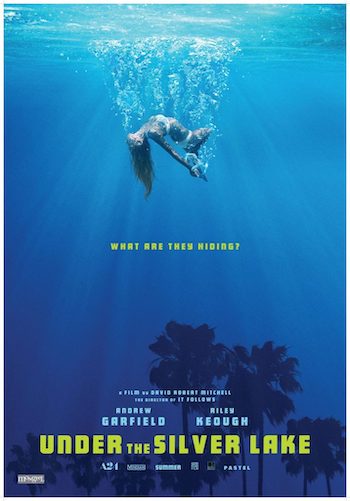
Director: David Robert Mitchell
Screenplay: David Robert Mitchell
Cast: Andrew Garfield as Sam, Riley Keough as Sarah, Topher Grace as the Man at the Bar, Laura-Leigh as Mae, Zosia Mamet as Troy, Jimmi Simpson as Allen, Patrick Fischler as the Comic Fan
Synopsis: Sam (Andrew Garfield) is a slacker who becomes fixated on his new female neighbour Sarah (Riley Keough), only for her to immediately vanish. His search for her across — Los Angeles will include the King of the Homeless, conspiracies, a serial killer of dogs, and codes in Nintendo games.
Well, at least David Robert Mitchell was ambitious, which is not something you say a lot when, frankly, most American directors (and some beyond the States) when they have just made something interesting now get sucked into blockbusters with no creative control in the slightest. It’s a view easily bias to how Under the Silver Lake is absolutely indulgent and not without faults, but God only knows how many filmmakers, when they’ve done well even in art house cinema, tend to now go for the blandest and predictable of routes with their newest films too. The comparisons to Richard Kelly have been apt – Kelly gained a reputation for Donnie Darko (2001), less when it actually debuted theatrically but from word of mouth, the follow up the notorious Southland Tales (2006). Tales was even more ambitious, comic book prologues and all tied in, and was also debuted at the Cannes Film Festival as Under the Silver Lake was, getting a good thrashing between them. Time is looking to potential give Southland Tales a chance, but Under the Silver Lake’s too young to start asking about this.
Mitchell’s journey is curious as, three films in when Kelly’s was just a debut before he got to Southland Tales, he started with an indie The Myth of the American Sleepover (2010), then suddenly got a surprise hit by entering the horror genre, It Follows (2014) getting a lot of traction. So he decides to take his chips accumulated and gamble them all on this two and a half hour neo-noir pastiche which gets through so many weird tangents I don’t know when to begin. Definitely, absolutely, the legacy of Thomas Pynchon is growing even outside of literature into cinema – amazingly, there’s only been one official Pynchon adaptation in Inherent Vice (2014), but filmmakers like Mitchell have instead appropriated his style of numerous tangents and conspiracies interweaving into each other, loose ends, eccentrics and a lot of pop culture. Under the Silver Lake, whether you like it or not, is surprisingly faithful to his style even if by accident, even the length befitting some of his monolithic tomes like Gravity’s Rainbow.
Mitchell’s film is strange, a farce to be honest whose central figure, an obsessive compulsive conspiracy nut and slacker, is inherently a dick, who indulges in his old Playboys and Nintendo Power magazines, and is a peeping tom who gets distracted by eyeing up women. Andrew Garfield imbues him with some charisma, but he’s having sex with an on-and-off-again girlfriend whilst having women’s tennis on the television at the same time, beating up children for vandalising his car the next. The voyeurism has put people off with the film, and I’ll admit that whilst we get to see Garfield’s bared arse a lot for balance, the amount of female nudity is not helped by how the female characters really blur into each other; its far more problematic than the nudity itself, or that our protagonist thinks with his smallest head too much, or that it’s roping in noir tropes of mysterious femme fatales. And Mitchell does make it clear he’s flawed, a little pathetic, even sprayed by a skunk for a lasting plot effect, even having a voyeuristic scene involving a drone deliberately being a challenge to the viewer when the woman being spied on in a screen on screen is in tears.
Sympathy is to be had for him as much as failure, the film a long journey for him to potentially grow. A weird journey, crammed to the point it’s wrong to follow the story as a concise one but, like Pynchon, a tangent factory. LA here is a place of odd events and mysteries, just from the outset with a squirrel dropping to its death off a tree in front of our lead and (visibly a puppet) gasping in a way that’s sickly humorous, an immediate warning Under the Silver Lake is going to get silly on purpose. Independent comics talk of a spate of dog serial killers and killer owl women, that the secrets of the city can be found in an old fifties cereal’s game on the box, or how the elite and rich are naturally getting up to hysterical hodgepodges out of boredom. The only sane ones, or in a way in control, are naturally the homeless or coyotes. The fact I first though the film was set in the nineties, because of the strange logic gap where our lead was able to see Kurt Cobain but is still young, does also suggest that, eventually, the nostalgia for the eighties is finally going to be punted off the throne in favour of a much more interesting and weirder nostalgia that is the nineties, where Cornershop is on the soundtrack side-by-side with R.E.M.
It’s also, dangerously, riffing on the past whilst constantly undercutting it as being merely a distraction. It’s an odd paradox that it gets a lot of humour from even a help guide for a video game being actually of importance, but that we also encounter a master songwriter who undercuts any sense even the most rebellious of pop culture is of actual subversion if it’s mainstream. It comes off as bleaker, as a film, than anything I’ve yet read of Thomas Pynchon, and does show the real issue I have about Under the Silver Lake for all my enjoyment of it, a second viewing allowing any clouding of judgement to take place, that Mitchell’s visibly crammed numerous obsessions together but the underlying idea that should tie it all together isn’t cognitive enough. Even a much weirder, scattershot experimental film would at least lean on atmosphere and dream logic more, whilst Under the Silver Lake still plays out as a quirky mystery.
This also includes some of the mysteries and conspiracies as well, playing off coincidence or just an insane amount of planning for a New World Order to make reality – it does make an argument that such a conspiracy doesn’t make sense in real life, due to how chaotic on a large scale it would be, unless one takes the idea that it’s as shambolic of everything on the surface or that some really coordinated calculations make us all sheep. Either way, going for the obvious like the sexual suggestions of advertisement and such parts are the weakest moments in Under the Silver Lake, “duh” moments no way near as simple and crisp as when They Live (1988) just had signs everywhere, black text on white, just telling us all to marry and procreate.
This is more so as a lot is brought in – silent cinema, Hollywood itself, hobo sign language, fifties culture, and poignantly sixties and seventies cults alongside the type of modern art performances you’d get now. The centre of this film is, arguably, that nothing is resolved, which is a huge risk to take – details, without spoiling anything, allow for interpretation, such as Sam carrying dog biscuits and having dreams of women literally barking at him, or how the owl woman’s identity is resolved. (Then there’s the caged bird whose one word he says everyone including the viewer is trying to figure out). It’s as much this why I liked Under the Silver Lake immensely, but I will be the first to throw out (if it hasn’t already) that even Southland Tales, the notorious film it’s compared to from a decade earlier, was at least circling the idea of how mad, chaotic and strange America had gotten and exaggerated it in terms of a plot. Whilst it took multiple viewings to get and love the film, which it at least went a direction with progression. Here, aware of its clear leanings to the idea of lack of resolution, or that the final scene at least has Sam finding a serenity seeing the apartment he’s about to be evicted from through a new light, it was a gamble that a few people didn’t like to be a lot more vaguer in terms of plot expectations.
A lot of this is as well why the languid pace and sense of nonsense is a good thing for Under the Silver Lake, less a mystery in the conventional sense but an Alex in Wonderland tale of Andrew Garfield encountering strange figures. A literal layabout, a semblance of (legitimate) skill to be a good detective when he’s actually focused, but he’s lead on a wild goose chase that we follow as confused as he is. This is the best way to view the film, and thankfully, it’s a well made accomplishment technically to work in this direction, right down to the funny end credits animation. Bright, colourful and vivid in a way that’s drastically different from It Follows. Disasterpiece, who made his name known to the public conscious through his score for that earlier work, comes with Mitchell here too and also takes a new direction, an orchestral score which does riff on Bernard Herrmann’s work with Alfred Hitchcock but has its own playful richness to it.
The resulting film’s a divisive one even for a defender like myself, just for the fact that it’s decision to be a maximalist work in detail, but ensue a primary theme, is going to cause a lot of misreading or confused ones over multiple viewings. There’s also just the fact it’s a director going into his foibles despite the mystery/noir genre suggesting there’ll be a conclusion at the end of everything.
What is there though, beyond this, is still a playful, very funny and sometimes poignant work. A brave risk which was worth taking, but what David Robert Mitchell is going to do next after this one is up in the air now.
Watch the full film on Hoopla here: https://www.hoopladigital.com/title/13468085
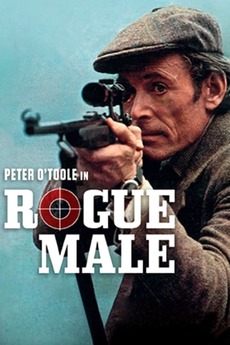
Peter O’Toole plays the huntsman who nearly shoots Hitler before the war and is forced on the run through rural Britain in the 70s TV film Rogue Male.
By Adam Scovell
Source: BFI
British TV films of the 1970s were obsessed with landscape. Getting their hands on 16mm cameras, directors gravitated towards rural realms in order to tell the most surreal and unusual of stories. Whether it be BBC Ghost Stories, Play for Today episodes or one-off films, the countryside never seemed so strange or omnipresent a setting as it did back then.
With a large part of its narrative set in the Dorset countryside, it’s unsurprising then to find Geoffrey Household’s tense 1939 novel, Rogue Male, adapted in this period. Clive Donner’s version, scripted by Frederic Raphael (Far from the Madding Crowd; Eyes Wide Shut) and now released on Blu-ray and DVD, is one of the strongest evocations of landscape of the time. The film shows how people must adapt to their role in an increasingly dangerous pre-war ecosystem, one that’s predicated on notions of survival of the fittest.
Broadcast on BBC2 on 22 November 1976, Rogue Male follows the misfortunes of sporting aristocrat Sir Robert Hunter (Peter O’Toole). On a suspiciously random trip to the continent, he is caught aiming his rifle at Adolf Hitler (Michael Sheard) and only misses by chance. Escaping the clutches of the Nazis after being caught and tortured by the Gestapo, Hunter makes his way slowly back to Britain, soon believing that he’s safe on his home turf. But, on finding that he has been followed by Nazi agents, and with little help from his politician uncle (Alastair Sim), he’s forced to flee from London to Dorset. Here he must confront his pursuers and the memories from his past that first motivated him to take aim at the Führer.
Household’s novel was first adapted by Fritz Lang as Man Hunt in 1941, with a screenplay by Dudley Nichols. But in Lang’s film, the landscape is less of a vital presence. Donner – known previously for the 1963 film of Harold Pinter’s The Caretaker and the swinging 60s romp Here We Go round the Mulberry Bush (1968) – is more aware of the inherent symbolism in Household’s original novel, and more concerned with the detail the author went into in describing the Dorset topography. His film matches this detail with a gritty but effective rendering of the hills and holloways where Hunter hides out, filling the scenes with sustained shots of the land: the only reliable constant in Hunter’s world.
Rogue Male’s script is filled with double entendres regarding the role of Hunter, who becomes more and more animalistic as the film progresses. His torment at the hands of the Gestapo turns him into a creature not unlike the animals he himself used to hunt. Even when he’s back in England, a country where we see walls scrawled with pro-fascist graffiti, he is “not out of the woods yet”. Later, he is described as having “gone to ground”, a fox-hunting term that implies he is no longer fleeing but in hiding.
All of these detail a subtle devolution in Hunter’s relationship with the land, from his mastery of it as a predator to scurrying with ingenuity as prey. He even wrote a book about the skill of hunting – much to his own misfortune, as it becomes the key that his chief pursuer, Quive-Smith (John Standing), uses to track him down.
With Hunter trapped underground in a warren of his own making, the imagery can’t help but remind us of the animated version of Richard Adams’ Watership Down (1978), with its equally subterranean battleground between the liberal and the totalitarian. Rogue Male’s very setting also recalls Mike Leigh’s Nuts in May, broadcast in January of the same year. Like a comedic inversion of Hunter, Leigh’s fastidious camper, Keith (Roger Sloman), also ends up foraging in the undergrowth after battling against ulterior – albeit antisocial – forces.
Unlike Keith, however, who never comes to terms with his lower placement in the Dorset landscape, Hunter adapts his way to freedom. Sir Robert knows, though, that for the next hunt he must be predator rather than prey, as the stakes will never be higher.
Watch the full film at the Anarchist Film Archive.

By August Cole and P.W. Singer
Source: Slate
It hits you every so often.
When you when you tug on a face mask to go pick up food for your family.
When you witness the powerless suffer casual violence by a man with a sneer.
When you see riot police surround the Lincoln Memorial and protesters snatched off the streets by masked soldiers in unmarked cars.
And when you realize that it is all being watched by an unblinking eye of A.I. surveillance.
At times, it feels like we are living in a real-world version of dystopia. The strange outcome, though, is that it means we need dystopian fiction now more than ever, to help us sort and even make it through it.
You’d think with everything going on, now would be the last time to escape to a world of darkness. And yet books, including those of awful imagined worlds, are in deep demand.
Some of it has been a return to old classics. In a period of disease and lockdowns lasting for weeks, booksellers report the seeming irony that Albert Camus’ The Plague and Gabriel García Márquez’s One Hundred Years of Solitude have seen renewed demand. And some of it has been escaping into new worlds, as with Divergent author Veronica Roth taking readers into another post-apocalypse with her new novel Chosen Ones. People have even been willing to enter imagined worlds that seem not too far away, such as Lawrence Wright’s best-selling pandemic thriller The End of October.
Yet the value of the genre is as much in education as entertainment. It can elucidate dangers, serving the role of warning and even preparation. Think of the recent resonance of Margaret Atwood’s 1985 Handmaid’s Tale and its 2020 sequel The Testaments or the revival of interest in It Can’t Happen Here by Sinclair Lewis in 1935. These are finely written works, not as indulgences, but as a pure expression of the idea that to be forewarned is to be forearmed. Even Susan Collins’ Hunger Games prequel, The Ballad of Songbirds and Snakes, might be interpreted in that light, showing how authoritarian rule can originate through the manipulations of an ambitious striver.
Our personal corner of this dark market is the meld of imagination with research. For our book Burn-In: A Novel of the Real Robotic Revolution, we chose the setting of not a far-off imagined world like Panem or Gilead, but Washington, D.C., just around the corner. What happens as Silicon Valley’s visions of utopia hits our real, and very divided, country? What plays out in politics, business, and even family life as our economy is rewired by AI and automation? Yet to make our scenario more haunting, we back up everything that happens in it with 27 pages of endnotes.
When the scarier elements from an imagined world come to life in the real one, however, there is no gleeful “I told you so.” When the novel coronavirus accelerated the more widespread roll out of the robots, remote work, job automation, and AI surveillance projected in our book, we certainly weren’t happy. All it meant was that all the tough dilemmas that our characters face would come quicker for all of us. What was perhaps most disturbing of the last few weeks, though, were when some of the most dystopian scenes we had painted of a future Washington, D.C., also came true, from our book’s scene of riot police deployed around the Lincoln Memorial to the militarized fence thrown up around the White House being put exactly where we had it in Burn-In.
Yet what makes dystopian fiction different is that its creators are oddly optimists at heart, as we are. These works are not about prediction, but prevention. The stories warn of just how far things can go if action isn’t taken, wrapped in a package that is far more impactful than a white paper or PowerPoint. Indeed, research shows that narrative, the oldest communication technology of all, holds more sway over both the public and policymakers than even the “most canonical academic sources.” Our minds can’t help but connect to the “synthetic environment” that our fictional heroes and villains experience, living part of our lives through theirs, even if imagined.
Most importantly, though, the dark worlds are only the setting. The stories are really about the agency of the people in them. And that is perhaps the true value of the dystopian fiction. These stories are not about what those characters experience so much as how they act. At the heart of every story of darkness is a story of perseverance.
As we face our own difficult journeys through the reality of 2020, it is perhaps that lesson which is most important of all.

Notes by Filmogs
| 4 short films by a quartet of directors. 1) Rosselini’s Illibatezza deals with an attractive air hostess who receives the unwelcome attentions of a middle aged American. 2) Godard’s Il Nuovo Mondo illustrates a post-apocalyptic world the same as the pre-apocalyptic one, but for an enigmatic change in attitude in most people, including the central character’s girlfriend. 3) Pasolini’s La Ricotta, a lavish film about the life of Jesus Christ is being made in a poor area. The people subject themselves to various indignities in the name of moviemaking (and to get some food). The central character’s hoisted up on a cross for filming, and dies there. 4) Gregoretti’s Il Pollo Ruspante in which a materialist family inadvertently shows the cynical, metallic-voiced doctrine of a top sales theorist. |
INDIAN COUNTRY NEWS
"It is the duty of every man, as far as his ability extends, to detect and expose delusion and error"..Thomas Paine
Human in Algorithms
100% Accurate Google Sheets + KDP Book Formatting | 24hr Delivery
From the Roof Top
I See This
blog of the post capitalist transition.. Read or download the novel here + latest relevant posts
अध्ययन-अनुसन्धानको सार
 After the Crash