If you’ve seen Top Gun or Transformers, you may have wondered: Does all of that military machinery on screen come with strings attached? Does the military actually get a crack at the script? Theaters of War digs deep into a vast new trove of recently released internal government documents to bring the answers to these questions into sharp focus. Traveling across America, filmmaker and media scholar Roger Stahl engages an array of other researchers, bewildered veterans, PR insiders, and industry producers willing to talk. In unsettling and riveting detail, he discovers how the military and CIA have pushed official narratives while systematically scrubbing scripts of war crimes, corruption, racism, sexual assault, coups, assassinations, and torture. From The Longest Day to Lone Survivor, Iron Man to Iron Chef, and James Bond to Jack Ryan, Theaters of War uncovers an alternative “cinematic universe” that stands as one of the great Pentagon PR coups of our time. As these activities gain new public scrutiny, new questions arise: How have they managed to fly under the radar for so long? And where do we go from here?
In 2008, Chris Bell’s Bigger, Stronger, Faster* plunged into the (un)surprisingly rampant reality of athletic doping. Never a fly-on-the-wall documentarian, Bell organically infuses himself into his films, rendering them particularly potent. In the case of his fascinating 2008 exposé, Bell turned his lens on American bodybuilders’ use of steroids, with a particular focus on his own brother, Mike. Mike “Mad Dog” Bell was an aspiring WWE wrestler who, while struggling to achieve the stardom he so fully desired, took to using performance and muscle enhancers.
Now, seven years later, Chris Bell returns with a natural follow-up. Prescription Thugs examines the fallout of another substance abuse problem all too common in, though far from exclusive to professional sports. Perpetually banged and bruised in the ring, Mike Bell took to prescription drugs as a means of curing—or at least numbing—his ailing body. He was by no means alone. Chris Bell and his co-directors, Josh Alexander and Greg Young, interview a number of athletes whose dependency upon over the counter medications got the better of them.
Immensely relatable and genuine as the face of the film, Bell sheds tremendous light on America’s dependence on prescription medication, an addiction which he indicates was largely born in the Reagan years. Given his brother’s history—and, it turns out, his own—Bell approaches the problem from an extremely personal angle, and the honesty pays off in spades. We feel for Bell and his friends and family, as they break down—or defend—their perilous reliance upon pill popping. One of the most extreme cases is Matt “Horshu” Wiese, who at the acme of his addiction, was taking upwards of 90 pills a day. Horshu admits that part of his regimen included two Viagra each morning, “just in case.” Through interviews with his burly subjects—and also with homemakers and students, who inadvertently and unintentionally got hooked—Bell reveals how easily one pill can lead to two, can lead to ten or more. The genesis of the addiction often comes in the form of the “just ask your doctor” Rx ads that inundate television these days. Big pharma colludes to sell medication for virtually any and every imaginable symptom (some of which they basically fabricate), and when side effects present previously unfelt problems, they develop a secondary drug for those. So on and so forth, until consumers are hooked to a habit Bell reveals to be little different from a legalized form of heroin in some cases.
With Prescription Thugs, Bell again proves a consistent, affable filmmaker well versed in investigative filmmaking with a penchant for the personal.
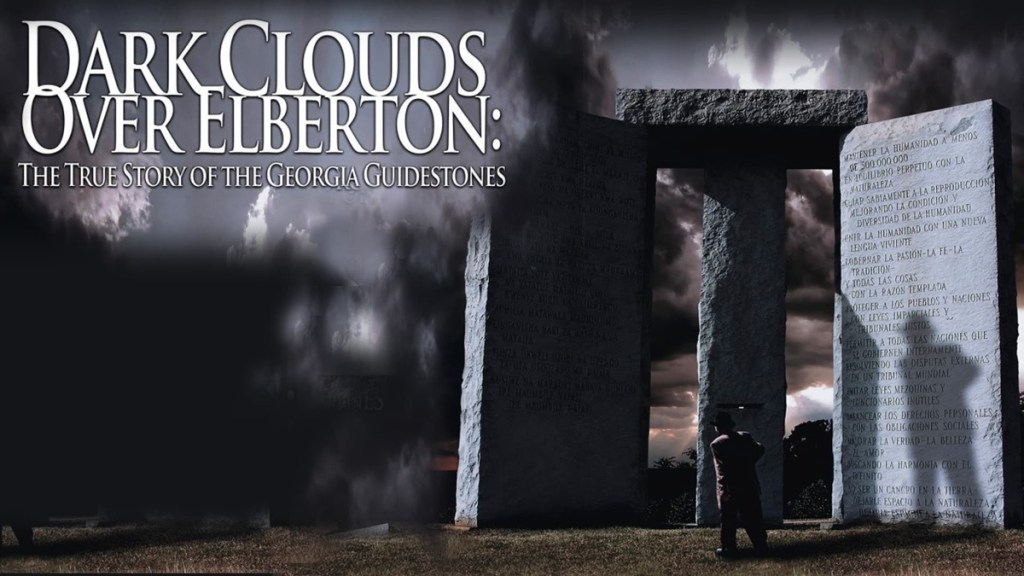
In 1979, a mysterious stranger appeared in the remote town of Elberton, Georgia. The man introduced himself as R.C. Christian, but admitted this was not his real name. He claimed to represent a small group of loyal Americans who wanted to erect a monument they hoped would inspire “the Age of Reason.”
The monument was named the Georgia Guidestones, and since its completion has spawned a host of conspiracy theories about who or what was behind it. Written on the great granite stones are ten commands or “guides” that were intended to provide wisdom for mankind. But the first of them calls for a reduction of the world population to a mere 500 million. In order to achieve this, billions of people would have to die. Many have wondered: is the monument designed to inspire wisdom? Or to launch a global genocide?
Researchers have wondered for decades about the identity of R.C. Christian and the purpose of his mysterious structure. Was he part of a globalist group? Was he working with the United Nations? After a five year investigation, this powerful documentary presents groundbreaking information, and dares to solve the mystery of who R.C. Christian really was.
This film is a must see for those who wish to learn more about the globalist use of environmentalism towards the cause of population control.
An ADULLAM FILMS Production Written & Directed by Christian J. Pinto Produced by Christian J. Pinto, Dr. Mike Bennett ADULLAMFILMS.com
Werner Herzog is an inimitable documentary filmmaker whose curiosity, wonder and awe for the mysteries and eccentricities of our world is unbounded. One of the hallmarks of his work is his unmistakable voice-overs (with a distinctive German accent) which serve as the narrative threads holding the materials together. Here are five of his most recent documentaries which illustrate the diversity of themes that interest him:
Encounters at the End of the World:A visually stunning documentary about the scientists, dreamers, adventurers, philosophers, and creatures of Antarctica.
Grizzly Man:A mesmerizing documentary about a young man obsessed with grizzly bears in the Alaskan wilderness.
Into the Abyss:A daring examination of capital punishment filled with small and humble human touches.
Wheel of Time:An exotic look at a Buddhist ritual held in Bodh Gay, India, and Graz, Austria in 2002 that attracted thousands of pilgrims.
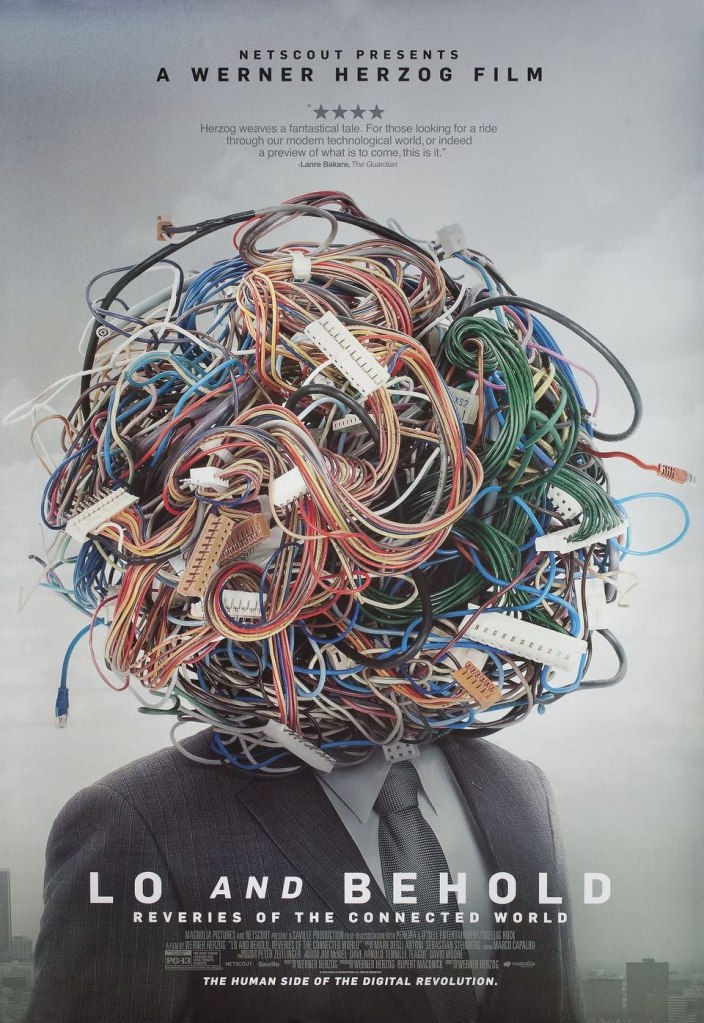
In Lo and Behold, Reveries of the Connected World, Herzog tackles the complex, controversial, and mysterious Internet. He refers to this technological tool as “one of the greatest revolutions” in human history. This bold and multidimensional film is divided into 10 chapters:
The Early Days
The Glory of the Net
The Dark Side
Life without the Net
The End of the Net
Earthly Invaders
Internet on Mars
Artificial Intelligence
The Internet of Me
The Future
Here you will discover a breadth of material that ranges from the very serious to the extremely quirky and odd. Herzog begins with a terse history of the Internet’s beginnings at U.C.L.A. during the 1960s. Leonard Kleinrock, a professor of computer science, takes us into the “holy room” where the first Internet computer remains. He recalls his feelings when a message was transmitted from this computer to the Stanford Research Institute on October 29, 1969. Programmers were on the phone confirming that the login was happening. Stanford replied that they had received the “L” and the “o.” Then its computer crashed. So the first Internet message was “Lo.” This documentary chronicles what happened beyond that.
Danny Hillis, another scientist, reminisces about a time when all the users of this technology could be identified in one directory. Now, he states, the global directory would be 72 miles thick. Another statistic which stands out is: “Today, about 3.2 billion people use the internet around the world.” Herzog chimes in that CDs containing a single day’s worth of global data would stretch “to Mars and back.”
Here are some observations made in interviews with computer and robot specialists, hackers, technicians, programmers, gamers, and professors.
Elon Musk, the entrepreneur behind Telsa, is now interested in colonizing Mars; he also reflects on cyberwarfare or other earth catastrophes.
Kevin Mitnick, a legendary hacker, reveals the mayhem and the mischief that can take place by those who can get into large computer systems; cyberwarfare now puts smaller states on the same level as larger ones.
Joydeep Biswas, an engineer who has put together a robotic soccer team, shows how they work together and even reveals his favorite robot player.
Sebastian Thrun, an online-learning pioneer, notes that self-driving cars can all learn from the collective experiences of other cars and their mistakes, unlike human drivers.
Also included is an account of abusive cyber behavior ending with a mother calling the Internet “a work of the Devil” after pictures of her dead child were widely circulated online. Herzog talks with several persons who are sensitive to electromagnetic waves and get radiation sickness; they now live in an isolated area totally off the grid. A segment on video-game addicts reveals that many of them have completely stopped being present to the real world; some have developed blood clots in their legs after sitting so long at their computers. Astronomers explain that a large solar flare, which has not happened in many years, could disrupt Internet communication worldwide, affecting all the food supply, water and other systems supporting modern life.
In a telling scene, we see a group of Buddhist monks standing in front of a city skyline and the question is posed, “Have the monks stopped meditating?” We see that they are not bowing their heads in prayer or meditation. All of them are totally focused on their cell phones. Herzog quotes a startling statistic: There will be 31 billion devices connected to the Internet by 2020.
A famous New Yorker cartoon by Peter Steiner shows two dogs by a computer. The caption reads: “On the Internet, nobody knows you’re a dog.” It’s good for a laugh, and it’s also a reminder that Internet technology is raising many spiritual questions. Who are you? Where do you really live? And who are your companions? Don’t miss this thought-provoking documentary!



 After the Crash