Two for Tuesday
Reply

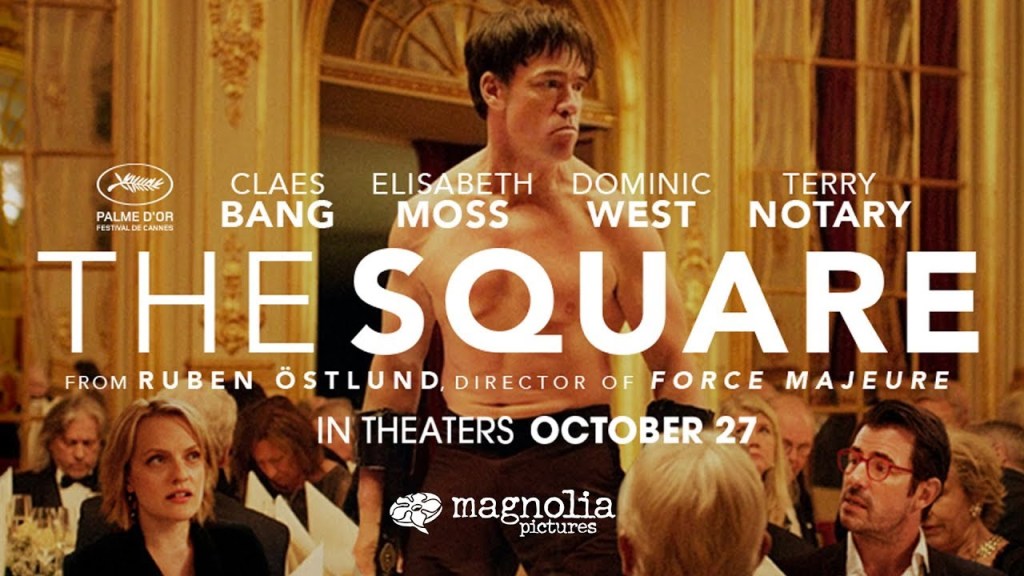
By Freda Cooper
Source: Flickering Myth
SYNOPSIS:
A museum curator is preparing to launch a major art exhibition. He sees himself as having a social conscience, but when his wallet and phone are stolen, the other side of his character emerges and he badly mis-handles the situation – and does the same thing when it comes to promoting his new show.
A film from Ruben Ostlund isn’t going to be cozy. Compelling and fascinating, yes, but never easy and sometimes impenetrable. His previous offering, Force Majeure, was well received and won the Un Certain Regard prize at Cannes in 2014. His latest, The Square, went one step further and scooped the Palme D’Or last year.
Force Majeure centred on a spontaneously cowardly act by a father. This has another act from another father at its centre, but this time one that’s thought out. Badly. And it’s followed by a second one, which is equally ill-considered. The Square of the title is an art installation, the centrepiece of an exhibition supervised by museum curator Christian (Claes Bang). He’s a man under pressure, both professionally and domestically, but still believes he has a social conscience – until his wallet and phone are stolen. His reaction is extreme, a more accurate reflection of the real man, and he’s responsible for something equally rash when it comes to launching his beloved exhibition.
That’s putting it simply. Ostlund has a number of targets for what is, at times, a savage satire. At the heart of it is how those with money treat others – the homeless, the poor or those who are just not as wealthy. Society encourages tolerance and kindness, but it’s easier to ignore them. “Would you take a moment to save a life?” asks a charity worker and everybody who walks past her says no. Are they just saying no to her or to her actual question? Or both?
The art establishment, in the form of The Square installation, comes in for attack as well. It’s meant to represent a space where everybody is safe and responsible for each other – but that can apply to any space, from a circle to a pentagon. It’s nonsense. As are some of the other exhibits, especially one made up of conical piles of gravel. It’s no surprise that some are accidently vacuumed up by the cleaner. The exhibition’s marketing team is equally ridiculous, but also irresponsible in its creation of a promotional video of a little, impoverished girl. It goes viral and causes an outcry – all because Christian doesn’t take the time to think it through properly.
Much of this creates uncomfortable laughter, but lurking in the background in the museum is another installation featuring an ape like man, brought to life by a performance artist. His actual appearance at the exhibition launch is breath-stoppingly unsettling, as he lumbers around the room, aggressively whooping and pawing at the guests. The end of the scene is even more deeply disturbing. Yet again, the idea is mis-judged, with the guests initially alarmed and scared and then turning on the man in the most vicious of ways.
That scene marks a change in tone, but it’s also where the film starts to unravel. Christian delivers a speech, videoed on his phone, which essentially explains the plot. Except that, by that stage, the point is already clear, so it’s hardly necessary. His explanation of the marketing video to a packed press conference is equally superfluous and more than a little disingenuous. But Claes Bang holds both halves of the film together with the arrogant, flawed but not wholly unlikeable Christian, although talents like Dominic West and Elizabeth Moss are under-used and have only a handful of scenes apiece. Terry Notary, in that exhibition launch sequence delivers the piece of acting that sticks in your mind and, disturbing as it is, it’s powerfully excellent.
The Square doesn’t have the clarity of Force Majeure, but it does have the ability to grab the audience firmly by the shoulders for the duration. Given the complexity and occasional obscurity of the story, the film needs it. It isn’t always satisfying, but it is never less than compelling.
____________________
Watch The Square on Tubi here: https://tubitv.com/movies/590338/the-square?start=true

By Josh Larsen
Source: Larsen on Film
Little visual gags fly as fast as the bullets in this 2010 Chinese action comedy, starring co-writer and director Jiang Wen as Pocky Zhang, a bandit leader who poses as governor of a southern outpost. One of the first things we see is a bandit leaning down to listen for an approaching train on railroad tracks—but first he ostentatiously sticks his finger in his ear to clear it out.
Mistaken identity is at the core of much of the movie’s comedy. Let the Bullets Fly opens with Zhang and his band hijacking that train, which is carrying the actual governor (Ge You) to his post in Goose Town. During his interrogation of the governor (captured in a shot-reverse-shot sequence that’s edited at light speed), Zhang decides that pretending to be the governor might be more lucrative than simply robbing him. But upon arriving in Goose Town (with the real governor in tow, disguised as Zhang’s counselor), Zhang finds that things are actually run by the local crime boss, Master Huang (Chow Yun-Fat). This leads to a series of strategic chess moves between the two men, culminating in a comic set piece where Zhang’s crew and Huang’s henchmen square off while wearing the same bandit masks with red circles on them, unable to tell who is who. It’s a face-off as farce.
With its manic comic sensibility, Let the Bullets Fly recalls the work of Hong Kong’s Stephen Chow (Shaolin Soccer, Kung Fu Hustle, CJ7), whose own films seem inspired by Looney Tunes cartoons (the opening train sequence here could easily be a Wile E. Coyote short). Physics takes a back seat to fun, so that much of the film seems to be occurring in fast motion. As director, Jiang looks for every opportunity to be showy; at one point an alarm clock is thrown in the air and shot to pieces, causing a metal circle to sail over the camera like a collar.
As an actor, Jiang seems to understand that his face has a comic appeal—those big ears—that allows him to underplay the gags by keeping a straight face. He’s a delight. The legendary Chow (The Killer, Crouching Tiger, Hidden Dragon) gets a double role as the villainous Master Huang and Huang’s dim-witted body double. He’s quite a bit broader than Jiang, but equally amusing.
The disparate tones Jiang juggles can make for some uncomfortable moments. There are sudden bits of graphic violence, for instance, and a rape scene that isn’t given nearly the serious consideration it deserves. (Like much of the movie, it’s a setup for a later gag.) But as a political satire, Let the Bullets Fly is pointed and precise. “I want to make money standing tall,” Zhang says at one point, trying to explain why he’s left forest robbery behind. “Impossible,” the real governor replies, knowing bureaucratic corruption all too well. The best joke in Let the Bullets Fly might be that a bandit is the movie’s moral center.
____________________
Watch Let the Bullets Fly on Hoopla here: https://www.hoopladigital.com/title/10088666

By Marc Savlov
Source: Austin Chronicle
As Hollywood increasingly relies on ever less entertaining parodies of whole cinematic genres to sate an apparently insatiable public appetite for seriously dumb humor, the comparatively sophisticated yuks of Airplane! and The Naked Gun have devolved into the lowest-common-denominator yucks of the Scary Movie franchise and the viciously unfunny gurgles of Not Another Teen Movie, et al. Truly great parody relies in equal measure on both finely calibrated nuance and audience familiarity with the object of comic ridicule and not on how many fart jokes you can jam into an already bloated 90-minute running time. Austin Powers, for example, succeeded as much on the merits of its hyper-detailed production and art design as it did on Mike Myers’ groovy, hirsute mugging. Its swinging, Bond-esque London looked, or at least felt, as real as its modern-day counterpart, and its subject of parody, the 007 films, was universally known. Leave it to the French to beat us at our own bizarrely self-reflexive comic shenanigans. OSS 117: Cairo, Nest of Spies is a model of smart, often very silly, but never, ever stupid comic perfection. Set in 1955, back when Cairo was bristling with anti-English antipathy over a looming Suez canal crisis and radical Islam was just getting warmed up, the French Office of Strategic Services sends its best man, Hubert Bonisseur de la Bath, aka OSS 117 (Dujardin), to Egypt to discover the whereabouts of vanished agent Jack Jefferson (Lefebvre). OSS 117 is, of course, a fatuous, self-involved, debonair jerk who attracts the leggiest ladies and trouble of every sort. But Cairo, Nest of Spies, is far more than a Clouseau-on-holiday knockoff. Simple, period touches like the frequent use of obvious rear-projection (a nod to Hitchcock and a wonderfully evocative gag in and of itself), an ongoing bit about OSS 117’s nicotine independency, and an unexpectedly hilarious undercurrent of homoeroticism among spies of all nations conspire to make this a consistently entertaining parody that never once makes you feel like an idiot for laughing out loud at its idiocy.
___________________
Watch OSS 117: Cairo, Nest of Spies on Crackle here: https://www.crackle.com/details/cde3fda4-76e8-4b82-b612-ba0ae52fa27c/oss-117:-cairo-nest-of-spies
By Eric Zuesse
Source: The Duran
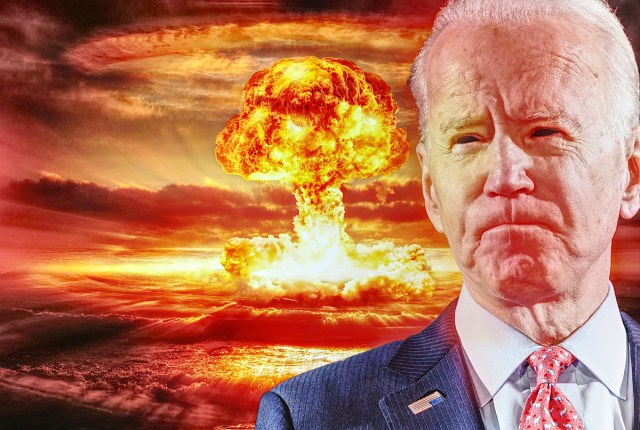
On June 25th, the former Obama Secretary of State and current Biden climate czar John Kerry was interviewed by Darius Rochebin on the TF1 French TV network and Kerry accused Putin of aggression against Ukraine, he was pretending that the war in Ukraine hadn’t started with America’s coup in Ukraine in 2014 turning that country, which has the nearest border to The Kremlin, rabidly anti-Russian. Rochebin replied by comparing Russia’s 2022 invasion of Ukraine and America’s 2003 invasion of Iraq. He asked Kerry: wasn’t that an international war-crime, an aggressive invasion against Iraq, which was based on the lie that Iraq was hiding WMD, weapons of mass destruction? Kerry answered “No.” Rochebin asked Kerry why it wasn’t comparable to Bush’s invasion of Iraq. Kerry said that there was no comparison because whereas Putin is being charged by the ICC for a war crime of aggression, Bush never was. An accurate description of the discussion was provided by Russia’s RT, and here that is:
——
https://www.rt.com/news/578750-john-kerry-iraq-aggression-lie/
26 June 2023 17:29
US envoy admits Iraq invasion was based on lie
The 2003 war was not a crime because President George W. Bush was never charged, John Kerry has insisted
[The passage is starting at 9:30 in the video:
The US-led invasion of Iraq was completely different to the current Ukraine conflict, Washington’s special envoy for climate change John Kerry has told French TV channel LCI.
He appeared on LCI’s Sunday evening show hosted by Darius Rochebin, who had previously interviewed him for a Swiss outlet in 2017. Rochebin tweeted a video segment of the interview, in which he confronted Kerry about the West accusing Russia of aggression regarding Ukraine. The French journalist noted that the 2003 invasion of Iraq was an actual war of aggression, based on the lie that Baghdad secretly possessed weapons of mass destruction.
“No,” Kerry replied. “Because there’s never even been, you know, a process of direct accusation of President [George W.] Bush himself.”
He added that there had been “abuses” in the course of that conflict, and that he “spoke out against them.” When Rochebin asked him directly whether the Iraq War had been a crime of aggression, Kerry repeatedly denied it.
“No, No, No. Well, you didn’t know it was a lie at the time. [That’s a lie because Bush certainly did know that it was a lie, at that time.] The evidence that was produced, people didn’t know that it was a lie,” the former diplomat said, before telling Rochebin that he doesn’t intend to “re-debate the Iraq War” at this point.
Kerry also claimed he was opposed to the war at the time and thought it was the wrong thing to do. He actually voted in the Senate to authorize the invasion, however. When Rochebin pushed him on the apparent double standard, Kerry began speaking about “climate justice.”
The Bush administration accused Iraqi President Saddam Hussein of having chemical and biological weapons, as well as being somehow involved in the 9/11 terrorist attacks in New York and Washington. The ‘evidence’ for WMDs offered to the media and the UN Security Council turned out to be entirely fabricated, and no such weapons were ever found. Likewise, no connection between Baghdad and Al-Qaeda was ever established.
The 2003 invasion and the subsequent occupation of Iraq was carried out without UN approval, by what Bush called a ‘coalition of the willing’. The US, the UK, Australia and Poland provided troops for the attack, though Washington later claimed 44 more countries had offered some kind of support.
Kerry ran against Bush in 2004 but lost. He later served as secretary of state in the Barack Obama administration, and was appointed climate change ambassador by the current president, Joe Biden, in 2021.
——
Here was Rochebin’s tweeted video-clip of the discussion:
The tweeted responses to the discussion were largely regurgitations of U.S.-and-allied propaganda against Putin and against Russia. Very few tweets addressed the comparison of the 2003 invasion of Iraq and the 2022 invasion of Ukraine. Almost all of the tweeted replies were irrelevant to that issue — which had been the issue. Most of the tweets were non-responsive.
I have previously argued that the comparison is valid, and that the case that Bush is a war-criminal is far stronger than is the case that Putin is.
However, what is most remarkable here is the aristocratic Kerry’s unconcern with the substance of the matter — that Bush is at least as guilty as Putin is — and Kerry’s total and obsessive concern instead about whether Bush has been charged as having been a war-criminal. He thinks in labels, instead of realities. Bush has not been labelled “war-criminal.” It seems that all that concerns Kerry is what people think, and not what actually is.
His type of thinking is sometimes called “other-directed” as opposed to “inner-directed,” or else “conformist” instead of “autonomous” (or “independent”). It seems to lack a core, have no personality or character, because the only ‘conscience’ the person has is other people’s opinions, nothing inside the person — the person is actually a vacancy. That’s a classic psychopath: no conscience is present.
Is this a trait that is virtually universal among the people who run the U.S. Government? To judge by those twitter-responses, it appears to be a rather common trait, though perhaps not as universal as among the individuals who run the U.S. Government. In order to participate in the U.S. leadership, psychopathy seems to be the chief prerequisite. It’s the way to ignore reality.
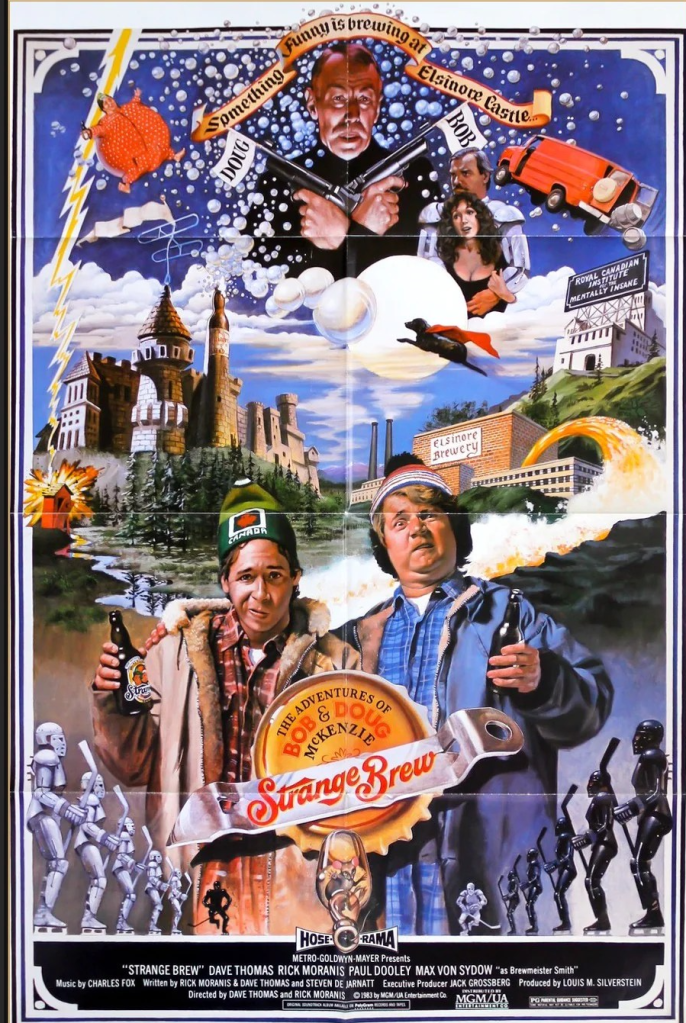
Beer. Hockey. Shakespeare. Beauty, eh?
By Lloyd Farley
Source: Collider
It’s August, 1983 at the local movie theatre.The lights go down, the curtains part. A trailer or two roll, maybe A Christmas Story, or the hilarious Yentl. The iconic MGM lion then comes on screen, and you wait breathlessly for his mighty roar to begin the film. And then…BURP.
No, this movie can’t possibly begin with such comedic absence of reverence, can it? The camera pans around to capture two parka and toque clad men, one of which is turning the lion’s tail like a crank to get it to roar. Absence of reverence, confirmed. The two men see the camera is running, so they run to the set, riddled with cases of beer and a backdrop with a large map on it, the words Great White North spread across, and so wide it includes England, Russia and Hawaii. The hilarious, absurd, Shakespearian, James Bond villainous, rife with all manner of Canadian stereotype film Strange Brew has begun.
The two men are brothers Bob and Doug McKenzie, played by Rick Moranis and Dave Thomas. The duo came to life on SCTV as The Great White North, an improvised bit by Moranis and Thomas for more Canadian content. They used every stereotype — toques, parkas, back bacon, beer, the iconic “coo-roo-coo-coo” loon call, “hosers” — and simply talked. They would add “eh?” to the end of every sentence, a tic as Canadian as “oh yea, no, for sure”. The McKenzie’s took off with syndication in the US. Capitalizing on their popularity, they released the comedy album The Great White North, which included the song “Take Off” with collaborator Geddy Lee (his highest charting single, including his work with Rush). The success of the album begat the movie, which Thomas pitched as having creative ties with Hamlet.
The beginning of the film is a movie within the movie: Mutants of 2051 A.D., a home-made sci-fi classic, like the works of The Goldbergs‘ Adam (Sean Giambrone). When the film breaks, the brothers, watching the film in the theatre, flee from angered moviegoers, and lose their dad’s (Mel Blanc) beer money. Forced to get beer for their dad the next morning, they place a mouse in an empty bottle of Elsinore beer, hoping to leverage it for free beer. They are told to go to the brewery, where the new owner, Pam Elsinore (Lynne Griffin), gives them jobs watching for mice in beer bottles (and cases of free beer). They wander around the brewery and into Brewmeister Smith’s (Max von Sydow) operations room, where they can see patients from the nearby Royal Canadian Mental Health Facility playing hockey.
Wait, back up. Esteemed Swedish actor Max von Sydow, of Bergman‘s The Seventh Seal? Yep. His son was a huge fan of SCTV, and encouraged his father to take the role. The character has been working on a plan to take over the world by adding a mind control drug to Elsinore beer, testing on the patients from the nearby facility. Through certain musical tones, those under the drug can be made aggressive (shown in an amusing bit where Doug plays the iconic loon theme on the keyboard), with those results tested through games of hockey. Because, you know, Canada.
Tranquilized by Smith and his accomplice, Pam’s Uncle Claude (Paul Dooley), the brothers wake up and make a delivery in their van, not knowing that the brakes are cut and that the beer kegs in the back have Pam and her father’s friend Henry (Douglas Campbell) inside. They careen down the hill into the lake, and then…Intermission.
Police divers find the boys in the van, alive and drinking beer. Charged with attempted murder, they are found insane by the judge. The brothers are sent to the asylum and placed in Smith’s care, where they are straitjacketed, prompting a game of steamroller, and take turns using electric shocks on one another. Freed by Rosie, they return to the brewery to stop Smith.
Pam and Bob are captured by Smith and placed in a brewery tank, which begins filling with beer. Rosie and Doug find them, discovering that Bob drank the entire contents of the tank and is now cartoonishly bloated, and needing to ‘take a leak’, which he does by, um, expelling and putting out a fire at the asylum. Knowing Smith has shipped tainted beer to Oktoberfest, Bob and Doug stop at home to get the help of Hosehead (Buddy), who flies off — you read that right — to stop the party and indulge in beer and sausages. The brothers take the remaining beer away, and presumably home. The film ends…
… no, it doesn’t. Bob and Doug reappear on the set of The Great White North and talk throughout the credits, sending off those that stayed behind – not the hosers that took off after the movie was done — with a beer whistle and a “happy trails”. Right now you’re thinking, “Geez, we got hosed! What about Hamlet, you knob?”
Strange Brew‘s retelling of Hamlet ranges from the painfully obvious to a much subtler degree. An intellectual ribbon throughout the lunacy. The name Elsinore is the easiest reference, a clear nod to the Danish royal castle Elsinore from the play. Pam is the Hamlet, the heiress of the brewery/kingdom after the death of her father, who is still reeling from her mother Gertrude (Jill Frappier, Queen Gertrude) marrying her uncle Claude (Claudius) within days of the loss. Pam is shown by the ghost of her father, John (Eric House), how Claude and Smith murdered him. The ghost recounting the details of his death is taken directly from Hamlet, but the fact that he appears via a Galactic Border Patrol videogame in the movie is a clever reference to a feared invasion of Denmark by neighboring Norway. The presence of the Mental Health Facility would suggest a reference to the role of madness in Hamlet, from Hamlet’s acting as such to Ophelia’s descent into true madness, while the tinged beer a bow to the poisoned glasses of wine in the play’s final act. The McKenzie brothers themselves have a link to the play as a modern-day Rosencrantz and Guildenstern.
Strange Brew is as much an experience as a comedy, and, with the Canadian penchant for self-deprecation and a highbrow Shakespearian tint, its lighthearted jabs at the Canadian identity should be mandatory (well, at least suggested) viewing every July 1st on Canada Day. Happy trails indeed, eh?
INDIAN COUNTRY NEWS
"It is the duty of every man, as far as his ability extends, to detect and expose delusion and error"..Thomas Paine
Human in Algorithms
100% Accurate Google Sheets + KDP Book Formatting | 24hr Delivery
From the Roof Top
I See This
blog of the post capitalist transition.. Read or download the novel here + latest relevant posts
अध्ययन-अनुसन्धानको सार
 After the Crash