Two for Tuesday
Reply


Directed by Raúl de la Fuente, Damian Nenow
An animated documentary presenting a journalist’s poignant perspectives on the horrors of war.
By Frederic and Mary Ann Brussat
Source: Spirituality & Practice
You must save something if you can. Because people disappear without a trace. Completely and irretrievably. From the world, and then from our memory.
— Ryszard Kapuscinski
Another Day of Life is an intense, chilling, and convincing anti-war animated documentary about the civil war in Angola at the time of its independence in 1975. With the exit of the Portuguese colonizers, two factions fought with each other to determine who would rule and control the country’s thriving businesses and resources, especially diamonds and oil.
The film is based upon a book by acclaimed Polish war correspondent Ryszard Kapuscinski (1932 – 2007) in which he described the situation he witnessed with the Portuguese term confusão, “a state of absolute disorientation.” His story is told through animated recreations of his experiences during the war and filmed interviews with those he met and worked with.
Despite the advice of fellow journalists, Kapuscinski decides to travel from the relatively safe capital of Angola to the southern front in order to interview Farrusco, a military leader of the MPLA, the Soviet- and Cuba-backed People’s Movement for the Liberation of Angola. Other militias were supported by other African interests as well as the United States and South Africa. By the time the war ended in 2002, nearly one million people were displaced and 5,000 were dead.
The film brings us along on Kapuscinski’s travels through dangerous situations and his encounters with memorable people. Since his words (voiced by Kerry Shale) are used for the narration, we empathize with his perspectives — the horror that he and his companion Artur (Daniel Flynn) feel upon coming across a road clogged with corpses, his fascination with a charismatic female freedom fighter named Carlotta (Lillie Flynn), the desire of the people to be photographed so people would know “this is the face I had when I was alive.” At a key moment, the journalist has to decide whether to maintain his objectivity or reveal information that could change the outcome of the conflict.
IndieWire has published a review of Another Day of Life that includes excerpts from interviews with the two directors. We were very impressed with the insights and respect for the substantive themes of this story as explained by director Raul de la Fuente:
“I was fascinated by this surrealistic diary, the desperate chronicle of a reporter at the limit of his strengths, fighting for survival and finding the truth in a chaotic and fuzzy war. This film is a hallucinatory trip into the heart of darkness, a Cold War tale with a thrilling spy mood, magnetic topics, and characters: decolonization, freedom fighters, boy soldiers, epic battles, and, above all, the surreal and poetic approach by Kapuscinski.”
___________________
Watch Another Day of Life on Hoopla here: https://www.hoopladigital.com/movie/another-day-of-life-john-hollingsworth/12738084

Beyond the Infinite Two Minutes (2020) Review
Director: Junta Yamaguchi
Cast: Kazunari Tosa, Riko Fujitani, Gôta Ishida, Masashi Suwa, Yoshifumi Sakai, Haruki Nakagawa, Munenori Nagano, Takashi Sumita, Chikara Honda, Aki Asakura
Running Time: 70 min.
By Paul Bramhall
Source: City on Fire
The concept of time travel is always an interesting one when it’s transferred to screen, and the Japanese film industry has flirted with it just as much as any other. From modern day military units transported to feudal Japan in the likes of G.I. Samurai, to the quirkiness of Summer Time Machine Blues, to of course the countless romantic spins on the genre. What all of them have in common is characters travelling back to the past, whether it be days or decades, and their need to adjust to a different time period or right a wrong. Beyond the Infinite Two Minutes also uses time travel as its key theme, however it does so in an arguably more minutiae way than any of its predecessors (and perhaps anything that’ll come after it), dealing with a café owner who realises the monitor in his room is capable of showing 2 minutes into the future.
Played by Kazunari Tosa (Prisoners of the Ghostland, Misono Universe), his character lives in the apartment directly upstairs from the café he runs, and this realisation comes about when he returns home one night and the monitor flickers on, his own face staring back at him from behind the screen. His 2 minutes into the future self is back in the café downstairs, and after explaining the strange phenomenon to his current self, his current self heads back downstairs – completing the loop and setting things in motion. Soon the café’s barista, played by Riko Fujitani (Beautiful Dreamer, Asahinagu), gets in on the action, who proceeds to call up 3 of the cafes regulars to also come around and check it out as well. Before you know it, the group find themselves interacting between their current and 2 minutes into the future selves with all of the inconsequence you’d imagine 120 seconds can bring.
The directorial debut of Junta Yamaguchi, the creative force behind the indie production is actually a theatre troupe called Europe Kikaku based out of Kyoto, of which Yamaguchi is a member, as are most of the other cast and crew. The fact that the majority of talent involved in Beyond the Infinite Two Minutes comes from a theatre background makes a lot of sense when you consider that 95% of the punchy 70-minute runtime plays out in a single location – the upstairs and downstairs in a low-rise building. The use of the confined environment enables the 2 minutes plot device to play out via a series of comedic interactions involving the cast talking to themselves through a monitor, a feat which Yamaguchi makes look easy, but had to have taken a substantial amount of precision timed planning behind the scenes.
The plot itself is inspired by scriptwriter Makoto Ueda’s (who also scripted the previously mentioned Summer Time Machine Blues) own self-directed and penned short from 2014, Howling, with the motivation being to stretch out the concept from the shorts 11-minute runtime to a feature length production. Admittedly, Beyond the Infinite Two Minutes’ origins do show through on occasion. There can be no denying that the concept is a one-trick pony, and Yamaguchi spends a little too much time with the cafe’s regulars fooling around and being shouty in a slightly aggravating way. The focus initially seems to be on how many comedic vignettes can be pulled off with the concept, not all of which necessarily work, when it would be far more engaging if there was an actual plot to anchor the gimmick off.
As a result, because of the scenes inconsequential nature, topped off with the fact that we have to watch many of them play out twice (current and future), there are moments that feel like padding. Thankfully Yamaguchi has a plot up his sleeve, and once it kicks in it delivers the required narrative thrust just in time, ensuring that the concept alone isn’t left to carry the entire production on its shoulders. Sure it’s nothing we haven’t seen countless times before – a stash of cash with unknown origins and the yakuza who are looking for it – but paired up with the time travel concept it provides a reason for the audience to get behind the characters, as well as some of the biggest laughs.
Yamaguchi goes for the double whammy on the gimmick front, opting for the one-take approach for the 70-minute duration, although he confessed in an interview that it is in fact made up of several 10-minute takes which have then been blended together in post. The authenticity behind the one-take isn’t the important part here though (as opposed to its importance in productions like One Shot and Crazy Samurai Musashi, where the performers endurance is an integral part of enjoying the single take), rather the flow it gives to the time loop allows both the characters and the audience to experience the 2-minute time travel in real time.
As much as the previously mentioned productions are defined by the performers sustained physicality during the continuous takes, here the admiration goes to how skilfully everyone involved has executed a narrative which essentially involves them talking to themselves for extended periods. I had to frequently remind myself while watching Beyond the Infinite Two Minutes that the actors are actually not talking to themselves in real time (it was done with recordings), and the complexity behind creating such a unique character dynamic must have been vast. It’s a testament to the passion of the cast and crew that onscreen not once does it come across as questionable or contrived, and the fact that the complexity only increases as the plot progresses but the illusion never wavers is an outstanding feat.
As the owner of the café Kazunari Tosa makes for a likable protagonist. His realisation that he has a monitor that can see into the future is one of understated (almost disinterested) bewilderment, and his lack of enthusiasm to utilise its potential makes him a relatable character for the audience. The short runtime doesn’t give much room for character development, but his change from a passive observer (in his own café no less!) into a somewhat man of action is a convincing one, spurred on by the chance of a date with the café owner next door, played by Aki Asakura (the most recognisable name in the cast, having featured in the likes of Whistleblower and 2017’s live action Fullmetal Alchemist).
Despite this though, there should be no doubt that the real star of the show in Beyond the Infinite Two Minutes is the filmmaking technique itself. Whereas just a few years ago saying a movie looked like it was shot on an iPhone would be considered an insult (see my review for 2018’s The Dark Soul), here the entire thing actually was shot on an iPhone, and it looks just fine. In Yamaguchi’s eagerness as a first time director he also took on the role of cinematographer (something which he openly states he likely won’t do again for his next production!), and his commitment to getting certain shots at certain angles can be seen in the behind-the-scenes footage as he scrambles on top of, over, and around tables and various other objects to maintain the integrity of his vision.
While Beyond the Infinite Two Minutes has had plenty of labels thrown at it already, from being a time travel movie for the Zoom generation, to One Cut of the Dead comparisons due to its micro budget and one-take approach, in the end both only tenuously relate to the end product that Yamaguchi has crafted. While far from perfect and at times a little too stretched for its own good, ultimately the way such a complex tale has been successfully pulled off from both a technical and story standpoint is difficult not to admire. The fact that some genuine laugh out loud moments are thrown in along the way make its shortcomings easy to overlook, and at just 70 minutes Beyond the Infinite Two Minutes self fulfils its title, not sticking around a minute longer than it needs to.
____________________
Watch Beyond the Infinite Two Minutes on Tubi here: https://tubitv.com/movies/671945/beyond-the-infinite-two-minutes
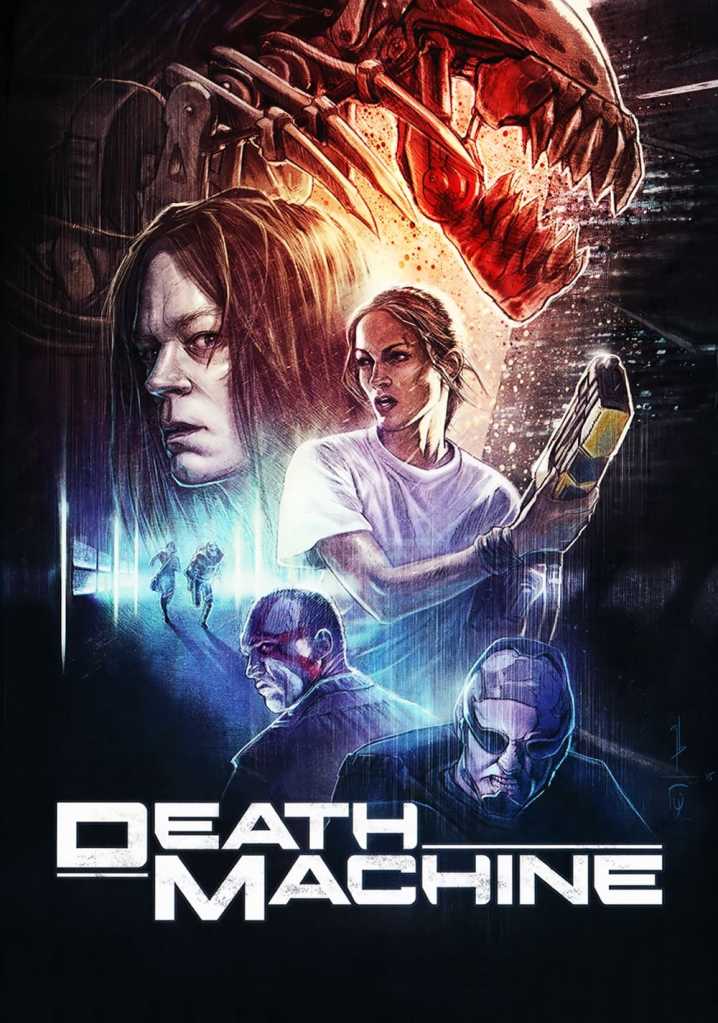
THE DAILY DIG: DEATH MACHINE (1994)
“DEATH MACHINE” HAS ALL THE WORKINGS TO BE A CULT SCI-FI HORROR FILM, RIPE FOR REDISCOVERY AND A PROPER US RELEASE FINALLY.
By Bobby Lisse:
Source: Morbidly Beautiful
A weapons manufacturer tries to cover up its mistakes with a super soldier program while a morally sound executive does her best to uncover their evil plot and the scientist behind it all plots to maim and destroy it all. Let’s dig into 1994’s “Death Machine”, directed by Stephen Norrington!
The directorial debut from Stephen Norrington, and reportedly the effort that landed him the director’s chair for Blade, Death Machine is a good movie with an arsenal of flaws.
Set in the future, which is now past, 2003, we follow the company Chaank that provides military weapons. Their failed Robocop-like super-soldier suit has malfunctioned and caused a slaughter of civilians. Now they’re back to the drawing board, so to speak, though the bottom line is always more important. In steps Scott Ridley who instructs the board they will just be pivoting.
The mad scientist behind the creation, Jack Dante, secretly creates a psycho-death bot named Warbeast. And once the fun starts, this metal death force shreds everyone in its path.
The story has interesting points, such as the evil corporation, the righteous humanist alliance, and the mad genius hellbent on domination. But the acting and script fall off a cliff a little more than halfway through the film. The sets are great, and the animation on the Warbeast is chaotic and amazing, which makes sense because the Director used to cut his teeth in creature effects on films like Aliens and Alien 3.
The homages are off the charts.
Some of the examples I picked up on were sound effects from Doom, Masters of the Universe toys that decorate Dante’s office, a Daffy Duck impression from Brad Dourif, a battle cry from Street Fighter, as well as the Warbeast resembling a Mouser from Teenage Mutant Ninja Turtles. The names of the characters as well are tributary. Some are identical: John Carpenter, Scott Ridley (Ridley Scott), Jack Dante (Joe Dante), Weyland, Yutani (Alien).
There was too much whimsy and cheeky humor inserted for the tone of the film and could have used some fine-tuning. But I feel it was just on the cusp of being a classic sci-fi/horror.
Brad Dourif (Dante): you know him, you love him, he’s everyone’s favorite good guy. He always brings the same quality of maniacal energy and really excels as the bad guy, but no role was as iconic and great as that of our friend Chuck in Child’s Play.
He has since become a Rob Zombie regular (31 and Three from Hell), but Richard Brake (Ridley) showed he has the propensity for villainy in what I felt was an underappreciated role. He really stood out, and it was a shame he was killed off so early as he seemed to have an insurmountable level of maddening bravado.
William Hootkins (John Carpenter) is probably most famous as Porkins (Red Six) in Star Wars. He also played Eckhart in Tim Burton’s Batman.
Rachel Weisz has a brief cameo in this her first feature, and would later go on to star in The Mummy series and marry James Bond.
The inclusion of the heartbreaking and gut-wrenching story of Cale’s daughter getting her arm flayed in a garbage disposal does nothing for the greater good of the story. It affords Pouget an opportunity to display another emotion in her repertoire. At this point, however, the script already jumped the shark.
Ely Pouget (Hayden Cale) is a great leading lady for this genre, and her skills are emphasized in the first half of the film. She’s got Ripley’s bad-ass woman card in my opinion, and she’s beautiful to boot. She seems to have hardly aged since 1994 in most recent photographs as well.
This is one of those odd, hardly heard of, 90’s films that deserved better. I know it’s been given numerous cuts and a so-called definitive cut, but it could really stand to use some sound editing and unbiased clipping. It’s not sacred ground, but I would rather it see a clean pass rather than a clean slate.
No progeny to report.
An uncut Blu-ray was released in Germany (the version I watched). If you don’t feel like paying up for it, you can stream on Amazon Prime, Roku, Vudu, or Plex.
INDIAN COUNTRY NEWS
"It is the duty of every man, as far as his ability extends, to detect and expose delusion and error"..Thomas Paine
Human in Algorithms
From the Roof Top
I See This
blog of the post capitalist transition.. Read or download the novel here + latest relevant posts
अध्ययन-अनुसन्धानको सार
 After the Crash