Bonus Track: Post Mortem (Feat. EL-P, Jean Grae & Akrobatik)

 “if…” (1968) is one of the all-time classic student rebellion films directed by notorious anarchist Lindsay Anderson. In his first screen role, Malcolm McDowell stars as the oppressed non-conformist Mick Travis who with a few cohorts, stage an armed revolution in their school. According to the film’s Wikipedia entry, shortly before Lindsay Anderson’s death in 1994 he had completed the script for a yet unmade official sequel to “if…” (not to be confused with the other films in the Mick Travis trilogy, “O Lucky Man” and Britannia Hospital”) described as follows:
The sequel takes place during a Founders’ Day Celebration where many of the characters reunite. Mick Travis is now an Oscar-nominated movie star, eschewing England for Hollywood. Wallace is a military major who has lost his arm. Johnny is a clergyman. Rowntree is the Minister of War. In the script Rowntree is kidnapped by a group of anti-war students and saved by Mick and his gang, though not before Mick crucifies Rowntree with a large nail through his palm.
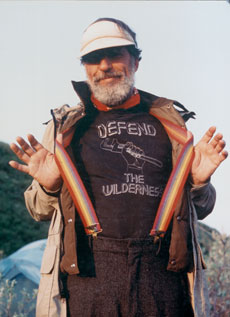
(Editor’s note: in honor of author/activist Edward Abbey, who was born on this day in 1927, you can learn a little more about his life through this overview of the FBI’s file on the courageous iconoclast beginning in his college days followed by a short video essay filmed in Moab.)
By David Gessner
Source: Orion Magazine
THE FILE BEGINS in 1947, when Abbey, just twenty and freshly back from serving in the army in Europe, posts a type-written notice on the bulletin board at the State Teacher’s College in Pennsylvania. The note urges young men to send their draft cards to the president in protest of peacetime conscription, exhorting them to “emancipate themselves.” It is at this point that Abbey becomes “the subject of a communist index card” at the FBI, and from then until the end of his life the Bureau will keep track of where Abbey is residing. They will note when he heads west and when, as acting editor of the University of New Mexico’s literary magazine, The Thunderbird, he decides to print an issue with a cover emblazoned with the words: “Man will not be free until the last king is strangled with the entrails of the last priest!” The quote is from Diderot, but Abbey thinks it funnier to attribute the words to Louisa May Alcott. And so he quickly loses his editorship while the FBI adds a few more pages to his file. Also quoted in full in his files is a letter to the editor of the New Mexico Daily Lobo, in which he writes: “In this day of the cold war, which every day shows signs of becoming warmer, the individual who finds himself opposed to war is apt to feel very much out of step with his fellow citizens.” He then announces the need to form a group to “discuss implications and possibilities of resistance to war.”
The files contain interviews with fellow students and teachers at the University of New Mexico, who talk of Abbey’s “instability and poor judgment,” with one interviewee saying that, as an editor, Abbey showed “a stubborn ego, a taste for shocking the reader, a lack of maturity.” Abbey, according to other colleagues, was “indiscreet in his individualism” and “demonstrated a somewhat radical rebellious quality . . .” Though the interviews are mildly damning, no one questioned the subject’s loyalty to his country.
One wonders how Abbey would have fared these days. Would the FBI, or the NSA, have simply kept tabs on him or actually called him in for questioning? So many of his views, and so much of his personality, match just the sort of profile we have come to associate with our rather broad definition of domestic terrorism. It isn’t just his gun advocacy, or his monkey wrenching. It’s his belief that wilderness is a place where the last free men can retreat when the tyrants take over. He writes:
Democracy has always been a rare and fragile institution. . . . As social conflict tends to become more severe . . . there will inevitably be a tendency on the part of the authoritarian element—always present in our history—to suppress individual freedoms, to utilize the refined techniques of police surveillance (not excluding torture of course) in order to preserve—not wilderness!—but the status quo . . .
It’s a type of sentiment that anticipates our government’s reaction to 9/11. Thoreau said that under a government that unjustly imprisons its own, “the true place for the just man is also a prison.” Prison is exactly where Abbey’s monkey wrenching and FBI record might have landed him in today’s world.
Abbey’s beliefs in freedom and resistance, and his message of aggressive nonconformity, of screw-you freedom, were perfect for the ’60s and ’70s. But it’s hard to imagine that the same message would get a similar reaction today, or to see, at least at first, how his spirit might be adapted to fit our times. For instance, isn’t monkey wrenching dead as a legitimate possibility for the environmental movement? I must admit that in my own grown-up life as a professor and father I don’t blow a lot of things up. For most of us who care about the environment, Wallace Stegner provides a much more sensible model.
But I don’t want to be so quick to toss Abbey on the scrap heap. If the times have changed, Abbey’s ideas about freedom have in some ways never been more relevant. Many of the things that he foresaw have come to pass: we currently live in an age of unprecedented surveillance, where the government regularly reads our letters (now called e-mails) and monitors our movements. Abbey offers resistance to this. Resistance to the worst of our times, the constant encroaching on freedom and wildness. He says to us: Question them, question their authority. Don’t be so quick to give up the things you know are vital no matter what others say.

“Vital” (2004) is a film by Shinya Tsukamoto about a med school student who loses his memory after surviving a car crash which kills his girlfriend. Shortly after resuming studies he realizes a cadaver assigned to him to dissect is the body of his girlfriend. Against the advice of everyone around him, he becomes obsessed with his work in an effort to recover his memories and former sense of self. Like other films by Shinya Tsukamoto, Vital has much psychological conflict, Cronenbergian body horror and surreal imagery, but is more subdued and life-affirming than any other feature film he’s made to date. Vital also features a masterful performance from lead actor Tadanobu Asano.

“Tokyo Fist” (1995) can be seen as director Shinya Tsukamoto’s surreal precursor to “Fight Club”, but it also features an unsettling mood and body horror reminiscent of the films of David Lynch and David Cronenberg respectively. Added to the mix is Tsukamoto’s unique brand of visceral and hyper-kinetic filmmaking, making Tokyo Fist an unforgettable experience for fans of global cult cinema (though it’s not for the squeamish).
(Click the “CC” button at the bottom right corner of video window while playing to activate English subtitles.)
INDIAN COUNTRY NEWS
"It is the duty of every man, as far as his ability extends, to detect and expose delusion and error"..Thomas Paine
Human in Algorithms
From the Roof Top
I See This
blog of the post capitalist transition.. Read or download the novel here + latest relevant posts
अध्ययन-अनुसन्धानको सार
 After the Crash