Two for Tuesday
Reply

By Moe
Source: Cup of Moe
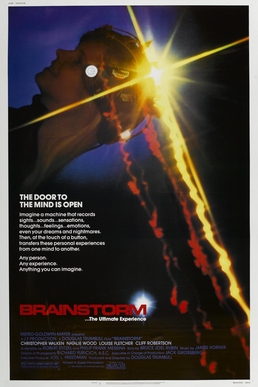
The 1983 sci-fi thriller “Brainstorm” stars Christopher Walken and Natalie Wood. This forward-thinking science fiction romp presents virtual reality (VR) in its early stages and evolution. Although the Douglas Trumbull-directed film isn’t perfect, it’s a neat look at VR with superb acting, a magnificent score, and excellent effects.
A scientific group led by Michael Brace (Walken) and his estranged wife Karen (Natalie Wood), along with Michael’s colleague Lillian (Louise Fletcher) invents the computer and brain interfacing device. Their creation not only allows for virtual reality experiences but allows feelings and sensations to be recorded on tape. In this way, others may experience those as well.

After their initial success, CEO Alex Terson (Cliff Robertson) instructs Brace et al to offer a demo of their device with the intent to secure financial backing. It’s during this exhibition that the group realizes the true power of their device: its ability to record human emotions. Michael uses the device to record memories with emotions, and thereby influence the real world. But whereas Michael employs this as the utility to reconnect with his estranged wife, previous colleague Landan Marks (Donald Hotton) aspires to use it for military applications.
When Lillian suffers a heart attack, she puts on the headset and records her death. Michael later discovers her recorded memories. Eventually, Michael realizes the insidious intent to use his creation for warfare when he uncovers “Project Brainstorm.” As such, Michael and Karen team up to thwart efforts to use their technology to perpetuate the military industrial complex.
“Brainstorm” offers an intriguing and groundbreaking look at VR. There’s an exploration of not only virtual reality experiences but the effects on the user. This manifests in the ability to record emotions as well as memories. I like the way “Brainstorm” touches on humanity’s influence of tech, and the means through which tech shapes humanity. Moreover, “Brainstorm” presents an accurate portrayal of tech advancement. Early in the film, Terson instructs his team to make a smaller version of their helmet. Similarly, a trend in real-world technology is constant innovation in creating smaller devices.
I quite enjoy the helmet design and the effects are top-notch. The 1983 movie has aged pretty well with its fish-eye lens shots and well-crafted animation sequences.Trumbull worked on effects for films such as “2001: A Space Odyssey,” “Silent Running,” and “Blade Runner.” It’s evident that Trumbull understood the genre and he infuses mesmerizing special effects, particularly at the end.
Cinematography is fantastic. The film is set in North Carolina and uses several NC scenes as prominent backdrops. Notably, the Wright Brothers National Memorial plays an important role. Plus, there’s a neat shot of Duke Chapel. Locations even appear futuristic. The Burroughs Wellcome building offers its then high-tech looks as the main office for Michael, Karen, and Lillian. A gorgeous Chapel Hill, NC home with its parallelogram angles and solar panels was used as well.
Acting is phenomenal. Walken lends an inspired performance, and Natalie Wood is captivating in her final cinematic appearance. But it’s Louise Fletcher as Lillian who completely steals the show with a tour de force acting job.
It would be remiss to discuss “Brainstorm” without touching on its superb score. Renowned composer James Horner provides the musical backing which is replete with the timpani Horner became best known for. Horner’s “Brainstorm” soundtrack features elements from his “Wolfen” score. Later, in the 1986 sci-fi hit “Aliens,” Horner continued this trend. But it’s a formula that works.
Unfortunately, “Brainstorm” doesn’t quite end as well as it starts. The finale is admittedly a muddled moment which will leave you wondering “what?” as the credits roll. Michael plays back Lillian’s tape and watches the afterlife playing out, even glimpsing hell for a moment. Departed souls in the form of bioluminescent butterflies flow peacefully into heaven. Though the effects hold up fine, this sequence falls flat in lacking the poetry of similar scenes like the end of “2001: A Space Odyssey.”
Still, it’s tough to hold the abrupt and admittedly cheesy, ending against the movie. Wood’s tragic and mysterious death led production to halt. Eventually, Trumbull rewrote the script and used Wood’s younger sister as a stand-in for her remaining shots.
I especially enjoy how “Brainstorm” probes the relationship between tech and humanity, presenting complex concepts like computer-brain transference. “Brainstorm” may not carry the legacy of sci-fi flicks like “Blade Runner,” “Alien,” and “The Matrix.” However, its stellar cinematography, acting, score, and effects plus forward-thinking portrayal of tech make this 1983 movie a smart, lasting thriller.
Three Days of the Condor
A thriller for thinkers probing covert activities within the CIA.
By Frederic and Mary Ann Brussat
Source: Spirituality & Practice
Joseph Turner — code name Condor — works at the American Literary Historical Society in New York City. The organization is actually a branch office of the CIA. He and his youthful coworkers read, analyze, and computerize various spy stories, mysteries, and periodicals for the CIA’s mammoth intelligence gathering operations.
One rainy day while Turner is out to lunch, the rest of the staff is brutally murdered. Scared out of his wits, he contacts the CIA and is told to go into hiding. When he does arrange a meeting with the CIA, he is fired upon and his best friend, along to help identify the contact, is shot by another agent. Terror grips Turner. He abducts Kathy Hale, a photographer, and in her apartment in Brooklyn tries to unravel the mysteries surrounding the executions.
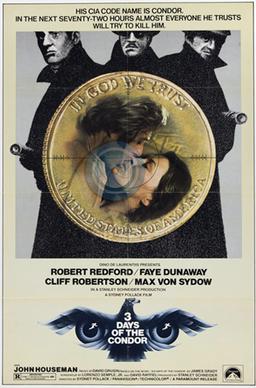
Three Days at the Condor works on two levels: as an examination of the covert activities within the CIA and as a somewhat curious look at the development of a relationship through shared stress. Robert Redford is just right as the paranoid Turner, a bright young man unexplainably put in a harrowing situation. Did the slaughter of the American Literary Historical Society staff stem from his inquiry to CIA headquarters about a mystery novel only translated into Dutch and Arabic? Perhaps someone in higher places was doing unauthorized intelligence work and Turner stumbled onto his scheme. Can Turner now determine who’s out to silence him? Director Sydney Pollack, (The Way We Were, Yakuza) orchestrates the zigzag storyline into a labyrinth of effective scenes, revealing Turner’s fright and his own special brand of grace under pressure.
Faye Dunaway gives a well modulated performance as the woman who is kidnapped by Turner at gunpoint and forced to serve as his host. Her initial fright turns to anger as he brutalizes her. But then, through the bizarre intermix of their wants and needs, the two develop an uneasy relationship. Sex is one part of the bond drawing them together; intelligence the other. She helps him solve the mystery and come to terms with his conscience. He helps her to a new understanding of her loneliness. Faye Dunaway, moving from her standout role in Chinatown to this notable performance, proves that she is one of our better actresses.
Also featured in this gripping suspense story are Cliff Robertson and John Houseman as two Central Intelligence Agency officials and Max Von Sydow as a hit man used by the CIA on various contacts. In the wake of Watergate and the recent probes on the CIA, Three Days of the Condor has a resonance with the general mood of public uneasiness about secrecy in high places. We can empathize with these characters and their paranoia. Although it doesn’t really make any sophisticated political commentary on the activities of the CIA, this movie does work as a thriller for thinkers.
Watch Three Days at the Condor here: https://m.ok.ru/video/9819443366575
Dark Star: H.R. Giger’s World, In Which The Alien Artist Is Examined
By Supreme Being
Source: Stand By for Mind Control
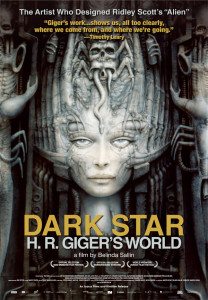
H.R. Giger, who most famously created the monster design for Alien (and less famously, prior to that, artwork for Jodorowsky’s never-made Dune adaptation), is a pleasant old man at the end of his life in the new documentary, Dark Star: H.R. Giger’s World, much of which follows Giger, his wife, and friends puttering around his cluttered home of many years.
Dark Star is a nicely puttering little movie, refreshingly unlike so many modern docs, those that consist largely of talking heads speedily edited together with rapid-fire clips, so as not to bore audiences. Defensive movie-making, this is called. It’s assumed documentaries bore people, so they’re now edited as jauntily as possible, to keep things moving. Dark Star has very few people sitting down for proper interviews. There are a few, scattered throughout, but they’re not there to relate Giger’s history. Instead they talk about him as a man and as an artist, or talk about his art, or about how he and his artwork affected their lives.
No chronological story is told here. A certain amount of old footage is included of Giger as a younger man, but there’s no narration over it. It’s more that Dark Star, a Swiss production directed by Belinda Sallin, gives an impression of Giger’s life and work, and does so in a gently paced, meandering way. Which style I liked quite a bit. By its nature it was slow to grow on me, but the more I watched, the more the picture was filled in, and the more I became absorbed in it.
At one point I began wishing they’d just show more of his artwork up close, instead of showing shaky shots of it hanging on the walls of his house—and almost as if reading my mind, the movie went into a section showing off his artwork. Well played, Dark Star, well played.
Giger’s art is generally described as being “biomechanoid,” or some other made up word like that. One thing’s for sure: it’s unique. Nobody paints like Giger. Once you’ve seen anything he’s done, and you have, because you love Alien and like me have watched it 500 times, his work, any of it, is instantly recognizeable. It’s all women and bones and machines and warped little children, birth and sex and death, all in the same painting, all happening at the same time.
Well. I’m not going to try to describe his art. Look for yourself. Whatever, exactly, it is, it sticks its fingers deep inside the human psyche and wriggles them around.
A small part of the movie focuses on Alien, with some nice footage of Giger constructing the space-jockey set, and an old interview where he explains that his original alien egg opening—a slit—looked too much like a vagina. “This movie is going to play in Catholic countries,” he was told, so he had to make it less sexual. His solution? Two crossing slits, i.e., two vaginas in the shape of a cross. Take that, Catholics!
There’s no mention of Giger’s earlier, unused work for Jodorowsky’s unrealized Dune project, but again, this isn’t a comprehensive look at Giger. It’s a meandering one. Eventually it meanders to a little Swiss town where Giger grew up. His mother, it turns out, was a huge supporter of his art, though initially Giger worried—as one might expect—about what reaction his parents would have to the things he painted.
Giger spent most the money his art brought in on still other creations. Like the kid-sized, haunted house-like train set in his backyard, which we get to ride around on. Also toward the end of his life, he participated in the creation of a Giger museum in Switzerland to house a large portion of his work, much of which he’d slowly bought back from collectors over the years. For the museum’s opening, Giger signs books and posters and body parts. One of his male fans pulls off his shirt and turns around to reveal his entire back tattooed with one of Giger’s images. “Very nice work,” mutters Giger. One tough-looking, tattooed young man has his art signed, shakes Giger’s hand, and walks away crying. Giger’s work had a profound effect on many people.
Giger died in 2014, shortly after the completion of Dark Star. He does look a bit like he’s near his end while being interviewed. He doesn’t have a lot to say. What comes across clearly is a man who’s satisfied with his work, who got to do exactly what he wanted, who didn’t feel he’d failed to accomplish anything he set out to accomplish.
Watch Dark Star: H. R. Giger’s World on tubi here: https://tubitv.com/movies/704843/dark-star-h-r-giger-s-world
By Berthold Gambrel
Source: RuinedChapel.com
Picture this: a movie that takes place mainly during the day, on a picturesque Scottish island. There is very little action in the movie; it’s mainly a police procedural, with a stony-faced, prim and proper policeman questioning the local population. The film contains almost no violence, except for a very brief scene towards the end. Indeed, what earns it its “R” rating is nudity; a few scenes of naked women dancing. Other than that, it could air on broadcast television with no cuts.
Moreover, did I mention this film has a number of songs? It’s not exactly a musical, but there is fast-paced nursery rhyme-like patter, a few ribald drinking songs, and a ballad performed by one of the aforesaid nude dancers.
There’s almost no blood, no sinister torture chambers, no howling dogs on desolate foggy moors; instead there is only a quaint little village in a quiet part of the world. I ask you, with such a setup, can a film really be scary?
Comes the answer: this is possibly the scariest movie I have ever seen.
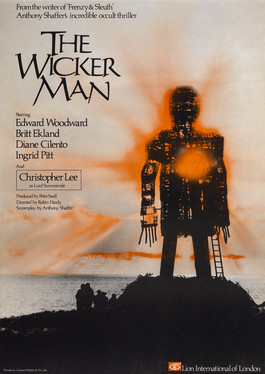
It follows Sgt. Neil Howie, a devout Christian police detective, who is dispatched by seaplane to the remote Summerisle to look for a missing girl. The townspeople are not unfriendly, but not exactly helpful either, referring Howie to Lord Summerisle, the nobleman whose family has administered the island’s affairs for generations.
During Howie’s investigation, he sees odd things. Strange rituals out of centuries past, like maypoles and disturbingly explicit fertility rites, quite at odds with his conservative Christian beliefs. When at last he meets Lord Summerisle, he confronts him about the unsettling things he has witnessed, and Summerisle acknowledges that, as part of a program to revive the island’s agricultural output, his grandfather gave the people back their ancient, pre-Christian folkways, to entice them to believe in the Old Gods of the Harvest.
Howie is appalled and horrified, and in view of everyone’s refusal to aid him in finding the missing girl, begins to suspect that she has been sacrificed to their Old Gods in some sort of bizarre druidical ceremony.
I really liked Howie, who is played perfectly by Edward Woodward. His refusal to compromise his beliefs, and unwavering resolve to find the missing child no matter what stands in his way, make him easy to root for. And also perhaps easy to… but no, that would be saying too much. This is not exactly an unknown film, but it would be wrong to spoil it.
The late, great Sir Christopher Lee is also fantastic as Summerisle. Offhand, I’d say it’s his best role. In fact, he said it was his best role. Of course, playing a charming but sinister aristocrat was pretty much Lee’s standard, but the devil is in the details, and it’s how he plays it that makes this interesting. He seems relaxed, almost easygoing, compared to the straight-laced Howie. But, let’s just say he has another side to him…
Okay, but what makes this movie so scary? I did say it might be the scariest film I’ve ever seen, after all. I can’t spoil it, but if I’m going to make such a bold claim, I have to try and justify it somehow.
Those of you who made it all the way through the sprawling post I wrote about the Metal Gear Solid 2 book a while back may remember that I made reference to a non-fiction book called The Meme Machine, by Susan Blackmore. Blackmore is a student of Richard Dawkins, the well-known evolutionary biologist. Dawkins coined the word “meme” as an analog for “gene” in the realm of culture. A “meme” is a unit of information; a word, a phrase, a song, a mannerism, a belief, that is transmitted through human culture, by a process not unlike evolution.
Dawkins derived his neologism “meme” from the Greek word mīmēma, which means “imitation.” And just as Dawkins described genes as “selfish,” memes likewise seek only to replicate themselves, so much so that we can analogize memes as if they were beings with conscious desires.
It’s all quite interesting, and Blackmore takes Dawkins’ idea and runs with it, arguing that the human brain evolved as a kind of super-powerful meme replicator, and our capacity for imitation of memes allowed us to evolve into the dominant life-form on the planet.
As she explains:
Memes spread themselves around indiscriminately without regard to whether they are useful, neutral or positively harmful to us… they are selfish like genes, and will simply spread if they can.
Elsewhere, Blackmore proposes the following thought experiment:
Imagine a world full of hosts for memes (e.g. brains) and far more memes than can possibly find homes.
Of course, as Blackmore takes pains to point out, it’s not as if these memes are literally flying around the world, taking over human brains and using them to replicate themselves. It’s just that, ah, they might as well be. It’s not literally true, but it’s a good model for approximating the behavior we see in the world. (Anyone who has studied Economics will be familiar with this sort of thing.)
However… there is something curious about all this. Because there is another Greek word Dawkins might have used instead, that describes much the same phenomenon. The Ancient Greeks tended to model human thought as the work of external entities—e.g. inspiration being given from Apollo, lust from Eros, and so on.
The Ancient Greek word I’m thinking of is daimōn, from which we get the modern word “demon.” “Meme” and “demon” even sound somehow similar, with the same phoneme as the central component. Now consider Blackmore’s hypothetical rewritten:
Imagine a world full of hosts for demons (e.g. brains) and far more demons than can possibly find homes.
In an instant, we have transformed the work of modern scientists (one of whom is famously an atheist) into something that sounds like what the wrinkled old woman living in a strange cabin in the woods tells the horror movie protagonist.
And this is what I find curious: the superstitious ancients described the world as inhabited by invisible spirits that took hold of people’s minds. The modern memeticists describe the world as inhabited by invisible memes that take hold of people’s minds.
If I tell you that I got an idea for a story when “out of the blue, it just popped in my head,” you would nod understandingly. If I said I got the idea when “the God of Fiction whispered it in my ear,” you’d think I was a bit of an oddball, at best. Yet, for practical purposes, the two are the same.
So if you say someone is possessed by a demon, it seems strange, but being possessed by an idea is totally normal.
Coming back around to The Wicker Man, this is what makes the film so scary. At the end, we see people who are possessed by something. We could argue all day about whether it is some true supernatural force or merely certain memes which they have learned to imitate; memes handed down from an ancient tradition dating back millennia. The film, like all great horror, leaves much to the audience’s imagination.
Practically speaking, it doesn’t much matter, does it? The fact is, there is something—call it a demon, a meme, an idea, a fashion, a spirit, whatever name suits you—that can take hold of human minds and compel them to do things that seem unthinkable to those immune to the phenomenon.
And that’s the ultimate horror of The Wicker Man. Here, in this bucolic setting, we gradually uncover the darkest impulses that lie in the hearts of human communities; primitive urges predating everything we call civilization. A base need for rituals that give meaning and provide a sense of power, of grandeur, even, to those craving it.
Unnerving, unsettling, disturbing and uniquely memorable, The Wicker Man is one of the greatest horror films ever made.
Watch The Wicker Man on tubi here: https://tubitv.com/movies/100010483/the-wicker-man
INDIAN COUNTRY NEWS
"It is the duty of every man, as far as his ability extends, to detect and expose delusion and error"..Thomas Paine
Human in Algorithms
From the Roof Top
I See This
blog of the post capitalist transition.. Read or download the novel here + latest relevant posts
अध्ययन-अनुसन्धानको सार
 After the Crash