Get Big or Get Out: Complex Systems and Reciprocal Ecocide

Europe-must-change-policy-on-GM-crops-warn-experts

By Gary Gripp

Source: The Hampton Institute

For awhile now I have been saying that the complex systems which supposedly serve us actually serve themselves: they call the tune and we dance as directed. But I haven’t offered a whole lot of examples of what I mean. Now I would like to remedy that by offering some examples of how systems may interlock with each other and lock us into their individual and collective agendas. I will jump in – not at the beginning, but in medias res – the world I was born into, in the middle of World War Two.

At this time, the bomb factories were manufacturing great guns here in America thanks to a discovery made in Germany in the early part of the twentieth century by Fritz Haber. The Haber process, for which Haber received the Nobel Prize, is a way of turning atmospheric nitrogen into ammonia, which can in turn be used as a basis for making military weapons like bombs. Munitions factories built amazing industrial capacity during the war years, but then, finally, the war came to an end. With such industrial infrastructure already in place, but with the cash flow drying up, there was incentive within these corporate-owned businesses to keep all their interconnected systems of extraction, production, and distribution chugging along, which, thanks to the Green Revolution, they were able to do by cranking out artificial fertilizer, pesticides, and other agro-chemicals.

During these same war years scientist Norman Borlaug was developing hybrid strains of wheat and other grains that required intensive irrigation and just the kinds of artificial fertilizers that these erstwhile bomb factories were now turning out. And thus began a revolution in land use, a population explosion, and a movement of people off the land and into cities. The institution of the small family farm, where parents and children worked together to make a living off the land, would come to be seen as an archaic way of life, and American Secretary of Agriculture, Ezra Taft Benson, would intone the new mantra of “Get big or get out” of agriculture. A later Secretary of Agriculture, Earl Butz, would enjoin those still on the farm to “plant fencerow to fencerow,” getting rid even of kitchen gardens and the trees that acted as wind breaks and thermal insulation in order to maximize “efficiency” in this industrial model of the economies of scale. In this atmosphere of postwar boom-times, America’s once small-scale farming became large-scale agribusiness where giant machines, artificial fertilizer, hybridized seed, and imported irrigation water became the order of the day. This trend continues, as less than two percent of Americans now make their living farming, while genetic engineering is touted as a technological breakthrough that will “feed the world.”

Many, many systems are involved in this revolution that has changed the face of America in our lifetimes. Two cultural institutions that preceded this land-use and societal revolution are the corporation and the banks, and both these have served as important drivers to the way things played out on the ground and in people’s lives. What keeps the banks in business is the culturally established convention of interest on debt. Money is borrowed to accomplish some desired project with the understanding (in the form of a contract) that all the money would be paid back plus a large bonus to the lenders: interest paid on debt is a huge factor in our economic system and a driver of continual growth. The system imperative of interest on debt is in fact a pyramid scheme that requires new players to enter the game in order to keep this system going. Likewise, the corporation, with its imperative to earn profits for shareholders above any societal or other value, requires management decisions that maximize profits while minimizing costs and risks to that single class of people. And this imperative is also a driver of growth. The “get big or get out” injunction applies not only to farmers; it applies at nearly all levels of business.

Between them, Fritz Haber and Norman Borlaug are credited with allowing the human population to grow to twice the size that it could have without the intervention of the systems their innovations set in motion. A burgeoning population in turn drives all the systems to do more and more: more extraction, more production, more distribution, more consumption, along with more waste products coming out of each one of these systems of the global industrial economy. Add to this the revolution of rising expectations, where everybody wants to live in the lavish way we do, and you have a recipe for using up every last asset of a living planet, until it is stripped down to a lifeless cinder. This is the direction we are headed in, and we are not slowing this juggernaut down; in fact, it is accelerating, as we add more people, more systems, and more drivers to push us at breakneck speed, toward what?

But let’s go back and consider some other implications of bomb factories becoming a driver of industrial-style agriculture. We have built one hell of a lot of dams in the last half of the twentieth century in order to supply irrigation water to chemically-enhanced crops on machine-carved, corporately-owned land. Redistributing the natural flow of rivers has been less than a boon to fish populations, including migratory fish like steelhead and salmon. Runoff of nitrogen-rich chemical fertilizers has created dead zones in the Gulf of Mexico, and everywhere this form of agriculture (temporarily) flourishes. All the little scraps of land that were once saved for wildlife by the small farmer have been effectively removed in the name of efficiency. The relationship that the small farmer once had to the land is all but gone now, replaced by a relationship to massive machines, and to the banks. All those small farmers who have lost their land to the economics of giant-sized agribusiness have surrendered a life they loved for something far less satisfactory, and how much less satisfactory is attested to by many a farmer suicide-sometimes by drinking the poisonous chemicals used to saturate the land. And the land itself is now all but dead, its living topsoil blown and washed away, and what is left depleted of its living, soil-building organisms. When the organisms that build soil health are drenched with poisons and leached away, the plants that grow in this diminished medium are robbed of much of their nutritional value, including many of the vitamins, minerals, and phytonutrients that are so important to human health. Deprived of full nutrition, the health of the people suffers-as we now see all around us.

This is just a sketch of some the interconnected systems that impinge on our lives. I personally don’t see much opportunity here for human interventions that are going to make meaningful change, and the reasons for this are several. The systems we find ourselves entangled in all seem to share in the same imperative for growth, and this growth manifests in several ways. One way it manifests can be seen is in the growth of medium-sized corporations in global mega-corporations, through mergers, buyouts, and hostile takeovers, resulting in an ever greater concentration of power in the hands of a few. This is a trend that became evident in post-war America, and has only intensified in the years since-despite lip service to anti-trust laws designed to prevent monopolistic distortions of a market that calls itself ‘free.’ The explosion of the human population, from 1.6 billion at the twentieth century’s start to 6.1 billion at its end, is another obvious example of the growth imperative gone off the rails. What may not be so obvious is how feedback loops between our population growth and the complex systems in which we were – and are – entangled, have swapped roles as driver in the growth of the other; were, and are, mutually reinforcing causes, while also being mutually reinforcing effects, of synergistic runaway growth. I personally don’t see that we humans have the clear option of disconnecting ourselves from these systems that both serve us and cause us to serve them. Something from outside this entangled relationship could break these very sticky bonds-something big, like Mother Nature, for instance. Short of such an intervention, I don’t expect to see our trajectory changing direction anytime soon.

Saturday Matinee: The Salton Sea

index

John Waters Narrates Offbeat Documentary on an Environmental Catastrophe, the Salton Sea

By Dan Colman

Source: Open Culture

In 2004, John Waters narrated Plagues & Pleasures on the Salton Sea, a humorous documentary on the accidental lake created in the desert of Southern California. You can now find the film hosted on the YouTube channel of KQED, the public television outfit in San Francisco (where we’re getting heavy, heavy rains today). They lay the foundation for watching the film as follows:

Once known as the “California Riviera,” the Salton Sea is now considered one of America’s worst ecological disasters: a fetid, stagnant, salty lake, coughing up dead fish and birds by the thousands. Narrated by cult-movie legend John Waters, Plagues & Pleasures is an epic western tale of real estate ventures and failed boomtowns.

Find Plagues & Pleasures on the Salton Sea listed in our collection, 200 Free Documentaries Online.

Dan Colman is the founder/editor of Open Culture. Follow us on Facebook, Twitter and Google Plus and share intelligent media with your friends. Or better yet, sign up for our daily email and get a daily dose of Open Culture in your inbox.


Does Work Undermine our Freedom?

1365203033_2628_auschwitz

By John Danaher

Source: Philosophical Disquisitions

Work is a dominant feature of contemporary life. Most of us spend most of our time working. Or if not actually working then preparing for, recovering from, and commuting to work. Work is the focal point, something around which all else is organised. We either work to live, or live to work. I am fortunate in that I generally enjoy my work. I get paid to read, write and teach for a living. I can’t imagine doing anything else. But others are less fortunate. For them, work is drudgery, a necessary means to a more desirable end. They would prefer not to work, or to spend much less time doing so. But they don’t have that option. Society, law and economic necessity all conspire to make work a near-essential requirement. Would it be better if this were not the case?

In recent months, I have explored a number of affirmative answers to this question. Back in July 2014, I looked at Joe Levine’s argument for the right not to work. This argument rested on a particular reading of the requirements of Rawlsian egalitarianism. In brief, Levine felt that Rawlsian neutrality with respect to an individual’s conception of the good life required some recognition of a right to opt out of paid labour. Then, in October 2014, I offered my own general overview of the anti-work literature, dividing the arguments up into two categories: intrinsic badness arguments (which claimed that there was something intrinsically bad about work) and opportunity cost arguments (which claimed that even if work was okay, non-work was better).

In this post, I want to explore one more anti-work argument. This one comes from an article by Julia Maskivker entitled “Employment as a Limitation on Self-Ownership”. Although this argument retreads some of the territory covered in previous posts, I think it also offers some novel insights, and I want to go over them. I do so in several parts. First, I offer a brief overview of Maskivker’s central anti-work argument. As we’ll see, this argument has two contentious premises, each based on three claims about freedom and justice. I then spend the next three sections looking at Maskivker’s defence of those three claims. I will then focus on some criticisms of her argument, before concluding with a general review.

1. Maskivker’s Anti-Work Argument
I’ll actually start with a mild criticism. Although I see much of value in Maskivker’s article, and although I learned a lot from it, I can’t honestly say that I enjoyed reading it. Large parts of it felt disorganised, needlessly convoluted, and occasionally repetitious. Although she introduced a central normative claim early on — viz. a claim about the need for effective control self-ownership — later parts of her argument seemed to stray from the strict requirements of that concept. This left me somewhat confused as to what her central argument really was. So what follows is very much my own interpretation of things and should be read with that caveat in mind.

Anyway, let’s start by clarifying what it is we are arguing against. In the past, I have lamented the fact that definitions of work are highly problematic. They are often value-laden, and prone to the sins of under and over-inclusiveness. I’m not sure that there can ever be a perfect definition of work, one that precisely captures all the phenomena of interest to those making the anti-work critique. Nevertheless, we need something more concrete, and Maskivker duly provides. She defines work as paid labour. That is, labour that is undertaken for the purposes of remuneration. This definition is simple and covers what is central to her own argument. My only complaint is that it may need to be expanded to cover forms of labour that are not directly remunerated but are undertaken in the hope of eventually being remunerated (e.g. work of entrepreneurs in the early stages of a business, or the work of unpaid interns). But this is just a quibble.

With that definition in place, we can proceed to Maskivker’s anti-work argument itself. That argument is all about the freedom-undermining effect of work. Although this argument is initially framed in terms of a particular conception of freedom as effective control self-ownership (something I previously covered when looking at the work of Karl Widerquist), I believe it ends up appealing to a much broader and more ecumenical understanding of freedom. As follows:

  • (1) If a phenomenon undermines our freedom, then it is fundamentally unjust and we should seek to minimise or constrain it.
  • (2) A phenomenon undermines our freedom if: (a) it limits our ability to choose how to make use of our time; (b) it limits our ability to be the authors of our own lives; and/or (c) it involves exploitative/coercive offers.
  • (3) Work, in modern society, (a) limits our ability to choose how to make use of our time; (b) limits our ability to be the authors of our own lives; and c) involves an exploitative/coercive offer.
  • (4) Therefore, work undermines our freedom.
  • (5) Therefore, work is fundamentally unjust and should be minimised or constrained.

You could alter this, as Maskivker seems to wish to do, by turning it into an argument for a right not to work. Though I will discuss this general idea later on, I’m avoiding that construal of the argument for the simple reason that it requires additional explanation. Specifically, it requires some explanation of what it would mean to have a right not to work, and some answer to the question as to why it is felt that we do not currently have a right not to work (after all, we can choose not to work, can’t we?). I think time would be better spent focusing specifically on the freedom-undermining effect of work and its injustice, rather than on the precise social remedy to this problem.

What about the rest of the argument. Well, premise (1) is a foundational normative assumption, resting on the value of freedom in a liberal society. We won’t question it here. Premise (2) is crucial because it provides more detail on the nature of freedom. Although Maskivker may argue that the three freedom-undermining conditions mentioned in that premise are all part of the what she means by effective control self-ownership, I think it better not to take that view. Why? Because I think some of the conditions appeal to other concepts of freedom that are popular among other political theorists, and it would be better not to limit the argument to any particular conception. Moving on, premise (3) is the specific claim about the freedom-undermining effect of work. Obviously, this too is crucial to Maskivker’s overall case. The two conclusions then follow.

Let’s go through the two central premises in more detail. Let’s do so in an alternating structure. That is to say, by looking at the defence of condition (a) in premise (2) and premise (3); then at the defence of condition (b) in premise (2) and premise (3); and finally at the defence of condition (c) in premise (2) and premise (3).

2. Freedom, Time and the 24/7 Workplace
Condition (a) is all about the need for an ability to choose how to use our time. Maskivker defends this requirement by starting out with a Lockean conception of freedom, one that is often beloved by libertarians. The Lockean conception holds that individuals are free in the sense that they have self-ownership. That is to say: they have ownership rights over their own bodies, and the fruits of their labour. This fundamental right of self-ownership in turn implies a bundle of other rights (e.g. the right to transfer the fruits of one’s labour to another). Any system of political authority must respect this fundamental right and its necessary implications.

The problem for Maskivker is that many fans of self-ownership limit themselves to a formal, rather than an effective, conception of that right. In other words, they simply hold, in the abstract, that individuals have this right of self-ownership and that they should not be interfered with when exercising it. They don’t think seriously about what it would take to ensure that everybody was really able to effectively enjoy this right. If they did this, they would realise that there are a number of social and evolutionary imbalances and injustices in the ability of individuals to exercise self-ownership. They would realise that, in order to effectively enjoy the right, individuals will also need access to resources.

Now, to be fair, some writers do recognise this. And they highlight the need for things like adequate education and healthcare in order for the right to self-ownership to be effective. Maskivker agrees with their approach. The originality of her contribution comes in its insistence on the importance of time as an essential resource for self-ownership. Time is, in many ways, the ultimate resource. Time is necessary for everything we do. Everything takes time. Other skills and abilities that we may have, only really have value when we have the time to exercise them. Furthermore, time is a peculiarly non-manipulable resource. There is a limited amount of time in which we get to act out our lives. This makes it all the more important for people to have access to time.

You can probably see where this is going. The problem with work is that it robs us of time. We need jobs in order to live, and they take up most of our time. Some people argue that the modern realities of work are particularly insidious in this regard. Jonathan Crary, in his slightly dystopian and alarmist work, 24/7: Late Capitalism and the Ends of Sleep, notes how work has colonised our every waking hour and how it threatens to colonise our sleep too. We are encouraged to make our time more productive, but also to be available to our workplaces at more times of the day, through email or social media. Indeed, the slow death of the regular 9-to-5 workday has, if anything, encouraged work to monopolise more of time. We have flexible working hours and our work may be more outcome-driven, but the marketplaces are open 24/7 and they demand more outcomes from us. The result is an infiltration of work into every hour of the day.

Some people may not resent this. They may feel that they are living the kind of life they wish to live, that their work is enjoyable, and that it gives them a sense of purpose. But others will feel differently. They will feel that work takes away valuable opportunities to truly express themselves as they wish.

In sum, access to time and the time-limiting nature of work, is one thing to think about when designing a scheme of distributive justice. An ability to opt out of work, or to have much less of it one’s lives may be necessary if we are to have a just society.

3. Freedom and Authorship of One’s Life
There is a related argument to made here about the ability to choose one’s time. It can be connected to Maskivker’s account of effective self-ownership, but it can also be separated from it. That’s what condition (b) is about. It appeals to a distinctive notion of freedom as being the ability to exercise true authorship over one’s life. This is a slightly more metaphysical ideal of freedom, one that joins up with the debate about free will and responsibility.

To understand the idea, we need to think more about the individual who truly enjoys their work. As I suggested at the end of the previous section, you could argue that there is nothing unjust about the current realities of work for such an individual. Granting them more free time, won’t really help them to exercise more effective self-ownership. They are getting what they want from life. Take me for example. I have already said that I enjoy my work, and I have been able to (I think) select a career that best suits my talents and abilities. I’m pretty sure I’m employing the scarce resource of time in a way that allows me to maximise my potential. I’m pretty sure there is nothing fundamentally unjust or freedom-undermining about my predicament.

Nevertheless, Maskivker wants to argue that there is something fundamentally unjust about my predicament. My freedom is not being respected in the way that it should. Despite all my claims about how much I enjoy my work, the reality is that I have to work. I have no real say in the matter. She uses an analogy between starving and fasting to make her point. When a person is starving or fasting, the physical results are often the same: their bodies are being deprived of essential nutrients. But there is something morally distinct about the two cases. The person who fasts has control over what is happening to their body. The person who is starving does not. The person who chooses to fast has authorship over their lives; the person who is starving is having their story written by someone else.

When it comes to our work, there is a sense in which we are all starving not fasting. We may enjoy it, embrace it and endorse it, but at the end of the day we have to do it. That’s true even in societies with generous welfare provisions, as most of those welfare provisions are conditional upon us either looking for work (and proving that we are doing so), or being in some state of unavoidable disability or deprivation. We are not provided us with an “easy out”, or with the freedom we need to become the true authors of our lives. (Maskivker notes that the introduction of a universal basic income could be a game-changer in this regard).

As I said, in appealing to this notion of self-authorship, Maskivker is touching upon a more metaphysical ideal of freedom. Within the debate about free will, there are those that argue that the ability to do otherwise is essential for having free will. But there are also those (e.g. Harry Frankfurt and John Fischer) who argue that it is not. They sometimes say that being free and responsible simply requires the reflexive self-endorsement of one’s actions and attitudes. The ability to do otherwise is irrelevant. So what Maskivker is arguing is somewhat contentious, at least when considered in light of these other theories of freedom. She claims that her theory better captures the normative ideal of freedom. But there is much more to be said about this issue.

4. Freedom and the Absence of Coercive Offers
The final condition of freedom — condition c) — is probably the most straightforward. It has its origins in the classic liberal accounts of freedom as non-interference by coercion. It is introduced by Maskivker in an attempt to address a possible weakness in the argument thus far. Someone could argue that the mere absence of acceptable alternatives to work is not enough to imply that it undermines our freedom, or that it creates a fundamental injustice.

An analogy might help to make the point. Suppose you are crossing the desert. You have run out of water and are unlikely to make it out alive. As you are literally on your last legs, you come across a man who is selling water from a small stand. He is, however, selling it at an obscene price. It will cost you everything you have to get one litre of water (which will be just enough to make it out). Because of your desperate situation, you hand over everything you have. Was your choice to hand over everything free? Was it just for the man to sell the water at that price? Many would argue “no” because you had no acceptable alternative.

But now consider a variation on this scenario. Suppose that this time the man is selling water at a very low price, well below the typical market rate. It will cost you less than one dollar to get a litre of water. You gratefully hand over the money. Was your choice free this time? Remember, you are still in a desperate state. All that has changed is the price. Nevertheless, there is something less disturbing about this example. Your choice seems more “free”, and the whole scenario seems more just.

The problem with the first case is that the man is exploiting your unfortunate situation. He knows you have no other choice and he wants to take you for everything that you’ve got. The second scenario lacks this feature. In that case, he doesn’t undermine your freedom, or violate some fundamental principle of justice, because he doesn’t exploit your misfortune.

How does this apply to Maskivker’s anti-work argument? Very simply. She claims that work, in the modern world, involves an exploitative bargain. There is no particular agent behind this exploitation. Rather, it is the broader society, with its embrace of the work ethic and its commitment to the necessity of work, that renders the decision to work exploitative:

Demanding fulltime work in exchange for a decent livelihood is comparable to demanding an exorbitant price for a bottle of water in the absence of competition. It leaves the individual vulnerable to the powerful party (society) in the face of the great loss to be suffered if the “offer” as stipulated is not taken (if one opts not to work while not independently wealthy)

(Maskivker 2010)

5. But isn’t the abolition of work impossible?
Thus ends the defence of Maskivker’s central argument. As you can see, her claim is that the modern realities of work are such that they undermine our freedom and create a fundamental injustice in our society. This is because (conjunctively or disjunctively) work monopolises our time and limits our effective self-ownership; the absence of a viable alternative to work prevents us from being the true authors of our live; and/or society is presenting us with an exploitative bargain “you better be working or looking for work or else…”. You may be persuaded on each of these points. You may agree that a full (positive?) right not to work would be nice. But you may think that it is naive and unrealistic. You may think that it is impossible to really avoid a life of work. Maskivker closes by considering two versions of this “impossibility” objection.

The first, which we might call the “strict impossibility” objection, works something like this:

  • (6) We all have basic needs (food, clothing, shelter etc); without these things we would die.
  • (7) We have to work in order to secure these basic needs.
  • (8) Therefore, we have to work.

Maskivker has a very simply reply to this version of the objection. She holds that premise (7) is false. Not all activities that are conducive to our survival are inevitable. At one point in time, we had to take the furs and hides of animals in order to stay warm enough to survive. We no longer have to do this. The connection between survival and procuring the furs and hides of animals has been severed. The same could happen to the connection between work and our basic needs. Indeed, it is arguable that we no longer need to work all that much to secure our basic needs. There are many labour saving devices in manufacturing and agriculture (and there are soon to be more) that obviate the need for work. And yet the social demand for work has, for some reason, not diminished. Surely this doesn’t have to be the case? Surely we could allow more machines to secure our basic needs?

The second impossibility objection, which we might call the “collective action” objection, is probably more serious. It holds that while a right not to work might be all well and good, the reality is that if everyone exercised that right, society would not be able to support its implementation. After all, somebody has to pay for the system. Maskivker’s responses to this objection are, in my opinion, somewhat problematic.

She makes one basic point. She says that the existence of a right is not contingent upon whether it may be impossible to recognise it in certain social contexts, or whether universal exercise of that right would lead to negative outcomes. She uses two analogies to support this point. First, she asks us to suppose that there is a universal right to healthcare. She then asks us to imagine that we live in a society in which there is some terrible natural disaster, which places huge strains on the healthcare system. The strains are such that the available resources will not be sufficient to save everyone. Maskivker argues that the universal right to healthcare still exists in this society. The limitations imposed by the natural disaster do not take away people’s rights. Second, she asks us to consider the right not to have children. She then points out that if everyone exercised the right not to have children, it would lead to a bad outcome: humanity would go extinct. Nevertheless, she argues, that this does not mean that the right not to have children does not exist.

In some ways, I accept Maskivker’s point. I agree that a right may exist in the abstract even if its implementation creates problems. But I don’t think that really addresses the collective action objection, and I don’t think her analogies work that well. With regards to the right to healthcare in the disasterzone, I’m inclined to think that the limitations of the available resources would compromise or limit the right to healthcare. And with regards to the right not to have children, I think there is something fundamentally different about the problems that arise when we collectively head towards our own extinction and the problems that might arise if everyone stopped working. In the former case, no individuals would be harmed by the collective exercise of the right: the future generations who would have existed, do not exist and cannot be harmed. But in the latter case, there are individuals who might be harmed. For example, if doctors and nurses stopped working, their patients would be harmed. So I’m not sure that Maskivker has really grappled with the collective action objection. I think she tries to sidestep it, but in a manner that will be unpersuasive to its proponents.

6. Conclusion
That brings me to the end of this post. To briefly sum up, Maskivker presents an anti-work argument that focuses on the ways in which work undermines our freedom. She argues that this happens in three ways. First, work robs us of time, which is an essential resource if we are to have effective self-ownership. Second, work prevents us from being the true authors of our lives because there is no acceptable alternative to work (even in societies with social welfare). And third, because work involves an exploitative bargain: we must work, or else.

I think there is much of value in Maskivker’s article. I like how she focuses on time as a resource, one which should be included in any scheme of distributive justice. I also like how she integrates the anti-work critique with certain aspects of the mainstream literature on freedom, self-control and justice. Nevertheless, I fear she dodges the collective action objection to the anti-work position. This is where I think that technology, and in particular a deeper awareness of the drive toward automation and technological unemployment could be a useful addition to the anti-work critique. But that’s an argument for another day.

Monsanto Shill Patrick Moore Fails “Glyphosate Challenge”

safe_image.php

France is not without it’s share of free speech issues, but much credit should be given to the Canal+ network and a recent documentary they aired, “Bientôt dans vos assiettes” (Soon on your plate), produced by investigative journalist Paul Moreira. During an interview for the show, corporate green-washer Patrick Moore claims that glyphosate, the key ingredient in Monsanto’s Roundup herbicide, is safe enough to drink (an oft-repeated claim for Monsanto chemicals). Moreira’s response is brilliant: offering Moore an opportunity to drink glyphosate in front of the cameras. This is a transcript of the PR nightmare moment:

Moore: Do not believe that glyphosate in Argentina is causing increases in cancer. You can drink a whole quart of it and it won’t hurt you.

Moreira: You want to drink some? We have some here.

Moore: I’d be happy to actually… Not, not really, but…

Moreira: Not really?

Moore: I know it wouldn’t hurt me.

Moreira: If you say so, I have some glyphosate.

Moore: No, I’m not stupid.

Moreira: OK. So you… So it’s dangerous, right?

Moore: No. People try to commit suicide with it and fail, fairly regularly.

Moreira: Tell the truth. It’s dangerous.

Moore: It’s not dangerous to humans. No, it’s not.

Moreira: So you are ready to drink one glass of glyphosate?

Moore: No, I’m not an idiot.

Moore then abruptly ends the interview losing what little dignity he had left by calling the interviewer “a complete jerk.” This is the man Monsanto and the Biotech industry would have us believe is a suitable science Ambassador for EXPO 2015 whose theme will be “Feeding the planet, energy for life”. Moore has also been vocal on social media in response to the decision of the World Health Organization’s panel of scientists to list glyphosate as a probable carcinogen.

Enjoy the schadenfreude with James Corbett through the following Corbett Report video:

It could only be better had Moore actually drank it.


Gates Foundation’s Seed Agenda in Africa ‘Another Form of Colonialism,’ Warns Protesters

Screen-Shot-2015-03-24-at-8.27.09-AM

‘This neoliberal agenda of deregulation and privatization poses a serious threat to food sovereignty and the ability of food producers and consumers to define their own food systems and policies,’ says campaigners

By Lauren McCauley

Source: CommonDreams.org

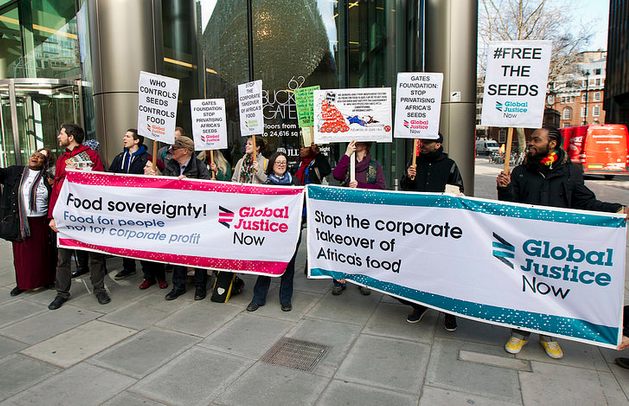
Food sovereignty activists are shining a light on a closed-door meeting between the Bill and Melinda Gates Foundation (BMGF) and the United States Agency for International Development (USAID), which are meeting in London on Monday with representatives of the biotechnology industry to discuss how to privatize the seed and agricultural markets of Africa.

Early Monday, protesters picketed outside the Gates Foundation’s London offices holding signs that called on the foundation to “free the seeds.” Some demonstrators handed out packets of open-pollinated seeds, which served as symbol of the “alternative to the corporate model promoted by USAID and BMGF.” Others smashed a piñata, which they said represented the “commercial control of seed systems;” thousands of the seeds which filled the pinata spilled across the office steps. A similar protest is expected later Monday in Seattle, Washington, where BMGF is headquartered.

The meeting was convened to discuss a report put forth by Monitor-Deloitte, which was commissioned by BMGF and USAID to develop models for the commercialization of seed production in Africa, especially “early generation seed,” and to identify ways in which the African governmental sectors could facilitate private involvement in African seed systems. The study was conducted in Ethiopia, Ghana, Nigeria, Tanzania and Zambia on maize, rice, sorghum, cowpea, common beans, cassava and sweet potato.

However, food sovereignty activists are sounding the alarm over the secret meeting. Heidi Chow, food sovereignty campaigner with Global Justice Now, which organized Monday’s protest, warned that the agenda being promoted by these stakeholders will only increase corporate control over seeds.

“This is not ‘aid’ – it’s another form of colonialism,” said Chow. “We need to ensure that the control of seeds and other agricultural resources stay firmly in the hands of small farmers who feed the majority of the population in Africa, rather than allowing big agribusiness to dominate even more aspects of the food system.”

In a blog post, Chow further explained:

For generations, small farmers have been able to save and swap seeds. This vital practice enables farmers to keep a wide range of seeds which helps maintain biodiversity and helps them to adapt to climate change and protect from plant disease. However, this system of seed saving is under threat by corporations who want to take more control over seeds. Big seed companies are keen to grow their market share of commercial seeds in Africa and alongside philanthropic organizations like the Gates Foundation and aid donors, they are discussing new ways to increase their market penetration of commercial seeds and displacing farmers own seed systems.

Corporate-produced hybrid seeds often produce higher yields when first planted, but the second generation seeds will produce low yields and unpredictable crop traits, making them unsuitable for saving and storing. This means that instead of saving seeds from their own crops, farmers who use hybrid seeds become completely dependent on the seed companies that sell them.

Further, many of the seeds produced by these biotechnology giants are sold alongside chemical fertilizer and pesticides, manufactured by the very same companies, the use of which often leads to widespread environmental destruction and other health problems.

As others noted, while the meeting attendees included representatives from the World Bank and Syngenta, the world’s third biggest seed and biotechnology company, no farmers or farming organizations were represented at the talks.

“Seeds are vital for our food system and our small farmers have always been able to save and swap seeds freely,” Ali-Masmadi Jehu-Appiah, chair of Food Sovereignty Ghana, said in a press statement. “Now our seed systems are increasingly under threat by corporations who are looking to take more control over seeds in their pursuit of profit. This meeting will push this corporate agenda to hand more control away from our small farmers and into the hands of big seed companies.”

Reporting on the Monitor-Deloitte study, Ian Fitzpatrick, a food sovereignty researcher for Global Justice Now, said that documents circulated ahead of the meeting revealed a neo-liberal agenda “laid bare.”

Fitzpatrick writes:

The report recommends that in countries where demand for patented seeds is weaker (i.e. where farmers are using their own seed saving networks), public-private partnerships should be developed so that private companies are protected from ‘investment risk’. It also recommends that that NGOs and aid donors should encourage governments to introduce intellectual property rights for seed breeders and help to persuade farmers to buy commercial, patented seeds rather than relying on their own traditional varieties.

Finally, in line with the broader neoliberal agenda of agribusiness companies across the world, the report suggests that governments should remove regulations (like export restrictions) so that the seed sector is opened up to the global market.

“This neoliberal agenda of deregulation and privatization, currently promoted in almost every sphere of human activity—from food production to health and education—poses a serious threat to food sovereignty and the ability of food producers and consumers to define their own food systems and policies,” Fitzpatrick adds.

AGRA Watch, a program of the grassroots group Community Alliance for Global Justice, notes that the BMGF-USAID commercial seed agenda further “extends U.S. foreign policy into Africa on behalf of corporate interests.”

Phil Bereano, food sovereignty campaigner with AGRA Watch and an Emeritus Professor at the University of Washington added: “This is an extension of what the Gates Foundation has been doing for several years—working with the US government and agribusiness giants like Monsanto to corporatize Africa’s genetic riches for the benefit of outsiders. Don’t Bill and Melinda realize that such colonialism is no longer in fashion? It’s time to support African farmers’ self-determination.”

The Real Story Behind the Republicans’ Iran Letter

images

By Gareth Porter

Source: Middle East Eye

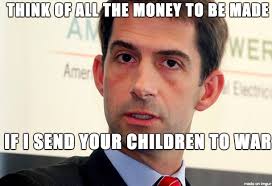
The “open letter” from Senator Tom Cotton and 46 other Republican Senators to the leadership of Iran, which even Republicans themselves admit was aimed at encouraging Iranian opponents of the nuclear negotiations to argue that the United States cannot be counted on to keep the bargain, has created a new political firestorm. It has been harshly denounced by Democratic loyalists as “stunning” and “appalling”, and critics have accused the signers of the letter of being “treasonous” for allegedly violating a law forbidding citizens from negotiating with a foreign power.

But the response to the letter has primarily distracted public attention from the real issue it raises: how the big funders of the Likud Party in Israel control Congressional actions on Iran.

The infamous letter is a ham-handed effort by Republican supporters of the Netanyahu government to blow up the nuclear negotiations between the United States and Iran. The idea was to encourage Iranians to conclude that the United States would not actually carry out its obligations under the agreement – i.e. the lifting of sanctions against Iran. Cotton and his colleagues were inviting inevitable comparison with the 1968 conspiracy by Richard Nixon, through rightwing campaign official Anna Chenault, to encourage the Vietnamese government of President Nguyen Van Thieu to boycott peace talks in Paris.

But while Nixon was plotting secretly to get Thieu to hold out for better terms under a Nixon administration, the 47 Republican Senators were making their effort to sabotage the Iran nuclear talks in full public scrutiny. And the interest served by the letter was not that of a possible future president but of the Israeli government.

The Cotton letter makes arguments that are patently false. The letter suggested that any agreement that lacked approval of Congress “is a mere executive agreement”, as though such agreements are somehow of only marginal importance in US diplomatic history. In fact, the agreements on withdrawal of US forces from both the wars in Vietnam and in Iraq were not treaties but executive agreements.

Equally fatuous is the letter’s assertion that “future Congresses could modify the terms of the agreement at any time”. Congress can nullify the agreement by passing legislation that contradicts it but can’t renegotiate it. And the claim that the next president could “revoke the agreement with the stroke of a pen”, ignores the fact that the Iran nuclear agreement, if signed, will become binding international law through a United Nations Security Council resolution, as Iranian Foreign Minister Mohammad Javad Zarif has pointed out.

The letter has provoked the charge of “treason” against the signers and a demand for charges against them for negotiating with a foreign government in violation of the Logan Act. In a little over 24 hours, more than 200,000 people had signed a petition on the White House website calling such charges to be filed.

But although that route may seem satisfying at first thought, it is problematic for both legal and political reasons. The Logan Act was passed in 1799, and has never been used successfully to convict anyone, mainly because it was written more than a century before US courts created legal standards for the protection of first amendment speech rights. And it is unclear whether the Logan Act was even meant to apply to members of Congress anyway.

AIPAC marching orders

The more serious problem with focusing on the Logan Act, however, is that what Cotton and his Republican colleagues were doing was not negotiating with a foreign government but trying to influence the outcome of negotiations in the interest of a foreign government. The premise of the Senate Republican reflected in the letter – that Iran must not be allowed to have any enrichment capacity whatever – did not appear spontaneously. The views that Cotton and the other Republicans have espoused on Iran were the product of assiduous lobbying by Israeli agents of influence using the inducement of promises of election funding and the threat of support for the members’ opponents in future elections.

Those members of Congress don’t arrive at their positions on issues related to Iran through discussion and debate among themselves. They are given their marching orders by AIPAC lobbyists, and time after time, they sign the letters and vote for legislation or resolution that they are given, as former AIPAC lobbyist MJ Rosenberg has recalled. This Israeli exercise of control over Congress on Iran and issues of concern to Israel resembles the Soviet direction of its satellite regimes and loyal Communist parties more than any democratic process, but with campaign contributions replacing the inducements that kept its bloc allies in line.

Cotton’s loyalty to Israel

Rosenberg has reasoned that AIPAC must have drafted the letter and handed it to Senator Cotton. “Nothing happens on Capitol Hill related to Israel,” he tweets, “unless and until Howard Kohr (AIPAC chief) wants it to happen. Nothing.” AIPAC apparently supported the letter, but there may be more to the story. Senator Cotton just happens to be a protégé of neoconservative political kingpin Bill Kristol, whose Emergency Committee on Israel gave him nearly a million dollars late in his 2014 Senate campaign and guaranteed that Cotton would have the support of the four biggest funders of major anti-Iran organisations.

Cotton proved his absolute fealty to Likudist policy on Iran by sponsoring an amendment to the Nuclear Iran Prevention Act of 2013 that would have punished violators of the sanctions against Iran with prison sentences of up to 20 years and extended the punishment to “a spouse and any relative, to the third degree” of the sanctions violator. In presenting the amendment in the House Foreign Affairs Committee, Cotton provided the useful clarification that it would have included “parents, children, aunts, uncles, nephews, nieces, grandparents, great grandparents, grandkids, great grandkids”.

That amendment, which he apparently believed would best reflect his adoption of the Israeli view of how to cut Iran down to size, was unsuccessful, but it established his reliability in the eyes of the Republican Likudist kingmakers. Now Kristol is grooming him to be the vice-presidential nominee in 2016.

So the real story behind the letter from Cotton and his Republican colleagues is how the enforcers of Likudist policy on Iran used an ambitious young Republican politician to try to provoke a breakdown in the Iran nuclear negotiations. The issue it raises is a far more serious issue than the Logan Act, but thus far major news organisations have steered clear of that story.

– Gareth Porter is an independent investigative journalist and winner of the 2012 Gellhorn Prize for journalism. He is the author of the newly published Manufactured Crisis: The Untold Story of the Iran Nuclear Scare.


The ISIS Truth We Hide From

Isis fighters, pictured on a militant website verified by AP.

By Bob Hennelly

Source: WhoWhatWhy

Identifying Terrorist Enemy No. 1—the Islamic State militants—is easy now, after a spate of horrific videos of beheadings and burnings.

But what’s hard for Western governments and the mainstream media is figuring out the popularity of this terror group among young western Muslims. Why do these people choose to leave the relative comforts of home and take up arms with IS militants? It’s as if these young people are from another planet.

Even after President Obama’s three-day White House Summit on Violent Extremism, few establishment “experts” and commentators seem ready to consider one possible answer: that it is the extreme militarism of the U.S. and its allies that helped spawn IS, and al Qaeda before that.

On the PBS NewsHour segment covering the White house confab, panelists were asked “why people are drawn to the kind of extremism we are seeing today?” The assembled pundits identified “local grievances” like “access to education and job opportunities” and faulted recruiting for “extreme ideology through books and social media.”

Yet there was no mention of U.S. drone strikes, prisoner rendition, torture, and the thousands of dead and wounded Muslim civilians. All of those factors have been exploited by ISIS and other violent groups to make their case that the U.S. is waging a war on Islam.

After several decades of self-proclaimed “nation building” and “exporting democracy” in the Middle East and its environs, the results are all too clear. There are shattered nations in Iraq and Afghanistan, failed states in Yemen, Libya and Syria, and more than a dozen African nations that the U.S. State Department concedes are under constant threat of attack by well-armed and organized terrorists.

Is it possible that what the U.S. has actually been doing in these hot spots is “terrorism building” and “exporting chaos”? Is this the awful truth the United States cannot bring itself to admit?

Massaging History

It would seem so, since instead of changing course, the U.S. is in the process of doubling down on its mistakes. How else to explain that the new GOP presidential hopeful, Jeb Bush, nonchalantly told the Chicago Council on Global Affairs that “mistakes were made” in Iraq. He then proceeded to lay out his own plan for becoming the new global sheriff in town.

Here’s a jaw-dropping statement from that speech:

There were mistakes made in Iraq, for sure. Using the intelligence capability that everybody embraced about weapons of mass destruction was not—turns out not to be accurate.

Watching his brother’s back, Jeb wove out of thin air a phony consensus that “everybody” signed on for the rationale for the Iraq war. That’s despite a vote in Congress in which 23 U.S. Senators and 133 House members opposed it.

You see, if “everybody” was wrong, then nobody was right. It should come as no surprise that Jeb’s team of policy wise men includes many Bush II veterans, among them the unrepentant Iraq war architect Paul Wolfowitz.

His Own Man, With an Old Plan

As much as Jeb Bush insists he is his own man, the audience in Chicago could hear echoes of his brother George’s cowboy-like approach. When Jeb was asked about how he would handle IS, he said he would develop a “global strategy” that would “tighten the noose” so he and the posse could “take them out.”

During Bush’s remarks, he took aim at the Obama administration for being too quick to disengage from the world and Iraq. He blamed Obama for creating a power vacuum that set the stage for the rise of IS and Iranian influence.

Yet an examination of President Obama’s new National Security Strategy, his proposed military budget and his request for his own War Powers re-authorization all indicate an administration that is prosecuting a global war on terror with unfettered latitude as to where and whom it targets.

Could it be that this “global war on terror,” whether it be the Bush 1.0 or Obama 2.0 version, may actually be what is proliferating the very thing it was aimed to eradicate?

One policy expert who dares to look deeper is Graham Fuller, a career CIA agent and analyst who was vice-chairman of the CIA’s National Intelligence Council. Fuller says it was the U.S. invasion of Iraq in 2003 that set the stage for IS. By creating an endemically corrupt central government in Baghdad, notes Fuller, the American occupation provided a focal point to unite disparate opposition groups. As for the high-profile effort to train a new Iraqi army, that “security” force collapsed the moment its U.S. handlers left. (In an odd twist to an already bizarre security meta-narrative, Fuller’s former son-in-law is the uncle of accused Boston Marathon Bombers Tamerlan and Dzhokhar Tsarnaev.)

***

In linking Washington’s Middle Eastern policies to the rise of terrorist groups in the region, MIT professor Noam Chomsky takes it even further back. He says the roots start with the U.S. support of Iraq in its brutal war with Iran in the 1980s, and include the draconian economic sanctions that followed Saddam Hussein’s 1990 invasion of Kuwait. In Chomsky’s view, these sanctions punished Iraqi civilians while reinforcing Saddam’s dictatorial control.

In his 2006 book Devil’s Game: How the U.S. Helped Unleash Fundamentalist Islam, longtime Nation correspondent Robert Dreyfuss documents how the U.S., as early as the 1950s, backed the Muslim Brotherhood in exchange for help fighting communism.

Peace’s Deadliest Year

One way to justify failed policies is to pretend that they have worked as advertised. Nowhere was this disconnect between rhetoric and reality more on display than in President Obama’s updating this month of his National Security Strategy.

In presenting this new security game-plan, the president exhibited excessive confidence in declaring that the United States was heading “home” and “moving beyond” ground wars in Iraq and Afghanistan. In his mini-version of Bush’s infamous ‘Mission Accomplished’ statement, he asserted that “the threat of catastrophic attacks” against the U.S. had “diminished.”

But even as the president describes a winding-down of combat operations, anything but peace is taking hold in those places.

The sectarian violence has resulted in record numbers of civilian deaths and injuries. The UN reported last month that more than 12,000 civilians were killed in Iraq in 2014, the deadliest year for noncombatants since 2008. In Afghanistan, the UN Assistance Mission counted close to 3,200 civilians killed and more than 6,400 wounded, the deadliest year since America’s longest war started.

Providing a sharp contrast to the president’s own assertion that peace is almost at hand, he has sent troops back into Iraq. And just a few days ago, his new Secretary of Defense, Ashton Carter, said the U.S. might end up sticking around in Afghanistan after all.

What the Administration and a cheerleading media refuse to acknowledge is that the two U.S. wars in Afghanistan and Iraq, aimed at ending terrorist threats in the region, have done the exact opposite. They not only caused tens of thousands of civilian casualties but hardened the resolve of yet another generation to seek revenge against their perceived Western oppressors.

Bottom Line

While details of how the president plans to use his refreshed war powers are still vague, the price tag is not.

In the name of defending the country and fighting terrorism, the president’s proposed 2016 budget calls for adding $38 billion in regular defense spending and another $58 billion for so-called “Overseas Contingency Operations.” These expanded outlays would come on top of the more than half a trillion dollars the U.S. is already spending on the military.

Even under the sequester restrictions, says one specialist, U.S. military spending was already quite robust and shamefully under-scrutinized.

“If you can’t protect the nation with $500 billion dollars,” then something is amiss, according to Veronique deRugy of George Mason University’s Mercatus Center. She notes that even under the sequester restrictions, U.S. military spending was already quite robust and shamefully under-scrutinized.

The failures are especially pronounced, says deRugy, when one takes into account that in the years since 9/11, Washington’s extra expenditures, labeled “emergency” war funding, have topped Pentagon budgets by tens of billions annually.

And so under presidents from both parties, who were supposedly ‘conservative’  and ‘liberal’,  the “emergency” continues to spread.