Two for Tuesday
Reply

By Seth Harris
Source: Pop Cult
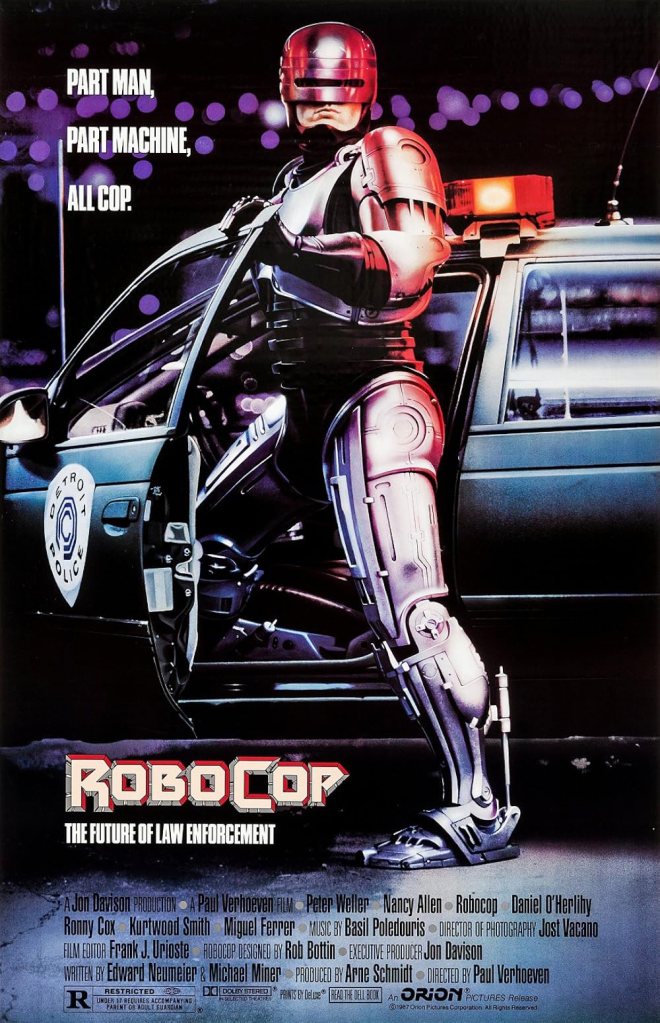
Robocop (1987)
Written by Edward Neumeier & Michael Miner
Directed by Paul Verhoeven
As an adult, I have developed an entirely new appreciation for the work of Paul Verhoeven. He was born in The Netherlands but managed to create a framework for American action movies in the 1980s while simultaneously delivering brutal satire about the United States. Robocop was his second English language film and his first pass at skewering the direction of Reagan’s America. The result is a science fiction classic, a combination of themes from Frankenstein mixed with commentary on the rise in corporatization of the public sphere. It’s not as biting as Starship Troopers, but it is full of brilliant takes on the United States’ ease & comfort with war and violence.
In the future, Detroit is on the verge of collapse. Money is dwindling, and society is overrun with crime. Omni Consumer Products (OCP) now have control of the Detroit PD and have plans to roll out innovations in crime-fighting. They just need a fresh corpse to make that happen. Meanwhile, Alex Murphy (Peter Weller) is transferred from the suburbs to a dangerous new precinct in the city’s heart. Murphy and his partner Lewis (Nancy Allen) begin the bonding process. They respond to a call over a bank robbery and pursue the suspect to an abandoned refinery. The officers get separated, and Murphy ends up riddled with bullets when the criminals ambush him. OCP recovers Murphy’s body and rebuilds him into Robocop. Of course, they don’t tell his fellow officers or his family that he’s partially alive. Even Murphy doesn’t remember his past except for a few flashes here and there.
The origins of Robocop lie in a surprising mishmash of influences. Screenwriter Edward Neumeier snuck his way onto the set of Blade Runner and was inspired by the production design of this future world. He imagined a story set in this place about a human turned into a cyborg police officer. He teamed up with aspiring director Michael Miner to collaborate on the script. They drew on their mutual love of comic books and experiences in 1980s corporate culture. They both found it bizarrely fascinating that the Japanese book The Way of the Five Rings was so popular on Wall Street at the time as it was focused around methods of samurai in the 17th century killing more effectively. Corporate types seemed to imagine themselves as these types of brazen warriors while working in finance and marketing. They envisioned a world influenced by this type of violent thinking leading to societal collapse, as we see in the film.
Paul Verhoeven was not the first choice, but he was suggested by a producer when other directors fell out. Verhoeven reportedly read the first page of Robocop, tossed it aside, and proclaimed it “a piece of shit.” It took his wife reading the script and encouraging him to look at the subtext of what was happening to convince the director to accept the project. Because he wasn’t fluent in English at the time, Verhoeven says a lot of the satire went over his head. When Murphy returns to his home, abandoned by his wife and son, the director clicked with the script.
For someone who didn’t understand the satire fully at the time, you can see the throughline in Verhoeven’s films coming out of Robocop to Total Recall and Starship Troopers. They are hyper-violent films where the villains are fascists. One of the best parts of Robocop are the snippets of news and commercials. They strongly emphasize the twisted psychology of this future world. News anchors smile through reports about apartheid South Africa arming themselves with nuclear weapons and U.S. forces crushing rebellions in Acapulco. Families play board games based around Mutual Assured Destruction. Everyone mindlessly gobbles up inane sitcoms that simply repeat catchphrases. The world feels rotten and hollow. Even as a kid seeing Robocop for the first time, it never felt like a movie where things would get better in the world when the credits rolled.
There’s a constant tension between the “civilized” world and devolution into wanton violence. A boardroom meeting dissolves into a bloodbath when an invention goes awry and kills an executive. Corporate heads employ some of the worst criminals to act as their muscle on the streets.
Robocop is another subversive action movie that seemed to satiate an American bloodlust while openly mocking the culture. It’s so surprising that so many appear to have been oblivious to what is very obvious satire. Robocop isn’t a traditional hero, and the film certainly doesn’t think the police are some flawless institution. Nothing is happening to remedy the circumstances that have led to the collapse of society; instead, corporate powers seek to create more brutal unfeeling enforcers. It’s sad how close to reality Robocop has become.
Watch Robocop on tubi here: https://tubitv.com/movies/389503/robocop-1987
By Roger Ebert
Source: RogerEbert.com
“Altered States” is one hell of a movie — literally. It hurls its characters headlong back through billions of years to the moment of creation and finds nothing there except an anguished scream of “No!” as the life force protests its moment of birth. And then, through the power of the human ego to insist on its own will even in the face of the implacable indifference of the universe, it turns “No!” into “Yes!” and ends with the basic scene in all drama, the man and the woman falling into each other’s arms.
But hold on just a second here: I’m beginning to sound like the movie’s characters, a band of overwrought pseudo-intellectuals who talk like a cross between Werner Er-hard, Freud, and Tarzan. Some of the movie’s best dialogue passages are deliberately staged with everybody talking at once: It doesn’t matter what they’re saying, only that they’re incredibly serious about it. I can tell myself intellectually that this movie is a fiendishly constructed visual and verbal roller coaster, a movie deliberately intended to overwhelm its audiences with sensual excess. I know all that, and yet I was overwhelmed, I was caught up in its headlong energy.
Is that a worthy accomplishment for a movie? Yes, I suppose it is, if the movie earns it by working as hard as “Altered States” does. This is, at last, the movie that Ken Russell was born to direct the same Ken Russell whose wretched excesses in the past include “The Music Lovers,” “The Devils,” and “Lisztomania.” The formula is now clear. Take Russell’s flair for visual pyrotechnics and apocalyptic sexuality, and channel it through just enough scientific mumbo jumbo to give it form. The result may be totally meaningless, but while you’re watching it you are not concerned.
The movie is based on a Paddy Chayevsky novel, which was, in turn, inspired by the experiments of Dr. John Lilly, the man who placed his human subjects in total immersion tanks floating them in total darkness so that their minds, cut off from all external reality, could play along the frontiers of sanity. In “Altered States,” William Hurt plays a Harvard scientist named Jessup who takes such an experiment one step further, by ingesting a drug made from the sacred hallucinatory mushrooms of a primitive tribe. The strange thing about these mushrooms, Hurt observes in an easily missed line of dialogue in the movie, is that they give everyone who takes them the same hallucinatory vision. Perhaps it is our cellular memory of creation: There is chaos, and then a ball of light, and then the light turns into a crack, and the crack opens onto Nothing, and that is all there was and all there will be, except for life, which has its only existence in the mind.
Got that? It hardly matters. It is a breathtaking concept, but “Altered States” hardly slows down for it. This is the damnedest movie to categorize. Just when it begins to sound like a 1960s psychedelic fantasy, a head trip, it turns into a farce. The scientist immerses himself in his tank for too long, he regresses to a simian state, physically turns into some kind of ape, attacks the campus security guards, is chased by a pack of wild dogs into the local zoo, and kills and eats a sheep for his supper before turning back into the kindly Professor Jessup, the Intellectual Hulk.
The movie splits up into three basic ingredients: The science, the special effects, and the love relationship between the professor and his wife. The science is handled deliciously well. We learn as much as we need to (that is, next to nothing) about total immersion, genetics, and the racial memory. Then come the special effects, in four long passages and a few short bursts. They’re good. They may remind you at times of the sound-and-light extravaganza toward the end of 2001, but they are also supposed to evoke the birth of the universe in a pulsating celestial ovum. In the center of this vision is Dr. Jessup, his body pulsing in and out of an ape shape, his mouth pulled into an anguished “O” as he protests the hell of being born. These scenes are reinforced by the music and are obviously intended to fuel the chemically altered consciousness of the next generation of movie cultists.
But then there is the matter of the love relationship between the professor and his wife (Blair Brown), and it is here that we discover how powerful the attraction of love really is. During the professor’s last experiment, when he is disappearing into a violent whirlpool of light and screams on the laboratory floor, it is his wife who wades into the celestial mists, gets up to her knees in eternity, reaches in, and pulls him out. And this is despite the fact that he has filed for divorce. The last scene is a killer, with the professor turning into the protoplasm of life itself, and his wife turning into a glowing shell of rock-like flesh, with her inner fires glowing through the crevices (the effect is something like an overheated Spiderman). They’re going through the unspeakable hell of reliving the First Moment, and yet as the professor, as Man, bangs on the walls and crawls toward her, and she reaches out, and the universe rocks, the Man within him bursts out of the ape-protoplasm, and the Woman within her explodes back into flesh, and they collapse into each other’s arms, and all the scene really needs at that point is for him to ask, “Was it as good for you as it was for me?”
“Altered States” is a superbly silly movie, a magnificent entertainment, and a clever and brilliant machine for making us feel awe, fear, and humor. That is enough. It’s pure movie and very little meaning. Did I like it? Yeah, I guess I did, but I wouldn’t advise trying to think about it very deeply.
Watch Altered States on tubi here: https://tubitv.com/movies/100045145/altered-states
By Stu Willis
Source: Sex Gore Mutants
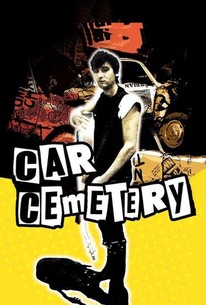
In an unspecified place, in an unspecified post-war future, the world is divided into two factions: the brutal Government-sponsored police regime, and the punks they hope to quash.
The punks spend their days scavenging the barren, post-Apocalyptic wastelands. Their nights are spent searching for “cemeteries” – secret places where they can hide from the authorities and enjoy a taste of their former lives. Much of the action is set in the titular car cemetery, a junkyard fashioned to house people in, fortress-style. Imagine a cross between STREET TRASH’s scrap-yard and Barter Town from MAD MAX BEYOND THUNDERDOME.
The cemetery’s pig-like keeper Milos (Roland Amstutz) welcomes the latest bunch of motley punks into his haven, referring to it as “Babylon”. Through his loudhailer he tells his guests that while they are there they are free to indulge in whatever perversions tickle their fancy. That includes the services of his own prostitute girlfriend, Dila (Juliet Berto).
The young adults retire to their individual car wrecks and get busy with all manner of sexual kinks, which allows director Fernando Arrabal to wallow in some customary carnal images before honing in on 80s fashion victim Tope (Boris Bergman) and his loyal friend.
They, along with everyone else, have heard that a Messiah-like rocker by the name of Emanou (Alain Bashung) is rumoured to be headed for the cemetery. There is a buzz in the air concerning his expected arrival but Tope, who has crossed paths with the new-age Christ figure once before, intimates designs on betraying him.
When Milos demands money from his transient guests for supper, they revolt. Fortunately for all, a riot is avoided by the arrival of the enigmatic Emanou. He is able to take two Big Mac sandwiches and feed the entire flock with them.
Meanwhile, as Emanou’s story is told in flashback by awestruck onlookers and Tope plots against the sultry music man, the cops await orders from their mysterious ruler The Bunker to locate and kill the Messiah.
Ah, I get it! Dila is the whore of Babylon … the cops are the Romans … Emanou walks on water and feeds the, well, around 20-or-so extras. Yes, Arrabal is reworking tales from the Bible through the filters of post-Apocalyptic sci-fi and new wave music.
Arrabal became a prominent figure in the Panic Movement of the 1960s, penning the play FANDO AND LIS – the screen adaptation of which later became the feature film debut of Alexandro Jodorowsky (SANTA SANGRE; EL TOPO). The Spanish surrealist then went on to become a cult filmmaker of his own distinction in the 1970s, with the brilliant VIVA LA MUERTE, the even wilder I WILL WALK LIKE A CRAZY HORSE and his nihilistic epic THE GUERNICA TREE (all three of which can be found in Cult Epics’ superb THE FERNANDO ARRABAL COLLECTION VOLUME 1 box-set).
CAR CEMETERY then, from 1983, comes as something of a disappointment. It’s not overly bad, just not as out-there or creative as its predecessors. The religious allegories have always been rife in Arrabal’s work, but here the blasphemy seems only half-hearted. The anger appears to have dissipated along with the budget for this low-rent REPO MAN relation.
The cast are game. Bashung, a famous singer in his native France up until his death from lung cancer in 2009, has an undeniable presence: he succeeds in the effortless cool of many a rock star. Everyone around him seems overly animated, as if being directed by Andrej Zulawski. But, somehow, it helps to keep the odd atmospherics afloat.
The problem is that the script is horribly ripe. Borrowing liberally from the Bible, this is portentous claptrap even by Arrabal’s standards (I say that with all due respect: I am a fan of the man). It’s true to say that his previous films were stuffed to the brim with surreal religious motifs and visual correlations between sex and death. Nothing has changed here, but everything feels so sedate in comparison. It’s no surprise to learn that this film is based on Arrabal’s play of the same name – and that explains its clunkiness: the limited sets; the dreadfully wooden dialogue; the cheap arthouse pretensions.
Worse still, the whole thing is given a punk rock look that firmly dates the film in the early 1980s – and not in a good way. It’s like Peter Greenaway directing CAFE FLESH with no budget, or the cast of JUBILEE racing through a softcore sci-fi variant of JESUS OF MONTREAL.
Cult Epics’ disc presents the film uncut in anamorphic 1.66:1. The transfer is generally dark and colours look a tad faded. Having said that, this is an obscure and largely unseen film – it’s amazing just to see it on DVD. It’s perfectly watchable, and relatively clean to boot.
The French audio track offered is 2.0 and is a good proposition throughout. Optional English subtitles are easy to read and, for the most part, free from typing errors.
A static main menu page leads into a static scene-selection menu allowing access to CAR CEMETERY via 10 chapters.
The only extras on the disc are trailers for VIVA LA MUERTE, I WILL WALK LIKE A CRAZY HORSE and THE GUERNICA TREE. The first and last of these are equipped with English subtitles, while the HORSE trailer has no dialogue.
The disc is a basic one, but fair when you consider that it’s likely to be the only legitimate standalone release this film is likely to receive. Cult Epics have also released CAR CEMETERY as part of a three-disc box-set – THE FERNANDO ARRABAL COLLECTION VOLUME 2 – which also contains the whimsical family film THE EMPEROR OF PERU (with Mickey Rooney!) and a third disc of documentaries, including the recommended watch FAREWELL BABYLON.
CAR CEMETERY is a hideously dated 80s film that fails to escape from the pratfalls of its stage origins. The fashions, the sets, the allegories – its all rank. But there is something that makes it just-to-say work regardless, be it the occasional inspired image (Dila conversing with a miniature angel; Tope’s fate) or authentic squalor and subversive anti-establishment message that seeps through. Arrabal is a cinematic terrorist of considerable intelligence and even a lesser film such as this demonstrates as much. Just don’t go into it expecting the same levels of polemical art or extremism of his earlier films.
Watch Car Cemetery on Kanopy here: https://www.kanopy.com/en/kcls/video/10605045
In Search of Mœbius: A Documentary Introduction to the Inscrutable Imagination of the Late Comic Artist Mœbius
By Colin Marshall
Source: Open Culture
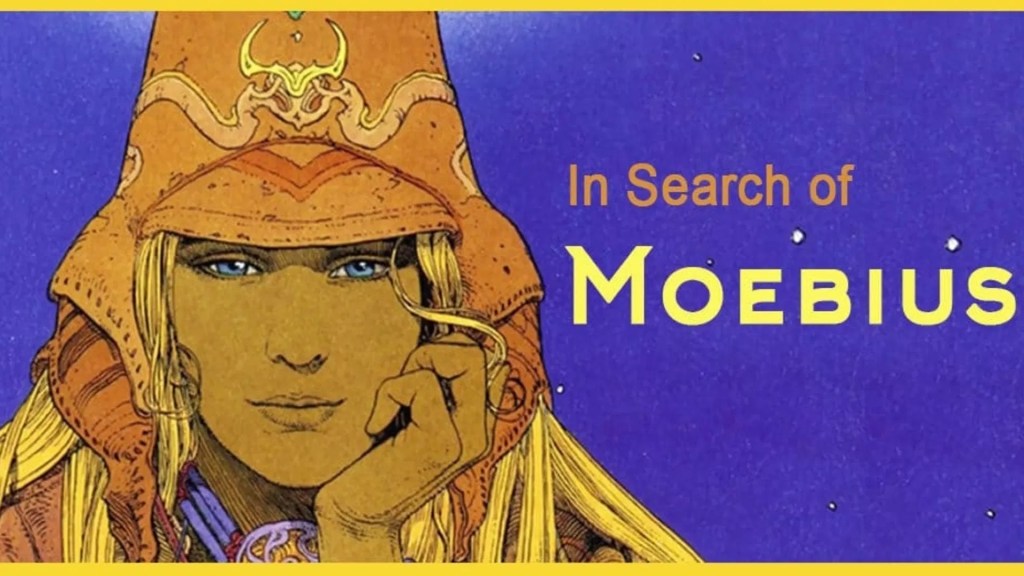
“I’ll die in some truly banal manner, the way I live,” says the subject of BBC Four’s In Search of Mœbius. I don’t know what would constitute a non-banal manner of death — or, for that matter, a banal one — but nobody familiar with modern comic art could believe that Jean Giraud, also known as Mœbius, could possibly have lived a banal life. If you haven’t read a comic since your childhood Sunday funnies, you need only watch this program to understand why the artist’s passing on Saturday brought forth so many breathless tributes. You’ll also catch a glimpse of the vast possibilities offered by comic art as a form. The inscrutable workings of Mœbius’ peculiar imagination drove him far into this territory, and many creators (in comics and elsewhere) still struggle to follow him.
Aside from Mœbius himself, the program interviews the coterie from his early years in France at Métal Hurlant, the magazine that would open the space for his distinctively subconscious-fueled, near-psychedelic yet richly textural science-fiction sensibility. It goes on to talk with well-known admirers who, feeling the resonance of those particular (and particularly difficult to describe) qualities of Mœbius’ vision that cross so many national and artistic boundaries, found ways to work with him.
These high-profile collaborators range from Marvel Comics founder Stan Lee, who enlisted Mœbius to take Silver Surfer in new aesthetic and intellectual directions, to screenwriter Dan O’Bannon, biomechanical surrealist H.R. Giger, and filmmaker/mystic Alejandro Jodorowsky, who worked with him on an unrealized (but still tantalizing) film adaptation of Dune.
In Search of Mœbius also explores the real landscapes that must have worked their way into Mœbius’ imagination, contributing to the strikingly unreal landscapes that worked their way out of it. We see the deserts of Mexico, traces of which appear in his Western series Blueberry, where he visited his mother in the 1950s. We see the Los Angeles he considered “really an amazing city,” where his work on Silver Surfer took him. We even see him in his native land, standing before the harshly iconic Bibliothèque nationale de France. Mœbius may be gone, but the world inside his head remains forever open for us on the page to explore. H/T @EscapeIntoLife
Colin Marshall hosts and produces Notebook on Cities and Culture. Follow him on Twitter at @colinmarshall.
INDIAN COUNTRY NEWS
"It is the duty of every man, as far as his ability extends, to detect and expose delusion and error"..Thomas Paine
Human in Algorithms
From the Roof Top
I See This
blog of the post capitalist transition.. Read or download the novel here + latest relevant posts
अध्ययन-अनुसन्धानको सार
 After the Crash