
15 Questions That Are More Useful Than “What Presidential Candidate Should Americans Vote For?”

By Caitlin Johnstone

Source: CaitlinJohnstone.com

People keep asking me to weigh in on the US presidential race and its candidates, which is what always happens whenever there’s a US presidential race on because media saturation makes it so central in the minds of Americans it’s often the main issue they want to talk about, even if they’re fairly aware.

I really don’t have anything to say about who Americans should vote for, other to repeat what I’ve said already about the fact that you can’t vote your way out of a mess you never voted yourself into in the first place.

But what I can do instead is offer my American friends some questions to ask that would probably be much more helpful to them and their nation than the question “Which presidential candidate should we vote for?”

Here are 15 such questions:

1. Why does nothing change no matter who we vote for?

2. Why does US foreign policy always continue along the same trajectory regardless of the president’s party or platform?

3. What keeps our voting population split right down the middle into two political factions of equal size, with neither side ever gaining enough of a majority to democratically change society in any meaningful way?

4. Why does the stalemate described in #3 always seem to benefit the rich, the powerful, and the war-horny?

5. Why is it that the most consequential US government policies like plutocratic influence, privatization, globalization, ecocidal capitalism and nuclear brinkmanship are never on the ballot? Why do these things keep happening, against our interests, without our ever voting for them or electing anyone who campaigned on the pledge to enact them?

6. If our federal government’s behavior never changes no matter who we elect, could it be that there are other bodies involved in government policy-setting whom we did not elect, and who remain in positions of influence regardless of the comings and goings of our official elected government?

7. If the above is the case, then who is it? Who’s really calling the shots in this country?

8. Could it be that everything we’ve been told about our country, our government, our political processes and our world is untrue?

9. If so, what are the implications of the fact that our schools and our media have been feeding us lies since we were small?

10. What forces would be responsible for keeping all these lies flowing throughout our society? What might keep an ostensibly free press spinning more or less the same lies throughout the western world day after day, year after year, generation after generation?

11. Is it possible that our entire electoral system is a sham designed to give the public the illusion of control so that they’ll let oligarchs and empire managers run the country undisturbed?

12. If the electoral system is a sham, then how do we enact the changes we so desperately need?

13. Is it possible that there are other ways to effect change in the United States which don’t involve casting a pretend vote in a fake election?

14. Could it be that those other means of forcing change are precisely what the charade of casting pretend votes in fake elections is meant to divert us from?

15. Should we perhaps spend less energy bickering about who should get sworn into the White House a year and a half from now, and more energy examining other possible avenues toward advancing meaningful change?
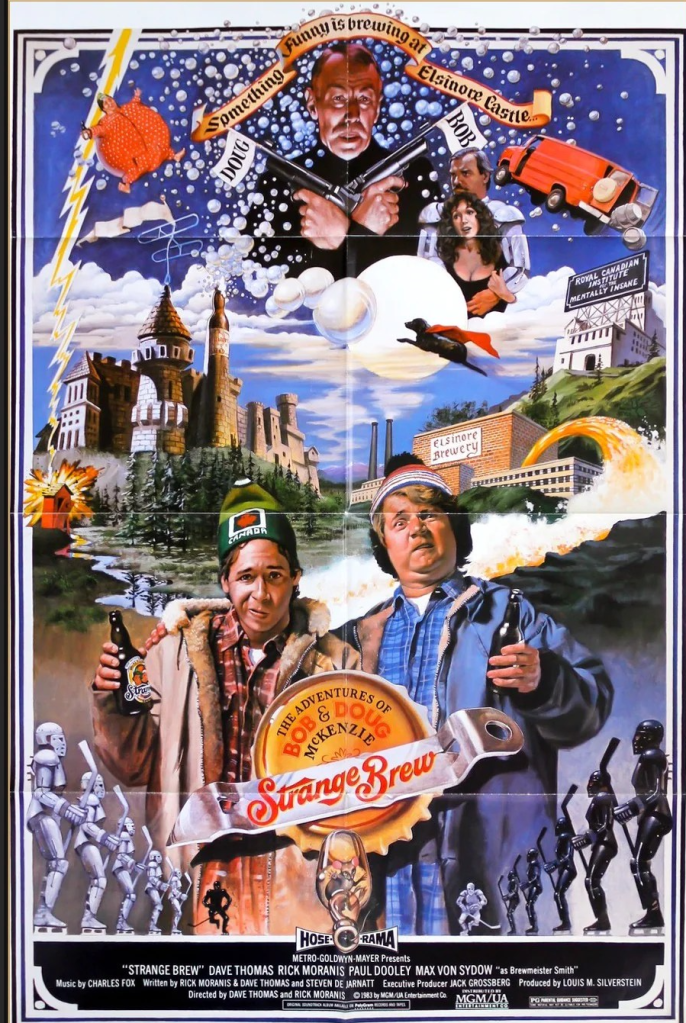
Saturday Matinee: Strange Brew

‘Strange Brew’: The Cult Comedy Classic that Married Canadiana with ‘Hamlet’

Beer. Hockey. Shakespeare. Beauty, eh?

By Lloyd Farley

Source: Collider

It’s August, 1983 at the local movie theatre.The lights go down, the curtains part. A trailer or two roll, maybe A Christmas Story, or the hilarious Yentl. The iconic MGM lion then comes on screen, and you wait breathlessly for his mighty roar to begin the film. And then…BURP.

No, this movie can’t possibly begin with such comedic absence of reverence, can it? The camera pans around to capture two parka and toque clad men, one of which is turning the lion’s tail like a crank to get it to roar. Absence of reverence, confirmed. The two men see the camera is running, so they run to the set, riddled with cases of beer and a backdrop with a large map on it, the words Great White North spread across, and so wide it includes England, Russia and Hawaii. The hilarious, absurd, Shakespearian, James Bond villainous, rife with all manner of Canadian stereotype film Strange Brew has begun.

The two men are brothers Bob and Doug McKenzie, played by Rick Moranis and Dave Thomas. The duo came to life on SCTV as The Great White North, an improvised bit by Moranis and Thomas for more Canadian content. They used every stereotype — toques, parkas, back bacon, beer, the iconic “coo-roo-coo-coo” loon call, “hosers” — and simply talked. They would add “eh?” to the end of every sentence, a tic as Canadian as “oh yea, no, for sure”. The McKenzie’s took off with syndication in the US. Capitalizing on their popularity, they released the comedy album The Great White North, which included the song “Take Off” with collaborator Geddy Lee (his highest charting single, including his work with Rush). The success of the album begat the movie, which Thomas pitched as having creative ties with Hamlet.

The beginning of the film is a movie within the movie: Mutants of 2051 A.D., a home-made sci-fi classic, like the works of The Goldbergs‘ Adam (Sean Giambrone). When the film breaks, the brothers, watching the film in the theatre, flee from angered moviegoers, and lose their dad’s (Mel Blanc) beer money. Forced to get beer for their dad the next morning, they place a mouse in an empty bottle of Elsinore beer, hoping to leverage it for free beer. They are told to go to the brewery, where the new owner, Pam Elsinore (Lynne Griffin), gives them jobs watching for mice in beer bottles (and cases of free beer). They wander around the brewery and into Brewmeister Smith’s (Max von Sydow) operations room, where they can see patients from the nearby Royal Canadian Mental Health Facility playing hockey.

Wait, back up. Esteemed Swedish actor Max von Sydow, of Bergman‘s The Seventh Seal? Yep. His son was a huge fan of SCTV, and encouraged his father to take the role. The character has been working on a plan to take over the world by adding a mind control drug to Elsinore beer, testing on the patients from the nearby facility. Through certain musical tones, those under the drug can be made aggressive (shown in an amusing bit where Doug plays the iconic loon theme on the keyboard), with those results tested through games of hockey. Because, you know, Canada.

Tranquilized by Smith and his accomplice, Pam’s Uncle Claude (Paul Dooley), the brothers wake up and make a delivery in their van, not knowing that the brakes are cut and that the beer kegs in the back have Pam and her father’s friend Henry (Douglas Campbell) inside. They careen down the hill into the lake, and then…Intermission.

Police divers find the boys in the van, alive and drinking beer. Charged with attempted murder, they are found insane by the judge. The brothers are sent to the asylum and placed in Smith’s care, where they are straitjacketed, prompting a game of steamroller, and take turns using electric shocks on one another. Freed by Rosie, they return to the brewery to stop Smith.

Pam and Bob are captured by Smith and placed in a brewery tank, which begins filling with beer. Rosie and Doug find them, discovering that Bob drank the entire contents of the tank and is now cartoonishly bloated, and needing to ‘take a leak’, which he does by, um, expelling and putting out a fire at the asylum. Knowing Smith has shipped tainted beer to Oktoberfest, Bob and Doug stop at home to get the help of Hosehead (Buddy), who flies off — you read that right — to stop the party and indulge in beer and sausages. The brothers take the remaining beer away, and presumably home. The film ends…

… no, it doesn’t. Bob and Doug reappear on the set of The Great White North and talk throughout the credits, sending off those that stayed behind – not the hosers that took off after the movie was done — with a beer whistle and a “happy trails”. Right now you’re thinking, “Geez, we got hosed! What about Hamlet, you knob?”

Strange Brew‘s retelling of Hamlet ranges from the painfully obvious to a much subtler degree. An intellectual ribbon throughout the lunacy. The name Elsinore is the easiest reference, a clear nod to the Danish royal castle Elsinore from the play. Pam is the Hamlet, the heiress of the brewery/kingdom after the death of her father, who is still reeling from her mother Gertrude (Jill FrappierQueen Gertrude) marrying her uncle Claude (Claudius) within days of the loss. Pam is shown by the ghost of her father, John (Eric House), how Claude and Smith murdered him. The ghost recounting the details of his death is taken directly from Hamlet, but the fact that he appears via a Galactic Border Patrol videogame in the movie is a clever reference to a feared invasion of Denmark by neighboring Norway. The presence of the Mental Health Facility would suggest a reference to the role of madness in Hamlet, from Hamlet’s acting as such to Ophelia’s descent into true madness, while the tinged beer a bow to the poisoned glasses of wine in the play’s final act. The McKenzie brothers themselves have a link to the play as a modern-day Rosencrantz and Guildenstern.

Strange Brew is as much an experience as a comedy, and, with the Canadian penchant for self-deprecation and a highbrow Shakespearian tint, its lighthearted jabs at the Canadian identity should be mandatory (well, at least suggested) viewing every July 1st on Canada Day. Happy trails indeed, eh?