Confronting Battered Citizen Syndrome

cycle_of_violence

By James F. Tracy

Source: The Memory Hole

State-sponsored terrorism poses a significant challenge to the psychological well-being of the body politic. While evident in many geopolitical locales, this condition arising from such government abuses is especially prevalent in the West. Such a disorder is comparable to the psychological manipulation recognized on a micro-level in some spousal relationships.

Indeed, the 13-year-old “war on terror” has contributed to a grave societal malady that might be deemed “battered citizen syndrome.” As the project of a transnational New World Order is laid out, the psychological constitution of the polity must necessarily experience perpetual crises and the threat thereof. Genuinely non-conventional political communication, organization and activism are among the few substantial means of combating battered citizen syndrome and the spiritual and psychological slavery it perpetuates.

Battered citizen syndrome is an extremely damaging psychological condition that effects individuals who are collectively subjected to emotional abuse and political disenfranchisement by the psychopathic types that all-too-frequently occupy public office in an era of political and socio-economic decay. The condition is often the result of “false flag” terrorism initiated by a tyrannical state that has long grown unresponsive to the citizen’s actual needs. This syndrome subdues individuals’ awareness of their own historical and political agency, and discourages them from seeking assistance for and ultimately remedying their unsafe situation.

There are various stages one will experience as a result of this condition. When persons in the singular or aggregate undergo the threat or experience of state violence in the form of false flag terror (i.e., political assassinations, seemingly spontaneous bombings or shootings, gigantic skyscrapers falling inexplicably at free-fall speed, CIA-sponsored terror bogeys such as Al Qaeda and ISIS, and perhaps even deadly plagues) they will find it expedient to deny such exploitation and decline to admit they are being manipulated by a paranoid and psychopathic state. Corporate-owned or controlled mass media routinely propagating the notion of “free choice” and personal agency by touting the supposed integrity of electoral processes and political institutions actively aid in this denial.

Once a victim accepts the fact that such manipulation is taking place, they will feel remorse. Victims will often believe that the abuse is their fault and not the fault of criminal governance. Eventually, a victim of state terror and violence will realize that they are not to blame for the cruelty they are being subjected to. Despite this realization, the individual will typically choose to remain in the abusive relationship. It may take some time, but eventually the truly self-respecting citizen-victim will understand that in order to defend themselves and their loved ones from harm they must escape their injurious relationship. These stages can be observed in many of the victims who have ultimately recognized and escaped their relationships with an abusive state.

Denial
The first stage of battered citizen syndrome is denial. Denial occurs when a victim of abuse is unable to acknowledge and accept that they are being subjected to political violence in the form of false flag terror and contrived events. During this stage, a victim of such psychological abuse will not only avoid admitting the mistreatment to their friends and their family members, but they themselves will not acknowledge the brutality from which they suffering. They will fail to recognize any problems between themselves and their government. There are numerous factors that may contribute to such steadfast denial.

In many instances, an individual does not realize they are being subjected to such calculating state violence. This is largely due to the manipulative and coercive behavior of the offending government. The acts of abuse may be so subtle that they do not appear to be harmful or damaging. In other instances, a victim of Machiavellian offenses may suppose that denial is the most effective way to avoid being subjected to further violence and cruelty. Whatever the cause, denial is extremely unhelpful to the victim. Until citizens individually and collectively admit and confront the abuses they are experiencing, they will not be able to secure necessary psychic and material aid and protection.

Guilt
After a citizen experiences the denial period they will move on the guilt stage. During this phase, victims of such coercive violence will undergo feelings of extreme guilt and dishonor by being fingered as potential terrorists themselves. Through the suggestion that they may also be terrorists, citizens will believe they may have somehow caused the harm that in reality elements within their exploitative government has subjected them to.

Abusive governments stage false flag terror events not only to create confusion, but also induce guilt in their subjects. Professional political and opinion leaders prompt feelings of guilt through similar rhetorical appeals. Those of the liberal or “progressive” sort in particular claim that such events are the result of “blow back,” due to the given nation’s foreign policy and imperialist overreach. Similarly, conservatives assert that the nation has been victimized because it has been too forthright in parading its “freedoms.”

Once internalized, “war on terror” guilt ideation is reinforced via the messaging slogans of state agencies. Typical messaging may include communications such as, “Is your neighbor or coworker a homegrown extremist?” “Keep your luggage with you at all times,” “Step this way after removing your shoes and valuables,” and so on.

Regardless of guilt stimulus, feelings of culpability are used to exert further control via rituals of submission, such as enacting excessive and unwarranted security measures to partake in travel, gain access to a public building, or withdraw cash from one’s bank account.

Along these lines, the offending government will convince the victim that it must resort to physical violence in order to punish the citizenry for their negative qualities or behavior. They may threaten or enact violence to teach the citizen not to take part in the activities of which it disapproves or finds inconvenient, such as public demonstrations and civil disobedience.

In addition to such acts, tyrannical governments strip citizens of their civil liberties and establish or strengthen a police state in order to further expand their control. As a result, the citizen’s already low self-esteem and depression will accelerate downward. Once this occurs, it is not difficult to convince the victim that they are being subjected to abuse due to their own faults and inadequacies. If they could only be more dependent on the state and live up to its expectations, they would not be experiencing state terror and exploitation. Victims of such manipulation will believe this. Therefore, they will not contest the abuse being experienced because they have rationalized that their abusive government is not to blame for such cruelty.

Enlightenment
One of the most important phases of the battered citizen’s syndrome is enlightenment. This occurs when a target of abuse recognizes how they are not to blame for their ill-treatment. They will begin to understand that no one deserves to be subjected to state-inflicted terror and violence regardless of their personal characteristics or perceived shortcomings. The fact that the state  seeks to manipulate their subjects and exhibits disapproval of their victim’s behavior does not justify exposing the victim to the trauma prompted by terrorist threats and violence.

During this stage, a citizen will begin to acknowledge that most states are abusive, violent, overseen by psychopathic personalities, and thus the violence experienced is the result of an external socio-political condition and not inherent in themselves. It is now that a victim begins to realize the importance of coming to terms with their situation and holding those in power accountable.

Despite the realization that their fear, anxiety, and loss of civil liberties likely stem from the broader designs of treacherous individuals in power, victims will continue to accept overzealous state power and commit themselves to saving the seriously flawed relationship. They will often use various reasons in order to justify this decision. However, individuals who choose to remain in such an environment will soon find that in most cases the tyrannical government will only increase the severity of its abuses.

Responsibility
Once a citizen recognizes how the psychological torment and terroristic violence they are suffering from is the fault of their government, it is only a matter of time before these victims understand the importance of taking responsibility and escaping their current situation. In the majority of cases, state violence does not improve over time. Most governments subjecting their citizens to violence and brutality are “repeat offenders” and will continue to reinforce control by exposing subjects to heightened abuses. When an individual acknowledges this, they will understand that their safety, and the safety of their loved ones, depends on establishing new modes of governance. During the responsibility stage of the battered citizen’s syndrome, a victim of state violence may experience a vast array of difficulties.

It is essential that an individual plan their escape well. Citizens who have decided to depart from their unfavorable situation should avoid the enticements of major political parties that are usually the root cause of battered citizen syndrome.

If a victim would like support and advice about leaving their abusive relationship they may wish to contact or support a third party candidate running for public office. Citizen violence shelters in the form of information derived from alternative news media, meaningful political discussion and debate, and grassroots and independent political organizing can also provide victims with the necessary support to make a clean break from tyrannical state power that will ultimately lead toward the forging of more constructive political realities for themselves and their fellow citizenry.
Afroman Remakes “Because I Got High” to Support Legalization

Afroman

By Sabrina Fendrick

Source: Norml

Nearly fifteen years after the release of “Because I Got High”- a song well known for poking fun at overzealous reefer madness rhetoric – Afroman is ready to jump headfirst back into the marijuana limelight.  Only this time, as an advocate for legalization.

The grammy nominated artist recently teamed up with NORML and Weedmaps to launch a remake of his hit song, turning the hip hop classic into a positive legalization anthem for the 2014 elections. The remix is a new and entertaining way to drive the narrative surrounding the benefits of cannabis law reform, as well as the medical benefits of the plant itself. With election day right around the corner, his latest project is geared towards keeping up the momentum for all the marijuana law reform efforts taking place across the country, and especially upcoming ballot initiatives.

On November 4th, two states and the District of Columbia will be voting to legalize marijuana, and Florida will be voting on a medical marijuana amendment. The timing couldn’t have been better to take, and remake the canna-cult classic. The 2014 version of “Because I Got High” not only challenges old stereotypes, it also seeks to build support and enthusiasm for the three measures proposing to create a regulated pot market for adults, age 21 and over.

Standard & Poor’s: Runaway Inequality Dampens GDP Growth, Leads to Boom/Bust Cycles and Discourages Trade, Investment and Hiring

income-inequality-yahoo

Source: Washington’s Blog

Inequality Also Dampens Social Mobility, Increases Political Pressure and Produces a Less Competitive Workforce

Standard & Poor’s released a report on inequality today, concluding:

Higher levels of income inequality increase political pressures, discouraging trade, investment, and hiring. Keynes first showed that income inequality can lead affluent households (Americans included) to increase savings and decrease consumption (1), while those with less means increase consumer borrowing to sustain consumption…until those options run out. When these imbalances can no longer be sustained, we see a boom/bust cycle such as the one that culminated in the Great Recession (2).

Aside from the extreme economic swings, such income imbalances tend to dampen social mobility and produce a less-educated workforce that can’t compete in a changing global economy. This diminishes future income prospects and potential long-term growth, becoming entrenched as political repercussions extend the problems.

Our review of the data, as well as a wealth of research on this matter, leads us to conclude that the current level of income inequality in the U.S. is dampening GDP growth, at a time when the world’s biggest economy is struggling to recover from the Great Recession and the government is in need of funds to support an aging population.

S&P joins many others in concluding that runaway inequality hurts the economy, including:

  • Former U.S. Secretary of Labor and UC Berkeley professor Robert Reich
  • Global economy and development division director at Brookings and former economy minister for Turkey, Kemal Dervi
  • Societe Generale investment strategist and former economist for the Bank of England, Albert Edwards
  • Michael Niemira, chief economist at the International Council of Shopping Centers
  • Former executive director of the Joint Economic Committee of Congress, senior policy analyst in the White House Office of Policy Development, and deputy assistant secretary for economic policy at the Treasury Department, Bruce Bartlett
  • Deputy Division Chief of the Modeling Unit in the Research Department of the IMF, Michael Kumhof

Even the father of free market economics – Adam Smith – didn’t believe that inequality should be a taboo subject.

Numerous investors and entrepreneurs agree that runaway inequality hurts the economy, including:

Indeed, extreme inequality helped cause the Great Depression, the current financial crisis … and the fall of the Roman Empire . And inequality in America today is twice as bad as in ancient Rome, worse than it was in Tsarist Russia, Gilded Age America, modern Egypt, Tunisia or Yemen, many banana republics in Latin America, and worse than experienced by slaves in 1774 colonial America. (More stunning facts.)

Bad government policy – which favors the fatcats at the expense of the average American – is largely responsible for our runaway inequality.

And yet the powers-that-be in Washington and Wall Street are accelerating the redistribution of wealth from the lower, middle and more modest members of the upper classes to the super-elite.

8 Facts About American Inequality

income-inequality-graphic

By Pierce Nahigyan

Source: Nation of Change

…that dream of a land in which life should be better and richer and fuller for everyone, with opportunity for each according to ability or achievement. It is a difficult dream for the European upper classes to interpret adequately, and too many of us ourselves have grown weary and mistrustful of it. It is not a dream of motor cars and high wages merely, but a dream of social order in which each man and each woman shall be able to attain to the fullest stature of which they are innately capable, and be recognized by others for what they are, regardless of the fortuitous circumstances of birth or position.”

– James Truslow Adams, The Epic of America (1931)

The American Dream has been defined many ways by writers of both poetic and prosaic bent, but its essentials tend to involve life, liberty and the pursuit of happiness (or property, depending on your source).

The Declaration of Independence, upon which an entire nation was radically brought into existence, asserts that not only are all men created equal but that this is a “self-evident” truth. The significance of this fact lies not in its semantics, which epistemologists would challenge, but in its utilization as a primary foundational creed. By this “unanimous Declaration of the thirteen united States of America,” a contract was agreed to, that their union would be founded on this principle. Furthermore, life, liberty and the pursuit of happiness are rights that governments are created to uphold. Thus, America was endowed with its dream at the moment of its conception: the freedom to succeed.  

The United States has promoted a self-congratulating exceptionalism for decades, waving its Declaration and Constitution in the faces of other sovereign nations as if the latter had never beheld such concepts. Our capital F “Freedom” sets us apart from the rest of the world, as the political rhetoric has repeated ad nauseam, no matter the freedoms enjoyed by democracies on every continent. And yet our basic freedom, the freedom to succeed, America’s contractual promise, has been shrinking for thirty years.

The freedom to succeed transcends economic systems but it is most potently expressed by capitalist gains. The ability to go “from rags to riches” is ingrained in this nation’s ethos and there is nothing intrinsically immoral about that goal. However, the current state of American inequality reveals a very real and expanding gap between the rich and poor that betrays the foundational endowment of this Union. When the freedom to succeed is denied every citizen, their equality is equally denied. 

The wealth and income inequalities in America do not require socialist reforms to fix, and capitalism is not the problem. The problem is that we have let inequality advance in this country so gradually that its obviousness is masked by its familiarity. Below I outline eight facts about inequality in America that every American should know. 

1) 400 Americans have more wealth than half of all Americans combined. To put that into context, as of 2013 there are an estimated 316,128,839 people living in the United States, according to the U.S. Census Bureau. Just 400 Americans have more money than over 158 million of their fellow citizens. Their net worth is over $2 trillion, which is approximate to the Gross Domestic Product of Russia. This ratio has been verified by Politifact and former Labor Secretary Robert Reich. One explanation for the vast discrepancy in wealth is the definition of “worth,” which includes everything a person or household owns. This means savings and property but also mortgages, bills and debt. Poorer households can owe so much in debt that they possess a negative net worth.

2) America has the second-highest level of income inequality, after Chile. The Organization for Economic Cooperation and Development studies thirty-four developed countries and ranks them both before and after taxes and government transfers take effect (government transfers include Social Security, income tax credit and unemployment insurance). Before taxes and government transfers, America ranks tenth in income inequality. After taxes and transfers, it ranks second. Whereas its developed peers reduce inequality through government programs, the United States’ government exacerbates it. 

3) The current state of inequality can be traced back to 1979. After the Stock Market Crash of 1929, the gap between the rich and the poor began to narrow. For fifty years, wages still differed greatly between the upper- and working-classes, but a robust middle-class took shape, as well as the opportunity for working-class individuals to ascend. In his book, “The Great Divergence,” journalist Timothy Noah traces today’s inequality to the beginning of the 1980s and the widening gap between the middle- and upper-classes. This gap was influenced by the following factors: the failure of American schools to prepare students for new technology; poor immigration policies that favor unskilled workers and drive down the price of already low-income labor; federally-mandated minimum wage that has failed to keep pace with inflation; and the decline of labor unions.

4) Non-union wages are also affected by the decline of unions. The Economic Policy Institute claims that 20% of the growth in the wage gap between high-school educated and college educated men can be attributed to deunionization. Between 1978 and 2011, union representation for blue-collar and high-school educated workers declined by more than half. This has also diminished the “union wage effect,” whereby the existence of unions (more than 40% of blue-collar workers were union members in ’78) was enough to boost wages in non-union jobs – in high school graduates by as much as 8.2%. Not only did unions protect lower- and middle-class workers from unfair wages, they also established norms and practices that were then adopted by non-union employers. Two prime examples are employee pensions and healthcare. Today about 13% of workers belong to unions, which has reduced their bargaining power and influence. 

5) There is less opportunity for intergenerational mobility. In December 2011, President Obama spoke at Osawatomie High School in Kansas. He was very clear about the prospects of the poor in today’s United States:

“[O]ver the last few decades, the rungs on the ladder of opportunity have grown farther and farther apart, and the middle class has shrunk. You know, a few years after World War II, a child who was born into poverty had a slightly better than 50-50 chance of becoming middle class as an adult. By 1980, that chance had fallen to around 40 percent. And if the trend of rising inequality over the last few decades continues, it’s estimated that a child born today will only have a one-in-three chance of making it to the middle class – 33 percent.”

As refreshing as that honesty is, Obama promised no fix beyond $1 trillion in spending cuts and a need to work toward an “innovation economy.” 

In a speech one month later, Obama’s Chairman of Economic Advisers, Alan Krueger, elaborated on the dire state of America’s shrinking middle-class. The contraction, he stated, could partially be attributed to “skill-biased technical change”: work activities that have become automated over time, reducing the need for unskilled labor and favoring those with analytical training. He also highlighted the 50 year decline in tax rates for the top 0.1%, increased competition from overseas workers, and a lack of educational equality for children. Poor children are denied the private tutors, college prep and business network of family and friends available to their wealthier peers, which locks them into the class they are born into.

6) Tax cuts to the wealthiest have not improved the economy or created more jobs. Krueger also revealed that the tax cuts of the 2000s for top earners did not improve the economy any better than they did in the 1990s (meanwhile, income growth was stronger for lower- and middle-class families in the 1990s than in the last forty years). Tax rates for the top income earners in America peaked in 1945 at 66.4 percent. Following decades of gradual reductions, they have since been cut in half. During the same time, the payroll tax has increased since the 1950s and individual income tax has bounced between 40-50% through the present day. Conversely, corporate tax declined from above 30% in the 1950s to under 10% in 2011. All of these tax cuts are made ostensibly to improve the economy and create jobs. However, the National Bureau of Economic Research has concluded that it is young companies, “regardless of their size,” that are the real job creators in America. Tax cuts to the wealthiest do not create jobs

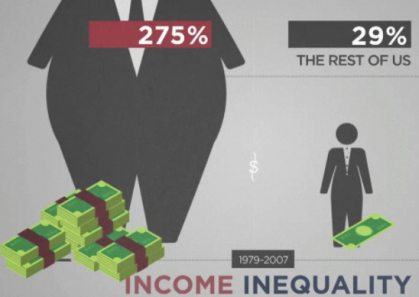
7) Incomes for the top 1% have increased (but the top 0.01% make even more). Between 1979 and 2007, the average incomes of the 1% increased 241%. Compare that to 19% growth for the middle fifth of America and 11% for the bottom fifth. Put another way, in 1980 the average American CEO earned forty-two times as much as his average worker. In 2001, he earned 531 times as much

Average income across the 1% is actually stratified into widely disparate echelons. Compare the $29,840 average income for the bottom 90% to the $161,139 of the top 10%. Compare the $1 million average income of the top 1% to the $2.8 million of the top 0.1%. Yet both still pale beside the $23 million average income of the top 0.01%. 

If those numbers seem a bit overwhelming, Politizane has created a video that illustrates this staggering inequality:

8) The majority of Congress does not feel your pain. Empowered by the Constitution to represent their constituents, United States Congress members are, for the first time in history, mostly millionaires. The 2012 financial disclosure information of the 534 current Congress men and women reveals that over half of them have a net worth of $1 million or more. After the past seven facts it is difficult to read this last one and believe that these 268 legislators have the best interests of the remaining 99% at heart. But if that is too presumptuous a leap, it is not too bold to say that wealthier donors, lobbyists and special interest groups enjoy greater access to these lawmakers than the average American. 

Life, and the Liberty to Go Hungry

Last week Congress failed to extend emergency benefits for unemployment, leaving 1.3 million people without federal aid. Congress is currently on a weeklong recess that will keep them from debating the issue until their return on January 27. The bill was too divisive for Republicans and Democrats to reach an agreement on, though unemployment is still above 7% nationally. 

Thankfully, the unemployed have their Congress working for them. And at $174,000 annual pay, those representatives are sure to return from vacation committed to fresh solutions. 

The pursuit of happiness is an ephemeral affair, but the freedom to succeed is not. It is something one possesses or lacks. It is the difference between enjoying a more prosperous life than one’s parents and believing there is no way out. A “self-evident” truth is one that is meaningful without proof, much akin to faith. If inequality continues to rise in America, the self-evident truths of its founding will be no more than words on an old piece of paper, its American Dream a tattered faith paid lip service by the deceitful and the blind.

Saturday Matinee: Versus

versus003

“Versus” (2000) is an action/horror/comedy directed by Ryuhei Kitamura about an escaped prisoner’s fight for survival against Yakuza gangsters and zombies in a forest containing an inter-dimensional portal. As the film’s title suggests, the main focus is on action scene setpieces which mash-up a wide range of genre tropes in an over-the-top style.

Obviously the film isn’t for everyone but if one happens to have intersecting interests in Yakuza, Samurai and zombie films, it doesn’t get much better than “Versus”. Even for those less fanatical about such genres it’s better than one might expect thanks to the enthusiasm and low-budget inventiveness of the filmmakers, athleticism of lead actor Tak Sakaguchi and the team of stuntmen, and a self-aware absurdist sense of humor.

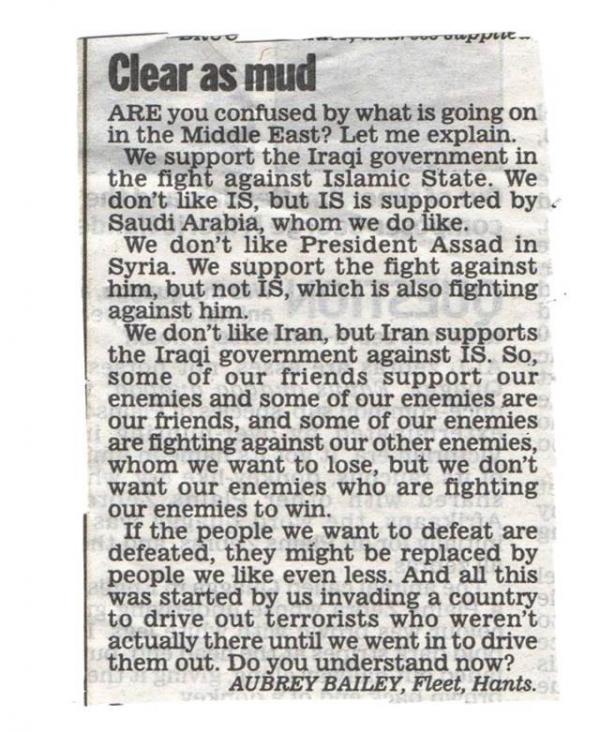
Clear as Mud

Middle East Explained_0The current state of U.S. foreign policy in a nutshell:

Are you confused by what is going on in the Middle-East? Let me explain. We support the Iraqi government in its fight against Islamic State (IS/ISIL/ISIS). We don’t like IS but IS is supported by Saudi Arabia whom we do like. We don’t like President Assad in Syria. We support the fight against him, but not IS, which is also fighting against him.

We don’t like Iran, but the Iranian government supports the Iraqi gov’t against IS. So, some of our friends support our enemies and some of our enemies are our friends, and some of our enemies are fighting our other enemies, whom we don’t want to lose, but we don’t want our enemies who are fighting our enemies to win.

If the people we want to defeat are defeated, they might be replaced by people we like even less. And, all this was started by us invading a country to drive out terrorists who weren’t actually there until we went in to drive them out – do you understand now?

We’re all criminals and outlaws in the eyes of the American police state

971022_267085910101343_1969177191_n

By John Whitehead

Source: Intrepid Report

“Never in the civilised world have so many been locked up for so little.”—“Rough Justice in America,” The Economist

Why are we seeing such an uptick in Americans being arrested for such absurd “violations” as letting their kids play at a park unsupervised, collecting rainwater and snow runoff on their own property, growing vegetables in their yard, and holding Bible studies in their living room?

Mind you, we’re not talking tickets or fines or even warnings being issued to these so-called “lawbreakers.” We’re talking felony charges, handcuffs, police cars, mug shots, pat downs, jail cells and criminal records.

Consider what happened to Nicole Gainey, the Florida mom who was arrested and charged with child neglect for allowing her 7-year-old son to visit a neighborhood playground located a half mile from their house.

For the so-called “crime” of allowing her son to play at the park unsupervised, Gainey was interrogated, arrested and handcuffed in front of her son, and transported to the local jail where she was physically searched, fingerprinted, photographed and held for seven hours and then forced to pay almost $4,000 in bond in order to return to her family. Gainey’s family and friends were subsequently questioned by the Dept. of Child Services. Gainey now faces a third-degree criminal felony charge that carries with it a fine of up to $5,000 and 5 years in jail.

For Denise Stewart, just being in the wrong place at the wrong time, whether or not she had done anything wrong, was sufficient to get her arrested.

The 48-year-old New York grandmother was dragged half-naked out of her apartment and handcuffed after police mistakenly raided her home when responding to a domestic disturbance call. Although it turns out the 911 call came from a different apartment on a different floor, Stewart is still facing charges of assaulting a police officer and resisting arrest.

And then there are those equally unfortunate individuals who unknowingly break laws they never even knew existed. John Yates is such a person. A commercial fisherman, Yates was sentenced to 30 days in prison and three years of supervised release for throwing back into the water some small fish which did not meet the Florida Fish and Wildlife Commission’s size restrictions. Incredibly, Yates was charged with violating a document shredding provision of the Sarbanes-Oxley Act, which was intended to prevent another Enron scandal.

The list of individuals who have suffered similar injustices at the hands of a runaway legal system is growing, ranging from the orchid grower jailed for improper paperwork and the lobstermen charged with importing lobster tails in plastic bags rather than cardboard boxes to the former science teacher labeled a federal criminal for digging for arrowheads in his favorite campsite.

As awful as these incidents are, however, it’s not enough to simply write them off as part of the national trend towards overcriminalization—although it is certainly that. Thanks to an overabundance of 4,500-plus federal crimes and 400,000 plus rules and regulations, it’s estimated that the average American actually commits three felonies a day without knowing it.

Nor can we just chalk them up as yet another symptom of an overzealous police state in which militarized police attack first and ask questions later—although it is that, too.

Nor is the problem that we’re a crime-ridden society. In fact, it’s just the opposite. The number of violent crimes in the country is down substantially, the lowest rate in 40 years, while the number of Americans being jailed for nonviolent crimes, such as driving with a suspended license, are skyrocketing.

So what’s really behind this drive to label Americans as criminals?

As with most things, if you want to know the real motives behind any government program, follow the money trail. When you dig down far enough, as I document in my book A Government of Wolves: The Emerging American Police State, you quickly find that those who profit from Americans being arrested are none other than the police who arrest them, the courts which try them, the prisons which incarcerate them, and the corporations, which manufacture the weapons and equipment used by police, build and run the prisons, and profit from the cheap prison labor.

Talk about a financial incentive.

First, there’s the whole make-work scheme. In the absence of crime, in order to keep the police and their related agencies employed, occupied, and utilizing the many militarized “toys” passed along by the Department of Homeland Security, one must invent new crimes—overcriminalization—and new criminals to be spied on, targeted, tracked, raided, arrested, prosecuted and jailed. Enter the police state.

Second, there’s the profit-incentive for states to lock up large numbers of Americans in private prisons. Just as police departments have quotas for how many tickets are issued and arrests made per month—a number tied directly to revenue—states now have quotas to meet for how many Americans go to jail. Having outsourced their inmate population to private prisons run by corporations such as Corrections Corp of America and the GEO Group, ostensibly as a way to save money, increasing numbers of states have contracted to keep their prisons at 90% to 100% capacity. This profit-driven form of mass punishment has, in turn, given rise to a $70 billion private prison industry that relies on the complicity of state governments to keep the money flowing and their privately run prisons full. No wonder the United States has the largest prison population in the world.

But what do you do when you’ve contracted to keep your prisons full but crime rates are falling? Easy. You create new categories of crime and render otherwise law-abiding Americans criminals. Notice how we keep coming full circle back to the point where it’s average Americans like you and me being targeted and turned into enemies of the state?

That brings me to the third factor contributing to Americans being arrested, charged with outrageous “crimes,” and jailed: the Corporate State’s need for profit and cheap labor. Not content to just lock up millions of people, corporations have also turned prisoners into forced laborers.

According to professors Steve Fraser and Joshua B. Freeman, “All told, nearly a million prisoners are now making office furniture, working in call centers, fabricating body armor, taking hotel reservations, working in slaughterhouses, or manufacturing textiles, shoes, and clothing, while getting paid somewhere between 93 cents and $4.73 per day.” Tens of thousands of inmates in U.S. prisons are making all sorts of products, from processing agricultural products like milk and beef, to packaging Starbucks coffee, to shrink-wrapping software for companies like Microsoft, to sewing lingerie for Victoria’s Secret.

What some Americans may not have realized, however, is that America’s economy has come to depend in large part on prison labor. “Prison labor reportedly produces 100 percent of military helmets, shirts, pants, tents, bags, canteens, and a variety of other equipment. Prison labor makes circuit boards for IBM, Texas Instruments, and Dell. Many McDonald’s uniforms are sewn by inmates. Other corporations—Microsoft, Victoria’s Secret, Boeing, Motorola, Compaq, Revlon, and Kmart—also benefit from prison labor.” The resulting prison labor industries, which rely on cheap, almost free labor, are doing as much to put the average American out of work as the outsourcing of jobs to China and India.

No wonder America is criminalizing mundane activities, arresting Americans for minor violations, and locking them up for long stretches of time. There’s a significant amount of money being made by the police, the courts, the prisons, and the corporations.

What we’re witnessing is the expansion of corrupt government power in the form of corporate partnerships which both increase the reach of the state into our private lives while also adding a profit motive into the mix, with potentially deadly consequences.

This perverse mixture of government authoritarianism and corporate profits is now the prevailing form of organization in American society today. We are not a nation dominated by corporations, nor are we a nation dominated by government. We are a nation dominated by corporations and government together, in partnership, against the interests of individuals, society and ultimately our freedoms.

If it sounds at all conspiratorial, the idea that a government would jail its citizens so corporations can make a profit, then you don’t know your history very well. It has been well documented that Nazi Germany forced inmates into concentration camps such as Auschwitz to provide cheap labor to BASF, Bayer, Hoechst, and other major German chemical and pharmaceutical companies, much of it to produce products for European countries.

Makes you wonder, doesn’t it, whether what we are experiencing right now is fascism, American style, or Auschwitz revisited?

Constitutional attorney and author John W. Whitehead is founder and president of The Rutherford Institute. His new book “The Freedom Wars” (TRI Press) is available online at www.amazon.com. Whitehead can be contacted at johnw@rutherford.org. Information about The Rutherford Institute is available at www.rutherford.org.

Related Podcast:


http://s39.podbean.com/pb/5665c5c51244adb1a2a1a2bd4c8c642e/53e29fdc/data2/blogs18/371244/uploads/PCH080514.mp3