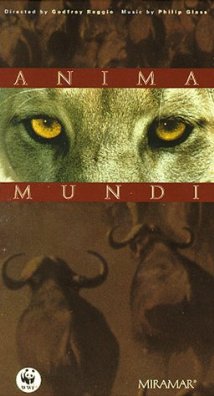
“Anima Mundi” (1992) was the third collaboration between director Godfrey Reggio and composer Philip Glass (following Koyaanisqatsi and Powaqqatsi). It was produced in collaboration with the World Wildlife Fund’s Biological Diversity Campaign and features amazing, beautiful and hypnotic images of a multitude of animal species from around the world. At just under half an hour, it’s a relatively short film but well worth seeing, especially for fans of non-narrative documentaries such as Koyaanisqatsi, Baraka, and Samsara.
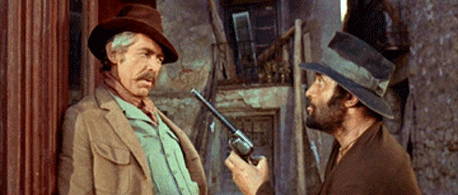
Most people know director Sergio Leone for his classic collaborations with Clint Eastwood on the “Man With No Name” trilogy of westerns or his later epics, “Once Upon a Time in the West” and “Once Upon a Time in America”. Fewer are familiar with the film he directed between the “Once Upon a Time” films, “Duck, You Sucker!” (1971). Its relative obscurity in the U.S. could partly be attributed to the horrible marketing from its American distributor United Artists.
The film’s title and advertising may have misled viewers to think they were in for a lighthearted comedy. It does have comedic moments but also contained scenes of massacres, some of which was edited out. For the film’s initial U.S. release it was trimmed by over half an hour because of violent and politically subversive content. Leone reportedly believed “Duck, You Sucker!” to be a common American colloquialism and so was probably not aware of the title’s slapstick tone. Not long after its release the film was reissued as “A Fistful of Dynamite” to cash in on the Clint Eastwood westerns which were popular at the time. Many were probably disappointed to discover that Eastwood wasn’t in the film. To add to the confusion, the title “Once Upon a Time…the Revolution” was used for some European releases to associate it with Leone’s previous film “Once Upon a Time in the West”.
Though “Duck You Sucker!” is not quite on par with Leone’s more well-known westerns such as “The Good, the Bad and the Ugly” and “Once Upon a Time in the West”, it’s still a great film though unfairly underrated. It contains many elements of classic Leone films such as beautiful panoramas, tense showdowns, extreme close-ups, morally complex characters, and a memorable soundtrack by Ennio Morricone. Similar to some of his earlier works, “Duck, You Sucker!” is at heart a philosophical action film exploring morality, honor, friendship, betrayal, idealism, pragmatism, redemption and the consequences of violence.
Since today marks the anniversary of Bob Marley’s birthday (February 6, 1945 – May 11, 1981), it seems an appropriate time to revisit that question with a repost of a classic article by Alex Constantine originally published in the February 2002 edition of High Times magazine:
Chanting Down Babylon: The CIA & The Death of Bob Marley
Story By Alex Constantine
Marley knew the drill – in Jamaica, at the height of his success, when music and politics were still one, before the fog of censorship rolled into the island, old wounds were opened by a wave of destabilization politics. Stories appeared in the local, regional and international press downsizing the achievements of the quasi-socialist Jamaican government under Prime Minister Michael Manley. In the late 1970s, the island was flooded with cheap guns, heroin, cocaine, right-wing propaganda, death squad rule and, as Grenada’s Prime Minister Maurice Bishop described it three years later, the CIA’s “pernicious attempts [to] wreck the economy.”
“Destabilization,” Bishop told the emergent New Jewel Party, “is the name given the most recently developed method of controlling and exploiting the lives and resources of a country and its people by a bigger and more powerful country through bullying, intimidation and violence.”
In response to the fascistic machinations of the CIA, Marley wove his lyrics into a revolutionary crucifix to ward off the cloak-and-dagger “vampires” descending upon the island. June 1976: Then-Governor-General Florizel Glasspole placed Jamaica under martial law to stanch the bloody pre-election violence. Prime Minister Manley’s People’s National Party asked the Wailers to play at the Smile Jamaica concert in December. Despite the rising political mayhem, Marley agreed to perform.
In late November, a death squad slipped beneath the gates of Marley’s home on Hope Road in Kingston. As biographer Timothy White tells it, at about 9 PM, “the torpor of the quiet tropical night was interrupted by a queer noise that was not quite like a firecracker.” Marley was in the kitchen at the rear of the house eating a grapefruit when he heard the bursts of automatic gunfire. Don Taylor, Marley’s manager, had been talking to the musician when the bullets ripped through the back of his legs. The men were “peppering the house with a barrage of rifle and pistol fire, shattering windows and splintering plaster and woodwork on the first floor.” Rita Marley, trying to escape with her children and a reporter from the Jamaica Daily News, was shot by one of the men in the front yard. The bullet caught her in the head, lifting her off her feet as it burrowed between scalp and skull.
Meanwhile, a man with an automatic rifle had burst through the back door off the pantry, pushing past a fleeing Seeco Patterson, the Wailers’ percussionist, to aim beyond Don Taylor at Bob Marley. The gunman got off eight shots. One bullet struck a counter, another buried itself in the ceiling, and five tore into Taylor. He fell but remained conscious, with four bullets in his legs and one buried at the base of his spine. The last shot creased Marley’s breast below his heart and drilled deep into his arm.
The survival of the reggae singer and his entire entourage appeared to be the work of Rasta. “The firepower these guys apparently brought with them was immense,” Wailers publicist Jeff Walker recalls. “There were bullet holes everywhere. In the kitchen, the bathroom, the living room, floors, ceilings, doorways and outside.”
There has since been widespread belief that the CIA arranged the hit on Hope Road. Neville Garrick, a Marley insider and former art director of the Jamaican Daily News, had film of “suspicious characters” lurking near the house before the assassination attempt. The day of the shooting he had snapped some photos of Marley standing beside a Volkswagen in a pool of mango-tree shade. The strangers in the background made Marley nervous; he told Garrick that they appeared to be “scouting” the property. In the prints, however, their features were too blurred by shadow to make out. After the concert, Garrick took the photographs and prints to Nassau. Sadly, while the Wailers and crew prepared to board a flight to London, he discovered that the film had been stolen.
Many of the CIA’s files on Bob Marley remain classified to the present day. However, on December 5, 1976, a week after the assault on Hope Road, the Wailers appeared at the Smile Jamaica fest, despite their wounds, to perform one long, defiant anthem of rage directed at the CIA – “War” – suggesting the Wailers’ own attitude toward the “Vampires” from Langley:
Until the ignoble and unhappy regimes
That now hold our brothers
In Angola, in Mozambique,
South Africa
In subhuman bondage
Have been toppled,
Utterly destroyed,
Everywhere is war…
Only a handful of Marley’s most trusted comrades knew of the band’s whereabouts before the festival. Yet a member of the film crew, or so he claimed – reportedly, he didn’t have a camera – managed to talk his way past machete-bearing Rastas to enter the Hope Road encampment: one Carl Colby, son of the late CIA director William Colby.
While the band prepared for the concert, a gift was delivered, according to a witness at the enclave – a pair of boots for Bob Marley. Former Los Angeles cinematographer Lee Lew-Lee [his camera work can be seen in the Oscar-winning documentary The Panama Deception] was close friends with members of the Wailers, and he believes that Marley’s cancer can be traced to the boots: “He put his foot in and said, ‘Ow!’ A friend got in there… he said, ‘let’s [get] in the boot, and he pulled a length of copper wire out – it was embedded in the boot.”
Had the wire been treated chemically with a carcinogenic toxin? The appearance of Colby at Marley’s compound was certainly provocative. [And so was Colby’s subsequent part in the fall of another black cultural icon, O.J. Simpson, nearly 20 years later. At Simpson’s preliminary hearing in 1995, Colby – who resided next door to Nicole Simpson on Gretna Green Way in Brentwood, a mile from her residence on Bundy – and his wife both took the stand to testify for the prosecution that Nicole’s ex-husband had badgered and threatened her. Colby’s testimony was instrumental in the formal charge of murder filed against Simpson and the nationally televised fiasco known as the “Trial of the Century.”]
Seventeen years after the Hope Road assault, Don Taylor published a memoir, Marley and Me, in which he alleges that a “senior CIA agent” had been planted among the crew as part of the plan to “assassinate” Marley. It’s possible that this lapse in security allowed Colby entrance to the compound. It’s clear that the CIA wanted Marley out of the picture. After the assassination attempt, a rumor circulated that the CIA was going to finish Marley off. The source of the rumor was the agency itself. The Wailers had set out on a world tour, and CIA agents informed Marley that should he return to Jamaica before the election, he would be murdered.
Taylor and others close to Marley suspect that it was more than a threat. Lew-Lee recalls: “I didn’t think so at the time, but I’ve always had my suspicions because Marley later broke his toe playing soccer, and when the bone wouldn’t mend the doctors found that the toe had cancer. The cancer metastasized throughout his body, but [Marley] believed he could fight this thing.”
British researcher Michael Conally observes: “They certainly had reasons for wanting to. For one, Marley’s highly charged message music made him an important figure that the rest of the world was beginning to notice. It was an influence that was hard to ignore, least of all because everywhere you went you saw middle- and upper-class white people sprouting dreadlocks, smoking spliffs and adopting the Rastafarian lifestyle. This sort of thing didn’t sit well with traditionalists and authoritarian types.”
The soccer game took place in Paris in 1977, five months after the boot incident, Marley took to the field with one of the leading teams in the country to break the monotony of the Wailers “Exodus” tour. His right toe was injured in a tackle. The toenail came off. At first, it wasn’t considered a serious wound.
But it would not heal. Marley was limping by July and consulted a physician, who was shocked by the toe’s appearance. It was so eaten away that doctors in London advised it be amputated. Marley’s religion forbade it: “Rasta no abide amputation,” he insisted. He told the physician, “De living God, His Imperial Majesty Haile Selassie I, Ras Tafari, Conquering Lion of the Tribe of Judah…He will heal me wit’ de meditations of me ganja chalice.” No scalpel, he said, “will crease me flesh… C’yant kill Rasta. Rastamon live out.”
He flew to Miami and Dr. William Bacon performed a skin graft on the lesion. The disease lingered undiagnosed and spread throughout his body.
Isaac Fergusson, a friend and devotee, observed the slow death of Bob Marley firsthand. In the three years separating soccer injury from cancer diagnosis, Marley remained immersed in music, “ignoring the advice of doctors and close associates that he stop and obtain a thorough medical examination.” He refused to give up recording and touring long enough to consult a doctor. Marley “would have to quit the stage and it would take years to recoup the momentum. This was his time and he seized upon it. Whenever he went into the studio to record, he did enough for two albums. Marley would drink his fish tea, eat his rice-and-peas stew, roll himself about six spliffs and go to work. With incredible energy and determination, he kept strumming his guitar, maybe 12 hours, sometimes till daybreak.” Reggae artist Jimmy Cliff observed after Marley’s death: “What I know now is that Bob finished all he had to do on this earth.” Marley was aware by 1977 that he was dying, and set out to condense a lifetime of music into the few years remaining.
The CIA Rocks Trenchtown
In 1975, US Secretary of State Henry Kissinger, on a diplomatic junket to the island, had assured Prim Minister Manley in a private meeting that there was “no attempt now underway involving covert actions against the Jamaican government.” But in the real world, something of a Caribbean pogrom was underway, overseen, of course, by the CIA. As Kissinger croaked his denials to Manley, the destabilization push was already afoot. The emphasis at this stage was on psychological operations, but in the election year of 1976 a series of covert interventions – employing arson, bombing and assassination as required – completely disrupted Manley’s democratic-socialist rule.
An arsenal of automatic weapons somehow found their way to Jamaica. The CIA’s thugs, directed by a growing coven of pinstriped officers reporting to the US embassy in Kingston, quietly organized secret-police cadres to stoke political violence. Huge consignments of guns and advanced communications gear were smuggled onto the island. One such shipment was intercepted by Manley’s security patrols – a cache of 500 man-eating submachine guns.
The firearms were shipped to the island from Miami by the Jamaican Freedom League, a right-wing paramilitary faction with roots in Langley, financed largely by drugs. Peter Whittington, the group’s second-in-command, was convicted of drug trafficking in Dade County, Florida. The funds were laundered by the League at Miami’s Bank of Perrine, the key American subsidiary of Castle Bank, then the CIA’s financial base in Latin America. The bank was owned and operated by Paul Helliwell, bagman for the Bay of Pigs invasion, accused even by the conservative Wall Street Journal of involvement in the global narcotics trade.
A paramilitary force was mustered to quell the Rastafarian backlash, and the inevitable CIA-trained Cuban exiles beached in Jamaica. Among them was Luis Posada Carriles, once a secret-police official under deposed Cuban dictator Fulgencio Batista, currently a full-fledged agent of the CIA.
The “duppies” [ghosts] policed dissent by incarnating the chemical-warfare tactics of the 1960s. In a year’s time, Marley saw the Rastafarian resistance disintegrate with the rise of a ruthless, highly organized narcotics syndicate, apparently from the Jamaican sand. The sudden abundance of hard narcotics in Jamaica wounded the Rastafarian movement with the burning spear of addiction. Marley and former Wailer Peter Tosh promoted ganja as an alternative to cocaine and heroin, a statement of independence and cohesion against the brutal stratagems of colonial rule.
For the first time in Jamaican politics, public figures roundly criticized the governing elite. Peter Tosh, in particular, split form his peers in the local music scene by serving up impassioned political “livalogues” at his public performances. Tosh pushed on, a cursing, joint-smoking, speechifying black militant, until his murder six years after the passing of Marley.
The suppression of Rastafarian protest escalated in the late 1970s, and grotesque human-rights abuses were commonplace. And the political climate in the Caribbean sweltered with the escalation of American covert operations well into the next decade.
The Nazi Doctor
In September 1980, Bob Marley suffered a stroke while jogging in New York’s Central Park. He was released by a physician the following day and recuperated in his room at the Essex Hotel. Rita Marley choked when she saw him. Her fears rose into uncontrollable sobs, “Wha’ has happened to you?” “Doctor say brain tumor black me out,” Marley told her. Isaac Fergusson had caught the dying rebel’s performance at Madison Square Garden a few days before, and had realized then that something was terribly wrong, even as Marley gripped his guitar “like a machine gun” and “threw his ropelike hair about,” a “whirlwind around his small black face. The crack of a drum exploded into bass, into organ.” Midway into the set, the Wailers stood back and Marley did a solo: “These songs of freedom is all I ever had…” Why, Fergusson wondered, was he singing this alone? Why the past tense?
“Emancipate yourself from mental slavery…”
Fergusson noticed that Marley “was always rubbing his forehead and grimacing while performing.” The following weekend, Fergusson stopped to visit Rita Marley and Judy Mowatt. He asked about Bob’s condition. “We don’t know for sure,” Rita told him. “The doctors say he has a tumor in his brain.” In a silent moment, Fergusson realized that Marley was dying.
He was convinced at last to seek medical treatment. Marley was admitted to the Sloan-Kettering Cancer Center in Manhattan. Tests revealed that the cancer had spread to his brain, lungs and liver. The reggae legend received a few radiation treatments, but checked out when the New York papers let on that he was seriously ill. Marley consulted physicians in Miami, briefly returned to Sloan-Kettering, then to Jamaica, where he met with Dr. Carl “Pee Wee” Fraser, recommended to him by fellow Rastafarians. Dr. Fraser advised that Marley talk to Dr. Josef Issels, a German “holistic comprehensive immunotherapist” then practicing at the Ringberg Clinic in Rottach-Egern, a small Bavarian village located at the southern end of Tegernsee Lake.
Marley traveled to Bavaria and checked into the clinic. Dr. Issels met him, looked him over and allowed, without naming sources: “I hear that you’re one of the most dangerous black men in the world.”
The portrait offered by publicity releases from the Issels Foundation is imposing enough: Dr. Issels, born in 1907, founded the first hospital [financed by the estate of Karl Gischler, a Dutch shipping magnate] in Europe for comprehensive immunotherapy of cancer in 1951. He was the medical director and director of research.
All well and good… until it is considered that by this time, Dr. Issels was 44 years old. Certainly, his medical career did not begin in 1951. Why the unexplained gap in his bona fides? During World War II, it seems, Dr. Issels could be found plying his “research” skills for Hitler’s SS. Lew-Lee claims that Dr. Issels was assigned to the Auschwitz concentration camp, working alongside Dr. Josef Mengele. But author Gordon Thomas, in a long-out-of-print biography of Issels, contends that the doctor served in the SS only briefly. At any rate, he was indeed a member of the Nazi Party and served under Heinrich Himmler. Bob Marley, the “dangerous” black upstart, had placed his life in the hands of a Nazi doctor.
Lew-Lee recalls that Marley rejected conventional cancer treatments, “wanted to do anything but turn to Western medicine. This may have been a mistake.” Evidently so. “Dr. Issels said that he could cur Bob. And they cut Bob’s dreadlocks off. And he was getting all of this crazy, crazy medical treatment in Bavaria. I know this because Devon Evans [a musician then playing with the Wailers] told me that Bob was receiving these medical treatments.” Evans came by “every two or three months – 1979-80 – and told me: ‘Yeah, man, they’re killing Bob. They are KILLING Bob.’ I said, ‘What do you mean ‘they are killing Bob?’ ‘No, no, man,’ he said. ‘Dis Dr. Issels, he’s a Nazi!’”
Dr. Issels was one of the scores of Nazi practitioners to escape the attention of the Nuremberg tribunal. Michael Kater, a professor of history at York University in Canada, informs us that physicians of the Hitler period were steeped in Nazi racial doctrines at medical school, that many of them continued to practice undisturbed by war-crimes tribunals: “It was in a conventional medical culture, infiltrated from one side by a science alienated from humanity and from another by charlatanry, that young physicians in the Third Reich were raised to learn and prepare for practice, with many predestined to practice after 1945.”
Dr. Josef Issels first offered his alternative cancer therapies in a Nazi-fied atmosphere of ruthlessness and quackery. In the 1930s, chronic cancer patients consulted Dr. Issels and received his experimental “combination therapy,” a regimen of diet, homeopathic remedies, vitamins, exercise and detoxification, among other holistic approaches. Today, his clinic offers training in cancer immunization vaccines, UV blood irradiation, oxygen and ozone therapy, “biological dentistry” [tooth extraction], immunity elicitation by mixed bacterial vaccine, blood heating, and so on.
The medical establishment, particularly in the UK, has long rallied against some of Issels’ therapies. A former BBC producer reported in a televised documentary that Dr. Issels was arrested in September 1960. The police warrant alleged, “The accused claims to treat… cancer…. In fact [he] has neither reliable diagnostic methods nor a method to treat cancer successfully. It is contended [that] he is aware of the complete ineffectiveness of this so-called… tumor treatment.” It also called Issels a flight risk, noting that “he had prepared for all contingencies by depositing huge amounts in foreign banks.”
Marley, unaware of his physician’s past, was placed on a regimen of exercise, vaccines [some illegal], ozone injections, vitamins and trace minerals.
In time, Dr. Issels also introduced torture. Long needles were plunged through Marley’s stomach through to the spine. The patient-victim was told that this was part of his “treatment.” The torture continued until Marley foundered on the threshold of death.
Cedella Booker-Marley, his mother, visited him three times in the course of the “treatments.” She found Dr. Issels to be an “arrogant wretch” with the “gruff manners of a bully,” who subjected her dying son to a bloodless brand of “hocus-pocus” medicine. Booker-Marley: “I myself witnessed Issels’ rough treatment of Nesta [Marley]. One time I went with Nesta to the clinic, and we settled down in a treatment room. Issels came in and announced to Nesta, ‘I’m going to give you a needle.’” Dr. Issels “plunged the needle straight into Nesta’s navel right down to the syringe. [Marley] grunted and winced. He could only lie there helplessly, writhing on the table, trying his best to hide his pain. ‘Jesus Christ,’ I heard myself mumbling.” Issels yanked out the needle and strolled casually out of the room. Marley was left groaning with pain. “I went and stood at his side and held is hand.
“With every visit,” she recalls, “I found him smaller, frailer, thinner. As the months of dying dragged on, the suffering was etched all over his face. He would fall into fits of shaking, when he would lose all control and shiver from head to toe like a coconut leaf in the breeze. His eyes would turn in his head, rolling in their sockets until even the white jelly was quivering.”
Marley’s torment was aggravated by starvation. “For a whole week sometimes,” Booker laments, her son “would be allowed no nourishment other than what he got intravenously. Constantly hungry, even starving, he wasted away to a skeleton” – starved to death like an Auschwitz inmate. “To watch my first-born shrivel up to skin and bone ripped at my mother’s heart.” Marley weighed 82 pounds on the day of his death. The starvation diet must have devastated his immune system and rushed his demise, not prolonged his life as Dr. Issels and some biographers have contended. It also caused him intense pain. “It would drag on so, for one long painful month after the other, and every day would be a knife that death stabbed and twisted anew in an already open, bleeding wound.” The agony “wrapped him up like a crushing snake.”
Death finally claimed Marley on May 11, 1981. In Jamaica, May 20 was declared a national day of mourning. Marley’s wake at the National Arena was attended by some 30,000 mourners.
He was survived by his old partner Peter Tosh, who was shot to death in 1987. Marley and Tosh were not the only musicians murdered for political reasons in Jamaica. By the end of the decade, all Jamaican musicians were censored and subject to shell-casing politics.
The island’s Daily Gleaner reported in 1987 that Winston “Yellowman” Foster, stopped at a police roadblock and frisked for drugs, resisted detainment. One of the officers hissed, “You want to go like Tosh?” When Tosh went, there was nothing random about it. Witnesses and friends insist that he was a political hit. Two of the gunmen fled to New York to remain at large. The third was Dennis “Leppo” Lobban, an ex-con sentenced for the murder after an 11-minute trial.
Like Marley, Peter Tosh found the bloodshed and hypocrisy of death squad justice and CIA covert ops in the Third World unbearable. He was so obsessed with hidden evil and the upswell of violence in Jamaica that they visited him in his sleep. He had “visions” of “destruction [and] millions of people inside of [a] pit going down. And I… say, ‘bloodbath, where so much people come from?’ and looking in the pit, mon, it the biggest pit… but the way the people was crying, it was awful.”
“The Spook Who Sat by the Door” (1973) is one of the most unabashedly radical revenge fantasies ever filmed. Based on the 1969 novel by Sam Greenlee, the film was directed by Ivan Dixon, and co-produced by Dixon and Greenlee, who had to resort to grassroots community fundraising to get it made. The plot centers on Dan Freeman, a covert black nationalist who infiltrates the Chicago offices of the CIA as a token black employee in a clerical position (they seat him by the door to demonstrate their commitment to diversity for visitors). After learning what he needs to learn, Freeman promptly resigns, gets a new position as a social worker in the ghetto, recruits an army of freedom fighters and teaches them CIA guerrilla warfare tactics in preparation for an uprising. Not surprisingly, the film was removed from theaters shortly after release due to pressure from the FBI and was not available on home video until 2004.
The full version of the The Spook Who Sat by the Door presented on the following YouTube video is preceded by interviews with Sam Greenlee who provides details about how his film was suppressed by the government:
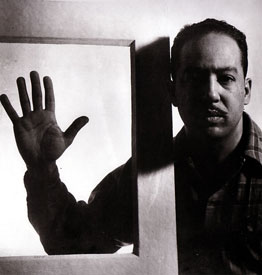
On this day in 1902, legendary poet, novelist, playwright and activist Langston Hughes was born in Joplin, Missouri. He was a central figure of the Harlem Renaissance movement and produced art that was often influenced by the music of his time and were expressions of his cultural pride and love for humanity. These are a sampling of his poems that retain their power and relevance to this day:
Give Us Our Peace
Give us a peace equal to the war
Or else our souls will be unsatisfied,
And we will wonder what we have fought for
And why the many died.
Give us a peace of accepting every challenge –
The challenge of the poor, the black, of all denied,
The challenge of the vast colonial world
That long has had so little justice by its side.
Give us a peace that dares us to be wise.
Give us a peace that dares us to be strong.
Give us a peace that dares us still uphold
Throughout the peace our battle against wrong.
Give us a peace that is not cheaply used,
A peace that is no clever scheme,
A people’s peace for which men can enthuse,
A peace that brings reality to our dream.
Give us a peace that will produce great schools –
As the war produced great armament,
A peace that will wipe out our slums –
As war wiped out our foes on evil bent.
Give us a peace that will enlist
A mighty army serving human kind,
Not just an army geared to kill,
But trained to help the living mind.
An army trained to shape our common good
And bring about a world of brotherhood.
Harlem (Dream Deferred)
What happens to a dream deferred?
Does it dry up
like a raisin in the sun?
Or fester like a sore—
And then run?
Does it stink like rotten meat?
Or crust and sugar over—
like a syrupy sweet?
Maybe it just sags
like a heavy load.
Or does it explode?
Let America be America Again
Let America be America again.
Let it be the dream it used to be.
Let it be the pioneer on the plain
Seeking a home where he himself is free.
(America never was America to me.)
Let America be the dream the dreamers dreamed–
Let it be that great strong land of love
Where never kings connive nor tyrants scheme
That any man be crushed by one above.
(It never was America to me.)
O, let my land be a land where Liberty
Is crowned with no false patriotic wreath,
But opportunity is real, and life is free,
Equality is in the air we breathe.
(There’s never been equality for me,
Nor freedom in this “homeland of the free.”)
Say, who are you that mumbles in the dark?
And who are you that draws your veil across the stars?
I am the poor white, fooled and pushed apart,
I am the Negro bearing slavery’s scars.
I am the red man driven from the land,
I am the immigrant clutching the hope I seek–
And finding only the same old stupid plan
Of dog eat dog, of mighty crush the weak.
I am the young man, full of strength and hope,
Tangled in that ancient endless chain
Of profit, power, gain, of grab the land!
Of grab the gold! Of grab the ways of satisfying need!
Of work the men! Of take the pay!
Of owning everything for one’s own greed!
I am the farmer, bondsman to the soil.
I am the worker sold to the machine.
I am the Negro, servant to you all.
I am the people, humble, hungry, mean–
Hungry yet today despite the dream.
Beaten yet today–O, Pioneers!
I am the man who never got ahead,
The poorest worker bartered through the years.
Yet I’m the one who dreamt our basic dream
In the Old World while still a serf of kings,
Who dreamt a dream so strong, so brave, so true,
That even yet its mighty daring sings
In every brick and stone, in every furrow turned
That’s made America the land it has become.
O, I’m the man who sailed those early seas
In search of what I meant to be my home–
For I’m the one who left dark Ireland’s shore,
And Poland’s plain, and England’s grassy lea,
And torn from Black Africa’s strand I came
To build a “homeland of the free.”
The free?
Who said the free? Not me?
Surely not me? The millions on relief today?
The millions shot down when we strike?
The millions who have nothing for our pay?
For all the dreams we’ve dreamed
And all the songs we’ve sung
And all the hopes we’ve held
And all the flags we’ve hung,
The millions who have nothing for our pay–
Except the dream that’s almost dead today.
O, let America be America again–
The land that never has been yet–
And yet must be–the land where every man is free.
The land that’s mine–the poor man’s, Indian’s, Negro’s, ME–
Who made America,
Whose sweat and blood, whose faith and pain,
Whose hand at the foundry, whose plow in the rain,
Must bring back our mighty dream again.
Sure, call me any ugly name you choose–
The steel of freedom does not stain.
From those who live like leeches on the people’s lives,
We must take back our land again,
America!
O, yes,
I say it plain,
America never was America to me,
And yet I swear this oath–
America will be!
Out of the rack and ruin of our gangster death,
The rape and rot of graft, and stealth, and lies,
We, the people, must redeem
The land, the mines, the plants, the rivers.
The mountains and the endless plain–
All, all the stretch of these great green states–
And make America again!
Starting tomorrow I will be trekking through rural Central America. Since I will have very limited (if any) internet access I will resume regular postings when I return on February 24. Until then, there’s plenty to see in the archives and I’ve prescheduled recurring film and music features with a few surprise posts in-between.
Thanks to all who follow this blog and have supported it through likes, links, reposts, pings, and comments, especially Peter, Jeff, Nolan and Truthman (who are each skilled and insightful writers in their own right). You’ve helped make the site not just a source of news, commentary and media, but a unique community. Since starting the blog last August I’ve also found it to be therapeutic in the sense that it’s rewarding to facilitate the process of discovery of a world of ideas whether others find it relevant, wrongheaded, uplifting, depressing, humorous, etc. I just hope it’s interesting, provocative and/or promotes critical thought
I’ll miss doing the blog while away but will return re-energized, inspired and with a broadened perspective.