The Drums of War Beat Louder

Illustration by Shutterstock – edited by Büşra Öztürk.

By Paul Craig Roberts

Source: PaulCraigRoberts.org

My forebodings/predictions about the Kremlin’s limited go-slow war in Ukraine are proving correct.  Putin and Russia are demonized.  Unprecedented sanctions amounting to piracy and theft have been imposed on Russia. The US and Europe are joining the war as de facto combatants. More countries are joining NATO with the result being the prospect of more US missile bases on Russia’s borders. The Western media controls the narrative, which is Russia is losing and can be defeated with more many billions of dollars from the US and more weapons that enrich the US military/security complex.  Why any Russian government would expose itself to this and so many chances for miscalculation that ends in WW III is a mystery.  What did the Kremlin imagine it was achieving by creating a situation that exposed Rusaia to many months of war propaganda, punishment, and Western preparations for wider war?

What peace needed was a quick decisive Russian victory that demonstrated extraordinary military power that completely stopped any further Western provocations of Russia.  But the Kremlin was too liberal-minded to do what was neccessary. Consequently the Kremlin made a strategic error, dropped the ball and has failed to protect Russia from provocations that are leading to WW III.

Instead, the Kremlin filled with liberal delusions long discarded in the West decided to show a good side by limiting itself to the rescue of the Donbass Russians.  This gave the West all it needed to present Russia as a military incompetent upstart.  Among the Kremlin’s errors, the Kremlin overlooked that Ukraine’s distress from the limited Russian intervention created an opportunity for Poland to claim former Polish territories in western Ukraine where there are no Russian troops engaged. It is possible that the Polish government, disinformed by Western media’s picture of Russian military failure in Ukraine, will occupy western Ukraine as preparation to reclaiming it as Russia did Crimea and now Donbass.  As Russia will have eastern and southern Ukraine, the country could simply disappear as Poland resurrects greater Poland. In its history, Ukraine has either been part of Poland’s empire or part of Russia.

If Poland moves into western Ukraine as it is tempted to do, opportunities for Polish-Russian conflict arise.  As Poland is a NATO member, Washington has given Poland, as the British government did with World War II’s “Polish Guarantee,” the power to start a world war.

The Polish government has a penchant for emotional decisons, not responsible decisions. Just as the Polish military dictatorship thought the “British Guarantee” protected them, causing them to spurn Hitler’s demand for the return of German territory stripped from Germany in the Versailles Treaty despite President Wilson’s “guarantee” of no territorial losses, the Polish government thinks today that NATO membership protects Poland from Russian retaliation.

The government in Warsaw does not comprehand that the “NATO Guarantee” is worth no more than the British Government’s guarantee that launched WW II.

The governments that comprise the Western World have given Poland, once again, the decision whether there is to be a World War.

This deplorable and unsettling fact stares us in the face, but no Western media, not even online media, acknowledges it.

The situation that exists today is that either Russia and China must accept US hegemony or the neoconservaties will push Russia and China into war with the West. The hegemonic ambition of the neoconservatives is inconsistent with a peaceful world.

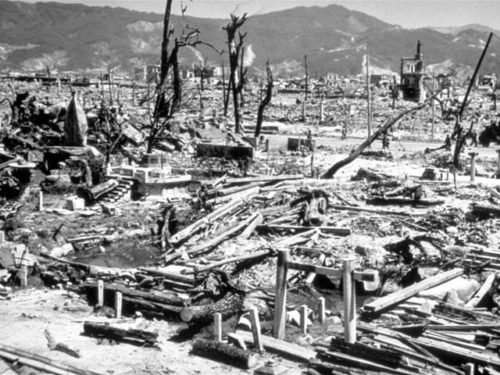
Were the Atomic Bombings of Hiroshima and Nagasaki a War Crime and a Crime Against Humanity?

This August 6, 1945 file photo shows the destruction from the explosion of an atomic bomb in Hiroshima Japan AP-Photo-File

By Rossen Vassilev Jr.

Source: Global Research

74 Years Ago, the first atomic bomb was dropped on Hiroshima on August 6, 1945

Was President Harry Truman “a murderer,” as the renowned British analytic philosopher Gertrude Elizabeth Anscombe once charged? Were the atomic bombings of Hiroshima and Nagasaki indeed a war crime and a crime against humanity, as she and other academic luminaries have publicly claimed? A Distinguished Professor of Philosophy and Ethics at Oxford and Cambridge, who was one of the 20th century’s most gifted philosophers and recognizably the greatest woman philosopher in history, Dr. Anscombe openly called President Truman a “war criminal” for his decision to have the Japanese cities of Hiroshima and Nagasaki leveled by atomic bombs in August 1945 (Rachels & Rachels 127). According to another academic critic, the late American historian Howard Zinn, at least 140,000 Japanese civilians were “turned into powder and ash” in Hiroshima. Over 70,000 civilians were incinerated in Nagasaki, and another 130,000 residents of the two cities died of radiation sickness in the next five years (Zinn 23).

The two most often cited reasons for President Truman’s controversial decision were to shorten the war and to save the lives of “between 250,000 and 500,000” American soldiers who could have possibly died in battle had the U.S. military had to invade the home islands of Imperial Japan. Truman reportedly claimed that

“I could not bear this thought and it led to the decision to use the atomic bomb” (Dallek 26).

But Dr. Gertrude Anscombe, who along with her husband, Dr. Peter Geach, Professor of Philosophical Logic and Ethics, were the 20th century’s foremost philosophical champions of the doctrine that moral rules are absolute, did not buy this morally callous argument:

“Come now: if you had to choose between boiling one baby and letting some frightful disaster befall a thousand people—or a million people, if a thousand is not enough—what would you do? For men to choose to kill the innocent as a means to their ends is always murder” (Rachels & Rachels 128-129).

In 1956, Professor Anscombe and other prominent faculty members of Oxford University openly protested the decision of university administrators to grant Truman an honorary degree in gratitude for America’s wartime help. She even wrote a pamphlet, explaining that the former U.S. President was “a murderer” and “a war criminal” (Rachels & Rachels 128).

In the eyes of many contemporaries of Elizabeth Anscombe, the atomic bombings of Hiroshima and Nagasaki violated famous philosophical-ethical norms such as the “Sanctity of Human Life,” the “Wrongfulness of Killing,” and also that “it is wrong to use people as means to other people’s ends.” Former President Herbert Hoover was another early critic, openly declaring that

“The use of the atom bomb, with its indiscriminate killing of women and children, revolts me” (Alperovitz The Decision 635).

Even President Truman’s own Chief of Staff, the five-star Admiral William D. Leahy (the most senior U.S. military officer during the war) made no secret of his strong disapprobation of the atomic bombings:

“It is my opinion that the use of this barbarous weapon at Hiroshima and Nagasaki was of no material assistance in our war against Japan. The Japanese were already defeated and ready to surrender because of the effective sea blockade and the successful bombing with conventional weapons…. My own feeling is that in being the first to use it, we had adopted an ethical standard common to the barbarians of the Dark Ages…. I was not taught to make war in that fashion, and wars cannot be won by destroying women and children” (Claypool 86-87, emphasis added).

The apologists for President Truman, on the other hand, seem to be using the quasi-Utilitarian “Benefits Argument” to justify the barbaric use of a devastating weapon of mass destruction, which killed hundreds of thousands of innocent civilians in the two targeted Japanese cities even though (contrary to Truman’s many public pronouncements at that time) there had been no military troops, no heavy weaponry, or even any major war-related industries in either city. Because nearly the entire adult male population of both Hiroshima and Nagasaki had been drafted by the Japanese military, it was mostly women, children, and old men who fell victims to fiery death from the sky. The excuse that Truman himself repeatedly offered was:

“The dropping of the bombs stopped the war, saved millions of lives” (Alperovitz Atomic Diplomacy 10).

He even boasted that he had “slept like a baby” the night after signing the final order to use the atomic bombs against Japan (Rachels & Rachels 127). But what Truman was saying in self-justification was far from being the truth—let alone the whole truth.

Unleashing a nuclear Frankenstein

At the urging of a fellow nuclear physicist—the anti-Nazi Hungarian émigré Leo SzilardAlbert Einstein wrote a letter to President Franklin D. Roosevelt on August 2, 1939, recommending that the U.S. government should start work on a powerful atomic device as a defensive deterrent to Nazi Germany’s possible acquisition and use of nuclear weaponry (Ham 103-104). But when the top-secret Manhattan Project finally got off the ground in early 1942, the U.S. military obviously had other, much more offensive plans regarding the future targets of America’s A-bombs. While at least 67 other Japanese cities, including the capital Tokyo, were reduced to rubble by daily conventional firebombing, including the use of napalm and other incendiaries, Hiroshima and Nagasaki had been deliberately spared for the sole purpose of testing the destructiveness of the new atomic device (Claypool 11).

An even more important reason for employing the bomb was to scare Stalin, who had turned quickly from “Old Uncle Joe” at the time of the FDR presidency into “the Red Menace” in the eyes of Truman and his top advisers. President Truman had quickly abandoned FDR’s policy of cooperation with Moscow, replacing it with a new policy of hostile confrontation with Stalin, in which America’s newly-acquired monopoly over nuclear armaments would be exploited as an aggressive tool of Washington’s anti-Soviet diplomacy (Truman’s so-called “atomic diplomacy”). Fully two months before Hiroshima and Nagasaki, the same Leo Szilard had met privately with Truman’s Secretary of State, James F. Byrnes, and had tried unsuccessfully to persuade him that the nuclear weapon should not be used to destroy helpless civilian targets such as Japan’s cities. According to Dr. Szilard,

“Mr. Byrnes did not argue that it was necessary to use the bomb against the cities of Japan in order to win the war…. Mr. Byrnes’s view [was] that our possessing and demonstrating the bomb would make Russia more manageable in Europe” (Alperovitz Atomic Diplomacy 1, 290).

The Truman Administration had, in fact, postponed the Potsdam meeting of the Big Three until July 17, 1945—one day after the successful Trinity test of the first A-bomb at the Alamogordo testing range in New Mexico—to give Truman extra diplomatic leverage in negotiating with Stalin (Alperovitz Atomic Diplomacy 6). In Truman’s own words, the atom bomb “would keep the Russians straight” and “put us in a position to dictate our own terms at the end of the war” (Alperovitz Atomic Diplomacy 54, 63).

At this point, the Truman Administration was no longer interested in having Moscow’s Red Army liberate Northern China (Manchuria) from Japanese military occupation (as FDR, Churchill, and Stalin had jointly agreed at the Yalta Conference in February 1945)—let alone invade or capture Imperial Japan itself. Quite to the contrary. Publicly deploring the “political-diplomatic rather than military motives” behind Truman’s decision to nuke Japan, Albert Einstein complained that “a great majority of scientists were opposed to the sudden employment of the atom bomb. I suspect that the affair was precipitated by a desire to end the war in the Pacific by any means before Russia’s participation” (Alperovitz The Decision 444). Winston Churchill privately told his Foreign Secretary, Anthony Eden,at the Potsdam Conference that

“It is quite clear that the United States do not at the present time desire Russian participation in the war against Japan” (Claypool 78).

Not even Tokyo’s last-minute desperate offer (made during and after the Potsdam Conference) to surrender if the Allies promised not to prosecute Japan’s god-like emperor or remove him from office—could prevent this deadly decision, even though Truman “had indicated a willingness to maintain the emperor on the throne” (Dallek 25).

Therefore, sparing the lives of American GIs was hardly one of Truman’s more convincing arguments. In early 1945, FDR and Army General Dwight Eisenhower, Supreme Commander of the Allied Forces in Europe, had together decided to leave the capture of Berlin to Soviet Marshal Georgi Zhukov‘s battle-hardened troops in order to avoid heavy American casualties. After officially declaring war on Tokyo on August 8, 1945, and having destroyed the Japanese military forces in Manchuria, Stalin’s Red Army prepared to invade and occupy Japan’s home islands—which certainly would have saved the lives of thousands of U.S. servicemen about whom Truman seemed so vocally concerned. But following Nazi Germany’s unconditional surrender in May 1945, Truman had come to share Winston Churchill’s famous revisionist assessment that “We have slain the wrong swine.”

It is not even clear whether Tokyo finally surrendered on August 14 due to the two U.S. nuclear attacks carried out on August 6 and August 9, respectively (after which there were practically no more Japanese cities left to destroy nor any more U.S. A-bombs to drop)—or because of the threat of Soviet invasion and occupation after Moscow had entered the war against the Empire of Japan. Just days before the Soviet declaration of war, the Japanese ambassador to Moscow had cabled Foreign Minister Shigenori Togo in Tokyo that Moscow’s entry into the war would spell a total disaster for Japan:

“If Russia…should suddenly decide to take advantage of our weakness and intervene against us with force of arms, we would be in a completely hopeless situation. It is clear as day that the Imperial Army in Manchukuo [Manchuria] would be completely unable to oppose the Red Army which has just won a great victory and is superior to us on all points” (Barnes).

To nuke or not to nuke

General Eisenhower was later quoted as stating his conviction that it had not been “necessary” militarily to use the bomb to force Japanese surrender:

“Japan was, at that very moment, seeking some way to surrender with a minimum loss of ‘face’…it wasn’t necessary to hit them with that awful thing” (Alperovitz Atomic Diplomacy 14).

In private, Eisenhower repeated his objections to his direct boss, Truman’s Secretary of War Henry L. Stimson:

“I had been conscious of a feeling of depression and so I voiced to him my strong misgivings, first on the basis of my belief that Japan was already defeated and that dropping the bomb was completely unnecessary, and secondly because I thought that our country should avoid shocking world opinion by the use of a weapon whose employment was, I thought, no longer mandatory as a measure to save American lives” (Alperovitz Atomic Diplomacy 14).

Admiral William F. Halsey, commander of the U.S. Third Fleet (which conducted the bulk of naval operations against the Japanese in the Pacific during the entire war), agreed that there was “no military need” to employ the new weapon, which was used only because the Truman Administration had a “toy and they wanted to try it out…. The first atomic bomb was an unnecessary experiment…. It was a mistake to ever drop it” (Alperovitz The Decision 445). Indeed, it was quite “certain” at the time that a totally devastated Japan, which was on the verge of internal collapse, would have surrendered within weeks, if not days, without the atomic bombings of Hiroshima and Nagasaki or even without the Soviet declaration of war against Tokyo. As the official U.S. Strategic Bombing Survey concluded at the end of the war, “certainly prior to 31 December 1945, and in all probability prior to 1 November 1945, Japan would have surrendered even if the atomic bombs had not been dropped, even if Russia had not entered the war, and even if no invasion had been planned or contemplated” (Alperovitz Atomic Diplomacy 10-11).

Major General Curtis E. Lemay, commander of the U.S. Twenty-first Bomber Command which had conducted the massive conventional bombing campaign against wartime Japan and dropped the atomic bombs on Hiroshima and Nagasaki, stated publicly: “I felt there was no need to use them [atomic weapons]. We were doing the job with incendiaries. We were hurting Japan badly…. We went ahead and dropped the bombs because President Truman told me to do it…. All the atomic bomb did was, in all probability, save a few days” (Alperovitz The Decision 340).

The fateful decision to drop the two atomic bombs code-named “Little Boy” and “Fat Man” on Japan may have been made a little bit more morally acceptable for Truman by the daily carpet bombing of German and Japanese cities throughout the war, including the firebombings of Hamburg, Dresden, and Tokyowhich had nearly wiped out their civilian populations. The declared goal of these relentless city-busting air raids was to destroy the morale and the will to fight of the German and Japanese people and thus shorten the war. But many years after the war Dr. Howard Zinn (himself a B-17 co-pilot and bombardier who had flown dozens of bombing missions against Nazi Germany) sadly mused: “No one seemed conscious of the irony—that one of the reasons for the general indignation against the fascist powers was their history of indiscriminate bombing of civilian populations” (Zinn 37). But, in fact, Secretary of War Henry Stimson, Admiral William Leahy, and Army General Douglas MacArthur were no less disturbed by what they saw as the barbarity of the “terror” air campaign, with Stimson privately fearing that the U.S. would “get the reputation for outdoing Hitler in atrocities” (Ham 63).

Clearly, Japan was defeated and was preparing to surrender before the bomb was used, whose main—if not the only—purpose was to intimidate the Soviet Union. But there had been several viable alternatives, some of which were discussed prior to the atomic bombings. The Under Secretary of the Navy, Ralph Bard, had become convinced that “the Japanese war was really won” and was so disturbed by the prospect of using atom bombs against defenseless civilians that he secured a meeting with President Truman, at which he unsuccessfully pressed his case “for warning the Japanese of the nature of the new weapon” (Alperovitz Atomic Diplomacy 19). Admiral Lewis L. Strauss, Special Assistant to the Secretary of the Navy, who replaced Bard after the latter’s angry resignation, also believed that “the war was very nearly over. The Japanese were nearly ready to capitulate.” That is why Admiral Strauss insisted that the atom bomb should be demonstrated in a way that would not kill large numbers of civilians, proposing that “…a satisfactory place for such a demonstration would be a large forest of cryptomeria trees not far from Tokyo” (Alperovitz Atomic Diplomacy 19). General George C. Marshall, U.S. Army Chief of Staff, was equally opposed to the bomb being used on civilian areas, arguing instead that

“…these weapons might be used against straight military objectives such as a large naval installation and then if no complete result was derived from the effect of that…we ought to designate a number of large manufacturing areas from which people would be warned to leave —telling the Japanese that we intend to destroy such centers…. Every effort should be made to keep our record of warning clear…. We must offset by such warning methods the opprobrium which might follow from an ill-considered employment of such force” (Alperovitz Atomic Diplomacy 20).

General Marshall also insisted that instead of surprising the Russians with the first use of the atom bomb, Moscow should be invited to send observers to the Alamogordo nuclear test. Many of the scientists working for the Manhattan Project likewise urged that a demonstration be arranged first, including a possible nuclear explosion at sea in close proximity to Japan’s coast, so that the bomb’s destructive power would be made clear to the Japanese before it was used against them. But, like the U.S. military’s dissenting views, the nuclear scientists’ opposition was never considered seriously by the Truman Administration (Alperovitz Atomic Diplomacy 20-21).

Conclusion

As a result of Truman’s immoral decision to use nuclear explosives against the “Japs” (a derogatory name for the Japanese commonly used in public in wartime America, including by President Truman himself), well over 200,000 civilians were instantly cremated and many thousands died later of radiation sickness. J. Robert Oppenheimer, scientific director of the Manhattan Project and “father” of the U.S. atom bomb, declared that Truman’s decision was “a grievous error,” because now “we have blood on our hands” (Claypool 17). Howard Zinn agreed with Dr. Oppenheimer’s judgment, remarking that “much of the argument defending the atomic bombings has been based on a mood of retaliation, as if the children of Hiroshima had bombed Pearl Harbor…. Did American children deserve to die because of the U.S. massacre of Vietnamese children at My Lai?” (Zinn 59).

The controversial General Curtis Lemay, who had opposed the two atomic blasts, later confided to former Secretary of Defense Robert McNamara (who had worked for Lemay during the war, helping select Japanese targets for the American firebombing raids): “If we’d lost the war, we’d all have been prosecuted as war criminals” (Schanberg). Given the unjustifiable and unnecessary use of such an inhumane and indiscriminate weapon of mass destruction as the atomic bombs dropped on Hiroshima and Nagasaki, Professor Elizabeth Anscombe called President Truman a murderer and a war criminal. Until the day she died, Dr. Anscombe believed that Truman should have been put on trial for having committed some of the worst war crimes and crimes against humanity during WWII.


Sources

Alperovitz, Gar. Atomic Diplomacy: Hisroshima and Potsdam. The Use of the Atomic Bomb and the American Confrontation with Soviet Power. London and Boulder, CO: Pluto Press. 1994. Print.

—-. The Decision to Use the Atomic Bomb. New York: Vintage Books. 1996. Print.

Barnes, Michael. “The Decision to Use the Atomic Bomb: Arguments Against.” Web. 14 Apr. 2019.
Claypool, Jane. Hisroshima and Nagasaki. New York and London: Franklin Watts, 1984. Print.

Dallek, Robert. Harry S. Truman. New York: Times Books, 2008. Print.

Ham, Paul. Hiroshima Nagasaki: The Real Story of the Atomic Bombings and Their Aftermath. New York: St. Martin’s Press. 2011. Print.

Rachels, James, and Stuart Rachels. The Elements of Moral Philosophy (8th edition). McGraw-Hill Education, 2015. Print.

Schanberg, Sydney. “Soul on Ice.” The American Prospect, October 27, 2003. Web. 14 Apr. 2019.

Zinn, Howard. The Bomb. San Francisco, CA: City Lights Books, 2010. Print.

A diabolic false flag empire

A review of David Ray Griffin’s “The American Trajectory: Divine or Demonic?”

By Edward Curtin

Source: Intrepid Report

The past is not dead; it is people who are sleeping. The current night and daymares that we are having arise out of murders lodged deep in our past that have continued into the present. No amount of feigned amnesia will erase the bloody truth of American history, the cheap grace we bestow upon ourselves. We have, as Harold Pinter said in his Nobel address, been feeding on “a vast tapestry of lies” that surrounds us, lies uttered by nihilistic leaders and their media mouthpieces for a very long time. We have, or should have, bad consciences for not acknowledging being active or silent accomplices in the suppression of truth and the vicious murdering of millions at home and abroad.

But, as Pinter said, “I believe that despite the enormous odds which exist, unflinching, unswerving, fierce intellectual determination, as citizens, to define the real truth of our lives and our societies is a crucial obligation which devolves upon us all. It is in fact mandatory.”

No one is more emblematic of this noble effort than David Ray Griffin, who, in book after book since the attacks of 11 September 2001, has meticulously exposed the underside of the American empire and its evil masters. His persistence in trying to reach people and to warn them of the horrors that have resulted is extraordinary. Excluding his philosophical and theological works, this is his fifteenth book since 2004 on these grave issues of life and death and the future of the world.

In this masterful book, he provides a powerful historical argument that right from the start with the arrival of the first European settlers, this country, despite all the rhetoric about it having been divinely founded and guided, has been “more malign that benign, more demonic than divine.” He chronologically presents this history, supported by meticulous documentation, to prove his thesis. In his previous book, Bush and Cheney: How They Ruined America and the World, Griffin cataloged the evil actions that flowed from the inside job/false flag attacks of September 11, while in this one—a prequel—he offers a lesson in American history going back centuries, and he shows that one would be correct in calling the United States a “false flag empire.”

The attacks of 11 September 2001 are the false flag fulcrum upon which his two books pivot. Their importance cannot be overestimated, not just for their inherent cruelty that resulted in thousands of innocent American deaths, but since they became the justification for the United States’ ongoing murderous campaigns termed “the war on terror” that have brought death to millions of people around the world. An international array of expendable people. Terrifying as they were, and were meant to be, they have many precedents, although much of this history is hidden in the shadows. Griffin shines a bright light on them, with most of his analysis focused on the years 1850-2018.

As a theological and philosophical scholar, he is well aware of the great importance of society’s need for religious legitimation for its secular authority, a way to offer its people a shield against terror and life’s myriad fears through a protective myth that has been used successfully by the United States to terrorize others. He shows how the terms by which the U.S. has been legitimated as God’s “chosen nation” and Americans as God’s “chosen people” have changed over the years as secularization and pluralism have made inroads. The names have changed, but the meaning has not. God is on our side, and when that is so, the other side is cursed and can be killed by God’s people, who are always battling el diabalo.

He exemplifies this by opening with a quote from George Washington’s first Inaugural Address where Washington speaks of “the Invisible Hand” and “Providential agency” guiding the country, and by ending with Obama saying “I believe in American exceptionalism with every fiber of my being.” In between we hear Andrew Jackson say that “Providence has showered on this favored land blessings without number” and Henry Cabot Lodge in 1900 characterize America’s divine mission as “manifest destiny.” The American religion today is American Exceptionalism, an updated euphemism for the old-fashioned “God’s New Israel” or the “Redeemer Nation.”

At the core of this verbiage lies the delusion that the United States, as a blessed and good country, has a divine mission to spread “democracy” and “freedom” throughout the world, as Hilary Clinton declared during the 2016 presidential campaign when she said that “we are great because we are good,” and in 2004 when George W. Bush said, “Like generations before us, we have a calling from beyond the stars to stand for freedom.” Such sentiments could only be received with sardonic laughter by the countless victims made “free” by America’s violent leaders, now and then, as Griffin documents.

Having established the fact of America’s claim to divine status, he then walks the reader through various thinkers who have taken sides on the issue of the United States being benign or malign. This is all preliminary to the heart of the book, which is a history lesson documenting the malignancy at the core of the American trajectory.

“American imperialism is often said to have begun in 1898, when Cuba and the Philippines were the main prizes,” he begins. “What was new at this time, however, was only that America took control of countries beyond the North American continent.” The “divine right” to seize others’ lands and kill them started long before, and although no seas were crossed in the usual understanding of imperialism, the genocide of Native Americans long preceded 1898. So too did the “manifest destiny” that impelled war with Mexico and the seizure of its land and the expansion west to the Pacific. This period of empire building depended heavily on the “other great crime against humanity” that was the slave trade, wherein it is estimated that 10 million Africans died, in addition to the sick brutality of slavery itself. “No matter how brutal the methods, Americans were instruments of divine purposes,” writes Griffin. And, he correctly adds, it is not even true that America’s overseas imperialistic ventures only started in 1898, for in the 1850s Commodore Perry forced “the haughty Japanese” to open their ports to American commerce through gunboat diplomacy.

Then in 1898 the pace of overseas imperial expansion picked up dramatically with what has been called “The Spanish-American War” that resulted in the seizure of Cuba and the Philippines and the annexing of Hawaii. Griffin says these wars could more accurately be termed “the wars to take Spanish colonies.” His analysis of the brutality and arrogance of these actions makes the reader realize that My Lai and other more recent atrocities have a long pedigree that is part of an institutional structure, and while Filipinos and Cubans and so many others were being slaughtered, Griffin writes, “Anticipating Secretary of Defense Donald Rumsfeld’s declaration that ‘we don’t do empire,’ [President] McKinley said that imperialism is ‘foreign to the temper and genius of this free and generous people.’”

Then as now, perhaps mad laughter is the only response to such unadulterated bullshit, as Griffin quotes Mark Twain saying that it would be easy creating a flag for the Philippines:

We can have just our usual flag, with the white stripes painted black and the stars replaced by the skull and cross-bones.

That would have also worked for Colombia, Panama, Puerto Rico, the Dominican Republic, Haiti, Nicaragua, and other countries subjugated under the ideology of the Monroe Doctrine; wherever freedom and national independence raised its ugly head, the United States was quick to intervene with its powerful anti-revolutionary military and its financial bullying. In the Far East the “Open Door” policy was used to loot China, Japan, and other countries.

But all this was just the beginning. Griffin shows how Woodrow Wilson, the quintessentially devious and treacherous liberal Democrat, who claimed he wanted to keep America out of WW I, did just the opposite to make sure the U.S. would come to dominate the foreign markets his capitalist masters demanded. Thus Griffin explores how Wilson conspired with Winston Churchill to use the sinking of the Lusitania as a casus belli and how the Treaty of Versailles’s harsh treatment of Germany set the stage for WW II.

He tells us how in the intervening years between the world wars the demonization of Russia and the new Soviet Union was started. This deprecation of Russia, which is roaring at full-throttle today, is a theme that recurs throughout The American Trajectory. Its importance cannot be overemphasizedWilson called the Bolshevik government “a government by terror,” and in 1918 “sent thousands of troops into northern and eastern Russia, leaving them there until 1920.”

That the U. S. invaded Russia is a fact rarely mentioned and even barely known to Americans. Perhaps awareness of it and the century-long demonizing of the U.S.S.R./Russia would enlighten those who buy the current anti-Russia propaganda called “Russiagate.”

To match that “divine” act of imperial intervention abroad, Wilson fomented the Red Scare at home, which, as Griffin says, had lasting and incalculable importance because it created the American fear of radical thought and revolution that exists to this very day and serves as a justification for supporting brutal dictators around the world and crackdowns on freedom at home (as is happening today).

He gives us brief summaries of some dictators the U.S has supported, and reminds us of the saying of that other liberal Democrat, Franklin Roosevelt, who famously said of the brutal Nicaraguan dictator Anastasio Somoza, that “he may be a son-of-a-bitch, but he’s our son-of-a-bitch.” And thus Somoza would terrorize his own people for 43 years. The same took place in Cuba, Chile, Iran, Guatemala, the Dominican Republic, Haiti, etc. The U.S. also supported Mussolini, did nothing to prevent Franco’s fascist toppling of the Spanish Republic, and supported the right-wing government of Chiang-Kai Shek in its efforts to dominate China.

It is a very dark and ugly history that confirms the demonic nature of American actions around the world.

Then Griffin explodes the many myths about the so-called “Good War”—WW II. He explains the lies told about the Japanese “surprise” attack on Pearl Harbor; how Roosevelt wished to get the U.S. into the war, both in the Pacific and in Europe; and how much American economic self-interest lay behind it. He critiques the myth that America selflessly wished to defend freedom loving people in their battles with brutal, fascist regimes. That, he tells us, is but a small part of the story:

This, however, is not an accurate picture of American policies during the Second World War. Many people were, to be sure, liberated from terrible tyrannies by the Allied victories. But the fact that these people benefited was an incidental outcome, not a motive of American policies. These policies, as [Andrew] Bacevich discovered, were based on ‘unflagging self-interest.’

Then there are the conventional and atomic bombings of Hiroshima and Nagasaki. Nothing could be more demonic, as Griffin shows. If these cold-blooded mass massacres of civilians and the lies told to justify them don’t convince a reader that there has long been something radically evil at the heart of American history, nothing will. Griffin shows how Truman and his advisers and top generals, including Dwight Eisenhower and Admiral William D. Leahy, Truman’s chief of staff, knew the dropping of the atomic bombs were unnecessary to end the war, but they did so anyway.

He reminds us of Clinton’s Secretary of State Madeline Albright’s response to the question whether she thought the deaths of more than 500,000 Iraqi children as a result of Clinton’s crippling economic sanctions were worth it: “But, yes, we think the price is worth it.” (Notice the “is,” the ongoing nature of these war crimes, as she spoke.) But this is the woman who also said, “We are the indispensable nation. We stand tall . . .”

Griffin devotes other chapters to the creation of the Cold War, American imperialism during the Cold War, Post-Cold War interventions, the Vietnam War, the drive for global dominance, and false flag operations, among other topics.

As for false flag operations, he says, “Indeed, the trajectory of the American Empire has relied so heavily on these types of attacks that one could describe it as a false flag empire.” In the false flag chapter and throughout the book, he discusses many of the false flags the U.S. has engaged in, including Operation Gladio, the U.S./NATO terrorist operation throughout Europe that Swiss historian Daniele Ganser has extensively documented, an operation meant to discredit communists and socialists. Such operations were directly connected to the OSS, the CIA and its director, Allen Dulles, his henchman James Jesus Angleton, and their Nazi accomplices, such as General Reinhard Gehlen. In one such attack in 1980 at the Bologna, Italy, railway station, these U.S. terrorists killed 85 people and wounded 20 others. As with the bombs dropped by Saudi Arabia today on Yemeni school children, the explosive used was made for the U.S. military. About these documented U.S. atrocities, Griffin says:

These revelations show the falsity of an assumption widely held by Americans. While recognizing that the US military sometimes does terrible things to their enemies, most Americans have assumed that US military leaders would not order the killing of innocent civilians in allied countries for political purposes. Operation Gladio showed this assumption to be false.

He is right, but I would add that the leaders behind this were civilian, as much as, or more than military.

In the case of “Operation Northwoods,” it was the Joint Chiefs of Staff who presented to President Kennedy this false flag proposal that would provide justification for a U.S. invasion of Cuba. It would have involved the killing of American citizens on American soil, bombings, plane hijacking, etc. President Kennedy considered such people and such plans insane, and he rejected it as such. His doing so tells us much, for many other presidents would have approved it. And again, how many Americans are aware of this depraved proposal that is documented and easily available? How many even want to contemplate it? For the need to remain in denial of the facts of history and believe in the essential goodness of America’s rulers is a very hard nut to crack. Griffin has written a dozen books about 11 September 2001, trying to do exactly that.

If one is willing to embrace historical facts, however, then this outstanding book will open one’s eyes to the long-standing demonic nature of the actions of America’s rulers. A reader cannot come away from its lucidly presented history unaffected, unless one lives in a self-imposed fantasy world. The record is clear, and Griffin lays it out in all its graphic horror. Which is not to say that the U.S. has not “done both good and bad things, so it could not sensibly be called purely divine or purely demonic.” Questions of purity are meant to obfuscate basic truths. And the question he asks in his subtitle—Divine or Demonic?—is really a rhetorical question, and when it comes to the “trajectory” of American history, the demonic wins hands down.

I would be remiss if I didn’t point out one place where Griffin fails the reader. In his long chapter on Vietnam, which is replete with excellent facts and analyses, he makes a crucial mistake, which is unusual for him. This mistake appears in a four page section on President Kennedy’s policies on Vietnam. In those pages, Griffin relies on Noam Chomsky’s terrible book—Rethinking Camelot: JFK, the Vietnam War, and US Political Culture (1993), a book wherein Chomsky shows no regard for evidence or facts—to paint Kennedy as being in accord with his advisers, the CIA, and the military regarding Vietnam. This is factually false. Griffin should have been more careful and have understood this. The truth is that Kennedy was besieged and surrounded by these demonic people, who were intent on isolating him, disregarding his instructions, and murdering him to achieve their goals in Vietnam. In the last year of his life, JFK had taken a radical turn toward peace-making, not only in Vietnam, but with the Soviet Union, Cuba, and around the globe. Such a turn was anathema to the war lovers. Thus he had to die. Contrary to Chomsky’s deceptions, motivated by his hatred of Kennedy and perhaps something more sinister (he also backs the Warren Commission, thinks JFK’s assassination was no big deal, and accepts the patently false official version of the attacks of 11 September 2001), Griffin should have emphatically asserted that Kennedy had issued NSAM 263 on October 11, 1963, calling for the withdrawal of American troops from Vietnam, and that after he was assassinated a month later, Lyndon Johnson reversed that withdrawal order with NSAM 273. Chomsky notwithstanding, all the best scholarship and documentary evidence proves this. And for Griffin, a wonderful scholar, to write that with the change from Kennedy to Johnson that “this change of presidents would bring no basic change in policy” is so shockingly wrong that I imagine Griffin, a man passionate about truth, simply slipped up and got sloppy here. For nothing could be further from the truth.

Ironically, Griffin makes a masterful case for his thesis, while forgetting the one pivotal man, President John Kennedy, who sacrificed his life in an effort to change the trajectory of American history from its demonic course.

It is one mistake in an otherwise very important and excellent book that should be required reading for anyone who doubts the evil nature of this country’s continuing foreign policy. Those who are already convinced should also read it, for it provides a needed historical resource and impetus to help change the trajectory that is transporting the world toward nuclear oblivion, if continued.

If—a fantastic wish!—The American Trajectory: Divine or Demonic? were required reading in American schools and colleges, perhaps a new generation would arise to change our devils into angels, the arc of America’s future moral universe toward justice, and away from being the greatest purveyor of violence in the world today, as it has been for so very long.


Edward Curtin is a sociologist and writer who teaches at Massachusetts College of Liberal Arts and has published widely.


Why I Wept at the Russian Parade

00023783_medium

By William F. Engdah

Source: New Eastern Outlook

Something extraordinary just took place in Russia and it may have moved our disturbed world one major step nearer to peace and away from a looming new world war. Of all unlikely things, what took place was a nationwide remembrance by Russians of the estimated 27 to perhaps 30 million Soviet citizens who never returned alive from World War II. Yet in what can only be described in a spiritual manner, the events of May 9, Victory Day over Nazism, that took place across all Russia, transcended the specific day of memory on the 70th anniversary of the end of World War II in 1945. It was possible to see a spirit emerge from the moving events unlike anything this author has ever witnessed in his life.

The event was extraordinary in every respect. There was a sense in all participants that they were shaping history in some ineffable way. It was no usual May 9 annual show of Russia’s military force. Yes, it featured a parade of Russia’s most advanced military hardware, including the awesome new T-14 Armata tanks, S-400 anti-missile systems and advanced Sukhoi Su-35 fighter jets. It was indeed impressive to watch.

The military part of the events also featured for the first time ever elite soldiers from China’s Peoples’ Liberation Army marching in formation along with Russian soldiers. That in itself should shivers down the spines of the neoconservative warhawks in the EU and Washington, had they any spines to shiver. The alliance between the two great Eurasian powers—Russia and China—is evolving with stunning speed into a new that will change the economic dynamic of our world from one of debt, depression, and wars to one of rising general prosperity and development if we are good enough to help make it happen.

During his visit, China’s President Xi, in addition to his quite visible honoring of the Russian Victory event and its significance for China, met separately with Vladimir Putin and agreed that China’s emerging New Silk Road high-speed railway infrastructure great project will be integrated in planning and other respects with Russia’s Eurasian Economic Union which now consists of Russia, Belarus, Kazakhstan and Armenia with several prospective candidates waiting to join. While it may seem an obvious step, it was not at all certain until now.

The two great Eurasian countries have now cemented the huge oil and gas deals between them, the trade deals and the military cooperation agreements with a commitment to fully integrate their economic infrastructure. Following his meeting with Xi, Putin told the press, “The integration of the Eurasian Economic Union and Silk Road projects means reaching a new level of partnership and actually implies a common economic space on the continent.”

It’s Zbigniew Brzezinski’s worst geopolitical nightmare come to fruition. And that, thanks to the stupid, short-sighted geopolitical strategy of Brzezinski and the Washington war faction that made it clear to Beijing and to Moscow their only hope for sovereign development and to be free of the dictates of a Washington-Wall Street Sole Superpower was to build an entire monetary and economic space independent of the dollar world.

The Parade of the Good

Yet the most extraordinary part of the day-long events was not the show of military hardware at a time when NATO is not only rattling sabres at Russia, but even intervening militarily in Ukraine to provoke Russia into some form of war.

What was extraordinary about the May 9 Victory Day Parade was the citizens’ remembrance march, a symbolic parade known as the March of the Immortal Regiment, a procession through the streets of Moscow into the famous and quite beautiful Red Square. The square, contrary to belief of many in the West was not named so by the “Red” Bolsheviks. It took its name from Czar Alexei Mikhailovich in the mid-17th Century from a Russian word which now means red. Similar Immortal Regiment parades involving an estimated twelve million Russians took place all over Russia at the same time, from Vladivostock to St. Petersburg to Stevastopol in what is now Russian Crimea.

In an atmosphere of reverence and quiet, some three hundred thousand Russians, most carrying photos or portraits of family members who never returned from the war, walked on the beautiful, sunny spring day through downtown Moscow into Red Square where the President’s residence, the famous Kremlin, is also located.

To see the faces of thousands and thousands of ordinary Russians walking, optimism about their future beaming from their faces, young and the very old, including surviving veterans of the Great Patriotic War as it is known to Russians, moved this writer to quietly weep. What was conveyed in the smiles and eyes of the thousands of marchers was not a looking back in the sense of sorrow at the horrors of that war. Rather what came across so clearly was that the parade was a gesture of loving respect and gratitude to those who gave their lives that today’s Russia might be born, a new, future-looking Russia that is at the heart of building the only viable alternative to a one-world dictatorship under a Pentagon Full Spectrum Dominance and a dollar system choking on debt and fraud. The entire Russian nation exuded a feeling of being good and of being victorious. Few peoples have that in today’s world.

When the television cameras zoomed in on President Vladimir Putin who was also marching, he was walking freely and open amid the thousands of citizens, holding a picture of his deceased father who had served in the war and was severely wounded in 1942. Putin was surrounded not by bulletproof limousines that any US President since the assassination of Kennedy in 1963 would have, were he even to dare to get close to a crowd. There were three or four presidential security people near Putin, but there were thousands of ordinary Russians within arm’s length of one of the most influential world leaders of the present time. There was no climate of fear visible anywhere.

My tears

My tears at seeing the silent marchers and at seeing Putin amid them was an unconscious reaction to what, on reflection, I realized was my very personal sense of recognition how remote from anything comparable in my own country, the United States of America, such a memorial march in peace and serenity would be today. There were no “victory” marches after US troops destroyed Iraq; no victory marches after Afghanistan; no victory marches after Libya. Americans today have nothing other than wars of death and destruction to commemorate and veterans coming home with traumas and radiation poisonings that are ignored by their own government.

That transformation in America has come about in those same 7o years since the end of the war, a war when we–Americans and Russians, then the Soviet Union of course—had fought side-by-side to defeat Hitler and the Third Reich. Today the Government of the United States is siding with and backing neo-nazis in Ukraine to provoke Russia.

I reflected how much my countrymen have changed over those few decades. From the world’s most prosperous nation, the center of invention, innovation, technology, prosperity, in the space of seven decades we have managed to let our country be ruined by a gaggle of stupid and very rich oligarchs with names like Rockefeller, Gates, Buffett and their acolytes in the Bush dynasty. Those narcissistic oligarchs cared not a whit for the greatness of the American people, but saw us as a mere platform to realize their sick dream of world dominion.

We let that happen.

I’ll let you in on a secret that I recently discovered. The American oligarchs ain’t all-powerful; they ain’t some new Illuminati or gods as some try to convince us. They ain’t omniscient. They get away with murder because we allow them. We are hypnotized by their aura of power.

Yet were we to stand tall and clear in the open and say, “These silly would-be Emperors have no clothes!,” their power would evaporate like cotton candy in hot water.

That’s what they’re terrified of. That’s why they are deploying the US Armed Forces into Texas to stage war games aimed at US citizens; that’s why they have torn up the Constitution and Bill of Rights after 911. That’s why the Created a Department of Homeland Security. It’s why they try to terrify our citizens to vaccinate with untested Ebola or other vaccines. It’s why they are desperate to control free expression of political ideas in the Internet.

Now, when I reflect on the true state of America today compared with Russia, it brings tears. Today the economy of the USA is in ruins. It has been “globalized” by its Fortune 500 global companies and the banks of Wall Street. Its industrial jobs have been outsourced to China, Mexico, even Russia over the past 25 or so years. Investment in the education of our youth has become a politically-correct sick joke. College students must go deep into debt to private banks, some $1 trillion worth today, to get a piece of paper called a degree in order to look for non-existent jobs.

Our Washington government has become serial liars who have lied to us about the true state of the economy ever since Lyndon Johnson during the Vietnam War ordered the Commerce and Labor departments to find ways to fake the numbers to hide the developing internal economic rot. The consequence, followed by every president since, is that we live in a fairy tale world where the mainstream media tells us we are in the “sixth year of economic recovery” and have a mere 5.4% unemployment. The reality is that more than 23% of Americans today are unemployed but through clever tricks have been defined out of the statistics. Some 93 million Americans are unable to get full time work. It isn’t the fault of Obama or Bush before him or Clinton, Bush, Reagan or Jimmy Carter. It’s our own fault because we were passive; we gave them the power because we did not believe in ourselves enough. We let billionaires decide for us who will be our President and Congress because we no longer believed that we were good.

By the same token, Russians today, amid brutal Western economic and financial warfare sanctions; amid a NATO war in Ukraine that has led more than one million Russian-speaking Ukrainians to flee to Russia for safety, despite the demonization in the western media of their country, exude a new optimism about their future. What makes Vladimir Putin so extraordinarily popular, with over 83% approval, is that he acts out that growing sense of representing that Russian soul, the people who are good, being just, being right, the sense that the vast majority of Russians today have.

That was overwhelmingly visible in the faces of the May 9 marchers. You could feel that Putin on the speaker’s podium felt it when he looked into the vast crowd. It was clear when Defense Minister Shoigu, a Russian-Mongolian Tuvan-born Buddhist, respectfully and humbly made the Orthodox sign of the cross with bowed head as he passed through the Kremlin’s Saviour Tower to take his place aside Putin. As Victor Baranets, a noted Russian journalist put it: ”At that moment I felt that with his simple gesture Shoigu brought all of Russia to his feet. There was so much kindness, so much hope, so much of our Russian sense of the sacred in this gesture.“  The legendary Russian Soul was manifest on May 9 and its alive and very well, thank you.

And that’s why I shed the tears on May 9, watching hundreds of thousands of peaceful Russians walk through their capital city, the city that saw the defeat of Napoleon’s army and of Hitler’s. I was moved deeply watching them slowly and deliberately walking into the Red Square next to their President’s residence at a time when Washington’s White House is surrounded by concrete barriers, barbed wire and armed guards.

You could see it in the eyes of the Russians on the street: they knew that they were good. They were good not because their fathers or grandfathers had died defeating Nazism. They were god because they could be proud Russians, proud of their country after all the ravages of recent decades, most recently the US-backed looting during the 1990’s Harvard Shock Therapy in the Yeltsin era.

I shed tears being deeply moved by what I saw in those ordinary Russians and tears for what I felt had been destroyed in my country. We Americans have lost our sense that we are good or even perhaps again could be. We have accepted that we are bad, that we kill all around the world, that we hate ourselves and our neighbors, that we fear, that we live in a climate of race war, that we are despised for all this around the world.

We feel ourselves to be anything but good because we are in a kind of hypnosis induced by those narcissistic oligarchs to be so. Hypnosis, however, can be broken under the right circumstances. We only have to will it so.

Postscript:

The last time I wept at a public event was in November 1989 when the Berlin Wall came down and Germans—east and west—danced together on the symbol of the Cold War division between East and West, Beethoven’s Ode to Joy rang out. The German Chancellor made a speech to the Bundestag proposing the vision of a high-speed rail linking Berlin to Moscow. Then, Germany was not strong enough, not free enough from guilt feelings from the war, to reject the pressure that came from Washington. The architect of that vision, Alfred Herrhausen, was assassinated by the ‘Red Army Fraction’ of Langley, Virginia. Russia was deliberately thrown into chaos by IMF shock therapy and the criminal Yeltsin family. Today the world has a new, far more beautiful possibility to realize Herrhausen’s dream—this time with Russia, China and all Eurasia. This is what was so beautiful about the May 9 parade.

F. William Engdahl is strategic risk consultant and lecturer, he holds a degree in politics from Princeton University and is a best-selling author on oil and geopolitics, exclusively for the online magazine “New Eastern Outlook”.