
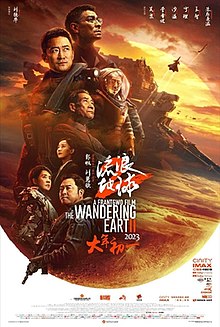
Saturday Matinee: The Wandering Earth II

By Simon Abrams

Source: RogerEbert.com

Time runs out in carefully marked units in the mainland Chinese sci-fi disaster pic “The Wandering Earth II,” a sturdy prequel to the record-smashing adaptation of Liu Cixin’s novel. In “The Wandering Earth II,” the apocalyptic problems faced by this movie’s Chinese characters—along with their international peers from the United Earth Government (UEG)—have already happened. Because in “The Wandering Earth,” the planet has already left its orbit thanks to some high-powered rocket engines, which have pushed the Earth out of harm’s way (aka a crash course with the Sun). Set in the near-future—a range of dates that includes 2044, 2058, and 2065—“The Wandering Earth II” follows China’s men and women of action as they lead the planet out of the solar system and into the previous movie.

Both “The Wandering Earth” and its sequel are flashy, state-approved cornball spectacles about humanity’s resilience (especially the Chinese). Both movies were produced with gargantuan budgets that would make even James Cameron blink, and they both look fantastic thanks to director Frant Gwo’s eye for panoramic scope and paperback cover-worthy details. The main difference between these two blockbusters is that the protagonists of “The Wandering Earth II” must repeatedly choose to be hopeful despite perpetually impending disasters, each one of which is neatly labeled and foregrounded with pulpy on-screen text like “The Lunar Crisis in 12 hours” and “Nuclear explosion in 3 hours.”

In this way, Gwo (“The Sacrifice”) and his five credited co-writers succeed in refocusing our attention on scenes of ticking-clock suspense, sandwiched between syrupy—and mostly satisfying—melodramatic interludes, where square-jawed astronauts and UEG diplomats struggle to do what we know is a foregone conclusion.

Most of “The Wandering Earth II” follows the superhuman efforts needed to jumpstart the Moving Mountain Project, the mission to first build and then deploy the globe-shifting engines needed to push the Earth out of harm’s way. The UEG’s Chinese delegation, led by the paternal diplomat Zhezhi Zhou (Li Xuejian), recommends prioritizing the Moving Mountain Project instead of the Digital Life Project. This radical initiative would transfer human participants’ consciousnesses into artificially intelligent computer programs. Some Digital Life supporters try to sabotage the Moving Mountain Project, including a deadly attack on the Space Elevator transportation ships that send UEG representatives from the Earth to the Moon.

Nobody living through the events of “The Wandering Earth II” knows what we know: That the Moving Mountain project succeeds and eventually becomes the Wandering Earth project, which comes under threat by a HAL 9000-esque artificial intelligence (A.I.) named MOSS in the first film. Still, multiple scientists, government officials, and space adventurers—mostly Chinese—believe in their work’s vital necessity, whether they’re punching out saboteurs or detonating one of a couple hundred nuclear devices scattered around the moon. There’s a lot of hand-wringing and teeth-gnashing along the way, mostly from English and Russian-speaking UEG members, all of whom speak in stilted, poorly dubbed dialogue. But Chinese astronauts, like “The Wandering Earth” co-leads Liu Peiqiang (“Wolf Warrior 2” star Wu Jing) and Han Duoduo (Wang Zhi), always prove Zhou’s slogan-simple maxim: “In times of crisis, unity above all.”

Some melancholic (and occasionally maudlin) flashbacks and dialogue emphasize the personal motives of one-note characters who, in the movie’s best scenes, are just parts of a beautiful post-human landscape. Liu remembers his wife and young daughter while melancholic scientist Tu Hengyu (Andy Lau) talks with his dead child after he uploads her personality into an experimental A.I. program; she cries a lot and sometimes responds with existentially troubling questions like, “Where am I, daddy? I want to get out.” We’re then periodically reminded of the next impending crisis—“the moon disintegrates in 50 hours”—in between solar storms and nuclear explosions. Somehow, “The Wandering Earth II” never feels tonally unbalanced or narratively convoluted, partly because Gwo and his collaborators keep their movie’s plot focused on feats of action-adventure heroism.

“The Wandering Earth II” only seems relatively unambitious because it’s more focused on sap-happy human emotions than on dystopian intrigue. Both movies are still essentially showcases for beautiful and expensive-looking computer graphics. But “The Wandering Earth II”—a brittle and, at heart, old-fashioned space opera—would be insufferable if Gwo and his ensemble cast members didn’t sell you on the possibility that someday, people who are as selfless, monomaniacal, and capable as Liu and Tu could exist.

“The Wandering Earth II” is also like “The Wandering Earth” because it’s just the right mix of silly and somber. Hurt, scared people wonder about the recent past, but always from a rare position of forward-thinking emotional clarity. (“She’s dead, and that’s it. That’s the reality.”) So when humanity must inevitably save the day, their accomplishments are appropriately surreal and awesome. 

Saturday Matinee: Call of Heroes

CALL OF HEROES: Old School Story, New School Style

By Alexander Miller

Source: Film Inquiry

Hong Kong has been making genre films for decades, and many of them adhere to the formulaic structure that has maintained their reputation as foremost purveyors of action movies. Benny Chan is one of the few noted Hong Kong directors to have transitioned from the early nineties action movies through the handover into current action films, from period wuxia films like Shaolin 2010, to contemporary actioners like the Gen X Cops, and Jackie Chan vehicles Who am I? and New Police Story. Although Benny Chan’s filmography might suggest that of a hired gun working amid the many cogs in the modicum of action films in Hong Kong, there’s a slightly transgressive and gritty tone throughout his career.

Taking place in 1914, Call of Heroes opens when our napping protagonist, an amiable rapscallion Ma Feng (Eddie Peng), pummels some thugs who try to rob a noodle bar in the country; did the bandits offend his sense of honor and propriety? Not really, it seems Ma Feng is more annoyed that they interrupted what should have been a peaceful lunch.

After the introductory clobbering, he meets a teacher, Ms. Pak (Jiang Shuying), who has narrowly escaped (with a group of children in tow) a military siege on her school led by the sinister Cao Shaolun, who murders with impunity being the son of a general.

Meanwhile, in the village of Pucheng, led by the honorable Sheriff Yang (Lau Ching-Wan), there is an area that has become a haven for refugees as a result of the murderous military campaigns going on through the lands. While Ms. Pak and her accompanying travelers are met with resistance, they are welcomed by the locals; however, the mysterious wanderer arrives around the same time as the nefarious Cao Shaolun, and our seemingly ambivalent loner is intertwined in the ensuing intrigue.

In concert with the cultural influence, what with John Ford inspiring Kurosawa, whose samurai epics were later remade into westerns in Hollywood and Italy, Call of Heroes has the dirty look of a Cinecittà production, with the twangy electric guitar echoing Ennio Morricone as a tasteful homage.

Old School, New School

Does this incidental hybrid of east-west convey an entertaining action yarn? Considering some edges that need sanding off, Call of Heroes is a fun trip to the dusty plains of both samurai and western movies, with the now prototypical stray dog hero. Here Eddie Peng’s Ma Feng is equal parts Toshiro Mifune’s Sanjuro character with Clint Eastwood’s laconic ‘Man With No Name’ and a hint of Elliott Gould’s iteration of Phillip Marlowe – Benny Chan’s film isn’t shy about its modernist mashup, and we’re all the better for it too, because the action is fun and the drama feels genuine.

This crossover of revisionist platitudes retains its accumulative power while sturdily fitting the wuxia formula; there’s good versus bad, and the moral boundaries are clearly drawn. Its black and white ethics are a perfect fit for this handsome little epic of quality, and in the past few years Hong Kong has gotten closer to reclaiming their throne as the foremost purveyors of fun action films. Not in the bullet ballets of John Woo and Ringo Lam, but in the period dramas that have populated the Chinese film market in their post-handover era. Benny Chan’s latest is just as much a return to form as it is a continuation of (relatively) recent hits like 7 AssassinsBrotherhood of Bladesand Bodyguards & Assassins.

“A Hero is Only as Good as His Villain”

Call of Heroes has an air of familiarity in its execution, but plays towards a more mature demeanor. Koo’s performance of Cao Shaolun is more than a mustache-twirling baddie; he’s homicidal, sadistic and it shows as he mercilessly guns down man, woman, and child. The film doesn’t shy from the nasty bits of his bastardly demeanor.

Veteran actor Koo might seem hammy, but he succeeds in filling out the archetypal story, and in concert with the rest of the leading cast who are delivering top-notch work. Johnnie To mainstay Lau Ching-Wan, (who starred in LifelineMad Detective, and Running out of Time) is powerful as the Pucheng village chief, but it’s baby-faced Eddie Peng who steals the show as the unkempt defender of the innocent; rightfully so, he’s funny, charming, and convincingly tough.

Influence of International Action

Deviating from the “cleaner” titles before it, Call of Heroes is as much a full-blooded action film as it is a martial arts movie; the blood flow makes the tenor of Chan’s feature feel more developed. Instead of anonymous henchman (who cease to be when they’re kicked out of frame), swords, bullets, spikes, fists and spears injure people, and violence has consequence.

The fight choreography, courtesy of martial arts guru Sammo Hung, employs a handful of fighting styles, from blunt punches and kicks, gravity-defying swordplay, as well as classic hand-to-hand combat. Call of Heroes might not have any headline martial artists such as Jackie Chan or Donnie Yen, but there’s no shortage of carefully choreographed action. Eddie Peng, under the tutelage of Sammo Hung, carries the film with stalwart Lau Ching-Wan doing some heavy lifting as well. Men, women, and children get in on the collective ass kicking, during some of the film’s exciting group brawls.

For the gravitas offered throughout, Hung and director Chan aren’t trying to mask the fantastical wire work, and in the spirit of high-flying fun it works to the film’s advantage; it’s the myth of heroism that we romanticize, and that comes off the screen every time someone trapezes themselves during the many scenes of combat.

Conclusion

What we are presented with is a thoroughly modern and satisfyingly self-aware action film; both classic, old fashioned, and authentically exciting. Fight sequences are plentiful and inventive; some standout moments include a waterside skirmish with walls of wooden spikes, a moonlit brawl with weaponized baskets and cookware; capped with a knockout finale involving Peng and accomplished martial artist Wu Jing duking it out with a mountain of clay pots.

I’d like to think of this inventive set piece as a nod to the 1976 John Woo/Jackie Chan vehicle Strike of Death (aka Hand of Death, choreography thanks to Sammo Hung), but this might be wishful thinking on my part.

Evolution in action films might take the form of stoic warriors abiding by Buddhist mantras in Jean-Pierre Melville’s heist films, or the operatic violence hyperbolized in the westerns of Sergio Leone. At the risk of evoking a cliché, action speaks every language and the more international cross pollinating that occurs the better off we all are; Hollywood’s been drawing from the eastern well for decades, and seeing the inverse in Call of Heroes is a pleasure.

Watch Call of Heroes on Hoopla here: https://www.hoopladigital.com/title/11726006