One Eyed Jacks
Hollywood Century, 1961: In which things start to get out of hand
By Tim Brayton
Source: Alternate Ending
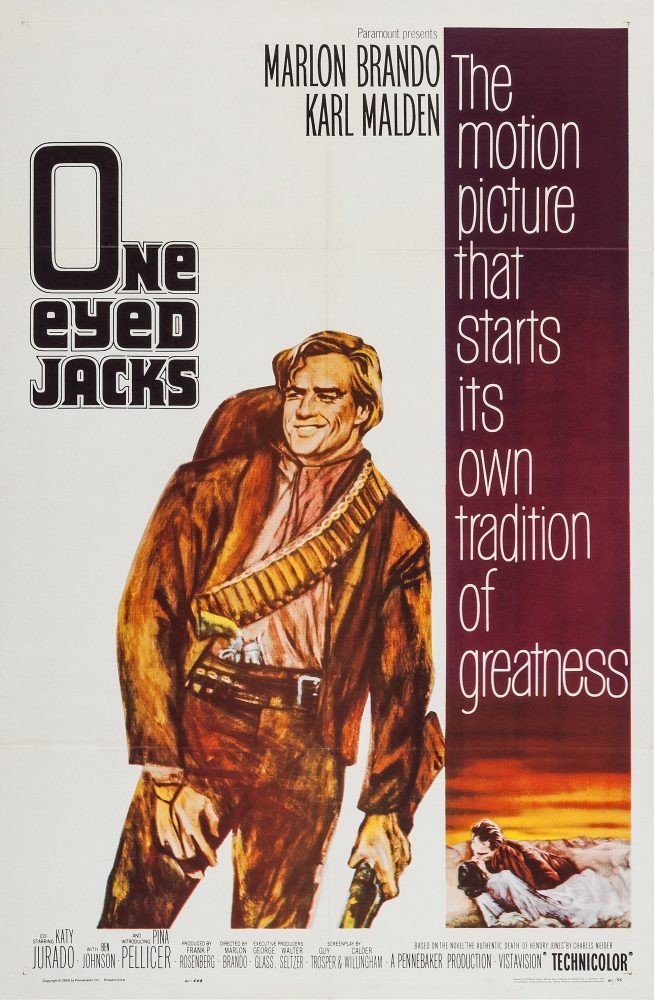
The one thing that can never be claimed of the 1961 Western One-Eyed Jacks is that it’s like other movies. Lumbering and bloated, often compelling, always gorgeous, and at times astonishingly bizarre in its attempt to force the psychological impulses of mid-century naturalist theater acting into the framework of a bog-standard Western revenge thriller, I haven’t decided whether or not it “works”, though I am inclined to say it does. But this is the kind of film in which functioning according to any conventional metric was out of the question long before the filming wrapped and the final cut was issued into theaters, and its considerable fascinations are mostly disconnected from its objective quality or lack thereof.
The film began life as a screenplay by Samuel Fuller, adapting Charles Neider’s novel The Authentic Death of Hendry Jones, to be directed by Stanley Kubrick, then just emerging from his enfant terrible years, and starring Marlon Brando. It certainly did not end up that way. When the film entered production in the second half of 1958, Brando’s early career as cinema’s most famous practitioner of Method acting had just begun its slow but steady drift into the wobbly and weird middle period, where he seemed more interested in indulging unspoken private whims than serving the needs of the picture (for a more graphic depiction of this process, I would point you to the actor’s next released film after One-Eyed Jacks, the marvelously clumsy 1962 version of Mutiny on the Bounty). To put it a little more bluntly, Brando had begun his irrevocably slide into becoming a prima donna of the first order. Kubrick had ego problems of his own, of course, as would shortly be thrown in to the sharpest relief on the production of Spartacus, but in the late ’50s, there was no question who was going to win. Brando was one of the biggest names the movies had, and he pulled rank over Kubrick at every turn; eventually, the conflict between the men resulted in Kubrick leaving the production, either because he simply couldn’t stand to be around his star any longer, or because Brando demanded that he be fired.
This left a movie with no clear direction and an in-progress rewrite by Calder Willingham, and nobody in charge to make things right; eventually, Brando assumed the role of director himself, for the first and only time in his career, extensively re-working the screenplay with yet a third writer, Guy Trosper (he and Willingham received final credit onscreen). It would be easy to regard the finished product as a vanity project, and in a lot of ways, that’s precisely what it is. Undoubtedly, there’s no missing that it’s a first-time effort by a man who didn’t necessarily want to direct (the film’s box office failure certainly hurt Brando’s future dreams in that direction if he had them, though I feel like a man of his stature could have finagled another directing assignment somewhere in all the years to come, if he’d been inclined), though it also doesn’t feel lazy or slapdash. Without having ever seen the film, I had rather assumed it would resemble secondhand Elia Kazan set in the West, Kazan being the director most responsible for shaping Brando into the cinematic figure he became. But there’s barely a trace of any such influence in a film that gives itself over to plenty of poetic, narratively fuzzy sequences in which the stillness and peace of the outdoors trumps anything to do with character or plot (and there would have allegedly been plenty more of them in Brando’s original cut, running well in excess of four hours; Paramount carved it down to two hours and 21 minutes, and neither the studio nor the actor-director were happy with that process).
Brando was lucky to have a seasoned old vet to help him shape the visuals: One-Eyed Jacks was shot by Charles Lang, a great and varied cinematographer who worked in everything from light comedy to film noir to character drama, and made visual successes out of material that wouldn’t seem to require any visual sensibility at all (he triumphed on what must have been the immensely thankless job of filming Some Like It Hot, a screenplay-dominated movie if one ever existed). Westerns are, of course, the exact opposite of movies that don’t require strong visuals, and his contribution to One-Eyed Jacks is the glue that holds everything together no matter how badly the drama wants to strain apart or, more often, dissolve into a fog of aimlessness. This is a film with a truly inspiring amount of depth to its compositions and blocking: how much of that was Brando’s theater-honed sensibility, how much was Lang’s desire to show off, how much was simply the sheer power of collaboration, it’s not mine to say. The results are what matter, and the result is a film that constantly offers to pull us in, through the action, into the rooms, and to appreciate the spaces between characters and what that says about their motivations and relative domination of any given moment. It is as impressively three-dimensional as any actual 3-D movie I’ve ever seen. And that’s without even pausing to mention the gorgeous use of color, the penetrating blue of the sky and the dusty, out-of-time feeling to the ground and the interiors.
Anyway, One-Eyed Jacks is something of a visual masterpiece, which I don’t mean as a slight, or as a backhanded compliment. Westerns, as much as any genre, tend to live or die on the quality of their images, which often do a lot of the heavy lifting for defining characters and conflict and themes and emotions. And so it is with this movie, where the way that people exist in the context of their environment tell us more about them than what they say or how they say it. And this is useful to the film, since it is in a lot ways a very stiff and unconvincing piece of storytelling.
Anyway, here’s the idea behind it: there are two bank robbers, Rio (Brando), and Dad Longworth (Karl Malden, whose casting was a chief sticking point between Kubrick and Brando). They’re being chased outside of Sonora, Mexico, in 1880, by the Rurales; Dad promises to get fresh horses and return for Rio, but he simply chickens out, leaving his partner to be taken by the law and imprisoned for five years, till he escapes. At that point, Rio teams up with fellow inmate Chico Modesto (Larry Duran) and the clearly untrustworthy Bob Amory (Ben Johnson), and tracks Dad to Monterey, California, where the turncoat has established himself as the much-loved sheriff, with a beautiful Mexican wife, Maria (Katy Jurado), and a beautiful stepdaughter, Louisa (Pina Pellicer). Eager for revenge on all fronts, Rio plots to steal from the Monterey bank to humiliate Dad and seduce Louisa to symbolically cuckold him, but then he goes and falls in love with the girl instead. And after Dad administers a terrible injury to his hand, and he has a chance to think for weeks while he recuperates, Rio begins to reconsider everything he has planned.
There’s absolutely no obvious reason under the sun for this to take 141 minutes, and One-Eyed Jacks doesn’t provide any non-obvious ones. It’s an indulgent film, is all: full of lengthy, go-nowhere scenes that allow Brando and his co-stars to bat dialogue and situations back and forth in longueurs that I suppose resemble Actors Studio exercises, or something those lines; there’s an aimlessness to the rhythm of scenes for which the only possible justification is that it “feels like life”, not that it in any way works dramatically. And, too, a lot of the film consists of the camera resting on Brando, doing a lot of small-scale business to show off his character and what he’s thinking about. A little bit of it goes a long way, and it doesn’t help that Brando’s performance is nowhere near one of his best: he strands himself with an accent that’s so off-base it’s rather more funny than anything, and threads the script with the most bluntly obvious “overthrowing the father” metaphor imaginable (for serious, Malden’s character has the given name “Dad”?) that provides very little to play that isn’t flat and obvious.
The acting as a whole is a mixed bag, which surprised me a little – apparently, Brando-the-director spent most of his time helping Pellicer into her character and out of her pants, and not to much of an end: she still gives the stiffest performance in the movie with the least modulation of her line deliveries, and only comes alive when she gets to play bigger, negative emotions. The rest of the cast range from excellent (Malden’s flop-sweating authority, Slim Pickens in a remarkable reined-in performance of admirable nastiness) to simply mediocre (Brando himself), and given the film’s obvious desire to be a modernist psychological drama in Western trappings, the inconsistency of the characterisations is a real problem.
The good thing, then, is that One-Eyed Jacks works best when it’s not the film it openly wants to be, and instead can be some kind of weird fever dream of clashing tones and visual abstraction. Especially in its opening quarter or so, the film induces a kind of whiplash in its extreme fluctuations of mood from scene to scene, and cut to cut; it’s laid back here, angry here, mildly comic here, tense here, thoughtful here, and all within five minutes. There’s a deranged electricity to it that’s not exactly the same (or even in the same wheelhouse) as solid genre filmmaking, but it’s a movie with real, palpable ambition to find new, challenging, different things to do with the form. Its radicalism has been overstated by its partisans (psychologically deep Westerns, and Westerns fronted by antiheroes, weren’t exactly new news in 1961), and so has its effectiveness, but that the film is brassy and unique is pretty much beyond dispute. It’s symptomatic in some ways of the bloat and loss of focus that marks so much Hollywood filmmaking of the 1960s, but it would be a lot harder to consider that a problem if every one of those bloated epics of the period had such demented, unpredictable personality as Brando’s captivating folly.



 After the Crash