Julian Assange’s Day in Court

Julian Assange’s lawyers — in a final bid on Tuesday to stop his extradition — fought valiantly to poke holes in the case of the prosecution to obtain an appeal.

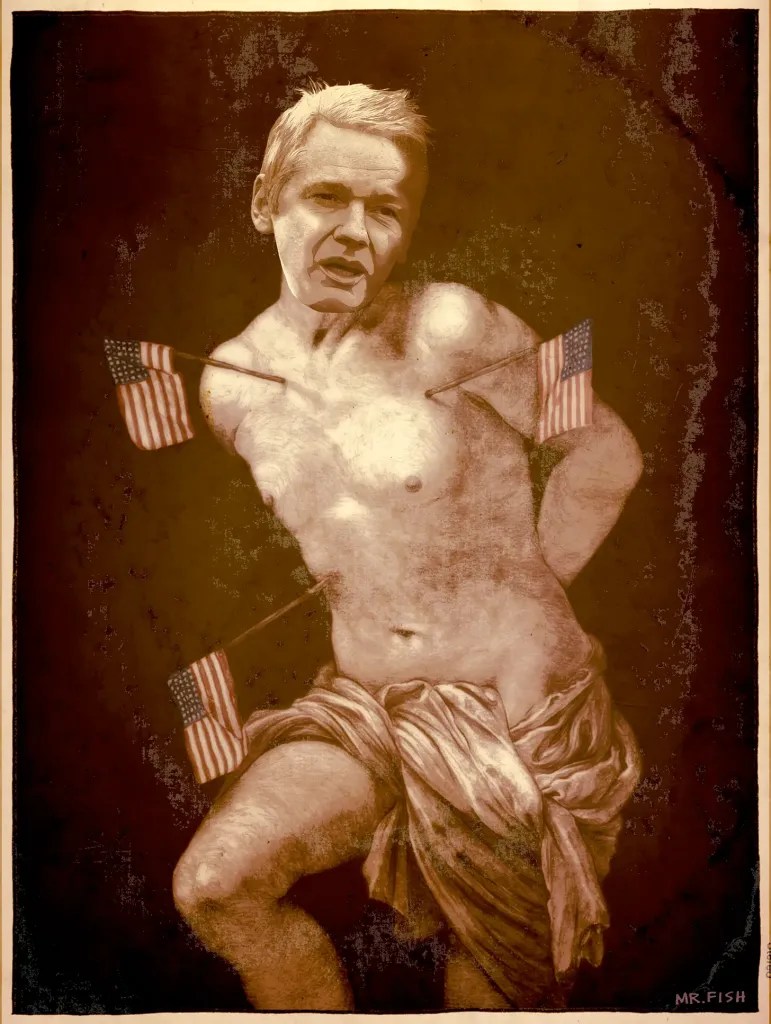
And Our Flags Are Still There – by Mr. Fish

By Chris Hedges

Source: Scheer Post

By the afternoon the video link, which would have allowed Julian Assange to follow his final U.K. appeal to prevent his extradition, had been turned off. Julian, his attorneys said, was too ill to attend, too ill even to follow the court proceedings on a link, although it was possible he was no longer interested in sitting through another judicial lynching. The rectangular screen, tucked under the black wrought iron bars that enclosed the upper left hand corner balcony of the courtroom where Julian would have been caged as a defendant, was perhaps a metaphor for the emptiness of this long and convoluted judicial pantomime. 

The arcane procedural rules — the lawyers in their curled blonde wigs and robes, the spectral figure of the two judges looking down on the court from their raised dais in their gray wigs and forked white collars, the burnished walnut paneled walls, the rows of lancet windows, the shelves on either side filled with law books in brown, green, red, crimson, blue and beige leather bindings, the defense lawyers, Edward Fitzgerald KC and Mark Summers KC, addressing the two judges, Dame Victoria Sharp and Justice Johnson, as “your lady” and “my lord” — were all dusty Victorian props employed in a modern Anglo-American show trial. It was a harbinger of a decrepit justice system that, subservient to state and corporate power, is designed to strip us of our rights by judicial fiat.

The physical and psychological disintegration of Julian, seven years trapped in the Ecuadorian Embassy in London and nearly five years held on remand in the high-security HM Prison Belmarsh, was always the point, what Nils Melzer the former U.N. Special Rapporteur on torture calls his “slow-motion execution.”  Political leaders, and their echo chambers in the media, fall all over themselves to denounce the treatment of Alexei Navalny but say little when we do the same to Julian. The legal farce grinds forward like the interminable case of Jarndyce and Jarndyce in Charles Dickens’ novel Bleak House. It will probably grind on for a few more months — one can’t expect the Biden administration to add the extradition of Julian to all its other political woes. It may take months to issue a ruling, or grant one or two appeal requests, as Julian continues to waste away in HM Prison Belmarsh. 

Julian’s nearly 15-year legal battle began in 2010 when WikiLeaks published classified military files from the wars in Iraq and Afghanistan — including footage showing a U.S. helicopter gunning down civilians, including two Reuters journalists in Baghdad. He took refuge in London’s Ecuadorian embassy, before being arrested by the Metropolitan Police in 2019 who were permitted by the Ecuadorian embassy to enter and seize him. He has been held for nearly five years in HM Prison Belmarsh.

Julian did not commit a crime. He is not a spy. He did not purloin classified documents. He did what we all do, although he did it in a far more important way. He published voluminous material, leaked to him by Chelsea Manning, which exposed U.S. war crimesliescorruptiontorture and assassinations. He ripped back the veil to expose the murderous machinery of the U.S. empire.

The two-day hearing is Julian’s last chance to appeal the extradition decision made in 2022 by the then British home secretary, Priti Patel. On Wednesday the prosecution will make its arguments. If he is denied an appeal he can request the European Court of Human Rights (ECtHR) for a stay of execution under Rule 39, which is given in “exceptional circumstances” and “only where there is an imminent risk of irreparable harm.” But the British court may order Julian’s immediate extradition prior to a Rule 39 instruction or may decide to ignore a request from the ECtHR to allow Julian to have his case heard by the court.

District Judge Vanessa Baraitser in January 2021, at Westminster Magistrates’ Court, refused to authorize the extradition request. In her 132-page ruling, she found that there was a “substantial risk” Julian would commit suicide due to the severity of the conditions he would endure in the U.S. prison system. At the same time, she accepted all the charges leveled by the U.S. against Julian as being filed in good faith. She rejected the arguments that his case was politically motivated, that he would not get a fair trial in the U.S. and that his prosecution is an assault on the freedom of the press.

Baraitser’s decision was overturned after the U.S. government appealed to the High Court in London. Although the High Court accepted Baraitser’s conclusions about Julian’s “substantial risk” of suicide if he was subjected to certain conditions within a U.S. prison, it also accepted four assurances in U.S. Diplomatic Note no. 74, given to the court in February 2021, which promised Julian would be treated well. The “assurances” state that Julian will not be subject to Special Administrative Measure. They promise that Julian, an Australian citizen, can serve his sentence in Australia if the Australian government requests his extradition. They promise he will receive adequate clinical and psychological care. They promise that, pre-trial and post-trial, Julian will not be held in the Administrative Maximum Facility in Florence, Colorado.

The defense must convince the two judges that the District Judge made serious legal errors to see an appeal granted.  

They argued that espionage is, as a matter of law, a political offense and that the extradition treaty with the U.S. prohibits extradition for political offenses. They focused on the extensive UK law, common law and international law that defines espionage as a “pure political offense” because it is directed against a state apparatus. For this reason, those charged with espionage should be protected from extradition. The lawyers spent a long time adjudicating the case of Chelsea Manning to justify her leak of documents that exposed war crimes as in the public interest, then arguing that if she was justified in leaking the documents Julian was justified in publishing them.

As the day wore on it became evident that the two judges were not well versed in the case, constantly asking for citations and expressing surprise that senior officials in the U.S., such as Mike Pompeo when he was head of the CIA, said Julian would not be protected by the First Amendment in an American court because he was not a citizen. Julian’s lawyers brought up past espionage cases, such as that of MI5 agent David Shaylerprosecuted under the Official Secrets Act 1989 for passing secret documents to The Mail on Sunday in 1997 — which included the names of agents. He also disclosed that MI5 (Britain’s domestic intelligence service) kept files on prominent politicians, including Labour ministers, and that MI6 (Britain’s foreign intelligence service) was involved in a plot to assassinate Libyan leader Colonel Momar Gaddafi. The British extradition request was rejected by the French Cour d’Appel because it was a “political offense.”  

All 18 counts filed against Julian allege that his purpose was “that such information so obtained could be used to the injury of the United States and the advantage of any foreign nation.”

The hearing was, after those in 2020 that focused on Julian’s mental and psychological health, refreshing in that it discussed the crimes committed by the U.S. and the importance of making them public. The two judges rarely interrupted, unlike other court proceedings for Julian I have attended where the judge often condescendingly cut short the defense. This may be a reflection of the broad public support, including by major media organizations, which have belatedly rallied behind Julian. Hundreds of people thronged the entrance to The Royal Courts of Justice, an expansive Victorian Gothic stone building adorned with statues of Jesus, Moses, Solomon and Alfred the Great, the celebrated pillars of the English legal tradition, to call for Julian’s freedom.

The afternoon session was different. On about a half dozen occasions the judges halted the defense to ask about how the leaks, because they were not thoroughly redacted, had endangered lives, although the U.S. has never been able to provide evidence of anyone whose life was lost as a result of the leaks. This canard has long been the cross on which U.S. officials have sought to crucify Julian. The two judges — one wonders if they had been given instructions during the lunch break — hurled these accusations at the defense lawyers until we adjourned.

“These indiscriminate disclosures were condemned by The Guardian and The New York Times,” Judge Sharp admonished the defense team. “They could have been done differently.”

This reference was especially egregious since the unredacted documents were first made public not by WikiLeaks or Julian but by the website Cryptome after reporters from The Guardian printed the password to the unredacted documents in their book.

The U.S. is officially seeking Julian’s extradition, where he potentially faces up to 175 years in prison, for the 2010 publication of the Iraq and Afghanistan war logs and US diplomatic cables. But the U.S. did not request his extradition until the release in March 2017 of the files known as Vault 7 which detailed how the CIA could hack Apple and Android smartphones and turn internet-connected televisions — even when they were off — into listening devices. Joshua Schulte, a former CIA employee, was found guilty last year of four counts each of espionage and computer hacking and one count of lying to FBI agents after handing over classified materials to WikiLeaks. He was given a forty-year sentence in February.

After the release of Vault 7 then CIA Director Mike Pompeo called WikiLeaks “a non-state hostile intelligence service.” The Attorney General at the time, Jeff Sessions, said that Julian’s arrest was a priority. By August the U.S. Senate had passed a 78-page intelligence finance bill which included a sentence declaring that “it is the sense of Congress that Wikileaks and the senior leadership of Wikileaks resemble a non-state hostile intelligence service often abetted by state actors and should be treated as such a service by the United States.” In May 2019 the Trump administration accused Julian of violating the Espionage Act and asked the UK to extradite him to stand trial in the U.S. Trump has called the allegations against Julian treason and called for “the death penalty or something.” Other politicians, including former Republican presidential candidate Mike Huckabee, have also called for Julian to be executed.

If Julian is extradited and additionally charged for the release of the Vault 7 documents, Fitzgerald told the court, “it could result in additional charges that merit the death penalty for aiding and abetting the enemy.” The U.S., he said, especially if Trump is elected again to the presidency, could easily “reformulate these charges into a capital offense.”

Summers brought up President Donald Trump’s request for “detailed options” of how to assassinate Julian when he was in the Ecuadorian Embassy. “Sketches were even drawn up,” he said, adding that the plot fell apart when the UK authorities backed down, especially over a potential shootout, in the streets of London”.

“The evidence showed that the US was prepared to go to any lengths, including misusing its own criminal justice system, to sustain impunity for US officials in respect of the torture/war crimes committed in its infamous ‘war on terror’, and to suppress those actors and courts willing and prepared to try to bring those crimes to account,” he said.

 The lawyers were right. The CIA is the driving force behind the extradition. The leak was highly embarrassing and to the CIA highly damaging. The CIA intends to make Julian pay. Schulte, who leaked Vault 7, was given a forty year sentence. Julian, if extradited, will be next. 

U.S. War Criminals, Conspiracy Theorists and the Mainstream Media vs. Julian Assange

By Timothy Alexander Guzman

Source: Silent Crow News

Julian Assange exposed U.S. war crimes, CIA spying capabilities, false flag cyber attacks and corruption within the Democratic Party and he’s the bad guy? Trump’s Justice department has decided to charge Julian Assange with “17 counts of violating the Espionage Act for his role in obtaining and publishing secret military and diplomatic documents in 2010, the Justice Department announced on Thursday, a novel case that raises profound First Amendment issues” according to The New York Times. The article ‘Assange Indicted Under Espionage Act, Raising First Amendment Issues’ does mention the fact that charging Assange under the Espionage Act sets the precedent to criminalize investigative journalism that is “related to obtaining, and in some cases publishing, state secrets to be criminal, the officials sought to minimize the implications for press freedoms.” However, The New York Times has become the judge and jury and says that Assange is a fugitive trying to avoid Sweden’s justice system for an alleged sexual assault charge and that he is a useful tool for the Russians in regards to interfering in U.S. elections:

The charges are the latest twist in a career in which Mr. Assange has morphed from a crusader for radical transparency to fugitive from a Swedish sexual assault investigation, to tool of Russia’s election interference, to criminal defendant in the United States.

Mr. Assange vaulted to global fame nearly a decade ago as a champion of openness about what governments secretly do. But with this indictment, he has become the target for a case that could open the door to criminalizing activities that are crucial to American investigative journalists who write about national security matters.

The case has nothing to do with Russia’s election interference in 2016, when Mr. Assange’s organization published Democratic emails stolen by Russia as part of its covert efforts to help elect President Trump. Instead, it focuses on Mr. Assange’s role in the leak of hundreds of thousands of State Department cables and military files by the former Army intelligence analyst Chelsea Manning

According to the head of the Justice Department’s National Security Division, John Demers, he said that “Some say that Assange is a journalist and that he should be immune from prosecution for these actions,” and that “The department takes seriously the role of journalists in our democracy and we thank you for it. It is not and has never been the department’s policy to target them for reporting.” But Mr. Assange, was “no journalist.”

Demers has accused Assange of collaborating with Chelsea Manning to steal classified information when he said that “No responsible actor, journalist or otherwise, would purposefully publish the names of individuals he or she knew to be confidential human sources in a war zone, exposing them to the gravest of dangers.”

The New York Times admits that they can be charged for doing what Wikileaks has done in the near future under the Espionage Act:

Notably, The New York Times, among many other news organizations, obtained precisely the same archives of documents from WikiLeaks, without authorization from the government — the act that most of the charges addressed. While The Times did take steps to withhold the names of informants in the subset of the files it published, it is not clear how that is legally different from publishing other classified information

Assange’s lawyer, Barry J. Pollack said that his client was charged for a crime, but according to Pollack, Assange is guilty “for encouraging sources to provide him truthful information and for publishing that information.” The New York Times also said that “the United States has asked Britain to extradite Mr. Assange, who is fighting the move, and the filing of the new charges clears the way for British courts to weigh whether it would be lawful to transfer custody of him to a place where he will face Espionage Act charges.” Britain will most likely extradite Assange to the U.S. since Britain is a close U.S. ally. The New York Times is sort of playing good cop, bad cop with the case of Julian Assange. They describe Assange as a fugitive who is avoiding Sweden’s sexual assault investigation to becoming a tool or a puppet for “Russia’s election interference” which is a joke, then they say that they can face the same charges as Wikileaks if they use the same tactics to obtain information. However, The New York Times and every other mainstream media outlet works for the U.S. government and are on the same page with the politicians as they shamefully and continuously discredit Assange. According to a report by FAIR (Fairness and Accuracy in Reporting) titled ‘Media Cheer Assange’s Arrest’ said that the media demonized Assange after his arrest:

A Washington Post editorial (4/11/19) claimed Assange was “no free-press hero” and insisted the arrest was “long overdue.” Likewise, the Wall Street Journal (4/11/19) demanded “accountability” for Assange, saying, “His targets always seem to be democratic institutions or governments.”

Other coverage was more condemnatory still. The View’s Meghan McCain (4/11/19) declared she hoped Assange “rots in hell.” Saturday Night Live’s Colin Jost (4/13/19) said it was “so satisfying to see an Internet troll get dragged out into the sunlight.” But it was perhaps the National Review (4/12/19) that expressed the most enthusiastic approval of Assange’s arrest, condemning him for his “anti-Americanism, his antisemitism and his raw personal corruption” and for harming the US with his “vile spite”

Trump and the CIA

The CIA is Trump’s wet dream, I know it sounds nasty but it was obvious from the start when Trump made his first visit as President of the United States to the CIA headquarters in Langley, Virginia and said “But I want to say that there is nobody that feels stronger about the intelligence community and the CIA than Donald Trump. There’s nobody.” Trump practically brown-nosed the CIA, and in doing so, the writing was on the wall to where the Trump-CIA relationship was going, that’s why Trump’s u-turn on Julian Assange’s arrest was not surprising and may I say, one of the most dishonest responses made by the president since the Obama and Bush years. Let’s remember during Trump’s campaign trail, it was reported that he mentioned Wikileaks more than 141 times until the day Assange was dragged out in handcuffs from the Ecuadorian embassy, and then Trump changed his tune when he was asked by the media about Assange’s arrest, and what was his response? “I know nothing about WikiLeaks.” Politicians from both sides of the aisle in Washington praised the arrest of Julian Assange especially Hillary Clinton who said Assange “has to answer for what he has done” according to The Guardian.

Trump’s entire administration wants Julian Assange and his Wikileaks organization to be permanently shut down including Trump’s advisor John Bolton who was exposed by Wikileaks when they released more than 800 files exposing his war crimes. Secretary of State and former CIA Director, Mike Pompeo is another war hawk neocon who wants Assange either dead or alive. Pompeo had called Julian Assange a “narcissist” who allegedly works hands in glove with Russia and that Assange depends on “the dirty work of others to make him famous.” During a speech at The Center for Strategic and International Studies(CSIS) back in 2017, Pompeo said that “It is time to call out WikiLeaks for what it really is: a non-state hostile intelligence service often abetted by state actors like Russia.” Pompeo said that the U.S. intelligence community (including the CIA) had already determined that Russia’s military intelligence service, the GRU used WikiLeaks to release hacked information from the DNC. But the reality is that the hacked emails came from a source who faced a serious risk according to Assange and that source was Seth Rich who was shot and killed in an affluent neighborhood in Washington, D.C. in the summer of 2016 in an apparent robbery that “failed” according to Seth Rich’s father, Joel during an interview with a local TV station KMTV. In 2016, Assange was interviewed on a Dutch television program Nieuwsuur, and said that they concerned about what happened to Seth Rich and were investigating the situation:

“We have to understand how high the stakes are in the US, and that our sources face serious risks. That’s why they come to us, so we can protect their anonymity. We are investigating what happened with Seth Rich. We think it is a concerning situation. There is not a conclusion yet; we are not willing to state a conclusion, but we are concerned about it. And more importantly, a variety of WikiLeaks sources are concerned when that kind of thing happens”

 Wikileaks offered a $20,000 reward for information leading to a conviction for the murder of Seth Rich.

Robert Mueller is a Conspiracy Theorist

The New York Times published an article based on the Mueller Report regarding the murder of Seth Rich ‘Seth Rich Was Not Source of Leaked D.N.C. Emails, Mueller Report Confirms’ claiming that Seth Rich was not the source of the Democratic National Committee’s (DNC) leaked emails proving that they were undermining the Bernie Sander’s campaign. The emails were first published by DCLeaks and then by WikiLeaks on July 22, 2016 right before the 2016 Democratic National Convention. According to The New York Times:

The special counsel’s report confirmed this week that Seth Rich, a young Democratic National Committee employee whose unsolved killing became grist for a right-wing conspiracy theory, was not the source of thousands of internal D.N.C. emails that WikiLeaks released during the 2016 presidential race, officially debunking a notion that had persisted without support for years

The report also said that “tucked amid hundreds of pages of the report’s main findings, the special counsel, Robert S. Mueller III, took aim at WikiLeaks and its founder, Julian Assange, for falsely implying that Mr. Rich was somehow involved in the dissemination of the emails, an act that aided President Trump’s campaign.” Mueller said that “WikiLeaks and Assange made several public statements apparently designed to obscure the source of the materials that WikiLeaks was releasing.” The report claims that WikiLeaks collaborated with the “true source of the leaked emails — Russian hackers — after Mr. Rich’s death.” The New York Times also said that “The theory linking Mr. Rich to the email leak took root in conservative circles and was cited by prominent conservatives like Newt Gingrich and right-wing commentators like Rush Limbaugh, Sean Hannity and Alex Jones of Infowars.” Mueller’s final statement regarding the murder of Seth Rich is just a diversion away from the truth and with Mueller’s help he can make it just go away, at least in the mainstream-media. The only people that can expose the truth regarding Seth Rich is Julian Assange and the Wikileaks organization. According to an nbcwashington.comarticle “The Mueller report says beginning in the summer of 2016 Julian Assange and WikiLeaks made statements about Rich falsely implying he leaked the stolen emails.” Last month, Vox.com published an article declaring that ‘The Seth Rich conspiracy theory needs to end now’ and falsely claimed that Assange knew that Seth Rich was not the source, because it was the Russians:

The report definitively disproved the notion that a Democratic National Committee staffer named Seth Rich was the source of leaked DNC documents later published by WikiLeaks, and that his July 2016 murder came as the result of his decision to leak those documents to WikiLeaks. This wasn’t true, although Trump associates like Jerome Corsi, Roger Stone, and countless others, have argued vehemently for years that it was. And WikiLeaks, and its founder Julian Assange, knew it

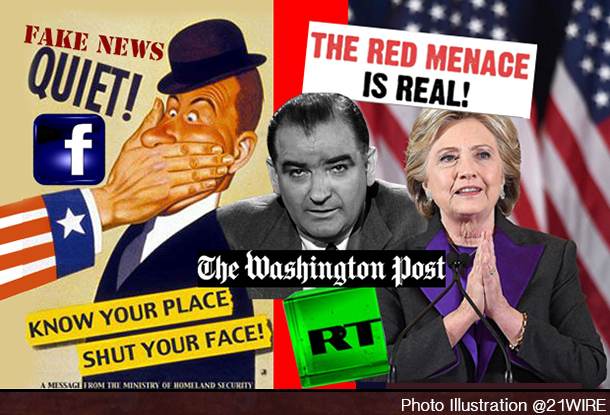
The Trump-Russia collusion hoax has been on air since Trump took office more than 2 years ago. MSNBC who was a cheerleader for the removal of Trump was humiliated after the Mueller Report revealed that Trump did not collude with Russia in the 2016 Presidential elections to defeat Hillary Clinton. Clinton lost the election because of Clinton, not Assange, the Russians or anyone else. Clinton was and still is despised by most people within the U.S. especially when she tried to undermine the other hypocrite, Bernie Sanders (who would be another puppet of the deep state if he were to win the 2020 U.S. elections)and she was exposed. Clinton and the DNC’s plan to undermine the Sander’s campaign was to secure her nomination. Wikileaks embarrassed the DNC and forced them to make an apology to Bernie Sanders and his supporters by saying “On behalf of everyone at the DNC, we want to offer a deep and sincere apology to Senator Sanders, his supporters, and the entire Democratic Party for the inexcusable remarks made over email” and that “These comments do not reflect the values of the DNC or our steadfast commitment to neutrality during the nominating process.” The Mueller report claims that the emails were allegedly stolen by hackers associated with Russian intelligence called Guccifer 2.0. In the summer of 2018, Robert Mueller indicted 12 Russian military intelligence agents called Fancy Bear who were allegedly responsible for the attack. Fancy Bear was supposedly behind Guccifer 2.0 who claimed they were responsible, but then again, it’s all a lie.

Vault 7: The CIA’s ‘Global Covert Hacking System’

One of the biggest news stories involving Wikileaks and the release of more than 8,761 documents under ‘Year Zero’, exposing the CIA and its global operations. It was the first part of a series of leaks that Wikileaks called ‘Vault 7’ a network that was inside the CIA’s Center for Cyber Intelligence based in Langley, Virginia that involves a “global covert hacking program,” including what Wikileaks describes as “weaponized exploits” used against such devices as “Apple’s iPhone, Google’s Android and Microsoft’s Windows and even Samsung TVs, which are turned into covert microphones.” The CIA bypassed encryption codes on messaging services such as WhatsApp and other phones devices. WikiLeaks said that government hackers can hack Android phones that basically collects “audio and message traffic before encryption is applied.” There are various parts of Vault 7 such as ‘Dark Matter’ that exposed the CIA’s hacking capabilities including Apple’s iPhones and Macs. Weeping Angel is another hacking tool that was developed by the CIA and the U.K.’s very own MI5 used to penetrate smart TVs to gather intelligence. Once the program is installed in smart T.V.s with a USB stick, it enabled those same televisions’ with built-in microphones and sometimes even video cameras to record while the television is turned off. Then the recorded data is either stored into the television’s memory or sent to the CIA through the internet. There are several other programs exposed under the ‘Year Zero’ global covert hacking program, but one other program stands out the most is what the CIA uses to conduct “false flag” cyber-attacks that has portrayed Russia in the past as the aggressor. Regarding the CIA’s Remote Devices Branch’s UMBRAGE group, which is a subdivision of the center’s Remote Development Branch (RDB), and according to Wikileaks’s source, the program “collects and maintains a substantial library of attack techniques” that were stolen from malware produced in other states including the Russian Federation. Wikileaks said the following:

With UMBRAGE and related projects the CIA cannot only increase its total number of attack types but also misdirect attribution by leaving behind the “fingerprints” of the groups that the attack techniques were stolen from. UMBRAGE components cover keyloggers, password collection, webcam capture, data destruction, persistence, privilege escalation, stealth, anti-virus (PSP) avoidance and survey techniques

Kim Dotcom commented on the Wikileaks revelations when he tweeted that the “CIA uses techniques to make cyber attacks look like they originated from enemy state. It turns DNC/Russia hack allegation by CIA into a JOKE.” Wired.com claimed that “Russian hacking deniers” were at an advantage in a 2017 article titled ‘WikiLeaks CIA Dump Gives Russian Hacking Deniers the Perfect Ammo’ and said that:

One nugget of particular interest to Trump supporters: a section titled “Umbrage” that details the CIA’s ability to impersonate cyber-attack techniques used by Russia and other nation states. In theory, that means the agency could have faked digital forensic fingerprints to make the Russians look guilty of hacking the Democratic National Committee

The CIA’s ability to hack smart TV’s, Smartphone’s and encrypted messaging applications and we must add to the fact that the CIA also has the capability to conduct cyber-attacks under the UMBRAGE group and make them appear it came from a foreign power is as Orwellian as one can get, it also carries very serious geopolitical implications. What is insane about the CIA’s UMBRAGE group is that according to Wikileaks, “With UMBRAGE and related projects the CIA cannot only increase its total number of attack types but also misdirect attribution by leaving behind the “fingerprints” of the groups that the attack techniques were stolen from.” In other words, the CIA could launch a malware attack that was originally developed by another country to intentionally “misdirect attribution” for the hack that would not be traced back to the CIA in any way. In 2017, CNN quoted the former CIA director James Woolsey as saying that “It’s often not foolproof to say who it is because it is possible and sometimes easy to hide your tracks,” he said. “There’s lots of tricks.” and he should know. “I think the Russians were in there, but it doesn’t mean other people weren’t, too,” Woolsey told CNN.

The CIA and the Persecution of Julian Assange 

When Julian Assange was arrested by British authorities, Wikileaks immediately released a statement on twitter mentioning the role of the CIA:

This man is a son, a father, a brother. He has won dozens of journalism awards. He’s been nominated for the Nobel Peace Prize every year since 2010. Powerful actors, including CIA, are engaged in a sophisticated effort to dehumanise, delegitimize and imprison him. #ProtectJulian

The arrest of Assange has sparked outrage and anger around the world. Assange is a hero to us all especially those in the alternative media. The mainstream-media, as we all know are based on conspiracy theories, fabrications and flat-out lies are celebrating the arrest of Assange. Perhaps, they are hoping to rebound after the ‘RussiaGate’ conspiracy theory hoax which backfired in their faces and since then, their viewership has completely collapsed.

Julian Assange will face a U.S. court if he is extradited. But rest assured, there will be those of us who will continue to speak out for Assange, and there will also be worldwide protests in coming months and years until Julian Assange is released from prison. There is hope because Assange has the truth on his side no matter what happens. If is imprisoned for life or god forbid executed at the behest of Washington and the CIA, Assange will become a Martyr. There will be many more people like Assange because the truth is like a virus to the establishment, and that’s why they want to destroy Wikileaks and the alternative media, but it’s too late, the truth is out and it will never be stopped. #ProtectJulian

Still Waiting for Evidence of a Russian Hack

More than two years after the allegation of Russian hacking of the 2016 U.S. presidential election was first made, conclusive proof is still lacking and may never be produced, says Ray McGovern.

By Ray McGovern

Source: Consortium News

If you are wondering why so little is heard these days of accusations that Russia hacked into the U.S. election in 2016, it could be because those charges could not withstand close scrutiny. It could also be because special counsel Robert Mueller appears to have never bothered to investigate what was once the central alleged crime in Russia-gate as no one associated with WikiLeaks has ever been questioned by his team.

Veteran Intelligence Professionals for Sanity — including two “alumni” who were former National Security Agency technical directors — have long since concluded that Julian Assange did not acquire what he called the “emails related to Hillary Clinton” via a “hack” by the Russians or anyone else. They found, rather, that he got them from someone with physical access to Democratic National Committee computers who copied the material onto an external storage device — probably a thumb drive. In December 2016 VIPS explained this in some detail in an open Memorandum to President Barack Obama.

On January 18, 2017 President Obama admitted that the “conclusions” of U.S. intelligence regarding how the alleged Russian hacking got to WikiLeaks were “inconclusive.” Even the vapid FBI/CIA/NSA “Intelligence Community Assessment of Russian Activities and Intentions in Recent U.S. Elections” of January 6, 2017, which tried to blame Russian President Vladimir Putin for election interference, contained no direct evidence of Russian involvement.  That did not prevent the “handpicked” authors of that poor excuse for intelligence analysis from expressing “high confidence” that Russian intelligence “relayed material it acquired from the Democratic National Committee … to WikiLeaks.”  Handpicked analysts, of course, say what they are handpicked to say.

Never mind. The FBI/CIA/NSA “assessment” became bible truth for partisans like Rep. Adam Schiff (D-CA), ranking member of the House Intelligence Committee, who was among the first off the blocks to blame Russia for interfering to help Trump.  It simply could not have been that Hillary Clinton was quite capable of snatching defeat out of victory all by herself.  No, it had to have been the Russians.

Five days into the Trump presidency, I had a chance to challenge Schiff personally on the gaping disconnect between the Russians and WikiLeaks. Schiff still “can’t share the evidence” with me … or with anyone else, because it does not exist.

WikiLeaks

It was on June 12, 2016, just six weeks before the Democratic National Convention, that Assange announced the pending publication of “emails related to Hillary Clinton,” throwing the Clinton campaign into panic mode, since the emails would document strong bias in favor of Clinton and successful attempts to sabotage the campaign of Bernie Sanders.  When the emails were published on July 22, just three days before the convention began, the campaign decided to create what I call a Magnificent Diversion, drawing attention away from the substance of the emails by blaming Russia for their release.

Clinton’s PR chief Jennifer Palmieri later admitted that she golf-carted around to various media outlets at the convention with instructions “to get the press to focus on something even we found difficult to process: the prospect that Russia had not only hacked and stolen emails from the DNC, but that it had done so to help Donald Trump and hurt Hillary Clinton.”  The diversion worked like a charm.  Mainstream media kept shouting “The Russians did it,” and gave little, if any, play to the DNC skullduggery revealed in the emails themselves. And like Brer’ Fox, Bernie didn’t say nothin’.

Meanwhile, highly sophisticated technical experts, were hard at work fabricating “forensic facts” to “prove” the Russians did it.  Here’s how it played out:

June 12, 2016: Assange announces that WikiLeaks is about to publish “emails related to Hillary Clinton.”

June 14, 2016: DNC contractor CrowdStrike, (with a dubious professional record and multiple conflicts of interest) announces that malware has been found on the DNC server and claims there is evidence it was injected by Russians.

June 15, 2016: “Guccifer 2.0” affirms the DNC statement; claims responsibility for the “hack;” claims to be a WikiLeaks source; and posts a document that the forensics show was synthetically tainted with “Russian fingerprints.”

The June 12, 14, & 15 timing was hardly coincidence. Rather, it was the start of a pre-emptive move to associate Russia with anything WikiLeaks might have been about to publish and to “show” that it came from a Russian hack.

Enter Independent Investigators

A year ago independent cyber-investigators completed the kind of forensic work that, for reasons best known to then-FBI Director James Comey, neither he nor the “handpicked analysts” who wrote the Jan. 6, 2017 assessment bothered to do.  The independent investigators found verifiable evidence from metadata found in the record of an alleged Russian hack of July 5, 2016 showing that the “hack” that day of the DNC by Guccifer 2.0 was not a hack, by Russia or anyone else.

Rather it originated with a copy (onto an external storage device – a thumb drive, for example) by an insider — the same process used by the DNC insider/leaker before June 12, 2016 for an altogether different purpose. (Once the metadata was found and the “fluid dynamics” principle of physics applied, this was not difficult to disprove the validity of the claim that Russia was responsible.)

One of these independent investigators publishing under the name of The Forensicator on May 31 published new evidence that the Guccifer 2.0 persona uploaded a document from the West Coast of the United States, and not from Russia.

In our July 24, 2017 Memorandum to President Donald Trump we stated, “We do not know who or what the murky Guccifer 2.0 is. You may wish to ask the FBI.”

Our July 24 Memorandum continued: “Mr. President, the disclosure described below may be related. Even if it is not, it is something we think you should be made aware of in this general connection. On March 7, 2017, WikiLeaks began to publish a trove of original CIA documents that WikiLeaks labeled ‘Vault 7.’ WikiLeaks said it got the trove from a current or former CIA contractor and described it as comparable in scale and significance to the information Edward Snowden gave to reporters in 2013.

“No one has challenged the authenticity of the original documents of Vault 7, which disclosed a vast array of cyber warfare tools developed, probably with help from NSA, by CIA’s Engineering Development Group. That Group was part of the sprawling CIA Directorate of Digital Innovation – a growth industry established by John Brennan in 2015. [ (VIPS warned President Obama of some of the dangers of that basic CIA reorganization at the time.]

Marbled

“Scarcely imaginable digital tools – that can take control of your car and make it race over 100 mph, for example, or can enable remote spying through a TV – were described and duly reported in the New York Times and other media throughout March. But the Vault 7, part 3 release on March 31 that exposed the “Marble Framework” program apparently was judged too delicate to qualify as ‘news fit to print’ and was kept out of the Times at the time, and has never been mentioned since.

“The Washington Post’s Ellen Nakashima, it seems, ‘did not get the memo’ in time. Her March 31 article bore the catching (and accurate) headline: ‘WikiLeaks’ latest release of CIA cyber-tools could blow the cover on agency hacking operations.’

“The WikiLeaks release indicated that Marble was designed for flexible and easy-to-use ‘obfuscation,’ and that Marble source code includes a “de-obfuscator” to reverse CIA text obfuscation.

“More important, the CIA reportedly used Marble during 2016. In her Washington Post report, Nakashima left that out, but did include another significant point made by WikiLeaks; namely, that the obfuscation tool could be used to conduct a ‘forensic attribution double game’ or false-flag operation because it included test samples in Chinese, Russian, Korean, Arabic and Farsi.”

A few weeks later William Binney, a former NSA technical director, and I commented on Vault 7 Marble, and were able to get a shortened op-ed version published in The Baltimore Sun.

The CIA’s reaction to the WikiLeaks disclosure of the Marble Framework tool was neuralgic. Then Director Mike Pompeo lashed out two weeks later, calling Assange and his associates “demons,” and insisting; “It’s time to call out WikiLeaks for what it really is, a non-state hostile intelligence service, often abetted by state actors like Russia.”

Our July 24 Memorandum continued:  “Mr. President, we do not know if CIA’s Marble Framework, or tools like it, played some kind of role in the campaign to blame Russia for hacking the DNC. Nor do we know how candid the denizens of CIA’s Digital Innovation Directorate have been with you and with Director Pompeo. These are areas that might profit from early White House review.  [ President Trump then directed Pompeo to invite Binney, one of the authors of the July 24, 2017 VIPS Memorandum to the President, to discuss all this.  Binney and Pompeo spent an hour together at CIA Headquarters on October 24, 2017, during which Binney briefed Pompeo with his customary straightforwardness. ]

“We also do not know if you have discussed cyber issues in any detail with President Putin. In his interview with NBC’s Megyn Kelly he seemed quite willing – perhaps even eager – to address issues related to the kind of cyber tools revealed in the Vault 7 disclosures, if only to indicate he has been briefed on them. Putin pointed out that today’s technology enables hacking to be ‘masked and camouflaged to an extent that no one can understand the origin’ [of the hack] … And, vice versa, it is possible to set up any entity or any individual that everyone will think that they are the exact source of that attack.

“‘Hackers may be anywhere,’ he said. ‘There may be hackers, by the way, in the United States who very craftily and professionally passed the buck to Russia. Can’t you imagine such a scenario? … I can.’

New attention has been drawn to these issues after I discussed them in a widely published 16-minute interview last Friday.

In view of the highly politicized environment surrounding these issues, I believe I must append here the same notice that VIPS felt compelled to add to our key Memorandum of July 24, 2017:

“Full Disclosure: Over recent decades the ethos of our intelligence profession has eroded in the public mind to the point that agenda-free analysis is deemed well nigh impossible. Thus, we add this disclaimer, which applies to everything we in VIPS say and do: We have no political agenda; our sole purpose is to spread truth around and, when necessary, hold to account our former intelligence colleagues.

“We speak and write without fear or favor. Consequently, any resemblance between what we say and what presidents, politicians and pundits say is purely coincidental.” The fact we find it is necessary to include that reminder speaks volumes about these highly politicized times.

The Misguided ‘Vault 7’ Whodunit

By Jesselyn Radack

Source: Expose Facts

It is the leakiest of times in the Executive Branch. Last week, Wikileaks published a massive and, by all accounts genuine, trove of documents revealing that the CIA has been stockpiling, and lost control of, hacking tools it uses against targets. Particularly noteworthy were the revelations that the CIA developed a tool to hack Samsung TVs and turn them into recording devices and that the CIA worked to infiltrate both Apple and Google smart phone operating systems since it could not break encryption. No one in government has challenged the authenticity of the documents disclosed.

We do not know the identity of the source or sources, nor can we be 100% certain of his or her motivations. Wikileaks writes that the source sent a statement that policy questions “urgently need to be debated in public, including whether the CIA’s hacking capabilities exceed its mandated powers and the problem of public oversight of the agency” and that the source “wishes to initiate a public debate about the security, creation, use, proliferation and democratic control of cyber-weapons.”

The FBI has already begun hunting down the source as part of a criminal leak investigation. Historically, the criminal justice system has been a particularly inept judge of who is a whistleblower. Moreover, it has allowed the use of the pernicious Espionage Act—an arcane law meant to go after spies—to go after whistleblowers who reveal information the public interest. My client, former NSA senior official Thomas Drake, was prosecuted under the Espionage Act, only to later be widely recognized as a whistleblower. There is no public interest defense to Espionage Act charges, and courts have ruled that a whistleblower’s motive, however salutary, is irrelevant to determining guilt.

The Intelligence Community is an equally bad judge of who is a whistleblower, and has a vested interest in giving no positive reinforcement to those who air its dirty laundry. The Intelligence Community reflexively claims that anyone who makes public secret information is not a whistleblower. Former NSA and CIA Director General Michael V. Hayden speculated that the recent leaks are to be blamed on young millennials harboring some disrespect for the venerable intelligence agencies responsible for mass surveillance and torture. Not only is his speculation speculative, but it’s proven wrong by the fact that whistleblowers who go to the press span the generational spectrum from Pentagon Papers whistleblower Daniel Ellsberg to mid-career and senior level public servants like CIA torture whistleblower John Kiriakou and NSA whistleblower Thomas Drake to early-career millennials like Army whistleblower Chelsea Manning and NSA whistleblower Edward Snowden. The lawbreaker does not get to decide who is a whistleblower.

Not all leaks of information are whistleblowing, and the word “whistleblower” is a loaded term, so whether or not the Vault 7 source conceives of him or herself as a whistleblower is not a particularly pertinent inquiry. The label “whistleblower” does not convey some mythical power or goodness, or some “moral narcissism,” a term used to describe me when I blew the whistle. Rather, whether an action is whistleblowing depends on whether or not the information disclosed is in the public interest and reveals fraud, waste, abuse, illegality or dangers to public health and safety. Even if some of the information revealed does not qualify, it should be remembered that whistleblowers are often faulted with being over- or under-inclusive with their disclosures. Again, it is the quality of the information, not the quantity, nor the character of the source.

Already, the information in the Vault 7 documents revealed that the Intelligence Community has misled the American people. In the wake of Snowden’s revelations, the Intelligence Community committed to avoid the stockpiling of technological vulnerabilities, publicly claiming that its bias was toward “disclosing them” so as to better protect everyone’s privacy. However, the Vault 7 documents reveal just the opposite: not only has the CIA been stockpiling exploits, it has been aggressively working to undermine our Internet security. Even assuming the CIA is using its hacking tools against the right targets, a pause-worthy presumption given the agency’s checkered history, the CIA has empowered the rest of the hacker world and foreign adversaries by hoarding vulnerabilities, and thereby undermined the privacy rights of all Americans and millions of innocent people around the world. Democracy depends on an informed citizenry, and journalistic sources—whether they call themselves whistleblowers or not—are a critical component when the government uses national security as justification to keep so much of its activities hidden from public view.

As we learn more about the Vault 7 source and the disclosures, our focus should be on the substance of the disclosures. Historically, the government’s reflexive instinct is to shoot the messenger, pathologize the whistleblower, and drill down on his or her motives, while the transparency community holds its breath that he or she will turn out to be pure as the driven snow. But that’s all deflection from plumbing the much more difficult questions, which are: Should the CIA be allowed to conduct these activities, and should it be doing so in secret without any public oversight?

These are questions we would not even be asking without the Vault 7 source.

Vault 7: CIA Hacking Tools Revealed

Source: WikiLeaks

Press Release

Today, Tuesday 7 March 2017, WikiLeaks begins its new series of leaks on the U.S. Central Intelligence Agency. Code-named “Vault 7” by WikiLeaks, it is the largest ever publication of confidential documents on the agency.

The first full part of the series, “Year Zero”, comprises 8,761 documents and files from an isolated, high-security network situated inside the CIA’s Center for Cyber Intelligence in Langley, Virgina. It follows an introductory disclosure last month of CIA targeting French political parties and candidates in the lead up to the 2012 presidential election.

Recently, the CIA lost control of the majority of its hacking arsenal including malware, viruses, trojans, weaponized “zero day” exploits, malware remote control systems and associated documentation. This extraordinary collection, which amounts to more than several hundred million lines of code, gives its possessor the entire hacking capacity of the CIA. The archive appears to have been circulated among former U.S. government hackers and contractors in an unauthorized manner, one of whom has provided WikiLeaks with portions of the archive.

“Year Zero” introduces the scope and direction of the CIA’s global covert hacking program, its malware arsenal and dozens of “zero day” weaponized exploits against a wide range of U.S. and European company products, include Apple’s iPhone, Google’s Android and Microsoft’s Windows and even Samsung TVs, which are turned into covert microphones.

Since 2001 the CIA has gained political and budgetary preeminence over the U.S. National Security Agency (NSA). The CIA found itself building not just its now infamous drone fleet, but a very different type of covert, globe-spanning force — its own substantial fleet of hackers. The agency’s hacking division freed it from having to disclose its often controversial operations to the NSA (its primary bureaucratic rival) in order to draw on the NSA’s hacking capacities.

By the end of 2016, the CIA’s hacking division, which formally falls under the agency’s Center for Cyber Intelligence (CCI), had over 5000 registered users and had produced more than a thousand hacking systems, trojans, viruses, and other “weaponized” malware. Such is the scale of the CIA’s undertaking that by 2016, its hackers had utilized more code than that used to run Facebook. The CIA had created, in effect, its “own NSA” with even less accountability and without publicly answering the question as to whether such a massive budgetary spend on duplicating the capacities of a rival agency could be justified.

In a statement to WikiLeaks the source details policy questions that they say urgently need to be debated in public, including whether the CIA’s hacking capabilities exceed its mandated powers and the problem of public oversight of the agency. The source wishes to initiate a public debate about the security, creation, use, proliferation and democratic control of cyberweapons.

Once a single cyber ‘weapon’ is ‘loose’ it can spread around the world in seconds, to be used by rival states, cyber mafia and teenage hackers alike.

Julian Assange, WikiLeaks editor stated that “There is an extreme proliferation risk in the development of cyber ‘weapons’. Comparisons can be drawn between the uncontrolled proliferation of such ‘weapons’, which results from the inability to contain them combined with their high market value, and the global arms trade. But the significance of “Year Zero” goes well beyond the choice between cyberwar and cyberpeace. The disclosure is also exceptional from a political, legal and forensic perspective.”

Wikileaks has carefully reviewed the “Year Zero” disclosure and published substantive CIA documentation while avoiding the distribution of ‘armed’ cyberweapons until a consensus emerges on the technical and political nature of the CIA’s program and how such ‘weapons’ should analyzed, disarmed and published.

Wikileaks has also decided to redact and anonymise some identifying information in “Year Zero” for in depth analysis. These redactions include ten of thousands of CIA targets and attack machines throughout Latin America, Europe and the United States. While we are aware of the imperfect results of any approach chosen, we remain committed to our publishing model and note that the quantity of published pages in “Vault 7” part one (“Year Zero”) already eclipses the total number of pages published over the first three years of the Edward Snowden NSA leaks.


Analysis

CIA malware targets iPhone, Android, smart TVs

CIA malware and hacking tools are built by EDG (Engineering Development Group), a software development group within CCI (Center for Cyber Intelligence), a department belonging to the CIA’s DDI (Directorate for Digital Innovation). The DDI is one of the five major directorates of the CIA (see this organizational chart of the CIA for more details).

The EDG is responsible for the development, testing and operational support of all backdoors, exploits, malicious payloads, trojans, viruses and any other kind of malware used by the CIA in its covert operations world-wide.

The increasing sophistication of surveillance techniques has drawn comparisons with George Orwell’s 1984, but “Weeping Angel”, developed by the CIA’s Embedded Devices Branch (EDB), which infests smart TVs, transforming them into covert microphones, is surely its most emblematic realization.

The attack against Samsung smart TVs was developed in cooperation with the United Kingdom’s MI5/BTSS. After infestation, Weeping Angel places the target TV in a ‘Fake-Off’ mode, so that the owner falsely believes the TV is off when it is on. In ‘Fake-Off’ mode the TV operates as a bug, recording conversations in the room and sending them over the Internet to a covert CIA server.

As of October 2014 the CIA was also looking at infecting the vehicle control systems used by modern cars and trucks. The purpose of such control is not specified, but it would permit the CIA to engage in nearly undetectable assassinations.

The CIA’s Mobile Devices Branch (MDB) developed numerous attacks to remotely hack and control popular smart phones. Infected phones can be instructed to send the CIA the user’s geolocation, audio and text communications as well as covertly activate the phone’s camera and microphone.

Despite iPhone’s minority share (14.5%) of the global smart phone market in 2016, a specialized unit in the CIA’s Mobile Development Branch produces malware to infest, control and exfiltrate data from iPhones and other Apple products running iOS, such as iPads. CIA’s arsenal includes numerous local and remote “zero days” developed by CIA or obtained from GCHQ, NSA, FBI or purchased from cyber arms contractors such as Baitshop. The disproportionate focus on iOS may be explained by the popularity of the iPhone among social, political, diplomatic and business elites.

A similar unit targets Google’s Android which is used to run the majority of the world’s smart phones (~85%) including Samsung, HTC and Sony. 1.15 billion Android powered phones were sold last year. “Year Zero” shows that as of 2016 the CIA had 24 “weaponized” Android “zero days” which it has developed itself and obtained from GCHQ, NSA and cyber arms contractors.

These techniques permit the CIA to bypass the encryption of WhatsApp, Signal, Telegram, Wiebo, Confide and Cloackman by hacking the “smart” phones that they run on and collecting audio and message traffic before encryption is applied.


CIA malware targets Windows, OSx, Linux, routers

The CIA also runs a very substantial effort to infect and control Microsoft Windows users with its malware. This includes multiple local and remote weaponized “zero days”, air gap jumping viruses such as “Hammer Drill” which infects software distributed on CD/DVDs, infectors for removable media such as USBs, systems to hide data in images or in covert disk areas ( “Brutal Kangaroo”) and to keep its malware infestations going.

Many of these infection efforts are pulled together by the CIA’s Automated Implant Branch (AIB), which has developed several attack systems for automated infestation and control of CIA malware, such as “Assassin” and “Medusa”.

Attacks against Internet infrastructure and webservers are developed by the CIA’s Network Devices Branch (NDB).

The CIA has developed automated multi-platform malware attack and control systems covering Windows, Mac OS X, Solaris, Linux and more, such as EDB’s “HIVE” and the related “Cutthroat” and “Swindle” tools, which are described in the examples section below.


CIA ‘hoarded’ vulnerabilities (“zero days”)

In the wake of Edward Snowden’s leaks about the NSA, the U.S. technology industry secured a commitment from the Obama administration that the executive would disclose on an ongoing basis — rather than hoard — serious vulnerabilities, exploits, bugs or “zero days” to Apple, Google, Microsoft, and other US-based manufacturers.

Serious vulnerabilities not disclosed to the manufacturers places huge swathes of the population and critical infrastructure at risk to foreign intelligence or cyber criminals who independently discover or hear rumors of the vulnerability. If the CIA can discover such vulnerabilities so can others.

The U.S. government’s commitment to the Vulnerabilities Equities Process came after significant lobbying by US technology companies, who risk losing their share of the global market over real and perceived hidden vulnerabilities. The government stated that it would disclose all pervasive vulnerabilities discovered after 2010 on an ongoing basis.

“Year Zero” documents show that the CIA breached the Obama administration’s commitments. Many of the vulnerabilities used in the CIA’s cyber arsenal are pervasive and some may already have been found by rival intelligence agencies or cyber criminals.

As an example, specific CIA malware revealed in “Year Zero” is able to penetrate, infest and control both the Android phone and iPhone software that runs or has run presidential Twitter accounts. The CIA attacks this software by using undisclosed security vulnerabilities (“zero days”) possessed by the CIA but if the CIA can hack these phones then so can everyone else who has obtained or discovered the vulnerability. As long as the CIA keeps these vulnerabilities concealed from Apple and Google (who make the phones) they will not be fixed, and the phones will remain hackable.

The same vulnerabilities exist for the population at large, including the U.S. Cabinet, Congress, top CEOs, system administrators, security officers and engineers. By hiding these security flaws from manufacturers like Apple and Google the CIA ensures that it can hack everyone &mdsh; at the expense of leaving everyone hackable.


‘Cyberwar’ programs are a serious proliferation risk

Cyber ‘weapons’ are not possible to keep under effective control.

While nuclear proliferation has been restrained by the enormous costs and visible infrastructure involved in assembling enough fissile material to produce a critical nuclear mass, cyber ‘weapons’, once developed, are very hard to retain.

Cyber ‘weapons’ are in fact just computer programs which can be pirated like any other. Since they are entirely comprised of information they can be copied quickly with no marginal cost.

Securing such ‘weapons’ is particularly difficult since the same people who develop and use them have the skills to exfiltrate copies without leaving traces — sometimes by using the very same ‘weapons’ against the organizations that contain them. There are substantial price incentives for government hackers and consultants to obtain copies since there is a global “vulnerability market” that will pay hundreds of thousands to millions of dollars for copies of such ‘weapons’. Similarly, contractors and companies who obtain such ‘weapons’ sometimes use them for their own purposes, obtaining advantage over their competitors in selling ‘hacking’ services.

Over the last three years the United States intelligence sector, which consists of government agencies such as the CIA and NSA and their contractors, such as Booz Allan Hamilton, has been subject to unprecedented series of data exfiltrations by its own workers.

A number of intelligence community members not yet publicly named have been arrested or subject to federal criminal investigations in separate incidents.

Most visibly, on February 8, 2017 a U.S. federal grand jury indicted Harold T. Martin III with 20 counts of mishandling classified information. The Department of Justice alleged that it seized some 50,000 gigabytes of information from Harold T. Martin III that he had obtained from classified programs at NSA and CIA, including the source code for numerous hacking tools.

Once a single cyber ‘weapon’ is ‘loose’ it can spread around the world in seconds, to be used by peer states, cyber mafia and teenage hackers alike.


U.S. Consulate in Frankfurt is a covert CIA hacker base

In addition to its operations in Langley, Virginia the CIA also uses the U.S. consulate in Frankfurt as a covert base for its hackers covering Europe, the Middle East and Africa.

CIA hackers operating out of the Frankfurt consulate ( “Center for Cyber Intelligence Europe” or CCIE) are given diplomatic (“black”) passports and State Department cover. The instructions for incoming CIA hackers make Germany’s counter-intelligence efforts appear inconsequential: “Breeze through German Customs because you have your cover-for-action story down pat, and all they did was stamp your passport”

Your Cover Story (for this trip)
Q: Why are you here?
A: Supporting technical consultations at the Consulate.

Two earlier WikiLeaks publications give further detail on CIA approaches to customs and secondary screening procedures.

Once in Frankfurt CIA hackers can travel without further border checks to the 25 European countries that are part of the Shengen open border area — including France, Italy and Switzerland.

A number of the CIA’s electronic attack methods are designed for physical proximity. These attack methods are able to penetrate high security networks that are disconnected from the internet, such as police record database. In these cases, a CIA officer, agent or allied intelligence officer acting under instructions, physically infiltrates the targeted workplace. The attacker is provided with a USB containing malware developed for the CIA for this purpose, which is inserted into the targeted computer. The attacker then infects and exfiltrates data to removable media. For example, the CIA attack system Fine Dining, provides 24 decoy applications for CIA spies to use. To witnesses, the spy appears to be running a program showing videos (e.g VLC), presenting slides (Prezi), playing a computer game (Breakout2, 2048) or even running a fake virus scanner (Kaspersky, McAfee, Sophos). But while the decoy application is on the screen, the underlaying system is automatically infected and ransacked.


How the CIA dramatically increased proliferation risks

In what is surely one of the most astounding intelligence own goals in living memory, the CIA structured its classification regime such that for the most market valuable part of “Vault 7” — the CIA’s weaponized malware (implants + zero days), Listening Posts (LP), and Command and Control (C2) systems — the agency has little legal recourse.

The CIA made these systems unclassified.

Why the CIA chose to make its cyberarsenal unclassified reveals how concepts developed for military use do not easily crossover to the ‘battlefield’ of cyber ‘war’.

To attack its targets, the CIA usually requires that its implants communicate with their control programs over the internet. If CIA implants, Command & Control and Listening Post software were classified, then CIA officers could be prosecuted or dismissed for violating rules that prohibit placing classified information onto the Internet. Consequently the CIA has secretly made most of its cyber spying/war code unclassified. The U.S. government is not able to assert copyright either, due to restrictions in the U.S. Constitution. This means that cyber ‘arms’ manufactures and computer hackers can freely “pirate” these ‘weapons’ if they are obtained. The CIA has primarily had to rely on obfuscation to protect its malware secrets.

Conventional weapons such as missiles may be fired at the enemy (i.e into an unsecured area). Proximity to or impact with the target detonates the ordnance including its classified parts. Hence military personnel do not violate classification rules by firing ordnance with classified parts. Ordnance will likely explode. If it does not, that is not the operator’s intent.

Over the last decade U.S. hacking operations have been increasingly dressed up in military jargon to tap into Department of Defense funding streams. For instance, attempted “malware injections” (commercial jargon) or “implant drops” (NSA jargon) are being called “fires” as if a weapon was being fired. However the analogy is questionable.

Unlike bullets, bombs or missiles, most CIA malware is designed to live for days or even years after it has reached its ‘target’. CIA malware does not “explode on impact” but rather permanently infests its target. In order to infect target’s device, copies of the malware must be placed on the target’s devices, giving physical possession of the malware to the target. To exfiltrate data back to the CIA or to await further instructions the malware must communicate with CIA Command & Control (C2) systems placed on internet connected servers. But such servers are typically not approved to hold classified information, so CIA command and control systems are also made unclassified.

A successful ‘attack’ on a target’s computer system is more like a series of complex stock maneuvers in a hostile take-over bid or the careful planting of rumors in order to gain control over an organization’s leadership rather than the firing of a weapons system. If there is a military analogy to be made, the infestation of a target is perhaps akin to the execution of a whole series of military maneuvers against the target’s territory including observation, infiltration, occupation and exploitation.


Evading forensics and anti-virus

A series of standards lay out CIA malware infestation patterns which are likely to assist forensic crime scene investigators as well as Apple, Microsoft, Google, Samsung, Nokia, Blackberry, Siemens and anti-virus companies attribute and defend against attacks.

“Tradecraft DO’s and DON’Ts” contains CIA rules on how its malware should be written to avoid fingerprints implicating the “CIA, US government, or its witting partner companies” in “forensic review”. Similar secret standards cover the use of encryption to hide CIA hacker and malware communication (pdf), describing targets & exfiltrated data (pdf) as well as executing payloads (pdf) and persisting (pdf) in the target’s machines over time.

CIA hackers developed successful attacks against most well known anti-virus programs. These are documented in AV defeats, Personal Security Products, Detecting and defeating PSPs and PSP/Debugger/RE Avoidance. For example, Comodo was defeated by CIA malware placing itself in the Window’s “Recycle Bin”. While Comodo 6.x has a “Gaping Hole of DOOM”.

CIA hackers discussed what the NSA’s “Equation Group” hackers did wrong and how the CIA’s malware makers could avoid similar exposure.

Examples

The CIA’s Engineering Development Group (EDG) management system contains around 500 different projects (only some of which are documented by “Year Zero”) each with their own sub-projects, malware and hacker tools.

The majority of these projects relate to tools that are used for penetration, infestation (“implanting”), control, and exfiltration.

Another branch of development focuses on the development and operation of Listening Posts (LP) and Command and Control (C2) systems used to communicate with and control CIA implants; special projects are used to target specific hardware from routers to smart TVs.

Some example projects are described below, but see the table of contents for the full list of projects described by WikiLeaks’ “Year Zero”.


UMBRAGE

The CIA’s hand crafted hacking techniques pose a problem for the agency. Each technique it has created forms a “fingerprint” that can be used by forensic investigators to attribute multiple different attacks to the same entity.

This is analogous to finding the same distinctive knife wound on multiple separate murder victims. The unique wounding style creates suspicion that a single murderer is responsible. As soon one murder in the set is solved then the other murders also find likely attribution.

The CIA’s Remote Devices Branch‘s UMBRAGE group collects and maintains a substantial library of attack techniques ‘stolen’ from malware produced in other states including the Russian Federation.

With UMBRAGE and related projects the CIA cannot only increase its total number of attack types but also misdirect attribution by leaving behind the “fingerprints” of the groups that the attack techniques were stolen from.

UMBRAGE components cover keyloggers, password collection, webcam capture, data destruction, persistence, privilege escalation, stealth, anti-virus (PSP) avoidance and survey techniques.


Fine Dining

Fine Dining comes with a standardized questionnaire i.e menu that CIA case officers fill out. The questionnaire is used by the agency’s OSB (Operational Support Branch) to transform the requests of case officers into technical requirements for hacking attacks (typically “exfiltrating” information from computer systems) for specific operations. The questionnaire allows the OSB to identify how to adapt existing tools for the operation, and communicate this to CIA malware configuration staff. The OSB functions as the interface between CIA operational staff and the relevant technical support staff.

Among the list of possible targets of the collection are ‘Asset’, ‘Liason Asset’, ‘System Administrator’, ‘Foreign Information Operations’, ‘Foreign Intelligence Agencies’ and ‘Foreign Government Entities’. Notably absent is any reference to extremists or transnational criminals. The ‘Case Officer’ is also asked to specify the environment of the target like the type of computer, operating system used, Internet connectivity and installed anti-virus utilities (PSPs) as well as a list of file types to be exfiltrated like Office documents, audio, video, images or custom file types. The ‘menu’ also asks for information if recurring access to the target is possible and how long unobserved access to the computer can be maintained. This information is used by the CIA’s ‘JQJIMPROVISE’ software (see below) to configure a set of CIA malware suited to the specific needs of an operation.


Improvise (JQJIMPROVISE)

‘Improvise’ is a toolset for configuration, post-processing, payload setup and execution vector selection for survey/exfiltration tools supporting all major operating systems like Windows (Bartender), MacOS (JukeBox) and Linux (DanceFloor). Its configuration utilities like Margarita allows the NOC (Network Operation Center) to customize tools based on requirements from ‘Fine Dining’ questionairies.

HIVE

HIVE is a multi-platform CIA malware suite and its associated control software. The project provides customizable implants for Windows, Solaris, MikroTik (used in internet routers) and Linux platforms and a Listening Post (LP)/Command and Control (C2) infrastructure to communicate with these implants.

The implants are configured to communicate via HTTPS with the webserver of a cover domain; each operation utilizing these implants has a separate cover domain and the infrastructure can handle any number of cover domains.

Each cover domain resolves to an IP address that is located at a commercial VPS (Virtual Private Server) provider. The public-facing server forwards all incoming traffic via a VPN to a ‘Blot’ server that handles actual connection requests from clients. It is setup for optional SSL client authentication: if a client sends a valid client certificate (only implants can do that), the connection is forwarded to the ‘Honeycomb’ toolserver that communicates with the implant; if a valid certificate is missing (which is the case if someone tries to open the cover domain website by accident), the traffic is forwarded to a cover server that delivers an unsuspicious looking website.

The Honeycomb toolserver receives exfiltrated information from the implant; an operator can also task the implant to execute jobs on the target computer, so the toolserver acts as a C2 (command and control) server for the implant.

Similar functionality (though limited to Windows) is provided by the RickBobby project.

See the classified user and developer guides for HIVE.

Frequently Asked Questions

Why now?

WikiLeaks published as soon as its verification and analysis were ready.

In Febuary the Trump administration has issued an Executive Order calling for a “Cyberwar” review to be prepared within 30 days.

While the review increases the timeliness and relevance of the publication it did not play a role in setting the publication date.

Redactions

Names, email addresses and external IP addresses have been redacted in the released pages (70,875 redactions in total) until further analysis is complete.

  1. Over-redaction: Some items may have been redacted that are not employees, contractors, targets or otherwise related to the agency, but are, for example, authors of documentation for otherwise public projects that are used by the agency.
  2. Identity vs. person: the redacted names are replaced by user IDs (numbers) to allow readers to assign multiple pages to a single author. Given the redaction process used a single person may be represented by more than one assigned identifier but no identifier refers to more than one real person.
  3. Archive attachments (zip, tar.gz, …) are replaced with a PDF listing all the file names in the archive. As the archive content is assessed it may be made available; until then the archive is redacted.
  4. Attachments with other binary content are replaced by a hex dump of the content to prevent accidental invocation of binaries that may have been infected with weaponized CIA malware. As the content is assessed it may be made available; until then the content is redacted.
  5. The tens of thousands of routable IP addresses references (including more than 22 thousand within the United States) that correspond to possible targets, CIA covert listening post servers, intermediary and test systems, are redacted for further exclusive investigation.
  6. Binary files of non-public origin are only available as dumps to prevent accidental invocation of CIA malware infected binaries.

Organizational Chart

The organizational chart corresponds to the material published by WikiLeaks so far.

Since the organizational structure of the CIA below the level of Directorates is not public, the placement of the EDG and its branches within the org chart of the agency is reconstructed from information contained in the documents released so far. It is intended to be used as a rough outline of the internal organization; please be aware that the reconstructed org chart is incomplete and that internal reorganizations occur frequently.

Wiki pages

“Year Zero” contains 7818 web pages with 943 attachments from the internal development groupware. The software used for this purpose is called Confluence, a proprietary software from Atlassian. Webpages in this system (like in Wikipedia) have a version history that can provide interesting insights on how a document evolved over time; the 7818 documents include these page histories for 1136 latest versions.

The order of named pages within each level is determined by date (oldest first). Page content is not present if it was originally dynamically created by the Confluence software (as indicated on the re-constructed page).

What time period is covered?

The years 2013 to 2016. The sort order of the pages within each level is determined by date (oldest first).

WikiLeaks has obtained the CIA’s creation/last modification date for each page but these do not yet appear for technical reasons. Usually the date can be discerned or approximated from the content and the page order. If it is critical to know the exact time/date contact WikiLeaks.

What is “Vault 7”

“Vault 7” is a substantial collection of material about CIA activities obtained by WikiLeaks.

When was each part of “Vault 7” obtained?

Part one was obtained recently and covers through 2016. Details on the other parts will be available at the time of publication.

Is each part of “Vault 7” from a different source?

Details on the other parts will be available at the time of publication.

What is the total size of “Vault 7”?

The series is the largest intelligence publication in history.

How did WikiLeaks obtain each part of “Vault 7”?

Sources trust WikiLeaks to not reveal information that might help identify them.

Isn’t WikiLeaks worried that the CIA will act against its staff to stop the series?

No. That would be certainly counter-productive.

Has WikiLeaks already ‘mined’ all the best stories?

No. WikiLeaks has intentionally not written up hundreds of impactful stories to encourage others to find them and so create expertise in the area for subsequent parts in the series. They’re there. Look. Those who demonstrate journalistic excellence may be considered for early access to future parts.

Won’t other journalists find all the best stories before me?

Unlikely. There are very considerably more stories than there are journalists or academics who are in a position to write them.