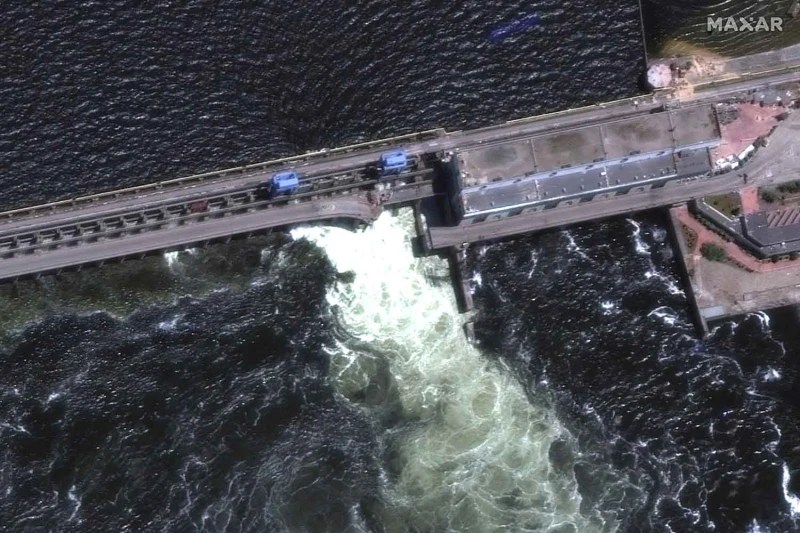
Though Western ‘news’ media have gotten their ‘explanation’ of this event from Ukraine’s Government, it never made sense that Russia would have wanted to flood, harm, and weaken, the entire western half of the territory that Russia now controls in the former Ukraine, including in Crimea (which was getting its water-supply from that dam).
The anonymous author of the “Moon of Alabama” website has a long and almost flawless record of accurately exposing realities that mainstream U.S.-and-allied ‘news’-media had been hiding, and the latest such is his June 13 “Did Russia Destroy The Nova Kakhovka Dam?” His report there turns upside-down and inside-out the Ukrainian Government’s ‘explanation’ that the dam had been bombed not by a missile, but by an explosive device which had been placed there by saboteurs whom Ukraine’s Government assumes were from Russia. U.S.-Government-approved ‘news’-media accept and amplify that assumption, but “MoA” does not.
First, he quotes the New York Times and other U.S. Government mouthpieces presenting the Ukrainian Government’s ‘explanation’ of the blow-up; and then he rips it apart by noting the extremely relevant (but in U.S.-and-occupied lands ignored) fact, that on May 12, Britain had supplied to Ukraine its “Storm Shadow” missiles that are designed to have a two-stage bombing-operation: first, a normal surface bomb, but then after it a fuse-ignited ground-penetrating bomb to explode deeper inside even a fortified and hardened underground target such as that dam was apparently blown up.
The British-supplied Storm Shadow weapon is perfect for this type of destruction — exploding from deep underground, instead of from the surface. And whereas Russia doesn’t have any Storm Shadows, Ukraine definitely does — ever since May 12.
The present news-report about U.S.-and-allied lies is being simultaneously submitted for publication by all of the standard U.S.-Government mouthpiece propaganda-media, just in case any of them might finally want to go beyond their standard U.S.-Government-approved sources.
“Due to the possibility of the use of prohibited methods of war by the Ukrainian regime, as well as information that Kyiv is preparing a massive missile strike on the Kakhovka hydroelectric station, there is an immediate danger of the Kherson region being flooded,” Vladimir Saldo, Russian-installed head of occupied Kherson province, said in a video message.
“Given the situation, I have decided to expand the evacuation zone by 15 km from the Dnipro,” he said. “The decision will make it possible to create a layered defence in order to repel Ukrainian attacks and protect civilians.”
Moscow has accused Kyiv of planning to use a so-called “dirty bomb” to spread radiation, or to blow up a dam to flood towns and villages in Kherson province. Kyiv says accusations it would use such tactics on its own territory are absurd, but that Russia might be planning such actions itself to blame Ukraine. …
Saldo, the Russian-imposed occupation leader for the province, identified seven towns on the east bank that would now be evacuated, comprising the main populated settlements along that stretch of the river.
Even U.S.-and-allied ‘news’-media occasionally report relevant facts when they find them useful to mention in a ‘news’-report that has an anti-Russian “spin.”
So: we know that Russia’s Government was trying to protect the residents in that region against this attack, but U.S.-and-allied ‘news’-media have unquestioningly accepted the Ukrainian government’s accusation that Russia’s Government did it. And, now, an extremely likely explanation has finally been provided, which implicates both Ukraine’s government and UK’s Government as having done it.
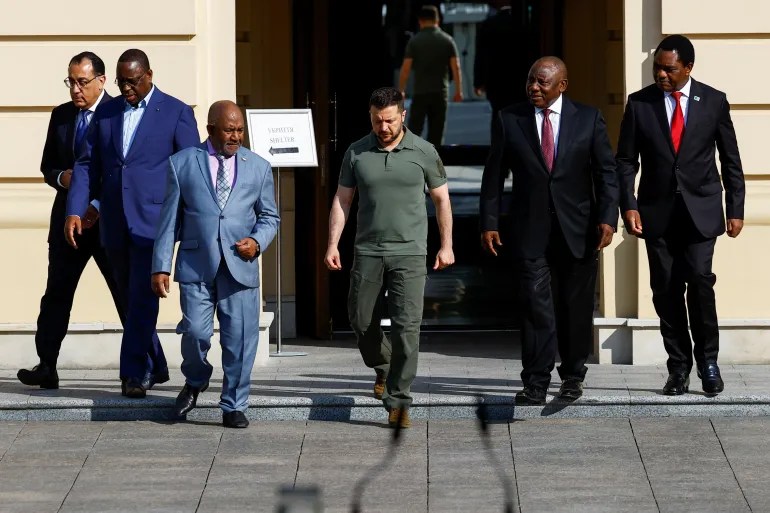
A delegation of African leaders travelled to Ukraine and Russia to help broker peace. But the collective west insists on prolonging the conflict.
The war in Ukraine grinds on and the Ukrainian army is being destroyed by Russia with great loss of life. One would think that Ukraine would be grateful for any and all peace efforts, but it is being used as a proxy by the United States and its NATO allies, the collective west. The seeds of this catastrophe began long before Russia’s special military operation. The European Union and NATO nations brought anti-Russian right-wing forces to power in 2014 in a coup against the elected Ukrainian president. If not for them there would be no war at all.
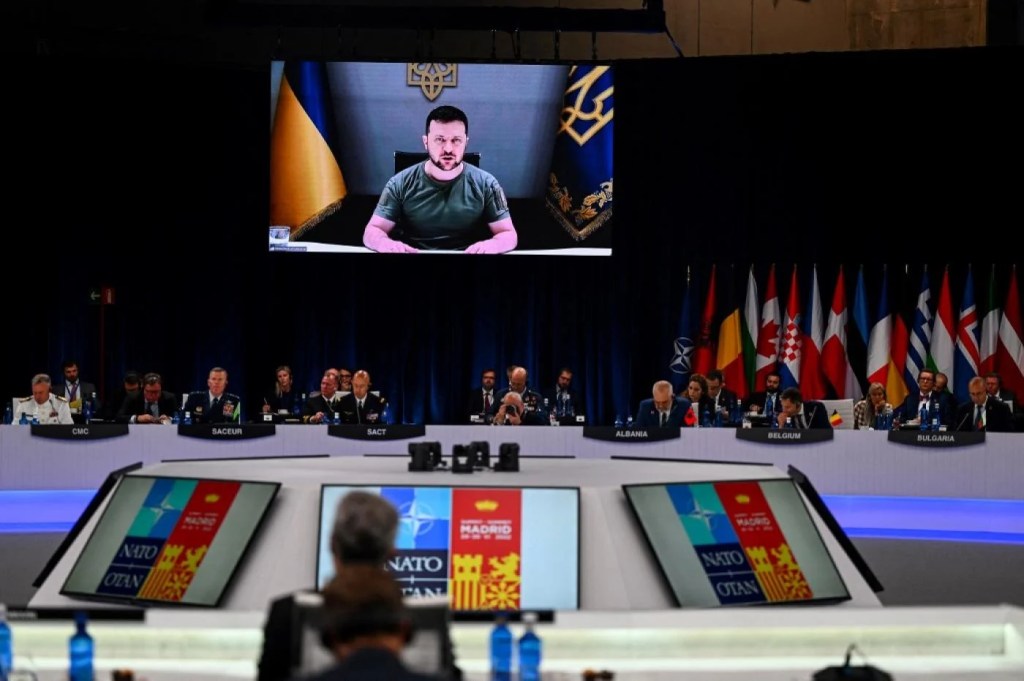
Their degree of culpability became clear recently when a delegation of African leaders traveled to Ukraine and Russia as part of a peacemaking initiative. The party included heads of state of Senegal, Egypt, Zambia, Comoros, Uganda, Republic of Congo, and South Africa. Comoros President Azali Assoumani is the current chair of the African Union. The group was greeted in Kiev by air raid sirens used to create the appearance that a Russian missile attack was underway. President Zelensky was barely polite, thanking South African president Cyril Ramaphosa and others for coming but letting them know that everything was Russia’s fault and that he had no interest whatsoever in peace talks.
Not only is Ukraine a de facto U.S. colony which lives and dies by Washington’s whims, but it is also a deeply racist country. Much of its population is still attached to Nazi ideology and the politics of World War II collaborator Stephan Bandera.
Nazi salutes, swastikas and other insignias are common there. So much so that the New York Times recently felt obliged to wonder in feigned innocence why these symbols are worn openly. The simple and obvious answer is that Ukraine is full of Nazis. Any likelihood that the same people would listen to Africans were indeed slim.
Ukraine was joined in racial superiority theater by Poland. Media and security staff accompanying the presidents were delayed there and the delegation had to travel without them. When the manufactured drama was no longer needed the delegation arrived in St. Petersburg, Russia and met with president Vladimir Putin who had a surprise of his own.
Putin listened politely to the 10-point plan and then interrupted with a surprise of his own. He not only reminded them the conflict began in 2014 but pointed out that Russia has been ready for peace ever since Turkey brokered negotiations with Ukraine in April 2022. Ukraine was on the verge of signing an agreement until its collective west friends, the US and UK in particular, scuttled the plan.
The Treaty on Permanent Neutrality and Guarantees of Security of Ukraine offered security guarantees for Ukraine in exchange for a commitment to remain neutral, meaning that NATO membership would be off the table. Putin pointed out that as soon as Russian forces left Kiev the agreement was thrown into “the dustbin.” Just as in the case of the Minsk Agreements, the collective west offered treachery instead of peace.
The African leaders have their own self-interest which sent them to Russia. Their nations’ supplies of grain and fertilizer have been disrupted by the western sanctions and restrictions on trade with Russia. Earlier agreements on this trade have worked against Africans, as Putin pointed out, “These European neo-colonial powers, technically the US, have once again deceived the international community and the Africa countries in need: 31.7 million tonnes were exported and only three percent reached Africa’s needy countries. Is this not deception?”
It is all to the good that the international community works together to end this war, but the west is only interested in escalating and Ukraine pays the price. The collective west excels in creating propaganda and bullying its allies. The rest of the world is working to escape U.S. and NATO domination as Ukrainians die in large numbers.
Ukraine’s love of Nazi symbolism reveals why that country is content to turn its population into cannon fodder. Meanwhile western insistence on escalation brings the entire world to the brink. Yet there is still no honest discussion about how the war began, or how the Nordstream pipeline exploded. Russia is still painted as the villain and the people of this country go into another presidential election year in the dark.
Russia is not just winning on the battlefield. Nation after nation has declared an intention to use currencies other than the dollar for trade or to join the BRICS. But the collective west cannot accept defeat. The threat they represent to the world cannot be underestimated.
U.S. Think Tank Land hacks are not exactly familiar with Montaigne: “On the highest throne in the world, we still sit only on our own bottom.”
Hubris leads these specimens to presume their flaccid bottoms are placed high above anyone else’s. The result is that a trademark mix of arrogance and ignorance always ends up unmasking the predictability of their forecasts.
U.S. Think Tank Land – inebriated by their self-created aura of power – always telegraphs in advance what they’re up to. That was the case with Project 9/11 (“We need a new Pearl Harbor”). That was the case with the RAND report on over-extending and unbalancing Russia. And now that’s the case with the incoming
It’s always painful to suffer through the intellectually shallow Think Thank Land wet dreams masquerading as “analyses” but in this particular case key Global South players need to be firmly aware of what awaits them.
Predictably, the whole “analysis” revolves around the imminent, devastating humiliation to the Hegemon and its vassals: what happens next in country 404, also known – for now – as Ukraine.
Brazil, India, Indonesia and Saudi Arabia are dismissed as “four major fence-sitters” when it comes to the U.S./NATO proxy war against Russia. It’s the same old “you’re with us or against us” trope.
But then we are presented with the six major Global South culprits: Brazil, India, Indonesia, Saudi Arabia, South Africa and Turkey.
In yet another crude, parochial remix of a catch phrase referring to the American elections, these are qualified as the key swing states the Hegemon will need to seduce, cajole, intimidate and threaten to assure its dominance of the “rules-based international order”.
Saudi Arabia and South Africa are added to a previous report focused on the “four major fence sitters”.
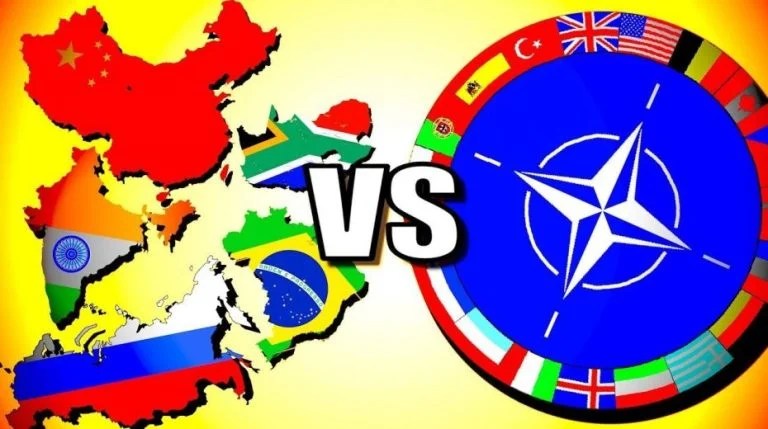
The swing state manifesto notes that all of them are G-20 members and “active in both geopolitics and geoeconomics” (Oh really? Now that’s some breaking news). What it does not say is that three of them are BRICS members (Brazil, India, South Africa) and the other three are serious candidates to join BRICS+: deliberations will be turbo-charged in the upcoming BRICS summit in South Africa in August.
So it’s clear what the swing state manifesto is all about: a call to arms for the American war against the BRICS.
So BRICS packs no punch
The swing state manifesto harbors wet dreams of near-shoring and friend-shoring moving away from China. Nonsense: enhanced intra-BRICS+ trade will be the order of the day from now on, especially with the expanded practice of trade in national currencies (see Brazil-China or within ASEAN), the first step towards widespread de-dollarization.
The swing states are characterized as “not a new incarnation” of the Non-Aligned Movement (NAM), or “other groupings dominated by the Global South, such as the G-77 and BRICS.”
Talk about exponential nonsense. This is all about BRICS+ – which now has the tools (including the NDB, the BRICS bank) to do what NAM could never accomplish during the Cold War: establish the framework of a new system bypassing Bretton Woods and the interlocking coercion mechanisms of the Hegemon.
As for stating that BRICS has not “packed much punch” that only reveals U.S. Think Tank Land’s cosmic ignorance of what BRICS + is all about.
The position of India is only considered in terms of being a Quad member – defined as a “U.S.-led effort to balance China”. Correction: contain China.
As for the “choice” of swing states of choosing between the U.S. and China on semiconductors, AI, quantum technology, 5G and biotechnology, that’s not about “choice”, but to what level they are able to sustain Hegemon pressure to demonize Chinese technology.
Pressure on Brazil, for instance, is much heavier than on Saudi Arabia or Indonesia.
In the end though, it all comes back to the Straussian neocon obsession: Ukraine. The swing states, in varying degrees, are guilty of opposing and/or undermining the sanctions dementia. Turkey, for instance, is accused of channeling “dual-use” items to Russia. Not a word on the U.S. financial system viciously forcing Turkish banks to stop accepting Russian MIR payment cards.
On the wishful thinking front, this pearl stands out among many: “The Kremlin seems to believe it can make a living by turning its trade south and east.”
Well, Russia is already making excellent living all across Eurasia and a vast expanse of the Global South.
The economy has re-started (drivers are domestic tourism, machine building and the metals industry); inflation is at only 2.5% (lower than anywhere in the EU); unemployment is at only 3.5%; and head of the Central Bank Elvira Nabiullina said that by 2024 growth will be back to pre-SMO levels.
U.S. Think Tankland is congenitally incapable of understanding that even if BRICS+ nations may still have some serious trade credit issues to iron out, Moscow has already shown how even an implied hard backing of a currency can turn out to be an instant game changer. Russia is at the same time backing not only the ruble but also the yuan.
Meanwhile, the Global South de-dollarization caravan moves on relentlessly – as much as the proxy war hyenas may keep howling in the dark. When the full – staggering – scale of NATO’s humiliation in Ukraine unfolds, arguably by mid-summer, the de-dollarization high-speed train will be fully booked, non-stop.
“Offer you can’t refuse” rides again
If all of the above was not already silly enough, the swing state manifesto doubles down on the nuclear front, accusing them of “future (nuclear) proliferation risks”: especially – who else – Iran.
By the way, Russia is defined as a “middle power, but one in decline”. And “hyper-revisionist” to boot. Oh dear: with “experts” like this, the Americans don’t even need enemies.
And yes, by now you may be excused to roar with laughter: China is accused of attempting to direct and co-opt BRICS. The “suggestion” – or “offer you can’t refuse”, Mafia-style – to the swing states is that you cannot join a “Chinese-directed, Russian-assisted body actively opposing the United States.”
The message is unmistakable: “The threat of a Sino-Russian co-optation of an expanded BRICS—and through it, of the global south—is real, and it needs to be addressed.”
And here are the recipes to address it. Invite most swing states to the G-7 (that was a miserable failure). “More high-level visits by key U.S. diplomats” (welcome to cookie distributor Vicky Nuland). And last but not least, Mafia tactics, as in a “nimbler trade strategy that begins to crack the nut of access to the U.S. market.”
The swing state manifesto could not but let the Top Cat out of the bag, predicting, rather praying that “U.S.-China tensions rise dramatically and turn into a Cold War-style confrontation.” That’s already happening – unleashed by the Hegemon.
So what would be the follow-up? The much sought after and spun-to-death “decoupling”, forcing the swing states to “align more closely with one side or the other”. It’s “you’re with us or against us” all over again.
So there you go. Raw, in the flesh – with inbuilt veiled threats. The Hybrid War 2.0 against the Global South has not even started. Swing states, you have all been warned.
All around us things are falling apart. Collectively, Americans are experiencing national and imperial decline. Can America save itself? Is this country, as presently constituted, even worth saving?
For me, that last question is radical indeed. From my early years, I believed deeply in the idea of America. I knew this country wasn’t perfect, of course, not even close. Long before the 1619 Project, I was aware of the “original sin” of slavery and how central it was to our history. I also knew about the genocide of Native Americans. (As a teenager, my favorite movie — and so it remains — was Little Big Man, which pulled no punches when it came to the white man and his insatiably murderous greed.)
Nevertheless, America still promised much, or so I believed in the 1970s and 1980s. Life here was simply better, hands down, than in places like the Soviet Union and Mao Zedong’s China. That’s why we had to “contain” communism — to keep them over there, so they could never invade our country and extinguish our lamp of liberty. And that’s why I joined America’s Cold War military, serving in the Air Force from the presidency of Ronald Reagan to that of George W. Bush and Dick Cheney. And believe me, it proved quite a ride. It taught this retired lieutenant colonel that the sky’s anything but the limit.
In the end, 20 years in the Air Force led me to turn away from empire, militarism, and nationalism. I found myself seeking instead some antidote to the mainstream media’s celebrations of American exceptionalism and the exaggerated version of victory culture that went with it (long after victory itself was in short supply). I started writing against the empire and its disastrous wars and found likeminded people at TomDispatch — former imperial operatives turned incisive critics like Chalmers Johnson and Andrew Bacevich, along with sharp-eyed journalist Nick Turse and, of course, the irreplaceable Tom Engelhardt, the founder of those “tomgrams” meant to alert America and the world to the dangerous folly of repeated U.S. global military interventions.
But this isn’t a plug for TomDispatch. It’s a plug for freeing your mind as much as possible from the thoroughly militarized matrix that pervades America. That matrix drives imperialism, waste, war, and global instability to the point where, in the context of the conflict in Ukraine, the risk of nuclear Armageddon could imaginably approach that of the 1962 Cuban Missile Crisis. As wars — proxy or otherwise — continue, America’s global network of 750-odd military bases never seems to decline. Despite upcoming cuts to domestic spending, just about no one in Washington imagines Pentagon budgets doing anything but growing, even soaring toward the trillion-dollar level, with militarized programs accounting for 62% of federal discretionary spending in 2023.
Indeed, an engorged Pentagon — its budget for 2024 is expected to rise to $886 billion in the bipartisan debt-ceiling deal reached by President Joe Biden and House Speaker Kevin McCarthy — guarantees one thing: a speedier fall for the American empire. Chalmers Johnson predicted it; Andrew Bacevich analyzed it. The biggest reason is simple enough: incessant, repetitive, disastrous wars and costly preparations for more of the same have been sapping America’s physical and mental reserves, as past wars did the reserves of previous empires throughout history. (Think of the short-lived Napoleonic empire, for example.)
Known as “the arsenal of democracy” during World War II, America has now simply become an arsenal, with a military-industrial-congressional complex intent on forging and feeding wars rather than seeking to starve and stop them. The result: a precipitous decline in the country’s standing globally, while at home Americans pay a steep price of accelerating violence (2023 will easily set a record for mass shootings) and “carnage” (Donald Trump’s word) in a once proud but now much-bloodied “homeland.”
Lessons from History on Imperial Decline
I’m a historian, so please allow me to share a few basic lessons I’ve learned. When I taught World War I to cadets at the Air Force Academy, I would explain how the horrific costs of that war contributed to the collapse of four empires: Czarist Russia, the German Second Reich, the Ottoman empire, and the Austro-Hungarian empire of the Habsburgs. Yet even the “winners,” like the French and British empires, were also weakened by the enormity of what was, above all, a brutal European civil war, even if it spilled over into Africa, Asia, and indeed the Americas.
And yet after that war ended in 1918, peace proved elusive indeed, despite the Treaty of Versailles, among other abortive agreements. There was too much unfinished business, too much belief in the power of militarism, especially in an emergent Third Reich in Germany and in Japan, which had embraced ruthless European military methods to create its own Asiatic sphere of dominance. Scores needed to be settled, so the Germans and Japanese believed, and military offensives were the way to do it.
As a result, civil war in Europe continued with World War II, even as Japan showed that Asiatic powers could similarly embrace and deploy the unwisdom of unchecked militarism and war. The result: 75 million dead and more empires shattered, including Mussolini’s “New Rome,” a “thousand-year” German Reich that barely lasted 12 of them before being utterly destroyed, and an Imperial Japan that was starved, burnt out, and finally nuked. China, devastated by war with Japan, also found itself ripped apart by internal struggles between nationalists and communists.
As with its prequel, even most of the “winners” of World War II emerged in a weakened state. In defeating Nazi Germany, the Soviet Union had lost 25 to 30 million people. Its response was to erect, in Winston Churchill’s phrase, an “Iron Curtain” behind which it could exploit the peoples of Eastern Europe in a militarized empire that ultimately collapsed due to its wars and its own internal divisions. Yet the USSR lasted longer than the post-war French and British empires. France, humiliated by its rapid capitulation to the Germans in 1940, fought to reclaim wealth and glory in “French” Indochina, only to be severely humbled at Dien Bien Phu. Great Britain, exhausted from its victory, quickly lost India, that “jewel” in its imperial crown, and then Egypt in the Suez debacle.
There was, in fact, only one country, one empire, that truly “won” World War II: the United States, which had been the least touched (Pearl Harbor aside) by war and all its horrors. That seemingly never-ending European civil war from 1914 to 1945, along with Japan’s immolation and China’s implosion, left the U.S. virtually unchallenged globally. America emerged from those wars as a superpower precisely because its government had astutely backed the winning side twice, tipping the scales in the process, while paying a relatively low price in blood and treasure compared to allies like the Soviet Union, France, and Britain.
History’s lesson for America’s leaders should have been all too clear: when you wage war long, especially when you devote significant parts of your resources — financial, material, and especially personal — to it, you wage it wrong. Not for nothing is war depicted in the Bible as one of the four horsemen of the apocalypse. France had lost its empire in World War II; it just took later military catastrophes in Algeria and Indochina to make it obvious. That was similarly true of Britain’s humiliations in India, Egypt, and elsewhere, while the Soviet Union, which had lost much of its imperial vigor in that war, would take decades of slow rot and overstretch in places like Afghanistan to implode.
Meanwhile, the United States hummed along, denying it was an empire at all, even as it adopted so many of the trappings of one. In fact, in the wake of the implosion of the Soviet Union in 1991, Washington’s leaders would declare America the exceptional “superpower,” a new and far more enlightened Rome and “the indispensable nation” on planet Earth. In the wake of the 9/11 attacks, its leaders would confidently launch what they termed a Global War on Terror and begin waging wars in Afghanistan, Iraq, and elsewhere, as in the previous century they had in Vietnam. (No learning curve there, it seems.) In the process, its leaders imagined a country that would remain untouched by war’s ravages, which was we now know — or do we? — the height of imperial hubris and folly.
For whether you call it fascism, as with Nazi Germany, communism, as with Stalin’s Soviet Union, or democracy, as with the United States, empires built on dominance achieved through a powerful, expansionist military necessarily become ever more authoritarian, corrupt, and dysfunctional. Ultimately, they are fated to fail. No surprise there, since whatever else such empires may serve, they don’t serve their own people. Their operatives protect themselves at any cost, while attacking efforts at retrenchment or demilitarization as dangerously misguided, if not seditiously disloyal.
That’s why those like Chelsea Manning, Edward Snowden, and Daniel Hale, who shined a light on the empire’s militarized crimes and corruption, found themselves imprisoned, forced into exile, or otherwise silenced. Even foreign journalists like Julian Assange can be caught up in the empire’s dragnet and imprisoned if they dare expose its war crimes. The empire knows how to strike back and will readily betray its own justice system (most notably in the case of Assange), including the hallowed principles of free speech and the press, to do so.
Perhaps he will eventually be freed, likely as not when the empire judges he’s approaching death’s door. His jailing and torture have already served their purpose. Journalists know that to expose America’s bloodied tools of empire brings only harsh punishment, not plush rewards. Best to look away or mince one’s words rather than risk prison — or worse.
Yet you can’t fully hide the reality that this country’s failed wars have added trillions of dollars to its national debt, even as military spending continues to explode in the most wasteful ways imaginable, while the social infrastructure crumbles.
Clinging Bitterly to Guns and Religion
Today, America clings ever more bitterly to guns and religion. If that phrase sounds familiar, it might be because Barack Obama used it in the 2008 presidential campaign to describe the reactionary conservatism of mostly rural voters in Pennsylvania. Disillusioned by politics, betrayed by their putative betters, those voters, claimed the then-presidential candidate, clung to their guns and religion for solace. I lived in rural Pennsylvania at the time and recall a response from a fellow resident who basically agreed with Obama, for what else was there left to cling to in an empire that had abandoned its own rural working-class citizens?
Something similar is true of America writ large today. As an imperial power, we cling bitterly to guns and religion. By “guns,” I mean all the weaponry America’s merchants of death sell to the Pentagon and across the world. Indeed, weaponry is perhaps this country’s most influential global export, devastatingly so. From 2018 to 2022, the U.S. alone accounted for 40% of global arms exports, a figure that’s only risen dramatically with military aid to Ukraine. And by “religion,” I mean a persistent belief in American exceptionalism (despite all evidence to the contrary), which increasingly draws sustenance from a militant Christianity that denies the very spirit of Christ and His teachings.
Yet history appears to confirm that empires, in their dying stages, do exactly that: they exalt violence, continue to pursue war, and insist on their own greatness until their fall can neither be denied nor reversed. It’s a tragic reality that the journalist Chris Hedges has written about with considerable urgency.
The problem suggests its own solution (not that any powerful figure in Washington is likely to pursue it). America must stop clinging bitterly to its guns — and here I don’t even mean the nearly 400 million weapons in private hands in this country, including all those AR-15 semi-automatic rifles. By “guns,” I mean all the militarized trappings of empire, including America’s vast structure of overseas military bases and its staggering commitments to weaponry of all sorts, including world-ending nuclear ones. As for clinging bitterly to religion — and by “religion” I mean the belief in America’s own righteousness, regardless of the millions of people it’s killed globally from the Vietnam era to the present moment — that, too, would have to stop.
History’s lessons can be brutal. Empires rarely die well. After it became an empire, Rome never returned to being a republic and eventually fell to barbarian invasions. The collapse of Germany’s Second Reich bred a third one of greater virulence, even if it was of shorter duration. Only its utter defeat in 1945 finally convinced Germans that God didn’t march with their soldiers into battle.
What will it take to convince Americans to turn their backs on empire and war before it’s too late? When will we conclude that Christ wasn’t joking when He blessed the peacemakers rather than the warmongers?
As an iron curtain descends on a failing American imperial state, one thing we won’t be able to say is that we weren’t warned.
The West is now waking up to the reality of the emerging, polycentric and fluid global order, Alastair Crookewrites.
More than a year into Russia’s Special Operation, the initial burst of European excitement at western push-back on Russia has dissipated. The mood instead has turned to “existential dread, a nagging suspicion that [western] civilisation may destroy itself”, Professor Helen Thompson writes.
For an instant, a euphoria had coalesced around the putative projection of the EU as a world power; as a key actor, about to compete on a world scale. Initially, events seemed to play to Europe’s conviction of its market powers: Europe was going to bring down a major power – Russia – by financial coup d’état alone. The EU felt ‘six feet tall’.
It seemed at the time a galvanising moment: “The war re-forged a long-dormant Manichaean framing of existential conflict between Russia and the West, assuming ontological, apocalyptic dimensions. In the spiritual fires of the war, the myth of the ‘West’ was rebaptised”, Arta Moeini suggests.
After the initial disappointment at the lack of a ‘quick kill’, the hope persisted – that if only the sanctions were given more time, and made more all-embracing, then Russia surely would ultimately collapse. That hope has turned to dust. And the reality of what Europe has done to itself has begun to dawn – hence Professor Thomson’s dire warning:
“Those who assume that the political world can be reconstructed by the efforts of human Will, have never before had to bet so heavily on technology over [fossil] energy – as the driver of our material advancement”.
For the Euro-Atlanticists however, what Ukraine seemed to offer – finally – was validation for their yearning to centralise power in the EU, sufficiently, to merit a place at the ‘top table’ with the U.S., as partners in playing the Great Game.
Ukraine, for better or worse, underlined Europe’s profound military dependence on Washington – and on NATO.
More particularly, the Ukraine conflict seemed to open the prospect for consolidating the strange metamorphosis of NATO from military alliance to an enlightened, Progressive, peace alliance! As Timothy Garton Ash effused in the Guardian in 2002, “NATO has become a European peace movement” where one could watch “John Lennon meet George Bush”.
The Ukraine war is portrayed, in this vein, as the “war that even former pacifists can get behind. All its proponents seemed to be singing is “Give War a Chance””.
“…especially in the past 12 months, telegenic female leaders such as the Finnish Prime Minister, Sanna Marin, German Foreign Minister, Annalena Baerbock, and Estonian Prime Minister, Kaja Kallas, have increasingly served as the spokespersons of enlightened militarism in Europe … ”
“No political party in Europe better exemplifies the shift from militant pacifism to ardent pro-war Atlanticism than the German Greens. Most of the original Greens had been radicals during the student protests of 1968 … But as the founding members entered middle age, fissures began to appear in the party – that would one day tear it apart”.
“Kosovo then changed everything:The 78-day NATO bombing of what remained of Yugoslavia in 1999, ostensibly to halt war crimes committed by Serbian security forces in Kosovo, would forever transform the German Greens. NATO for the Greens became an active military compact concerned with spreading and defending values such as human rights, democracy, peace, and freedom – well beyond the borders of its member states”.
A few years later, in 2002, an EU functionary (Robert Cooper) could envisage Europe as a new ‘liberal imperialism’. The ‘new’ was that Europe eschewed hard military power, in favour of weaponising both a controlled ‘narrative’ and controlled participation in its market. He advocated for ‘a new age of empire’, in which Western powers no longer would have to follow international law in their dealings with ‘old fashioned’ states; they could use military force independently of the United Nations; and could impose protectorates to replace regimes which ‘misgovern’.
The German Greens’ Foreign Minister, Annalena Baerbock, has continued with this metamorphosis, scolding countries with traditions of military neutrality, and imploring them to join NATO. She has invoked Archbishop Desmond Tutu’s line: “If you are neutral in situations of injustice, you have chosen the side of the oppressor”. And the European Left has been utterly captivated. Major parties have abandoned military neutrality and opposition to war – and now champion NATO. It is a stunning reversal.
All this may have been music to the ears of the Euro-élites anxious for the EU to rise to Great Power status, but this soft-power European Leviathan was wholly underpinned by the unstated (but essential) assumption that NATO ‘had Europe’s back’. This naturally implied that the EU had to tie itself ever closer to NATO – and therefore to the U.S. which controls NATO.
But the flip-side to this Atlanticist aspiration – as President Emmanuel Macron noted – is its inexorable logic that Europeans simply end by becoming American vassals. Macron was trying rather, to rally Europe towards the coming ‘age of empires’,hoping to position Europe as a ‘third pole’ in a concert of empires.
The Atlanticists were duly enraged by Macron’s remarks (which nonetheless drew support of other EU states). It could even seem (to furious Atlanticists) that Macron actually was channelling General de Gaulle who had called NATO a “false pretence” designed to “disguise America’s chokehold over Europe”.
There are however, two related schisms that flowed out from this ‘re-imagined’ NATO: Firstly, it exposed the reality of internal European rivalries and divergent interests, precisely because the NATO lead in the Ukraine conflict sets the interests of the Central East European hawks wanting ‘more America, and more war on Russia’ up and against that of the original EU western axis which wants wanting strategic autonomy (i.e. less ‘America’, and a quick end to the conflict).
Secondly, it would be predominantly the western economies that would have to bankroll the costs and divert their manufacturing capacity towards military logistic chains. The economic price, non-military de-industrialisation and high inflation, potentially, could be enough to break Europe – economically.
The prospect of a pan-European cohesive identity might be both ontologically appealing – and be seen to be an ‘appropriate accessory’ to an aspiring ‘world actor’ – yet such identity becomes caricature when mosaic Europe is transformed into an abstract de-territorialised identity that reduces people to their most abstract.
Paradoxically, the Ukraine war – far from consolidating the EU ‘identity’, as first imagined – has fractured it under the stresses of the concerted effort to weaken and collapse Russia.
Secondly, as Arta Moeini, the director of the Institute for Peace and Diplomacy, has observed:
“The American push for NATO expansion since 1991 has enlarged the alliance by adding a host of faultline states from Central and Eastern Europe. The strategy, which began with the Clinton administration but was fully championed by the George W. Bush administration, was to create a decidedly pro-American pillar on the continent, centred on Warsaw – which would force an eastward shift in the alliance’s centre of gravity away from the traditional Franco-German axis”.
“By using NATO enlargement to weaken the old power centres in Europe that might have occasionally stood up to [Washington] such as in the run-up to the invasion of Iraq, Washington ensured a more compliant Europe in the short-term. The upshot, however, was the formation of a 31-member behemoth with deep asymmetries of power and low compatibility of interests” – that is much weaker and more vulnerable – than it believes itself to be”.
Here is the key: “the EU is much weaker than it believes it to be”. The outset of the conflict was defined by a cast of mind entranced by the notion of Europe as a ‘mover and shaker’ in world affairs, and mesmerised by Europe’s post-war prosperity.
EU leaders convinced themselves that this prosperity had bequeathed it the clout and the economic depth to contemplate war – and to weather its reversals – with panglossian sanguinity. It has produced rather, the converse: It has put its project in jeopardy.
In John Raply and Peter Heather’s The Imperial Life Cycle, the authors explain the cycle:
“Empires grow rich and powerful and attain supremacy through the economic exploitation of their colonial periphery. But in the process, they inadvertently spur the economic development of that same periphery, until it can roll back and ultimately displace its overlord”.
Europe’s prosperity in this post-war era, thus was not so much one of its own making, but drew benefit from the tail-end of accumulations hewn from an earlier cycle – now reversed.
“The fastest-growing economies in the world are now all in the old periphery; the worst-performing economies are disproportionately in the West. These are the economic trends that have created our present landscape of superpower conflict — most saliently between America and China”.
America may think of itself as exempt from the European colonial mould, yet fundamentally, its model is
“an updated cultural-political glue that we might call “neoliberalism, NATO and denim”, which follows in the timeless imperial mould: The great wave of decolonisation that followed WW2 was meant to end that. But the Bretton Woods system, which created a trading regime that favoured industrial over primary producers and enshrined the dollar as the global reserve currency – ensured that the net flow of financial resources continued to move from developing countries to developed ones. Even when the economies of the newly-independent states grew, those of the G7 economies and their partners grew more”.
A once-mighty empire is now challenged and feels embattled. Taken aback by the refusal of so many developing countries to join with isolating Russia, the West is now waking up to the reality of the emerging, polycentric and fluid global order. These trends are set to continue. The danger is that economically weakened and in crisis, western countries attempt to re-appropriate western triumphalism, yet lack the economic strength and depth, so to do:
“In the Roman Empire, peripheral states developed the political and military capacity to end Roman domination by force… The Roman Empire might have survived – had it not weakened itself with wars of choice – on its ascendant Persian rival”.
The final ‘transgressive’ thought goes to Tom Luongo: “Allowing the West to keep thinking they can win – is the ultimate form of grinding out a superior opponent”.
Brazil’s Luiz Inacio Lula da Silva has called on BRICS nations to create an alternative to replace the dollar in foreign trade. Other experts suggest President Joe Biden’s policies will destroy America’s middle class for good. The news comes when China and Russia strengthen ties with Brazil and Latin America. Brazil’s leader questioned the institution of the U.S. dollar as the world’s trade currency in the first place and asked why each country could not trade in its currency.
This brings to the forefront the historical moment when the gold standard was abolished in favor of the current system. When President Richard Nixon moved to abolish the gold standard as a commitment mechanism, his administration ushered in decades of relative volatility and made hard currency.
The exchange of gold was severely curtailed through the Bretton Woods international monetary agreement of 1944. When the International Monetary Fund was established, the U.S. Dollar became the most potent currency in the world. Initially, the role of the IMF was only to assist with international transactions, but as we see today, that institution has far overstepped its original purpose. Today, the IMF is a leverage arm for the United States and a few European nations to fund countries/regimes that align with its policy. The U.S., for instance, has an almost 20% share of contributions to the fund.
The primary purpose of remaining off the gold standard is that the government can print money endlessly, with two primary goals. First, a massive defense budget and needless proxy wars would not be possible if the United States were on the gold standard. Secondly, the people who control the central banks cannot extract interest on national debts that are currently out of control. So, the fiat currency supposedly backed by the “full faith and credit” of the government, the dollar, is worth what lying politicians and finance ministers say it is.
One look at the worldwide bond market reveals a disturbing imbalance. The U.S., which now has over $51 trillion in outstanding debt, has borrowed more to finance wars and programs than China, Japan, Germany, Italy, France, the U.K., and Canada combined. The American taxpayer is responsible for almost 40% of all the foreign debt in the world. And the outlook for the short and long-term future could be better.
President Joe Biden wants to borrow even more when his administration conducts a proxy war against Russia in Ukraine. With billions flowing into Europe’s most corrupt country, Americans are on the precipice of an economic catastrophe not seen since the Great Depression.
According to the Bipartisan Policy Center in Washington and the Congressional Budget Office, the government will no longer be able to pay everyone — including bondholders, Social Security recipients, and federal employees — sometime this summer or early this fall. A New York Times report from late March outlines the situation. But the problem is far worse than many experts suggest. No matter which way lawmakers move, the U.S. has almost insurmountable fiscal issues. The ramifications will be dire whether or not they raise the debt limit. And if the BRICS countries go off the dollar as a trade currency… Well.
Many experts predict that American greenbacks won’t be worth the printed paper if the world stops using the U.S. dollar as its world currency reserve. Moreover, if the dollar loses its value significantly, every American who owes a credit card loan or a home mortgage will find it ten times harder to pay off those debts.
To make matters worse, millions of jobs will be sacrificed for the Federal Reserve to get any financial stability. Analysis from RSM International shows that the central banks must “induce” a recession to get America’s economic situation in check. And the dollar being made useless by the larger world community was not a factor in their analysis.
The bottom line is if we were still on the gold standard, this would be fine. The gold standard reduced the risks of such economic crises and recessions. Income levels were higher when we were on the bullion-backed system. More importantly, the gold standard created hard limits on printing money and limiting military spending. For more intuition on this, this Barron’s report reveals how our current failing system came into being. The information also serves as a crystal ball for what will happen.
As confidence in the dollar wanes and U.S. policy overseas gets more aggressive toward BRICS nations and others, the tipping point of the American hegemony draws closer.
Christo Grozev of Bellingcat gained a front row seat to a bungled Ukrainian intelligence operation that left a friendly airfield destroyed and soldiers dead. His narrative about his role in the plot is filled with holes.
Criminal charges of treason and abuse of power have been leveled against an unspecified number of Ukrainian servicemen by the Security Service of Ukraine (SBU). In a bizarre plot to seize Russian aircraft and transfer the planes to Ukraine, the accused soldiers disclosed sensitive information that allowed Moscow to strike an important Ukrainian airfield with a Kalibr missile. A commander was killed, 17 airmen were wounded, two fighter jets destroyed, and “significant damage” was inflicted to the airstrip and several nearby buildings.
Will Ukrainian authorities now level criminal charges against members of Bellingcat, the Western government-funded open source investigations collective, for its role in the connivance? Christo Grozev, the organization’s “lead Russia investigator,” was inexplicably granted a front row seat to the chicanery by the individuals who attempted to carry it out.
Once the plot unravelled spectacularly, Grozev attempted to spin it as an embarrassment for Russia, while denying the SBU or Ukraine’s Defense Intelligence Directorate (GUR) played any role in its execution. Instead, he claimed, it was the work of “maverick ex-operatives.” The criminal cases pursued by the SBU validate this narrative:
“These actions of individual servicemen [emphasis added], which led to serious consequences, death and injury of Ukraine’s defenders and harmed the country’s defence capabilities, require an appropriate legal assessment.”
As we will see, Grozev was far from a passive spectator in the scheme. Indeed, his framing of the event gives every appearance of a damage control exercise, shielding Bellingcat and the GUR and SBU from blame. Coincidentally, his Bellingcat website profile notes his interest in “the weaponization of information.”
Read Alex Rubinstein’s report on Christo Grozev’s defense of a terror attack on a St. Petersburg, Russia cafe, and his call for more of such actions.
Bulgarian journalist and Bellingcat’s “lead Russia investigator” Christo Grozev
Bellingcat’s proxy war blunders pile up
Since the war in Ukraine began, Christo Grozev and Bellingcat have played a lead role in disseminating and “verifying” dubious, if not outright fraudulent, material and claims related to the conflict.
Just over a week after Russia’s February 24, 2022 invasion, Grozev confidently declared that Moscow’s war-fighting resources would be spent by March 6th, at which time Russian forces would “collapse.” Over a year later, the gears of the Russian war machine are still churning away.
By the end of March 2022, Bellingcat had fed the Wall Street Journal an entirely bogus tale, asserting that oligarch Roman Abramovich and two Ukrainian negotiators who had been trying to broker peace between their two countries were poisoned.
The finding was the result of an investigation reportedly organized by Grozev, who claimed to have seen the images of the effects of the attack. He further alleged that “too much time had passed for the suspected poison to be detected by the time a German forensic team was able to perform an examination,” accounting for why his assertions could not be verified by authorities.
“It was not intended to kill, it was just a warning,” Grozev falsely declared.
Though Ukrainian and US officials quickly dismissed the story as fantasy, Grozev was not deterred. In late April 2022, while appearing on a charity telethon for Kiev, he claimed to have “personally checked,” and found that Russia had already lost “90%” of the “highest quality, important and essential part of its army, without which it is impossible to conquer key infrastructure facilities.”
For the families of those killed at Kanatove airfield, and the countless conscripts who have lost their lives under Russian artillery fire in Bakhmut, such comments must seem like a sick joke.
Bellingcat’s Grozev spins a cinematic yarn
On July 25th 2022, Moscow’s state-owned news agency TASS reported that Russia’s FSB security agency had thwarted a Ukrainian operation to steal Russian aircraft, “supervised by NATO.”
Intelligence officers acting on behalf of Kiev’s political leadership reportedly approached Russian military pilots in secret, offering them millions of dollars and citizenship of an EU country of their choosing in return for deliveries of aircraft such as Su-24s and Su-34s.
Several pilots appeared to take the bait. And it turned out that Bellingcat’s Christo Grozev had been helping to cultivate the turncoats through a series of exchanges on encrypted messaging apps.
However, the FSB had apparently infiltrated the plot from the outset, and were using discussions over defection to glean sensitive information from the Ukrainians. This yield then helped the Russian air force to “inflict fire damage on a number of Ukrainian military facilities.”
The Russian strike on Ukraine’s Kanatove airfield, and the SBU’s criminal investigation of the incident, tends to confirm that version of events. However, in the wake of the TASS report, Grozev offered a radically different tale: a “crazier-than-fiction story of triple-agents, fake passports and faux girlfriends.”
The Bellingcat staffer claimed that after Kiev passed a law in April offering financial incentives to Russians to surrender and hand over weapons and vehicles, “a team of Ukrainian operatives decided to approach Russian pilots with an offer based on this law.” Bellingcat miraculously “found out about the initiative” and secured a “front seat” to make a documentary about a “brazen operation.”
Grozev and company then watched as Russian pilots were successfully lured into providing “proof-of-access” videos from inside their planes, some of which were “quite detailed and enlightening,” as they prepared to defect. It was only then that the FSB became involved, as the Ukrainians learned later on. At this point, the plot morphed into a “double ‘operational game’ in which both sides were trying to extract maximum information from the other, while feeding them maximum disinfo.”
The Ukrainians peddled the FSB “fake maps of their anti-aircraft deployments, as well as disinfo on the operational airstrips.” They even convinced the security service to send one of the pilot’s wives, “along with a whole FSB tailing team,” to Minsk, Belarus for an in-person meeting. When nobody showed up, the Russians realized they had been “burned,” the Ukrainians realized they were not “getting a real pilot,” and the “mutual-deceit game came to an end.”
“While Russia is presenting today this as a coup for its counter intelligence, in fact the operation was a serious blunder for the FSB, disclosing unintentionally identities of dozens of counter intel officers, their methods of operation, and their undercover assets,” Grozev boldly declared.
After pushback, Grozev changes his story
The narrative Grozev spun out was marred by several obvious problems. How did Bellingcat learn of a secret Ukrainian operation? Why were outsiders – particularly ostensibly independent journalists – encouraged by the plotters to film a documentary on the operation as it was being conducted? Why did Grozev wait for the FSB to get the first word, if the plot was such a stunning success for the Ukrainians?
Perhaps most pertinently of all, if Bellingcat played no active part in the connivance and were simply observers, how did the Russians learn of their presence, to be able to falsely accuse Grozev of involvement?
Even if Grozev’s version of events were true, it provides numerous indications that Bellingcat assisted the so-called “Ukrainian operatives.”
For example, one of the pilots sent the Ukrainians a photo of his “lover,” whom he wished to take with him when he defected. Grozev boasted that it took him “about five minutes” to discover that the woman was in reality “an FSB girlfriend-for-hire.” Did he keep this information siloed from the “operatives”? Would Grozev really not share this revelation with the supposed subjects of his “documentary”?
While many took Grozev’s unbelievable fable at face value, several of Bellingcat’s normally deferential mainstream boosters began asking if the organization’s involvement with “Ukrainian operatives” placed it in direct quarters with the SBU and GUR. At this point, Grozev felt compelled to issue a clarification. He claimed neither agency was involved, and if either had been, “there’d be no way we would – or want to – get access to it.”
Instead, Grozev contended the Ukrainians in contact with Bellingcat had been “maverick ex-operatives” who he met during a previous investigation, and that they were acting independently of the government and security services. As such, he claimed the FSB’s counterintelligence wing was “fighting tooth and nail against a bunch of, essentially, volunteers.”
Grozev’s clunky narrative raised far more suspicion than it allayed. It is inconceivable that such a sensitive attempt to secure defections during wartime would be conducted without state authorization or knowledge. This is particularly the case if defections are sought under the terms of a dedicated government program providing financial incentives for switching sides and handing over military hardware.
Offers of money and EU citizenship for the pilots and their “lovers” would have necessarily needed to be approved by Kiev. Even if the Ukrainian “ex-operatives” ultimately intended to betray the defectors and not provide what they promised, the Ukrainian military would have by definition needed to agree to the pilots’ arrival, and their planned flightpaths, in advance. Otherwise, their jets would be shot down before they landed.
In any event, not providing the pilots with what was offered would inevitably deter any further defections from the Russian side, therefore sabotaging the government’s high-profile incentive scheme outright.
Bonfire of security officials suggests state involvement
In a curious twist, just hours after Grozev deployed a blizzard of excuses, Ukrainian President Volodymyr Zelensky fired the First Deputy Secretary of the National Security and Defense Council, Ruslan Demchenko, and Special Operations Forces (SSO) commander Hryhoriy Halahan. Both positions are directly related to clandestine operations, such as attempts to facilitate Russian military defections.
The firings followed the surprise canning of Zelensky’s childhood friend and close confidante, Ivan Bakanov, as SBU chief on July 17th 2022. Bakanov was officially dismissed under Article 47 of the Disciplinary Statute of the Armed Forces of Ukraine: “non-performance (improper performance) of official duties, which caused human casualties or other serious consequences or created a threat of such consequences.” The grounds for his termination echo the charges faced by the unnamed Ukrainian servicemen.
It is not hard to imagine the righteous fury that would have erupted in Mariinskyi Palace if Zelensky were told the FSB had stitched up a plot to recruit Russian pilots and their cutting-edge fighter jets. Public confirmation on July 25 that the conspiracy had been a setup all along would have provided ample grounds for the firing of Demchenko and Halahan.
This March, Yahoo News published a lengthy investigation supporting Grozev’s claims that the Ukrainians involved were mere “volunteers,” and that Russian pilots had indeed been planning to defect, only for the FSB to catch them and step in. However, the report also revealed that substantial amounts of money had been sent to the pilots to convince them to defect. The sums were so high, it is almost inconceivable Kiev did not pay them, reinforcing the interpretation that the mission was state-approved.
While basing its story exclusively on testimony and material supplied by an unnamed “volunteer,” Yahoo News nonetheless acknowledged at least one of the pilots may have been working for the FSB all along. Moreover, it claimed some of the pilots could still be active in the Ukraine war, which obviously would not be the case if they had ever seriously intended to defect.
Did careless disclosures from the “volunteer” to Yahoo News play any role in triggering the SBU’s sudden move to prosecute the individuals involved? It would by definition silence them, killing off any and all suggestions the cataclysm was Kiev’s own doing. Alternatively, with Western military aid running out and the Pentagon and mainstream media alike acknowledging Russia’s air force will soon fly effectively unopposed in Ukrainian airspace, it may be necessary to find people to blame.
Grozev has remained eerily silent about the SBU’s criminal investigation. It would be reasonable to expect a “documentarian” with such a candid, insider view of what went down to be a suspect, or at least a witness, in such a probe. Should he and his fellow laptop jockeys not be charged with assisting reckless actions of “individual servicemen” that cost lives, it would strongly suggest Bellingcat enjoys some degree of protection from Ukrainian security and intelligence services.
While Bellingcat and Christo Grozev seek to downplay their role in a high-level Ukrainian intelligence operation, their website continues to refer to their organization as “an independent investigative collective.”
Since 2014, which marked the first Russian intervention in Ukraine, a new global geopolitical dynamic has amplified under conflicting impulses. The areas of direct, or more often proxy conflicts, have been in many senses contained with some sort of cynical pressure-cooker mechanism. If empires always seek hegemony, sane geopolitics imply balance to avoid slipping into World War scenarios. We have presently reached a Cold War-like balance between two blocks: the West and their satellites on one side, against BRICS nations and their affiliates on the other side. In the best case scenario, this new cold war could give birth to a lasting bipolar world order: curiously enough, following pretty closely Orwell’s cartography of Oceania & Eurasia.
The West is defined by the US empire and its vassals
The two axes of powers must be explained more precisely. On one side “the West” includes US, UK, EU, Canada, Japan, South Korea and Australia. The command headquarters of this imperial structure are of course located in the United States of America. The empire’s military muscle is NATO. As for the junior members such as the UK, European Union and Japan, they are, despite some claims of the contrary the vassals of big Uncle Sam.
One factor could be viewed as a miscalculation by Vladimir Putin. In many ways his decision last year to start a military operation in Ukraine had a paradoxical effect. The intervention was an attempt by Russia to prevent Ukraine from joining NATO & the EU, but this has failed as Western military gears as well as direct assistance have poured in. Just like in Afghanistan in the 1980’s Russia was effectively sucked into a West proxy war. Meanwhile, NATO has found a new raison d’etre with Finland now officially a member and Sweden soon also to become one. The general paranoia used in Western media to depict Putin as the ultimate bogeyman has worked wonders on Europe’s public opinion.
BRICS & affiliates
On the other side it is more complex as China’s dominance is more subdued than that of the US. Besides the BRICS nations of Brazil, Russia, India, China & South-Africa, other nations are gravitating into the same geopolitical orbit: notably Iran, Venezuela and African countries such as Mali and Burkina Faso. While China is clearly the biggest power within BRICS, the other two major players, which are Russia and India, also are heavyweights on an overall geopolitical and economic scale.
Russia holds vast reserves of energy products, such as gas and oil, and since the European sanctions has quickly worked on redirecting its energy production both towards China and India. India, which has become the most populous country on Earth, has just like China a considerable manufacturing power as well as a huge internal market for products and services. In other words, neither China nor India have to rely mainly on exports to sustain their respective economic growth.
Non-alignment is dead
The concept ofnon-alignment in a multipolar world, dear to the likes of Tito and de Gaulle, has unfortunately become a geopolitical faux pas at best, or a risky behavior for a small state wanting to stay independent at worst. Because of a lack of political will and leadership, the European Union has basically capitulated from asserting itself as a third block to become a provincial entity of the US empire. The notion of true non-alignment might have run its course in this new bipolar order.
As matter of fact, one of the Ukraine war’s major side effects has been to speed up the process of obedient realignment of the EU to the US. European leaders with their respective media propaganda divisions (either state or corporate controlled) have managed to convince the bulk of their public opinion that the ogre Vladimir Putin and Russia had to be defeated in Ukraine as if the hordes from a memory of the Red Army were about to invade Europe. The Ukraine war has been sold in Europe as a war of necessity to counter an existential threat that was never really there. Public opinion largely bought it, and the financial rewards are pouring into the coffers of the military-industrial complex, as well as US and Qatari energy businesses of natural gas liquefaction, to replace the well-organized Russian gas supply Europe used to get before the sanctions against Russia.
Ukraine war cannot be won on the battle fields
Despite what most people are lead to believe in the West, a military victory by Ukrainian forces, even with full logistic support from NATO in equipment and training is quasi impossible. After all, a lesson should be learned from Afghanistan where the Taliban managed to defeat the mighty alliance. If the EU and the United States cared for the welfare of Ukrainians, they would come to the realization that only a diplomatic solution can resolve the crisis. A sine qua non condition of diplomacy is that it requires concessions on all sides.
For example, let’s take the case of Crimea. It has a complex history. During the 15th century Crimea was under control of the Ottoman Empire. In 1783, the Russian Empire of Tsarina Catherine the Great annexed Crimea after a conflict with Turkey. Lastly, under the authority of Nikita Khrushchev, the USSR gave Crimea to Ukraine in 1954. Therefore, Crimea was Russian for 171 years while it was Ukrainian for only 60 years. The weight of history, in this case, should tilt the balance in favor of Russia.
Military-industrial complex Uber Alles
Wars have always been capitalism‘s best friend. Ultimately they are seldom about the lofty notions of patriotism but systematically about profits. Ukraine’s Western proxy adventure is no exception. As matter of fact, it has been a gargantuan bonanza for the global military-industrial complex and its stockholder war profiteers. Case in point: since Russia started its military operation in Ukraine in February 2022, the United States has spent $30 billion in military equipment which was shipped to Ukraine. This is according to the US Department of Defense.
For its part the European Union is planning a 74 billion Euros increase in military spending within three years. This trend of huge increase in military spending affects all the EU 27 members, as they are allocating bigger shares of their respective GDPs to this weapons race. In December 2022, the European Defense Agency proudly announced that EU defense spending had surpassed 200 billion Euros for the first time in the union’s history. What an accomplishment!
Needless to say, military-industrial consortium and their unscrupulous stockholders have collected huge dividends from the death and destruction business. Stocks in the so-called aerospace & defense area of the market have been incredibly profitable for investors and are therefore in high demand. On average, most defense-company stocks have seen their values increase by 25 to 30 percent since February 2022.
Naturally, in terms of military spending, the United States represents the lions’ share with a whopping 38 percent of the global military spending. It is an astronomical $800 billion a year or 3.1 percent of the US GDP. Unfortunately other major powers are catching up. In second place comes China with $293 billion or 1.7 percent of its GDP; then India with $76.6 billion; the UK with 68.4 billion; Russia with $65.9 billion or 3.1 percent of GDP; France and Germany with $56 billion each; and Japan with $54 billion. In France, despite a very concerning debt, the Macron administration has announced that 413 billion Euros will be spent on the military between 2024 and 2030.
Taiwan: the Ukraine of the far-east?
With Russia sucked into what can be called a military quagmire in Ukraine, one has to wonder if the Oceania empire, with its Washington nevralgic center, would not indeed want to take advantage or even provoke a Chinese move to take over Taiwan, in accordance to the One-China precept. This could create a Ukrainian-like situation for China in Taiwan. Instead of having the obedient EU to absorb part of the cost in the West, in the Pacific it could be US vassals such as Japan, South-Korea and Australia that could get involved into a proxy war with China, and therefore increase their military spending in US equipment. Trillion of dollars would be wasted in resources to allow the chess masters of geopolitics to keep playing their mindless criminal games. Everywhere, the brutal Russian roulette folly of capitalism, either state or corporate, would thrive while all populations suffer.




 After the Crash