
Resisting Genetically Mutilated Food & the Eco-Modern Nightmare: Together, ‘Just You and Me’  

By Colin Todhunter

Source: OffGuardian

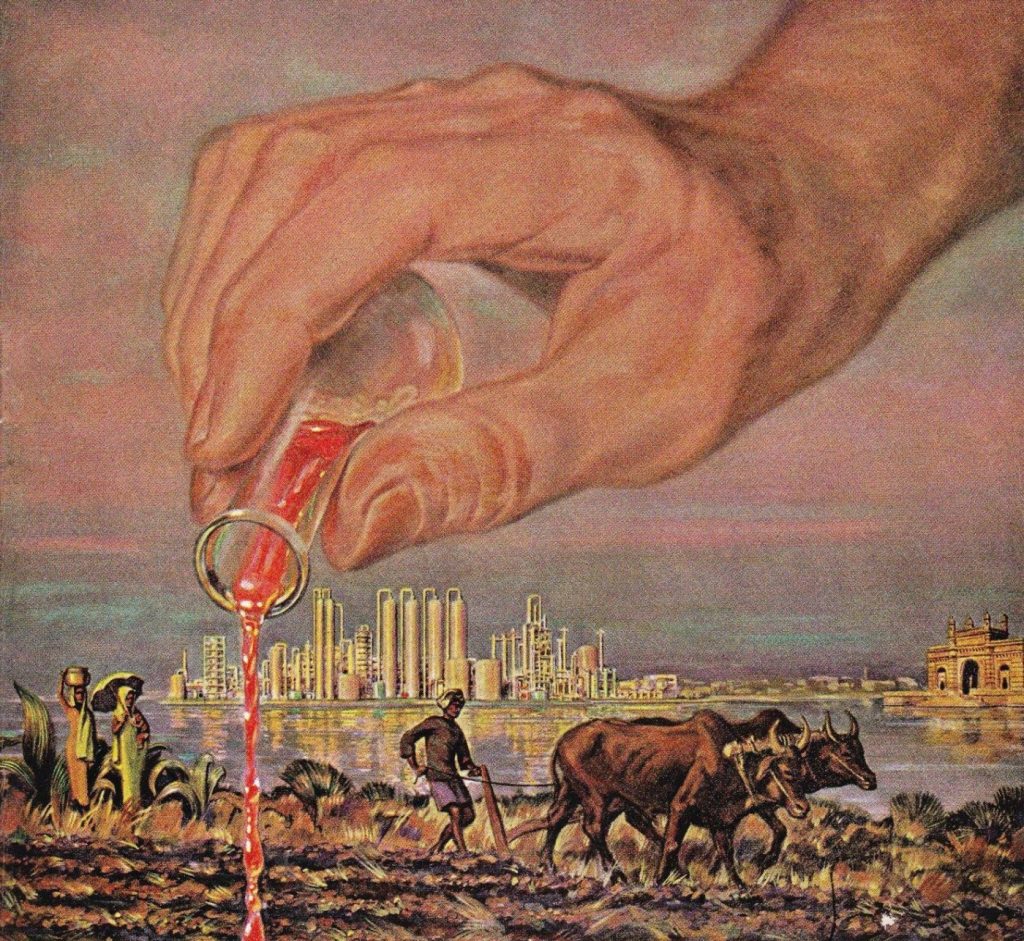
This image is symbolic of everything that is wrong with modern society.

A gas leak from Union Carbide’s pesticide plant in Bhopal in 1984 resulted in around 560,000 injured (respiratory problems, eye irritation, etc.), 4,000 severely disabled and 20,000 dead.

Not only that, but the pesticides produced at the factory and the model of farming promoted has caused well-documented misery for farmers, harm to soil, water sources and the health of the population and a radical transformation of social relations in rural communities. And these issues apply not only to India but also to other countries.

That old advertising brochure dating from around the early 1960s encapsulates the arrogance of billionaires and their companies that think they are the hand of God, that they are the truth and the science, and that we should all be in awe of the technology they produce.

Facilitated by the likes of the Rockefeller Foundation and the Bill and Melinda Gates Foundation, they uproot highly productive traditional agriculture, saying it is deficient. They poison the soil, the food, the waterways and people. But that’s not enough. They pirate, own and genetically engineer the seeds. The chemicals and engineering do not result in more or better food. Quite the opposite. Diets have become narrower, and the nutritional content of many food items has progressively diminished (see McCance and Widdowson’s the Mineral Depletion of Foods). Moreover, food secure regions have become food insecure.

But it goes beyond this.

Consider the amount of killer-chemicals that the likes of Union Carbide’s promised techno-utopian consumer society (Union Carbide produced numerous other similar brochures to the one presented above, promoting the role of science and technology across all sectors) has gifted to humanity in everyday products from shampoos to toys, pans, packaging, sofas and tins.

It is notable that glyphosate, the world’s most used agricultural herbicide, began life as an industrial chelator of minerals in metal pipes to prevent blockages and deterioration. It now ensures mineral depletion/nutrient deficiencies in the human body. Glyphosate affects human soil – the gut microbiome – which directly feeds the major organs. Little wonder we witness a proliferation of illness and disease.

But forget about what has become modernism’s spiralling public health crisis – don’t forget to take that money-spinning experimental booster jab because, remember, they said that they really care about you and your health.

Meanwhile, bioscience parks across the world expand and promise an even more marvellous techno-dystopia than the one already created. They are working on injecting you with nanotechnology to ‘cure’ you of all the diseases that the modernist type of thinking, products and technology created in the first place – or on manipulating your DNA-physiology to hook you up to the internet (of things). The patents are there – this is not speculation.

And as these bioscience parks expand, their success is measured in annual turnover, profits and ‘growth’. They want more and more ‘talent’ to study life sciences and health subjects and to take up positions at the biotech companies. And they call for more public subsidies to facilitate this. More kids to study science so that they can be swept up into the ideology and practices of the self-sustaining paradigm of modern society.

Of course, ‘sustainability’ is the mantra. Sustainability in terms of fake-green, net-zero ideology but, more importantly, sustainable growth and profit.

Meanwhile, across the world, most notably in the Netherlands, these parks demand more land. More land for expansion and more land to house ‘global talent’ to be attracted to work. That means displacing farmers under the notion that they are the major emitters of ‘greenhouse gases’, which, in the Netherlands at least, they are clearly not. Look towards other sectors or even the US military if you require a prime example of a major polluter. But that’s not up for discussion, not least because military-related firms are often intertwined with the much-valued bioscience-business ‘ecosystems’ promoted.

And once the farmers have gone and the farmland is concreted over under the concept (in the Netherlands) of a Tristate City, do not worry – your ‘food’ will be created in a lab courtesy of biosynthetic, nanotechnological, biopharmaceutical, genetically engineered microbes and formulas created at the local bioscience park.

Any carbon-related pollution created by these labs will supposedly be ‘offset’ by a fraudulent carbon credit trading Ponzi scheme – part of which will mean buying up acres in some poor country to plant trees on the land of the newly dispossessed.

This brave new ecomodernism is to be overseen by supranational bodies like the UN and the WHO. National uniparty politicians will not be engaged in policy formation. They will be upholders of the elite-determined status quo – junior ‘stakeholders’ and technocratic overseers of an algorithm/AI-run system, ensuring any necessary tweaks are made.

Of course, not everything that happens under the banner of bioscience should be dismissed out of hand, but science is increasingly the preserve of an increasingly integrated global elite who have created the problems that they now rollout the ‘solutions’ for. It is a highly profitable growth industry – under the banner of ‘innovation’, cleaning up the mess you created.

But the disturbing trend is that the ‘science’ and the technology shall not be questioned. A wealthy financial-digital-corporate elite funds this science, determines what should be studied, how it should be studied and how the findings are disseminated and how the technology produced is to be used.

As we saw with the COVID event, this elite has the power to shut down genuine debate, prevent scrutiny of ‘the science’ and to smear and censor world-renowned scientists and others who even questioned the narrative. And it also pulls the strings of nation states so much so that former New Zealand PM Jacinda Arden said that her government is ‘the truth’. The marriage of science and politics in an Orwellian dystopia.

The prevailing thinking is that the problems of illness, hunger, malnutrition, unemployment, pollution, resource usage and so on are all to be solved down at the bioscience park by what farmer/author Chris Smaje says through technical innovation and further integration into private markets which are structured systematically by centralised power in favour of the wealthy.

The ecomodernist ideology we see embedded within the mindsets of those lobbying for more resources, land and funding have nothing much to say about how humanity got ill, infertile, poor, dispossessed, colonised, depressed, unemployed or marginalised in the first place. Driven by public funding, career progression and profit, they remain blinkered and push ahead with an ideology whose ‘solutions’ only produce more problems that call for more ‘innovation’ and more money.

At the same time, any genuine solutions are too often dismissed as being driven by ideology and ignorance that will lead us all to ruin. A classic case of projection.

As I have written previously, current hegemonic policies prioritise urbanisation, global markets, long supply chains, commodified corporate knowledge, highly processed food and market dependency at the expense of rural communities, independent enterprises and smallholder farms, local markets, short supply chains, indigenous knowledge, diverse agroecological cropping, nutrient-dense diets and food sovereignty.

And this has led us to where we are now.

Trade and agriculture policy specialist Devinder Sharma once said that we need family farms not family doctors. Imagine the reduction in illnesses and all manner of conditions. Imagine thriving local communities centred on smallholder production, nutrient-dense food and healthy people. Instead, we get sprawling bioscience parks centred on economic globalisation, sickness and the manipulation of food and human bodies.

Although a few thousand immensely powerful people are hellbent on marching humanity towards a dystopian ecomodernist future, we can, in finishing, take some inspiration from the words of John Seymour (1912-2004), a pioneer of the self-sufficiency movement.

Seymour was described as a one-man rebellion against modernism by writer and ecologist Herbert Girardet. But as a farmer himself, Seymour regarded himself a ‘crank peasant’ and offered solutions in terms of localism, small-scale economics, a return to the land and organic agriculture.

In a call to action, he stated:

The tiny amount you and I can do is hardly likely to bring the huge worldwide moloch of plundering industry down? Well, if you and I don’t do it, it will not be done, and the Age of Plunder will terminate in the Age of Chaos. We have to do it – just the two of us – just you and me. There is no ‘them’ – there is nobody else. Just you and me. On our infirm shoulders we must take up this heavy burden now… Tomorrow will be too late.”

Pouring Poison and Planting Seeds of Dependency

By Colin Todhunter

Source: Off-Guardian

Do you remember the iconic Union Carbide image from the 1950s or early 1960s? The one with the giant hand coming from the sky, pouring pesticides onto Indian soil.

The blurb below the image includes the following:

Science helps build a new India – India has developed bold new plans to build its economy and bring the promise of a bright future to its more than 400 million people. But India needs the technical knowledge of the western world. For example working with Indian engineers and technicians, Union Carbide recently made available its fast scientific resource to help build a chemicals and plastics plant near Bombay. Throughout the free world, Union Carbide has been actively engaged in building plants for the manufacture of chemicals, plastics, carbons, gases and metals.”

In the bottom corner is the Union Carbide logo and the statement ‘A HAND IN THINGS TO COME’.

This ‘hand of god’ image has become infamous. Union Carbide’s ‘hand in things to come’ includes the gas leak at its pesticides plant in Bhopal in 1984. It resulted in around 560,000 injured (respiratory problems, eye irritation, etc), 4,000 severely disabled and 20,000 dead.

As for the chemical-intensive agriculture it promoted, we can now see the impacts: degraded soils, polluted water, illness, farmer debt and suicides (by drinking pesticides!), nutrient-dense crops/varieties being side-lined, a narrower range of crops, no increase in food production per capita (in India at least), the corporate commodification of knowledge and seeds, the erosion of farmers’ environmental learning, the undermining of traditional knowledge systems and farmers’ dependency on corporations.

Whether it involves the type of ecological devastation activist-farmer Bhaskar Save outlined for policy makers in his 2006 open letter or the social upheaval documented by Vandana Shiva in the book The Violence of the Green Revolution, the consequences have been far-reaching.

And yet – whether it involves new genetic engineering techniques or more pesticides –  there is a relentless drive by the agritech conglomerates to further entrench their model of agriculture by destroying traditional farming practices with the aim of placing more farmers on corporate seed and chemical treadmills.

These corporations have been pushing for the European Commission to remove any labelling and safety checks for new genomic techniques. The European Court of Justice ruled in 2018 that organisms obtained with new genetic modification techniques must be regulated under the EU’s existing GMO laws. However, there has been intense lobbying from the agriculture biotech industry to weaken the legislation, aided financially by the Gates Foundation.

Since 2018, top agribusiness and biotech corporations have spent almost €37 million lobbying the European Union. They have had 182 meetings with European Commissioners, their cabinets and director generals. More than one meeting a week.

In recent weeks, Syngenta (a subsidiary of ChemChina) CEO Erik Fyrwald has come to the fore to cynically lobby for these techniques.

But before discussing Fyrwald, let us turn to another key agribusiness figure who has been in the news. Former Monsanto chairman and CEO Hugh Grant recently appeared in court to be questioned by lawyers on behalf of a cancer patient in the case of Allan Shelton v Monsanto.

Shelton has non-Hodgkin lymphoma and is one of the 100,000-plus people in the US claiming in lawsuits that exposure to Monsanto’s Roundup weedkiller and its other brands containing the chemical glyphosate caused their cancer.

His lawyers argued that Grant was an active participant and decision-maker in the company’s Roundup business and should be made to testify at the trial.

Why not? After all, he did make a financial killing from peddling poison.

Bayer acquired Monsanto in 2018 and Grant received an estimated $77 million post-sale payoff. Bloomberg reported in 2017 that Monsanto had increased Grant’s salary to $19.5 million.

By 2009, Roundup-related products, which include genetically modified seeds developed to withstand glyphosate-based applications, represented about half of Monsanto’s gross margin.

Roundup was integral to Monsanto’s business model and Grant’s enormous income and final payoff.

Consider the following quote from a piece that appeared on the Bloomberg website in 2014:

Chairman and Chief Executive Officer Hugh Grant is focused on selling more genetically modified seeds in Latin America to drive earnings growth outside the core US market. Sales of soybean seeds and genetic licenses climbed 16%, and revenue in the unit that makes glyphosate weed killer, sold as Roundup, rose 24%.”

In the same piece, Chris Shaw, a New York-based analyst at Monness Crespi Hardt & Co, is reported as saying “Glyphosate really crushed it” – meaning the sales of glyphosate were a major boost.

All fine for Grant and Monsanto. But this has had devastating effects on human health. ‘The Human Cost of Agrotoxins. How Glyphosate is killing Argentina’, which appeared on the Lifegate website in November 2015, serves as a damning indictment of the drive for “earnings growth” by Monsanto. Moreover, in the same year, some 30,000 doctors in that country demanded a ban on glyphosate.

The bottom line for Grant was sales and profit maximisation and the unflinching defence of glyphosate, no matter how carcinogenic to humans it is and, more to the point, how much Monsanto knew it was.

Noam Chomsky underlines the commercial imperative:

… the CEO of a corporation has actually a legal obligation to maximize profit and market share. Beyond that legal obligation, if the CEO doesn’t do it, and, let’s say, decides to do something that will, say, benefit the population and not increase profit, he or she is not going to be CEO much longer –  they’ll be replaced by somebody who does do it.”

Syngenta’s CEO is cut from the same cloth as Grant. While Monsanto’s crimes are well documented, Syngenta’s transgressions are less well publicised.

In 2006, writer and campaigner Dr Brian John claimed:

GM Free Cymru has discovered that Syngenta, in its promotion of GM crops and foods, has been involved in a web of lies, deceptions and obstructive corporate behaviour that would have done credit to its competitor Monsanto.”

Some weeks ago, Fyrwald called for organic farming to be abandoned. In view of the food crisis, brought on by the war in Ukraine, he claimed rich countries had to increase their crop production – but organic farming led to lower yields. Fyrwald also called for gene editing to be at the heart of the food agenda in order to increase food production.

He stated:

“The indirect consequence is that people are starving in Africa because we are eating more and more organic products.”

In response, Kilian Baumann, a Bernese organic farmer and president of the Swiss Small Farmers’ Association, called Fyrwald’s arguments “grotesque”. He claimed Fyrwald was “fighting for sales”.

Writing on the GMWatch website, Jonathan Matthews says the Russian invasion of Ukraine seems to have emboldened Fyrwald’s scaremongering.

Matthews states:

Fyrwald’s comments reflect the industry’s determination to undermine the European Union’s Farm to Fork strategy, which aims by 2030 not just to slash pesticide use by 50% and fertilizer use by 20% but to more than triple the percentage of EU farmland under organic management (from 8.1% to 25%), as part of the transition towards a ‘more sustainable food system’ within the EU’s Green Deal.”

He adds:

Syngenta view[s] these goals as an almost existential threat. This has led to a carefully orchestrated attack on the EU strategy.”

The details of this PR offensive have been laid out in a report by the Brussels-based lobby watchdog Corporate Europe Observatory (CEO): A loud lobby for a silent spring: The pesticide industry’s toxic lobbying tactics against Farm to Fork.

Mathews quotes research that shows GM crops have no yield benefit. He also refers to a newly published report that draws together research clearly showing GM crops have driven substantial increases – not decreases – in pesticide use. The newer and much-hyped gene-edited crops look set to do the same.

Syngenta is among the corporations criticised by a report from the UN for “systematic denial of harms” and “unethical marketing tactics”. Matthews notes that selling highly hazardous pesticides is actually at the core of Syngenta’s business model.

According to Matthews, even with the logistical disruptions to maize and wheat crops caused by the war in Ukraine, there is still enough grain available to the world market to meet existing needs. He says the current price crisis (not food crisis) is a product of fear and speculation.

Matthews concludes:

If Erik Fyrwald is really so concerned about hunger, why isn’t he attacking the boondoggle that is biofuels, rather than going after organic farming? The obvious answer is that the farmers being subsidised to grow biofuels are big consumers of agrichemicals and, in the US case, GMO seeds – unlike organic farmers, who buy neither.”

Fyrwald has a financial imperative to lobby for particular strategies and technologies. He is far from an objective observer. And he is far from honest in his appraisal – using fear of a food crisis to push his agenda.

Meanwhile, the sustained attacks on organic agriculture have become an industry mainstay, despite numerous high-level reports and projects indicating it could feed the world, mitigate climate change, improve farmers’ situations, lead to better soil, create employment and provide healthier and more diverse diets.

There is a food crisis but not the one alluded to by Fyrwald –  denutrified food and unhealthy diets that are at the centre of a major public health crisis, a loss of biodiversity which threatens food security, degraded soils, polluted and depleted water sources and smallholder farmers, so vital to global food production (especially in the Global South), squeezed off their land and out of farming.

Transnational agribusiness has lobbied for, directed and profited from policies that have caused much of the above. And what we now see is these corporations and their lobbyists espousing (fake) concern (a cynical lobbying tactic) for the plight of the poor and hungry while attempting to purchase EU democracy to the tune of €37 million. Cheap at the price considering the financial bonanza that its new patented genetic engineering technologies and seeds could reap.

Various scientific publications show these new techniques allow developers to make significant genetic changes, which can be very different from those that happen in nature. These new GMOs pose similar or greater risks than older-style GMOs.

By attempting to dodge regulation as well as avoid economic, social, environmental and health impact assessments, it is clear were the industry’s priorities lie.

Unfortunately, Fyrwald, Bill Gates, Hugh Grant and their ilk are unwilling and too often incapable of viewing the world beyond their reductionist mindsets that merely regard seed/chemical sales, output-yield and corporate profit as the measuring stick of success.

What is required is an approach that sustains indigenous knowledge, local food security, better nutrition per acre, clean and stable water tables and good soil structure. An approach that places food sovereignty, local ownership, rural communities and rural economies at the centre of policy and which nurtures biodiversity, boosts human health and works with nature rather than destroying these.

Fyrwald’s scaremongering is par for the course – the world will starve without corporate chemicals and (GM) seeds, especially if organics takes hold. This type of stuff has been standard fare from the industry and its lobbyists and bought career scientists for many years.

It flies in the face of reality, not least how certain agribusiness concerns have been part of a US geopolitical strategy that undermines food security in regions across the world. These concerns have thrived on the creation of dependency and profited from conflict. Moreover, there is the success of agroecological approaches to farming that have no need for what Fyrwald is hawking.

Instead, the industry continues to promote itself as the saviour of humanity – a hand of god powered by a brave new techno-utopian world of corporate science, pouring poison and planting seeds of corporate dependency with the missionary zeal of Western saviourism.