
The Illusion of Freedom: We’re Only as Free as the Government Allows

By John W. Whitehead & Nisha Whitehead

Source: The Rutherford Institute

“Rights aren’t rights if someone can take them away. They’re privileges. That’s all we’ve ever had in this country, is a bill of temporary privileges. And if you read the news even badly, you know that every year the list gets shorter and shorter. Sooner or later, the people in this country are gonna realize the government … doesn’t care about you, or your children, or your rights, or your welfare or your safety… It’s interested in its own power. That’s the only thing. Keeping it and expanding it wherever possible.”— George Carlin

We’re in a national state of denial.

For years now, the government has been playing a cat-and-mouse game with the American people, letting us enjoy just enough freedom to think we are free but not enough to actually allow us to live as a free people.

Case in point: on the same day that the U.S. Supreme Court appeared inclined to favor a high school football coach’s right to pray on the field after a game, the high court let stand a lower court ruling that allows police to warrantlessly track people’s location and movements through their personal cell phones, sweeping Americans up into a massive digital data dragnet that does not distinguish between those who are innocent of wrongdoing, suspects, or criminals.

Likewise, although the Supreme Court gave the go-ahead for a death row inmate to have his pastor audibly pray and lay hands on him in the execution chamber, it refused to stop police from using hidden cameras to secretly and warrantlessly record and monitor a person’s activities outside their home over an extended period of time.  

For those who have been paying attention, there’s a curious pattern emerging: the government appears reasonably tolerant of those who want to exercise their First Amendment rights in a manner that doesn’t challenge the police state’s hold on power, for example, by praying on a football field or in an execution chamber.

On the other hand, dare to disagree with the government about its war crimes, COVID-19, election outcomes or police brutality, and you’ll find yourself silenced, cited, shut down and/or branded an extremist.

The U.S. government is particularly intolerant of speech that reveals the government’s corruption, exposes the government’s lies, and encourages the citizenry to push back against the government’s many injustices. For instance, Wikileaks founder Julian Assange, the latest victim of the government’s war on dissidents and whistleblowers, is in the process of being extradited to the U.S. to be tried under the Espionage Act for daring to access and disclose military documents that portray the U.S. government and its endless wars abroad as reckless, irresponsible, immoral and responsible for thousands of civilian deaths.

Even political protests are fair game for prosecution. In Florida, two protesters are being fined $3000 for political signs proclaiming stating “F—k Biden,” “F—k Trump,” and “F—k Policing 4 Profit” that violate a city ban on “indecent” speech on signs, clothing and other graphic displays.

The trade-off is clear: pray all you want, but don’t mess with the U.S. government.

In this way, the government, having appointed itself a Supreme and Sovereign Ruler, allows us to bask in the illusion of religious freedom while stripping us of every other freedom afforded by the Constitution.

We’re in trouble, folks.

Freedom no longer means what it once did.

This holds true whether you’re talking about the right to criticize the government in word or deed, the right to be free from government surveillance, the right to not have your person or your property subjected to warrantless searches by government agents, the right to due process, the right to be safe from militarized police invading your home, the right to be innocent until proven guilty and every other right that once reinforced the founders’ belief that this would be “a government of the people, by the people and for the people.”

Not only do we no longer have dominion over our bodies, our families, our property and our lives, but the government continues to chip away at what few rights we still have to speak freely and think for ourselves.

My friends, we’re being played for fools.

On paper, we may be technically free.

In reality, however, we are only as free as a government official may allow.

We only think we live in a constitutional republic, governed by just laws created for our benefit.

Truth be told, we live in a dictatorship disguised as a democracy where all that we own, all that we earn, all that we say and do—our very lives—depends on the benevolence of government agents and corporate shareholders for whom profit and power will always trump principle. And now the government is litigating and legislating its way into a new framework where the dictates of petty bureaucrats carry greater weight than the inalienable rights of the citizenry.

With every court ruling that allows the government to operate above the rule of law, every piece of legislation that limits our freedoms, and every act of government wrongdoing that goes unpunished, we’re slowly being conditioned to a society in which we have little real control over our lives.

As Rod Serling, creator of the Twilight Zone and an insightful commentator on human nature, once observed, “We’re developing a new citizenry. One that will be very selective about cereals and automobiles, but won’t be able to think.”

Indeed, not only are we developing a new citizenry incapable of thinking for themselves, we’re also instilling in them a complete and utter reliance on the government and its corporate partners to do everything for them—tell them what to eat, what to wear, how to think, what to believe, how long to sleep, who to vote for, whom to associate with, and on and on.

In this way, we have created a welfare state, a nanny state, a police state, a surveillance state, an electronic concentration camp—call it what you will, the meaning is the same: in our quest for less personal responsibility, a greater sense of security, and no burdensome obligations to each other or to future generations, we have created a society in which we have no true freedom.

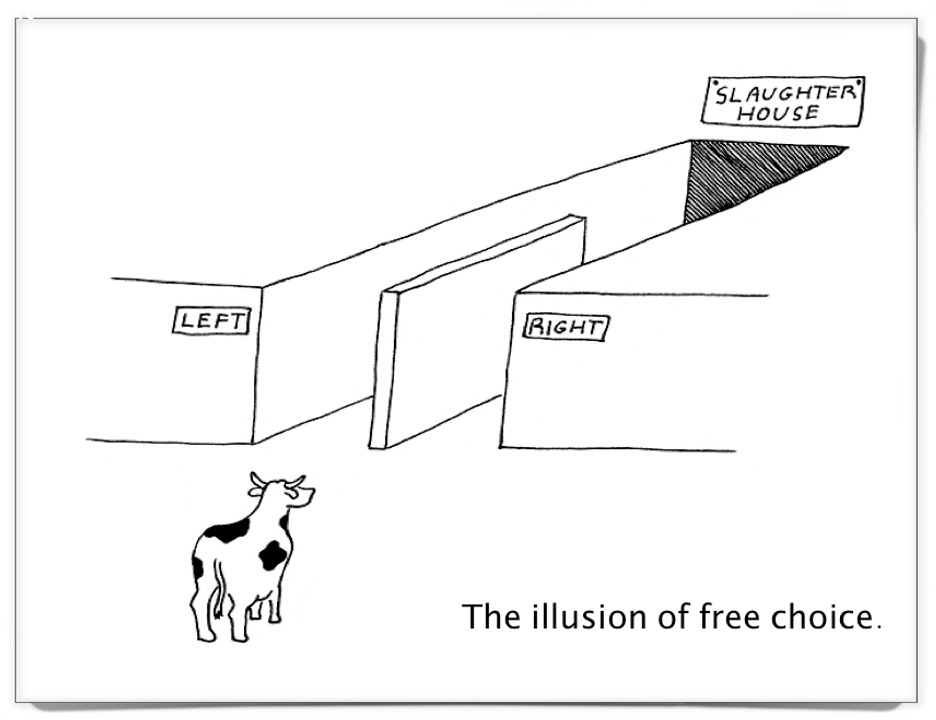
Government surveillance, police abuse, SWAT team raids, economic instability, asset forfeiture schemes, pork barrel legislation, militarized police, drones, endless wars, private prisons, involuntary detentions, biometrics databases, free speech zones, etc.: these are mile markers on the road to a fascist state where citizens are treated like cattle, to be branded and eventually led to the slaughterhouse.

Freedom, or what’s left of it, is being threatened from every direction. The threats are of many kinds: political, cultural, educational, media, and psychological. However, as history shows us, freedom is not, on the whole, wrested from a citizenry. It is all too often given over voluntarily and for such a cheap price: safety, security, bread, and circuses.

This is part and parcel of the propaganda churned out by the government machine.

That said, what we face today—mind manipulation and systemic violence—is not new. What is different are the techniques used and the large-scale control of mass humanity, coercive police tactics and pervasive surveillance.

We are overdue for a systemic check on the government’s overreaches and power grabs.

By “government,” I’m not referring to the highly partisan, two-party bureaucracy of the Republicans and Democrats. Rather, I’m referring to “government” with a capital “G,” the entrenched Deep State that is unaffected by elections, unaltered by populist movements, and has set itself beyond the reach of the law.

For years now, we have suffered the injustices, cruelties, corruption and abuse of an entrenched government bureaucracy that has no regard for the Constitution or the rights of the citizenry.

We have lingered too long in this strange twilight zone where ego trumps justice, propaganda perverts truth, and imperial presidents—empowered to indulge their authoritarian tendencies by legalistic courts, corrupt legislatures and a disinterested, distracted populace—rule by fiat rather than by the rule of law.

Where we find ourselves now is in the unenviable position of needing to rein in all three branches of government—the Executive, the Judicial, and the Legislative—that have exceeded their authority and grown drunk on power.

We are the unwitting victims of a system so corrupt that those who stand up for the rule of law and aspire to transparency in government are in the minority. This corruption is so vast it spans all branches of government: from the power-hungry agencies under the executive branch and the corporate puppets within the legislative branch to a judiciary that is, more often than not, elitist and biased towards government entities and corporations.

The predators of the police state are wreaking havoc on our freedoms, our communities, and our lives. The government doesn’t listen to the citizenry, it refuses to abide by the Constitution, which is our rule of law, and it treats the citizenry as a source of funding and little else.

The American kleptocracy (a government ruled by thieves) has sucked the American people down a rabbit hole into a parallel universe in which the Constitution is meaningless, the government is all-powerful, and the citizenry is powerless to defend itself against government agents who steal, spy, lie, plunder, kill, abuse and generally inflict mayhem and sow madness on everyone and everything in their sphere.

This dissolution of that sacred covenant between the citizenry and the government—establishing “we the people” as the masters and the government as the servant—didn’t happen overnight. It didn’t happen because of one particular incident or one particular president. It is a process, one that began long ago and continues in the present day, aided and abetted by politicians who have mastered the polarizing art of how to “divide and conquer.”

Unfortunately, there is no magic spell to transport us back to a place and time where “we the people” weren’t merely fodder for a corporate gristmill, operated by government hired hands, whose priorities are money and power.

As I make clear in my book Battlefield America: The War on the American People and in its fictional counterpart The Erik Blair Diaries, our freedoms have become casualties in an all-out war on the American people.

If we continue down this road, there can be no surprise about what awaits us at the end.
The System Is Rigged: Qualified Immunity Is How the Police State Stays in Power

By John W. Whitehead

Source: Mint Press News

The system is rigged, the government is corrupt, and “we the people” continue to waste our strength by fighting each other rather than standing against the tyrant in our midst.

Because the system is rigged, because the government is corrupt, and because “we the people” remain polarized and divided, the police state will keep winning and “we the people” will keep losing.

Because the system is rigged and the U.S. Supreme Court—the so-called “people’s court”—has exchanged its appointed role as a gatekeeper of justice for its new role as maintainer of the status quo, there will be little if no consequences for the cops who brutalize and no justice for the victims of police brutality.

Because the system is rigged, there will be no consequences for police who destroyed a private home by bombarding it with tear gas grenades during a SWAT team raid gone awry, or for the cop who mistakenly shot a 10-year-old boy after aiming for and missing the non-threatening family dog, or for the arresting officer who sicced a police dog on a suspect who had already surrendered.

This is how unarmed Americans keep dying at the hands of militarized police.

By refusing to accept any of the eight or so qualified immunity cases before it this term that strove to hold police accountable for official misconduct, the Supreme Court delivered a chilling reminder that in the American police state, ‘we the people’ are at the mercy of law enforcement officers who have almost absolute discretion to decide who is a threat, what constitutes resistance, and how harshly they can deal with the citizens they were appointed to ‘serve and protect.”

This is how qualified immunity keeps the police state in power.

Lawyers tend to offer a lot of complicated, convoluted explanations for the doctrine of qualified immunity, which was intended to insulate government officials from frivolous lawsuits, but the real purpose of qualified immunity is to rig the system, ensuring that abusive agents of the government almost always win and the victims of government abuse almost always lose.

How else do you explain a doctrine that requires victims of police violence to prove that their abusers knew their behavior was illegal because it had been deemed so in a nearly identical case at some prior time: it’s a setup for failure.

Do you know how many different ways a cop can kill, maim, torture and abuse someone without being held liable?

The cops know: in large part due to training classes that drill them on the art of sidestepping the Fourth Amendment, which protects us from being bullied, badgered, beaten, broken and spied on by government agents.

This is how “we the people” keep losing.

Although the U.S. Supreme Court recognized in Harlow v. Fitzgerald (1982) that suing government officials for monetary damages is “the only realistic avenue” of holding them accountable for abusing their offices and violating the Constitution, it has ostensibly given the police and other government agents a green light to shoot first and ask questions later, as well as to probe, poke, pinch, taser, search, seize, strip and generally manhandle anyone they see fit in almost any circumstance, all with the general blessing of the courts.

Whether it’s police officers breaking through people’s front doors and shooting them dead in their homes or strip searching motorists on the side of the road, these instances of abuse are continually validated by a judicial system that kowtows to virtually every police demand, no matter how unjust, no matter how in opposition to the Constitution.

Make no mistake about it: this is what constitutes “law and order” in the American police state.

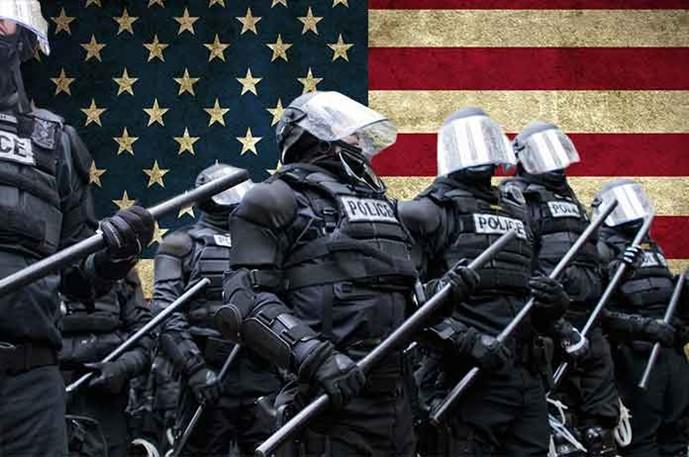
These are the hallmarks of a police state: where police officers, no longer mere servants of the people entrusted with keeping the peace, are part of an elite ruling class dependent on keeping the masses corralled, under control, and treated like suspects and enemies rather than citizens.

Unfortunately, we’ve been traveling this dangerous road for a long time now.

A review of critical court rulings over the past several decades, including rulings affirming qualified immunity protections for government agents by the U.S. Supreme Court, reveals a startling and steady trend towards pro-police state rulings by an institution concerned more with establishing order, protecting the ruling class, and insulating government agents from charges of wrongdoing than with upholding the rights enshrined in the Constitution.

Indeed, as Reuters reports, qualified immunity “has become a nearly failsafe tool to let police brutality go unpunished and deny victims their constitutional rights.” Worse, as Reuters concluded, “the Supreme Court has built qualified immunity into an often insurmountable police defense by intervening in cases mostly to favor the police.”

The system is rigged.

Police can claim qualified immunity for warrantless searches. In Anderson v. Creighton, the Supreme Court ruled that FBI and state law enforcement agents were entitled to qualified immunity protections after they were sued for raiding a private home without a warrant and holding family members at gunpoint, all in a search for a suspected bank robber who was not in the house.

Police can claim qualified immunity for warrantless arrests based on mere suspicion. In Hunter v. Bryant, the Court ruled that police acted reasonably in arresting James Bryant without a warrant in order to protect the president. Bryant had allegedly written a letter that referenced a third-party plot to assassinate President Ronald Reagan, but police had no proof that he intended to harm Reagan beyond a mere suspicion. The charges against Bryant were eventually dropped.

Police can claim qualified immunity for using excessive force against protesters. In Saucier v. Katz, the Court ruled in favor of federal law enforcement agents who forcefully tackled a protester as he attempted to unfurl a banner at Vice President Gore’s political rally. The Court reasoned that the officers acted reasonably given the urgency of protecting the vice president.

Police can claim qualified immunity for shooting a fleeing suspect in the back. In Brosseau v. Haugen, the Court dismissed a lawsuit against a police officer who shot Kenneth Haugen in the back as he entered his car in order to flee from police. The Court ruled that in light of existing case law, the cop’s conduct fell in the “hazy border between excessive and acceptable force” and so she did not violate clearly established law.

Police can claim qualified immunity for shooting a mentally impaired person. In City of San Francisco v. Sheehan, the Court ruled in favor of police who repeatedly shot Teresa Sheehan during the course of a mental health welfare check. The Court ruled that it was not unreasonable for police to pepper spray and shoot Sheehan multiple times after entering her room without a warrant and encountering her holding a knife.

Police officers can use lethal force in car chases without fear of lawsuits. In Plumhoff v. Rickard, the U.S. Supreme Court declared that police officers who used deadly force to terminate a car chase were immune from a lawsuit. The officers were accused of needlessly resorting to deadly force by shooting multiple times at a man and his passenger in a stopped car, killing both individuals.

Police can stop, arrest and search citizens without reasonable suspicion or probable cause. In a 5-3 ruling in Utah v. Strieff, the U.S. Supreme Court effectively gave police the go-ahead to embark on a fishing expedition of one’s person and property, rendering Americans completely vulnerable to the whims of any cop on the beat.

Police officers can stop cars based on “anonymous” tips or for “suspicious” behavior such as having a reclined car seat or driving too carefully. In a 5-4 ruling in Navarette v. California, the U.S. Supreme Court declared that police officers, under the guise of “reasonable suspicion,” can stop cars and question drivers based solely on anonymous tips, no matter how dubious, and whether or not they themselves witnessed any troubling behavior. Then in State v. Howard, the Kansas Supreme Court declared that motorists who recline their car seats are guilty of suspicious behavior and can be subject to warrantless searches by police. That ruling, coupled with other court rulings upholding warrantless searches and seizures by police renders one’s car a Constitution-free zone.

Americans have no protection against mandatory breathalyzer tests at a police checkpoint, although mandatory blood draws violate the Fourth Amendment (Birchfield v. North Dakota). Police can also conduct sobriety and “information-seeking” checkpoints (Illinois v. Lidster and Mich. Dep’t of State Police v. Sitz).

Police can forcibly take your DNA, whether or not you’ve been convicted of a crime. In Maryland v. King, a divided U.S. Supreme Court determined that a person arrested for a crime who is supposed to be presumed innocent until proven guilty must submit to forcible extraction of their DNA. Once again the Court sided with the guardians of the police state over the defenders of individual liberty in determining that DNA samples may be extracted from people arrested for “serious” offenses. The end result of the ruling paves the way for a nationwide dragnet of suspects targeted via DNA sampling.

Police can use the “fear for my life” rationale as an excuse for shooting unarmed individuals. Upon arriving on the scene of a nighttime traffic accident, an Alabama police officer shot a driver exiting his car, mistakenly believing the wallet in his hand to be a gun. A report by the Justice Department found that half of the unarmed people shot by one police department over a seven-year span were “shot because the officer saw something (like a cellphone) or some action (like a person pulling at the waist of their pants) and misidentified it as a threat.”

Police have free reign to use drug-sniffing dogs as “search warrants on leashes.” In Florida v. Harris, a unanimous U.S. Supreme Court determined that police officers may use highly unreliable drug-sniffing dogs to conduct warrantless searches of cars during routine traffic stops. The ruling turns man’s best friend into an extension of the police state, provided the use of a K-9 unit takes place within a reasonable amount of time (Rodriguez v. United States).

Not only are police largely protected by qualified immunity, but police dogs are also off the hook for wrongdoing. The Fourth Circuit Court of Appeals ruled in favor of a police officer who allowed a police dog to maul a homeless man innocent of any wrongdoing.

Police can subject Americans to strip searches, no matter the “offense.” A divided U.S. Supreme Court actually prioritized making life easier for overworked jail officials over the basic right of Americans to be free from debasing strip searches. In its 5-4 ruling in Florence v. Burlington, the Court declared that any person who is arrested and processed at a jail house, regardless of the severity of his or her offense (i.e., they can be guilty of nothing more than a minor traffic offense), can be subjected to a strip search by police or jail officials, which involves exposing the genitals and the buttocks. This “license to probe” is now being extended to roadside stops, as police officers throughout the country have begun performing roadside strip searches—some involving anal and vaginal probes—without any evidence of wrongdoing and without a warrant.

Police can break into homes without a warrant, even if it’s the wrong home. In an 8-1 ruling in Kentucky v. King, the U.S. Supreme Court placed their trust in the discretion of police officers, rather than in the dictates of the Constitution, when they gave police greater leeway to break into homes or apartments without a warrant. Despite the fact that the police in question ended up pursuing the wrong suspect, invaded the wrong apartment and violated just about every tenet that stands between us and a police state, the Court sanctioned the warrantless raid, leaving Americans with little real protection in the face of all manner of abuses by police.

Police can use knock-and-talk tactics as a means of sidestepping the Fourth Amendment. Aggressive “knock and talk” practices have become thinly veiled, warrantless exercises by which citizens are coerced and intimidated into “talking” with heavily armed police who “knock” on their doors in the middle of the night. Andrew Scott didn’t even get a chance to say no to such a heavy-handed request before he was gunned down by police who pounded aggressively on the wrong door at 1:30 a.m., failed to identify themselves as police, and then repeatedly shot and killed the man when he answered the door while holding a gun in self-defense.

Police can carry out no-knock raids if they believe announcing themselves would be dangerous. Police can perform a “no-knock” raid as long as they have a reasonable suspicion that knocking and announcing their presence, under the particular circumstances, would be dangerous or futile or give occupants a chance to destroy evidence of a crime (Richards v. Wisconsin). Legal ownership of a firearm is also enough to justify a no-knock raid by police (Quinn v. Texas). For instance, a Texas man had his home subject to a no-knock, SWAT-team style forceful entry and raid based solely on the suspicion that there were legally-owned firearms in his household. The homeowner was actually shot by police through his closed bedroom door.

Police can recklessly open fire on anyone that might be “armed.” Philando Castile was shot and killed during a routine traffic stop allegedly over a broken tail light merely for telling police he had a conceal-and-carry permit. That’s all it took for police to shoot Castile four times in the presence of his girlfriend and her 4-year-old daughter. A unanimous Supreme Court declared in County of Los Angeles vs. Mendez that police should not be held liable for recklessly firing 15 times into a shack where a homeless couple had been sleeping because the grabbed his BB gun in defense, fearing they were being attacked.

Police can destroy a home during a SWAT raid, even if the owner gives their consent to enter and search it. In West v. Winfield, the Supreme Court provided cover to police after they smashed the windows of Shaniz West’s home, punched holes in her walls and ceilings, and bombed the house with so much tear gas that it was uninhabitable for two months. All of this despite the fact that the suspect they were pursuing was not in the house and West, the homeowner, agreed to allow police to search the home to confirm that.

Police can suffocate someone, deliberately or inadvertently, in the process of subduing them. “I can’t breathe” has become a rallying cry following the deaths of Eric Garner and George Floyd, both of whom died after being placed in a chokehold by police. Dozens more have died in similar circumstances at the hands of police who have faced little repercussions for these deaths.

As I make clear in my book Battlefield America: The War on the American People, we are dealing with a nationwide epidemic of court-sanctioned police violence carried out with impunity against individuals posing little or no real threat.

So what’s the answer to reforming a system that is clearly self-serving and corrupt?

Abolishing the police is not the answer: that will inevitably lead to outright anarchy, which will give the police state and those law-and-order zealots all the incentive it needs to declare martial law.

Looting and violence are not the answer: As Martin Luther King Jr. recognized, “A riot merely intensifies the fears of the white community while relieving the guilt.” Using the looting and riots as justification for supporting police brutality is also not the answer:  As King recognized, “It is not enough … to condemn riots… without, at the same time, condemning the contingent, intolerable conditions that exist in our society. These conditions are the things that cause individuals to feel that they have no other alternative than to engage in violent rebellions to get attention. And I must say tonight that a riot is the language of the unheard. And what is it America has failed to hear? It has failed to hear that the plight of the negro poor has worsened over the last twelve or fifteen years. It has failed to hear that the promises of freedom and justice have not been met. And it has failed to hear that large segments of white society are more concerned about tranquility and the status quo than about justice and humanity.”

Police reform is necessary and unavoidable if we are to have any hope of living in an America in which freedom means something more than the right to stay alive, but how we reform the system is just as important as getting it done.

We don’t need to wait for nine members of a ruling aristocracy who primarily come from privileged backgrounds and who have a vested interest in maintaining the status quo to fix what’s broken in America.

Nor do we need to wait for 535 highly paid politicians to do something about these injustices only when it suits their political ambitions

And we certainly don’t need to wait for a president with a taste for totalitarian tactics to throw a few crumbs our way.

This is as much a local problem as it is a national one.

Be fair. Be nonviolent. Be relentless in your pursuit of justice for all.

Let’s get it done.