The Final Act

By Dmitry Orlov

Source: Club Orlov

In processing the flow of information about the goings on in the US, it is impossible to get rid of a most unsettling sense of unreality—of a population trapped in a dark cave filled with little glowing screens, all displaying different images yet all broadcasting essentially the same message. That message is that everything is fine, same as ever, and can go on and on. But whatever it is that’s going on can’t go on forever, and therefore it won’t. More specifically, a certain coal mine canary has recently died, and I want to tell you about it.

It’s easy to see why that particular message is stuck on replay even as the situation changes irrevocably. As of 2019, 90% of the media in the United States is controlled by four media conglomerates: Comcast (via NBCUniversal), Disney, ViacomCBS (controlled by National Amusements), and AT&T (via WarnerMedia). Together they have formed a corporate media monoculture designed to most effectively maximize shareholder value.

As I wrote in Reinventing Collapse in 2008, “…In a consumer society, anything that puts people off their shopping is dangerously disruptive, and all consumers sense this. Any expression of the truth about our lack of prospects for continued existence as a highly developed, prosperous industrial society is disruptive to the consumerist collective unconscious. There is a herd instinct to reject it, and therefore it fails, not through any overt action, but by failing to turn a profit because it is unpopular.”

Two years earlier, in a slideshow optimistically titled “Closing the Collapse Gap” (between the USSR and the USA), I wrote: “…It seems that there is a fair chance that the US economy will collapse sometime within the foreseeable future. It also would seem that we won’t be particularly well-prepared for it. As things stand, the US economy is poised to perform something like a disappearing act.” And now, 12 years later, I believe I am finally watching what amounts to preparations for that act’s final rehearsal; the ballet troupe is doing stretching exercises and the fat lady is singing arpeggios to warm up…

Clearly, this final act is yet to be performed. The media replay loop continues to play, keeping the populace convinced that the future will resemble the past (except, perhaps, it will have more wind generators, solar panels and electric cars). The populace continues to be persuaded to go out and shop for (or, more frequently now, order online) things it doesn’t need, to be paid for by money it doesn’t have.

Of course, there have been changes. The populace in the US has been doing progressively worse. Drug addiction and suicide rates have skyrocketed while rates of childbirth have plummeted. The purchase of a home is now out of reach for the vast majority of young couples. Artificially rosy unemployment statistics hide the 100 million or so people who are considered “not in labor force” (because they lost their jobs some time ago and haven’t been able to find another one). Uniquely among developed nations, life expectancy among white males—historically the most economically active and prosperous part of the population—has been dropping. These are all negatives, but neither any one of them nor any combination of them adds up to anything that could cause the US economy to undergo a spontaneous existence failure.

Nevertheless, it is possible to build a convincing case that Rome is, to put it figuratively, burning. To continue with the metaphor, evidence that there is some fiddling going on is particularly compelling. Overall, there is a steady backing away from addressing the substance of any problem and a concerted effort to maintain appearances at all cost.

Take the trade war with China, which has been going on since early 2018. Trump has recently declared a major victory in it, but upon examination signs of victory are impossible to discern. In 2017 the US ran a $750 billion trade deficit with China on $3.3 trillion of trade (22.7%). In 2018 it has jumped to $930 billion on $3.8 trillion of trade (24.4%). China has found ways to parry each of Trump’s thrusts by imposing countertariffs. After two years of this sort of World War I-style trench warfare, in which the US has been slowly losing ground, it became clear that the US doesn’t have any means to put pressure on China.

And so Trump suddenly declares victory; not a full victory (that will have to wait until after Trump is reelected for his second term) but a victory nonetheless, because the Chinese have supposedly agreed to buy an extra $200 billion worth of US exports, $50 billion of them of agricultural exports from states that voted for Trump in 2016. But Trump is lying to his supporters. Over the past two years the Chinese have imported roughly $24 billion of agricultural commodities from the US, and sources close to the trade talks have said that the Chinese have agreed to increase these imports by just $16 billion, putting the total $10 billion short of the $50 billion mark. Even then, the US agricultural sector would have to rapidly scale up production by a factor of 1.6—and this is not at all likely.

The farmers will discover this only after they vote to reelect Trump, but that’s not Trump’s problem. Nor was it Trump’s problem when in 2017 the Chinese promised to buy $120 billion of US liquefied natural gas exports and then the US wasn’t able to provide anywhere near that volume. And now that Russia’s Power of Siberia pipeline is operational and ramping up volumes, while US fracking companies are going bankrupt left and right, the question has become largely moot. The AG promise is just a replay of the LNG promise at a smaller scale. Appearances are all that matter, and appearances are what Trump delivers every time. And if his voters want to believe—who’s to stop them? Even though it is clearly heading toward a defeat for the US as a whole, the trade war with China is definitely a huge positive for Trump: all he has to do to win personally is periodically deliver promises that others won’t keep—but that’s not his problem.

Another net benefit for Trump is the never-ending impeachment saga. It has kept him in the media limelight and has allowed him to pretend that he is prevailing heroically against great odds while making his opposition look ridiculous in the eyes of his supporters. After the “Russian meddling” fable unraveled, an even more preposterous rationale for impeachment has taken its place. An attempt to impeach Trump for refusing to cooperate with a congressional investigation is in the process of failing, since anyone with more intelligence than a bucket of California penis fish should know that it is up to the courts, not up to the legislature, to resolve disputes between the legislature and the executive. All that remains now is an alleged abuse of power by Trump. Apparently, it is a no-no for a US president to ask a foreign leader to investigate a US presidential candidate for a variety of crimes such as corruption, bribery and money-laundering. This may all seem quite ridiculous, but it serves a purpose: it allows Trump to clean up on free publicity and to continue fiddling (tweeting, in his case) as Rome burns.

But what has set fire under Rome is not the decrepitating state of US society, or the permanent and permanently worsening trade imbalance with China, or the never-ending impeachment farce. It is the incipient failure of the US dollar. For those who have been paying careful attention, the surreal nature of the proceedings, and the fact that results no longer matter—only appearances do—have become perfectly obvious, but they are a tiny minority. What has allowed the politicians and the media to exploit the general public’s innate normalcy bias and to keep the media replay loop going without too many people catching on to what’s really happening was (note the past tense!) the ability of the US government (with the assistance of the Federal Reserve, which is a government-linked but essentially private entity) to paper over the gaping chasm in the nation’s finances by issuing debt, in the form of US Treasury paper.

The US Treasury has been able to exploit its “exorbitant privilege” to issue internationally recognized and traded debt instruments denominated in its own currency—the US dollar—which has been the world’s main reserve currency for many decades. The reserve currency status has conveyed a certain aura of security and reliability (paper money is, after all, pretty much just a confidence game) and has supported the world’s largest and most liquid financial market. Anybody anywhere could put up US Treasury paper as collateral for a loan and get a low interest rate because that paper was considered as good as “real money” (whatever that means). And then that scheme suddenly broke.

It is difficult to say what caused the confidence game to fail. It could be just the inexorable and ever-accelerating increase in US government debt. It could be the blatant decoupling between the growth rate of the US economy and the rate of increase of its indebtedness. It could also be the fact that much of the world is making a concerted effort to walk away from the US dollar as a reserve currency and as a means of exchange in international trade (Russia has sold off almost all of its US debt; China’s hoard is much larger but it is also gradually selling it off). It is unclear what was the ultimate cause, but what is clear is that in August of 2019 something finally snapped, and USTs went from “good as real money” to “stuff nobody wants to hold.”

I first wrote about this in September when it became clear that real trouble was brewing in the market for US debt. Now, three months later, the situation has gone from bad to worse, and it would appear that the market for USTs definitively broke. I will try to sketch out what that means for the US economy and society later on (spoiler alert: nothing good) but for now I just want to lay out some of what has happened. In the meantime please take your normalcy bias and put it some place safe (in case you need it later, although I have no idea what for).

Previously, when it was clear that an overburden of bad debt could trigger financial collapse at any moment, the Federal Reserve (which is in charge of printing money) engaged in something it euphemistically called “quantitative easing” (“QE”). It printed lots of US dollars in exchange for various bits of USTs, along with other financial garbage, with the goal of later selling the USTs while hiding the garbage, thereby preserving the appearance that USTs are sovereign debt supported by the full faith and credit of the US government rather than just some waste paper clogging up its vaults. But when it declared “quantitative easing” to be over and tried selling the USTs, all hell immediately broke loose and it was forced to go right back to buying them up, in a scheme that has been sarcastically referred to as “not QE.” Euphemisms aside, what is happening is properly called “debt monetization”: it’s when a government “borrows” money not by selling its debt in exchange for money that already exists but simply printing the money using paper and ink, or magic digits inside a very secure computer.

Let’s go over some of the relevant details. “Not QE” actually started well before it was announced and proceeded in stealth mode. Over six weeks starting in September 2019, the Fed monetized an average of $20.5 billion per week. This rate is compatible with the extent of its previous efforts at “quantitative easing” at their height. It was forced to do so because the REPO rate on USTs spiked to 10 times the rate set by the Fed. (REPO stands for “repurchase agreement”; it is where one party borrows short-term from another party, using USTs (and other supposedly very safe debt instruments) as collateral, much as a pawn shop will give you money for a watch and then allow you to buy it back.) The huge spike in interest rates signaled that USTs were no longer seen as particularly safe collateral and the Fed had to step in and start throwing freshly minted dollars at the problem. And it never stopped. In fact, the problem grew larger; so large, that now, at the year’s end, the Fed has committed $500 billion of printing press output to making sure that nobody runs out of cash.

It is commonly thought that the Fed’s action has to do with short-term debt, and is therefore a short-term problem, but that’s simply not the case. Since early August (the start of stealth-mode “not QE”) the Fed has vacuumed up $179 billion with of USTs, of which USTs with terms longer than a year made up $108 billion, or 60%. Compare these numbers to the total borrowing by the US government over the same period, which amounted to $659 billion, of which $368 billion was short-term debt and $291 billion long-term. Thus, over this period the Fed has monetized 29.4% of new long-term debt and 24.4% of short-term debt. This should help put your mind at ease if you suspected that this isn’t a short-term problem but weren’t sure. It’s a long-term, structural problem.

Next, let’s consider whether the problem is being solved or is getting worse. Rest assured, it is getting worse. Looking at the numbers for October and November, the Fed monetized over half (50.7%) of new US government debt. A straight-line projection is that if it took the Fed to go from 0% to 50% in four months, then it will go from 50% to 100% in another four—by April Fool’s 2020. But who’s to say that the increase will be linear rather than exponential? Whichever it is, the trend is unmistakable: the market in US government debt—once the deepest and most liquid market in the world—is dead. The only thing propping up the value of USTs is the Fed’s printing press. And the only thing propping up the value of the output of the Fed’s printing press is… what is it, exactly? Exactly!

Let’s add one more salient detail. Over the course of 2020, $4.665 trillion of USTs will mature and will need to be rolled over into new USTs. This is an all-time record, and this is on top of new debt that will have to be issued in order for the US government to be able to stay open. Over the past year the US budget deficit has amounted to $1.022 trillion, which is a 15.8% increase over the previous year. If this trend continues, the new deficit will be around $1.183 trillion. In order to keep the wheels of finance from grinding to a halt, over 2020 the Fed will have to monetize, or print, close to $6 trillion.

It appears likely that at some point over the coming months Fed chairman Jerome Powell will have to announce “not not QE,” and then “not not not QE,” and then “Milk-milk-lemonade, ’round the corner fudge is made!” and run for the unigender restroom sobbing inconsolably. And then Donald Trump will be forced to channel Boris Yeltsin, who, on August 14, 1998, summoned all the presidential gravitas he could muster and spoke the following sage words:

«Девальвации рубля не будет. Это твердо и четко. Мое утверждение — не просто моя фантазия, и не потому, что я не хотел бы девальвации. Мое утверждение базируется на том, что все просчитано. Работа по отслеживанию положения проводится каждые сутки. Положение полностью контролируется».

“There will be no ruble devaluation. This is my firm and clear position. My assertion is not just a product of my fantasy, and not because I don’t want devaluation to happen. My assertion is based on the fact that everything is taken into account. The work on reassessing the situation is being conducted daily. The situation is entirely under control.” (My translation.)

And then three days later the Russian government declared sovereign default. The ruble dropped by 2/3 against the US dollar and the Russian economy, which was at that time extremely import-dependent, crashed hard. In a similar scenario, the US economy will crash much harder. Like Russia in 1998, the US is extremely import-dependent. But here the US government is not the only large borrower: most of US corporations are zombified corpses bloated with debt. For many years they have been borrowing at artificially low interest rates in order to buy up their own shares and prop up their value in a ridiculous effort to maximize shareholder value in the face of stalling economic growth. If they become unable to roll over their debt at artificially low interest rates (which will go away once the Fed definitively loses control of the situation) then they will automatically be forced to declare bankruptcy and liquidate.

If you want to maintain an optimistic outlook in spite of all of this, here is a book you might want to read.

Get Ready For An Economic Wake-Up Call This Holiday Season

By Brandon Smith

Source: Alt-Market.com

If we are to measure the concept of “economic recovery” in real terms, then we would have to look at the fundamentals (not stock markets) and whether or not they’re improving. Unfortunately, not all economic data is presented to the public honestly. Very often it is mired and obscured in a fog of disinformation and false standards.

I would point out, though, that there is relatively accurate information out there in certain areas of the global economy, and it tells us our economic structure is destabilizing. Beyond that, even the rigged numbers are moving into negative territory. But what does all this mean for the holiday retail season, one of the mainstream’s favorite gauges of US financial health? And, if 2019’s holiday profits sink, what does this tell us is going to happen in 2020?

First, let’s start with what we know…

Since we live in a “globalized” economy where everything is supposedly “interdependent”, it helps to examine international export numbers. The US doesn’t manufacture and export much of anything anymore beyond agricultural products, but global markets do expect us to consume the goods of other nations. A decline in exports indicates a failing global economy, but in particular a failing US consumer economy.

The obvious example would be China, which has seen plunging export data at least the past three months, though many will argue that this is merely due to tariffs and the trade war. However, it’s not just China that is showing signs of collapse.

South Korea, another major manufacturing and export hub in Asia (5th largest in the world) has seen declining exports for 11 consecutive months. South Korean shipping is crumbling in November and the media is blaming the trade war, as some SK companies would be “hit indirectly” because they sell intermediate goods to China are are linked to US companies in China. But this makes little sense. Tariffs are highly targeted to specific companies and specific goods, and so far the US has not directed major tariff attention at South Korea beyond the auto market.  Also, the new KORUS deal between Trump and SK is different only cosmetically to original trade agreements, yet, South Korean exports continue to fall.

The same situation can be seen in Japan, with Japanese exports witnessing a 9.2% year-over-year drop in October, the largest decline in 3 years. Japan has seen three consecutive months of declines in exports.

And what about Europe? While Germany, the manufacturing powerhouse of the EU, finally saw a jump in exports to the US this past month, overall the European Union has seen consistently poor export performance for the past year, and Germany itself is hovering on the edge of recession with 0.1% official GDP growth. Many economist already consider Germany to be in recession, as official GDP numbers are constantly manipulated by governments to the upside.

But let’s not forget about the US. Remember how Trump promised that the trade war would result in a renaissance for US manufacturing and that millions of industrial jobs would be returning to our shores? Well, as I’ve warned consistently for the past couple years, there is NO WAY corporations will be bringing manufacturing jobs and factories back to the US without ample incentives. Trump already gave companies tax cuts without demanding anything in return, and the cost/benefit ratio of building new factories and paying American workers top dollar versus keeping existing factories in Asia and dealing with 10%-25% tariffs just doesn’t add up to a new US rust belt renaissance.

While manufacturing jobs have increased, US manufacturing activity has declined.  Meaning, there simply isn’t enough demand for the goods being produced.  US manufacturing ISM index just sank this month and has been sinking for the past four month into negative territory. While US PMI manufacturing data jumped this month, it is still well below the 10 year average and is also very low compared to past holiday seasons, which almost always see a spike in manufacturing.  US manufacturing remains at a historic low of 11% of US GDP and production output has decline steadily since January of this year.

The question is, will the vast decline in global manufacturing translate to a crash in consumer demand?  We know that US credit dependency has skyrocketed in the past few years, but will more debt result in more profits for retailers?  This is highly unlikely, as US retail sales growth, for example, has been in decline at the same time that consumer debt has been rising.  Why?  Credit delinquencies have been relatively stable (so far) this year, so my theory is that people in the US are paying off previous debts by taking on new debt. They are kicking the can on their insolvency.

We have seen this kind of destructive credit death cycle before – Right before the crash of 2008.

So what does all this mean? And why is the media portraying the trade war with China as the cause of the global export and shipping crisis when clearly most of the world is not directly or even indirectly tied to the tariffs?

As noted above, the narrative that is being pushed is that we live in an “interdependent” and globalized world, and that nations cannot function economically without cooperation. The trade war, I believe, is a smokescreen designed by the globalist establishment to do two things specifically:

1) It is being created to hide a crash in the greater economy. Notice that almost no one in the mainstream is talking about a collapse in global production and multiple fundamentals due to DEMAND; instead they constantly talk about the trade war and exports. The trade war is becoming the scapegoat for the implosion of the market bubble engineered by globalists and central banks through a decade of stimulus measures.

The collapse of the economic bubble is being caused in part by massive debt and a lack of consumer demand due to lack of consumer savings and cash flow. The trade war has little to do with it, and I suspect we would be seeing sharp declines in the US economy in particular even without the trade war.

2) The trade war creates a false dichotomy in which many Americans will be lured into blaming China and other nations for their economic ills, and China and the rest of the world will be lured into blaming America. It also reasserts the globalist propaganda argument that when nations and economies “go rogue”, they hurt everyone; therefore, more global controls and centralization will have to be established in order to prevent nationalism from harming the rest of the world.

And what does this all have to do with the Christmas shopping season? Like the end of last year, I think we are in for another ugly holiday retail event – Perhaps far worse than before. All the manufacturing and export data indicates that this will be the case. If so, then the mainstream narrative of recovery, long perpetuated as fact by the media and the Federal Reserve for the past several years, will finally die.

The only thing that might elevate holiday numbers would be increased price inflation in goods, but I predict that even inflation misrepresented as “profits” will not save Christmas stats this year.  Some skeptics of the ongoing crash will argue that Black Friday numbers this year were the best since 2013, therefore the holiday season will be a good one.  These people don’t know their economic history.  In most cases, holiday seasons that start off with a high traffic Black Friday end with poor overall sales data, including 2013.  This is because consumers that are cash strapped are more likely to buy early during Black Friday sales and spend far less over the rest of the season.

In the mind of the average American consumer, holiday retail sales are a primary indicator of the health of the economy. A dramatic crash in Christmas retail will end the delusion of a stable US system and cause the public to start asking questions. Economics is 50% math and 50% psychology. The math in the US economy says we are in the middle of a crash. The psychological orientation of the public has been on the opposite end of spectrum, but is now slowly moving to meet with reality. When the psychological delusion ends, the game is over. And, for the globalists a new game begins.

Order out of chaos is their motto for a reason…

The global “reset” as they sometimes refer to it, has already been triggered. Going into 2020, the question is will the fantasy fall completely away to reveal the grotesque economic swamp our foundation has been built on top of? Or, will the delusion drag on for at least one more year? Given the current data, I suspect the party is over. But it is difficult to predict how the public will react to a financial crash. Sometimes people have no choice but to acknowledge the danger in front of them, but sometimes they simply bury their heads in the sand deeper and hope that by dragging out the inevitable the inevitable will become forgettable.

What globalism did was to transfer the US economy to China

By Paul Craig Roberts

Source: Intrepid Report

The main problem with the US economy is that globalism has been deconstructing it. The offshoring of US jobs has reduced US manufacturing and industrial capability and associated innovation, research, development, supply chains, consumer purchasing power, and tax base of state and local governments. Corporations have increased short-term profits at the expense of these long-term costs. In effect, the US economy is being moved out of the First World into the Third World.

Tariffs are not a solution. The Trump administration says that the tariffs are paid by China, but unless Apple, Nike, Levi, and all of the offshoring companies got an exemption from the tariffs, the tariffs fall on the offshored production of US firms that are sold to US consumers. The tariffs will either reduce the profits of the US firms or be paid by US purchasers of the products in higher prices. The tariffs will hurt China only by reducing Chinese employment in the production of US goods for US markets.

The financial media is full of dire predictions of the consequences of a US/China “trade war.” There is no trade war. A trade war is when countries try to protect their industries by placing tariff barriers on the import of cheaper products from foreign countries. But half or more of the imports from China are imports from US companies. Trump’s tariffs, or a large part of them, fall on US corporations or US consumers.

One has to wonder that there is not a single economist anywhere in the Trump administration, the Federal Reserve, or anywhere else in Washington capable of comprehending the situation and conveying an understanding to President Trump.

One consequence of Washington’s universal economic ignorance is that the financial media has concocted the story that “Trump’s tariffs” are not only driving Americans into recession but also the entire world. Somehow tariffs on Apple computers and iPhones, Nike footwear, and Levi jeans are sending the world into recession or worse. This is an extraordinary economic conclusion, but the capacity for thought has pretty much disappeared in the United States.

In the financial media the question is: Will the Trump tariffs cause a US/world recession that costs Trump his reelection? This is a very stupid question. The US has been in a recession for two or more decades as its manufacturing/industrial/engineering capability has been transferred abroad. The US recession has been very good for the Asian part of the world. Indeed, China owes its faster than expected rise as a world power to the transfer of American jobs, capital, technology, and business know-how to China simply in order that US shareholders could receive capital gains and US executives could receive bonus pay for producing them by lowering labor costs.

Apparently, neoliberal economists, an oxymoron, cannot comprehend that if US corporations produce the goods and services offshore that they market to Americans, it is the offshore locations that benefit from the economic activity.

Offshore production started in earnest with the Soviet collapse as India and China opened their economies to the West. Globalism means that US corporations can make more money by abandoning their American work force. But what is true for the individual company is not true for the aggregate. Why? The answer is that when many corporations move their production for US markets offshore, Americans, unemployed or employed in lower paying jobs, lose the power to purchase the offshored goods.

I have reported for years that US jobs are no longer middle-class jobs. The jobs have been declining for years in terms of value-added and pay. With this decline, aggregate demand declines. We have proof of this in the fact that for years US corporations have been using their profits not for investment in new plant and equipment, but to buy back their own shares. Any economist worthy of the name should instantly recognize that when corporations repurchase their shares rather than invest, they see no demand for increased output. Therefore, they loot their corporations for bonuses, decapitalizing the companies in the process. There is perfect knowledge that this is what is going on, and it is totally inconsistent with a growing economy.

As is the labor force participation rate. Normally, economic growth results in a rising labor force participation rate as people enter the work force to take advantage of the jobs. But throughout the alleged economic boom, the participation rate has been falling, because there are no jobs to be had.

In the 21st century, the US has been decapitalized and living standards have declined. For a while the process was kept going by the expansion of debt, but consumer income has not kept place and consumer debt expansion has reached its limits.

The Fed/Treasury “plunge protection team” can keep the stock market up by purchasing S&P futures. The Fed can pump out more money to drive up financial asset prices. But the money doesn’t drive up production, because the jobs and the economic activity that jobs represent have been sent abroad. What globalism did was to transfer the US economy to China.

Real statistical analysis, as contrasted with the official propaganda, shows that the happy picture of a booming economy is an illusion created by statistical deception. Inflation is undermeasured, so when nominal GDP is deflated, the result is to count higher prices as an increase in real output, that is, inflation becomes real economic growth. Unemployment is not counted. If you have not searched for a job in the past 4 weeks, you are officially not a part of the work force and your unemployment is not counted. The way the government counts unemployment is so extraordinary that I am surpised the US does not have a zero rate of unemployment.

How does a country recover when it has given its economy away to a foreign country that it now demonizes as an enemy? What better example is there of a ruling class that is totally incompetent than one that gives its economy bound and gagged to an enemy so that its corporate friends can pocket short-term riches?

We can’t blame this on Trump. He inherited the problem, and he has no advisers who can help him understand the problem and find a solution. No such advisers exist among neoliberal economists. I can only think of four economists who could help Trump, and one of them is a Russian.

The conclusion is that the United States is locked on a path that leads directly to the Third World of 60 years ago. President Trump is helpless to do anything about it.

Wall Street, Banks, and Angry Citizens

The Inequality Gap on a Planet Growing More Extreme

By Nomi Prins

Source: TomDispatch.com

As we head into 2019, leaving the chaos of this year behind, a major question remains unanswered when it comes to the state of Main Street, not just here but across the planet. If the global economy really is booming, as many politicians claim, why are leaders and their parties around the world continuing to get booted out of office in such a sweeping fashion?

One obvious answer: the post-Great Recession economic “recovery” was largely reserved for the few who could participate in the rising financial markets of those years, not the majority who continued to work longer hours, sometimes at multiple jobs, to stay afloat. In other words, the good times have left out so many people, like those struggling to keep even a few hundred dollars in their bank accounts to cover an emergency or the 80% of American workers who live paycheck to paycheck.

In today’s global economy, financial security is increasingly the property of the 1%. No surprise, then, that, as a sense of economic instability continued to grow over the past decade, angst turned to anger, a transition that — from the U.S. to the Philippines, Hungary to Brazil, Poland to Mexico — has provoked a plethora of voter upheavals. In the process, a 1930s-style brew of rising nationalism and blaming the “other” — whether that other was an immigrant, a religious group, a country, or the rest of the world — emerged.

This phenomenon offered a series of Trumpian figures, including of course The Donald himself, an opening to ride a wave of “populism” to the heights of the political system. That the backgrounds and records of none of them — whether you’re talking about Donald Trump, Viktor Orbán, Rodrigo Duterte, or Jair Bolsonaro (among others) — reflected the daily concerns of the “common people,” as the classic definition of populism might have it, hardly mattered. Even a billionaire could, it turned out, exploit economic insecurity effectively and use it to rise to ultimate power.

Ironically, as that American master at evoking the fears of apprentices everywhere showed, to assume the highest office in the land was only to begin a process of creating yet more fear and insecurity. Trump’s trade wars, for instance, have typically infused the world with increased anxiety and distrust toward the U.S., even as they thwarted the ability of domestic business leaders and ordinary people to plan for the future. Meanwhile, just under the surface of the reputed good times, the damage to that future only intensified. In other words, the groundwork has already been laid for what could be a frightening transformation, both domestically and globally.

That Old Financial Crisis

To understand how we got here, let’s take a step back. Only a decade ago, the world experienced a genuine global financial crisis, a meltdown of the first order. Economic growth ended; shrinking economies threatened to collapse; countless jobs were cut; homes were foreclosed upon and lives wrecked. For regular people, access to credit suddenly disappeared. No wonder fears rose. No wonder for so many a brighter tomorrow ceased to exist.

The details of just why the Great Recession happened have since been glossed over by time and partisan spin. This September, when the 10th anniversary of the collapse of the global financial services firm Lehman Brothers came around, major business news channels considered whether the world might be at risk of another such crisis. However, coverage of such fears, like so many other topics, was quickly tossed aside in favor of paying yet more attention to Donald Trump’s latest tweets, complaints, insults, and lies. Why? Because such a crisis was so 2008 in a year in which, it was claimed, we were enjoying a first class economic high and edging toward the longest bull-market in Wall Street history. When it came to “boom versus gloom,” boom won hands down.

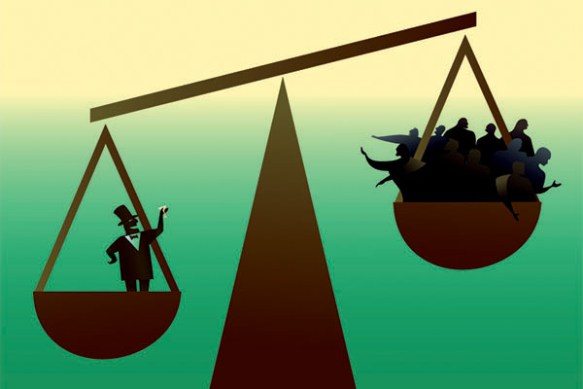
None of that changed one thing, though: most people still feel left behind both in the U.S. and globally. Thanks to the massive accumulation of wealth by a 1% skilled at gaming the system, the roots of a crisis that didn’t end with the end of the Great Recession have spread across the planet, while the dividing line between the “have-nots” and the “have-a-lots” only sharpened and widened.

Though the media hasn’t been paying much attention to the resulting inequality, the statistics (when you see them) on that ever-widening wealth gap are mind-boggling. According to Inequality.org, for instance, those with at least $30 million in wealth globally had the fastest growth rate of any group between 2016 and 2017. The size of that club rose by 25.5% during those years, to 174,800 members. Or if you really want to grasp what’s been happening, consider that, between 2009 and 2017, the number of billionaires whose combined wealth was greater than that of the world’s poorest 50% fell from 380 to just eight. And by the way, despite claims by the president that every other country is screwing America, the U.S. leads the pack when it comes to the growth of inequality. As Inequality.org notes, it has “much greater shares of national wealth and income going to the richest 1% than any other country.”

That, in part, is due to an institution many in the U.S. normally pay little attention to: the U.S. central bank, the Federal Reserve. It helped spark that increase in wealth disparity domestically and globally by adopting a post-crisis monetary policy in which electronically fabricated money (via a program called quantitative easing, or QE) was offered to banks and corporations at significantly cheaper rates than to ordinary Americans.

Pumped into financial markets, that money sent stock prices soaring, which naturally ballooned the wealth of the small percentage of the population that actually owned stocks. According to economist Stephen Roach, considering the Fed’s Survey of Consumer Finances, “It is hardly a stretch to conclude that QE exacerbated America’s already severe income disparities.”

Wall Street, Central Banks, and Everyday People

What has since taken place around the world seems right out of the 1930s. At that time, as the world was emerging from the Great Depression, a sense of broad economic security was slow to return. Instead, fascism and other forms of nationalism only gained steam as people turned on the usual cast of politicians, on other countries, and on each other. (If that sounds faintly Trumpian to you, it should.)

In our post-2008 era, people have witnessed trillions of dollars flowing into bank bailouts and other financial subsidies, not just from governments but from the world’s major central banks. Theoretically, private banks, as a result, would have more money and pay less interest to get it. They would then lend that money to Main Street. Businesses, big and small, would tap into those funds and, in turn, produce real economic growth through expansion, hiring sprees, and wage increases. People would then have more dollars in their pockets and, feeling more financially secure, would spend that money driving the economy to new heights — and all, of course, would then be well.

That fairy tale was pitched around the globe. In fact, cheap money also pushed debt to epic levels, while the share prices of banks rose, as did those of all sorts of other firms, to record-shattering heights.

Even in the U.S., however, where a magnificent recovery was supposed to have been in place for years, actual economic growth simply didn’t materialize at the levels promised. At 2% per year, the average growth of the American gross domestic product over the past decade, for instance, has been half the average of 4% before the 2008 crisis. Similar numbers were repeated throughout the developed world and most emerging markets. In the meantime, total global debt hit $247 trillion in the first quarter of 2018. As the Institute of International Finance found, countries were, on average, borrowing about three dollars for every dollar of goods or services created.

Global Consequences

What the Fed (along with central banks from Europe to Japan) ignited, in fact, was a disproportionate rise in the stock and bond markets with the money they created. That capital sought higher and faster returns than could be achieved in crucial infrastructure or social strengthening projects like building roads, high-speed railways, hospitals, or schools.

What followed was anything but fair. As former Federal Reserve Chair Janet Yellen noted four years ago, “It is no secret that the past few decades of widening inequality can be summed up as significant income and wealth gains for those at the very top and stagnant living standards for the majority.” And, of course, continuing to pour money into the highest levels of the private banking system was anything but a formula for walking that back.

Instead, as more citizens fell behind, a sense of disenfranchisement and bitterness with existing governments only grew. In the U.S., that meant Donald Trump. In the United Kingdom, similar discontent was reflected in the June 2016 Brexit vote to leave the European Union (EU), which those who felt economically squeezed to death clearly meant as a slap at both the establishment domestically and EU leaders abroad.

Since then, multiple governments in the European Union, too, have shifted toward the populist right. In Germany, recent elections swung both right and left just six years after, in July 2012, European Central Bank (ECB) head Mario Draghi exuded optimism over the ability of such banks to protect the financial system, the Euro, and generally hold things together.

Like the Fed in the U.S., the ECB went on to manufacture money, adding another $3 trillion to its books that would be deployed to buy bonds from favored countries and companies. That artificial stimulus, too, only increased inequality within and between countries in Europe. Meanwhile, Brexit negotiations remain ruinously divisive, threatening to rip Great Britain apart.

Nor was such a story the captive of the North Atlantic. In Brazil, where left-wing president Dilma Rouseff was ousted from power in 2016, her successor Michel Temer oversaw plummeting economic growth and escalating unemployment. That, in turn, led to the election of that country’s own Donald Trump, nationalistic far-right candidate Jair Bolsonaro who won a striking 55.2% of the vote against a backdrop of popular discontent. In true Trumpian style, he is disposed against both the very idea of climate change and multilateral trade agreements.

In Mexico, dissatisfied voters similarly rejected the political known, but by swinging left for the first time in 70 years. New president Andrés Manuel López Obrador, popularly known by his initials AMLO, promised to put the needs of ordinary Mexicans first. However, he has the U.S. — and the whims of Donald Trump and his “great wall” — to contend with, which could hamper those efforts.

As AMLO took office on December 1st, the G20 summit of world leaders was unfolding in Argentina. There, amid a glittering backdrop of power and influence, the trade war between the U.S. and the world’s rising superpower, China, came even more clearly into focus. While its president, Xi Jinping, having fully consolidated power amid a wave of Chinese nationalism, could become his country’s longest serving leader, he faces an international landscape that would have amazed and befuddled Mao Zedong.

Though Trump declared his meeting with Xi a success because the two sides agreed on a 90-day tariff truce, his prompt appointment of an anti-Chinese hardliner, Robert Lighthizer, to head negotiations, a tweet in which he referred to himself in superhero fashion as a “Tariff Man,” and news that the U.S. had requested that Canada arrest and extradite an executive of a key Chinese tech company, caused the Dow to take its fourth largest plunge in history and then fluctuate wildly as economic fears of a future “Great Something” rose. More uncertainty and distrust were the true product of that meeting.

In fact, we are now in a world whose key leaders, especially the president of the United States, remain willfully oblivious to its long-term problems, putting policies like deregulation, fake nationalist solutions, and profits for the already grotesquely wealthy ahead of the future lives of the mass of citizens. Consider the yellow-vest protests that have broken out in France, where protestors identifying with left and right political parties are calling for the resignation of neoliberal French President Emmanuel Macron. Many of them, from financially starved provincial towns, are angry that their purchasing power has dropped so low they can barely make ends meet.

Ultimately, what transcends geography and geopolitics is an underlying level of economic discontent sparked by twenty-first-century economics and a resulting Grand Canyon-sized global inequality gap that is still widening. Whether the protests go left or right, what continues to lie at the heart of the matter is the way failed policies and stop-gap measures put in place around the world are no longer working, not when it comes to the non-1% anyway. People from Washington to Paris, London to Beijing, increasingly grasp that their economic circumstances are not getting better and are not likely to in any presently imaginable future, given those now in power.

A Dangerous Recipe

The financial crisis of 2008 initially fostered a policy of bailing out banks with cheap money that went not into Main Street economies but into markets enriching the few. As a result, large numbers of people increasingly felt that they were being left behind and so turned against their leaders and sometimes each other as well.

This situation was then exploited by a set of self-appointed politicians of the people, including a billionaire TV personality who capitalized on an increasingly widespread fear of a future at risk. Their promises of economic prosperity were wrapped in populist platitudes, normally (but not always) of a right-wing sort. Lost in this shift away from previously dominant political parties and the systems that went with them was a true form of populism, which would genuinely put the needs of the majority of people over the elite few, build real things including infrastructure, foster organic wealth distribution, and stabilize economies above financial markets.

In the meantime, what we have is, of course, a recipe for an increasingly unstable and vicious world.

America’s Debt Dependence Makes It An Easy Economic Target

By Brandon Smith

Source: Alt-Market.com

There is a classic denial tactic that many people use when confronted with negative facts about a subject they have a personal attachment to; I would call it “deferral denial” — or a psychological postponing of reality.

For example, point out the fundamentals on the U.S. economy such as the fact that unemployment is not below 4% as official numbers suggest, but actually closer to 20% when you factor in U-6 measurements including the record 96 million people not counted because they have run out of unemployment benefits. Or point out that true consumer inflation in the U.S. is not around 3% as the Federal Reserve and the Bureau of Labor Statistics claims, but closer to 10% according to the way CPI used to be calculated before the government started rigging the numbers.  For a large part of the public including a lot of economic analysts, there is perhaps a momentary acceptance of the danger, but then an immediate deferral — “Well, maybe things will get worse down the road, 10 or 20 years from now, but it’s not that bad today…”

This is cognitive dissonance at its finest. The economy is in steep decline now, but the mind in denial says “it could be worse,” and this is how you get entire populations caught completely off guard by a financial crash. They could have easily seen the signs, but they desperately wanted to believe that all bad things happen in some illusory future, not today.

There is also another denial tactic I see often in the world of politics and economics, which is what I call “paying it backward.” This is what people do when they have a biased attachment to a person or institution and refuse to see the terrible implications of their actions. For example, when we point out that someone like Donald Trump makes destructive decisions, such as the continued support of Israel and Saudi Arabia in Syria and Yemen, or the reinstatement of funding for the White Helmets in Syria who are tied to ISIS, Trump supporters will often say “Well what about Obama?”

This is a game of shifting accountability. Is one person worse than the other? Possibly. I say give it time and make notes. However, the negative decisions of one politician we don’t like do not diminish the negative decisions of another politician we might like. They should BOTH be held accountable.

The same goes for countries and economies. When an analyst points out that U.S. debt is at historic highs and is utterly unsustainable, people in denial will say “but what about China or Europe?” One does not negate the other and, of course, there are differences that make the situation in the U.S. far more tenuous.

Primarily I am talking about America’s endless dependency on the world reserve status of the U.S. dollar and, beyond that, the steady expansion of debt at low interest rates for the past decade.

The Federal Reserve, once the No. 1 buyer of U.S. debt, has essentially declared it is cutting off support and has begun dumping assets from its balance sheet. The only assets the Fed seems to be maintaining are Mortgage Backed Securities (MBS). All others are being cut, including Treasuries. The American economy is inexorably attached to the idea of our Treasury debt as a safe investment, with our national debt spiking above $21 trillion and many trillions more owed to entitlement programs depending on how you calculate the expenditures, there is a vital need for steady foreign investment in U.S. debt.

But what happens when investment in U.S. debt becomes politically unsavory? Consider the current escalation of the trade war; Many pro-dollar talking heads and cheerleaders have argued in the past that no nation has the guts to dump dollar denominated assets and risk the wrath of American “economic might.” But, already we have seen Russia dump half its U.S. Treasury holdings in a single month and the trade war has only just begun.

Is Russia’s action a sign of things to come? Will other nations like China follow the same strategy? We will have to wait and see, but I believe this is the inevitable outcome of the trade war if it drags on for the rest of the year.

America’s dependent nature, feeding off of foreign investment to support its debts, is a disaster waiting to happen. The concept of economic “recovery” is laughable until this issue is addressed.  And, entering into a trade war while ignoring this blaring weakness is foolish, to say the least.

Beyond the issue of government (taxpayer) debt, let’s not forget about American corporations and consumers. U.S. corporate debt as a percentage of gross domestic product is at historic highs not seen since the housing bubble of 2008 or the dot-com bubble of 2001. There is a distinct difference, though, that makes today’s bubble far more insidious. After years of near-zero interest rates, corporations have become addicted to cheap debt. So much so that they have been borrowing nonstop to support their own stock prices through stock buyback manipulation. But now the Fed is raising interest rates and has committed to expanded hikes in the future.

So, what will corporations do as the cheap debt dries up? Thus far, they are spending the majority of their Trump tax cut still trying to artificially prop up stock process. When this money runs out (and I believe it will much faster than the mainstream thinks), the existing debt of these companies will cost much more to finance, and future borrowing at the same pace will become impossible. This is a threat that is developing now, not in some far-off future.

Eventually, corporations will have to make deep spending cuts rather than borrow. This means mass layoffs, store closures and potential cuts to pensions. And, of course, no more stock buybacks, meaning a market crash will ensue.

What about the U.S. consumer? U.S. consumer debt is set to reach new highs by the end of the year; around $4 trillion by official estimates.  While discussion continues about the alleged “labor shortage” in the U.S., one thing is clear — the jobs that do exist do NOT pay wages that keep up with true inflation. When we see spikes in retail sales in the U.S. and this is applauded as economy recovery, very few mainstream analysts point out that higher retail sales are merely tracking higher inflation.

That is to say, consumers are spending more money on less stuff. Again, this is unsustainable, which is why consumer debt is exploding. Dependency on credit cards and loans is being used by the public to offset much higher costs. But as the Fed raises interest rates, this too will end. Higher Fed rates translate to higher credit rates as well as higher mortgage rates (indirectly). With higher interest payments comes a large drop in overall spending.

As you can see, there are at least two forces at work here that will end all talk of U.S. recovery and which undermine any notion of economic strength — the first is the trade war, which I believe is a massive distraction designed to draw attention away from the actions of international banks and central banks. The second is the Federal Reserve, which has addicted the country to cheap fiat and is now flushing the drugs. We cannot delude ourselves into thinking that this trend will remain slow or that it will not develop into a crash in the near term. We also cannot simply deflect to other countries like China or those in Europe as if their problems are somehow worse and therefore ours are not a concern.

The fact that the health of the US economy is inexorably reliant on the continued foreign demand for the dollar and Treasury debt means any reduction of the dollar’s world reserve status or petro-status, or any decline in treasury purchases, will directly affect the carefully crafted image of America as a stable system.  Without a sudden and aggressive resurgence of domestic production and innovation America has no safety net in the event that our debt addiction is used against us.

The argument that the central bank can jump in at any time to monetize that debt and reduce the danger is also delusional.  This assumes first and foremost that the Fed WANTS to reduce the danger.  I believe they want the danger to increase, not decrease.  Debt monetization also has the added bonus of causing even more inflation as foreign investors dump their dollar denominated assets back into the US.  Monetization is a poison, not a cure.

The crisis is here, now. Seeing and accepting it allows us to prepare accordingly. Denying it as inconsequential sets people up as victims of their own bias and ignorance.