
How Covid lockdowns primed the current financial crisis

By Christian Parenti

Source: The Grayzone

The lockdowns and the stimulus required to keep the economy alive helped drive inflation. Then the Fed jacked up interest rates. And all hell broke loose.

On Friday March 10th, 2023, Silicon Valley Bank (SVB) died of Covid. Alright, it’s a little more complicated than that, but Covid lockdowns followed by massive government stimulus were a critical – and massively under-acknowledged – factor in propelling the bank’s demise.

At the heart of the crisis is the gigantic pile of low-interest debt that was issued during the height of the pandemic. While private-sector pandemic-era debt like corporate bonds also soared, US government debt like Treasury bonds piled up.

In a nutshell, during the pandemic the government issued enormous amounts of extremely low interest government debt — about $4.2 trillion of it. But now interest rates, including on government debt, are higher than they have been in 15 years and investors are dumping their old low-interest debt. As they dump, the resale price of the old debt goes down. The more it declines, the more investors want to dump. And thus, a panic is born. 

To understand the problem fully, the question of US government debt has to be put into its larger context, which is: the pandemic response as a whole.

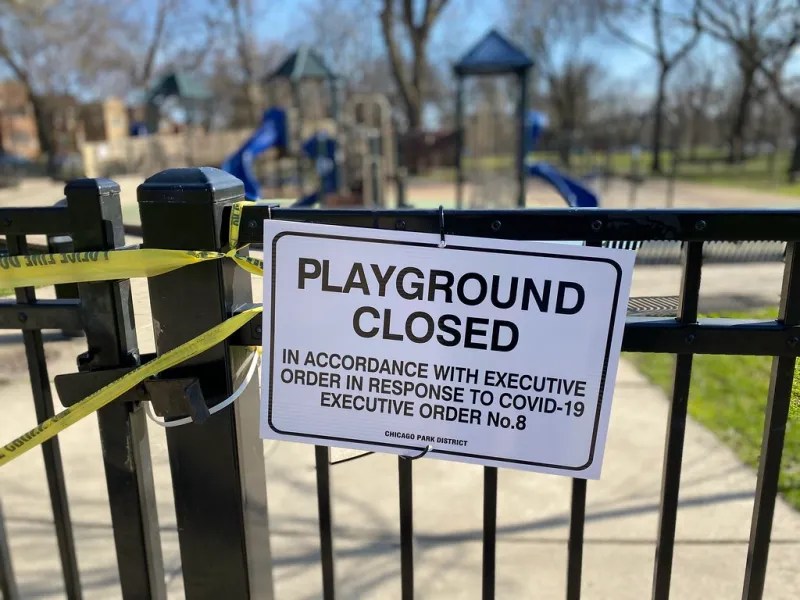
When news of the Covid virus first broke in December 2019, the 2 Year Treasury bond was being offered at 1.64% interest; the 10 year was at about 1.80%, and the resale value of such bonds on secondary markets was strong. Then, in March 2020, as Covid cases and deaths spiked, the US began to shutter its economy with panicked lockdowns that were supposed to “flatten the curve” or slow the spread of the virus and thus protect the hospitals. But Covid was politicized and the lockdowns were extended.  

As the lockdowns dragged on, the US economy began to collapse, shrinking at a record-shattering annualized rate of 31.4% during the second quarter of fiscal year 2020.

To avoid total economic devastation, the federal government began massive debt-financed spending. In March 2020, Trump signed into law the $2.2 trillion economic stimulus bill the CARES Act, or Coronavirus Aid, Relief, and Economic Security. Then, in March 2021, Biden signed the American Rescue Plan Act which contained $1.9 trillion more in Covid relief. Finally, in April 2021, another trillion or so of Covid relief arrived in the Consolidated Appropriations Act. 

Thanks to these laws, every industry and most people received public money. There was increased and extended unemployment payments, as well as the so-called “stimmy checks” or stimulus payments to everyone earning under $75,000 a year (about half the population). The Paycheck Protection Program spent almost a trillion dollars. The Provider Relief Fund doled out $178 billion to the healthcare system. 

All this debt spending kept millions of people in their homes, and helped feed, employ, and care for millions more. The measures allowed hundreds of thousands of businesses to stay afloat even as many thousands of others went under. The impact of the spending on Americans’ well-being was generally positive. For a moment, the US child poverty rate was cut in half, falling to 5.2%. 

But the economically destructive lockdowns were not necessary and did not work. Covid fanatics maintain that the lockdowns were unavoidable because the virus is so deadly. That, however, is uninformed. Last year I explained in detail how the Lockdown Left got the Covid crisis wrong. Not a single critic has challenged any of the facts I presented so there is little point in rehashing them all here. 

Those who advocated an alternative to ham-fisted lockdowns, like the authors of the Great Barrington Declaration, which called for “focused protection” of vulnerable groups like the elderly, were viciously targeted in a reputation destruction campaign covertly orchestrated by former NIH director Francis Collins and de facto Covid czar Anthony Fauci. Never mind that the document’s authors were three eminently qualified scientists: Sunetra Gupta, professor of Theoretical Epidemiology at Oxford University; Jay Bhattacharya, professor of medicine at Stanford; and Martin Kulldorff, formerly a professor of medicine and biostatistics at Harvard. They were portrayed as far-right cranks who were almost eager to see millions die. But now, they have been vindicated.

Ultimately, the federal government spent $4.2 trillion propping up the economy that it was simultaneously choking to death with lockdowns. These two contradictory pressures laid the groundwork for the recent bank failures. Government mandated lockdowns hit the economy like a body blow. Factories closed, small businesses went under, ports and logistic hubs reduced operations, and about 2 million mostly older workers simply resigned. But at the same time, the federal government injected vast amounts of purchasing power into the economy, thus boosting consumption.

These two, contradictory government moves imposed almost unbearable pressure on supply chains. As shortages mounted, prices began to surge. Put simply: lockdowns plus stimulus equaled inflation.

Consider just one of the most important bottlenecks in the whole economy. During lockdown, many commercial driving license schools were closed. This helped create a shortage of about 80,000 truckers. If trucks do not roll supplies run low and prices go up.

At first, the official line on inflation – parroted by the Lockdown Left – maintained that inflation was “transitory.” But it was not. Inflation peaked at 9.1% in June 2022 while wage growth lagged at about 5%. In April 2020 during the worst of the lockdown, the Federal Reserve’s Federal Funds Rate sank to 0.5%. By February 2022, it had only risen to 0.8%.  

Meanwhile, inflation was surging. By February 2022, inflation had reached 7.9%. Only then did the Fed, in an effort to tamp down prices, begin raising interest rates at the fastest pace rate in its history. The federal Funds rate was around 4.57% when SVB went under. Perhaps a massive wave of taxation could have soaked up enough liquidity to have helped cool prices, but that was a political impossibility. The more politically palatable response in Washington was for the Federal Reserve to raise interest rates. 

Herein lies the problem. During the height of the lockdowns, banks bought up enormous amounts of government debt. As the Wall Street Journal put it: “U.S. banks are suffering the aftereffects of a Covid-era deposit boom that left them awash in cash that they needed to put to work. Domestic deposits at federally insured banks rose 38% from the end of 2019 to the end of 2021, FDIC data show. Over the same period, total loans rose 7%, leaving many institutions with large amounts of cash to deploy in securities as interest rates were near record lows.” Awash in deposits with not enough demand for loans, the banks bought US government securities. Their purchases surged 53% between 2019 and the end of 2021, to a total of $4.58 trillion, according to Fed data reported by the Wall Street Journal.

Because so much debt was being issued, it carried super-low interest rates. For example, on July 27, 2020, the 10 Year Treasury was offered at an annual interest rate of only 0.55%. This is fine if you are the borrower of money, but if you are the lender (that is to say, a bank giving the federal government money in exchange for a Treasury bond), it means your income stream will be reduced to a mere trickle. If inflation rises, it essentially disappears. 

As the yield on new government debt reached toward 5% and inflation hung stubbornly at around 6.4%, all of that old, low-interest, pandemic-era debt started to look like garbage and banks began unloading it. The more that banks dumped old debt, the less value that debt had on resale markets. The lower its resale value, the more the banks wanted to dump it. SVB lost almost $2 billion selling off Government securities. And when they announced the loss, their stock price plunged by 60%. 

At the same time, many of SVB’s clients were withdrawing money. This was in part because rising interest rates made borrowing new money more expensive and thus incentivized the use of savings in day-to-day business operations. Also, higher inflation and higher interest rates made low-earning bank deposits less attractive and compelled depositors to redeploy their surplus capital towards higher-earning investments. So, just as SVB needed cash, deposits were evaporating.

By the end of the week of March 10, the four biggest banks in the United States had lost $51 billion because of their panicked dumping of pandemic-era debt. Right after SVB was taken under government control, state regulators closed the New York-based Signature Bank. Before the weekend was over the Federal Reserve announced the creation of a new lending facility that would ensure that “banks have the ability to meet the needs of all their depositors.” Furthermore, the Fed said it was “prepared to address any liquidity pressures that may arise.”

It would seem that the federal government is ready to execute another de facto partial nationalization of US banking, just as they did in 2008 via emergency “cash injections” and then the Troubled Assets Relief Program (TARP). In this current crisis, banks can avoid losses on their low-interest debt if they do not sell it before its maturity. For that to happen, the banks need money. The Fed has said it will pour enormous amounts of money into the banks while all of the relevant officials have proclaimed that the banking system will somehow pay for this. All of this will almost certainly mean even more government debt will be issued. 

Already, interest payments on the federal debt are one of the largest single items in the US budget – set to reach $400 billion this year. That is almost half as much as the grotesquely overdeveloped military budget. By comparison, federal spending on housing is only $78 billion.

Shoring up the banking system is necessary because if it collapses, the whole economy goes with it. At least in the short term, Americans are hostages of the US financial system. But government intervention without any new regulations and taxes upon the financial sector will likely mean more inflation and a bigger financial bubble. By refusing to properly tax the top 1%, the federal government also commits itself to more austerity for the many and more welfare for the rich, because rising government debt means a rising portion of our taxes must go toward interest payments. 

This system of crisis-prone, hyper-financialized capitalism seems ever more like a junkie. If it doesn’t get its regular fix of public sector help, it will simply collapse and die. 

Even if the federal government can stanch the current crisis, the pandemic debt story is global and very likely to cause trouble for some time to come. As a 2021 report by the World Bank put it: “The debt buildup during the pandemic-induced global recession of 2020 was the largest in several decades. This was true for all types of debt—total, government, and private debt; and advanced-economy and EMDE [emerging market and developing economy] debt; external and domestic debt. In 2020, total global debt reached 263 percent of GDP and global government debt 99 percent of GDP, their highest levels in half a century.” 

The US intelligentsia and its media elites are finally beginning to reckon with the impact of misguided and authoritarian lockdowns on student learning and the psychological and physical health of millions. But in all the discussion of the current bank runs, the pivotal role of lockdowns in priming the crisis remains overlooked.

Weimar America, Here We Come! Virus Hysteria Adds $10 Trillion to the National Debt

By Mike Whitney

Source: The Unz Review

There’s no doubt that the Coronavirus is a serious infection that can lead to severe illness or death. There’s also no doubt that ‘virus hysteria’ has been used for other purposes. Wall Street, for example, has used virus-panic to advance its own agenda and get another round of trillion dollar bailouts. In fact, it took less than a week to get the pushover congress to ram through a massive $2.2 trillion boondoggle without even one lousy congressman offering a peep of protest. That’s got to be some kind of record.

In 2008, at the peak of the financial crisis, Congress voted “No” to the $700 billion TARP bill. Some readers might recall how a number of GOP congressmen bravely banded together and flipped Wall Street “the bird”. That didn’t happen this time around. Even though the bill is three times bigger than the TARP ( $2.2 trillion), no one lifted a finger to stop it. Why?

Fear, that’s why. Everyone in congress was scared to death that if they didn’t rush this debt-turd through the House pronto, the economy would collapse while tens of thousands of corpses would be stacking up in cities across the country. Of course the reason they believed this nonsense was because the goofy infectious disease experts confidently assured everyone that the body-count would be “in the hundreds of thousands if not millions.” Remember that fiction? The most recent estimate is somewhere in the neighborhood of 60,000 total. I don’t need to tell you that the difference between 60,000 and “millions” is a little more than a rounding-error.

So we’ve had the wool pulled over our eyes, right? Not as bad as congress, but, all the same, we’ve been hoodwinked and we’ve been fleeced. And the people who have axes to grind have been very successful in taking advantage of the hysteria and promoting their own agendas. Maybe you’ve noticed the reemergence of creepy Bill Gates and the Vaccine Gestapo or NWO Henry Kissinger warning us that, “the world will never be the same after the coronavirus”.

What do these people know that we don’t know? Doesn’t it all make you a bit suspicious? And when you see nonstop commercials on TV telling you to “wash your hands”or “keep your distance” or “stay inside” and, oh yeah, “We’re all in this together”, doesn’t it leave you scratching your head and wondering who the hell is orchestrating this virus-charade and what do they really have in mind for us unwashed masses??

At least in the case of Wall Street, we know what they want. They want money and lots of it.

Have you looked over the $2.2 trillion CARES bill that Trump just signed into law a couple weeks ago? It’s pretty grim reading, so I’ll save you the effort. Here’s a rough breakdown:

$250 billion will go for the $1,200 checks that most of us will receive in a couple weeks. And $250 billion will be provided for extended unemployment insurance benefits.

That’s $500 billion.

Working people will get $500 billion while Wall Street and Corporate America will get 3 times that amount. ($1.7 trillion) And even that’s a mere fraction of the total sum because– hidden in the small print– is a section that allows the Fed to lever-up the base-capital by 10-to-1 ($450 billion to $4.5 trillion) which means the Fed can buy as many “toxic” bonds and garbage assets as it chooses. The Fed is turning itself into a hedge fund in order to buy the sludge that has accumulated on the balance sheets of corporations and financial institutions for the last decade. It’s another gigantic ripoff that’s being cleverly concealed behind the ridiculous coronavirus hype. It’s infuriating.

So here’s the question: Do you think Congress knew that working people would only get a pittance while the bulk of the dough would go to Wall Street?

It’s hard to say, but they certainly knew that the economy was cratering and that $500 billion wasn’t going to put much of a dent in a $20 trillion economy. In other words, even if everyone goes out and blows their measly $1,200 checks on Day 1, we’re still going to experience the sharpest economic contraction on record, a second Great Depression.

Maybe they should have talked about that in congress before they voted for this trillion-dollar turkey? Maybe they should have thought a little more about how the money should be distributed: Should it go to the people who actually buy things, generate activity and produce growth, or to the parasite class that blows up the system every decade and drags the economy down a black hole? That seems like something you might want to know before you pass a multi-trillion dollar bill that’s supposed to fix the economy.

It’s also worth noting that the $5.8 trillion is not nearly the total amount that Wall Street will eventually get. The Fed has already spent $2 trillion via its QE program (to shore up the dysfunctional repo market) and Fed chair Jay Powell announced on Thursday that another $2.3 trillion in loans and purchases would be used to buy municipal bonds, corporate bonds and loans to small businesses. The allocation for small businesses, which falls under the, Main Street Lending Program, has been widely touted as a sign of how much the Fed really cares about struggling Mom and Pop businesses that employ the majority of working Americans. But, once again, it’s a sham and a boondoggle. The program is on-track to get $600 billion funding of which the US Treasury will provide the base-capital of $75 billion. The rest will be levered-up by 9-to-1 by the Fed, which means it’s just more smoke and mirrors.

What readers need to realize is that the Treasury has accepted the credit risk for all of the loans that default. In other words, the American people are now on the hook for 100% of all of the loans that go south, and there’s going to be alot of them because the banks have no reason to find creditworthy borrowers. They get a 5% cut off-the-top whether the loans blow up or not. And, that, my friend, is how you incentivize fraud which, as Bernie Sanders noted, “is Wall Street’s business model.”

It also helps to explain why Trump has repeatedly rejected congressional oversight of the various bailout programs. He’s smart enough to know a good swindle when he sees one, and this one is a corker. The government is essentially waving trillions of dollars right under the noses of the world’s most ravenous hyenas expecting them not to act in character. But of course they will act in character and hundreds of billions of dollars will be siphoned off by scheming sharpies who figure out how game the system and turn the whole fiasco into another Wall Street looting operation. You can bet on it.

So, what is the final tally?

Well, according to Trump’s chief economic advisor, Larry Kudlow, the first bailout installment is $6.2 trillion (after the Fed ramps up the Treasury’s contribution of $450 billion.). Then there’s the $2.3 trillion in additional programs the Fed announced on Thursday. Finally, the Fed’s QE program adds another $2 trillion in bond purchases since September 17, when the repo market went haywire.

Altogether, the total sum amounts to $10.5 trillion.

You know what they say, “A trillion here, a trillion there, pretty soon you’re talking real money.”

Of course, no one on Capitol Hill worries about trivialities like money because, “We’re the United States of America, and our dollar will always be King.” But there’s a fundamental flaw to this type of thinking. Yes, the dollar is the world’s reserve currency, but that’s a privilege that the US has greatly abused over the years, and it’s certainly not going to survive this latest wacky helicopter drop. No, I am not suggesting the US would ever default on its debt, that’s not going to happen. But, yes, I am suggesting that the US will have to repay its debts in a currency that has lost a significant amount of its value. You don’t have to be Einstein to figure out that you can’t willy-nilly print-up $10 or $20 trillion dollars without eroding the value of the currency. That’s a no-brainer. Central bankers around the world are now looking at their piles of USDs thinking, “Hmmm, maybe it’s time I traded some of these greenbacks in for a few yen, euros or even Swiss francs?”

So how does this end? Can the Fed continue to write trillion dollar checks on an account that is already $23 trillion overdrawn? Will Central banks around the world continue to stockpile dollars when the Fed is printing them up faster than anyone can count? And what about China? How long before China realizes that US Treasuries are grossly overvalued, that US equities markets are unreformable, that the dollar is backed by nothing but red ink, and that Wall Street is the biggest and most corrupt cesspit on earth?

Not long, I’d wager. So, how does this end? It ends in a flash of monetary debasement preceded by a violent and destabilizing currency crisis. It’s plain as the nose on your face. The Fed knows that when a nation’s sovereign debt exceeds 100% of GDP, “there’s almost no mathematical way to service that debt in real terms.” Well, the US passed that milestone way-back in 2019 before this latest drunken spending-spree even began. It’s safe to say, we’ve now entered the financial Twilight Zone, the Land of No Return. If we add the Fed’s bulging balance sheet to the final estimate, (after all, it’s just another shady Enron-type Special Purpose Vehicle) the national debt will be somewhere north of $33 trillion by year-end, which means that Uncle Sam will be the greatest credit risk on Planet Earth. Imagine how jaws will drop on the day that Moodys and Fitch slash the ratings on US Treasuries to Triple B “junk” status. That should turn a few heads.

So what can we expect in the months to come?

First, the economy is going to slip into a deflationary period as people get back to work and slowly resume their spending. But once demand picks up and the Fed’s liquidity starts to kick in, the economy will rebound sharply followed by steadily rising prices. That’s the red flag that will signal a weakening dollar. Similar to 1933, when Roosevelt took the U.S. off the gold standard and printed money like crazy, economic activity picked up but the value of the dollar dropped by 40%. A similar scenario seems likely here as well. Economist Lyn Alden Schwartzer summed it up like this in an article at Seeking Alpha:

“One of the common debates is whether all of this debt, counteracted by a tremendous monetary expansion by the Federal Reserve in response, will cause a deflationary bust or an inflationary problem…..Fundamentally, evidence points to a period of deflation due to this global shutdown and demand destruction shock, likely followed in the coming years by rising inflation….

In the coming years, the United States will be effectively printing money to fund large fiscal deficits, while also having a large current account deficit and negative net international investment position. This is one of the main variables for my view that the dollar will likely decrease in value relative to a basket of foreign currencies in the coming years….” (“Why This Is Unlike The Great Depression”, Seeking Alpha)

So, after decades of lethal low interest rates, relentless meddling and gross regulatory malpractice, the Fed has led us to this final, fatal crossroads: Inflate or default. From the looks of things, the choice has already been made. Weimar America, here we come!


The Federal Reserve and the Global Fracture

Octopus 1912

An Interview with Finnish Journalist Antti J. Ronkainen

Michael Hudson

Source: The Unz Review

Antti J. Ronkainen: The Federal Reserve is the most significant central bank in the world. How does it contribute to the domestic policy of the United States?

Michael Hudson: The Federal Reserve supports the status quo. It would not want to create a crisis before the election. Today it is part of the Democratic Party’s re-election campaign, and its job is to serve Hillary Clinton’s campaign contributors on Wall Street. It is trying to spur recovery by resuming its Bubble Economy subsidy for Wall Street, not by supporting the industrial economy. What the economy needs is a debt writedown, not more debt leveraging such as Quantitative Easing has aimed to promote. But the Fed is in a state of denial that the U.S. and European economies are plagued by debt deflation.

The Fed uses only one policy: influencing interest rates by creating bank reserves at low give-away charges. It enables banks too make easy gains simply by borrowing from it and leaving the money on deposit to earn interest (which has been paid since the 2008 crisis to help subsidize the banks, mainly the largest ones). The effect is to fund the asset markets – bonds, stocks and real estate – not the economy at large. Banks also are heavy arbitrage players in foreign exchange markets. But this doesn’t help the economy recover, any more than the ZIRP (Zero Interest-Rate Policy) since 2001 has done for Japan. Financial markets are the liabilities side of the economy’s balance sheet, not the asset side.

The last thing either U.S. party wants is for the election to focus on this policy failure. The Fed, Treasury and Justice Department will be just as pro-Wall Street under Hillary. There would be no prosecutions of bank fraud, there would be another bank-friendly Attorney General, and a willingness to subsidize banks now that the Dodd-Frank bank reform has been diluted from what it originally promised to be.


So let’s go back to beginning. When the Great Financial Crisis escalated in 2008 the Fed’s response was to lower its main interest rate to nearly zero. Why?

The aim of lowering interest rates was to provide banks with cheap credit. The pretense was that banks might lend to help the economy get going again. But the Fed’s idea was simply to re-inflate the Bubble Economy. It aimed at restoring the value of the mortgages that banks had in their loan portfolios. The hope was that easy credit would spur new mortgage lending to bid housing prices back up – as if this would help the economy rather than simply raising the price of home ownership.

But banks weren’t going to make mortgage loans to a housing market that already was over-lent. Instead, homeowners had to start paying down the mortgages they had taken out. Banks also reduced their credit-card exposure by a few hundred billion dollars. So instead of receiving new credit, the economy was saddled with having to repay debts.

Banks did make money, but not by lending into the “real” production and consumption economy. They mainly engaged in arbitrage and speculation, and lending to hedge funds and companies to buy their own stocks yielding higher dividend returns than the low interest rates that were available.


In addition to the near zero interest rates, the Fed bought US Treasury bonds and mortgage backed securities (MBS) with almost $4 trillion during three rounds of Quantitative Easing stimulus. How have these measures affected the real economy and financial markets?

In 2008 the Federal Reserve had a choice: It could save the economy, or it could save the banks. It might have used a fraction of what became the vast QE credit – for example $1 trillion – to pay off the bad mortgages and write them down. That would have helped save the economy from debt deflation. Instead, the Fed simply wanted to re-inflate the bubble, to save banks from having to suffer losses on their junk mortgages and other bad loans.

Keeping these debts on the books, in full, let banks foreclose on defaulting homeowners. This intensified the debt-deflation, pushing the economy into its present post-2008 depression. The debt overhead is keeping it depressed.

One therefore can speak of a financial war waged by Wall Street against the economy. The Fed is a major weapon in this war. Its constituency is Wall Street. Like the Justice and Treasury Departments, it has been captured and taken hostage.

Federal Reserve chairwoman Janet Yellen’s husband, George Akerlof, has written a good article about looting and fraud as ways to make money. But instead of saying that looting and fraud are bad, the Fed has refused to regulate or move against such activities. It evidently recognizes that looting and fraud are what Wall Street is all about – or at least that the financial system would come crashing down if an attempt were made to clean it up!

So neither the Fed nor the Justice Department or other U.S. Government agencies has sanctioned or arrested a single banker for the trillions of dollars of financial fraud. Just the opposite: The big banks where the fraud was concentrated have been made even larger and more dominant. The effect has been to drive out of business the smaller banks not so involved in derivative bets and other speculation.

The bottom line is that banks made much more by getting Alan Greenspan and the Clinton-Bush Treasury officials to deregulate fraud than they could have made by traditional safe lending. But their gains have increased the economy’s overhead.


Do you believe Mike Whitney’s argument that QE was about a tradeoff between the Fed and the government: the Fed pumped the new bubble and saved the banks that the government didn’t need to bail out more banks. The government’s role was to impose austerity so that inflation and employment didn’t rise – which would have forced the Fed to raise interest rates, ending its QE program? source: http://www.counterpunch.org/2016/01/15/the-chart-that-explains-everything/]

That was a great chart that Mike put up from Richard Koo, and you should reproduce it here. It shows that the Fed’s enormous credit creation had zero effect on raising commodity prices or wages. But stock market prices doubled in just six years, 2008-15, and bond prices rose to new peaks. Banks left much of the QE credit on deposit with the Fed, earning an interest giveaway premium.

(Richard Koo: “The struggle between markets and central banks has only just begun,”

http://www.businessinsider.com/richard-koo-struggle-between-markets-and-central-banks-has-only-just-begun-2015-9?r=UK&IR=T

The important point is that the Fed (backed by the Obama Administration) refused to use this $4 trillion to revive the production-and-consumption economy. It claimed that such a policy would be “inflationary,” by which it meant raising employment and wage levels. The Fed thus accepted the neoliberal junk economics proposing austerity as the answer to any problem – austerity for the industrial economy, not the Fed’s own Wall Street constituency.


According to a Fed staff report, QE would lower the exchange rate of dollar to the other currencies causing competitiveness boost for the U.S. firms. Former finance minister of Brazil Guido Mantega, as well as the chairman of Central Bank of India Raghuram Rajan, have described the Fed’s QE as a “currency war.” What’s your take?

The Fed’s aim was simply to provide banks with low-interest credit. Banks lent to hedge funds to buy securities or make financial bets that yielded more than 0.1 percent. They also lent to companies to buy their own stock, and to corporate raiders for debt-financed mergers and acquisitions. But banks didn’t lend to the economy at large, because it already was “loaned up,” and indeed, overburdened with debt.

Lower interest rates did spur the “carry trade,” as they had done in Japan after 1990. Banks and hedge funds bought foreign bonds paying higher rates. The dollar drifted down as bank arbitrageurs could borrow from the Fed at 0.1 percent to lend to Brazil at 9 percent. Buying these foreign bonds pushed up foreign exchange rates against the dollar. That was a side effect of the Fed’s attempt to help Wall Street make financial gains. It simply didn’t give much consideration to how its QE flooding the global economy with surplus dollars would affect U.S. exports – or foreign countries.

Exchange rate shifts don’t affect export trends as much as textbook models claim. U.S. arms exports to the Near East, and many technology exports are non-competitive. However, a looming problem for most countries is what may happen when ending QE increases the dollar’s exchange rate. If U.S. interest rates go back up, the dollar will strengthen. That would increase the cost to foreign countries of paying dollar-denominated debts. Countries that borrowed all dollars at low interest will need to pay more in their own currencies to service these debts. Imagine what would happen if the Federal Reserve let interest rates rise back to a normal level of 4 or 5 percent. The soaring dollar would push debtor economies toward depression on capital account much more than it would help their exports on trade account.


You have said that QE is fracturing the global economy. What do you mean by that?

Part of the flood of dollar credit is used to buy shares of foreign companies yielding 15 to 20 percent, and foreign bonds. These dollars are turned over to foreign central banks for domestic currency. But central banks are only able to use these dollars to buy U.S. Treasury securities, yielding about 1 percent. When the People’s Bank of China buys U.S. Treasury bonds, it’s financing America’s dual budget and balance-of-payment deficits, both of which stem largely from military encirclement of Eurasia – while letting U.S. investors and the U.S. economy get a free ride.

Instead of buying U.S. Treasury securities, China would prefer to buy American companies, just like U.S. investors are buying Chinese industry. But America’s government won’t permit China even to buy gas station companies. The result is a double standard. Americans feel insecure having Chinese ownership in their companies. It is the same attitude that was directed against Japan in the late 1980s.

I wrote about this financial warfare and America’s free lunch via the dollar standard in Super Imperialism (2002) and The Bubble and Beyond (2012), and about how today’s New Cold War is being waged financially in Killing the Host (2015).


The Democrats loudly criticized the Bush administration’s $700 billion TARP-program, but backed the Fed’s QE purchases worth of almost $4 trillion during the Obama administration. How does this relate to the fact that officially, QE purchases were intended to support economic recovery?

I think you’ve got the history wrong. My Killing the Host describes how the Democrats supported TARP, while the Republican Congress opposed it on populist grounds. Republican Treasury Secretary Hank Paulson offered to use some of the money to aid over-indebted homeowners, but President-elect Obama blocked that – and then appointed Tim Geithner as Treasury Secretary. FDIC head Sheila Bair and by SIGTARP head Neil Barofsky have written good books about Geithner’s support for Wall Street (and especially for Citigroup and Goldman Sachs) against the interests of the economy at large.

If you are going to serve Wall Street – your major campaign contributors – you are going to need a cover story pretending that this will help the economy. Politicians start with “Column A”: their agenda to reimburse their campaign contributors – Wall Street and other special interests. Their public relations team and speechwriters then draw up “Column B”: what public voters want. To get votes, a rhetorical cover story is crafted. I describe this in my forthcoming J is for Junk Economics, to be published in March. It’s a dictionary of Orwellian doublethink, political and economic euphemisms to turn the vocabulary around and mean the opposite of what actually is meant.


How do TARP and QE relate to the Federal Reserve’s mandate about price stability?

There are two sets of prices: asset prices and commodity prices and wages. By “price stability” the Fed means keeping wages and commodity prices down. Calling depressed wage levels “price stability” diverts attention from the phenomenon of debt deflation – and also from the asset-price inflation that has increased the advantages of the One Percent over the 99 Percent. From 1980 to the present, the Fed has inflated the largest bond rally in history as a result of driving down interest rates from 20 percent in 1980 to nearly zero today, as you have noted.

Chicago School monetarism ignores asset prices. It pretends that when you increase the money supply, this increases consumer prices, commodity prices and wages proportionally. But that’s not what happens. When banks created credit (money), they don’t lend much to people to buy goods and services or for companies to make capital investments to employ more workers. They lend money mainly to transfer ownership of assets already in place. About 80 percent of bank loans are mortgages, and the rest are largely for stocks and bond purchases, including corporate takeovers and stock buybacks or debt-leveraged purchases. The effect is to bid up asset prices, while loading down the economy with debt in the process. This pushes up the break-even cost of doing business, while imposing debt deflation on the economy at large.

Wall Street isn’t so interested in exploiting wage labour by hiring it to produce goods for sale, as was the case under industrial capitalism in its heyday. It makes its gains by riding the wave of asset inflation. Banks also gain by making labour pay more interest, fees and penalties on mortgages, and for student loans, credit cards and auto loans. That’s the postindustrial financial mode of exploiting labor and the overall economy. The Fed’s QE program increases the price at which stocks, bonds and real estate exchange for labour, and also promotes debt leverage throughout the economy.


Why don’t economists distinguish between asset-price and commodity price inflation?

The economics curriculum has been turned into an exercise for students to pretend that a hypothetical parallel universe exists in which the rentier classes are job creators, necessary to help economies recover. The reality is that financial modes of getting rich by debt leveraging creates a Bubble Economy – a Ponzi scheme leading to austerity and shrinking markets, which always ends in a convulsion of bankruptcy.

The explanation for why this is not central to today’s economic theory is that the discipline has been captured by this neoliberal tunnel vision that overlooks the financial sector’s maneuvering to make quick trading profits in stocks, bonds, mortgages and derivatives, not to take the time and effort to develop long-term markets. Rentiers seek to throw a cloak of invisibility around how they make money. They know that if economists don’t measure their wealth and the public does not see it, voters will be less likely to bring pressure to regulate and tax it.

Today’s central economic problem is that inflating asset prices by debt leveraging extracts more interest and financial charges. When the resulting debt deflation ends up hollowing out the economy, creditors try to blame labour, or government spending (except for bailouts and QE to help Wall Street). It is as if debtors are exploiting their creditors.


If there is a new class war, what is the current growth model?

It’s an austerity model, as you can see from the eurozone and from the neoliberal consensus that cites Latvia as a success story rather than a disaster leading to de-industrialization and emigration. In real democracies, if economies polarize like they are doing today, you would expect the 99 Percent to fight back by electing representatives to enact progressive taxation, regulate finance and monopolies, and make public investment to raise wages and living standards. In the 19th century this drive led parliaments to rewrite the tax rules to fall more on landlords and monopolists.

Industrial capitalism plowed profits back into new means of production to expand the economy. But today’s rentier model is based on austerity and privatization. The main way the financial sector always has obtained wealth has been by privatizing it from the public domain by insider dealing and indebting governments.

The ultimate financial business plan also is to lend with an eye to end up with the debtor’s property, from governments to companies and families. In Greece the European Central Bank, European Commission and IMF demanded that if the nation’s elected representatives did not sell off the nation’s ports, land, islands, roads, schools, sewer systems, water systems, television stations and even museums to reimburse the dreaded austerity troika for its bailout of bondholders and bankers, the country would be isolated from Europe and faced with a crash. That forced Greece to capitulate.

What seems at first glance to be democracy has been hijacked by politicians who accept the financial class war ideology that the way for an economy to get rich is by austerity. That means lowering wages, unemployment, and dismantling government by turning the public domain over to the financial sector.

By supporting the banking sector even in its predatory and outright fraudulent behavior, U.S. and European governments are reversing the trajectory along which 19th-century progressive industrial capitalism and socialism were moving. Today’s rentier class is not concerned with long-term tangible investment to earn profits by hiring workers to produce goods. Under finance capitalism, an emerging financial over-class makes money by stripping income and assets from economies driven deeper into debt. Attacking “big government” when it is democratic, the wealthy are all in favor of government when it is oligarchic and serves their interests by rolling back the past two centuries of democratic reforms.


Does the Fed realize global turbulences what its unconventional policies have caused?

Sure. But the Fed has painted itself in a corner: If it raises interest rates, this will cause the stock and bond markets to go down. That would reverse the debt leveraging that has kept these markets up. Higher interest rates also would bankrupt Third World debtors, which will not be able to pay their dollar debts if dollars become more expensive in their currencies.

But if the Fed keeps interest rates low, pension funds and insurance companies will have difficulty making the paper gains that their plans imagined could continue exponentially ad infinitum. So whatever it does, it will destabilize the global economy.


China’s stock market has crashed, western markets are very volatile, and George Soros has said that the current financial environment reminds him of the 2008 crash. Should we be worried?

News reports make it sound as if debt-ridden capitalist economies will face collapse if the socialist countries don’t rescue them from their shrinking domestic markets. I think Soros means that the current financial environment is fragile and highly debt-leveraged, with heavy losses on bad loans, junk bonds and derivatives about to be recognized. Regulators may permit banks to “extend and pretend” that bad loans will turn good someday. But it is clear that most government reports and central bankers are whistling in the dark. Changes in any direction may pull down derivatives. That will cause a break in the chain of payments when losers can’t pay. The break may spread and this time public opinion is more organized against 2008-type bailouts.

The moral is that debts that can’t be paid, won’t be. The question is, how won’t they be paid? By writing down debts, or by foreclosures and distress sell-offs turning the financial class into a ruling oligarchy? That is the political fight being waged today – and as Warren Buffet has said, his billionaire class is winning it.


That’s all for now. Thank you Michael!

The Global Money Matrix: The Forces behind America’s Economic Destruction

money-globe

By Dr. Gary Null

Source: GlobalResearch.ca

On the Brink of Economic Calamity

We are witnessing unprecedented low points in American economic history as 50 million Americans—17 million of them children—are living below the poverty line[i],[ii] while 47 million citizens rely on food stamps[iii].  All told, the 2008 economic collapse cost over $20 trillion globally[iv]. Millions of people lost their homes and jobs, while many of our nation’s children fell deeper into hunger. According to some figures, 53 million people entered the poverty ranks.[v] In the US and other developed nations, suicide rates skyrocketed due to financial stress and disruption of families. The Bureau of Labor Statistics has listed unemployment at 7.5% — a rate that is irreconcilable with reality. The more reliable figure, calculated by economist John Williams from Shadow Government Statistics, places unemployment at 22%. If we are to believe the analyses of Tyler Cowen at the Mercatus Center at George Mason University, we might be looking at an unemployment rate as high as 41%, since 33% of Americans are not working and no longer have the desire to find jobs.[vi]  This group is categorically removed from the government’s labor radar and is absent from the Bureau of Labor Statistics’ fudged data. 

 The Global Money Matrix

In the midst of this economic turmoil there is one group that still manages to flourish: the global elite. With more than $32 trillion stashed in offshore banks around the world, the wealth of the so-called “1%” is staggeringly obscene and grows by the day.[vii]  Their aggregate wealth, larger than the US GDP and national debt combined, is a testament to the tremendous influence and lobbying power held by a coterie of private interests that dominate nearly every sector of society.

Instead of reining in the inordinate control exercised by the elite, most of our elected officials have become little more than shills for these corporate overlords, creating policies that favor their campaign donors instead of the American people. Hundreds of millions of dollars were funneled into Barack Obama’s 2012 presidential campaign by donors whose business affiliations run the gamut from real estate and finance to media and law firms. According to Opensecrets.org, “Together, 769 elites are directing at least $186,500,000 for Obama’s re-election efforts — money that has gone into the coffers of his campaign as well as the Democratic National Committee.”[viii] This figure doesn’t even account for the massive contributions to Obama’s reelection by corporate-driven SuperPACs. Obama is just one example of how our politicians are beholden to the elite agenda. A quick glance at the campaign donation figures presented at Opensecrets.org reveals just how much special interests control Washington’s policymakers.

Given the corporatist influence that infects our halls of power, it is little wonder that our tax dollars continue to fund unconstitutional spying, perpetual war, and neoliberal policies that extend the powers of the world’s richest individuals and organizations. As Americans struggle financially, our social safety nets are increasingly losing priority to military and security expenditures that are historically unmatched anywhere in the world. Increasingly, the actions taken by the world’s most powerful corporations and governments seem to be at odds with public perception and wellbeing. Here are a few examples of how this combined influence has increased at the expense of the average American:

ALEC – This conservative group, funded by donors like the Koch brothers and Exxon Mobil and fueled by politicians including Ohio Governor John Kasich and Wisconsin Governor Scott Walker,[ix] writes model legislation calling to “privatize education, break unions, deregulate major industries, pass voter ID laws, and more.”[x] They do so with the stated aim to “form formal internal Task Forces to develop policy covering virtually every responsibility of state government.”[xi] ALEC’s website claims, “Each year, close to 1,000 bills, based at least in part on ALEC Model Legislation, are introduced in the states. Of these, an average of 20% become law.”[xii]

Federal Taxes and Expenditures – In 2014, President Obama plans to spend 57% of his discretionary budget on military, with 6% going to education, 3% to science, and 1% to food and agriculture.[xiii] And while the federal corporate tax rate is 35% in America, a variety of loopholes means that the average rate paid by corporations is 25%, with some companies paying as low as 10%.[xiv]

Citizens United – This US Supreme Court case set the legal precedent for unlimited campaign donations in US elections, qualifying corporate donations as a form a free speech. Since this case concluded, campaign expenditures have tripled.[xv]

TARP, or “the Bailout” – Following the economic crisis of 2008, US taxpayers handed $700 billion to major players in the automotive, financial, and insurance industries[xvi]. According to The New York Times, “Treasury…provided the money to banks with no effective policy or effort to compel the extension of credit. There were no strings attached: no requirement or even incentive to increase lending to home buyers, and…not even a request that banks report how they used TARP funds.”[xvii]  The Huffington Post reports, “Twenty-five top recipients of government bailout funds spent more than $71 million on lobbying in the year since they were rescued.”

In the Name of Security

The most concerning imbalance of power, however, may lie in the ‘security state’. In 2010, there were over 1900 private corporations with government contracts working for Homeland Security and NSA intelligence projects. Just one of these firms, Booz Allen Hamilton, where Edward Snowden was employed, has over 25,000 employees, nearly half of whom have security clearance of “top secret or higher”.[xviii]  Overall, there are an estimated half million individuals in private firms with access to intelligence secrets.[xix]  The federal intelligence agencies only employ 107,000 individuals; therefore, the bulk of intelligence and surveillance operations are conducted by private workforces.[xx] For fiscal year 2013, the country’s budget for intelligence, across 16 agencies, was approximately $52.6 billion, with 70% going to private contractors.[xxi]

Recent revelations by Edward Snowden unearthed the breadth and scope of this surveillance network. The National Security Agency has collected vast amounts of data to spy upon American citizens, elected legislators in Congress, leaders and populations of other nations, multilateral and international administrations, non profit organizations, and a variety of public and environmental advocacy groups. This defines the current trajectory of the US as a failed republic degenerating into a fascist regime.  For both corporate Republicans and Democrats, the rise of surreptitious surveillance on citizens, in direct violation of the Constitution, is perceived as a matter of national security to protect both the country’s domestic and foreign interests.

NSA Director Gen. Keith Alexander claimed publicly that intelligence surveillance of the American public “foiled” 54 terrorist attacks by extremists. Independent research confirmed that in fact only one, and a possible second attack, could be directly associated with the war on terrorism.  Speaking on the matter, Vermont Senator Patrick J. Leahy stated,

“There is no evidence that [bulk] phone records collection helped to thwart dozens or even several terrorist plots….These weren’t all plots and they weren’t all foiled.”.[xxii]

The Washington Times reported that “Keith B. Alexander admitted that the number of terrorist plots foiled by the NSA’s huge database of every phone call made in or to America was only one or perhaps two—far smaller than the 54 originally claimed by the administration.” General Alexander, under the questioning of Senator Leahy, also admitted that only 13 of the 54 cases were in any way connected to the U.S.  As the Washington Times clarifies,

“The [NSA phone records] database contains so-called metadata—the numbers dialing and dialed, time and duration of call—for every phone call made in or to the U.S.”[xxiii] 

This is but one example highlighting how the consolidation of corporate and political power comes at the cost of human rights and personal liberties for the average citizen.

 Obama has lied to the American people repeatedly about the extent of the security state and its infiltration into the lives of average citizens, including massive data collection of private phone calls, emails, and internet activity. The NSA revelations of Edward Snowden provide documented proof that intelligence surveillance is far more extensive than ever believed. The activities of the FBI, CIA, Pentagon, FISA courts, USDA and FDA, and the Justice Department contribute to the deterioration of citizens’ privacy and freedom. And a recent report by Essential Information entitled Spooky Business describes how some of America’s largest corporations have engaged in corporate espionage to spy on non-profit organizations. Ralph Nader writes, “In effect, big corporations have been able to hire portions of the national security apparatus, and train their tools of spycraft on the citizen groups of our country.”[xxiv] Thus, the powers of government and corporations are fostered and increased by one another, while those of the average American continue to dwindle

Groupthink and the 15%

It is unrealistic to frame the problem of control and socio-economic manipulation as a war between the 1 and the 99.  The 1 percent cannot achieve its goals without support from armies of technocrats and workforces willing to sacrifice moral values to secure careers in corporations and political parties, regardless of the inhumane ruthlessness behind their undemocratic agendas. The private industrial complexes of Too Big to Fail corporations require minions of technocrats and employees—as well as a large network of contracted small businesses, advisors, and consultants—to exert control over the population.  Therefore, we should realistically be speaking of a 15 versus 85 percent in the war on inequality, control, and power.

 When this additional 45 million people, or 15 percent of the population, are added to the formula for who controls the major stakes of power, wealth, influence and policymaking today, we can more easily understand how the psychology of “group think” creates a protective shield around the power brokers calling the shots.  When the psychologist Irving Janis first used the term “groupthink”, he referred to a collective weakening of individuals’ “mental efficiency, reality testing and moral judgment” through pressure to stick with the corporate plan.[xxv]  Among the characteristics common to groupthink, which enables the privileged elite to exert compliance to their mission without dissent, is a false belief in the inherent morality of their jobs. For example, the neoliberal free-market ideology posits that trickle down economics from the top will create more jobs and raise families’ personal income—a persistent myth that has no historical example to prove it as fact.  

The actual facts, according to the 2012 Global Wealth Data Book, show that since the implementation of neoliberal economics in the late 1970s and early 1980s, the financial health of America’s middle class has fallen to 27th globally, behind Qatar, Taiwan, Cyprus and Kuwait. Simultaneously, the US has the most millionaires and billionaires of any other nation.[xxvi]  Groupthink also generates an “illusion of invulnerability,” an insincere and narrow confidence that enables workers to take extreme risks and a distorted group rationalization to deny facts to the contrary of their optimism.  Other characteristics include stereotyping enemies, managerial pressure on nonconformists, and self-censorship of doubts within the organization.  An illusion of unanimity is sustained whereby the image is created and perpetuated that the majority agree with organization’s purpose and mission.[xxvii]

Without the possibility of groupthink and this additional 15 percent passively serving the most powerful 1 percent’s destructive acts, life in the US would be far more democratic, just, and free today. Unfortunately, our society currently necessitates profit for both legitimacy and survival. This unprecedented economic and political atmosphere is giving birth to a new face of fascism.

 The Dominant Culture

When considering the human element in our societal structure, the question arises as to how human beings can act with such blatant disregard for damage incurred. There are varying figures assessing the percent of psychopathology among high level financial and corporate executives. In the general population, approximately 1% can be clinically diagnosed with sociopathic and psychopathic disorders[xxviii]. However, for the wealthy and power elite, estimates are higher.

Canadian psychiatrist Dr. Robert Hare estimates that 4 percent of corporate executives are clinically sociopathic.[xxix] Sherree DeCovny, a former high-powered investment banker now with CFA Financial Magazine, believes it is as high as 10 percent.[xxx] Figures from psychological surveys in the UK place estimates even higher. Psychologist Clive Boddy has argued that the psychopathological behavior of financial executives was a major cause for the 2007 economic collapse. He also notes that individuals with the strongest psychopathic tendencies are those who tend to be promoted fastest.[xxxi]

Research supports this claim. In a survey of 500 senior executives in the US and UK, 26 percent observed firsthand wrongdoing in the workplace and 24 percent believed that it was necessary for professionals in the financial sector to engage in unethical and even illegal conduct in order to be successful. Sixteen percent said they would commit insider trading if they were certain they could get away with it, and 30 percent said that the pressures of compensation plans were an incentive to break the law.[xxxii]

Today, this banking elite owns the lives of millions of Americans by imprisoning them in debt. In the third quarter of 2013, consumer indebtedness reached $11.28 trillion.[xxxiii]  2014 and every year thereafter will see household debt increase. The majority of this debt, in the form of mortgages and outstanding home equity, student loans, auto loans, and credit cards, is money owed to the banking industry. It is by keeping the masses indebted, securing government allegiance and protection to extract money from citizens, that bankers are able to control the economy.

In a letter to Federal Reserve Chairman Ben Bernanke, Representative Alan Grayson and three of his Congressional colleagues raised their concern over large investment banks taking over the real economy.  According to their investment relations reports, both banks are engaged in the “production, storage, transportation, marketing and trading of numerous commodities.”[xxxiv] These include crude oil and oil products, natural gas, coal, electric power, agricultural and food products, and precious and rare metals. Additionally, JP Morgan markets electric power and “owns electricity generating facilities in the US and Europe.”[xxxv] Goldman Sachs has entered the uranium mining market.  According to Rep. Grayson, none of these activities have anything to do with the business of banking, and there is no indication that the Fed or any other agency is regulating these irregular business undertakings.[xxxvi]

In early 2013, the Swiss Federal Institute of Technology in Zurich conducted the most thorough analysis of the financial ties between over 43,000 transnational banks and corporations. This was the first empirical study to identify a network where global power and wealth is most heavily concentrated. Their startling results observed that a small faction of 147 super companies controls over 40 percent of the entire transnational network, with an additional 36 million companies below them. 

Predictably, almost all of the 147 super companies were financial institutions, with Barclays, Capital Group, the Vanguard Group, Deutsche Bank, JP Morgan, Goldman Sachs, Credit Suisse, and Bank of New York among the top of the list.[xxxvii]  With financial instruments of speculative trade insufficient to satisfy greed, such companies have every incentive to move into new territory, particularly resources and services that are essential to life. This includes fuel, water, food and minerals. As it stands, at least twenty-five major US companies have more wealth than entire countries.[xxxviii]

The prediction can be suggested that with current trends, the largest global banks will become the world’s most powerful “nations,” acting with complete autonomy outside of international laws that apply to sovereign states.  As corporate groupthink increases and infiltrates the larger civilian community, the transnationalist mind will persist as a breeding ground for psychopathology.

Conclusion

The consequences of today’s cowboy free market culture have sent the US middle class and economic mobility spiraling downward. Laid off workers have nowhere to use their skills to earn a livelihood for themselves and their families. Consequently, the worker is unable to meet expenditures and falls into a lower income bracket or poverty.  Mortgage defaults, credit card payments, and loans drag him further into debt. Without work and hence unable to pay taxes, the state, county and town suffer. In turn, local entities are forced to reduce their workforce and public services. The final result is the decline in the national quality of life, and the gradual deterioration of the US.  The inequality gap widens as the wealthy get richer and more powerful, while growing numbers of families become destitute.

A clear conflict exists between the values that we promote in the home and those values that are rewarded in the workplace. Unless we apply the same moral requirements to governments and corporations as we do to ourselves, friends, and families, the revolving door at the top of society will continue to consolidate power and wealth at any cost.

Notes

[i] Fessler, Pam. “How Many Americans Live In Poverty?” NPR. http://www.npr.org/blogs/money/2013/11/06/243498168/how-many-americans-live-in-poverty (accessed December 2, 2013).

[ii] National Center for Children in Poverty. “Child Poverty.” NCCP. http://www.nccp.org/topics/childpoverty.html (accessed December 1, 2013).

[iii] Plumer, Brad. “Why are 47 million Americans on food stamps? It’s the recession — mostly.” WashingtonPost.com. http://www.washingtonpost.com/blogs/wonkblog/wp/2013/09/23/why-are-47-million-americans-on-food-stamps-its-the-recession-mostly/ (accessed December 3, 2013).

[iv] Melendez, Eleazar. “Financial Crisis Cost Tops $22 Trillion, GAO Says.” The Huffington Post. http://www.huffingtonpost.com/2013/02/14/financial-crisis-cost-gao_n_2687553.html (accessed December 3, 2013).

 [v] Moench, Brian. “Death by Corporation, Part II: Companies as Cancer Cells.” Truthout. http://www.truth-out.org/news/item/17705-death-by-corporation-part-ii-companies-as-cancer-cells (accessed December 3, 2013).

 [vi]  “The real jobs numbers: 41% of America unemployed, 1 in 3 doesn’t want work at all – RT USA.” RT.com. http://rt.com/usa/jobs-us-employment-welfare-749/ (accessed December 3, 2013).

 [vii] Vellacott, Chris. “Super Rich Hold $32 Trillion in Offshore Havens.” Reuters.com. http://www.reuters.com/article/2012/07/22/us-offshore-wealth-idUSBRE86L03U20120722 (accessed December 13, 2003).

 [viii] “Barack Obama’s Bundlers.” Opensecrets RSS. http://www.opensecrets.org/pres12/bundlers.php

[ix] “What is ALEC?.” ALEC Exposed. http://www.alecexposed.org/wiki/What_is_ALEC%3F#Who_funds_ALEC.3F (accessed December 3, 2013).

[x] Nichols, John. “ALEC Exposed.” The Nation. http://www.thenation.com/article/161978/alec-exposed# (accessed December 3, 2013).

[xi] “History.” ALEC American Legislative Exchange Council. http://www.alec.org/about-alec/history/ (accessed December 3, 2013).

[xii] Ibid.

[xiii] “Where Does the Money Go? Federal Budget 101.” National Priorities Project. http://nationalpriorities.org/budget-basics/federal-budget-101/spending/ (accessed December 2, 2013).

[xiv] The Economist Newspaper. “The Trouble with Tax Reform.” The Economist. http://www.economist.com/blogs/democracyinamerica/2011/02/corporate-tax_reform (accessed December 3, 2013).

[xv] “Daily Kos.” : Buying Elections: Campaign Spending TRIPLES Since Citizens United. If You Can’t Win, Cheat + News!. http://www.dailykos.com/story/2013/03/11/1193246/-Buying-Elections-Campaign-Spending-TRIPLES-Since-Citizens-United-If-You-Can-t-Win-Cheat# (accessed December 3, 2013).

[xvi] Stein, Sam. “Top Bailout Recipients Spent $71 Million On Lobbying In Year Since Bailout.” The Huffington Post. http://www.huffingtonpost.com/2009/11/05/top-bailout-recipients-sp_n_346877.html (accessed December 3, 2013).

[xvii] Barofski, Neil. “Where the Bank Bailout Went Wrong.” NYTimes.com. http://www.nytimes.com/2011/03/30/opinion/30barofsky.html (accessed March 12, 2013).

[xviii] Murphy, Dan. “Booz Allen Hamilton, federal contractor.” Christian Science Monitor. http://www.csmonitor.com/World/Security-Watch/Backchannels/2013/0610/Booz-Allen-Hamilton-federal-contractor (accessed December 4, 2013).

[xix] Jonathan Fahey, Adam Goldman. “NSA Leak Highlights Key Role of Private Contractors,”  Huffington Post. June 10, 2013  http://www.huffingtonpost.com/2013/06/10/nsa-leak-contractors_n_3418876.html

[xx] Barton Gellman, Greg Miller.  “US Spy Network’s Successes, Failures and Objectives Detailed in ‘Black Budget’ Summary,”  Washington Post. August 29. 2013  http://articles.washingtonpost.com/2013-08-29/world/41709796_1_intelligence-community-intelligence-spending-national-intelligence-program

[xxi] Aubrey Bloomfield. “Booz Allen Hamilton: 70% of the US Intelligence Budget Goes to Private Contractors,”  Policymic.  http://www.policymic.com/articles/48845/booz-allen-hamilton-70-of-the-u-s-intelligence-budget-goes-to-private-contractors

[xxii] Waterman, Shaun. “NSA chief’s admission of misleading numbers adds to Obama administration blunders.” Washington Times. http://www.washingtontimes.com/news/2013/oct/2/nsa-chief-figures-foiled-terror-plots-misleading/ (accessed December 3, 2013).

 [xxiii] Ibid.

[xxiv] Nader, Ralph. “Corporate espionage undermines democracy.” The Great Debate RSS. http://blogs.reuters.com/great-debate/2013/11/26/corporate-espionage-undermines-democracy/ (accessed December 2, 2013).

[xxv] “Groupthink in Service of Government.” BATR. http://www.batr.org/wrack/080413.html (accessed December 3, 2013).

 [xxvi] “How Does America’s Middle Class Rank Globally?.” A Lightning War for Liberty. http://libertyblitzkrieg.com/2013/07/23/how-does-americas-middle-class-rank-globally-27/ (accessed December 3, 2013).

[xxvii] BATR.  Ibid.

[xxviii] Hare, Robert. “Focus on Psychopathy.” FBI. http://www.fbi.gov/stats-services/publications/law-enforcement-bulletin/july-2012/focus-on-psychopathy (accessed December 1, 2013).

 [xxix] Bercovici, Jeff. “Why (Some) Psychopaths Make Great CEOs.” Forbes. http://www.forbes.com/sites/jeffbercovici/2011/06/14/why-some-psychopaths-make-great-ceos/ (accessed December 2, 2013).

[xxx] Decovny, Sherree. “The Financial Psychopath Next Door.” CFA Magazine, Mar. – Apr. 2012. http://www.cfapubs.org/doi/pdf/10.2469/cfm.v23.n2.20 (accessed December 3, 2013).

 [xxxi] Boddy, Clive R.. “The Corporate Psychopaths Theory Of The Global Financial Crisis.” Journal of Business Ethics 102, no. 2 (2011): 255-259.

  [xxxii] LaCapra, Lauren Tara, and Leslie Adler. “Many Wall Street Executives Say Wrongdoing is Necessary: Survey.” Reuters. http://uk.reuters.com/article/2012/07/10/business-us-wallstreet-survey-idUKBRE86906G20120710 (accessed December 3, 2013).

[xxxiii] Salas Gage, Caroline. “Household Debt in US Climbed 1.1% in Third Quarter, Fed Says.” Bloomberg.com. http://www.bloomberg.com/news/2013-11-14/household-debt-in-u-s-climbed-1-1-in-third-quarter-fed-says.html (Accessed December 4, 2013.)

 [xxxiv]“Giant Banks Take Over Real Economy As Well As Financial System … Enabling Manipulation On a Vast Scale.” Washingtons Blog. http://www.washingtonsblog.com/2013/07/giant-banks-take-over-real-economy-as-well-as-financial-system-enabling-manipulation-on-a-vast-scale.html (accessed December 3, 2013).

  [xxxv] Hopkins, Cheyenne. “Fed Said to Review Commodities at Goldman, Morgan Stanley.” Bloomberg.com. http://www.bloomberg.com/news/2013-10-01/fed-said-to-review-commodities-at-goldman-morgan-stanley.html (accessed December 3, 2013). 

[xxxvi] “Giant Banks Take Over Real Economy As Well As Financial System … Enabling Manipulation On a Vast Scale.” Washingtons Blog. http://www.washingtonsblog.com/2013/07/giant-banks-take-over-real-economy-as-well-as-financial-system-enabling-manipulation-on-a-vast-scale.html (accessed December 3, 2013).

 [xxxvii] Upbin, Bruce. “The 147 Companies That Control Everything.” Forbes. http://www.forbes.com/sites/bruceupbin/2011/10/22/the-147-companies-that-control-everything/ (accessed December 3, 2013).