
If Americans Truly Cared About Muslims, They Would Stop Killing Them by the Millions

index

By Glen Ford

Source: Black Agenda Report

In the most dramatic expression of insider opposition to a sitting administration’s policies in generations, over 1,000 U.S. State Department employees signed on to a memo protesting President Donald Trump’s temporary ban on people from seven predominantly Muslim countries setting foot on U.S. soil. Another recent high point in dissent among the State Department’s 18,000 worldwide employees occurred in June of last year, when 51 diplomats called for U.S. air strikes against the Syrian government of President Bashar al Assad.

Neither outburst of dissent was directed against the U.S. wars and economic sanctions that have killed and displaced millions of people in the affected countries: Iran, Iraq, Libya, Somalia, Sudan, Syria and Yemen. Rather, the diplomatic “rebellion” of last summer sought to pressure the Obama administration to join with Hillary Clinton and her “Big Tent” full of war hawks to confront Russia in the skies over Syria, while the memo currently making the rounds of State Department employees claims to uphold “core American and constitutional values,” preserve “good will towards Americans” and prevent “potential damage to the U.S. economy from the loss of revenue from foreign travelers and students.”

In neither memo is there a word of support for world peace, nor a hint of respect for the national sovereignty of other peoples — which is probably appropriate, since these are not, and never have been, “core American and constitutional values.”

Ironically, the State Department “dissent channel” was established during one of those rare moments in U.S. history when “peace” was popular: 1971, when a defeated U.S. war machine was very reluctantly winding down support for its puppet regime in South Vietnam. Back then, lots of Americans, including denizens of the U.S. government, wanted to take credit for the “peace” that was on the verge of being won by the Vietnamese, at a cost of at least four million Southeast Asian dead. But, those days are long gone. Since 2001, war has been normalized in the U.S. — especially war against Muslims, which now ranks at the top of actual “core American values.” Indeed, so much American hatred is directed at Muslims that Democrats and establishment Republicans must struggle to keep the Russians in the “hate zone” of the American popular psyche. The two premiere, officially-sanctioned hatreds are, of course, inter-related, particularly since the Kremlin stands in the way of a U.S. blitzkrieg in Syria, wrecking Washington’s decades-long strategy to deploy Islamic jihadists as foot soldiers of U.S. empire.

The United States has always been a project of empire-building. George Washington called it a “nascent empire,” Thomas Jefferson bought the Louisiana Territory from France in pursuit of an “extensive empire,” and the real Alexander Hamilton, contrary to the Broadway version, considered the U.S. to be the “most interesting empire in the world.” The colonial outpost of two million white settlers (and half a million African slaves) severed ties with Britain in order to forge its own, limitless dominion, to rival the other white European empires of the world. Today, the U.S. is the Mother of All (Neo)Colonialists, under whose armored skirts are gathered all the aged, shriveled, junior imperialists of the previous era.

In order to reconcile the massive contradiction between America’s predatory nature and its mythical self-image, however, the mega-hyper-empire must masquerade as its opposite: a benevolent, “exceptional” and “indispensible” bulwark against global barbarism. Barbarians must, therefore, be invented and nurtured, as did the U.S. and the Saudis in 1980s Afghanistan with their creation of the world’s first international jihadist network, for subsequent deployment against the secular “barbarian” states of Libya and Syria.

In modern American bureaucratese, worrisome barbarian states are referred to as “countries or areas of concern” — the language used to designate the seven nations targeted under the Terrorist Travel Prevention Act of 2015 signed by President Obama. President Donald Trump used the existing legislation as the basis for his executive order banning travelers from those states, while specifically naming only Syria. Thus, the current abomination is a perfect example of the continuity of U.S. imperial policy in the region, and emphatically not something new under the sun (a sun that, as with old Britannia, never sets on U.S. empire).

The empire preserves itself, and strives relentlessly to expand, through force of arms and coercive economic sanctions backed up by the threat of annihilation. It kills people by the millions, while allowing a tiny fraction of its victims to seek sanctuary within U.S. borders, based on their individual value to the empire.

Donald Trump’s racist executive order directly affects about 20,000 people, according to the United Nations High Commissioner on Refugees. President Obama killed an estimated 50,000 Libyans in 2011, although the U.S. officially does not admit it snuffed out the life of a single civilian. The First Black President is responsible for each of the half-million Syrians that have died since he launched his jihadist-based war against that country, the same year. Total casualties inflicted on the populations of the seven targeted nations since the U.S. backed Iraq in its 1980s war against Iran number at least four million — a bigger holocaust than the U.S. inflicted on Southeast Asia, two generations ago — when the U.S. State Department first established its “dissent channel.”

But, where is the peace movement? Instead of demanding a halt to the carnage that creates tidal waves of refugees, self-styled “progressives” join in the macabre ritual of demonizing the “countries of concern” that have been targeted for attack, a process that U.S. history has color-coded with racism and Islamophobia. These imperial citizens then congratulate themselves on being the world’s one and only “exceptional” people, because they deign to accept the presence of a tiny portion of the populations the U.S. has mauled.

The rest of humanity, however, sees the real face of America — and there will be a reckoning.
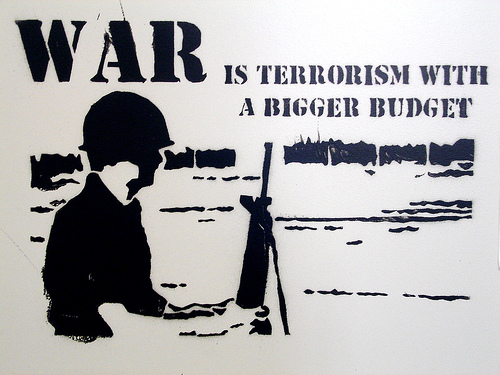
 

Domestic Fear Is the Price of Empire

waristerrorism

By Sheldon Richmond

Source: The Future of Freedom Foundation

If you find no other argument against American intervention abroad persuasive, how about this one? When the U.S. government invades and occupies other countries, or when it underwrites other governments’ invasions or oppression, the people in the victimized societies become angry enough to want and even to exact revenge — against Americans.

Is the American empire worth that price?

We should ask ourselves this question in the wake of the weekend news that al-Shabaab, the militant Islamist organization that rules parts of Somalia ISIS-style, appeared to encourage attacks at American (and Canadian) shopping malls.

Maybe the Shabaab video was just a prank to scare us. Maybe it was an attempt to plant violent thoughts in the minds of Somalis living in the United States. No one believes that the organization itself is capable of attacking Americans where they live, but that doesn’t mean Shabaab-inspired violence is impossible.

At any rate, it’s unsettling to be advised to watch out for terrorism when we shop at the mall.

Here’s the thing: We don’t have to live this way. The empire is just not worth it. We must understand that people in the Middle East, Africa, and Central Asia who subscribe to fringe militant interpretations of Islam would not be wishing us harm except for the violence the U.S. government has inflicted or helped to inflict on Muslim societies for many decades. In fact, those militant interpretations wouldn’t be nearly so attractive without the American empire and its ally Israel.

Why won’t the media describe this context? It’s because their job, despite what they say, is to be the government’s megaphone, not its adversary.

Let’s look at Somalia, where the latest threat originated.

U.S. intervention goes back to 1992, when President George H.W. Bush sent the military into a civil war there. Among the military’s activities was the suppression of the Somalis’ use of the intoxicant khat, which has been part of their culture for millennia.

That’s right. The U.S. government imposed a war on the Somali drug of choice.

President Bill Clinton withdrew the forces after two Blackhawk helicopters were shot down, but that was not the end of U.S. intervention. After the September 11 attacks, Somali warlords seeking American largess played on the George W. Bush administration’s concerns about al-Qaeda. The CIA obliged the warlords with suitcases of cash. As a result, everyday life became intolerably violent. So when the Islamic Courts Union (ICU) — a relatively moderate coalition of Sharia courts in the capital, Mogadishu —drove out the warlords and produced a measure of peace and stability, the Somali people were relieved.

That should have been deemed satisfactory, except that the warlords and their American backers were unhappy with the new situation, as Jeremy Scahill reported in 2011. “Most of the entities that made up the Islamic Courts Union did not have anything resembling a global jihadist agenda,” Scahill wrote. “Nor did they take their orders from Al Qaeda.”

Nevertheless, the U.S. government was determined to oust the ICU. To achieve that goal the Bush administration in 2006 backed a military invasion by Ethiopia, Somalia’s long-time Christian adversary, which overthrew the ICU.

“The Ethiopian invasion was marked by indiscriminate brutality against Somali civilians,” Scahill wrote.

Ethiopian and Somali government soldiers secured Mogadishu’s neighborhoods by force, raiding houses in search of ICU combatants, looting civilian property and beating or shooting anyone suspected of collaboration with antigovernment forces.… If Somalia was already a playground for Islamic militants, the Ethiopian invasion blew open the gates of Mogadishu for Al Qaeda. Within some US counterterrorism circles, the rise of the Shabab in Somalia was predictable and preventable.

To make things worse, the U.S. government has waged a drone war, with civilian casualties, and special operations against the Somalis. According to Scahill, the CIA also operates a secret prison and other facilities there.

So the U.S.-sponsored intervention sowed the ground for the most militant group in Somalia, al-Shabaab. Had the ICU been left to govern, we might never have heard of these young Islamists, whom the Obama administration now uses to scare American shoppers.

We can live without the fear of terrorism — but only if the U.S. government stops antagonizing foreign populations that have never threatened us.

Sheldon Richman is vice president of The Future of Freedom Foundation and editor of FFF’s monthly journal, Future of Freedom. For 15 years he was editor of The Freeman, published by the Foundation for Economic Education in Irvington, New York. He is the author of FFF’s award-winning book Separating School & State: How to Liberate America’s Families; Your Money or Your Life: Why We Must Abolish the Income Tax; and Tethered Citizens: Time to Repeal the Welfare State. Calling for the abolition, not the reform, of public schooling. Separating School & State has become a landmark book in both libertarian and educational circles. In his column in the Financial Times, Michael Prowse wrote: “I recommend a subversive tract, Separating School & State by Sheldon Richman of the Cato Institute, a Washington think tank… . I also think that Mr. Richman is right to fear that state education undermines personal responsibility…” Sheldon’s articles on economic policy, education, civil liberties, American history, foreign policy, and the Middle East have appeared in the Washington Post, Wall Street Journal, American Scholar, Chicago Tribune, USA Today, Washington Times, The American Conservative, Insight, Cato Policy Report, Journal of Economic Development, The Freeman, The World & I, Reason, Washington Report on Middle East Affairs, Middle East Policy, Liberty magazine, and other publications. He is a contributor to the The Concise Encyclopedia of Economics. A former newspaper reporter and senior editor at the Cato Institute and the Institute for Humane Studies, Sheldon is a graduate of Temple University in Philadelphia. He blogs at Free Association. Send him e-mail.

Unanswered Questions About Raids in Libya and Somalia

catch-and-release

Today marks the 12th anniversary of the Invasion of Afghanistan, so perhaps it’s no coincidence that there happens to be many news reports about two raids against alleged terrorists which took place over the weekend. The raid getting more attention took place in Libya and resulted in the capture of Abu Anas al-Liby, who is allegedly linked to the 1998 bombings of American embassies in Kenya and Tanzania. Interestingly, al-Liby was reported captured at least twice in the past, once in the late 90s and a second time in January 2002.

The goal of the raid in Somalia was to capture a man named Ikrimah who, according to anonymous U.S. senior officials, claimed responsibility for the Westgate Mall massacre in Kenya. The force carrying out the mission was SEAL Team Six, the same team that allegedly killed Osama Bin Laden and has had a string of suspiciously bad luck ever since. According to other anonymous officials interviewed by the Washington Post and NYT:

[…]troops retreated after an intense gunfight unfolded, fearing that escalating it could result in civilian casualties.

[…]Witnesses described a firefight lasting over an hour, with helicopters called in for air support.

Read the full article here: http://allafrica.com/stories/201310070803.html

An early leaked report posted at the New York Times website on Saturday stated the SEAL team had succeeded in seizing a “senior leader” of al Shabaab. But 45 minutes later, the Times said officials had “backed off” that report.

According to yet another anonymous senior official quoted in a CNN report with the headline Official: Navy SEAL team pulled out when it couldn’t capture suspect alive :

Their mission was to capture him. Once it became clear we were not going to [be] able to take him, the Navy commander made the decision to withdraw.

[…]Another U.S. official told CNN the Navy SEALs reported seeing children at the compound, part of the reason the mission was stopped during the firefight.

It seems unlikely they withdrew due to safety concerns, but it’s also unusual that they attempted a live capture, given how quick they were to drone bomb alleged terrorist leaders (and innocent civillians including children) in Afghanistan, Pakistan, Yemen, Sudan, Somalia, Libya, etc.

Geopolitical Motives Behind Kenya Mass Shooting

Western corporate news has predictably portrayed the recent massacre in Kenya as a senseless terrorist attack by “Muslim fanatics” of Al Shabaab, a Somalian Al Qaeda franchise. If their motive was solely religious, perpetrating a large-scale slaughter drawing international condemnation would be a self-defeating act. Unfortunately, propaganda and mass social conditioning has led many in the West to accept that Muslim terrorists “hate us for our freedoms” and will do anything to wipe out everyone but themselves. Of course this is a stereotype and is no more true than saying fundamentalist Christian or Jewish terrorists want to kill all Muslims. The reality of terrorism is much more complex and convoluted (and often involves covert intelligence agencies).

Tony Cartalucci of Land Destroyer Report puts the Nairobi mall attack in context, describing how in 2011 the Kenyan military participated in attacks against Somalia with U.S. and French forces. But this wasn’t the first attack against Somalia the U.S. was involved in. According to Cartalucci:

Before using Kenya as a proxy for US aggression in Africa, and amidst two decades of unilateral, covert military operations, the US had backed two Ethiopian invasions into Somalia. The first US-backed invasion, under then US President George Bush, was carried out in 2006. USA Today reported in its 2007 article, “U.S. support key to Ethiopia’s invasion,” that:

The United States has quietly poured weapons and military advisers into Ethiopia, whose recent invasion of Somalia opened a new front in the Bush administration’s war on terrorism.

The second US-backed Ethiopian invasion of Somalia, under US President Barack Obama, was carried out in 2011 – coordinated with Kenya’s 2011 US-French-backed extraterritorial adventure into Somali territory. The UK Independent’s December 2011 article, “UN-backed invasion of Somalia spirals into chaos,” reported that:

Kenya’s invasion of Somalia, hailed by the West and the UN Security Council, was meant to deliver a knockout blow to the militant Islamist group al-Shabaab. Instead it has pulled Somalia’s regional rival Ethiopia back into the country, stirred up the warlords and rekindled popular support for fundamentalists whose willingness to let Somalis starve rather than receive foreign aid had left them widely hated.

It was in fact this US-backed military invasion that served as the alleged motivation of the Al Shabaab terrorists who attacked Kenya’s Westgate Mall this week.

In the same article, Cartalucci describes in detail how and why the same terrorists the U.S. is funding and arming in Syria are behind the massacre in Kenya. He also provides a concise description of what Al Qaeda really is and how they support the objectives of Western superpowers:

Al Qaeda: The Perfect Pretext to Invade, The Perfect Mercenary Army to Covertly Wage War

Al Qaeda, for the West, serves as the ultimate geopolitical tool. It can be used as a pretext to invade, as well as a nearly inexhaustible mercenary army to carry out ruthless terrorist campaigns and even full-scale war as seen in Syria and Libya, to achieve Western objectives. Additionally, the omnipresent, nebulous nature of Al Qaeda serves as justification to strip away the rights and liberties of people at home, across Western civilization – perpetuating a climate of fear within which the seeds of very profitable war can be sown and continuously reaped.

How profitable? A Harvard’s Kennedy School research paper titled, “The Financial Legacy of Iraq and Afghanistan,” places the total expenditures of the Afghanistan and Iraq wars alone somewhere between 4-6 trillion dollars. That isn’t 4-6 trillion dollars that went into a black hole. That is 4-6 trillion dollars that went to the Fortune 500 corporations that engineered and sold these conflicts to the American public in the first place.

Read the full article here: http://landdestroyer.blogspot.com/2013/09/kenyan-bloodbath-reaping-benefits-of-us.html#more