Arab regimes collude with Israel’s genocide and ethnic cleansing of Gaza

By By Jean Shaoul

Source: Defend Democracy Press

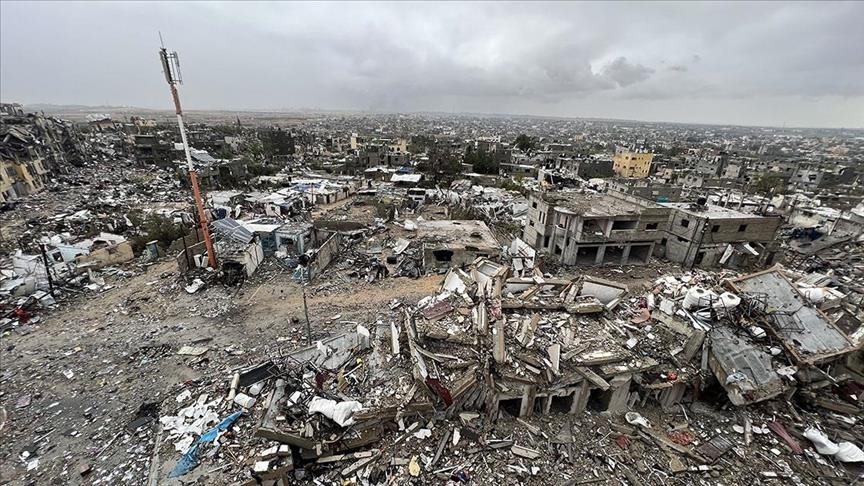
As Israel’s fascist government prepares to launch a massive ground invasion to take over Rafah city, discussions are now under way about setting up 15 campsites—each with around 25,000 tents—across the southwestern part of the Gaza Strip, to house the million-plus Palestinians that have taken refuge in the city.

These tent cities are to be funded by the United States and Arab despots and operated by the butcher of Cairo, Egypt’s Abdel Fattah el-Sisi. Egypt and other Arab regimes are in effect providing Israeli Prime Minister Benjamin Netanyahu with the ability to claim he has assured the “safe passage” he said he would provide so that the planned ground invasion could take place. As Netanyahu again declared as Israel mounted a massive aerial bombardment of the city, his real goal is “total victory”—which means killing as many Palestinians as possible and driving the rest into the desert.

That such proposals could even be discussed with the Arab regimes confirms that their collusion with Israel’s genocidal offensive against Gaza, from day one, has now become direct participation in its ethnic cleansing through a second Nakba.

Israel has already killed at least 29,000 people, mostly women, children and the elderly, buried thousands more under the rubble, and displaced approximately 86 percent of Gaza’s population—1.7 million out of 2.3 million people. The majority are now sheltering in Rafah, close to the border with Egypt where they face famine, lack access to clean water and medical care and the imminent prospect of extermination.

Egypt: Israel’s border guard

Egypt, the most populous Arab state with 104 million people and the key frontline state, has for decades played a criminal role as a direct accomplice in Israel’s suppression of the Palestinians and its de facto border guard.

Since signing a peace treaty with Israel in 1979, Cairo has extended its ties with Tel Aviv, importing natural gas from Israel for refining and re-export, coordinating security over their shared border and the Gaza Strip, maintaining Israel’s blockade on Gaza, and strictly limiting the movement of people and goods across its borders after Hamas took control in 2007. Egypt stood by when Israel launched murderous assaults on the besieged enclave in 2008-9, 2012, 2014, the 2018-29 Great March of Return and 2021.

When the Gaza offensive started in October, Israel’s “wartime proposal” to push Gaza’s 2.3 million Palestinians into Egypt’s Sinai desert was met with a furious response from Cairo. However, this was not out of any concern for the Palestinians but because of what El-Sisi called “Gaza’s existential threat to Egypt’s national security.” If a million Gazans crossed the border, he warned, this would lead to a resurgence of Islamist “militancy” in Sinai.

When El-Sisi refers to a resurgence of Islamist militancy, he means a renewal of the mass popular opposition known as the 25 January Revolution, which in 2011, at the height of the “Arab Spring”, ended Mubarak’s personal rule. On July 3, 2013, the junta was able to resume power in a military coup thanks to the political bankruptcy of the bourgeois liberal opposition and their pseudo-left appendages in the Revolutionary Socialists, who provided leading personnel for the anti-Islamist Tamarod movement through which the military and its billionaire backers prepared the political ground for the coup. El-Sisi has brutally crushed all dissent ever since and the last thing he wants is millions of displaced and angry Palestinians to act as the focus for broader political opposition to his regime, to US imperialism and all its allies in the region.

The army has already fortified the concrete border wall with Gaza, installing barbed wire to prevent the Palestinians from crossing into the Sinai and deploying troops and 40 tanks along the border.

El-Sisi, speaking at a press conference on October 18 with German Chancellor Olaf Scholz in Cairo, argued that Israel could move Gaza’s Palestinians to Israel’s Negev desert instead of Sinai “until Israel is capable of defeating Hamas and Islamic Jihad. Afterwards, Palestinians could return to their homeland.”

Reports are circulating, citing the Sinai Foundation for Human Rights, that Egypt is constructing an eight-square-mile walled enclosure in northern Sinai to host Palestinians forcibly expelled from Gaza, though this is described as a “contingency plan” in the event Palestinians succeed in breaching the reinforced border.

But wherever the de facto concentration camps being discussed are eventually established, Egypt and the other Arab regimes involved are giving a greenlight for mass murder in Rafah. On Sunday, with breathtaking cynicism Egyptian officials, responding to these latest proposals for tent cities, told Israel that they would not object to a military operation in Rafah as long as it is conducted without harming Palestinian civilians. Army Radio also said that Egypt had emphatically denied reports it might pullout of its 1979 Camp David treaty if Israel attacked Rafah.

All the oil-rich despots are working openly with Israel to enable it to pursue its genocidal war, even deepening their ties to ensure Israel can continue the war without hindrance. They cover their treachery with crocodile tears over the plight of the Palestinians in Gaza, support for South Africa’s case against Israel at the International Court of Justice and appeals for an urgent meeting of the toothless UN Security Council that is subject to Washington’s veto “to prevent Israel from causing an imminent humanitarian disaster for which everyone who supports the aggression is responsible.”

Jordan: Repressing Palestinian protests

Jordan has played the most open role in repressing popular opposition to Israel. It shares a long border with Israel and is home to over 2.2 million registered Palestinian refugees driven there by wars between 1947 and 1967, and their descendants. Around half of its 11 million population are of Palestinian descent, of whom around two thirds have been granted citizenship, but they face discrimination while nearly 400,000 still live in 10 refugee camps. Jordan has maintained a “cold peace” with Israel following a US Clinton administration-brokered normalization treaty in 1994.

The Jordanian government has banned protests along its border with the West Bank and clamped down on protests against Israel’s war on Gaza. According to Human Rights Watch (HRW), it has “arrested or harassed” over 1,000 pro-Palestine protesters who have called for the Jordanian government to take action against Israel. Lama Fakih, HRW’s Middle East director, said “Jordanian authorities are trampling the right to free expression and assembly to tamp down Gaza-related activism.”

Last week, the authorities arrested activist, Khaled al-Natour, after he shared posts calling for the lifting of the blockade on Gaza, as part of the government’s heightened crackdown on pro-Palestine activists, under a controversial new cybercrime law. According to Amnesty International, the vaguely worded law, passed in August, gives the government huge latitude to crack down on free speech and has been used to arrest and charge at least six political activists for their “social media posts expressing pro-Palestinian sentiments or criticizing the authorities’ policies towards Israel and advocating for public strikes and protests.”

Arab regimes keeping Israel’s economy running

Jordan, along with several other Arab states, is also playing a central role in keeping Israel’s economy functioning during the war.

According to Israel’s television Channel 13, the United Arab Emirates-based PureTrans FZCO and Israel-based Trucknet, which provides logistics technology for the Arab shipping companies, are transporting vital goods, including food, plastics, chemicals and electronic devices and components, between Dubai’s Jebel Ali Port and Haifa port, via roads passing through Saudi Arabia and Jordan.

The route was established prior to the Gaza offensive. In June, Miri Regev, Israel’s Minister of Transportation and Road Safety, announced plans to develop the route, stating on X/Twitter that “the overland transportation of the goods will shorten the time by 12 days and greatly reduce the existing waiting time due to the wire problem. We will do it and we will succeed.” In September, Trucknet signed a shipping agreement with the UAE and Bahrain.

The plans also include a railway line, yet to be agreed, linking the UAE and Israel with a high-speed train service between Israel’s northern city of Beit She’an and southern port of Eilat on the Red Sea.

The route has assumed greater strategic significance since October and especially because of Houthi attacks on Israeli-linked shipping in the Red Sea, helping Israel circumvent the shipping blockade and cutting the 14-day sea route around the Cape to four days.

Acutely conscious of the mass opposition within its already restive population to Israel’s genocidal war, Jordan denied that goods were being transported to Israel via its territory. But television reports showing trucks from the UAE crossing Jordanian territory to reach Israel exposed this lie, sparking anger and demonstrations against Jordan’s ‘shameful land bridge’ to Israel.

The Dubai-Haifa “land corridor” was in fact first mooted in 2017 by Israel’s transport minister Yisrael Katz and highlighted at the signing in 2020 of the Abraham Accords with the UAE and Bahrain–and later with Sudan and Morrocco–that ended the participants’ long-standing economic boycott of Israel. It made apparent Israel’s economic ties with the Gulf states that had long been kept under wraps.

The Accords not only signified the ditching of their long defunct adherence to securing a “two-state solution,” even as Netanyahu threatened to annex one third of the West Bank, illegally occupied by Israel since the 1967 Arab Israeli war. It crucially paved the way for trade and investment deals with Tel Aviv, particularly in arms, technology and cyberware, and Israel’s broader economic integration into the region begun clandestinely after the 1993 Oslo Accords.

Saudi Arabia and the planned war against Iran

Bahrain could only sign up to the Accords with the tacit consent of its paymaster in Saudi Arabia. Riyadh is now directly involved in the Dubai-Haifa corridor as part of its efforts to extract as many concessions as possible from Washington, including a defence agreement, commitment of “security” support, arms and fighter jets and help with a civilian nuclear program, even as it expanded its economic and political links with China to strengthen its bargaining position.

The land corridor is a key concern for the US and European imperialist powers. It is aimed at positioning the Israeli port of Haifa as a major gateway to Europe, altering the political and economic map of the region by bypassing the Red Sea and furthering Israel’s integration into the Gulf states’ economies.

Haifa would be the linchpin of the India-Middle East Europe Economic Corridor (IMEC), a major transport infrastructure project aimed at integrating India, the Gulf and Europe while avoiding Iran, which would bring India closer to US imperialism and counter China’s Belt and Road Initiative. Oman’s Salalah Port, which has extensive ties with India, could also become part of the new network.

The project, which excludes Turkey, the largest non-oil economy in the Middle East, has aroused Ankara’s wrath, with government officials saying that the most suitable route for east-west trade passes through Turkey not Greece. It also undermines Egypt’s Suez Canal that is already suffering financial losses from the diversion of shipping round the Cape, intensifying its economic and social crisis.

The Arab regimes now account for one quarter of Israel’s $12.5 billion defence exports. Leaders from the UAE have also reiterated their commitment to the Abraham Accords, with UAE presidential foreign affairs adviser Anwar Gargash telling a conference in Dubai last month, “The UAE has taken a strategic decision, and strategic decisions are long-term.”

The bilateral flow of goods has exploded, expanding from $11.2 million in 2019 to $2 billion, excluding software, from January to August 2023, according to Israel’s UAE ambassador. The UAE-Israel partnership deal that came into force last year lowered tariffs with the aim of increasing bilateral trade to $10bn within five years. While far less than Israel’s trade with the European Union and Turkey, this is nevertheless far more than Israel’s trade with Egypt and Jordan.

As Israeli CEOs told the Financial Times, amid the Gaza genocide it has been “business as usual,” with new investment plans going ahead and the UAE’s airline continuing its flights to Tel Aviv even as others cancel theirs.

While Saudi Arabia was never a “frontline state” in the Arab Israeli conflict, in October 1973 it led the Organisation of Petroleum Exporting Countries’ (OPEC) ban on the export of oil to those countries that had supported Israel during the October 1973 Arab Israeli War. The war began after Egypt and Syria launched a surprise attack on Israel in an ultimately unsuccessful attempt to recover the territories lost in the 1967 war. Only Iraq and Libya did not take part in the oil embargo that was lifted in March 1974, by which time the price of oil had risen nearly threefold, massively increasing the oil states’ wealth and reactionary political influence in the region.

50 years later, there has been no mention of a similar embargo in defence of the 2.3 million Palestinians in Gaza, indicating the monarchies’ backing for Israel’s war, paid for and planned by the Biden administration, to assert US hegemony over the resource-rich region and suppress all opposition to Washington and its regional allies and to their own regime.

Israel’s war on Gaza has done nothing to derail Washington’s long-running efforts to broker a normalization deal between Israel and Saudi Arabia. A potential Saudi-Israel deal is a crucial part of its bid to settle the Gaza conflict with Riyadh indicating its willingness to proceed with discussions. For their part, the US and UK have consolidated the reversal of their previous opposition to Riyadh’s war to unseat the Houthis in Yemen, launching hundreds of aerial strikes on the Houthis in response to their attacks on shipping linked to Israel aimed at putting pressure on Israel to end its war and blockade of Gaza.

The Arab regimes, whose populations hold them in contempt, have made a pact with the devil: support for Israel—and by implication US imperialism—in return for Washington’s commitment to back their “security” in the event of a new “Arab Spring” or mass movement to unseat them, and to wage war against Iran, which has backed opposition forces to their rule, as part of its preparations for war on China.
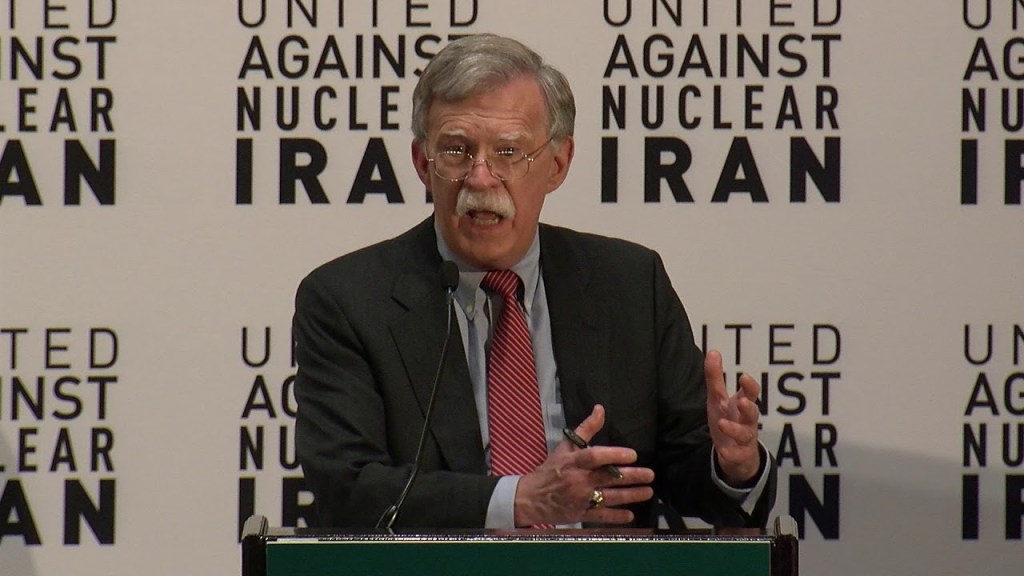
UNITED AGAINST NUCLEAR IRAN: THE SHADOWY, INTELLIGENCE-LINKED GROUP DRIVING THE US TOWARDS WAR WITH IRAN

By Alan MacLeod

Source: Mint Press News

Most of the world has watched the Israeli assault on Gaza in horror. As tens of thousands have been killed and millions displaced, tens of millions of people around the world have poured onto the streets to demand an end to the violence. But a few select others have taken to the pages of our most influential media to demand an escalation of the violence and that the United States help Israel strike not just Palestine, Syria, and Lebanon but Iran as well.

“I might have once favored a cease-fire with Hamas, but not now,” wrote Bush-era diplomat Dennis Ross in The New York Times, explaining that “if Hamas is perceived as winning, it will validate the group’s ideology of rejection, give leverage and momentum to Iran and its collaborators and put [our] own governments on the defensive.”

In the wake of Hamas’ October 7 assault, arch-neoconservative official John Bolton was invited on CNN, where he claimed that what we witnessed was really an “Iranian attack on Israel using Hamas as a surrogate” and that the U.S. must immediately respond. When asked whether he had any evidence, given the implications of what he was saying, he shrugged and replied, “This is not a court of law.”

On December 28, Bolton doubled down on his hawkish stance, writing in the pages of Britain’s Daily Telegraph that “The West may now have no option but to attack Iran” – a position he has held for at least a decade.

Meanwhile, in an interview with Saudi state-funded broadcaster Iran International, senior Bush official Mark Wallace bellowed that, “This is Iran’s work. Iran will suffer at the hands of retribution and will suffer the consequences of supporting this terror group and its horrific attack on Israel.” Wallace continued:

No civilized country wants further conflict. But the Iranians are forcing the civilized world’s hand. And you will see a dramatic response soon as the United States, Israel, and our allies begin to position assets around the world in preparation.”

If there was any doubt as to what sort of “dramatic response” Wallace wanted to see, he added a message to Iran’s Islamic Revolutionary Guard Corps: “I look forward to seeing you hanged from the end of one of your own ropes.”

Iran was recently the victim of a deadly terrorist attack. As mourners commemorated the U.S. assassination of Qassem Soleimani, two bombs exploded, killing 91 and injuring hundreds more. In this context, it was understandable why Iranian officials pointed the finger at the U.S. and Israel.

Warmongers, Inc

What these individuals all have in common is that they are board members of United Against Nuclear Iran (UANI), a shadowy but influential organization dedicated to pushing the West toward a military confrontation with the Islamic Republic.

Founded in 2008, the group is led by neoconservative hawks and has close ties to both U.S. and Israeli intelligence. It does not divulge where it receives its copious funding. However, it is known that right-wing Israeli-American billionaire Sheldon Adelson was a source. There is strong circumstantial evidence that Gulf dictatorships may also be bankrolling the group, although UANI has strongly denied this. In 2019, Iran designated UANI as a terrorist organization.

When asked by MintPress what he made of UANI’s recent statements, Eli Clifton, one of the few investigative journalists to have covered the group, said, “It’s very consistent with the positions and advocacy that the organization has taken since its inception.” Adding,

United Against Nuclear Iran does not miss an opportunity to try to bring the United States closer to a military conflict with Iran. And on the other side of the equation, they also have worked very hard to oppose efforts to de-escalate the U.S.-Iran relationship.”

UANI’s board is a who’s who of high state, military and intelligence officials from around the Western world. Among its more notable members include:

  • CEO Mark Wallace, former U.S. Ambassador to the United Nations and deputy campaign manager for George W. Bush’s 2004 reelection.
  • Chairman Joe Lieberman, former senator and Democratic vice-presidential nominee for the 2000 election.
  • Tamir Pardo, Director of the Mossad, 2011-2016.
  • Dennis Ross, former State Department Director of Policy Planning and former Middle East Envoy under George H. W. Bush and Bill Clinton.
  • Field Marshall Lord Charles Guthrie, ex-Chief of Staff of the U.K. Armed Forces.
  • Jeb Bush, former Governor of Florida.
  • August Hanning, President of the German Federal Intelligence Service (BND), 1998-2005; State Secretary at the Federal Interior Ministry, 2005-2009.
  • Zohar Palti, former head of the Political-Military Bureau, Israeli Ministry of Defense; former Director of Intelligence of the Mossad.
  • Frances Townsend, Homeland Security Advisor to President George W. Bush.
  • John Bolton, former U.S. National Security Advisor and former U.S. Ambassador to the U.N.
  • Roger Noriega, former Assistant Secretary of State for Western Hemisphere Affairs and Ambassador to the Organization of American States.
  • Otto Reich, former Assistant Secretary of State for Western Hemisphere Affairs and architect of the 2002 U.S. coup against Venezuela.
  • Michael Singh, White House Senior Director for Near East and North African Affairs, 2007-2008.
  • Giulio Terzi di Sant-Agata, former Italian Foreign Minister.
  • Robert Hill, former Minister of Defense of Australia.
  • Jack David, Deputy Assistant Secretary of Defense for Combating Weapons of Mass Destruction, 2004-2006.
  • Mark Kirk, U.S. Senator for Illinois, 2010-2017.
  • Lt. Gen. Sir Graeme Lamb, ex-Director of U.K. Special Forces and Commander of the British Field Army.
  • Norman Roule, former CIA Division Chief and National Intelligence Manager for Iran at the Director of National Intelligence.
  • Irwin Cotler, Canadian Minister of Justice and Attorney General, 2003-2006.
  • Baroness Pauline Neville-Jones, U.K. Minister of State for Security and Counter Terrorism, 2010-2011.

In addition, notable former board members include ex-CIA Director R. James Woolsey; head of Mossad between 2002 and 2011, Meir Dagan; and one-time chief of British spy agency MI6, Sir Richard Dearlove.

For 15 years, UANI has organized conferences, published reports, and lobbied politicians and governments, all with one goal: pushing a neoconservative line on Iran. “UANI are a force multiplier. They provide at least the veneer of an intellectual infrastructure for the Iran hawk movement. They did not invent being hawkish on Iran, but they sure made it a heck of a lot easier,” Ben Freeman, Director of the Democratizing Foreign Policy Program at the Quincy Institute, told MintPress.

Conflicts and Conflicts of Interest

For such a large, well-financed, and influential organization filled with senior officials, United Against Nuclear Iran keeps its funding sources very quiet. However, in 2015, Clifton was able to obtain a UANI donor list for the 2013 financial year. By far and away, the largest funders were billionaire New York-based investor Thomas Kaplan and multibillionaire Israeli-American casino mogul Sheldon Adelson.

Kaplan, whose $843,000 donation supplied around half the group’s 2013 funding, is a venture capitalist investor concentrating on metals, particularly gold. He is the chairman of Tigris Financial and the Electrum Group LLC. Both of Kaplan’s firms employ UANI CEO Mark Wallace as CEO and COO, respectively.

A 2010 Wall Street Journal article titled “Tigris Financial Goes All-in on Gold” noted that the company had bet billions of dollars on the price of gold rising, more than the reserves of the Brazilian central bank. As Clifton has noted, both Kaplan and Wallace have marketed gold to clients as the perfect commodity to hold if there is increased instability in the Middle East. Therefore, both Kaplan and Wallace stand to make massive sums if the U.S. or Israel were to attack Iran, making their UANI warmongering a gigantic and potentially profitable conflict of interest.

Adelson provided the majority of the rest of UANI’s funding. The world’s 18th-richest individual at the time of his 2021 death, the tycoon turned his economic empire into a political one, supporting ultraconservative causes in both the United States and Israel. Between 2010 and 2020, he and his wife donated more than $500 million to the Republican Party, becoming GOP kingmakers in the process. He would often vet Republican presidential candidates at his casino in Las Vegas, and it was often said that this “Adelson Primary” was almost as important as the public one.

An ardent Zionist, Adelson bankrolled numerous pro-Israel lobby projects, such as AIPAC, One Jerusalem and Taglit Birthright. He also owned Israel Hayom, the country’s most-read newspaper, with 31% of the national share. Relentlessly pro-Netanyahu, it was said that the Israeli prime minister asked his friend Adelson to set up a newspaper to help his political career.

Adelson and his influence have been one of the driving forces of American hostility towards Iran. In 2013, during a conversation with Rabbi Shmuley Boteach, he called for the United States to stop negotiating and drop a nuclear bomb on Iran to show that “we mean business.”

A potential third, even more controversial, source of funding is the Gulf monarchies of Saudi Arabia and the UAE. Leaked emails show UANI officials soliciting support from the Emirati royal family. Both Mark Wallace and Frances Townsend, for example, emailed the Emirati Ambassador to the U.S. detailing cost estimates for upcoming events and inquiring about support from the UAE.

Thomas Kaplan himself is extraordinarily close to the nation. “The country and the leadership of the UAE, I would say, are my closest partners in more facets of my life than anyone else other than my wife,” he told the Emirati outlet, The National News, which also detailed his friendship with Crown Prince of Abu Dhabi, Sheikh Mohamed bin Zayed.

Putting Iran in the Crosshairs

One of United Against Nuclear Iran’s primary activities, Iranian political commenter Ali Alizadeh told MintPress, is to create a worldwide “culture of fear and anxiety for investing in Iran.” The group attempts to persuade businesses to divest from the Islamic Republic and sign their certification pledge, which reads as follows:

The undersigned [Name], the [Title] of [Company] (the “Company”), does hereby certify on behalf of the Company that until the Iranian regime verifiably abandons its drive for nuclear weapons, support for terrorism, routine human rights violations, hostage-taking, and rampant anti-Americanism as state policy, that neither the Company nor any subsidiary or affiliate of the Company, directly or through an agent, representative or intermediary.”

One corporation that UANI targeted was the industrial machinery firm Caterpillar. UANI hectored the firm, even erecting a roadside billboard outside its headquarters in Peoria, IL, insinuating that they were aiding Iran in constructing a nuclear weapon. Caterpillar quickly ordered its Iran projects terminated. Wallace took heart from his group’s victory and warned that other businesses would be targeted.

These have included French companies such as Airbus and ​​Peugeot-Citroen, who were threatened with legal action. In 2019, UANI earned an official rebuke from the Russian Foreign Ministry for attempting to intimidate Russian corporations trading with Tehran. “We think such actions are unacceptable and deeply concerning,” said Foreign Ministry spokesperson Maria Zakharova. “Attempts to pressure and threaten Russian business … are a follow-up on the dishonorable anti-Iranian cause by the U.S. administration,” she added, hinting at collusion between the government and the supposedly non-governmental organization.

Some of UANI’s campaigns have been markedly petty, including pressuring New York City hotels to cancel bookings with Iranian officials (including then-President Mahmoud Ahmadinejad) visiting the city on United Nations business. Others, however, have been devastating to the Iranian economy, such as the SWIFT international money transfer terminating its relationship with Tehran, cutting the country off from the global banking system.

On UANI’s actions against businesses, Freeman said: “It’s effective, and (in some cases, at least) it’s to the detriment of the people of Iran; it’s to the detriment of these companies; and it’s to the detriment of peace in the region.”

While the group presents itself as against a nuclear Iran, UANI was strangely opposed to the Joint Comprehensive Plan of Action (JCPOA) – the deal between Iran and the West that limited the former’s nuclear technology research in exchange for sanctions relief from the latter. As MintPress reported at the time, UANI spent millions on T.V. advertisements trashing the agreement. As Wallace noted, “We have a multi-million-dollar budget, and we are in it for the long haul. Money continues to pour in.”

After the JCPOA was signed, UANI hosted a summit attended by senior Israeli, Emirati, and Bahraini officials, touting its failures. Once UANI’s John Bolton was named Donald Trump’s National Security Advisor, he persuaded the president to withdraw entirely from the deal. Bolton has deep connections to the Mojahedin-e-Khalq (MEK), an exiled Iranian political group widely identified as a terrorist organization. He has, for some time, considered them a government in waiting after the U.S. overthrows the current administration. “Before 2019, we will celebrate in Tehran,” he told the group in 2018, predicting that, with him at the helm, the Trump administration would soon cause the downfall of the Iranian government.

Bolton has long been a hardliner on regime change. “To stop Iran’s bomb, bomb Iran,” read the title of his 2015 New York Times op-ed. Yet this appears to be the dominant position at UANI. In March, Ross published an article in The Atlantic headlined “Iran needs to believe America’s threat,” which demanded that the U.S. “take forceful action to check Tehran’s progress toward a nuclear bomb.” Failure to do so, Ross claimed, would provoke Israel to do so itself – a “much more dangerous scenario,” according to him. Yet only two years previously, Ross called on the U.S. to “give Israel a big bomb” to “deter Iran,” noting that the “best way” to stop the Iranian nuclear program was to supply Israel with its own nukes, thereby taken as a given that Iran was indeed pursuing nuclear weapons itself (a highly questionable claim at the time) and ignoring Israel’s already existing 200+ stockpile of nuclear missiles.

“It doesn’t seem like UANI ever really took seriously the possibility of a diplomatic means to constrain Iran from continuing to increase its enrichment levels and moving towards a nuclear weapon,” Clifton told MintPress. “As a matter of fact, they generally fought tooth and nail against the JCPOA. They are eager to push the United States toward confrontation with Iran using the possibility of Iranian nuclear weapons as a reason,” he added.

Intelligence Connections

That UANI is headed by so many state, military and intelligence leaders begs the question: to what extent is this really a non-governmental organization? “That is one of the dirty secrets of think tanks: they are very often holding tanks for government officials,” Freeman said, adding:

The Trump folks all had to leave office when Biden won, so a lot of them ended up in think tanks for a while, four years, let’s say. And if Trump wins again, they will bounce back into government. And the same is true of Democratic administrations, too.”

The U.S. government also clearly has a longstanding policy of outsourcing much of its work to “private” groups in order to avoid further scrutiny. Many of the CIA’s most controversial activities, for example, have been farmed out to the National Endowment for Democracy (NED), a technically non-governmental organization funded entirely by Washington and staffed with ex-state officials. In recent years, the NED has funneled millions of dollars to protest leaders in Hong Kong, organized an attempted color revolution in Cuba, organized anti-government rock concerts in Venezuela, and propped up dozens of media organizations in Ukraine.

These sorts of institutions blur the line between public and private sectors. But a 2014 legal case raises even more questions about UANI’s connections to the U.S. government. After UANI accused Greek shipping magnate Victor Restis of working with the Iranian government, he sued them for libel. In an unprecedented move for what was a private, commercial lawsuit, Attorney General Eric Holder intervened in the lawsuit, ordering the judge to shut the case down on the grounds that, if it continued, it would expose key U.S. national security secrets. The case was immediately dropped without explanation.

In the past, when the Justice Department has invoked state secrets, a high-ranking state official has offered a public statement as to why. Yet, this time, nothing was offered. Reporters at the time speculated that much of the material Restis wanted to make public was possibly given to UANI by either the CIA or Mossad, which would have revealed a network of collusion between state intelligence agencies and a supposedly independent, private non-profit. Given the glut of ex-Mossad and CIA chiefs at UANI, this speculation is perhaps not as wild as it might seem.

UANI’s funders certainly also have extensive connections to Israel. Kaplan is the son-in-law of Israeli billionaire Leon Recanati and is said to be close with Prime Ministers Naftali Bennet and Yair Lapid. He has also employed a number of Israeli officials at his businesses. An example of this is Olivia Blechner, who, in 2007, left her role as the Director of Academic Affairs at the Israeli Consulate General in New York to become Executive Vice-President of Investor Relations and Research at Kaplan’s Electrum Group – a rather perplexing career move.

Adelson, meanwhile, was given what amounted to an official state funeral in Israel, one that even Prime Minister Netanyahu attended. He was buried on the Mount of Olives in Jerusalem – one of the holiest sites in Judaism and an honor that very few figures receive.

A Network of Regime Change Groups

While United Against Nuclear Iran is already a notable enough organization, it is actually merely part of a large group of shadowy non-governmental groups working to cause unrest and, ultimately, regime change in Iran. These groups all share overlapping goals, funders and key individuals.

One example of this is the Counter Extremism Project (CEP), a non-profit that purports to exist to “combat the growing threat posed by extremist ideologies.” Yet the group focuses largely on Islamist extremism – and only those groups that are enemies of the U.S., Israel and the Gulf Monarchies (about whose extremism and violence the CEP has nothing to say). Ten members of the CEP’s leadership council are also on UANI’s board, including Wallace, who is CEO of both organizations.

Another group headed by Wallace is the Jewish Committee to Support Women Life Freedom in Iran. This organization claims to be focused on improving women’s rights in Iran. It very quickly, however, divulges that this is a vehicle for regime change. On its homepage, for example, it writes:

These freedom fighters continue with no sign of relenting on their calls for regime change. Calls for “Woman Life Freedom” and the removal of Supreme Leader Ayatollah Ali Khamenei echo from rooftops, down street corridors, across campus hallways, and on government billboards. These brave Iranians have expressed their hatred for the ruling clerics not only in their words, but in their actions.”

Seven members of the Jewish Committee to Support Women Life Freedom in Iran’s steering group – including Wallace and Kaplan – also lead UANI.

Mike Wallace, second from right, poses with prominent anti-Iran figures at a lobbying event in Italy, February 2023. Photo | Twitter

Kaplan is well-known as a conservationist. However, his group, Panthera, which works to preserve the world’s 40 known species of big cats, has also been accused of being a secret regime change operation. Panthera has a number of UANI officials on its board or conservation council, including Wallace and Lamb (the ex-director of U.K. Special Forces and Commander of the British Army). Also on the council are Itzhak Dar, former Director of the Israeli Secret Service, Shin Bet, and General David Petraeus, former CIA Director and Commander of the U.S. invasion of Afghanistan.

In 2018, Iranian authorities arrested eight individuals working with Panthera inside the country. All eight were convicted of spying on behalf of the U.S. and Israel. While many in the West decried the trials as politically motivated, any organization led by these figures is bound to cause suspicions.

This is especially the case as Wallace is also a founder of PaykanArtCar, an organization that attempts to use art to, in its words, “advocate for the restoration of human rights and dignity for all in Iran.” All three team members of PaykanArtCar also work at UANI.

The final group in this Iran regime change network is the International Convention for the Future of Iran. Set up by Wallace himself, the organization’s website explains that it exists to “end the repression of the regime and bring true change to Iran.” Further purposes are to “connect the Iranian opposition in exile [i.e., the MEK] with policymakers in the United States and internationally” and to “offer program grants and technical support” to groups working to overthrow the government. However, judging by the lack of updates and the group’s Twitter profile having only 31 followers, it appears that it has not had much success achieving its goals.

In short, then, there exists a network of American NGOs with the mission statements of helping Iran, opposing Iran, preserving Iran, and bombing Iran, all staffed by largely the same ex-U.S. government officials.

Iran, however, is not the only target in Wallace’s sights. It appears that he is also trying to give Turkey similar treatment. Wallace is the CEO of the Turkish Democracy Project, a non-profit established to oppose the rule of President Recep Tayyip Erdoğan, who, it says, has “dramatically altered Turkey’s position in the international community and its status as a free and liberal democracy.” The Turkish Democracy Project denounces what it calls Erdoğan’s “destabilizing actions in and beyond the region, his systemic corruption, support for extremism, and disregard for democracy and human rights.” There are no Turkish people among the Turkish Democracy Project’s leadership. But there are seven UANI board members at the top, calling the shots.

A Lesson From History

The history of Iran has been intimately intertwined with the United States since at least 1953 when Washington orchestrated a successful coup against Prime Minister Mohammad Mosaddegh. Mosaddegh had refused U.S. demands to stamp out Communist influences in his country and had nationalized the nation’s oil. The U.S. installed Shah Mohammad Reza Pahlavi as a puppet ruler. An unpopular and authoritarian ruler, the Shah was overthrown in the Revolution of 1979. Since then, it has become a target for regime change, and its nuclear program is something of an obsession in the West.

Often orchestrated by UANI officials while they were in government, the U.S. has carried out a sustained economic war against Tehran, attempting to collapse its economy. American sanctions have severely hurt Iran’s ability to both buy and sell goods on the open market and have harmed the value of the Iranian rial. As prices and inflation rose rapidly, ordinary people lost their savings.

During the COVID-19 pandemic, the U.S. turned the screw once again, intimidating both businesses and nations into refusing to sell Tehran vital medical supplies. Eventually, the World Health Organization stepped in and directly supplied it with provisions – a factor in the Trump administration’s decision to pull out of the agency.

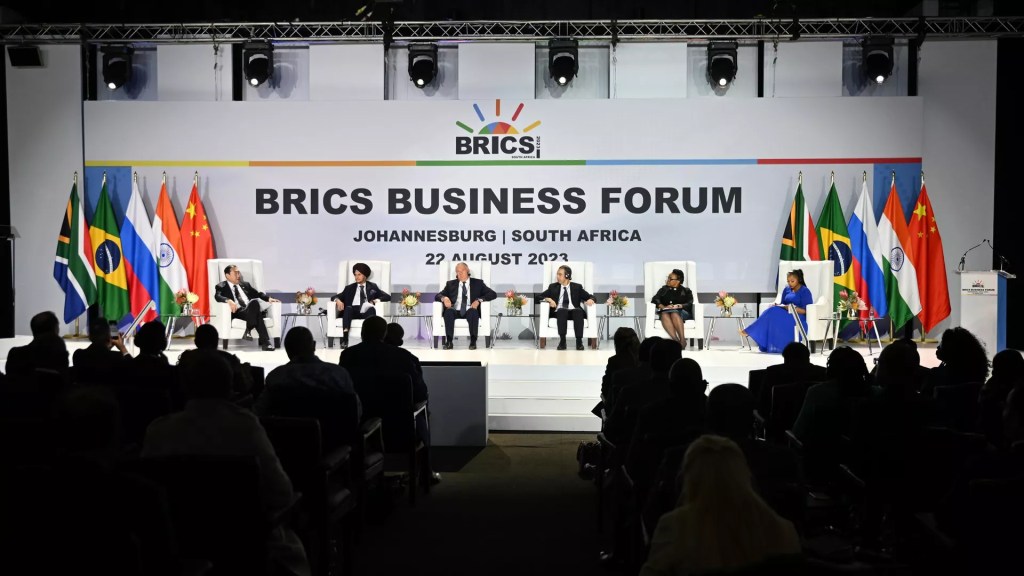
While U.S. actions have severely harmed the Iranian economy, a future bright spot may come in the form of BRICS, the economic bloc that Iran – along with Egypt, Ethiopia, Saudi Arabia, and the UAE – joined on January 1. American economic power on the global stage appears to be waning. However, This new reality might spur Washington policymakers to reconsider a military option, as UANI desperately wants them to.

It is perfectly reasonable to be worried about Iran – or any country, for that matter – developing atomic bombs. Nuclear weapons pose an existential threat to human civilization, and more actors with access to them increase the likelihood of a devastating confrontation. Already in the region, India, Pakistan, Israel and Russia possess them. But it is only the United States that has ever used them in anger, dropping two on Japan and coming close to doing so in China, Korea and Vietnam. And given the U.S.’ recent track record of attacking countries that do not possess weapons of mass destruction (e.g., Iraq, Libya, Afghanistan) and not touching those who do (such as North Korea), it is entirely understandable why Iran might want one. As Freeman said:

I certainly do not want Iran to get a nuclear weapon. But at the same time, you can also believe that it would be catastrophic if the U.S. were to engage in a war with Iran…And the concern with groups like UANI is that they are taking that [the worry of Iran getting a nuclear weapon] and pushing that argument to a point where it might lead to an active conflict.”

The slaughter in Gaza has been horrifying enough. More than 22,000 people have been killed in the Israeli invasion, and a further 1.9 million displaced. Israel is also simultaneously bombing the West Bank, Syria and Lebanon. The U.S. is facilitating this, sending billions of dollars in weaponry, pledging iron-clad political support to Israel, silencing critics of its actions, and vetoing United Nations resolutions.

But United Against Nuclear Iran is eager to escalate the situation to a vastly greater level, urging Washington to attack a well-armed country of nearly 90 million people, erroneously claiming that Iran is behind every Hamas or Hezbollah action. “This is not a nuclear non-proliferation organization” Clifton said, noting that there are plenty of genuine already existing peace and environmental groups worried about nuclear weapons that either supported the JCPOA or said it did not go far enough. “Their focus is more on working towards regime change in Iran rather than actually supporting efforts that might prevent Iranian nuclear weapons,” he added.

IF UANI gets its way, a conflict with Iran might spark a Third World War. And yet they are receiving virtually no pushback to their ultra-hawkish pronouncements, largely because they operate in the shadows and receive virtually no public scrutiny. It is, therefore, imperative for all those who value peace to quickly change that and expose the organization for what it is.

US-British Attacks on Yemen a Portent for Wider War

By Brian Berletic

Source: New Eastern Outlook

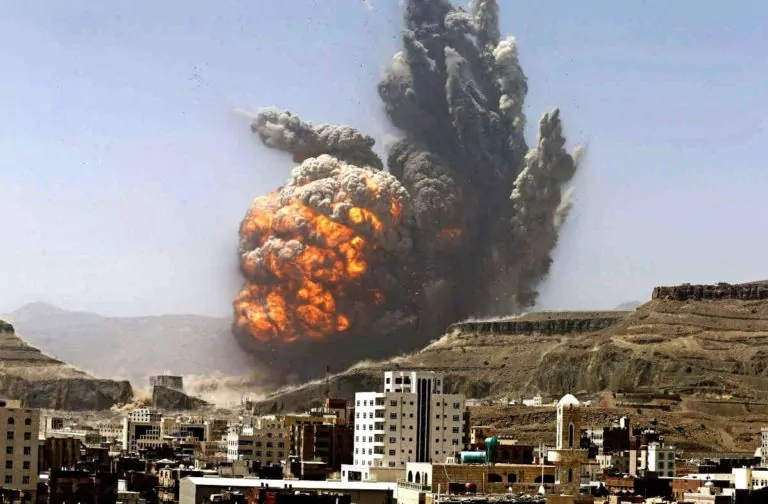
In the opening weeks of 2024, the US and British unilaterally launched several large-scale missile and air strikes on targets in territory held by Ansar Allah (referred to as the “Houthis” across the Western media) in Yemen.

The strikes follow a campaign of missile strikes and boardings conducted by Ansar Allah against commercial shipping destined to and from Israel in response to Israel’s ongoing punitive operations in Gaza.

While the stated purpose of the US-British strikes are to protect commercial shipping, hostility of any kind in the Red Sea is likely to prompt international shipping companies to continue seeking out and using alternative routes until fighting of any kind subsides.

Indeed, according to Euronews Business, despite the US-British strikes on Ansar Allah, the CEO of Maersk, responsible for one-fifth of global maritime shipping, believes safely transiting the Red Sea is still months away.

Despite the political posturing that accompanied these attacks, strategically, they will do little to impact Ansar Allah’s fighting capacity. The political movement possesses a formidable military organization that has weathered years of full-scale war waged against it by a Saudi-led Arab coalition, backed by both the US and UK.

Not only did the US and UK encourage Saudi Arabia to sustain an air and ground war against Yemen, both Western nations contributed directly to Saudi Arabia’s war efforts.

The New York Times in a 2018 article titled, “Army Special Forces Secretly Help Saudis Combat Threat From Yemen Rebels” admitted that US special forces were operating, at a minimum, along the Saudi-Yemeni border, assisting Saudi Arabia’s armed forces in choosing targets.

The same article admits that the US was also lending assistance related to “aircraft refueling, logistics and general intelligence sharing.”

The Guardian in a 2019 article titled, “‘The Saudis couldn’t do it without us’: the UK’s true role in Yemen’s deadly war,” admitted to the scope of support provided by the UK to Saudi Arabia in its war on Yemen. It included supplying weapons and munitions, thousands of maintenance contractors, pilot training, and even sending British troops to fight alongside Saudi soldiers in Yemen itself.

The scale of both Saudi Arabia’s own war on Yemen and the scale of US and British assistance to Saudi Arabia, including through the use of thousands of contractors and hundreds of soldiers on the ground, dwarfs the current missile and air strikes conducted by the US and British from the Red Sea. Even if the US and British significantly expanded their current missile and air strike campaign, it would still pale in comparison to the war that has been waged against Yemen in recent years.

Clearly then, the current US-British strikes on Yemen hold little prospect of deterring Ansar Allah, so why is the US and British carrying out these strikes anyway?

Washington’s True Motives for Striking Yemen 

CNN in an article titled, “US and UK carry out strikes against Iran-backed Houthis in Yemen,” would claim:

For weeks, the US had sought to avoid direct strikes on Yemen because of the risk of escalation in a region already simmering with tension as the Israel-Hamas war continues, but the ongoing Houthi attacks on international shipping compelled the coalition to act.

Yet, because the strikes only ensure shipping in the Red Sea remains obstructed and because the strikes themselves have little hope of impacting Ansar Allah strategically, the only other explanation as to why the US launched them was to specifically raise “the risk of escalation in the region.”

Ansar Allah’s ally, Iran, has been the target of US-sponsored regime change operations for decades. Entire policy papers have been written by US government and corporate-funded think tanks, including the Brookings Institution and its 2009 paper, “Which Path to Persia?,” detailing options to achieve regime change including through deliberate attempts to draw Iran into a war by both covert action within Iran, and through attacks on Iran’s network of regional allies.

The Brookings paper admits:

“…it would be far more preferable if the United States could cite an Iranian provocation as justification for the airstrikes before launching them. Clearly, the more outrageous, the more deadly, and the more unprovoked the Iranian action, the better off the United States would be. Of course, it would be very difficult for the United States to goad Iran into such a provocation without the rest of the world recognizing this game, which would then undermine it. (One method that would have some possibility of success would be to ratchet up covert regime change efforts in the hope that Tehran would retaliate overtly, or even semi-overtly, which could then be portrayed as an unprovoked act of Iranian aggression.)”

Preceding the US-British missile and air strikes on Yemen, the US has carried out strikes on Iranian allies across the region, including in Syria and Iraq. Israel, with US-backing, has also carried out attacks across the region on Iranian allies, specifically on Hezbollah in southern Lebanon.

There was also recently a terrorist bombing inside of Iran, likely carried out by one of several terrorist organizations sponsored by the US to carry out just such attacks, as per the Brookings paper’s own suggestion regarding “ratcheting up cover regime change efforts inside Iran.” It should be noted that elsewhere in the Brookings paper the option of using known terrorist groups to carry out US-backed “insurgency” is afforded an entire chapter (Chapter 7, Inspiring an Insurgency – Supporting Iranian Minority and Opposition Groups). 

Together, this constitutes a strategy of attempting to degrade Iranian allies in the region ahead of a wider conflict, and as a means of provoking and thus drawing Iran itself into that wider conflict.

So far, Iran has exhibited tremendous patience. Iran, as both Russia and China who face similar US policies of encirclement and containment, knows time works in its favor. Iranian patience has already served Tehran well. It has afforded it the ability to diplomatically resolve tensions between itself and Saudi Arabia through Chinese mediation. It has also allowed Iran to continue building up not only its own military capabilities, but those across its network of allies in the region, leading to a gradual shift in the balance of power in Tehran’s favor.

Washington realizes this. This time next year, if events continue to unfold as they have in recent years, Iran will only be stronger and the US more isolated in the region. The US faced a similar problem of waning primacy in Europe, using its proxy war in Ukraine against Russia as a means of reasserting itself over Europe. Washington likely imagines it can use a similar strategy to reassert itself over the Middle East while using a regional conflict to collectively weaken and thus subordinate the nations therein.

Only time will tell if the US is as “successful” in the Middle East as it was in Europe. Already many factors are working against the US, but from Washington’s perspective, it isn’t paying the price for any of these conflicts – the regions these conflicts are fought in are paying that price. As long as Washington is absolved from any direct cost in such a foreign policy, it will continue pursuing it until it is finally and fully denied the means to continue doing so.

Ukraine and Palestine: A double threat to US hegemony

The outcome of US-led conflicts in Ukraine and West Asia will have a profound impact on the developing world order. Washington has already lost the former, and its major adversaries are vested in making sure it loses the latter too.

By MK Bhadrakumar

Source: The Cradle

Geopolitical analysts broadly agree that the war in Ukraine and the West Asian crisis will dictate the trajectory of world politics in 2024. But a reductionist thesis appears alongside that views the Israel-Palestine conflict narrowly in terms of what it entails for the resilience of the US proxy war in Ukraine – the assumption being that the locus of world politics lies in Eurasia.

The reality is more complex. Each of these two conflicts has a raison d’être and dynamics of its own, while at the same time also being intertwined.

Washington’s neck-deep involvement in the current phase of the West Asian crisis can turn into a quagmire, since it is also tangled up with domestic politics in a way that the Ukraine war never has been. But then, the outcome of the Ukraine war is already a foregone conclusion, and the US and its allies have realized that Russia cannot be defeated militarily; the endgame narrows down to an agreement to end the conflict on Russia’s terms.

To be sure, the outcome of the Ukraine war and the denouement of the Israel-Palestine conflict, which is at the root of the West Asian crisis, will have a profound impact on the new world order, and the two processes reinforce each other. 

Russia realizes this fully. President Vladimir Putin’s stunning ‘year-enders’ in the run-up to the New Year speak for themselves: daylong visits to Abu Dhabi and Riyadh (watched by a shell-shocked US President Joe Biden), followed by talks with Iran’s president and rounded off with a telephone conversation with the Egyptian president. 

In the space of 48 hours or so, Putin touched base with his Emirati, Saudi, Iranian, and Egyptian colleagues who officially entered the portals of the BRICS on 1 January.

The evolving US intervention in the West Asian crisis can be understood from a geopolitical perspective only by factoring in Biden’s visceral hostility toward Russia. BRICS is in Washington’s crosshairs. The US understands perfectly well that the extra large presence of West Asian and Arab nations in BRICS — four out of ten member states — is central to Putin’s grand project to re-structure the world order and bury US exceptionalism and hegemony.

Saudi Arabia, the UAE, and Iran are major oil producing countries. Russia has been rather explicit that during its 2024 chairmanship of BRICS, it will push for the creation of a currency to challenge the petrodollar. Without doubt, the BRICS currency will be at the center stage of the grouping’s summit due to be hosted by Putin in Kazan, Russia in October.

In a special address on 1 January, marking the start of Russia’s BRICS Chairmanship, Putin stated his commitment to “enhancing the role of BRICS in the international monetary system, expanding both interbank cooperation and the use of national currencies in mutual trade.”

If a BRICS currency is used instead of the dollar, there could be significant impact on several financial sectors of the US economy, such as energy and commodity markets, international trade and investment, capital markets, technology and fintech, consumer goods and retail, travel and tourism, and so on. 

The banking sector could take the first hit that might eventually spill over to the markets. And if Washington fails to fund its mammoth deficit, prices of all commodities could skyrocket or even reach hyperinflation triggering a crash of the US economy.

Meanwhile, the eruption of the Israel-Palestine conflict has given the US an alibi — ‘Israel’s self-defense’ — to claw its way back on the greasy pole of West Asian politics. Washington has multiple concerns, but at its core are the twin objectives of resuscitating the Abraham Accords (anchored on Saudi-Israeli proximity) and the concurrent sabotage of the Beijing-mediated Saudi-Iranian rapprochement.

The Biden administration was counting on the fact that an Israeli-Saudi deal would provide legitimacy to Tel Aviv and proclaim to the Islamic world that there was no religious justification for hostility towards Israel. But Washington senses that post-7 October it would not be able to secure a Saudi-Israel deal during this Biden term, and all that could be coaxed out of Riyadh is a door left ajar for future discussion on the topic. No doubt, it is a major blow to the US strategy to liquidate the Palestinian question.

In a medium term perspective, if the Russian-Saudi mechanism known as OPEC+ liberates the world oil market from US control, BRICS drives a dagger into the heart of US hegemony which is anchored on the dollar being the ‘world currency.’ 

Saudi Arabia recently signed a currency swap deal worth $7 billion with China in an attempt to shift more of their trade away from the dollar. The People’s Bank of China said in a statement that the swap arrangement will “help strengthen financial cooperation” and “facilitate more convenient trade and investment” between the countries.

Going forward, sensitive Saudi-Chinese transactions in strategic areas such as defense, nuclear technology, among others, will henceforth take place below the US radar. From a Chinese perspective, if its strategic trade is sufficiently insulated from any US-led program of anti-China sanctions, Beijing can position itself confidently to confront US power in the Indo-Pacific. This is a telling example of how the US strategy for the Indo-Pacific will lose traction as a result of its waning influence in West Asia.

The conventional wisdom is that preoccupation in volatile West Asia distracts Washington from paying attention to the Indo-Pacific and China. In reality, though, the waning influence in West Asia is complicating the capacity of the US to counter China both in the region as well as in the Indo-Pacific. The developments are moving in a direction where the credentials of the US as a great power are at an inflection point in West Asia – and that realization has leaked into other geographic regions around the world.

Way back in 2007, the distinguished political scientists John Mearsheimer of the University of Chicago and Stephen Walt of the John F. Kennedy School of Government at Harvard, wrote with great prescience in their famous 34,000-word essay entitled The Israel Lobby and US Foreign Policy that Israel has become a ‘strategic liability’ for the United States, but retains its strong support because of a wealthy, well-organized, and bewitching lobby that has a ‘stranglehold’ on Congress and US elites.

The authors warned that Israel and its lobby bear outsized their responsibility for persuading the Bush Administration to invade Iraq and, perhaps one day soon, to attack the nuclear facilities of Iran. 

Interestingly, on New Year’s Eve, in a special report based on extensive briefing by top US officials, the New York Times highlighted that “No other episode [as the war in Gaza] in the past half-century has tested the ties between the United States and Israel in such an intense and consequential way.”

Clearly, even as Israel’s barbaric actions in Gaza and its colonial project in the occupied West Bank are exposed and laid bare, and the Israeli state’s campaign to force Palestinian population migration are in full view, two of the US strategic objectives in the region are unravelling: first, the restoration of Israel’s military superiority in the balance of forces regionally and vis-a-vis the Axis of Resistance, in particular; and second, the resuscitation of the Abraham Accords where the crown jewels would have been a Saudi-Israeli treaty.

Viewed from another angle, the directions in which West Asia’s crisis unfolds are being keenly watched by the world community, especially those in the Asia-Pacific region. Most notable here is that Russia and China have given the US a free hand to navigate its military moves – unchallenged, so far, in the Red Sea. This means that any conflagration in the region will be synonymous with a catastrophic breakdown of US strategy.

Soon after the US defeat in Afghanistan in Central Asia, and coinciding with an ignominious ending of the US-led proxy war by NATO against Russia in Eurasia, a violent, grotesque setback in West Asia will send a resounding message across all of Asia that the US-led bandwagon has run out of steam. Among the end users of this startling message, the countries of ASEAN stand at the forefront. The bottom line is that the overlapping tumultuous events in Eurasia and West Asia are poised to coalesce into a climactic moment for world politics.

Humanity Under Assault by the Elites – When Will We Have Had Enough?

By Phil Butler

Source: New Eastern Outlook

“I speak of peace, therefore, as the necessary rational end of rational men. I realize that the pursuit of peace is not as dramatic as the pursuit of war–and frequently the words of the pursuer fall on deaf ears. But we have no more urgent task.” – John F. Kennedy

For most people, it’s difficult to imagine much of what’s happening today. And this is why so many seem in the dark about what we should do to alleviate our problems. Looking at the situation in which a proxy is being waged on Russia from Ukraine, nothing seems to add up. The same is true for the genocide now going on in Gaza. And when we superimpose problems like curing cancer and other diseases, environmental problems, and failing economies, the only thing we can see is that our leaders have failed miserably at prioritising. It’s also obvious that we, the people, are the farthest thing from their minds.

Regarding visualisation, there’s no bigger confusion than grasping just how much money the Western powers are shovelling into the war against Russia. So far, something like $233 billion has been donated to Ukraine. The top donors are the EU($90B) and the United States ($73B). Interestingly, most of the EU funding has been aimed at financial aid, while the US donates are mostly military aid. Neither the EU nor the US spent much on humanitarian aid, at least not by comparison. But then, humanitarian money does not go into the pockets of the elites, now does it? The arms companies and financial institutions seem to be leveraging this Ukraine mess for a return on assets. But that’s another story. Now, I’d like to compare spending on Ukrainian and Israeli wars against efforts that do help human beings.

Let’s look at one of humanity’s most dreaded killers: cancer. In total, global oncology spending in 2022 was $193 billion. The numbers are far more telling in key research, where funding often comes from philanthropy. The Lancet reported recently that some 66,388 awards with a total investment of about $24.5 funded research for 2016–20. And now these figures have nosedived. In 2020, there were 19.3 million cases and 10 million deaths from the dreaded disease.

If we look at how many people are starving on our planet, it’s appalling to think of billions thrown away on unwinnable wars for the sake of selling weapons. In 2021, U.N. World Food Programme Executive Director David Beasley said it would take an estimated $40 billion annually to end world hunger by 2030. Let’s think about that for a moment. Each day, 25,000 people, including more than 10,000 children, die from hunger and related causes. Envision the lost potential of all those children perishing, if you can. Beasley went on to etch the situation in stone with this statement:

“There is 400 trillion dollars’ worth of wealth on the earth today, and the fact that 9 million people die from hunger every year… Shame on us. In the height of COVID, billionaires’ net worth increase was $5.2 billion per day. At the same time, 24,000 people die per day from hunger. Shame on us. Every hour, the net worth of billionaires during the height of COVID was a substantial $216 million per hour. Yet 1000 people per hour were dying from hunger… Shame on us.”

Two-hundred-sixteen million dollars per hour! I’ll wager the vast majority of that wealth had nothing whatsoever to do with helping human beings, curing disease, or stopping the endless wars. Moving on, let’s look at the homeless/poverty situation worldwide. In 2021, there were 150 million homeless people worldwide. While so many people here in Greece and other countries in Europe strive to go live in the United States, few realise that over 18% of the people living in my country live below the poverty line. And no one wanting to become American realises that the overwhelming solution to poverty in my country is to punish and imprison the poor (Homelessness World Cup). Using only what’s been spent on Ukraine so far, the U.S. Government could have issued a check for $1,825 to each of the 40 million homeless people in the country. That’s two or even three months’ rent for all homeless people in the USA.

Even in highly developed countries like Germany, more than 14.8% of the people are living beneath the national poverty line. Interestingly, some Latin American countries equal or better poverty rate than North American or some European countries. Take Argentina as an example. The situation there is no worse than it is in the United States. In Chile, only 9% of the population lives in dire circumstances. Unbelievably, there are countries like Bangladesh, traditionally thought of as the world’s poorest countries, where less than 13% of the population lives below the poverty line. In Romania, 26% of the people live in extreme poverty, and in neighbouring Bulgaria, the rate is almost 24%.

Turning to more practical matters that bear on quality of life and efficiency, we find the United States of America ranks 13th out of 141 countries in overall infrastructure. What a stunning achievement for the richest (supposedly) country in the world! After all, how do we balance what a country’s wealth is? What is the negative value of a dangerous, rusty bridge or a pothole in a road so deep you can hear Chinese being spoken from its depths? How bad is 13th place? Well, the American Society of Civil Engineers estimated that it would take 50 years to complete only the necessary repairs on more than 46,000 deteriorated bridges in the country. Both the Trump and Biden administrations promised to pour more money into the problem, but so far the US of A is still crumbling. So that you understand, Spain, Singapore, South Korea, Japan, and eight other countries have better quality infrastructures than the US. Remember I mentioned at the beginning, prioritisation? Is it possible that the Spaniards are doing more to care for their own people than America? Does Spain start proxy wars on Russia’s borders? I do not see Spanish ships in the South China Sea provoking war.

Since we landed in Spain, let’s take a look at some interesting facts about their quality of life. For instance, the Spanish Constitution includes a right to housing. The reality of homelessness there is that less than 8.5% of the population is homeless, and most of those live in shelters. Spain ranked 27th out of OF 189 countries in the Human Development Index Rankings.  Romania was 49th, the USA was 17th, Chile 43rd, and South Korea was 23rd. For me at least, what is significant in these numbers is the wide disparity in position in a world that was supposed to be some globalisation miracle a couple of decades ago. Despite all the PR and belly-rubbing the people of Earth have received, things in most countries are just not getting better. And trillions are being spent on wars and corporate machinations that steal from our prosperity.

Returning to my thesis, we must add the humongous waste of money that has gone to the state of Israel, Saudi deals, and the new monies soon to flow in that direction simply to eradicate or force migrate the Palestinians. Before the current crisis, the Biden administration had pledged $14.3 billion in aid to Israel since the October 7th Hamas campaign against the Israelis began. But this figure is a bit misleading if we want to see just how massive the American sacrifice for Israel has been. Since World War II, the United States has given Israel more aid than any other nation, currently more than $260 billion. To wrap things up for this report, the U.N. says the conflict in Yemen is one of the world’s worst humanitarian crises. Saudi Arabia does not receive American aid through loans, grants, or gifts pegged for killing Yemenis. However, the US Accounting Office reported that between 2015 and 2021, the US Department of Defense supplied more than $54.6 billion in military support for the Saudis and the United Arab Emirates. Now, imagine what human strife could be alleviated with these hundreds of billions combined with the trillions spent on failed US wars across the globe.

For those who enjoy simple examples of what could be. There are over 33,000 homeless veterans who fought these wars for the United States. The billions in military support only for Saudi Arabia would be enough to gift each one of those vets $1.7 million. You do the math. What is being spent to kill millions of us, could save the millions being killed PLUS millions of others starving, wasting away, or swept away by disasters. Now you tell me when the time will be right to get out the torches and pitchforks.

Countering NATO’s Efforts to Destroy China

NATO’s efforts to destroy Russia’s Black Sea fleet is a practice run to destroy China’s, Declan Hayes writes.

By Declan Hayes

Source: Strategic Culture Foundation

NATO’s efforts to destroy Russia’s Black Sea fleet is a practice run to destroy China’s. Although some of the soldiers guiding those air and sea drones towards Crimea may be Ukrainians, most of them are undoubtedly British and American. As, of course, are the spy planes pinpointing their Russian targets.

Although Russia has adopted a softly softly approach to all this unprecedented aggression, our focus is on the longer game where NATO is trying to contain the Russian navy and coral the Russian army and air force. To NATO, Ukrainian sovereignty is of no account one way or the other. The main objective is to herd Russia’s Armed Forces into a strategic stockade from which they have no way to drive forward. That seems to be working a charm in this NATO naval guerilla campaign against Sevastopol where NATO has exploited the grain deal corridors in much the same way that the Israeli air force hides behind civilian planes to bomb civilian Syrian targets.

Having steadied their Russian front, NATO can then turn their attention to the Chinese front which they hope will play out in a similar fashion. Because the Chinese Army has no need to cross the Russian border, it is redundant to external calculations unless it once again crosses the Yalu River.

Should a token force of 100,000 crack CPLA advisors, with Pyongyang’s blessing, sweep southwards towards the 38th Parallel, that would considerably complicate matters for China’s American friends as more maritime waters than they could presently handle would then be in play. Given that North Korea has thrown its weight behind Russia, Pyongyang would undoubtedly welcome such military help as China could provide in upgrading their missile and related technologies.

As the war against China will undoubtedly be primarily a maritime war, the Korean peninsula may not be quite in the eye of the storm, which will zero in on breaking China’s main shipping routes. As things currently stand, North Korea is just a card China can keep in reserve until it is time to play it.

Josh Kozlov, the leader of the U.S. Army’s 350th Spectrum Warfare Wing, and the British Royal United Services Institute (RUSI) are amongst the NATO worthies who have opined on the crucial role advanced electronic warfare is playing in the Black Sea and will play in the South China Sea. Given that Hansard has British Defence Secretary Ben Wallace on record calling Ukraine a “battle lab”, a good try out for the best of British hardware and software, no doubt Wallace will enjoy a good stress test against Blighty’s North Korean and Chinese electronic warfare peers.

Unelected European Union dictator Ursula von der Leyen, meanwhile, is complaining that China produces cheap electric cars. Those Chinese cads! How dare they copy Japan’s economic growth tactics.

Japan, remember Japan, when the U.S. Occupation troops used to buy their imitation watches and battery radios as a joke during the Korean war. Seiko, Mitsubishi, Toshiba and Panasonic had the last laugh there.

As will the Chinese, unless von der Leyen’s American bosses implement a naval blockade on China and thereby cut China off from her shipping routes to protect obsolete European competitors and “the rules based order”.

Although the Yanks have proposed the alternative India-Middle East-Europe Economic Corridor (IMEC) with the backing of the United Arab Emirates, Saudi Arabia, Israel, and Jordan, the world and his mother know that is all hot air to pretend that NATO has a viable alternative to China’s various economic infrastructural initiatives and that all this shadow boxing is a repeat of the prelude to The Great War when the rise of the German Navy’s dreadnoughts and the proposed Berlin Baghdad railway were seen as fatal threats to the Royal Navy’s maritime dominance.

Saudi Arabia, the UAE and the CIA hub of Jordan, which are all signed up to Team BRIICS, can expect plenty of NATO threats to come their way if they do not play ball and abandon the Chinese and, in Saudi’s case, the Indians as well, who would also want to send cargo through Saudi waters as part of China’s BRI initiative.

And though therailroad infrastructure linking Greece with Central Europe is a part of the BRI and Pakistan’s Gwadar Port is part of the China-Pakistan Economic Corridor (CPEC), NATO would feel itself entitled to hijack them as part of their mercurial “rules-based order” just as, for the same Nordstream related reasons, the oil and gas pipes beneath the Black Sea are prime targets for NATO’s Ukrainian proxies.

This is no conjecture. Senator Tom Cotton’s report spells out in great detail that NATO need to decouple from China and the Cato Institute, the Bipartisan Policy Center and Australian nut job Dr Ross Babbage have all kindly informed us how this war with China will play out more or less as we previously outlined.

Writing for AsiaNikkei, Admiral James Stavridis, who was formerly the 16th Supreme Allied Commander of NATO, tells us that that, as in Ukraine, NATO’s key advantage is in its allies, in its Filipino, Taiwanese, Korean and Japanese cannon fodder, in other words, and Forbes tells us that the key to success would be, as we said, a naval blockade.

Assuming, of course, China was not bullied into making the same mistakes Admiral Yamamoto’s Imperial Japanese Navy were forced to make when they attacked Pearl Harbor and the American colony of the Philippines. All American bluster about their god-like omnipotence aside, the Chinese High Command has a full and comprehensive appreciation of the capabilities of America’s military industrial complex and how it has progressed since China defanged it during the Korean war.

But let’s also not forget the Indo China wars where the Viêt Minh had their HQ in a Hanoi ice cream bar and the Viêt Cong had their HQ in a Saigon noodle shop and where the great British travel writer Norman Lewis made some very pertinent comments about the Chinese, the Cambodians, the Laotians and particularly the Vietnamese when he documented his experiences in French Indo China at the start of the Second IndoChina war.

Advantage at Sea—Prevailing With Integrated All-Domain Naval Power spells out how the U.S. Navy, Marine Corps and Coast Guard will, like Britannia before Yamamoto showed up, rule the waves. Because NATO is making contingency plans to lace “the straits of Hormuz, Suez, Gibraltar, Malacca, Panama, and Dover” with mines to disrupt supply chains, so must China.

But, if we leave such primitively effective sabotage operations to one side, we can expect NATO to target the digital infrastructure which underwrites the movement of some six million containers transported in approximately 61,000 ships that comprise the world’s trade outside of oil, gas and raw materials. American puppet von der Leyen, as indicated above, has already hinted at that tactic which, given China’s disproportionate power over the infrastructure through which international trade flows, makes sense from the Pentagon’s viewpoint. As they have already run many such pilot programs in insurance and banking against Russia over Ukraine, such efforts must also be factored into China’s calculus which, given China’s geographic and economic size, will be monumentally global in nature.

But then, because all politics is local, China must entice rather than coerce North Korea and Vietnam into its orbit, leaving the Vietnamese in particular with as much ambiguity as those inscrutable masters of intrigue need to defend their own interests in the East (South China) Sea. And, after Vietnam comes the Philippines, which has suffered as much from the Americans as have the Vietnamese. As with Hanoi, so also must China quietly make major diplomatic and economic inroads with Manila, whilst going easy on the jingoism. More carrot, less stick, in other words.

As regards Taiwan, all major players know there is no Chinese hurry there and that it is America and America alone which is using Taiwan as a casus belli. Finally, as regards the long-suffering people of Okinawa and all of Japan Yamamoto, in case they have not heard, is dead, assassinated by the Yanks in 1943. Not only can Japan, with or without another Yamamoto, not prevail in another war but there is no need for Japan to engage in such adventurism as there are much easier ways to commit hara-kiri than picking an unwinnable war with China to the south and Russia to the north.

The Japanese, like the Chinese, should hone their diplomatic skills, perhaps with the help of their good friends in Hanoi and Bangkok and the good people of Taiwan, where Japan and the Japanese are both much admired.

The governments of China, Vietnam, Thailand, Korea, Japan, the Philippines and those close to them have much more important things to attend to than killing each other to enhance the bottom lines of Lockheed Martin, Northrop, and BAE Systems and ensure further kickbacks for the Capitol Hill war hawks those gangsters bribe. The way forward for all of them is to work together for mutual and mutually respectful economic development, to enhance their military capabilities as needed and to ignore, as much as they can, the tone deaf war drums the Yanks and their toadies are never done beating to death.

Summer of the Hawks

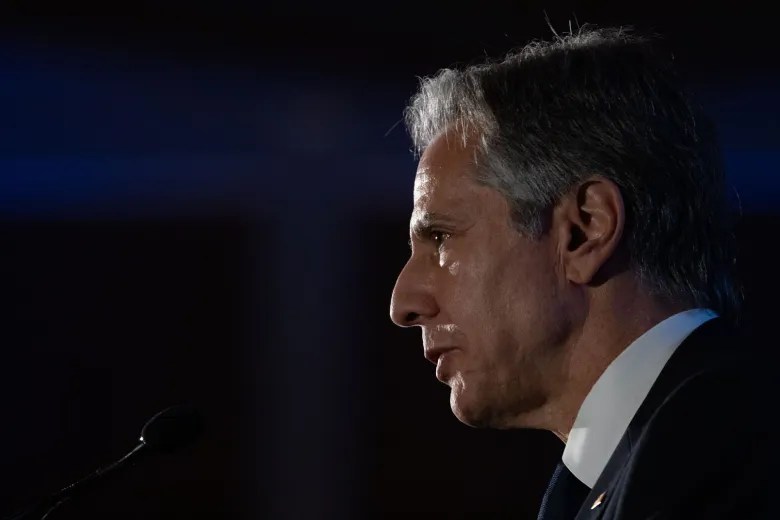
Secretary of State Antony Blinken speaks during the Mandela Washington Fellowship Summit for Young African Leaders in Washington, DC, August 2, 2023. (Official State Department photo by Chuck Kennedy)

By Seymour Hersh

Source: Rise Up Times

It’s been weeks since we looked into the adventures of the Biden administration’s foreign policy cluster, led by Tony Blinken, Jake Sullivan, and Victoria Nuland. How has the trio of war hawks spent the summer?

Sullivan, the national security adviser, recently brought an American delegation to the second international peace summit earlier this month at Jeddah in Saudi Arabia. The summit was led by Crown Prince Mohammed bin Salman, known as MBS, who in June announced a merger between his state-backed golf tour and the PGA. Four years earlier MBS was accused of ordering the assassination and dismemberment of the journalist Jamal Khashoggi at the Saudi consulate in Istanbul, for perceived disloyalty to the state.

As unlikely as it sounds, there was such a peace summit and its stars did include MBS, Sullivan, and President Volodymyr Zelensky of Ukraine. What was missing was a representative of Russia, which was not invited to the summit. It included just a handful of heads of state from the fewer than fifty nations that sent delegates. The conference lasted two days, and attracted what could only be described as little international attention.

Reuters reported that Zelensky’s goal was to get international support for “the principles” that that he will consider as a basis for the settlement of the war, including “the withdrawal of all Russian troops and the return of all Ukrainian territory.” Russia’s formal response to the non-event came not from President Vladimir Putin but from Deputy Minister of Foreign Affairs Sergei Ryabkov. He called the summit “a reflection of the West’s attempt to continue futile, doomed efforts” to mobilize the Global South behind Zelensky.

India and China both sent delegations to the session, perhaps drawn to Saudi Arabia for its immense oil reserves. One Indian academic observer dismissed the event as achieving little more than “good advertising for MBS’s convening power within the Global South; the kingdom’s positioning in the same; and perhaps more narrowly, aiding American efforts to build consensus by making sure China attends the meeting with . . . Jake Sullivan in the same room.”

Meanwhile, far away on the battlefield in Ukraine, Russia continued to thwart Zelensky’s ongoing counteroffensive. I asked an American intelligence official why it was Sullivan who emerged from the Biden administration’s foreign policy circle to preside over the inconsequential conference in Saudi Arabia.

“Jeddah was Sullivan’s baby,” the official said. “He planned it to be Biden’s equivalent of [President Woodrow] Wilson’s Versailles. The grand alliance of the free world meeting in a victory celebration after the humiliating defeat of the hated foe to determine the shape of nations for the next generation. Fame and Glory. Promotion and re-election. The jewel in the crown was to be Zelensky’s achievement of Putin’s unconditional surrender after the lightning spring offensive. They were even planning a Nuremberg type trial at the world court, with Jake as our representative. Just one more fuck-up, but who is counting? Forty nations showed up, all but six looking for free food after the Odessa shutdown”—a reference to Putin’s curtailing of Ukrainian wheat shipments in response to Zelensky’s renewed attacks on the bridge linking Crimea to the Russian mainland.

Enough about Sullivan. Let us now turn to Victoria Nuland, an architect of the 2014 overthrow of the pro-Russian government in Ukraine, one of the American moves that led us to where we are, though it was Putin who initiated the horrid current war. The ultra-hawkish Nuland was promoted early this summer by Biden, over the heated objections of many in the State Department, to be the acting deputy secretary of state. She has not been formally nominated as the deputy for fear that her nomination would lead to a hellish fight in the Senate.

It was Nuland who was sent last week to see what could be salvaged after a coup led to the overthrow of a pro-Western government in Niger, one of a group of former French colonies in West Africa that have remained in the French sphere of influence. President Mohamed Bazoum, who was democratically elected, was tossed out of office by a junta led by the head of his presidential guard, General Abdourahmane Tchiani. The general suspended the constitution and jailed potential political opponents. Five other military officers were named to his cabinet. All of this generated enormous public support on the streets in Niamey, Niger’s capital—enough support to discourage outside Western intervention.

There were grim reports in the Western press that initially viewed the upheaval in East-West terms: some of the supporters of the coup were carrying Russian flags as they marched in the streets. The New York Times saw the coup as a blow to the main US ally in the region, Nigerian President Bola Ahmed Tinubu, who controls vast oil and gas reserves. Tinubu threatened the new government in Niger with military action unless they returned power to Bazoum. He set a deadline that passed without any outside intervention.

The revolution in Niger was not seen by those living in the region in east-west terms but as a long needed rejection of long-standing French economic and political control. It is a scenario that may be repeated again and again throughout the French-dominated Sahel nations in sub-Saharan Africa.

There are distinctions that do not bode well for the new government in Niger. The nation is blessed, or perhaps cursed, by having a significant amount of the remaining natural uranium deposits in the world. As the world warms up, a return to nuclear generated power is seen as inevitable, with obvious implications for the value of the stuff underground in Niger. The raw uranium ore, when separated, filtered and processed is known worldwide as yellowcake.

The corruption so often “talked about in Niger is not about petty bribes by government officials, but about an entire structure—developed during French colonial rule—that prevents Niger from establishing sovereignty over its raw materials and over its development,” according to a recent analysis published by Baltimore’s Real News Network. Three out of four laptops in France are powered by nuclear energy, much of which is derived from uranium mines in Niger effectively controlled by its former colonial overlord.

Niger is also the home of three American drone bases targeting Islamic radicals throughout the region. There  are also undeclared Special Forces outposts in the region, whose soldiers receive double pay while on their risky combat assignments. The American official told me that “the 1,500 US troops now in Niger are exactly the number of American troops who were in South Vietnam at the time John F. Kennedy took over the presidency in 1961.”

Into this scene came Victoria Nuland, who must have drawn the short straw inside the Biden Administration. She was sent to negotiate with the new regime and to arrange a meeting with the ousted President Bazoum, whose life remains under constant threat from the governing junta. The New York Times reported that she got nowhere after talks she described as “extremely frank and at times quite difficult.” The intelligence official put her remarks to the Times in American military lingo: “Victoria set out to save the Niger uranium owners from the barbaric Russians and got a huge single-finger salute.”

Quieter in recent weeks than Sullivan and Nuland has been Secretary of State Tony Blinken. Where was he? I asked that question of the official, who said that Blinken “has figured out that the United States”—that is, our ally Ukraine—“will not win the war” against Russia. “The word was getting to him through the Agency [CIA] that the Ukrainian offense was not going to work. It was a show by Zelensky and there were some in the administration who believed his bullshit.

“Blinken wanted to broker a peace deal between Russia and Ukraine as Kissinger did in Paris to end the Vietnam war.” Instead, the official said, “it was going to be a big lose and Blinken found himself way over his skis. But he does not want to go down as the court jester.”

It was at this moment of doubt, the official said, that Bill Burns, the CIA director, “made his move to join the sinking ship.” He was referring to Burns’s speech earlier this summer at the annual Ditchley conference near London. He appeared to put aside his earlier doubts about expanding NATO to the east and affirmed his support at least five times for Biden’s program.

“Burns does not lack self-confidence and ambition,” the intelligence official said, especially when Blinken, the ardent war hawk, was suddenly having doubts. Burns served in a prior administration as deputy secretary of state and running the CIA was hardly a just reward.

Burns would not replace a disillusioned Blinken, but only get a token promotion: an appointment to Biden’s cabinet. The cabinet meets no more than once a month and, as recorded by C-SPAN, the meetings tend to be tightly scripted affairs and to begin with the president reading from a prepared text.

Tony Blinken, who publicly vowed just a few months ago that there would be no immediate ceasefire in Ukraine, is still in office and, if asked, would certainly dispute any notion of discontent with Zelensky or the administration’s murderous and failing war policy in Ukraine.

So the White House’s wishful approach to the war, when it comes to realistic talk to the American people, will continue apace. But the end is nearing, even if the assessments supplied by Biden to the public are out of a comic strip.

This piece is from Seymour Hersh’s Substack, you may subscribe to it here.

BRICS 11 – Strategic Tour de Force

By Pepe Escobar

Source: The Unz Review

Chinese President Xi Jinping defined all the major decisions embedded in the 15th BRICS summit in South Africa as “historic”. That may be seen as an understatement.

It will take time for the Global South, or Global Majority, or “Global Globe” (copyright President Lukashenko), not to mention the stunned collective West, to fully grasp the enormity of the new strategic stakes.

President Putin, for his part, described the negotiations on BRICS expansion as quite difficult. By now a relatively accurate picture is emerging of what really went down on that table in Johannesburg.

India wanted 3 new members. China wanted as many as 10. A compromise was finally reached, with 6 members: Egypt, Iran, Saudi Arabia, United Arab Emirates (UAE), Argentina and Ethiopia.

So from now on it’s BRICS 11. And that’s just the beginning. Starting with the rotating Russian presidency of BRICS on January 1, 2024, more partners will be progressively included, and most certainly a new round of full members will be announced at the BRICS 11 summit in Kazan in October next year.

So we may soon progress to BRICS 20 – on the way to BRICS 40. The G7, for all practical purposes, is sliding towards oblivion.

Bur first things first. At that fateful table in Johannesburg, Russia supported Egypt. China went all out for Persian Gulf magic: Iran, UAE and the Saudis. Of course: Iran-China are already deep into a strategic partnership, and Riyadh is already accepting payment for energy in yuan.

Brazil and China supported Argentina, Brazil’s troubled neighbor, running the risk of having its economy fully dollarized, and also a key commodity provider to Beijing. South Africa supported Ethiopia. India, for a series of very complex reasons, was not exactly comfortable with 3 Arab/Muslim members (Saudi Arabia, UAE, Egypt). Russia assuaged New Delhi’s fears.

All of the above respects geographic principles and imprints the notion of BRICS representing the Global South. But it goes way beyond that, blending cunning strategy and no-nonsense realpolitik.

India was mollified because Russian Foreign Minister Sergey Lavrov, at the table in Johannesburg negotiating on behalf of President Putin, and highly respected by New Delhi, fully understood that a new, single BRICS currency is a long way away. What really matters, short and medium term, is expanding intra-BRICS trade in their national currencies.

That was stressed by New Development Bank (NDB) president Dilma Rousseff in her report to the South African summit hosts – even as Brazilian President Lula once again emphasized the importance of setting up a work group to discuss a BRICS currency.

Lavrov understood how New Delhi is absolutely terrified of secondary sanctions by the US, in case its BRICS role gets too ambitious. Prime Minister Modi is essentially hedging between BRICS and the completely artificial imperial obsession embedded in the terminology “Indo-Pacific” – which masks renewed containment of China. The Straussian neo-con psychos in charge of US foreign policy are already furious with India buying loads of discounted Russian oil.

New Delhi’s support for a new BRICS currency would be interpreted in Washington as all-out trade war – and sanctions dementia would follow. In contrast, Saudi Arabia’s MbS doesn’t care: he’s a top energy producer, not consumer like India, and one of his priorities is to fully court his top energy client, Beijing, and pave the way for the petroyuan.

It Takes Just a Single Strategic Move

Now let’s get into the strategic stakes. For all practical purposes, in Eurasian terms, BRICS 11 is now on the way to lord over the Arctic Sea Route; the International North South Transportation Corridor (INSTC); BRI’s East West Corridors; the Persian Gulf; the Red Sea; and the Suez Canal.

That blends several overland corridors with several nodes of the Maritime Silk Roads. Nearly total integration in the Heartland and the Rimland. All with just a single strategic move in the geopolitical/geoeconomic chessboard.

Much more than an increase of BRICS 11 collective GDP to 36% of the world’s total (already larger than the G7), with the group now encompassing 47% of the world’s population, the top geopolitical and geoeconomic breakthrough is how BRICS 11 is about to literally break the bank on the energy and commodities market fronts.

By incorporating Iran, Saudi Arabia and the UAE, BRICS 11 instantly shines on as an oil and gas powerhouse. BRICS 11 now controls 39% of global oil exports; 45.9% of proven reserves; and at least 47.6% of all oil produced globally, according to InfoTEK.

With BRICS 11 possibly including Venezuela, Algeria and Kazakhstan as new members as early as in 2024, it may control as much as 90% of all oil and gas traded globally.

Inevitable corollary: operations settled in local currencies bypassing the US dollar. And inevitable conclusion: petrodollar in a coma. The Empire of Chaos and Plunder will lose its free lunch menu: control of global oil prices and means to enforce “diplomacy” via a tsunami of unilateral sanctions.

Already in the horizon, direct BRICS 11-OPEC+ symbiosis is inevitable. OPEC+ is effectively run by Russia and Saudi Arabia.

A ground-shaking geoeconomic reorientation is at hand, involving everything from routes plied by global supply chains and new BRICS roads to the progressive interconnection of BRI, the Saudi Vision 2030 and massive port expansion in the UAE.

By choosing Ethiopia, BRICS expands its African reach on mining, minerals and metals. Ethiopia is rich in gold, platinum, tantalum, copper, niobium and offers vast potential in oil and natural gas exploration. Saudi Arabia and the UAE, incidentally, are also involved in mining.

This all spells out fast, progressive integration of North Africa and West Asia.

How Diplomacy Goes a Long Way

The BRICS 11 Shock of the New, in the energy sphere, is a sharp historical counterpoint to the 1973 oil shock, after which Riyadh started wallowing in petrodollars. Now Saudi Arabia under MbS is operating a tectonic shift, in the process of becoming strategically aligned with Russia-China-India-Iran.

Diplomatic coup does not even begin to describe it. This is the second stage of the Russian-initiated and Chinese-finalized rapprochement between Riyadh and Tehran, recently sealed in Beijing. The Russia-China strategic leadership, working patiently in synch, never lost sight of the ball.

Now compare it with collective West’s “strategies”, such as the G7-imposed oil price cap. Essentially the G7 “coalition of the willing” self-imposed a price cap on Russian crude imported by sea. The result is that they had to start buying way more oil products from Global South nations which ignored the price cap and duly increased their purchase of Russian crude.

Guess who are the top two: BRICS members China and India.

After wallowing in several stages of denial, the collective West may – or may not – realize it’s a fool’s dream to attempt to “de-couple” the West-ruled part of the global economy from China, whatever is spewed out by Washington.

BRICS 11 now shows, graphically, how the “Global South/Global Majority/”Global Globe” is more non-aligned with the West than anytime in recent history.

By the way, the president of the G77, Cuban leader Diaz-Canel, was at the BRICS summit representing the de-facto new Non-Aligned Movement (NAM): the G77 actually incorporates no less than 134 nations. Most are African. Xi Jinping in Johannesburg met in person with the leaders of most of them.

The collective West, in panic, regards all of the above as “dangerous”. So the last refuge is, predictably, rhetorical: “de-coupling”, “de-risking”, and similar idiocies.

Yet that may also get practically dangerous. As in the first ever trilateral summit in Camp David on August 18 between the Empire and two Asian vassals, Japan and South Korea. That may be interpreted as the first move towards a military-political Asian NATO even more toxic than Quad or AUKUS, obsessed to simultaneously contain China, Russia and the DPRK.

The Collective Outstripping of the Global North

The UN lists 152 nations in the world as “developing countries”. BRICS 11 is aiming at them – as they outstrip the Global North on everything from population growth to overall contribution to global GDP growth measured by PPP.

In the past 10 years since the announcement of BRI first in Astana and then in Jakarta, Chinese financial institutions have lent nearly $1 trillion for infrastructure connectivity projects across the Global South. The upcoming BRI forum in Beijing will signal a renewed drive. That’s the BRI-BRICS symbiosis.

In the G20 last year, China was the first nation to lobby for the inclusion of the 55-member African Union (AU). That may happen at the G20 summit next month in New Delhi; in that case, Global South representation will be close to parity with the Global North.

Claims that Beijing was organizing a malign conspiracy to turn BRICS into a weapon against the G7 are infantile. Realpolitik – and geoeconomic indicators – are dictating the terms, configuring the Shock of the New: the G7’s irreversible irrelevance with the rise of BRICS 11.